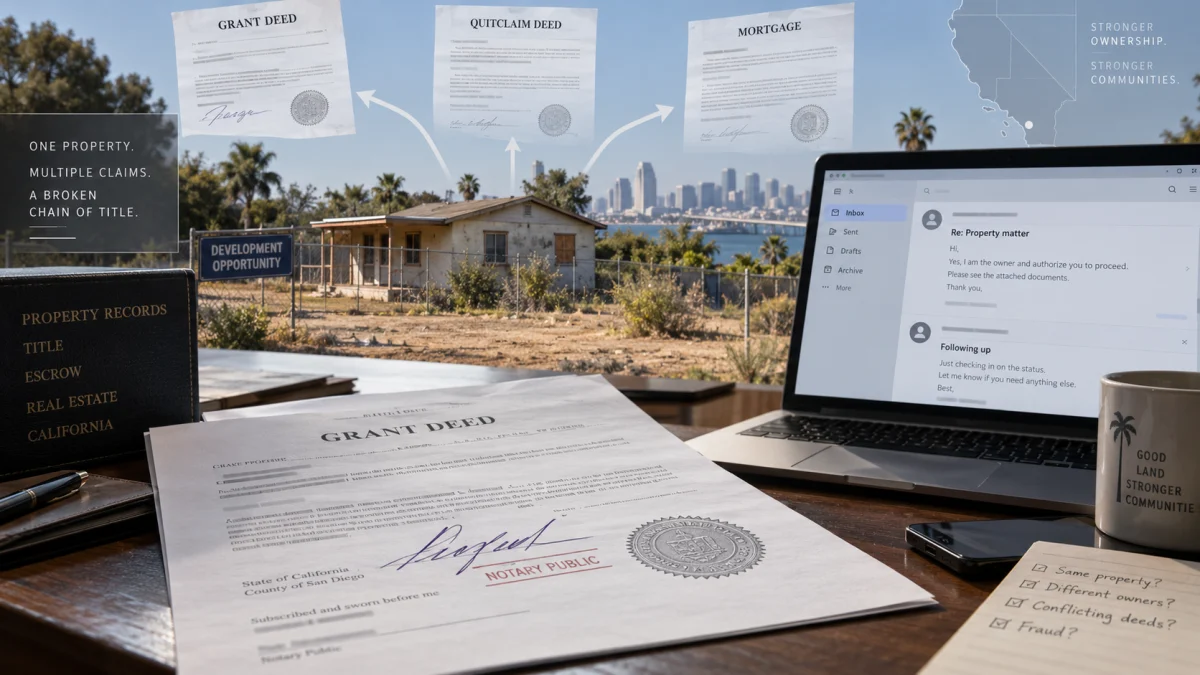
A forged deed can be recorded without legally transferring ownership. In California, a deed bearing a genuinely forged owner signature is generally void from the beginning. That means an innocent buyer can pay hundreds of thousands of dollars, appear in the public property records and still fail to acquire valid legal title.
That distinction is at the center of an unusual San Diego fraud case involving Victor Hugo Villalobos Almazan and Nayeli Noemi Montoya Rodriguez.
The couple admitted participating in fraudulent sales of two San Diego properties they did not own. The scheme generated $400,748.41 from 3873 36th Street and $561,463.25 from 555 Hollister Street, according to their plea agreements. The money was then moved through defendant-controlled accounts and largely transferred abroad. Villalobos and Montoya were sentenced September 4, 2026, to 27 months and 10 months in custody, respectively.
But the criminal case leaves the question homeowners and buyers are most likely to ask almost completely unanswered:
What happens to the property after a scammer sells it—and who actually loses the money?
The answer requires separating three things that are often mistakenly treated as the same: legal title, recorded title and financial loss.
The short answer: a recorded deed is not necessarily a valid deed
When someone records a forged deed, three different realities can exist at once.
| Issue | What it means after a forged sale |
|---|---|
| Legal title | In California, a genuinely forged deed ordinarily transfers no valid ownership. |
| Recorded title | County records may nevertheless temporarily appear to show the fraudulent buyer or a later buyer as owner. |
| Financial loss | Buyers, lenders, insurers or transaction companies may have already sent real money based on the false transaction. |
That is how a scammer can seemingly “sell” property without actually acquiring the legal power to transfer it.
The legitimate owner can retain the superior ownership right while an innocent buyer is left trying to recover money that has already disappeared.
What Villalobos and Montoya admitted doing
According to the June 2026 plea-based account from the U.S. Attorney’s Office, conspirators impersonated legitimate property owners and created email addresses closely resembling the owners’ real addresses.
They then used those identities to market properties to unsuspecting purchasers while avoiding in-person meetings. Once buyers were found, conspirators supplied forged property-transfer documents that appeared to carry the legitimate owners’ signatures.
Villalobos and Montoya admitted opening bank accounts using business names similar to those of the legitimate owners so the sale proceeds could be routed into accounts they controlled.
The admitted proceeds were:
| Property | Fraud proceeds |
|---|---|
| 3873 36th Street, San Diego | $400,748.41 |
| 555 Hollister Street, San Diego | $561,463.25 |
| Total | $962,211.66 |
Montoya transmitted nearly all of the 3873 proceeds to bank accounts in Mexico. Villalobos removed the 555 Hollister proceeds through international transfers to Mexico and Jordan and through cash withdrawals.
Those facts are established through the guilty pleas rather than merely alleged by prosecutors.
What was alleged but not necessarily admitted
Some additional details came from the government’s original November 2025 criminal complaint and should be treated differently.
Prosecutors initially alleged that the defendants impersonated owners of vacant or undeveloped properties, forged notary signatures and directed escrow proceeds into accounts they controlled. The complaint also alleged that photographs showed Villalobos physically delivering forms needed for one fraudulent transaction to the escrow company.
Those allegations are useful for understanding how the scheme allegedly worked, but they should not automatically be treated as admissions simply because the defendants later pleaded guilty to related bank-fraud charges.
That also means the commonly repeated description that the properties were sold “entirely by email” needs qualification.
The fake sellers apparently avoided personally meeting the buyers, but at least one conspirator was alleged to have physically handled transaction paperwork.
These were especially vulnerable properties
The prosecution’s early description also makes the scheme less mysterious.
These were not simply scammers walking into an occupied suburban house and somehow selling it out from under the family living there.
The government’s complaint described the targets as vacant or undeveloped real estate, including one property with a vacant structure.
That matches a broader fraud pattern identified by the FBI.
In June 2026, the FBI warned about parcel-owner impersonation, in which criminals obtain information about owners of vacant property, create fake identification and communications accounts, and approach real-estate and title professionals while pretending to be the legitimate seller.
Vacant and non-owner-occupied property is attractive because the real owner may be less likely to see unusual activity at the site or interact personally with the people handling the transaction.
How can a fake deed get recorded in the first place?
Because a county recorder is not conducting a court proceeding every time someone files a deed.
San Diego County expressly explains that California law requires its Recorder’s Office to record documents that meet statutory recording requirements and that the office lacks authority to reject an otherwise recordable document merely because there may be a problem with its legal sufficiency.
That distinction is critical.
The recorder is essentially determining:
Is this a document the law permits us to record in this form?
It is not necessarily determining:
Did the true owner really sign this document, and will a court ultimately recognize the transfer as valid?
A sufficiently convincing fraudulent deed can therefore enter the official records before the true owner knows anything has happened.
San Diego County’s own Owner Alert system exists partly because of that vulnerability. Property owners can register names or parcel numbers and receive notifications when matching documents are recorded. The county cautions, however, that the service alerts owners only after a document has been recorded; it does not prevent the recording.
A forged deed is generally void in California
California appellate law supplies the most important answer in this entire case.
In WFG National Title Insurance Co. v. Wells Fargo Bank, the California Court of Appeal reaffirmed that a deed containing a forged grantor signature is void, rather than merely voidable.
A void deed does not transfer valid title to the supposed buyer. And because the buyer never obtains valid title, later purchasers or lenders ordinarily cannot obtain a stronger property right merely because they acted in good faith.
The court explained that title derived through a forged instrument is generally unenforceable even when the later party is an innocent purchaser, absent unusual circumstances that would legally prevent the original owner from challenging it.
That produces a counterintuitive result:
Someone can pay full market value for property, honestly believe the seller owns it, record a deed and still fail to acquire valid title if the seller’s supposed ownership depended on a forgery.
Forged and fraudulently obtained deeds are not always the same
California law also distinguishes between a deed that is void and one that is merely voidable.
In Schiavon v. Arnaudo Brothers, the Court of Appeal explained that a deed is void when the purported grantor’s signature is forged or the grantor does not understand the nature of the document being signed.
By contrast, if the real owner understands that he or she is signing a deed but was induced to do it through fraud or misrepresentation, the resulting deed may be voidable rather than automatically void. That distinction can materially affect an innocent subsequent purchaser’s rights.
The San Diego prosecution is significant because the defendants’ plea-based account specifically describes forged property-transfer documents falsely appearing to carry the owners’ signatures.
Even an innocent lender can be left without valid collateral
The problem does not necessarily stop with the buyer.
Suppose an unsuspecting buyer obtains a forged deed and then borrows money using the property as collateral.
If the borrower never obtained valid title, the lender’s mortgage or deed of trust may also be defective.
That was essentially the problem in WFG. An innocent lender had advanced approximately $850,000 while relying on a title chain that ultimately depended on a forged instrument. The California Court of Appeal held that the forged root document was void and could not provide the later interest the lender expected to receive.
This is why deed fraud can create damage far beyond the original fake closing.
A single forged document can be followed by:
fraudulent deed → innocent buyer → resale → mortgage → refinance → title-insurance claim → litigation
while the original deed remains legally incapable of transferring title.
What happened at 555 Hollister Street?
The public trail around 555 Hollister Street makes the San Diego prosecution considerably more interesting than the criminal press releases suggest.
Before the fraud, D.I.M.E. Hollister was identified as owner
The strongest accessible official record from the later development process identifies D.I.M.E. Hollister LLC as the owner of the 5.92-acre 555 Hollister site.
In October 2024, the San Diego City Council approved permits for the Palm & Hollister Apartments project and expressly identified D.I.M.E. Hollister LLC as owner and Palm Hollister LLC as permittee.
The site included an existing structure but was being redeveloped into a 198-unit multifamily project.
April 17, 2023: a roughly $560,000 transfer appears
Public-record-derived property databases show a grant deed recorded April 17, 2023, as instrument 2023-0099728.
PropertyShark reports the transaction at approximately $560,000. CountyOffice independently identifies the April 17 recording and document number.
The federal plea account says the fraudulent sale of 555 Hollister produced $561,463.25.
The property, timing and near-identical amounts make it a strong inference that the April 17 transfer is the public-record transaction corresponding to the admitted fraudulent sale.
It is not quite direct proof. The actual deed image is not freely available through San Diego County’s web index, and a database’s reported sale price does not necessarily equal the exact amount ultimately disbursed from escrow.
That distinction matters.
Four days later, another $750,000 sale appears
The title trail gets stranger almost immediately.
Property-record sources show another transaction for 555 Hollister on April 21, 2023—just four days later—at approximately $750,000.
Redfin reports the April 21 public-record sale at $750,000. PropertyShark shows both the April 17 $560,000 event and the April 21 $750,000 transaction.
CountyOffice identifies the second grant deed as instrument 2023-0105194, dated April 18 and recorded April 21.
No criminal press release explains this second transaction.
That is important because it suggests that the fraudulent chain may have reached beyond the first unsuspecting buyer before the problem was corrected.
We cannot responsibly identify the exact downstream buyer without the underlying recorded deed, but the existence and timing of the second transfer are supported by multiple property-record feeds.
By 2024, the City again identified D.I.M.E. Hollister as owner
That gives us an unusually revealing chronology:
| Date | Event | Evidence status |
|---|---|---|
| April 17, 2023 | Approximately $560,000 transfer | Strongly corresponds to admitted fraud |
| April 21, 2023 | Approximately $750,000 second transfer | Corroborated public-record data |
| October 2024 | City identifies D.I.M.E. Hollister LLC as owner | Official city record |
| November 2025 | Property-record source reports approximately $6.6 million sale | Secondary property-record data |
| November 2025 | $66.15 million construction financing arranged | Confirmed by financing arranger |
The October 2024 City record does not itself constitute a quiet-title judgment. A development permit is not a substitute for a deed or court order.
But it is strong evidence that the apparent 2023 fraud chain was no longer controlling the property’s development by that point.
The site later obtained $66.15 million in construction financing
In November 2025, Northmarq announced that it had arranged a $66.15 million construction loan from Genesis Capital for the Palm & Hollister Apartments project at 555 Hollister Street on behalf of Ambient Communities.
PropertyShark separately reports a roughly $6.6 million property transaction on November 10, 2025.
Those are two different numbers describing two different events.
The $66.15 million figure is construction financing, not the reported sale price of the land.
That distinction matters because property databases can make financing transactions appear similar to sales when records are summarized without context.
What can reasonably be inferred?
It would be extraordinarily difficult for a sophisticated development transaction involving a multimillion-dollar property conveyance and a $66.15 million construction loan to close while an obvious unresolved forged ownership chain remained untreated.
The cumulative chronology therefore supports a strong inference:
The fraudulent 2023 title problem at 555 Hollister was eventually unwound, cured, settled or otherwise resolved sufficiently for the later development transaction to proceed.
What the accessible records do not reveal is exactly how.
We have not found a publicly accessible corrective deed, quiet-title judgment, insurance settlement or other document conclusively showing the mechanism.
What happened at 3873 36th Street?
The other fraudulent sale provides a useful independent comparison.
DOJ says the fraudulent transaction at 3873 36th Street produced $400,748.41 in illicit proceeds.
Independent real-estate databases show a public-record sale at the property in April 2023 for approximately $400,000. Realtor.com reports an April 11, 2023 public-record sale at that price.
Again, the close correspondence among the address, timing and dollar amount makes it highly likely that the public-record sale corresponds to the fraudulent transaction described in the plea agreement.
But the property databases do not provide enough reliable underlying documentation to reconstruct its entire downstream title chain with the same confidence as 555 Hollister.
Its tax history also illustrates an important point: assessor records, recorder records and legal ownership are separate systems. A reassessment or owner name shown in a consumer property database is not equivalent to a court ruling that a disputed deed was legally valid.
So who actually lost the $962,211?
This is the biggest question the criminal coverage leaves unanswered.
The answer is not necessarily the original property owners.
If their signatures were forged, California law ordinarily treats the deed as void. In that situation, the true owner has a superior claim to the property even though the county records may temporarily say otherwise.
Meanwhile, somebody else may have already paid the supposed seller.
The possible economic chain looks like this:
- The real owner retains the legal ownership right.
- An innocent buyer pays money for the property.
- The scammer receives or diverts the sale proceeds.
- A forged deed is recorded.
- A later purchaser or lender may rely on that recorded chain.
- The fraud is discovered.
- The parties turn to litigation, title insurance, restitution or settlement to allocate the loss.
The property and the money can therefore travel in different directions.
Did the innocent buyers lose their money?
Possibly—but the accessible public record does not establish their ultimate net losses.
They may have had title insurance.
They may have received reimbursement.
There may have been settlements among transaction participants.
An insurer may have paid a covered claim and then pursued other responsible parties.
A later valid sale may also have been negotiated as part of a resolution.
The federal sentencing announcement does not identify the buyers, title insurers, restitution recipients or final loss allocations.
That means it would be speculation to say that the innocent buyers ultimately absorbed the full $400,748 or $561,463.
Does title insurance cover a forged seller?
It can.
The California Department of Insurance specifically identifies forgeries and false impersonation among potential title defects.
An owner’s title policy protects the buyer against covered title problems, while a lender’s policy separately protects the lender’s security interest. Coverage and payment depend on the specific policy, exclusions and facts of the claim.
That means a buyer who unknowingly purchases through a forged pre-existing deed may have a title-insurance claim even though the buyer cannot keep valid title to the property.
The insurer can potentially pay the covered loss and legal expenses, then pursue recovery from other parties through subrogation.
An existing homeowner faces a different coverage question
There is another distinction homeowners should understand.
Traditional title insurance primarily protects against covered defects connected to the title that existed when the policy took effect. If somebody forges your own deed years after you bought the property, that is a post-policy event and may require different coverage.
The title industry’s trade association, the American Land Title Association, has developed ALTA 49 and 49.1 endorsements specifically offering certain post-policy protection against forged deeds and mortgages. ALTA says the endorsements can cover legal costs and covered losses resulting from later recorded forgeries, subject to their terms.
ALTA is an industry association, so its descriptions should not be treated as independent consumer advocacy. But the existence of the endorsements illustrates why homeowners should not assume every owner’s policy automatically covers every future deed-forgery event.
Did the title company in this case pay the loss?
There is no public evidence reviewed for this article establishing that.
Some property-record databases associate Corinthian Title Company with the 2023 555 Hollister transfers.
But that does not prove Corinthian:
- performed the escrow function;
- insured the buyer;
- underwrote a lender’s policy;
- negligently authenticated the seller;
- paid an insurance claim;
- or ultimately absorbed any portion of the loss.
California’s Department of Insurance notes that especially in Southern California, escrow services, underwritten title companies and the actual title insurer can be separate entities.
No criminal allegation located in this case accuses Corinthian Title of wrongdoing.
Identifying a company in the recorded transaction is therefore not enough to assign responsibility.
Why couldn’t the government simply tell us who lost the money?
Because the criminal prosecution and the civil property problem are different proceedings.
The DOJ releases focus on:
- what the defendants did;
- which crimes they admitted;
- how much money flowed through their accounts;
- and their sentences.
They do not disclose:
- the title policies;
- private insurance claims;
- civil settlements;
- the precise curative deeds;
- every later buyer or lender;
- or the final economic allocation of the loss.
The September 4 sentencing release does not publicly identify a restitution recipient or amount.
That does not prove restitution was not ordered. It means the public materials reviewed here do not establish the answer.
What the simplified coverage gets wrong
“The scammers sold two houses.”
The prosecution itself initially described the targets more specifically as vacant or undeveloped properties, including one with a vacant structure. That matters because such properties are common seller-impersonation targets.
“They transferred ownership just by sending emails.”
Email impersonation was central, but physical documents still entered the property-closing system, and prosecutors alleged that Villalobos physically delivered forms to an escrow company.
“The county recorded the deed, so the buyer owned the property.”
Not necessarily. Recording and legal validity are different questions. A genuinely forged deed is ordinarily void under California law.
“The legitimate owners lost $962,000.”
The defendants obtained approximately $962,000 from the two transactions. That is not the same as proving the original owners personally absorbed a $962,000 financial loss.
“555 Hollister later sold for $66 million.”
The public-record source reports a roughly $6.6 million transaction. The separate $66.15 million figure was construction financing arranged for the development.
Can someone really sell your property without you knowing?
They can create and close an apparently valid transaction without your knowledge. That does not necessarily mean they successfully acquired or conveyed valid legal title.
A fraudster may impersonate you, convince a buyer and transaction professionals that the sale is legitimate, forge documents and cause a deed to be recorded.
The buyer may even send hundreds of thousands of dollars.
But if your signature was genuinely forged, California law generally treats the deed as legally void.
You may nevertheless need attorneys, insurers and corrective filings—or litigation—to remove the fraudulent instrument from the record and stop downstream parties from claiming interests in the property.
That difference between “a fake sale occurred” and “the scammer legally took ownership” is the essential point.
What property owners can do
No safeguard can guarantee that nobody will ever attempt deed fraud, but several measures can improve the chances of catching it quickly.
Sign up for recording alerts. San Diego County’s free Owner Alert can notify registered users after a deed, lien or other indexed document matching their name or parcel number is recorded. Other counties operate similar systems.
Keep government mailing information current. San Diego County recommends ensuring the Assessor and Tax Collector have the correct address for the owner.
Take unusual remote sellers seriously. The FBI identifies vacant property, remote communications, unusual notarization arrangements and seller reluctance to communicate through ordinary channels as warning signs in parcel-owner impersonation schemes.
Understand your title policy. Buyers should know whether they have an owner’s policy rather than assuming the lender’s required policy protects them personally. Existing owners concerned about future deed fraud should ask what, if any, post-policy forgery protection their own policy provides.
Act quickly if an unauthorized document appears. A recording alert is not a fraud-prevention lock. Once a suspicious deed is found, the owner may need to contact the recorder, law enforcement, the title insurer and a real-estate attorney depending on the circumstances.
Who owns 555 Hollister Street now?
The public records reviewed here do not justify naming a present legal owner with certainty.
What can be established is more limited:
- the City of San Diego identified D.I.M.E. Hollister LLC as owner in its October 2024 Palm & Hollister development approval;
- a property-record source reports a roughly $6.6 million transaction in November 2025;
- and Northmarq says it arranged $66.15 million in construction financing for the project on behalf of Ambient Communities.
The later development activity strongly indicates that the 2023 title problem was dealt with somehow.
But none of those sources is a substitute for the complete current recorded title chain.
The real lesson from the San Diego case
The unsettling part of deed fraud is not that a forged document magically defeats property law.
It does not.
The more serious vulnerability is that modern property transactions can move money and produce additional recorded documents before anyone discovers that the first instrument was legally worthless.
That is apparently what makes the 2023 San Diego transactions so consequential.
Villalobos and Montoya admitted participating in fraudulent sales that generated about $962,000. At 555 Hollister, public records then show another transfer only four days after the transaction that closely matches the admitted fraud proceeds.
By the following year, an official City document again identified D.I.M.E. Hollister as owner. By late 2025, the property was part of a major development financing.
The evidence therefore supports a firm conclusion about the property law but only a limited conclusion about the money:
A forged deed did not necessarily take legal ownership away from the true owner. But innocent people could still have paid enormous sums into the fraudulent chain. The available public record does not reveal which buyer, lender, insurer or other party ultimately absorbed those losses.
That unresolved distinction is not a technical footnote.
It is the answer most accounts of deed theft leave out.
Frequently Asked Questions
Does a forged deed transfer ownership in California?
Generally no. A deed containing a genuinely forged grantor signature is ordinarily void and transfers no valid title. Limited equitable exceptions may apply in unusual circumstances involving the true owner’s conduct.
Can an innocent buyer keep property bought from a fake owner?
Not automatically. If the buyer’s supposed ownership depends on a genuinely forged deed, California law generally does not allow the buyer to acquire valid title merely because the buyer acted in good faith.
Can a mortgage also become invalid?
Yes. If a borrower obtained no valid title because of a forged deed, a lender relying on that ownership chain can also face an unenforceable property interest.
Does title insurance cover forged deeds?
Potentially. California regulators identify forgery and false impersonation as risks that title insurance can cover. Coverage depends on the policy and whether the defect occurred before or after the policy date.
Does a county recorder verify that the seller really owns the property?
The recorder checks whether a document meets statutory recording requirements. San Diego County expressly says it does not have authority to reject an otherwise recordable document based on questions about legal sufficiency.
Who lost the money in the Villalobos-Montoya scheme?
The defendants admitted receiving approximately $962,000 from the two fraudulent transactions. The accessible criminal releases do not establish who ultimately absorbed the losses after insurance, litigation, restitution or other recovery.
Did the legitimate owners get their properties back?
California law strongly favors the legitimate owner where the deed was genuinely forged. At 555 Hollister, later official records again identified the pre-fraud owner in the development process. The exact instrument or settlement that resolved the 2023 title chain has not been located in publicly accessible online records.
References and Further Reading
Criminal case and primary government records
U.S. Attorney’s Office — Husband and Wife Plead Guilty in International Property Theft Scheme The strongest publicly accessible source for what Villalobos and Montoya admitted, including the two properties, forged transfer documents and exact proceeds.
U.S. Attorney’s Office — Husband and Wife Sentenced in International Property Theft Scheme Confirms the September 4, 2026 sentences and summarizes the admitted scheme.
U.S. Attorney’s Office — Mexican Nationals Arrested and Charged in Million-Dollar Real Estate Scheme The original complaint-stage account, useful for allegations about vacant properties, forged notary signatures and physical delivery of escrow documents. Those details should be treated as allegations unless independently established or incorporated into later admissions.
IRS Criminal Investigation — Two Mexican Nationals Indicted in Real Estate Fraud and Money Laundering Scheme Corroborates the indictment history and allegation that documents including notary signatures were forged. It derives from the same federal investigation and is not independent evidence of the conduct.
California forged-deed law
WFG National Title Insurance Co. v. Wells Fargo Bank, N.A. — California Court of Appeal (2020) Leading authority used here for the rule that a forged deed is void and generally cannot support valid downstream title even in the hands of an innocent purchaser or lender.
Schiavon v. Arnaudo Brothers — California Court of Appeal (2000) Explains the important distinction between void deeds involving forgery and voidable transactions involving fraud or misrepresentation.
People v. Miller — California Court of Appeal (2022) A recent example involving a fraudulent property transfer and an innocent downstream purchaser, illustrating the real-world consequences of a deed declared void.
Recorder and fraud-prevention guidance
San Diego County Assessor/Recorder/County Clerk — Owner Alert Explains why fraudulent documents can be recorded, the recorder’s limited role and San Diego County’s free notification system.
FBI Internet Crime Complaint Center — Protect Your Property From Illegal Sales Through Parcel Owner Impersonation June 2026 federal warning describing how criminals impersonate owners of vacant property and identifying common warning signs.
Title insurance
California Department of Insurance — Title Insurance Consumer Guide Authoritative California consumer guidance on owner and lender policies, forgery, false impersonation, escrow and the limits of coverage.
American Land Title Association — ALTA 49 Forgery Endorsements Industry-source explanation of newer endorsements providing certain post-policy forged-deed and forged-mortgage protection. ALTA represents the title industry, so its material is useful for policy information but should not be treated as independent evidence of industry performance.
555 Hollister records and development
City of San Diego — Palm & Hollister Apartments Development Approval, Resolution R-315803 Official City document identifying D.I.M.E. Hollister LLC as owner in the 2024 project approval.
Northmarq — $66.15 Million Palm & Hollister Construction Financing Primary transaction announcement from the financing arranger confirming the construction loan, borrower and lender.
PropertyShark — 555 Hollister Street Property and Sales History Secondary property-record database reporting the April 17, April 21 and November 2025 transaction values. Used cautiously because it is not the underlying recorder document.
San Diego County property-record aggregation for 555 Hollister Street Useful for the April 2023 recording dates and instrument numbers. The underlying recorded deeds should control if obtained.
3873 36th Street
Realtor.com — 3873 36th Street Public-Record Sale and Tax History Secondary property-data source corroborating the approximately $400,000 April 2023 transaction that closely matches the admitted fraud proceeds.
Editorial currency note: Property ownership, recorder indexes, title-insurance products and legal procedures can change. The criminal-case facts and California appellate authorities cited above were reviewed through September 6, 2026. Consumer property databases are secondary sources and should not be treated as substitutes for certified recorded instruments when determining current legal ownership.