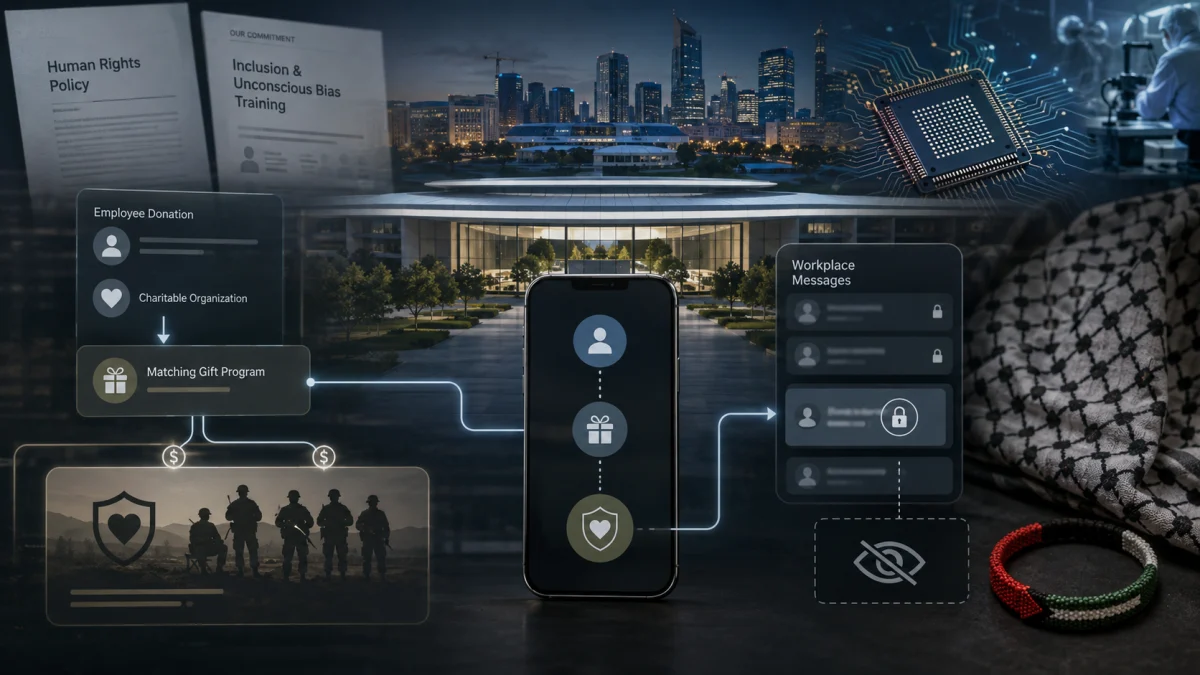
Yes, Apple has significant economic ties to Israel, and there is credible evidence that Apple’s employee donation-matching program made Friends of the Israel Defense Forces available as an eligible charity. Apple has also faced multiple documented allegations that employees expressing support for Palestinians were disciplined, restricted or treated differently.
But several viral claims go further than the evidence.
There is no public record showing that Apple itself donated $34.5 million to the IDF. There is no evidence that Apple gave $5.3 million—or $5.3 billion—to the Israeli military. Those numbers originated elsewhere and have been incorrectly blended into claims about Apple.
There is also an important distinction between Apple maintaining a large Israeli research operation, Apple matching an employee’s donation to an organization supporting Israeli soldiers, and Apple holding a direct military contract with the Israeli government. They are not the same thing.
At the same time, dismissing the controversy because some online claims are imprecise would be equally misleading.
Apple built a corporate identity around human rights, racial justice, unconscious-bias training and speaking publicly when it believes basic values are at stake. Then-CEO Tim Cook condemned the killing of George Floyd. He publicly called January 6 a “sad and shameful” chapter in American history. Apple required employees to undergo unconscious-bias and inclusion training.
When Israel’s assault on Gaza produced an extraordinary civilian catastrophe, however, Palestinian and allied Apple employees accused the company of a very different response: silence toward Palestinian suffering, restrictions on internal discussion, discipline over pro-Palestinian symbols, and a donation system that could direct Apple matching money to organizations supporting Israeli soldiers.
That contradiction—not a viral slogan—is the story worth investigating.
The Short Answer: In What Sense Does Apple “Support Israel”?
The phrase can mean several different things.
| Claim | What the evidence shows |
|---|---|
| Apple has major business operations in Israel | Verified. Apple maintains a substantial engineering and R&D presence in Israel. |
| Apple publicly expressed solidarity after the October 7 attacks | Verified. Then-CEO Tim Cook communicated sympathy following the attacks. |
| Apple’s employee-matching program included Friends of the IDF | Credibly reported and alleged by Apple employees/shareholders. Apple’s own giving policy confirms that eligible employee donations are matched to the same organization. |
| Apple directly donated $34.5 million to the IDF | Not established. That figure is not an Apple donation total. |
| Apple directly donated $5.3 million to Israel’s military | Not established. That figure came from an analysis of crowdfunding through IsraelGives. |
| Apple has a known direct contract with the IDF | No public evidence identified in the records reviewed. |
| Apple has been accused of suppressing pro-Palestinian employee expression | Verified as an allegation, with multiple documented incidents. Apple disputes that it unlawfully discriminated. |
| Apple’s conduct toward Palestinian employees has been proven discriminatory by a court | Not established in the evidence reviewed. |
This distinction matters.
Apple’s relationship with Israel is real. So are serious questions about where Apple matching money could go and how Palestinian advocacy was treated inside the company.
But the strongest argument does not require inflating the evidence.
Apple Has a Significant Economic Presence in Israel
There is nothing speculative about Apple’s economic relationship with Israel.
As of September 2026, Apple’s own careers system listed more than 100 open positions in Israel, with dozens in Herzliya alone. Positions covered silicon engineering, networking, wireless technology, computer vision, machine learning, optics, storage systems, security and other areas central to Apple’s products.
Apple is therefore not simply a company whose products happen to be sold in Israel.
Israel is part of Apple’s global engineering infrastructure.
That does not prove Apple supports Israeli government policy or the Israeli military. A civilian research center is not a military contract.
But it does establish that Apple has a substantial institutional and financial relationship with the country—and therefore something tangible at stake when employees demand that the company confront Israeli government conduct.
Did Apple Match Employee Donations to Friends of the IDF?
This is where the controversy becomes more consequential.
Apple openly promotes an Employee Giving program under which the company financially matches employee generosity.
Apple has described the arrangement in unusually direct terms: for every dollar an employee donates, Apple makes a monetary donation to the same organization.
That means charity eligibility matters.
In 2024, a group identifying itself as Apple shareholders and current and former employees published an open letter demanding that Apple stop matching contributions to organizations they said supported the Israeli military or Israeli settlements in occupied Palestinian territory.
The organizations named included:
- Friends of the Israel Defense Forces
- HaYovel
- One Israel Fund
- Jewish National Fund
- IsraelGives
Independent reporting by The Intercept similarly reported that Friends of the IDF and several organizations connected to Israeli settlement activity were eligible for Apple employee dollar-matching through the Benevity platform.
Apple did not publicly release recipient-level matching records that would allow outsiders to see how much Apple money ultimately went to each organization.
That missing disclosure is important.
But the underlying allegation cannot be waved away simply because employees, rather than Apple PR, disclosed it.
Friends of the IDF Really Does Support Israeli Soldiers
There is also no need to rely on an activist description of Friends of the IDF.
The organization describes itself.
Friends of the IDF currently says it is the official U.S. organization authorized to collect charitable donations on behalf of Israeli soldiers and that it works in direct coordination with Israel’s Ministry of Defense.
It says its programs support the health, welfare, education, rehabilitation and other needs of active soldiers, reservists, veterans and bereaved families.
Between 2023 and 2025, FIDF says it sent more than $325 million to Israel for programs benefiting Israeli soldiers, reservists, veterans and their families.
That does not mean every FIDF dollar purchases weapons. FIDF funds a range of welfare, educational, mental-health and family programs.
But arguments that FIDF has no meaningful connection to the Israeli military are untenable.
Its entire mission is built around supporting members of the Israel Defense Forces.
If Apple’s matching program allowed an employee to donate $100 to FIDF and Apple then contributed another $100 to FIDF, describing that second $100 as Apple money supporting an organization devoted to IDF soldiers is factually reasonable.
What we cannot currently determine is how often that happened or how much Apple money was involved.
No, the Evidence Does Not Show Apple Gave $34.5 Million to the IDF
This is one of the most important factual corrections.
Claims have circulated online that Apple “matched $34.5 million” in donations to organizations supporting the IDF.
I could not find evidence supporting that number as an Apple contribution.
The $34.5 million figure appears to have originated in reporting about money associated with Friends of the IDF itself during the early period after October 7—not a disclosure showing $34.5 million in Apple matching funds.
Those are fundamentally different propositions.
If FIDF raised or transferred $34.5 million, that does not mean Apple supplied $34.5 million of it.
The public record reviewed for this article does not reveal the total amount Apple matched to FIDF.
That number could be large, small or somewhere in between.
Apple could resolve the question immediately by disclosing it.
Until then, the responsible description is:
Apple’s matching program was reported to include FIDF as an eligible recipient, but the amount Apple ultimately contributed to FIDF has not been publicly established.
The $5.3 Million Number Is Also Not an Apple Donation
Another number has become distorted through repetition.
In December 2023, The Guardian investigated crowdfunding campaigns hosted through IsraelGives.
The newspaper calculated that donors had pledged approximately $5.3 million through campaigns supporting military, paramilitary or settler activities after October 7.
Again:
That was not $5.3 million from Apple.
It was not a calculation of Apple’s employee matching.
And it certainly was not $5.3 billion, as at least one later web page incorrectly claimed.
This is a good example of how internet claims mutate.
Apple was accused of matching donations to IsraelGives.
IsraelGives hosted campaigns that collectively raised millions.
Those two facts were then collapsed into a completely different claim: that Apple itself donated that amount.
The underlying Apple controversy is serious enough without inventing a number.
Apple’s Own History Makes the Gaza Controversy Harder to Dismiss
A former Apple employee recently described the contradiction from inside the company.
She recalled Apple’s mandatory anti-racism and unconscious-bias culture after the killing of George Floyd and the company’s reaction to January 6. She contrasted that experience with what she saw after returning from maternity leave during Israel’s war in Gaza.
Several important parts of that account can be independently verified.
After George Floyd was killed in 2020, Tim Cook published an unusually forceful statement on Apple’s website.
Cook wrote about racism in policing, health, education and daily life. Apple pledged additional work on racial justice, inclusion and community investment.
Apple did not merely issue a generic condolences statement.
The company presented racial injustice as something corporations have a responsibility to confront.
Apple subsequently told shareholders through an SEC filing that all Apple employees were required to complete unconscious-bias and inclusion training. Managers received additional inclusive-leadership instruction.
Cook also publicly condemned the January 6, 2021 attack on the U.S. Capitol, calling it a “sad and shameful chapter” and saying those responsible should be held accountable.
Apple therefore cannot plausibly argue that taking moral or political positions is simply outside the company’s role.
Apple chose that role.
The question is how consistently it applied it.
Apple Employees Say the Company’s Response to Palestinian Suffering Was Different
Following Hamas’s October 7, 2023 attacks, Cook communicated sympathy for people killed and affected in Israel.
There was nothing inherently wrong with acknowledging Israeli victims.
The problem raised by Apple employees was what came afterward.
As Palestinian deaths mounted under Israel’s military campaign in Gaza, employees argued that Apple failed to show Palestinians comparable institutional recognition.
In April 2024, WIRED reported that nearly 300 current and former Apple employees had joined an Apples4Ceasefire open letter alleging that Apple workers were disciplined—or in some cases terminated—after displaying support for Palestinians through keffiyehs, bracelets and pins.
WIRED reported specific incidents rather than merely repeating a general accusation.
Employees also alleged that internal discussion of Gaza was restricted. The publication reported that Apple deleted some Slack posts concerning the conflict and paused Jewish and Muslim employee Slack channels amid tensions over the subject.
Apple did not provide WIRED with a substantive response before that story was published.
None of this proves that every employee allegation was accurate.
It does establish that the complaints were much broader than one angry former employee on social media.
A Palestinian Apple Employee Later Brought a Formal Discrimination Case
The strongest evidence that this controversy persisted beyond internal activism came from Australia.
Former Apple retail employee Khaled Dibb, a Palestinian and Lebanese man who worked at Apple’s Chadstone store in Melbourne, accused Apple of racial and political discrimination.
ABC News obtained legal correspondence and human-rights complaint materials connected to the dispute.
Dibb wore a “Free Palestine/Save Gaza” bracelet and Palestinian-related jewelry.
According to the documents reported by ABC, Dibb said he faced months of hostility from employees and customers, including being photographed, filmed, confronted and accused of antisemitism.
He repeatedly asked Apple management for intervention.
In May 2024, Apple formally directed him to stop wearing the jewelry.
Apple’s position deserves to be represented accurately—not because Apple is entitled to deference, but because the evidence should be tested against the company’s actual explanation.
Apple denied unlawful discrimination.
Its lawyers argued that Israel-Palestine was an exceptionally sensitive political issue and that political expression supporting either position could produce conflict in a retail environment. Apple said other employees had also agreed not to display political messaging.
That would be a coherent neutral policy if it were genuinely applied equally.
Dibb says it was not.
He alleged that other workers wore “I stand with Israel” bracelets without being similarly disciplined.
That allegation gets to the heart of the dispute.
A rule against political expression is one thing.
A rule disproportionately activated when the political expression is Palestinian is another.
The public evidence reviewed here does not establish a final judicial finding resolving that factual dispute.
But dismissing it as an internet conspiracy would be absurd. It became a formal employment and human-rights case supported by internal Apple correspondence.
The Viral Former Employee’s HR Story Is Plausible—but Still Unverified
The former employee in the viral video says she participated in a Black-focused anti-racism workplace channel and commented that “Zionist propaganda is next level.”
She says she received three HR complaints within roughly 30 minutes.
I have not found independent records verifying those three complaints.
That part of her account should therefore remain attributed to her.
There is an important distinction here.
Three HR complaints would not, by themselves, prove Apple retaliated against her. Coworkers are capable of making complaints independently, and employees generally have a right to raise concerns with HR.
The more important question would be what Apple subsequently did.
Did HR investigate her fairly?
Was criticism of Zionism treated as antisemitism?
Were comparable political statements supporting Israel treated differently?
Was discipline imposed?
Without those records, we cannot answer those questions.
But her broader description of conflict inside Apple over Palestine fits a pattern independently documented by other employees and journalists.
Criticism of Zionism Is Not Automatically Antisemitism
This distinction is important because some workplace disputes around Gaza have collapsed criticism of Israel or Zionism into hostility toward Jewish people.
They are not synonymous.
Antisemitism is hatred, discrimination or prejudice against Jews.
Zionism is a political and historical movement concerning Jewish national self-determination and the establishment or maintenance of a Jewish state in historic Palestine.
Jewish people hold a wide range of views about Zionism and Israel. Palestinians and others can oppose Zionism, Israeli state policy or the structure of the Israeli state without harboring hatred toward Jews.
Conversely, criticism of Zionism can become antisemitic when it relies on anti-Jewish stereotypes, collective guilt, conspiracies about Jews or hostility toward Jews as Jews.
The words actually used and the context therefore matter.
Calling “Zionist propaganda” powerful or pervasive may offend coworkers. Offense alone does not establish antisemitism.
And a corporation genuinely committed to inclusion should be capable of distinguishing political criticism from ethnic or religious bigotry instead of treating the Israeli state and Jewish identity as interchangeable.
Using the Word “Genocide” Is No Longer Merely a Fringe Characterization
The former employee describes Apple as a company working amid a “genocide in Gaza.”
That term requires precision.
The International Court of Justice has not yet issued its final judgment on the merits in South Africa’s genocide case against Israel.
So it would be inaccurate to say that the ICJ has legally convicted or definitively ruled against Israel for genocide.
But it is equally inaccurate, in 2026, to present the genocide characterization as nothing more than inflammatory activist rhetoric.
In September 2025, the United Nations Independent International Commission of Inquiry on the Occupied Palestinian Territory, including East Jerusalem, and Israel concluded after a detailed legal analysis that Israeli authorities and security forces had committed genocide against Palestinians in Gaza.
The commission found reasonable grounds that four genocidal acts had occurred and concluded that the required specific intent existed.
Israel rejects that finding.
Separately, the International Criminal Court issued arrest warrants in 2024 for Benjamin Netanyahu and then-Defense Minister Yoav Gallant after finding reasonable grounds regarding alleged war crimes and crimes against humanity, including starvation as a method of warfare, murder and persecution.
The legal cases should not be conflated.
But by 2026, Apple’s employees are not raising ethical concerns about an ordinary foreign-policy disagreement.
They are asking how one of the world’s largest corporations responded to conduct that major international legal and investigative institutions have subjected to extraordinary allegations and findings.
Apple’s Human-Rights Policy Raises an Obvious Question
Apple’s own Human Rights Policy says the company is committed to internationally recognized human rights and bases its approach on the United Nations Guiding Principles on Business and Human Rights.
Apple says it conducts human-rights due diligence, works to identify salient risks and seeks to mitigate adverse impacts.
Those commitments create an obvious question.
If Apple’s donation-matching system allowed corporate matching money to reach an organization officially coordinating with Israel’s Defense Ministry to support IDF personnel during the Gaza war, what human-rights review did Apple perform?
That question becomes even more significant if Apple’s system simultaneously included organizations involved in supporting Israeli settlement activity in the occupied West Bank.
The international legal status of Israeli settlements is not seriously ambiguous. The International Court of Justice concluded in its 2024 advisory opinion that Israel’s continued presence in the occupied Palestinian territory is unlawful and addressed settlement expansion as part of that illegal situation.
A corporation does not get to advertise internationally recognized human-rights principles and then treat questions about where its own matching funds go as somebody else’s problem.
At minimum, Apple owes employees and shareholders a transparent answer.
Did Apple Directly Fund the Israeli Military?
Based on the public records reviewed for this article, I found no evidence that Apple holds a direct contract with the IDF or Israeli Ministry of Defense comparable to documented military or government relationships involving some other major technology companies.
That matters.
Apple should not be accused of a military contract merely because it employs engineers in Israel.
Nor should a charitable match to an organization supporting soldiers be described as equivalent to selling weapons, cloud infrastructure or targeting technology to a military.
But “no direct military contract found” does not erase the donation issue.
The two questions are separate.
Apple can have no direct IDF procurement contract while still allowing its own corporate money to match employee donations to an organization whose explicit purpose is supporting IDF soldiers.
Both things can be true at once.
So Was Apple Applying a Double Standard?
There is no single document in which Apple executives write:
We speak out for some groups but not Palestinians.
Real institutional bias rarely arrives that neatly.
What exists instead is a pattern.
Apple publicly embraced racial justice after George Floyd.
Apple required employees to undergo inclusion and unconscious-bias training.
Tim Cook publicly condemned January 6.
Apple communicated concern following the October 7 attacks in Israel.
Meanwhile, Palestinian and pro-Palestinian employees complained that Palestinian suffering was not receiving comparable institutional recognition.
Workers alleged discipline for Palestinian symbols.
Internal discussions were reportedly restricted.
A Palestinian employee later brought a formal discrimination complaint after Apple ordered him to stop wearing pro-Palestinian jewelry.
Employees and shareholders also alleged that Apple’s supposedly values-driven giving program was matching donations to organizations supporting the Israeli military and settlements.
None of these facts individually proves a centrally coordinated anti-Palestinian policy.
Together, they make the double-standard allegation reasonable to investigate.
And Apple’s own rhetoric raises the standard by which it should be judged.
A company that says nothing about politics can at least argue for institutional silence.
Apple did not choose silence.
It chose selective moral engagement.
That makes the selection itself fair game.
Apple Should Disclose the Numbers
The easiest way for Apple to clear up the most consequential uncertainty would be transparency.
Apple should disclose:
- Whether Friends of the IDF was eligible for Employee Giving matching after October 7, 2023.
- The dates during which it was eligible.
- How much employees donated to FIDF through the program.
- How much Apple itself matched.
- Whether FIDF remains eligible today.
- Whether HaYovel, One Israel Fund, Jewish National Fund or IsraelGives were eligible.
- Whether any were removed after employee complaints.
- What human-rights criteria Apple uses when determining charitable eligibility.
- Whether Palestinian humanitarian organizations received comparable Apple matching or corporate support.
- Whether Apple investigated allegations that pro-Israel and pro-Palestinian political expression were treated differently inside its workforce.
None of those questions requires Apple to take a political side.
They require the company to account for its own money and policies.
The Evidence Does Not Support Every Viral Claim—but It Supports Serious Scrutiny of Apple
The cleanest conclusion is not that Apple secretly operates as an arm of the Israeli government.
There is no evidence for that.
It is also not that the controversy is simply anti-Apple or anti-Israel misinformation.
There is too much documented evidence for that dismissal.
Apple maintains a major economic and engineering presence in Israel.
Its employee-giving program explicitly matches eligible donations to the same recipient organization.
Employees and independent reporting identified Friends of the IDF among those eligible recipients.
FIDF openly exists to support Israeli soldiers and works directly with Israel’s Ministry of Defense.
Apple has not publicly disclosed how much of its own money ultimately reached FIDF.
Employees have separately alleged that Apple restricted or punished pro-Palestinian expression, and at least one former Palestinian employee escalated similar allegations into a formal discrimination dispute.
At the same time, Apple spent years telling employees and the public that racial justice, inclusion, human rights and speaking against injustice were part of its corporate identity.
That history makes the central criticism difficult to avoid:
Apple cannot credibly market itself as a company willing to confront injustice when doing so is culturally comfortable, then treat scrutiny of Palestinian rights, Israeli military support and its own financial programs as questions beneath corporate responsibility.
That does not mean every allegation against Apple is proven.
It means Apple should be held to the standards Apple chose for itself.
And on the questions that remain unresolved—the amount of money matched to FIDF, the consistency of its employee-speech rules and the human-rights review behind its giving program—the lack of transparency belongs to Apple, not to the people asking for answers.
References and Further Reading
Apple primary sources
Apple: Speaking Up on Racism Tim Cook’s 2020 statement following George Floyd’s killing establishes Apple’s public commitment to addressing racial injustice rather than remaining institutionally neutral.
Apple SEC filing describing mandatory unconscious-bias and inclusion training Apple told shareholders that all employees were required to complete unconscious-bias and inclusion training and that employees had access to courses concerning race, justice and allyship.
Apple: Employee Giving program Apple states that it makes a monetary contribution to the same organization for every dollar an employee donates or hour an employee volunteers.
Apple Human Rights Policy Apple’s own statement of its international human-rights commitments and due-diligence responsibilities.
Apple Careers: Current positions in Israel Primary evidence of Apple’s continuing engineering and R&D footprint in Israel.
Employee allegations and donation matching
Apple shareholders and employees: Cease Funding for Illegal Settlements and Israeli Military The 2024 open letter naming Friends of the IDF and other organizations employees and shareholders alleged were available through Apple’s matching program. This is a primary source for the employees’ allegations, not independent proof of every claim in the letter.
The Intercept: Apple Matches Worker Donations to IDF and Illegal Settlements, Employees Allege Independent reporting on the Apple/Benevity matching controversy and the organizations employees identified as eligible recipients.
Palestinian employee treatment
WIRED: Apple Store Employees Say Coworkers Were Disciplined for Supporting Palestinians Detailed reporting on named Apple employees, alleged discipline over Palestinian symbols, internal Slack restrictions and the Apples4Ceasefire campaign.
ABC News Australia: Apple Accused of Discrimination for Telling Employee to Stop Wearing Jewellery Supporting Gaza Reports from legal correspondence and complaint documents in Khaled Dibb’s discrimination dispute, including both Dibb’s allegations and Apple’s response.
Friends of the IDF
Friends of the IDF: Mission and Relationship With the IDF and Israeli Ministry of Defense FIDF’s own description of its mission, official relationship with Israeli authorities and support for soldiers.
Gaza and international law
UN Commission of Inquiry: Legal Analysis Finding Genocide in Gaza The September 2025 legal analysis in which the UN Independent International Commission of Inquiry concluded that Israeli authorities and security forces committed genocide against Palestinians in Gaza.
International Court of Justice: South Africa v. Israel case docket The authoritative docket for the ongoing Genocide Convention case. As of publication, the ICJ has not issued a final merits judgment.
International Criminal Court: Arrest warrants for Benjamin Netanyahu and Yoav Gallant The ICC’s explanation of its reasonable-grounds findings concerning alleged war crimes and crimes against humanity.
Source tracing for the $5.3 million claim
The Guardian: How U.S. Residents Funded Israeli Military and Settlement Crowdfunding Campaigns The original reporting behind the approximately $5.3 million IsraelGives-related figure frequently misattributed online to Apple.
Editorial currency note: Apple’s charitable eligibility rules, employee policies, leadership and Israeli operations can change. This article reflects evidence reviewed through September 1, 2026. Recipient-level Employee Giving totals have not been publicly disclosed by Apple and should be updated if Apple, Benevity or the recipient organizations release new records.