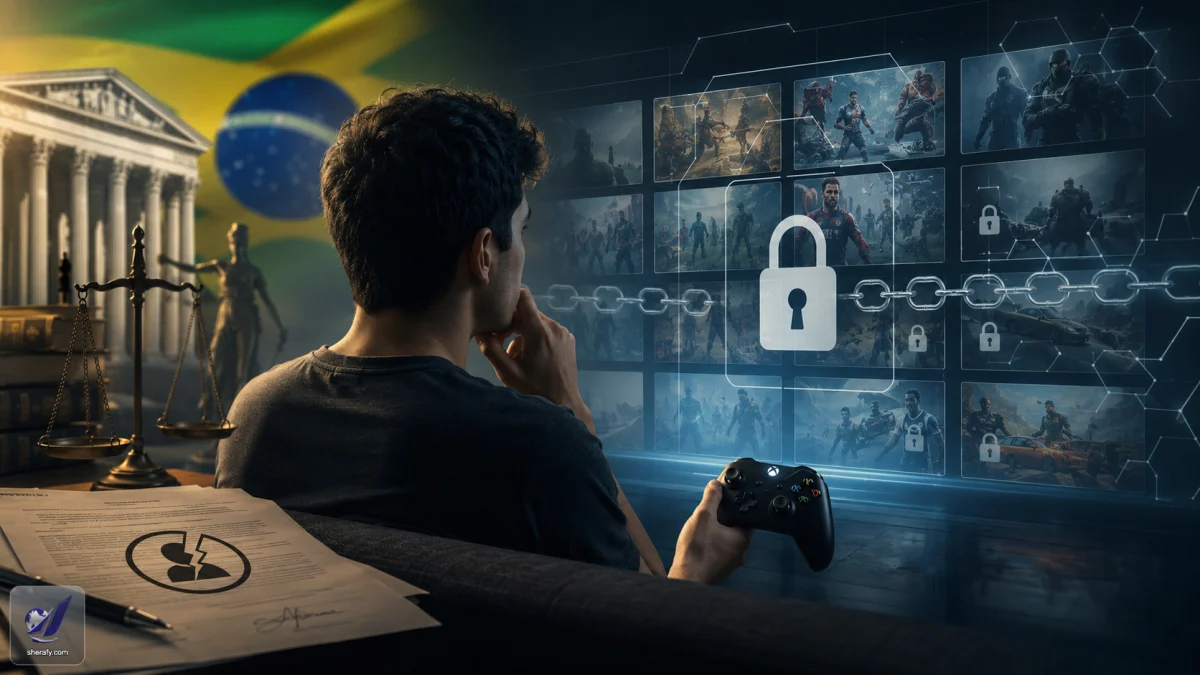
A Brazilian gamer lost access to his Microsoft account after it was compromised. Microsoft reportedly confirmed that an unauthorized person had taken over the account, but support still told the customer that the account could not be restored. The proposed solution was effectively to close it and repurchase the games attached to it.
The gamer sued.
A court in Rio de Janeiro ordered Microsoft to unblock the account within 15 days and awarded the consumer R$2,000 (≈$393 USD) in moral damages. The decision also imposed a daily fine if Microsoft failed to restore access. The dollar value of the judgment was small. The principle behind it was not.
The case asks a question that will eventually affect nearly every digital consumer:
When a company takes a one-time payment for a digital product, does the customer receive a durable legal right—or merely access that can disappear with an account, an algorithm or a support decision?
Under current U.S. law, the answer is uncomfortable. Consumers usually do not own digital games in the same complete sense that they own physical discs. They generally receive contractual licenses tied to accounts, platforms and digital-rights-management systems.
But that does not mean the consumer has no rights. A license is still a legal entitlement. It is not supposed to be a favor that the seller may withdraw without consequence.
The strongest consumer argument is therefore not that every digital transaction must be treated exactly like the sale of a physical object. It is that a company accepting a one-time payment for supposedly indefinite access should owe a corresponding duty of durability. If access is lost without the customer’s fault, the company should have to restore the license, transfer it to a verified account or refund the purchase.
The direct answer: Do you own the digital games you buy?
In the United States, a consumer who “buys” a digital game usually receives a license to use it rather than full ownership of the copyrighted work or an unrestricted copy.
That distinction limits the consumer’s ability to resell, transfer, lend, preserve or use the game independently of the platform. Microsoft’s current Digital Goods Rules expressly state that its digital goods are “licensed, not sold,” including goods associated with Xbox and Minecraft. The rules also describe circumstances in which access may change or disappear. (Microsoft Support)
But “licensed, not sold” does not automatically mean:
- The license has no value.
- The company may ignore its own promises.
- Access can be revoked for any reason.
- A hacked customer must purchase the same license twice.
- Consumer-protection law no longer applies.
- Every limitation buried in a contract is enforceable.
A digital buyer may not own the game’s copyright, but the buyer can still possess an enforceable contractual right to use the game.
That difference is the foundation of a legally sound digital-rights argument.
What happened in the Brazilian Microsoft account case?
The publicly identified consumer uses the Reddit name Ordo_Liberal. His real name and age have not been reliably established in public reporting, so it would be inaccurate to describe him as a child.
According to his account, the dispute began in April 2026 when someone compromised his Microsoft account despite two-factor authentication being enabled. The intruder changed the account’s security information. Microsoft support reportedly recognized that the account had been compromised but said it could not reverse the changes or return the account to its original owner.
The consumer said the loss affected more than Xbox access. A single Microsoft account can connect games, Minecraft purchases, cloud storage, files and other Microsoft services. That makes an account takeover less like losing a password and more like losing the key to an entire digital household. (TechSpot)
The gamer also claimed that an associated Ubisoft account was targeted through the compromised Microsoft login. Ubisoft allegedly restored that account after asking for identifying information and proof of ownership. That comparison does not prove that Microsoft could have used precisely the same procedure. It does, however, support the broader argument that account recovery is not inherently impossible once a consumer can provide strong identity and purchase evidence. (TechSpot)
When Microsoft allegedly maintained that the account could not be restored and the games would have to be purchased again, the consumer brought a claim in the Rio de Janeiro state court system.
The case number publicly supplied by the plaintiff is:
0811207-44.2026.8.19.0002
The translated portion of the order posted by the plaintiff says the court required Microsoft to:
- Unblock the account within 15 days.
- Pay a daily fine of R$150 (≈$29 USD) for noncompliance, capped at R$1,500 (≈$293 USD)
- Pay R$2,000 (≈$393 USD) in moral damages.
- Pay an additional statutory penalty if the monetary judgment was not paid after becoming final. (Reddit)
Important limits on what has been verified
The publicly circulating account of the case relies heavily on the plaintiff’s Reddit posts, an image of the operative portion of the decision and subsequent technology reporting. The full defense filing and complete docket are not readily available through indexed public sources.
As of July 21, 2026, I did not find reliable public confirmation that:
- Microsoft had completed the restoration.
- Microsoft had paid the award.
- Microsoft had appealed.
- The judgment had become final and unappealable.
- Microsoft had issued a substantive public response.
Engadget reported that it contacted Microsoft for comment, but its published story did not include a company response. (Engadget)
Those uncertainties do not erase the reported order. They simply mean that a serious legal article must distinguish the court’s stated ruling from what happened after the ruling.
What did the Brazilian court actually decide?
The court ordered relief for one consumer whose account had reportedly been compromised. It did not issue a sweeping declaration that every Brazilian gamer owns every digital game as ordinary personal property.
The reported judgment appears to be based on a much narrower and more practical conclusion:
Microsoft could not adequately respond to the loss of a consumer account by denying access to the account and its associated purchases without providing an effective remedy.
That is primarily a consumer-service and contract-performance decision. It is not a transfer of Microsoft’s copyrights to the customer.
The distinction matters because several separate things are involved in a digital game transaction:
The copyrighted game
The publisher or other rights holders own the intellectual property: the source code, artwork, music, characters, dialogue and other protected elements. Buying a game does not give the player the right to reproduce or commercially distribute those elements.
The particular copy or licensed access
The consumer obtains permission to install, access and play the game under specified conditions. With a physical disc, the consumer normally owns the disc itself. With a digital purchase, the platform often says that the consumer receives a nontransferable license instead.
The account infrastructure
The platform controls the login, purchase database, license verification, DRM system, cloud saves, support procedures and recovery process.
A person can therefore have a valid license in theory while being completely unable to use it in practice. That is exactly what makes account-based digital ownership so fragile.
A license is not the same as a subscription
One correction is essential to making the consumer argument legally credible: a license does not necessarily imply a subscription.
A license is permission to use intellectual property. It can be:
- Free or paid.
- Temporary or perpetual.
- Transferable or nontransferable.
- Revocable or irrevocable under specified conditions.
- Paid through recurring subscriptions or one upfront payment.
A subscription is a particular business arrangement in which access normally continues only while recurring payments continue.
Xbox Game Pass is a subscription. A consumer pays periodically for access to a changing catalog. When the subscription ends—or when a title leaves the catalog—the right to access that title through Game Pass normally ends.
A separately “purchased” Xbox game is different. The consumer pays once and ordinarily expects access to continue without another payment. The transaction may legally remain a license, but it is a paid-up, indefinite license, not a subscription license.
California law now expressly distinguishes these arrangements. Its digital-goods disclosure statute regulates products advertised with words such as “buy” and “purchase,” while separately excluding subscription services that provide access only for the subscription’s duration. (LegiInfo)
| Transaction | What the consumer normally receives | Expected duration | Platform control |
|---|---|---|---|
| Physical game disc | Ownership of the physical copy plus permission to play the copyrighted work | Indefinite, although online services may end | Relatively limited over the disc |
| One-time digital purchase | A paid-up license associated with an account | Usually indefinite, subject to terms and technical availability | Extensive |
| Subscription service | Access during the paid subscription and while a title remains included | Limited by payment period and catalog availability | Very extensive |
The legal reform argument should not be that every license is secretly a subscription. It should be:
A one-time, non-expiring digital license should create stronger and more durable consumer rights than a temporary subscription.
Payment alone does not always create ownership
It is tempting to argue that anything purchased with money must become the buyer’s property. That principle sounds fair, but it is legally too broad.
People pay for:
- Hotel rooms without owning the hotel.
- Movie tickets without owning the film.
- Software subscriptions without owning the software.
- Concert admission without owning the performance.
- Rental cars without owning the vehicle.
The important questions are not merely whether money changed hands. Courts also consider what was promised, how the transaction was marketed, how long it was supposed to last and which restrictions were disclosed.
A one-time digital game purchase creates a stronger ownership expectation because it is commonly presented as an alternative to a temporary rental or subscription. The storefront may invite the customer to buy the game, display it permanently in a personal library and retain a record identifying the customer as its purchaser.
The most defensible consumer position is therefore:
When a company markets a digital product as a one-time purchase, accepts full payment and provides no clearly stated expiration date, it should not later treat the transaction as temporary access without offering restoration, equivalent access or compensation.
The seller should not be permitted to use the language of ownership at checkout and the remedies of a rental after a dispute.
Why “licensed, not sold” matters under U.S. copyright law
Copyright law separates ownership of a creative work from ownership of an individual copy.
A person who buys a printed novel owns that particular book but does not own the novel’s copyright. The person can usually resell, lend or destroy the book, but cannot print and sell thousands of unauthorized reproductions.
Section 109 of the U.S. Copyright Act contains the first-sale doctrine. It generally allows the owner of a lawfully made particular copy to sell or otherwise dispose of that copy without the copyright holder’s permission. (U.S. Code)
Section 117 provides certain additional protections to an owner of a copy of a computer program, including making copies that are essential to using the program and making limited archival copies. (U.S. Code)
Digital sellers weaken those protections by structuring transactions as licenses rather than transfers of ownership.
Vernor v. Autodesk
In the 2010 case Vernor v. Autodesk, the U.S. Court of Appeals for the Ninth Circuit examined whether customers owned copies of Autodesk software or merely licensed them.
The court concluded that the customers were licensees because Autodesk:
- Called the arrangement a license.
- Significantly restricted transfers.
- Imposed substantial restrictions on use.
Because the customers were licensees rather than owners of the software copies, they could not rely on the first-sale doctrine to authorize resale. (Ninth Circuit Court of Appeals)
For consumers in the Ninth Circuit—which includes California—Vernor remains an important obstacle to treating digital software licenses like owned physical copies.
Capitol Records v. ReDigi
The resale problem becomes even harder when a digital file must be transferred from one device to another.
ReDigi attempted to create a marketplace for legally purchased digital music. Its system moved data from a seller to a buyer while attempting to ensure that two usable copies did not remain.
The Second Circuit still concluded that the process created a new copy and therefore implicated the copyright holder’s reproduction right. The first-sale doctrine protects the disposition of a particular copy; it does not generally authorize the creation of a new one during a digital transfer. (U.S. Copyright Office)
These cases help explain why American consumers usually cannot resell digital games the way they can resell discs.
But neither case establishes that a platform can accept payment, recognize that the buyer is an innocent account-takeover victim and then require the buyer to purchase the same license again.
That is a different legal question.
The stronger U.S. argument is contractual, not proprietary
A U.S. consumer might struggle to prove that a digital game is personal property in exactly the same way as a physical disc. The cleaner argument would focus on the paid license and the platform’s contractual obligations.
The consumer’s position would be:
- A valid license was purchased and fully paid.
- The license had no stated ordinary expiration date.
- The consumer did not voluntarily cancel it or materially violate its conditions.
- A third party compromised the account.
- The platform could verify the purchase history and the original customer’s identity.
- Permanent forfeiture was not necessary to secure the compromised account.
- The platform kept the entire purchase price while refusing to provide the promised benefit.
That may support several possible U.S. claims, depending on the consumer’s state and the precise facts.
Breach of contract
The consumer could argue that the platform failed to deliver the continued access promised by the paid-up license.
This claim would turn heavily on the exact terms in effect when the games were acquired, any product-page representations, Microsoft’s recovery promises and the reason given for the account decision.
Microsoft would respond that its terms reserve broad authority to suspend accounts, terminate services and restrict digital goods. Its current Digital Goods Rules say access is conditioned on payment and compliance and may be affected by account, service, device and distribution-related circumstances. (Microsoft Support)
But a contract works in both directions. A license agreement does not contain obligations only for the customer.
Breach of the implied covenant of good faith and fair dealing
American contract law generally prevents a party from using contractual discretion in a way that improperly destroys the other party’s expected benefit. The doctrine varies by state and cannot override express contract language, but it can matter when a company has broad decision-making authority.
A consumer could argue that even if Microsoft had discretion to freeze a compromised account, using that discretion to destroy paid entitlements after ownership could be verified would defeat the basic purpose of the transaction.
The distinction is between:
- Temporarily freezing access to stop a hacker.
- Permanently depriving the verified customer of purchases.
The first is a reasonable security measure. The second requires a much stronger justification.
State unfair or deceptive practices laws
Every state has some form of consumer-protection law addressing unfair or deceptive commercial conduct, although the elements and available remedies vary.
A possible claim would focus on the gap between the storefront’s presentation and the actual transaction:
- Was the product prominently labeled “Buy”?
- Was it displayed beside a rental or subscription option?
- Was the possibility of permanent account-based forfeiture clearly disclosed?
- Would an ordinary buyer understand that an unrelated account compromise could eliminate access?
- Was the company keeping payment while declining restoration or refund?
The Federal Trade Commission has itself warned consumers that a digital “buy” button may provide only a license tied to the continued existence of an account, platform or licensing arrangement. (Consumer Advice)
The FTC Act empowers the agency to act against unfair or deceptive commercial practices. Individual consumers, however, generally pursue their own claims under contracts and applicable state consumer statutes rather than bringing a private claim directly under the FTC Act. (Federal Trade Commission)
Restitution or unjust enrichment
A consumer may alternatively argue that the company should not retain the full benefit of the payment after providing neither the promised access nor a refund.
Where an express contract governs the transaction, unjust-enrichment claims can be restricted. Lawyers therefore often plead restitution theories in the alternative rather than treating them as substitutes for the contract.
Injunctive or declaratory relief
Money may not fully replace:
- A long-established account identity.
- Cloud saves.
- Achievements.
- Purchased add-ons.
- Personal files.
- Linked accounts.
- Content that is no longer available for purchase.
That can make restoration or license migration more valuable than a refund.
The difficulty is procedural. Some U.S. small-claims courts primarily award money and may have limited authority to order account restoration. The available relief depends on the state and court.
Microsoft’s current terms contain an important tension
Microsoft’s current U.S. Services Agreement, effective September 30, 2025, tells users that they are responsible for activity occurring through their accounts. That is a significant defense for the company when stolen credentials are used for fraud or rule violations. (Microsoft)
Yet the same agreement says that when Microsoft reasonably suspects fraudulent third-party use following an account compromise, it may suspend the account until the user can reclaim ownership. (Microsoft)
That language matters.
It suggests that account suspension after a compromise is supposed to be protective and potentially reversible. It does not read like an automatic forfeiture rule under which a successful hacker permanently destroys the original customer’s purchases.
Microsoft’s agreement separately warns that closing a service can lead to loss of acquired products and says, subject to applicable law, that Microsoft may not be obligated to provide replacement downloads for previously purchased digital goods. (Microsoft)
These provisions give Microsoft substantial contractual defenses. But the agreement also recognizes that local laws may provide consumer rights that the contract cannot eliminate. For U.S. residents, it states that the law of the consumer’s home state generally governs non-arbitration claims. (Microsoft)
The result is not a simple rule that Microsoft always wins because its terms say “licensed.” It is a dispute over how the different provisions fit together and how applicable consumer law limits them.
Even Microsoft distinguishes account punishment from purchase confiscation
Microsoft’s Xbox enforcement guidance says that, in most cases, a permanent Xbox network ban does not remove games or purchases. Previously downloaded content that works offline may remain accessible, although the banned profile may be unable to redownload content or use features requiring Xbox network access. (Xbox Support)
This is an important concession in principle.
It recognizes that at least three separate interests exist:
- Access to Xbox’s social and multiplayer network.
- Access to an account identity and online services.
- Access to previously purchased content.
Those interests do not always have to rise and fall together.
If even a person permanently banned for serious or repeated rule violations may retain some offline access to purchased games, the case for preserving a verified hacking victim’s purchases is considerably stronger.
A security incident should not automatically become a purchase-confiscation mechanism.
Could a U.S. gamer win a similar case against Microsoft?
Possibly, but success would depend heavily on the facts, state law, available remedies and Microsoft’s arbitration agreement.
The strongest case would involve a consumer who could show:
- The account was taken over by an unrelated third party.
- Microsoft recognized or had strong evidence of the compromise.
- The customer did not share or sell the account.
- There was no cheating, fraud or intentional violation.
- The customer supplied identification, original account details and purchase receipts.
- The games were individually purchased rather than accessed through Game Pass.
- Microsoft refused restoration, migration and refund.
- The company continued to retain the purchase money.
- Less destructive security measures were technically available.
The consumer’s case would be weaker if:
- The alleged owner could not reliably verify identity.
- Payment records were disputed.
- The account had been transferred or sold.
- Fraudulent chargebacks were involved.
- The consumer had materially violated enforcement rules.
- The lost games had only been available through an expired subscription.
- Restoration would expose another person’s private data.
- The consumer sought ownership of copyrights rather than enforcement of purchased licenses.
Microsoft’s likely security defense
Microsoft could reasonably argue that account recovery creates serious risks. A hacker may possess extensive personal information and could impersonate the original customer. Restoring an account to the wrong person could expose private files, communications, payment information and linked services.
That is a real concern. Platforms must be permitted to freeze disputed accounts while investigating ownership.
But it does not justify every possible outcome.
Once the company concludes that the original customer cannot safely return to the compromised account, it still has alternatives:
- Move eligible licenses to a clean account.
- Preserve a separate entitlement record.
- Export recoverable files and saves.
- Provide equivalent access.
- Refund purchases that cannot be restored.
- Create a supervised recovery procedure requiring stronger proof.
The relevant legal question is not whether Microsoft may protect a compromised account. It plainly may.
The question is whether permanent forfeiture without restoration, migration or compensation is proportionate to that security need.
The U.S. arbitration problem
The most significant difference between the Brazilian case and a similar American dispute may not be the definition of ownership. It may be where the dispute is allowed to be heard.
Microsoft’s current U.S. Services Agreement requires most disputes to proceed through binding individual arbitration before the American Arbitration Association. It also contains a class-action waiver and prohibits several forms of representative litigation. (Microsoft)
The agreement permits an alternative small-claims action when the dispute meets the local court’s requirements and seeks only individualized relief. That action must generally be filed in the consumer’s county of residence. (Microsoft)
This has several consequences.
An individual gamer may still be able to pursue a relatively small claim. But arbitration and class waivers make it harder for consumers to:
- Combine thousands of similar losses.
- Obtain a published judicial decision.
- Establish appellate precedent.
- Seek a broad injunction changing platform policy.
- Spread legal costs across a class.
- Create public discovery about account-recovery practices.
A company does not necessarily need to win every individual dispute if its contract prevents those disputes from developing into a coordinated public challenge.
That is why the Brazilian ruling matters symbolically. It placed an ordinary account-recovery decision before a judge and produced a public order requiring restoration rather than merely a confidential refund.
Did Microsoft really send 12 lawyers and a 300-page defense?
The plaintiff stated on Reddit that Microsoft responded through 12 lawyers and submitted a 300-page defense. Technology publications repeated that account. (Reddit)
That claim should not be presented as independently verified fact.
The available public materials do not establish:
- Whether 12 lawyers actively worked on the matter.
- Whether all 12 merely appeared on a firm’s filing.
- How much Microsoft spent.
- How much of the 300 pages consisted of exhibits or standard documents.
- Why the company decided to defend the claim.
- Whether preventing precedent was a stated objective.
It is reasonable to infer that Microsoft viewed the underlying account policy as worth defending. A global company may care less about a few hundred dollars in one case than about maintaining consistent fraud, security and license procedures across millions of accounts.
But an inference is not proof of motive.
The most accurate conclusion is:
The scale of the reported defense suggests that Microsoft did not treat the dispute as merely a request for R$2,000, but the public record does not prove that its purpose was to prevent a precedent.
This distinction makes the consumer argument stronger, not weaker. Advocacy loses credibility when speculation is presented as established fact.
Does the Brazilian decision set a legal precedent?
Not in the sweeping sense implied by some online coverage.
A judgment and a precedent are not the same thing.
A judgment resolves a dispute between the parties. Once final, it can bind those parties.
A binding precedent establishes a legal rule that later courts must follow. Brazil’s Code of Civil Procedure identifies particular higher-court decisions, binding summaries and structured repeat-case procedures that judges must observe. A single first-instance small-claims decision does not ordinarily fit those categories. (Planalto)
The ruling also has no binding force in an American court. A U.S. judge would not be legally required to follow a Brazilian trial-level decision involving Brazilian consumer law.
How the case can still move “in waves”
A decision can have influence before it becomes binding precedent.
This ruling may:
- Give other consumers a practical litigation model.
- Show that account restoration is a judicially manageable remedy.
- Encourage Brazilian lawyers to bring similar claims.
- Cause other courts to examine the same consumer-law provisions.
- Pressure Microsoft to improve account-recovery procedures.
- Attract legislative attention to digital ownership.
- Provide comparative evidence to policymakers outside Brazil.
- Change public understanding of what a digital purchase should mean.
In other words, it can become a litigation template without becoming a binding precedent.
If many similar cases produce consistent appellate decisions, the legal significance could grow. But one small-claims ruling does not itself rewrite Brazilian law, much less U.S. law.
Why Brazilian law produced a consumer-friendly result
Brazil has a broad national Consumer Defense Code rather than relying as heavily as the United States does on fragmented state statutes and private contracts.
Among other protections, the Brazilian code addresses:
- Clear and adequate consumer information.
- Liability for defective services.
- Remedies when services do not perform as reasonably expected.
- The binding effect of sufficiently precise offers.
- Consumer-favorable interpretation of contractual language.
- Invalidity of abusive terms that create excessive disadvantage.
Article 14 generally makes a service provider responsible for damage caused by service defects or inadequate information, subject to statutory defenses. A service can be considered defective when it does not provide the security a consumer reasonably expects. (Planalto)
That framework allows a court to focus on the entire service relationship: the account system, security response, recovery procedure and continued access to paid content. The consumer does not necessarily need to prove that a digital game is property in the traditional common-law sense.
Brazil’s small-claims structure also lowers the cost of pursuing modest individual disputes. Under Article 55 of Law 9,099/95, a first-instance judgment ordinarily does not impose court costs and attorney fees on the losing party, except in specified circumstances such as bad-faith litigation. (Planalto)
That procedural accessibility matters. A right that costs more to enforce than the underlying purchase is often not a meaningful right at all.
California has started confronting the word “buy”
California’s AB 2426, enacted in 2024, targets the language used to sell digital goods.
Subject to exceptions, the law restricts sellers from advertising a digital good using “buy,” “purchase” or similar language suggesting unrestricted ownership unless the seller obtains an affirmative acknowledgment or clearly discloses that:
- The transaction provides a license.
- The license has restrictions and conditions.
- Access may be revoked in specified circumstances.
- Full license terms are available through an accessible link or similar method.
The disclosure must be separate from general terms and conditions. The law also recognizes an exception for a genuinely permanent offline download that the seller cannot later revoke. (LegiInfo)
California’s law is important, but limited.
It does not say that every digital game must become fully owned property. It mainly requires sellers to be more honest about the weakness of the rights being offered.
Put plainly:
California makes digital non-ownership harder to hide. It does not yet make digital ownership substantially stronger.
A more ambitious law would regulate not only what sellers must disclose, but what minimum rights must accompany a one-time digital purchase.
Digital ownership is better understood as a bundle of rights
Ownership is not a single on-or-off status. It is a collection of powers and protections.
A traditional owner may have the right to:
- Possess an item.
- Use it.
- Exclude others from it.
- Lend it.
- Resell it.
- Modify or repair it.
- Give it away.
- Leave it to an heir.
- Continue using it after the seller disappears.
A typical digital-game customer receives only part of that bundle.
| Ownership-related right | Physical game | Typical digital purchase |
|---|---|---|
| Keep the copy | Usually | Dependent on account, DRM and platform |
| Play indefinitely | Often, if no server is required | Not guaranteed |
| Resell | Generally | Usually prohibited |
| Lend | Generally | Restricted |
| Transfer to another person | Usually possible with the disc | Usually prohibited |
| Move to a new account | Not applicable | Often unavailable |
| Preserve after store closure | Often possible | Uncertain |
| Use without authentication | Often | Frequently restricted |
| Leave to an heir | Physical copy can be inherited | Account transfer may be prohibited |
| Prevent seller revocation | Relatively strong | Relatively weak |
That is why calling both transactions a “purchase” can obscure more than it explains.
The physical consumer owns a durable copy but not the underlying copyright.
The digital consumer may own the console and storage device but have only a conditional right to access the game.
The deeper problem is account-based dependency
A digital library is not merely stored “in the cloud.” It is governed through a private permission system.
Continued access can depend on:
- The platform recognizing the login.
- The purchase database remaining accurate.
- DRM servers continuing to operate.
- The company retaining distribution rights.
- The account remaining in good standing.
- The support department accepting the consumer’s evidence.
- The company continuing to exist.
- The platform continuing to support the device.
- An automated enforcement system not making an irreversible mistake.
The customer pays at the beginning. The platform retains operational control for the life of the product.
That arrangement resembles ownership when everything works and a revocable tenancy when something goes wrong.
The Brazilian Microsoft case is important because the customer did not merely lose access to a downloadable file. He reportedly lost access to an ecosystem of purchases, services and personal data controlled through one identity.
The more services a company connects to a single account, the greater its duty should be to provide a serious recovery system.
Account enforcement and purchase rights should be separated
A platform sometimes has legitimate reasons to suspend a user.
It may need to stop:
- Fraud.
- Harassment.
- Cheating.
- Marketplace theft.
- Threats.
- Account sales.
- Unauthorized access.
- Payment abuse.
But removing access to a social or competitive service does not automatically require confiscating every unrelated purchase connected to the same identity.
A proportionate system could separately control:
- Multiplayer participation.
- Voice and text communication.
- Marketplace transactions.
- Competitive rankings.
- Social features.
- Previously purchased offline content.
- Personal files.
- Cloud-save export.
- Purchase records.
A person banned from online multiplayer may justifiably lose multiplayer privileges. That does not necessarily mean the person should also lose a single-player game purchased years earlier.
The consumer in the Brazilian case had an even stronger position because the account action was reportedly caused by a third-party compromise rather than proven misconduct by the customer.
What rights should accompany a one-time digital purchase?
Digital reform does not require pretending that copyright, servers and licensing agreements do not exist.
A workable consumer framework could recognize a category called a durable paid digital entitlement.
Such an entitlement would arise when:
- The consumer makes a one-time payment.
- The transaction is represented as a purchase rather than a rental or subscription.
- No fixed expiration date is prominently disclosed.
- Continued use may reasonably depend on a platform account.
The law could then require the seller to provide at least one of the following when access is lost without a material breach by the consumer:
- Restoration of the original account.
- Transfer of the entitlement to a verified clean account.
- Equivalent access through another method.
- A proportionate or full refund.
Additional protections should include:
A durable purchase ledger
Purchase records should survive the loss of the original login credentials. The proof that a person purchased a license should not disappear simply because the identity container associated with it was compromised.
License migration
If returning control of an old account would create a legitimate security risk, the platform should be able to transfer verified licenses to a new account.
Proportionate enforcement
A violation involving communications or multiplayer conduct should not automatically erase offline content, unrelated services or personal files.
Meaningful human review
Permanent account deprivation should not depend entirely on automated support responses. Consumers should have access to a trained reviewer with authority to examine identification, historical payment information and device records.
Notice and explanation
A consumer should receive a clear explanation of:
- What action was taken.
- Why it was taken.
- Which contractual provision applies.
- What evidence can be submitted.
- Whether purchases will be affected.
- How and when the decision can be appealed.
Data and save portability
Where security permits, consumers should be able to export personal files, cloud saves and purchase histories before an account is permanently closed.
End-of-life planning
A company should not necessarily be forced to operate an expensive multiplayer server forever. But games sold as permanent purchases should have a disclosed end-of-life plan where feasible, such as:
- An offline mode.
- Private-server support.
- A final compatibility patch.
- Release of necessary server tools.
- Continued local access.
- A proportionate refund when core functionality disappears unusually early.
Digital inheritance
A legal framework should distinguish personal communications from purchased economic entitlements. A private email account may raise serious identity and privacy concerns, while a library of paid games may be suitable for inheritance or family transfer.
The best consumer argument does not abolish licensing
Publishers have legitimate interests.
They need to protect:
- Copyrights.
- Licensed music and brands.
- Anti-cheat systems.
- Account security.
- Payment integrity.
- Other users’ privacy.
- Server infrastructure.
- Region-specific distribution agreements.
A rule granting consumers unrestricted ownership of every digital component would be difficult to reconcile with those interests.
The stronger reform is narrower:
A company may retain its copyright, enforce reasonable platform rules and use licensing agreements while still owing the consumer a durable, enforceable right to the benefit that was purchased.
The company can own the game’s intellectual property.
The consumer can own—or at least securely hold—the paid entitlement to use it.
Those positions are not mutually exclusive.
Why this case matters beyond Xbox
Digital dependency now reaches far beyond video games.
The same basic problem appears with:
- E-books.
- Digital films.
- Purchased music.
- Professional software.
- Cloud documents.
- Smart-home devices.
- Connected vehicles.
- Educational materials.
- Virtual currencies.
- In-game assets.
- Creative tools.
- Medical and accessibility software.
A person may spend thousands of dollars over many years while receiving no transferable object and no independent way to exercise the purchased rights.
The account becomes the asset. The company controls the account.
As more commerce moves into closed digital ecosystems, account recovery becomes a form of consumer infrastructure. A defective recovery process can destroy years of accumulated economic value even when the underlying purchase records remain intact.
That is why the Brazilian ruling is more than an interesting Xbox dispute. It presents a principle that lawmakers and courts will repeatedly confront:
A security system designed to protect consumers should not be permitted to convert the victim of an account takeover into the person who bears the entire loss.
Conclusion: A license must mean more than access at the seller’s pleasure
The Brazilian ruling did not establish global digital ownership. It did not make Microsoft’s copyrights the property of an Xbox customer. It did not create binding precedent in the United States.
Its significance is more practical.
A consumer paid for digital content. A third party reportedly compromised the account. The platform controlled the account, the purchase records and the recovery procedure. When the company’s solution was effectively to erase the account and make the customer purchase the content again, a court ordered restoration instead.
That outcome reflects a basic principle that American law has not yet applied consistently to digital commerce:
A paid license is still a right.
It may be narrower than ownership of a physical object. It may be subject to legitimate copyright, security and platform restrictions. But it should not be treated as worthless the moment the customer needs it enforced.
Consumers do not need ownership of Microsoft’s code to deserve protection. They need an enforceable right to the access they paid for.
When a platform cannot provide that access through no material fault of the buyer, it should have three choices:
Restore it. Transfer it. Or refund it.
“Licensed, not sold” should define the limits of the consumer’s use—not eliminate the seller’s obligations.
Frequently Asked Questions
Do you own a digital game after buying it?
Usually not in the same complete sense that you own a physical disc. In most U.S. digital storefronts, you receive a contractual license tied to an account and platform. You do not acquire the game’s copyright, and you may not have the right to resell or transfer the license.
Is a digital game license the same as a subscription?
No. A license is legal permission to use copyrighted material. A subscription is a payment and access model. A one-time digital purchase can provide a paid-up license with no ordinary expiration date, while a Game Pass license normally continues only during the subscription and while the game remains in the catalog.
Can Microsoft remove games from an Xbox account?
Microsoft’s terms reserve broad authority over accounts, services and digital goods. However, Microsoft’s Xbox enforcement guidance says that most permanent network bans do not remove games or purchases already downloaded for offline use. Online access, redownloading and account-dependent features may still be restricted. (Xbox Support)
Did the Brazilian court rule that digital games are property?
Not according to the publicly available portion of the decision. The court reportedly ordered Microsoft to restore the consumer’s account and pay damages. It did not appear to issue a general ruling declaring all digital games ordinary personal property.
Does the Brazilian Microsoft case set precedent in the United States?
No. A Brazilian first-instance judgment is not binding on a U.S. court. It can still influence public debate, inspire similar claims and show lawmakers that account restoration is a possible remedy.
Can an American sue Microsoft over a locked Xbox account?
An American consumer may be able to pursue an individual small-claims action if it meets the local court’s requirements. Otherwise, Microsoft’s current agreement generally requires individual arbitration. The strength of the claim depends on the facts, applicable state law, purchase records, account history and reason for the lock.
What is the strongest U.S. legal claim?
The strongest claim is likely not “Microsoft stole my property.” It is that Microsoft failed to honor a fully paid license, exercised its contractual discretion unfairly, misrepresented the durability of the transaction or retained payment without providing access, restoration or a refund.
References and Further Reading
The Brazilian Microsoft account case
- Original Reddit update containing the plaintiff’s account, translated order and case number
- TechSpot: This gamer had to sue Microsoft to get his hijacked Xbox account back
- Tom’s Hardware: Brazilian court orders Microsoft to restore a gamer’s account and digital library
- Engadget: Xbox gamer wins lawsuit seeking restoration of account and digital library
- Rio de Janeiro State Court public consultation portal
Microsoft’s current rules and account policies
- Microsoft Services Agreement
- Microsoft Usage Rules for Digital Goods
- Xbox Enforcement Action FAQ
- Xbox: How to submit an enforcement case review
U.S. copyright law and digital ownership cases
- 17 U.S.C. § 106: Exclusive rights in copyrighted works
- 17 U.S.C. § 109: The first-sale doctrine
- 17 U.S.C. § 117: Rights concerning copies of computer programs
- Vernor v. Autodesk, Ninth Circuit opinion
- U.S. Copyright Office summary of Capitol Records v. ReDigi
U.S. consumer protection and digital-purchase disclosure
- California AB 2426: Digital goods and false-advertising disclosures
- Federal Trade Commission: Do you really own the digital items you paid for?
- Federal Trade Commission Act
- FTC enforcement involving Epic Games and Fortnite billing practices
Brazilian consumer and procedural law
- Brazilian Consumer Defense Code—Law No. 8,078/1990
- Brazilian Small Claims Law—Law No. 9,099/1995
- Brazilian Code of Civil Procedure—Law No. 13,105/2015
- Constitution of the Federative Republic of Brazil
This article provides general legal analysis and public-policy commentary. It is not legal advice for a particular account dispute or jurisdiction.