
Editor’s note: This article is educational and strategic in nature. It is not a substitute for jurisdiction-specific legal advice.
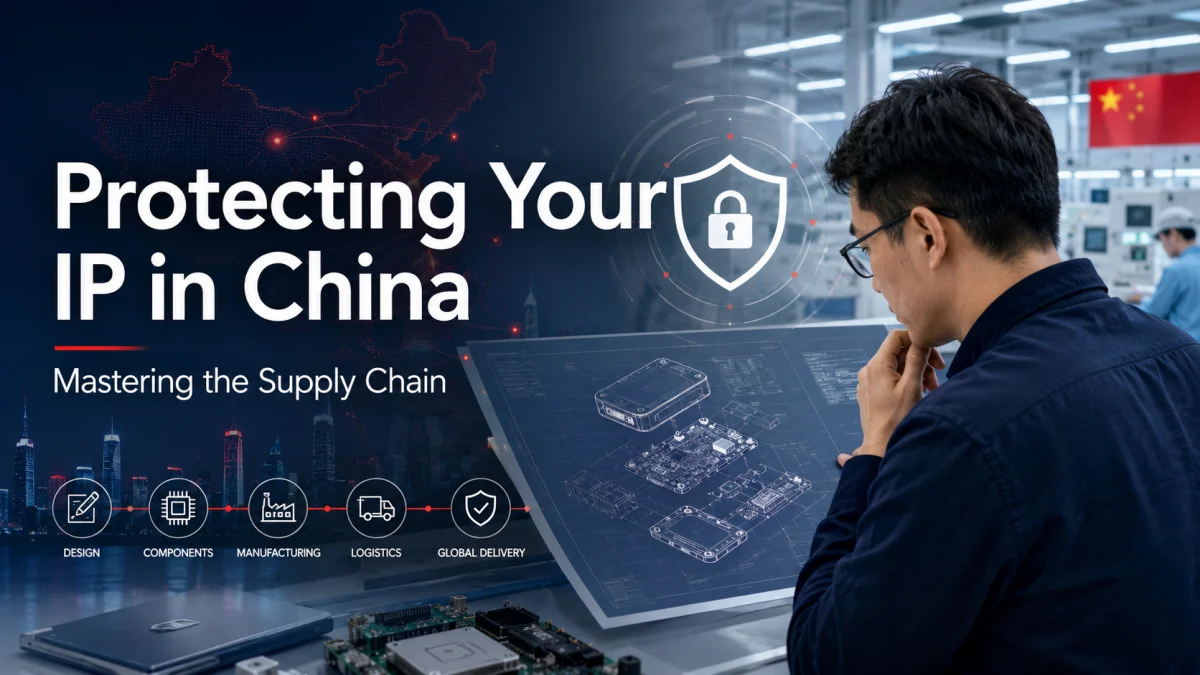
Every founder who manufactures overseas knows the nightmare version of the story: the concept deck goes out, CAD files get shared too early, a factory quote comes back fast, and months later a suspiciously similar product appears in-market. What usually gets framed as “China IP theft” is often less cinematic and more procedural. The biggest losses tend to happen upstream, when founders delay trademark filings, use contracts that are poorly adapted to Chinese enforcement, or disclose a complete product architecture to a single counterparty before establishing real secrecy controls [2] [9] [12].
That framing matters, because it points to a much more useful strategy. The core question is not whether China is inherently trustworthy or untrustworthy. The better question is whether your operating model remains protective even when incentives change. In practice, strong China supply chain IP protection rests on five layers working together: early registration, China-enforceable contracts, need-to-know disclosure, local execution discipline, and rapid iteration after launch [1] [10] [12] [14].
Why founders lose leverage before production even starts
For trademarks, China is fundamentally a first-to-file jurisdiction, not a prior-use system like the United States. CNIPA’s current guidance makes that explicit, and the practical consequence is severe: if you have not filed in China, prior branding activity abroad usually does not secure your position there. The law also contains a narrow same-day tie-breaker in which earlier use can matter only when identical or similar marks are filed on the same day, which is a nuance founders should know but never rely on as a strategy. Foreign applicants without a business domicile in China generally must work through a Chinese trademark agency, or designate China through the Madrid System [1] [2] [3].
That means the filing sequence should be the reverse of what many early-stage teams do in practice. You should file before you source, before you circulate vendor packets broadly, and ideally before your brand appears in any serious quote request. When you file, think beyond the single hero SKU. China uses the international Nice Classification for goods and services, and portfolio decisions should account not only for the current product but also for packaging, accessories, software, retail activity, training, after-sales services, and adjacent expansions that might matter if the product line works [1] [4].
The official fee for a CNIPA e-filed trademark application is currently CNY 270 per class for up to 10 items, with a surcharge for each additional item; the paper filing fee is CNY 300. In straightforward cases, founders should expect roughly a year from filing to registration, because China’s trademark system includes a legally binding nine-month examination window followed by a three-month publication/opposition period before a registration stabilizes. If you already filed in another Paris Convention country, you may also be able to claim priority in China within six months, which can materially improve your position if you move fast enough [2] [5] [6] [7].
Build the legal foundation before you send drawings, molds, or supplier lists
The second major error is contract mismatch. A generic English-language NDA is not automatically worthless, but it is often a poor instrument for China manufacturing because the most common risks are not just disclosure. They are also use of your information for the supplier’s own benefit and circumvention of your commercial relationships. The China IP SME Helpdesk explicitly discusses the use of NNN agreements – non-disclosure, non-use, and non-circumvention agreements – in these circumstances, and its guidance is consistent with years of China-focused commercial practice: if you are sourcing or developing in China, your protective contract needs to match the actual way value leaks in a manufacturing relationship [8] [9] [10].
The contract design details matter as much as the label. In China-facing confidentiality agreements, practitioners repeatedly emphasize the importance of making Chinese the controlling language, using PRC law, naming the correct Chinese entity in Chinese characters, choosing a credible Chinese forum for enforcement, and including a reasonable liquidated-damages clause that a court can apply without forcing you to reconstruct every dollar of loss after the fact. In other words, enforceability is not an abstract legal preference; it is part of deterrence. A supplier is more careful when the agreement looks usable in the jurisdiction where it operates and where its assets sit [10] [11].
China’s legal environment around trade secrets is also continuing to evolve. In 2026, China brought new trade secret regulations into force that explicitly broaden protection for modern technical assets, including data and algorithms, while the broader international trade secret framework still requires the rights holder to demonstrate “reasonable steps” to preserve secrecy. That is the key point for founders: law only helps if your operations show that the information was actually treated as secret in the first place [12] [25].
Design the supply chain so no one supplier sees your full moat
The most robust trade secret in a manufactured product is often not any single file. It is the combination: the exact tolerance stack, firmware behavior, sourcing choices, assembly order, test sequence, materials mix, packaging method, and customer-facing positioning. WIPO’s trade secret guidance is clear on two ideas that are extremely relevant to hardware founders: a trade secret can be a combination of elements that creates competitive advantage, and reasonable protection commonly includes giving access only on a need-to-know basis and using contracts to control recipients [12] [13].
That is the strategic logic behind supply-chain segmentation. If Supplier A does injection molding, Supplier B handles PCB work, Supplier C performs final assembly, and the final firmware key, calibration logic, or packaging sequence is retained in-house or controlled through your local representative, then no single supplier has the complete blueprint. You are not trying to eliminate trust from commerce; you are preventing any single supplier from holding unilateral power over the full commercial secret. This structure also overlaps with a second advantage: broader supplier diversification can improve resilience by reducing exposure to shocks, delays, or opportunistic behavior at a single point of failure [12] [14].
Not every product can be cleanly split across multiple factories, of course. Sometimes certification, precision alignment, or process complexity requires more integration. But even then, the same principle still applies. Stage your disclosures. Share manufacturing drawings instead of the entire design history. Strip customer names and channel data from vendor packets. Limit access to what that factory needs for its current operation, not what it might need someday. Keep the commercially decisive layer – the full BOM logic, the highest-value design rationale, the margin math, the market roadmap – outside the supplier’s field of vision whenever possible [12].
What China’s manufacturing ecosystem actually rewards
A second misconception is that China’s manufacturing advantage is still mostly about cheap labor plus copycat capacity. Current evidence points somewhere else. QIMA’s 2025 global sourcing survey still found persistent reliance on China even as diversification pressures continue, and WIPO’s 2024 science-and-technology cluster ranking placed Shenzhen-Hong Kong-Guangzhou second globally, behind only Tokyo-Yokohama and ahead of many other advanced manufacturing and innovation regions. That matters because it means founders are not just shopping for factories; they are plugging into a dense industrial ecosystem with engineering depth, supplier adjacency, and iteration capacity [15] [16].
The Shenzhen story also helps explain why Western media narratives are often outdated. Academic work on Huaqiangbei describes its evolution from a center associated with “shanzhai” imitation into a specialized makerspace and collaborative innovation environment. That does not mean imitation disappeared. It means the ecosystem matured into something more complex: fast prototyping, component access, design feedback, and compressed product-development cycles are now a central part of China’s competitive logic [16] [17].
It is also increasingly inaccurate to imagine that export manufacturing in China operates outside formal compliance systems. Major third-party providers such as QIMA and SGS openly position audits, inspections, and lab testing as baseline tools for quality, compliance, and supplier verification, which reflects how much global sourcing now depends on documented factory capability and monitored execution. On the legal side, China’s Supreme People’s Court has highlighted the growth of foreign-related IP litigation and described Chinese courts as increasingly used forums for international IP disputes. None of that means founders should become naive. It does mean the mature way to think about sourcing is through systems, documentation, and commercial incentives, not Cold War caricatures [18] [19] [26].
From that perspective, a useful inference follows: serious factories usually have more to gain from repeat export business than from a one-off misuse of a buyer’s information, especially when the buyer is organized, scalable, and hard to replace. Put differently, suppliers are most protective of customers who look like a long-term revenue stream rather than a confused first order. Clear forecasts, reliable payment discipline, realistic engineering timelines, and repeatable purchase orders are not just commercial hygiene; they improve your bargaining power and your protection [15] [18] [19] [20] [21].
Why innovation speed protects what paperwork cannot
The counterintuitive truth is that legal protection has a ceiling once your product is in the market. WIPO’s guide states plainly that trade secret protection generally does not extend to acquiring information through reverse engineering of a product that has been placed on the market. That means secrecy and contracts are essential before launch and during manufacturing, but after launch your moat must widen into other forms: patents or design rights where available, brand control, distribution control, software and data layers, customer community, and above all product cadence [2] [12].
This is where China’s cluster advantages become strategically important. The dense supplier geography around Shenzhen and the wider Pearl River Delta can compress prototype cycles, sourcing cycles, packaging changes, and engineering revisions in ways that many other manufacturing geographies still struggle to match. Founders who treat China only as a low-cost output zone miss the bigger opportunity. The real advantage is that the same ecosystem that raises IP anxiety can also create speed, and speed is the moat that keeps moving after contracts stop doing the heavy lifting [16] [17].
You can see the logic in the public behavior of successful Chinese hardware brands. DJI’s official release stream shows a continuing pace of launches and refreshes across drones, handheld imaging, creator tools, audio, and power products, while Anker’s official media and product channels show the same portfolio-level habit of releasing, extending, and updating categories rather than defending a single static hero product forever. The lesson for Western founders is not “become DJI” overnight. It is simpler: if your V1 is valuable enough to copy, your V2 roadmap should already be funded, specified, and moving before the first large production run lands [23] [24].
When a buyer office becomes your most valuable China asset
A buyer office – sometimes called an international purchasing office or procurement office – is best understood as your operating presence inside the supply chain rather than a middleman taking a margin without accountability. Research on international purchasing offices in China describes them as a frequently adopted organizational solution and identifies advantages including stronger quality control, reduced cultural distance, better supplier oversight, lower third-party markups, and better coordination of sourcing activity across overseas operations [20].
In practical terms, a strong buyer office or dedicated in-country sourcing team does five things exceptionally well. It vets suppliers before deposits move. It coordinates audits, samples, engineering clarification, and production checkpoints. It becomes your eyes during high-risk moments such as tooling, pilot production, in-process fixes, and final inspections. It ties payments to evidence, not optimism. And it reduces the amount of sensitive information that has to travel directly from founder inboxes to factory sales contacts. That is why many experienced importers eventually discover that the most important “IP tool” in China is operational, not purely legal [18] [19] [20] [21].
| Model | Primary alignment | What you usually gain | What you usually lose | Best fit |
|---|---|---|---|---|
| Buyer office | Your company or your retained dedicated team | High visibility, multi-supplier control, QC coordination, stronger information partitioning | Higher fixed cost and management effort | Higher-volume, IP-sensitive, multi-SKU programs |
| Sourcing agent | Usually acts as your local representative | Supplier search, negotiation help, QC support, logistics coordination | Varies widely by agent quality and transparency | Early-scale brands that need local execution without a full office |
| Trading company | Often acts as principal/reseller | Convenience, simpler single-point quoting | Less factory transparency and less direct operational control | Lower-complexity sourcing where transparency is less critical |
Comparison synthesized from academic work on international purchasing offices, sourcing-agent role descriptions, and practical observations on trading-company structures [20] [21] [22].
When should you invest in this layer? Usually when any three conditions appear at once: your product has meaningful IP sensitivity, your supply chain involves more than one critical supplier, and your order flow is becoming repeatable enough that small production errors now cost more than local oversight. At that point, a buyer office stops being “overhead” and becomes part of the control system that protects both margin and know-how [20] [21].
A practical roadmap and common questions
The most effective China strategy is not built through one heroic legal document. It is built through sequencing. The first ninety days should be about locking priority, narrowing disclosure, and making sure your first production run is not also your first organizational test [1] [5] [8] [10] [12] [20].
| Phase | Focus | Recommended actions |
|---|---|---|
| Foundation | Protect the brand and the paper trail | File China trademarks, select classes deliberately, claim priority if available, localize the confidentiality/NNN framework, and stop casual sharing of full product files |
| Architecture | Reduce concentrated exposure | Map which supplier truly needs which information, separate critical components where feasible, and identify a local execution layer for audits and production monitoring |
| Execution | Launch without surrendering leverage | Run controlled samples, monitor production, tie balances to inspections, and queue the next revision or variant before the first large run leaves the factory |
Roadmap synthesized from the trademark, contract, trade secret, sourcing, and buyer-office sources cited throughout this article [1] [5] [8] [10] [12] [18] [20].
Is China really first-to-file for trademarks?
Yes. In trademark practice, China generally awards priority to the first valid filer, not the party that used the mark first abroad, with only narrow exceptions such as same-day filing rules where earlier use may matter as a tie-breaker [1] [2] [3].
Do my U.S. or EU trademark registrations protect me automatically in China?
No. Your foreign registration does not automatically secure your rights in China, which is why CNIPA filing or Madrid designation matters before meaningful supplier outreach or market entry [1] [2] [8].
What is the practical difference between an NDA and an NNN agreement?
An NDA mainly targets disclosure. An NNN framework adds non-use and non-circumvention, which are often the more realistic risks in a manufacturing relationship where the supplier may never “leak” your information publicly but may still use it or route around you commercially [8] [9] [10].
What is supply-chain decoupling in plain English?
It means arranging production so that no single supplier can see and reproduce the entire commercial secret. That could mean separating components, assembly, firmware, calibration, packaging logic, or customer data so that the full value-creating combination stays under your control [12] [13] [14].
Can I trust Chinese factories?
Trust is the wrong operating category. A better strategy is to build a relationship with incentives for repeat business while structuring documents, disclosures, audits, and supplier roles so that trust is helpful but not dispositive. That approach aligns much better with the formal audit culture, sourcing controls, and enforcement environment that now characterize mature export manufacturing [18] [19] [20] [26].
When do I need a buyer office?
The inflection point is usually when your product becomes too important to manage through ad hoc founder emails: more suppliers, more engineering change orders, more cash at risk, and more downside from quality drift or uncontrolled disclosure. At that stage, a local operating layer often pays for itself by preventing avoidable mistakes rather than by negotiating a few cents off unit price [20] [21].
Conclusion: From fear to leverage
The strategic takeaway is simple enough to remember and difficult enough to practice: file early, contract locally, divide access, supervise execution, and move faster than the copy cycle. If you do that, China stops looking like a black box and starts behaving like what it actually is for disciplined founders: a powerful manufacturing system that rewards preparation more than fear [1] [10] [12] [20].
For researchers and entrepreneurs, the lesson is not to ignore IP risk. The lesson is to operationalize it. Strong China supply chain IP protection is not one contract, one trademark filing, or one trusted relationship. It is a system that combines legal priority, supplier architecture, execution monitoring, commercial leverage, and continuous product improvement.
References
- China National Intellectual Property Administration, “How can Foreign Applicants Apply for Trademark Registration?”
- United States Patent and Trademark Office, “A guide to protecting and enforcing IP rights in China”
- China National Intellectual Property Administration, “Guidelines on the Procedure for Same-Day Trademark Applications”
- World Intellectual Property Organization, “Nice Classification”
- China National Intellectual Property Administration, “Fees”
- WIPO Magazine, “China’s trademark activity continues to soar”
- Shanghai Intellectual Property Administration, “Trademark Law of the People’s Republic of China”
- China IP SME Helpdesk, “China – Frequently Asked Questions”
- European Innovation Council and SMEs Executive Agency, “Guide to Using Contracts to Protect Your Intellectual Property Rights in China”
- Harris Sliwoski, “China NNN Agreements: The Hard Truth”
- Harris Sliwoski, “China NNN Agreements and How to Give Them Real Teeth”
- WIPO, “WIPO Guide to Trade Secrets and Innovation – Part III: Basics of trade secret protection”
- WIPO, “Trade Secrets”
- International Monetary Fund, “Supply Chain Diversification and Resilience”
- QIMA, “2025 Global Supply Chain Landscape and Trends”
- WIPO Global Innovation Index 2024, “Science and Technology Cluster Ranking 2024”
- Oxford Academic, “Evolving scales and spaces of mission-oriented industrial policy: Huaqiangbei as a makerspace for collaborative innovation”
- QIMA, “Quality Control in China: Inspections, Audits, Lab Testing”
- SGS China, “Factory Audit Services”
- China-Europa Forum, “International purchasing offices in China”
- Statrys, “China Sourcing Agent Guide 2026: How to Find Reliable Suppliers”
- WebRetailer, “Buying From China: Manufacturers vs Trading Companies vs Sourcing Agents”
- DJI, “Official News – Company Updates & Product Releases”
- Anker Innovations, “Media Center”
- State Administration for Market Regulation, “Data, algorithms added to trade secret regulations”
- Supreme People’s Court of China / China Daily, “Chinese court increasingly favored for IP disputes”