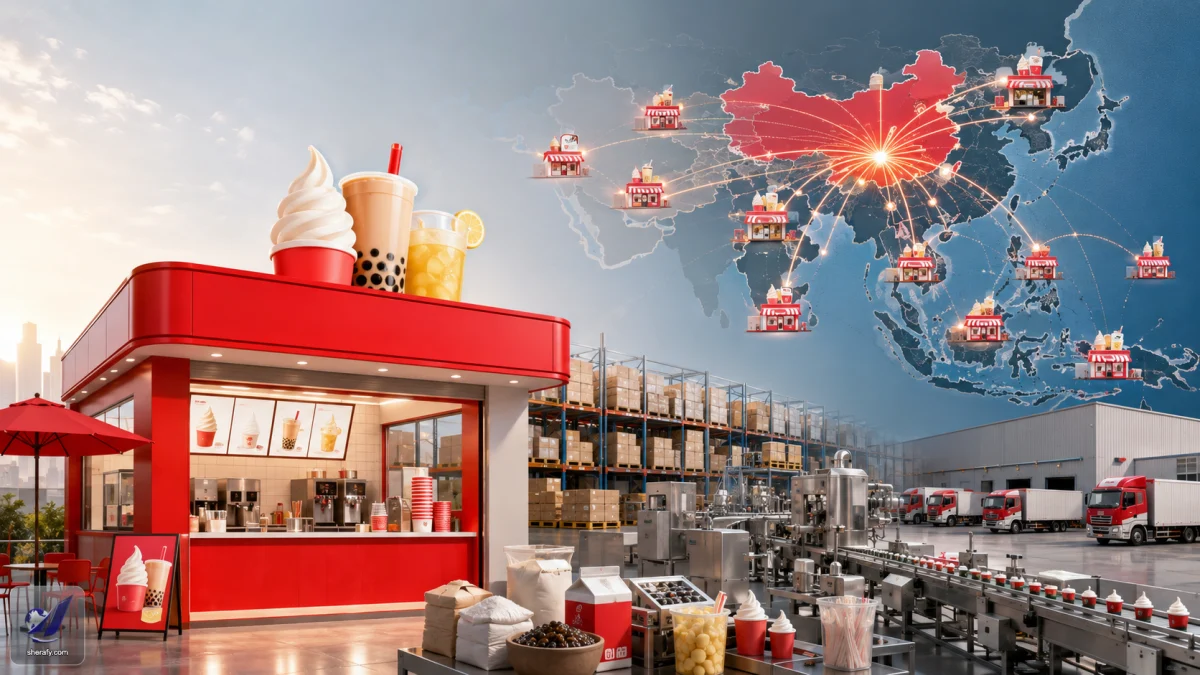
Mixue appears to be a low-cost ice cream and bubble tea chain. Beneath the storefront, however, is a vertically integrated manufacturing, logistics, technology, and franchising system designed to make extremely low prices economically sustainable.
A Mixue store does not look like the headquarters of a global industrial operation.
The shops are generally small. The menus are simple. Their bright red signs feature Snow King, a smiling cartoon snowman holding an ice cream-shaped staff. The signature products—soft-serve ice cream, lemonade, fruit tea and milk tea—often cost roughly the equivalent of one U.S. dollar.
Yet the company behind these inexpensive drinks has built one of the largest consumer retail networks in the world.
At the end of 2025, Mixue Group reported 59,823 stores across China and international markets. Nearly all were franchised. The network included 55,356 stores in mainland China and 4,467 outside it, although the group-wide total also included its Lucky Cup coffee brand and the recently acquired FULU Fresh Beer chain. Mixue’s flagship beverage brand had already overtaken Starbucks and McDonald’s in outlet count by late 2024.
It is tempting to explain that growth as a bubble tea craze or an unusually aggressive franchise strategy. Both explanations are incomplete.
Mixue’s real achievement is that it transformed the supply chain from a supporting function into the center of the business. The stores attract consumers, but the company largely makes its money by manufacturing and distributing the ingredients, packaging, equipment and operating systems those stores require.
Mixue is therefore best understood as two businesses occupying the same brand:
- a consumer-facing network selling inexpensive drinks and desserts; and
- an industrial supply platform selling standardized inputs to tens of thousands of franchise locations.
The first business creates demand. The second captures the economics.
What Is Mixue?
Mixue, formally known as Mixue Bingcheng, began in Zhengzhou, China, in 1997. Founder Zhang Hongchao started with a small shaved-ice shop called Coldsnap Shaved Ice. The Mixue Bingcheng name was introduced in 1999, and in 2005 Zhang developed an ice cream cone priced at only RMB1—approximately 15 U.S. cents at the exchange rate cited in the company’s prospectus.
That RMB1 cone was more than a popular menu item. It established the strategic problem that would shape the company:
How can a business sell a desirable product at an unusually low price without destroying its own economics?
The answer could not come from branding alone. A company cannot advertise its way out of expensive ingredients, inefficient deliveries, inconsistent store operations or excessive labor costs. To make the low price durable, Mixue had to redesign almost everything behind the counter.
The company established its first centralized factory in 2012, introduced freshly squeezed lemonade in 2013 and began constructing its own logistics system in 2014. It launched the Lucky Cup coffee brand in 2017, opened its first international Mixue store in Hanoi in 2018 and surpassed 10,000 stores in 2020.
Those milestones reveal the company’s actual development. Mixue did not simply open more shops. It gradually built the industrial infrastructure required to support more shops.
The Central Insight: Mixue Does Not Primarily Sell Franchise Licenses
Many people assume that a franchise company makes most of its money by charging franchise fees and collecting royalties from retail sales.
Mixue’s financial statements reveal a different model.
In 2025, Mixue Group generated RMB33.56 billion in revenue and RMB5.93 billion in profit. Approximately RMB32.77 billion of its revenue came from selling goods and equipment, while only RMB793.9 million came from franchise and related services. Franchise and service fees represented just 2.4% of total revenue.
That means approximately 97.6% of revenue came from goods and equipment rather than franchise services.
This changes the way the company should be understood.
A Mixue franchisee is not merely a licensed operator paying to use the brand. The franchisee is also a recurring customer of Mixue’s supply chain. Franchisees purchase ingredients, packaging materials, machinery and other store supplies from the group as part of their daily operations. In most sales transactions, Mixue receives payment before the goods are delivered.
The storefront sells to the public. Mixue sells to the storefront.
Every new franchise therefore does more than expand brand recognition. It creates another captive—or at least tightly integrated—point of demand for the company’s industrial output.
A new store requires initial equipment. Once operating, it continually consumes tea, syrup, milk products, fruit preparations, ice cream ingredients, cups, lids, straws and other materials. Unlike a one-time franchise fee, those supply purchases repeat as long as the store remains open and selling products.
This is why calling Mixue a beverage chain captures only the visible part of the system.
Economically, it resembles a centralized producer connected to tens of thousands of independently financed retail terminals.
How the Mixue Supply Chain Works
Mixue’s supply chain can be divided into five interconnected systems:
- global procurement;
- centralized manufacturing;
- warehousing and logistics;
- franchise distribution;
- digital operating control.
Each part reinforces the others.
1. Procurement: Buying at Industrial Scale
Mixue purchases food commodities, agricultural products and supporting materials through a broad procurement network. The company says its purchasing network reaches toward the origins of important raw materials rather than relying entirely on layers of intermediate distributors.
At sufficient scale, this creates several advantages.
First, large purchasing volumes strengthen Mixue’s negotiating position. A small independent tea shop may buy ingredients by the case. Mixue can negotiate for an entire national network. According to the company, this allows it to acquire many core raw materials below industry-average prices.
Second, centralized purchasing can reduce variation. If every franchisee independently selected its own tea, sweeteners, milk powder and fruit concentrate, the brand would struggle to maintain consistent flavor, safety and cost.
Third, scale makes direct investment more rational. A company serving a few hundred stores may not justify building specialized factories, laboratories or agricultural sourcing relationships. A network serving tens of thousands of stores can spread those fixed costs across billions of transactions.
The underlying economic principle is straightforward:
The larger the demand pool, the more activities the company can profitably bring under centralized control.
Scale therefore does not merely lower purchasing prices. It changes what the company can afford to own.
2. Production: Turning Recipes Into Industrial Inputs
Mixue operates five production bases in Henan, Hainan, Guangxi, Chongqing and Anhui. Its production system covers syrups, dairy-related ingredients, tea, coffee, fruit products, grains and condiments. In its 2025 results, the company stated that it self-produced all of its core ingredients.
This is a deeper form of vertical integration than simply placing a private label on ingredients made by outside suppliers.
When Mixue controls production, it can engineer ingredients around the needs of the store system. A syrup can be designed for predictable portioning. An ice cream mixture can be optimized for particular machines. A fruit preparation can be formulated for storage life, shipping stability, preparation speed and consistent sweetness.
The product is therefore not merely “tea” or “ice cream powder.” It is a standardized component of a larger operating process.
That matters because every extra decision made inside a store introduces cost and variation.
If employees must measure complicated recipes, prepare numerous ingredients from scratch or compensate for inconsistent raw materials, service becomes slower and mistakes become more likely. A centrally produced input transfers complexity away from the shop and into the factory, where automation and quality controls can handle it more efficiently.
Mixue is effectively converting craft preparation into modular assembly.
The store still prepares the final drink, but much of the difficult work—formulation, sourcing, testing and standardization—has already been completed upstream.
3. Logistics: Moving Low-Value Products Economically
Cheap products create a difficult logistics problem.
Transportation, handling and storage costs do not automatically decline because the final drink is inexpensive. In fact, a low-priced business may be more sensitive to logistical inefficiency because there is less revenue available to absorb each mistake.
Mixue began developing its own logistics system in 2014. By the end of 2025, it operated 28 warehouses in China, with distribution covering 33 provincial-level regions and more than 300 cities. It had also established local warehouse and delivery systems in eight overseas countries.
The network allows Mixue to combine shipments, plan replenishment across many stores and move supplies through regional distribution points instead of treating every franchise as an isolated customer.
Density is especially important.
Delivering to one store in a distant town may be expensive. Delivering to dozens or hundreds of stores within a region allows trucks, warehouses and delivery routes to be used more efficiently. As the number of stores increases, the cost of serving the next store may decline—provided the stores are placed intelligently and do not excessively cannibalize one another.
This creates a geographic network effect:
- more stores create more demand in a region;
- greater regional demand supports better warehouse and delivery economics;
- better logistics lower the cost and difficulty of opening additional stores;
- lower operating costs make the franchise more attractive;
- more franchisees enter the network.
The supply chain and store network consequently grow together.
4. Franchising: Outsourcing Retail Capital While Controlling Inputs
At the end of 2025, Mixue Group reported 59,785 franchised stores and only 38 self-operated stores. Its 27,450 franchisees owned their locations and were responsible for the stores’ financial results, while the company provided the brand, products, operating requirements, training and supply infrastructure.
This arrangement divides capital requirements between the company and the franchisee.
The franchisee typically bears store-level costs such as:
- leasing the location;
- hiring employees;
- paying local utilities;
- funding the store buildout;
- managing daily retail operations;
- absorbing the direct consequences of weak store performance.
Mixue concentrates its capital in activities that can serve the whole network:
- factories;
- warehouses;
- product development;
- software;
- quality-control systems;
- procurement;
- brand development;
- operating standards.
This is a powerful division of labor.
The company can expand its retail footprint without financing every storefront itself. At the same time, it retains influence over what those stores purchase and how they prepare products.
The model is “asset-light” at the retail layer but decidedly asset-heavy upstream.
That distinction matters. Mixue is not avoiding capital investment altogether. It is concentrating investment where scale can create the greatest advantage.
Its factories and logistics infrastructure would be difficult to justify for a small chain. Across tens of thousands of stores, however, those assets become the foundation of lower unit costs.
5. Digitalization: Making Thousands of Stores Behave Like One System
Supply chain control becomes far more powerful when combined with operational data.
Mixue’s digital infrastructure covers online ordering, store management, supply replenishment, corporate administration and supply chain operations. It also gathers direct consumer data through proprietary apps and mini programs operating through platforms such as Weixin and Alipay.
By the end of 2025, Mixue had deployed smart drink-dispensing equipment in more than 13,000 stores. The company said the equipment improved efficiency and product consistency while reducing food-safety risks.
The strategic value of these systems is larger than the machines themselves.
A digitally connected network can provide information about:
- which products are selling;
- how demand changes by time and location;
- how quickly stores consume ingredients;
- when inventory should be replenished;
- whether recipes are being followed;
- which promotions produce repeat sales;
- where service speed or quality is declining.
This creates a feedback loop connecting consumers, stores, warehouses and factories.
Consumer purchases create data. Data improves forecasts. Better forecasts improve procurement and production planning. More accurate production reduces shortages and waste. Reliable supply supports lower prices and more consistent service.
The storefront is therefore not only a sales channel. It is also a sensor inside the supply network.
Why Mixue Can Sell Products So Cheaply
Mixue’s core products in China are generally priced between RMB2 and RMB8. In 2025, the group described its broader offering as typically costing around one U.S. dollar per item. Approximately 58% of its mainland Chinese stores were located in third-tier or smaller cities, where consumers are often particularly sensitive to price and where occupancy costs may be lower than in central districts of Beijing, Shanghai or Shenzhen.
The low prices are made possible by several mutually reinforcing decisions.
A deliberately limited value proposition
Mixue does not attempt to compete primarily through luxurious interiors, elaborate service or premium positioning. It promises a recognizable, enjoyable and inexpensive product.
This keeps the operation focused.
High-volume products
Ice cream, lemonade and tea can be sold frequently and consumed casually. They do not require a major purchasing decision. A customer can return repeatedly without treating the transaction as a special occasion.
Small, standardized stores
Smaller formats can reduce rent, buildout costs and staffing requirements. Standardized layouts also make opening, training and operating locations easier.
Centralized ingredients
Factories absorb formulation complexity, enabling stores to prepare products more quickly and consistently.
Aggregated purchasing
The combined demand of the network supports stronger negotiations and larger production runs.
Franchise-funded expansion
Franchisees supply much of the capital required to open the retail network.
Recurring supply revenue
Mixue earns revenue whenever stores reorder supplies, not only when a franchise agreement is signed.
No individual advantage fully explains the price.
The price is the visible output of the entire system.
The Mixue Flywheel
The model can be summarized as a reinforcing cycle:
Low prices attract customers.
High customer volume increases ingredient consumption.
Ingredient consumption creates revenue for Mixue’s supply business.
Greater supply volume improves purchasing power and factory utilization.
Lower unit costs help Mixue maintain low retail prices.
Low prices attract additional consumers and franchisees.
More franchisees create greater geographic density.
Greater density improves distribution economics and brand visibility.
Stronger distribution and brand recognition support additional stores.
The cycle then repeats.
This is why a competitor cannot necessarily defeat Mixue by temporarily cutting the price of one drink.
A promotional discount is not the same thing as a structurally lower cost base.
A rival may match the price at the cash register while losing money behind it. To compete sustainably, the rival may need to redesign procurement, recipes, store formats, manufacturing, logistics, technology and franchise relationships.
The price is the weapon, but the supply chain is the ammunition factory.
Mixue and China’s Culture of Extreme Competition
Mixue developed inside one of the world’s most competitive consumer markets.
China’s beverage sector contains international coffee chains, domestic coffee companies, premium tea brands, discount tea chains, convenience stores, delivery platforms and countless independent operators. Multiple beverage brands can compete on the same street, while delivery promotions make prices instantly comparable.
This environment is sometimes described through the Chinese concept of neijuan, commonly translated as “involution.” In business, the term describes competition in which companies continually increase effort, reduce prices and accept thinner margins without necessarily creating proportionate new value.
Mixue should not be reduced to involution alone. Its supply chain investment predates the latest delivery and discount wars. Nevertheless, the company demonstrates how intense competition can force firms to develop capabilities that later become strategic advantages.
A business accustomed to comfortable margins may treat procurement and logistics as support functions. A business selling RMB2-to-RMB8 products must treat every gram of ingredient, minute of labor and kilometer of transportation as part of the strategy.
Mixue did not merely survive low-price competition. It built an organization designed for it.
The Snow King Paradox: Cheap Products Still Need a Strong Brand
Supply chain efficiency explains how Mixue can sell cheaply. It does not fully explain why customers choose it.
Low-price businesses still require trust, recognition and emotional appeal. Otherwise, they risk appearing generic or unreliable.
Mixue introduced Snow King as its permanent brand ambassador in 2018. The company has built songs, animations, merchandise, social media content and public events around the character. By the end of 2025, the #MIXUE hashtag had accumulated more than 65 billion views on Douyin, according to the company.
Snow King performs an important strategic function.
The character gives a standardized industrial system a friendly public identity. The factories remain invisible. The mascot makes the company memorable.
This combination is easy to underestimate:
- the supply chain keeps the product inexpensive;
- the brand keeps “inexpensive” from feeling anonymous;
- the franchise network makes the brand physically unavoidable;
- social media gives the network cultural visibility.
Mixue has therefore paired operational austerity with unusually expressive branding.
The store may be simple. The identity is not.
Why International Expansion Is More Difficult
By 2024, Mixue had built a major presence in Southeast Asia, particularly in Indonesia and Vietnam. Consumers interviewed by the Associated Press described the brand’s affordability as a central attraction, and its ice cream and drinks substantially undercut some established competitors. (AP News)
But international growth exposes the limits of a supply chain optimized primarily for China.
A low-price product can tolerate only limited additional cost. Overseas expansion introduces:
- import duties;
- longer shipping distances;
- currency fluctuations;
- different food regulations;
- local certification requirements;
- higher labor costs;
- unfamiliar real-estate markets;
- weaker warehouse density;
- different consumer tastes;
- limited supplier relationships;
- greater difficulty supervising franchisees.
In China, Mixue can serve an enormous, dense network through established production bases and warehouses. In a new country with only a small number of stores, the company may lack sufficient volume to reproduce those economics.
This creates a sequencing problem.
Mixue needs stores to justify local supply chain investment. But it may need a strong local supply chain before those stores can operate successfully at Mixue-style prices.
The company’s 2025 results provide evidence of this tension. Although it entered Kazakhstan and the United States, its total overseas store count declined from 4,895 at the end of 2024 to 4,467 at the end of 2025. Mixue said it was optimizing store operations in Indonesia and Vietnam rather than pursuing expansion at any cost.
This does not necessarily indicate a failed international strategy. It does show that rapid franchise growth can outrun the operational system supporting it.
Mixue has said it intends to build a more localized global supply platform based on “Global Procurement, Global Production, and Global Sales.” In practical terms, that means international success may require regional factories, local sourcing, warehouses, adapted products and stronger market-specific operating expertise—not merely exporting Chinese ingredients and opening red storefronts.
The Risks Inside the Model
Mixue’s scale is formidable, but the model is not invulnerable.
Franchise quality control
Nearly 60,000 stores create enormous supervisory challenges. A single poorly trained operator can mishandle ingredients, ignore cleaning rules or damage the brand locally.
Standardized supplies reduce variation, but they cannot eliminate human error.
Franchisee economics
Mixue’s interests and those of its franchisees overlap, but they are not identical.
Mixue earns revenue by selling supplies to the network. Individual franchisees must still pay rent, labor, utilities and local marketing expenses. A growing store count does not guarantee that every store is profitable.
Excessive density could also cause nearby locations to compete with one another, increasing corporate supply sales while weakening store-level returns.
Commodity exposure
Sugar, dairy inputs, tea, coffee, fruit and packaging materials are subject to price volatility. In 2025, Mixue reported that the gross margin on goods and equipment declined from 31.2% to 29.9%, partly because of increased procurement costs for certain raw materials.
A low-price brand may find it harder than a premium brand to pass those increases to consumers.
International replication
The farther the network expands from its Chinese production and logistics base, the more difficult it becomes to preserve the same relationship among price, consistency and franchise profitability. Analysts have specifically questioned whether Mixue can reproduce its Chinese supply-chain integration in distant markets. (Financial Times)
Consumer health preferences
Mixue’s core categories include sweetened drinks and desserts. Growing concern about sugar consumption, obesity and highly processed foods could affect demand or generate stricter labeling and taxation policies.
Complexity from diversification
The group now operates tea, ice cream, coffee and fresh beer brands. Shared procurement and logistics may create efficiencies, but expanding into additional categories can also dilute management attention and introduce new operational requirements.
What Other Businesses Can Learn From Mixue
The obvious lesson is not simply “charge less.”
Low prices without cost control are a path to insolvency.
The more useful lessons are structural.
1. Design the supply system before scaling the storefront
A brand can grow faster than its operations can support. Expansion should be paced around manufacturing, inventory, training, quality control and replenishment capacity.
2. Move complexity to the place best equipped to handle it
Factories should perform tasks that benefit from automation and precision. Stores should perform tasks that benefit from proximity to the customer.
3. Treat franchisees as both partners and customers
A franchise system becomes stronger when the parent company creates recurring value for operators rather than simply extracting fees.
4. Use volume to fund capabilities, not merely expansion
Scale should improve sourcing, production, technology and logistics. A large store count without improved unit economics is only a larger vulnerability.
5. Build around replenishment
The most important transaction may not be the customer’s first drink or the franchisee’s initial license. It may be the continuous movement of supplies through the network.
A strong business model asks:
What must customers or operators purchase repeatedly, and how can the company become the most efficient provider of it?
6. Understand that price is an organizational decision
Retail price is not chosen only by the marketing department. It is produced by procurement contracts, recipes, factory yields, labor requirements, warehouse locations, delivery density, store size and capital structure.
A company that wants structurally lower prices must redesign the organization that creates them.
Is Mixue Really a Beverage Company?
Yes—but that description is incomplete.
Mixue sells tea, lemonade, ice cream and coffee. Consumers experience it as a beverage and dessert brand. Franchisees operate it as a retail business.
From the parent company’s perspective, however, the network functions as a vast distribution system for standardized ingredients, packaging and equipment.
The stores are both businesses and endpoints.
The mascot is both a character and a customer-acquisition system.
The franchise program is both an expansion method and a demand-aggregation engine.
The low price is both a consumer benefit and a barrier that forces competitors to confront Mixue’s cost structure.
That is the larger business lesson.
Mixue did not become enormous because it discovered that people like inexpensive ice cream. Countless businesses already knew that.
It became enormous because it constructed an operating system capable of producing, moving and selling inexpensive products on an industrial scale.
The drink is what the customer sees.
The supply chain is the company.
References and Further Reading
Primary Sources and Company Filings
MIXUE Group. “Annual Results Announcement for the Year Ended December 31, 2025.” Hong Kong Exchanges and Clearing Limited, March 24, 2026.
Mixue’s official results announcement is the principal source for the article’s current financial and operational figures. It reports the group’s revenue, profit, revenue composition, franchise structure, store count, geographic distribution, production network, warehouse system, international operations and 2025 store closures and openings.
MIXUE Group. “History, Development and Corporate Structure.” In the MIXUE Group Global Offering Prospectus, Hong Kong Exchanges and Clearing Limited, February 21, 2025.
This official prospectus section documents Mixue’s development from Zhang Hongchao’s original 1997 shaved-ice shop in Zhengzhou through the introduction of the Mixue name, the RMB1 ice cream cone, centralized manufacturing, proprietary logistics, Lucky Cup, Snow King and the company’s first international store in Vietnam.
MIXUE Group. “Financial Information.” In the MIXUE Group Global Offering Prospectus, Hong Kong Exchanges and Clearing Limited, February 21, 2025.
This prospectus section provides detailed historical financial information about Mixue’s sales of ingredients, packaging materials and equipment to franchisees. It also explains the company’s franchise fees, cost structure, gross margins, raw-material exposure, advance payments and the extent to which supply sales—not conventional franchise fees—generate company revenue.
Independent Reporting and Analysis
Associated Press. “Make Room Starbucks and McDonald’s. China’s Mixue and Other Brands Win Fans in Southeast Asia.” March 15, 2025.
This on-the-ground report examines Mixue’s growth in Southeast Asia, especially Indonesia, Malaysia, Thailand and Vietnam. It includes local pricing comparisons, consumer perspectives, franchise activity and discussion of how Chinese food and beverage brands are competing with established Western chains.
Financial Times. “China’s $1 Bubble Tea Chain Soars 43% in Hong Kong Debut.” March 3, 2025.
This report covers Mixue’s Hong Kong stock-market debut, value-focused positioning, growth in lower-tier Chinese cities and reliance on sales of ingredients and equipment to franchisees. It also places Mixue within China’s intensely competitive freshly made beverage market. Subscription may be required.
Financial Times. “Chinese Bubble Tea Chain With More Stores Than McDonald’s Wants to Conquer the World.” May 10, 2026.
This later analysis examines Mixue’s international ambitions, including expansion into the United States, Brazil and Kazakhstan. It also discusses the central strategic question facing the company: whether the vertically integrated supply-chain model that supports its low prices in China can be recreated economically in distant markets. Subscription may be required.