Anthony Fauci’s private pandemic records do not prove that SARS-CoV-2 was engineered, that it escaped from a laboratory or that Fauci knowingly concealed the cause of the pandemic.
They reveal something that should still disturb the public.
Behind the image of a neutral scientific authority was a powerful government official simultaneously managing scientific uncertainty, political strategy, media relationships, institutional risk and his own growing celebrity. Questions that were privately considered legitimate were later described as conspiratorial. Policy influence was exercised more aggressively than later testimony sometimes suggested. Federal agencies failed to monitor risky research grants properly. Prominent journalists developed personal relationships with one of the officials they were supposed to scrutinize.
None of this requires inventing a biological-weapons plot. The documented record is serious enough.
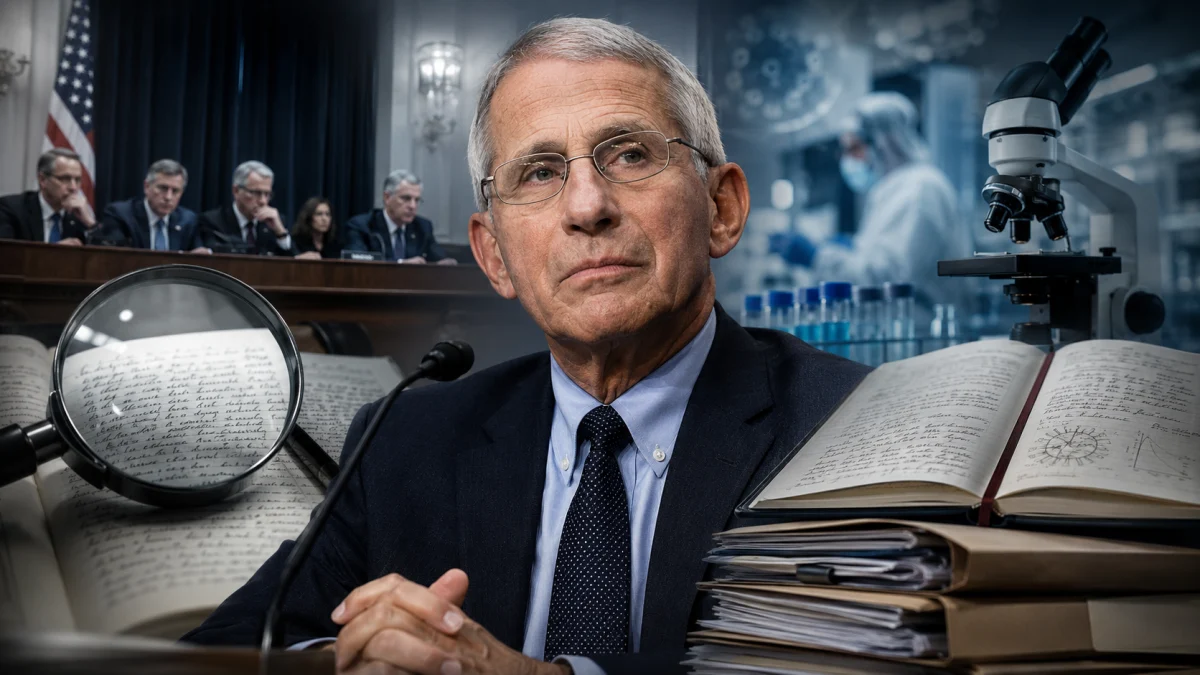
On July 29, 2026, Fauci appeared under subpoena before the Senate Homeland Security and Governmental Affairs Committee and invoked the Fifth Amendment rather than answer questions concerning the pandemic response and COVID-19’s origin. Fauci said committee chairman Rand Paul had an “obvious obsession” with prosecuting him and that his attorney advised him not to participate in what he regarded as an effort to produce a perjury case. Invoking the Fifth Amendment is not proof of guilt, but the spectacle underscored how far public confidence had collapsed. (AP News)
Days before the hearing, Paul released approximately 1,141 pages of Fauci’s contemporaneous notes covering December 2019 through Fauci’s retirement in December 2022. Sherafy reviewed the released records alongside federal audits, declassified intelligence assessments, congressional materials and scientific evaluations.
The resulting picture is not the cartoon offered by either political camp. Fauci was neither the infallible embodiment of science nor a proven architect of a global biological attack.
He was a government official with enormous influence who did not consistently separate scientific evidence from political advocacy, public relations and institutional self-preservation.
That is an accountability failure.
Key findings
The available evidence supports several firm conclusions:
- Fauci’s advisers privately considered possible laboratory manipulation during the earliest weeks of the outbreak.
- Fauci later dismissed congressional inquiries connecting federally supported research to COVID-19’s origin as “conspiracy theory like,” despite knowing that laboratory-related possibilities had been taken seriously.
- Federal watchdogs found real failures in NIH and EcoHealth Alliance’s monitoring of research and foreign subawards involving the Wuhan Institute of Virology.
- Fauci exerted meaningful influence over school, restaurant and business closures, even though local officials held the formal legal authority.
- Fauci’s records document unusually close personal and strategic relationships with prominent television journalists.
- The journals raise legitimate questions about misleading statements and concealment, but they do not yet establish the elements of a criminal offense.
- President Joe Biden’s broad 2025 pardon substantially limits the possibility of federal prosecution for Fauci’s official conduct before the pardon date.
The clearest proven wrongdoing is therefore institutional and administrative. The possibility of individual criminal wrongdoing deserves a proper legal investigation, but it should not be declared established before the necessary evidence exists.
What Fauci’s pandemic journals are
The released material is commonly described as Fauci’s “diary,” although it functions more like a running professional record.
Fauci documented telephone calls, meetings, television appearances, interactions with politicians, conversations with journalists, policy disputes and personal observations. He reportedly maintained the notes partly as source material for a future book.
Keeping these records was not itself suspicious. Their public value comes from comparison: What was Fauci hearing privately, and how did that compare with what government officials communicated publicly?
The entries span some of the most consequential decisions of the pandemic. They show officials attempting to understand a new virus while simultaneously navigating political pressure, news coverage, bureaucratic interests and fear of public panic. They also expose moments when uncertainty was converted into confidence before the underlying evidence justified it.
The full collection is available in the official journal package released by Senator Rand Paul. The document was initially published, removed and later reposted with additional redactions. (UPR)
Fauci privately knew the Wuhan market was not necessarily the origin
A January 26, 2020, entry has been widely presented as evidence that Fauci privately rejected the natural-origin explanation.
That interpretation goes too far, but the entry remains important.
Fauci recorded that the earliest identified infection was not connected to the Huanan Seafood Wholesale Market in Wuhan. He wrote that the market appeared to have been an “amplifier,” rather than the original source of the outbreak.
In the same entry, however, Fauci wrote that the virus had jumped from animals to humans somewhere. The entry therefore distinguishes between two questions that are often improperly combined:
- Did SARS-CoV-2 enter humans through a natural animal-to-human spillover?
- Did that first spillover happen at the Wuhan market?
A virus could have originated naturally even if the market was merely an early transmission center. The January 26 entry does not show that Fauci secretly believed the virus came from a laboratory.
It does show that the simple public story—virus emerges from animals at a Wuhan market—was already less certain than many people were led to believe. (UPR)
Public communication during an emergency necessarily simplifies complicated evidence. But simplification becomes misleading when uncertainty is removed rather than explained.
The February 1 conference call is more damaging
On February 1, 2020, Fauci participated in a conference call with approximately a dozen virologists and researchers examining unusual features of the SARS-CoV-2 genome.
According to Fauci’s own notes, only two participants were confident in a natural explanation at that moment. Regarding the others, Fauci wrote that “the rest felt that deliberate insertion was possible.”
That sentence does not mean the scientists had proved that SARS-CoV-2 was engineered. It does not establish that a laboratory accident occurred. The call happened extremely early, when genetic, epidemiological and animal-sampling evidence remained limited.
Scientific conclusions can and should change as better evidence becomes available.
But the entry destroys the idea that possible laboratory manipulation was inherently irrational, anti-scientific or unworthy of serious investigation. It was being discussed by prominent scientists in a private meeting with the director of the National Institute of Allergy and Infectious Diseases.
Some of those scientists later concluded that a natural origin better fit the genomic evidence. That change may have been sincere and scientifically justified. What requires scrutiny is not that scientists revised an early assessment. It is the gap between the legitimacy afforded to the question privately and the contempt often directed toward the same question publicly. (UPR)
By August 2021, Fauci was describing congressional letters attempting to connect federally supported research with COVID-19’s origin as “conspiracy theory like” and an “unbelievable waste” of government time.
That characterization was indefensible.
Congressional allegations may have been exaggerated. Some public theories were plainly unsupported. But investigating laboratory safety, foreign subawards and the possible relationship between risky coronavirus research and an outbreak in the same city was not a waste of time. It was basic oversight.
Was the public subjected to institutional gaslighting?
The word gaslighting is frequently overused. In its strict psychological sense, it describes an effort to make someone distrust their own perception of reality.
No released document proves that the federal government operated a unified campaign with that precise intention.
But the public experienced something functionally similar.
Officials possessed substantial uncertainty. They knew qualified scientists had considered laboratory manipulation. They knew the Wuhan Institute of Virology conducted coronavirus research. They knew the federal government had indirectly supported some of that work. They also knew that China had not supplied the information needed to rule laboratory scenarios in or out.
Yet many citizens who asked about these matters were treated as though the questions themselves demonstrated irrationality.
“Conspiracy theory” became less a description of evidence than a status label. It allowed institutions to avoid answering a question by discrediting the person asking it.
That was corrosive. It trained the public to interpret official confidence not as a reflection of evidence, but as a communications strategy.
The correct response to an unsupported claim is to explain why the evidence does not support it. The correct response to an unresolved question is to admit that it remains unresolved. Treating uncertainty as settled science may produce temporary compliance, but it eventually destroys the authority needed during the next emergency.
The journals do not prove a laboratory leak
Criticism of Fauci should not become an excuse to make the same epistemic mistake in the opposite direction.
As of July 2026, COVID-19’s precise origin has not been conclusively established.
The World Health Organization’s 2025 scientific assessment found that the weight of available evidence favored a zoonotic spillover, either directly from bats or through an intermediate host. The same assessment said that all major hypotheses, including a laboratory-related incident, must remain under consideration because China has not supplied critical evidence. Missing information includes early genetic sequences, details about animals sold in Wuhan and records concerning laboratory work and biosafety. (World Health Organization)
American intelligence agencies have also disagreed. A declassified assessment reported that the National Intelligence Council and four agencies favored natural exposure, while the FBI and Department of Energy favored a laboratory-associated incident. Other agencies remained unable to determine the origin.
Almost all intelligence agencies assessed that SARS-CoV-2 was not genetically engineered, and every agency assessed that it was not developed as a biological weapon.
The responsible conclusion is therefore straightforward:
A laboratory-associated origin is plausible and was always a legitimate subject of investigation. It has not been proved.
Likewise, the journals do not prove that Fauci knew a laboratory leak occurred. They prove that he knew laboratory-related possibilities were being taken seriously and later adopted an excessively dismissive posture toward related scrutiny.
That distinction is not a technicality. It is the boundary between evidence and accusation.
Gain-of-function research is dangerous—but it is not synonymous with bioweapons development
Gain-of-function research is a broad category of experimentation in which an organism acquires or is given a new or enhanced characteristic.
Some such research is routine. Other experiments can increase a pathogen’s transmissibility, virulence, host range or ability to escape immunity. When those traits involve a potential pandemic pathogen, an accident could have consequences far beyond the laboratory.
The stated goals include understanding viral evolution, identifying dangerous mutations, developing medical countermeasures and preparing for future outbreaks. The work can nevertheless be dual-use: techniques or organisms developed for defensive purposes can also be misused, stolen or released accidentally.
There is no credible basis for claiming that every scientist conducting gain-of-function research is secretly developing biological weapons. The U.S. intelligence community has specifically assessed that SARS-CoV-2 was not developed as a biological weapon.
There is, however, a powerful basis for questioning whether some experiments should be conducted at all.
The justification often assumes that creating a new biological danger will help society prepare for an existing one. That tradeoff cannot be left entirely to the researchers seeking grants, the institutions receiving funds or the agencies sponsoring the work.
A low-probability laboratory failure can still be unacceptable when the potential harm is global.
Federal oversight failures are established facts
The strongest evidence of government wrongdoing does not come from speculation about viral engineering. It comes from federal watchdogs.
A 2023 audit by the Department of Health and Human Services Office of Inspector General examined NIH grants to EcoHealth Alliance, including subawards involving the Wuhan Institute of Virology.
The audit found that NIH did not effectively monitor the awards or act promptly when compliance problems emerged. It also found that EcoHealth could not obtain required scientific documentation from the Wuhan institute.
Most strikingly, NIH learned from a late progress report that an experiment had produced viral growth meeting specified reporting benchmarks. NIH had failed to follow up on the report for nearly two years after it was due. The inspector general concluded that NIH missed opportunities to monitor the research properly and take more timely corrective action. (HHS Inspector General)
The Government Accountability Office separately found that HHS’s oversight framework for enhanced potential pandemic pathogens lacked a clear standard for determining what research was “reasonably anticipated” to create such a pathogen. That ambiguity permitted subjective and inconsistent decisions and left the department unable to guarantee that all appropriate projects received additional review. (Government Accountability Office)
These are not partisan talking points. They are findings from federal oversight bodies.
The documented failures include:
- Weak monitoring of high-risk foreign research.
- Late and incomplete reporting.
- Failure to follow up promptly.
- Inability to obtain laboratory documentation.
- An oversight framework vague enough to permit inconsistent application.
- Structural conflicts created when the agency funding research also helps determine whether the research requires stricter review.
Whether any of these failures caused the pandemic remains unknown. That does not make them acceptable.
Government agencies were funding or facilitating research capable of creating serious biosafety concerns without maintaining the level of visibility and control that such risks demanded.
Calling that merely an unfortunate administrative lapse would understate it. It was a serious breach of public responsibility.
Fauci influenced lockdown decisions more than later denials implied
Fauci did not have the legal power to close a school, restaurant or private business. Those orders came from presidents, governors, mayors and local health authorities.
But formal authority is not the same as practical influence.
In a March 15, 2020, journal entry, Fauci recorded conversations with then-New York City Mayor Bill de Blasio. Fauci wrote that de Blasio decided to close city schools based on their conversation and Fauci’s public remarks. Fauci also advised him to close bars and restaurants, writing that the mayor would base the decision on his recommendation.
Similar entries describe officials in California reacting to Fauci’s television appearances and advice. Fauci also recorded pushing the federal government toward a more aggressive 15-day mitigation strategy.
It is therefore misleading to reduce his role to the technically correct statement that local officials issued the orders.
Fauci was one of the country’s most influential public-health authorities. His recommendations carried immense political weight. Local leaders relied on them when imposing policies that disrupted education, employment, healthcare, family life and basic civil activity.
Responsibility should be distributed accurately. Governors and mayors were responsible for the orders they signed. Presidents and federal officials were responsible for the national strategy they promoted. Scientific advisers were responsible for the recommendations they supplied and the certainty with which they presented them.
No one should be allowed to claim influence when policies appear successful and deny influence when their costs become politically inconvenient.
Lockdown policy required a balance that public debate often prohibited
Emergency restrictions were not irrational by definition.
In early 2020, officials confronted a contagious new virus, limited testing, overcrowded hospitals, uncertain fatality rates and no vaccine. Temporary measures to reduce contact could slow transmission and prevent healthcare systems from being overwhelmed.
But “lockdown” was never one uniform intervention. Closing a crowded indoor bar, banning outdoor activity, shutting schools, restricting elective healthcare and ordering small businesses to close involved different evidence, risks and social costs.
The harms were substantial:
- Educational loss.
- Developmental disruption.
- Delayed medical care.
- Mental-health deterioration.
- Increased social isolation.
- Family stress.
- Business closures and job losses.
- Unequal burdens on low-income families and workers unable to operate remotely.
A 2024 study of young children found weaker performance on certain social-cognition tasks among children assessed after the pandemic began, particularly those from lower socioeconomic backgrounds. The study was observational and cannot isolate government restrictions from the broader effects of illness, disrupted schooling and family stress. It nevertheless adds to evidence that pandemic-era isolation and disruption were not developmentally neutral.
The core policy failure was not necessarily adopting temporary emergency measures when evidence was scarce. It was the refusal to treat those measures as costly interventions requiring continual reassessment.
Officials too often presented policy as though it were simply “the science.” Science can estimate transmission, hospitalization and mortality. It does not automatically determine how society should weigh those risks against education, civil liberty, mental health or economic survival.
Those are policy judgments. They should have been acknowledged as such.
Fauci’s relationship with the media crossed important ethical boundaries
Government officials and journalists routinely develop professional relationships. Access journalism would be impossible without regular communication between reporters and sources.
The concern begins when that relationship becomes personal, strategically collaborative or hidden from the audience.
Fauci’s journals describe a private dinner at the home of CNN anchor Jake Tapper as “friendship building.” More significantly, Fauci wrote during a July 2020 entry concerning an interview with another federal health official: “I gave Jake some questions to ask him.”
Other entries describe friendly messages from CNN’s Dana Bash and strategic advice from NBC’s Chuck Todd. Fauci wrote that Todd was “really being a friend” while acknowledging the tension between friendship and journalistic objectivity.
These entries do not prove that the journalists surrendered control of their coverage, that networks adopted Fauci’s instructions or that every interview was coordinated.
They do establish relationships that audiences had a legitimate interest in knowing about.
A journalist privately socializing with a recurring government source is already a matter requiring caution. Allowing that source to suggest questions for an interview with another government official creates a more direct concern. It risks turning journalism from independent scrutiny into an instrument within a bureaucratic conflict.
The problem is not that journalists spoke with Fauci. Their job required it.
The problem is that audiences were repeatedly presented with an image of independent questioning while being given little reason to suspect that some participants had become friends, confidants or informal strategic advisers behind the scenes.
Media organizations should address these entries directly. Silence will reinforce the belief that disclosure rules apply to everyone except the people who shape national narratives.
Fauci was unusually attentive to fame and public perception
One entry describes Fauci’s national and international fame as “explosive” and records his belief that he had become the country’s most discussed person and one of the most recognizable people in the world.
Noticing extraordinary public attention is not misconduct. It does not prove that Fauci designed policy to increase his celebrity.
But the entry matters because personal psychology does not disappear when someone enters government.
Fauci became more than a scientific adviser. He became a cultural symbol, a political counterweight to President Donald Trump and a highly marketable media personality. Praise for Fauci was often treated as support for science itself; criticism was treated as alignment with ignorance or partisan extremism.
That environment created dangerous incentives.
An official who becomes the embodiment of institutional competence may begin to protect personal credibility as though it were identical to protecting public health. Contradictory evidence then threatens not merely a policy position, but a reputation, an agency and an entire political narrative.
Fauci’s attention to coverage, critics and public stature does not establish corrupt intent. It provides important context for understanding why institutional self-protection may have influenced public communication.
Was Fauci lying?
The answer depends on what is meant by lying.
The records show that Fauci’s public posture sometimes conveyed more certainty than existed privately. They show that he minimized legitimate origin inquiries and portrayed himself as less influential over restrictions than his contemporaneous notes suggest. They reveal distinctions, omissions and rhetorical framing that gave the public an incomplete account.
That is enough to justify strong criticism.
It is not automatically enough to prove a criminal lie.
A prosecutable false statement under federal law must be materially false, made knowingly and willfully, and fall within federal jurisdiction. The government must prove actual falsity; a statement that is evasive, misleading or incomplete is not always legally false.
Perjury requires proof that a person, while under oath, willfully made a material statement the person did not believe to be true.
This matters particularly in disputes over whether certain research met a technical definition of “gain of function.” If different agencies, scientists or policies used different definitions, a prosecutor would need to establish exactly what Fauci understood the question to mean and prove beyond a reasonable doubt that his answer was false under that meaning.
A semantic dispute is not a criminal case.
But semantic ambiguity should not become a refuge from political accountability. An official can evade, mislead or exploit narrow definitions without committing prosecutable perjury. Congress and the public are entitled to condemn that conduct even when criminal law cannot reach it.
Could Fauci legally be prosecuted?
Several federal statutes could theoretically apply if sufficient evidence existed:
Perjury
Under 18 U.S.C. § 1621, prosecutors would need to prove that Fauci made a material statement under oath, that the statement was false and that he knew it was false when he made it.
False statements
Under 18 U.S.C. § 1001, knowingly and willfully making a materially false statement within the jurisdiction of Congress or another federal branch can carry a prison term of up to five years.
Obstruction of a congressional inquiry
Under 18 U.S.C. § 1505, corruptly impeding or attempting to impede a congressional investigation can be criminal. Proving obstruction would require evidence of corrupt intent and conduct directed at interfering with a pending inquiry—not merely hostility toward congressional questioning.
Contempt of Congress
Federal law also permits contempt proceedings against a subpoenaed witness who refuses to answer pertinent questions without a valid legal basis. A legitimate Fifth Amendment invocation is not contempt. The dispute would concern whether particular answers could reasonably expose the witness to unpardoned criminal liability.
These are plausible legal frameworks for investigation. They are not proof that their elements have been satisfied.
Prosecution should neither be demanded as a political slogan nor ruled out as though senior government officials are categorically immune. The appropriate standard is the same one that should apply to everyone: identify a specific offense, gather admissible evidence and test whether each element can be proved.
Biden’s pardon creates a major legal barrier
On January 19, 2025, President Joe Biden granted Fauci a “full and unconditional pardon” for any federal offenses committed from January 1, 2014, through the pardon date that arose from or related to his service as NIAID director, a member of the White House coronavirus teams or chief medical adviser. (Department of Justice)
The pardon does not establish that Fauci committed a crime. Biden described it as protection against politically motivated prosecution, not an admission of wrongdoing.
Its practical effect is nevertheless broad.
Potential federal offenses tied to Fauci’s official pandemic conduct before January 19, 2025—including any qualifying false statements or obstruction theories—are likely covered. That does not prevent Congress from investigating, publishing findings or exposing wrongdoing. It substantially restricts the federal government’s ability to punish covered conduct criminally.
The pardon does not cover:
- Conduct occurring after January 19, 2025.
- A new false statement or perjury committed after that date.
- State offenses, although no specific viable state case has been publicly established.
- Political, historical, professional or ethical accountability.
- Congressional investigation and public disclosure.
Fauci’s 2026 Fifth Amendment invocation is therefore legally complicated. The broad pardon may eliminate some federal exposure, but it may not eliminate every conceivable risk arising from unpardoned conduct, other jurisdictions or the possibility that answers concerning later actions could create new exposure.
Congress may challenge the invocation. A court may ultimately need to resolve its scope.
What Congress should not do is treat the Fifth Amendment itself as a confession. Constitutional rights do not become evidence of guilt simply because the person invoking them is politically unpopular.
Government wrongdoing does not require a criminal conviction
Public debate often collapses all accountability into one question: “Will anyone go to prison?”
That is too narrow.
The evidence already establishes failures that deserve condemnation even if no criminal charge is ever filed:
- NIH failed to monitor high-risk grants adequately.
- EcoHealth failed to provide timely and complete reporting.
- The Wuhan Institute of Virology failed to provide necessary records.
- HHS maintained an oversight structure with serious gaps and subjective standards.
- Public officials blurred the line between evidence and policy.
- Legitimate questions were stigmatized instead of answered.
- Journalists developed relationships with officials that should have received greater disclosure.
- Political leaders imposed severe restrictions without consistently accounting for their full social costs.
- Agencies responsible for evaluating possible failures were also institutionally invested in defending their own programs.
Criminal law establishes a minimum boundary for punishable conduct. It is not the complete measure of public integrity.
A government can betray public trust through concealment, incompetence, self-protection and arrogance without producing a conviction.
Questioning authority was not the mistake
Many Americans concluded during the pandemic that questioning public-health institutions was itself irresponsible.
That was wrong.
Skepticism toward concentrated power is not anti-scientific. It is a necessary condition for science and democratic government. Scientists must be questioned because scientific knowledge develops through challenge. Government officials must be questioned because they control resources, information and coercive power.
Conservative critics were correct that Fauci, NIH and the broader public-health establishment required far more scrutiny than they initially received.
That does not mean every conservative claim was accurate. Some critics presented an unresolved laboratory-origin hypothesis as proven. Others treated vaccines, masks or the pandemic itself through ideologically predetermined conclusions.
Being right to ask a question does not guarantee that every proposed answer is right.
The corresponding failure on the institutional side was worse because institutions possessed greater power. Officials and major media organizations could restrict debate, establish acceptable narratives and attach reputational costs to dissent. When they used that authority to conceal uncertainty or dismiss legitimate inquiry, they damaged not only their own credibility but the credibility of science itself.
Zero trust is not the solution
The collapse of public trust is understandable. Total distrust is still a poor method for finding truth.
Blind institutional trust makes people vulnerable to official deception. Blind anti-institutionalism makes them vulnerable to anyone who claims to expose it.
The better standard is calibrated trust.
A credible institution should earn confidence by:
- Publishing underlying evidence.
- Separating scientific findings from policy recommendations.
- Disclosing uncertainty.
- Correcting mistakes publicly.
- Allowing adversarial review.
- Revealing conflicts of interest.
- Protecting dissent rather than punishing it.
- Maintaining independent oversight of dangerous research.
Trust should rise when claims survive scrutiny and fall when officials obstruct it.
The public did not need Fauci to be perfect. It needed him and the government to be candid about what they knew, what they did not know and what interests might influence their judgment.
What meaningful accountability would look like
The response should extend beyond another partisan hearing.
Create independent oversight of high-risk pathogen research
The agency funding an experiment should not have final authority to determine whether the experiment requires enhanced safety review. High-risk pathogen research should be evaluated by an independent regulator with no financial or institutional stake in approval.
Publish a registry of federally supported high-risk research
Projects involving enhanced potential pandemic pathogens, foreign subawards and significant biosafety risks should be listed in a publicly accessible database, subject only to narrowly tailored security redactions.
Require immediate reporting of unexpected experimental results
Grant recipients should be required to report unexpected increases in viral growth, transmissibility, pathogenicity or host range promptly. Failure to report should trigger suspension, audit and potential debarment.
Prohibit funding where records cannot be inspected
The federal government should not finance laboratory research in countries or institutions that refuse timely access to experimental records, safety logs, databases and relevant biological samples.
Separate scientific advice from political authority
Scientific advisers should state what the evidence suggests. Elected officials should own the policy choices. Government should stop disguising value judgments and tradeoffs as scientifically mandatory conclusions.
Require emergency policies to expire unless renewed
School closures, business restrictions and similar emergency measures should include sunset dates, published evidence standards and regular assessments of educational, medical, economic and civil-liberty harms.
Strengthen media disclosure standards
Journalists should disclose personal relationships with recurring government sources when those relationships could reasonably affect perceptions of independence. Sources should not quietly help design questions for ostensibly independent interviews without public disclosure.
Release the remaining evidence
Congress and executive agencies should declassify and publish records related to pandemic origins, federal grant oversight, communications with researchers and decisions concerning public messaging—except where narrow and demonstrable security or privacy concerns require redaction.
Conclusion
Fauci’s pandemic journals do not prove every accusation made against him.
They establish enough.
They show an official who privately encountered genuine uncertainty and later treated some efforts to investigate that uncertainty as conspiratorial. They show policy influence that was easier to exercise than to acknowledge. They show personal and strategic relationships with journalists whose audiences were told they were witnessing independent scrutiny. They show a public figure acutely aware of fame and criticism while the institutions under his leadership were defending their own decisions.
Beyond Fauci, federal watchdogs documented weak monitoring, delayed action, incomplete records and major gaps in the system governing research capable of creating catastrophic risks.
That is not a story about one villain. It is a story about a system that confused authority with truth and reputation management with public accountability.
The laboratory-origin hypothesis remains unresolved. Claims of a biological-weapons program remain unsupported. A criminal case against Fauci has not been established, and Biden’s broad pardon may prevent prosecution for most relevant pre-2025 federal conduct.
None of that absolves the government.
Public officials do not earn exoneration merely because misconduct falls short of a provable felony. Institutions entrusted with public health owe society more than technical legal compliance. They owe honesty about uncertainty, transparency about risk and humility when their decisions carry consequences for millions of people.
The central lesson of the Fauci journals is not that science should be rejected.
It is that no individual—scientist, politician, journalist or bureaucrat—should ever be permitted to personify science so completely that questioning the person is treated as questioning reality itself.
Frequently Asked Questions
Do Fauci’s journals prove that COVID-19 came from a laboratory?
No. They show that prominent scientists seriously considered possible laboratory manipulation early in the outbreak. A laboratory-associated origin remains plausible but unproved.
Did Fauci know that the Wuhan market was not the original source?
His January 26, 2020, entry described the market as an amplifier rather than the original source. In the same entry, he continued to believe that the virus had jumped naturally from animals to humans somewhere.
Did Fauci privately consider the possibility that SARS-CoV-2 was engineered?
Fauci recorded that most participants in a February 1, 2020, scientific call believed deliberate insertion was possible. That reflected an early possibility under discussion, not a final conclusion.
Did the United States fund research at the Wuhan Institute of Virology?
NIH funded EcoHealth Alliance, which issued subawards involving the Wuhan Institute of Virology. Federal auditors found significant deficiencies in NIH and EcoHealth’s monitoring and reporting.
Is gain-of-function research the same as biological-weapons research?
No. Gain-of-function is a broad research category, and its stated uses include medical and pandemic-preparedness objectives. Some experiments nevertheless present serious dual-use and accident risks. U.S. intelligence agencies assessed that SARS-CoV-2 was not developed as a biological weapon.
Did Fauci order the lockdowns?
He lacked the legal authority to issue most state and local closure orders. His journals show that his advice and public statements substantially influenced officials who did possess that authority.
Did Fauci lie to Congress?
The journals reveal tensions between private knowledge and public presentation, but a criminal lie has not been legally established. Perjury or false-statement charges would require proof of a specific materially false statement made knowingly and willfully.
Can Fauci still be prosecuted?
President Biden’s 2025 pardon likely covers most federal offenses related to Fauci’s official service before January 19, 2025. It does not cover later conduct, but no prosecutable post-pardon offense has been established merely by his invocation of the Fifth Amendment.
Does invoking the Fifth Amendment mean Fauci is guilty?
No. The Fifth Amendment protects people from being compelled to provide testimony that could expose them to criminal liability. Its invocation may raise political questions, but it is not evidence of guilt.
Sources, References and Further Reading
Primary documents
Anthony Fauci’s pandemic journal records
Anthony Fauci pandemic-era journal package—released by Senator Rand Paul
The approximately 1,141-page primary record containing Fauci’s contemporaneous notes from December 2019 through December 2022. Relevant entries include the January 26 market discussion, the February 1 virologist conference call, communications concerning closures, criticism of congressional origin inquiries and interactions with journalists.
July 29, 2026, Senate hearing
Senate Homeland Security and Governmental Affairs Committee: Testimony of Anthony Fauci
Official hearing page identifying the date, location and witness.
Fauci pardon
Department of Justice: Executive Grant of Clemency for Anthony Fauci
The full pardon warrant covering qualifying federal offenses arising from Fauci’s official service from January 1, 2014, through January 19, 2025.
COVID-19 origins
World Health Organization
WHO Scientific Advisory Group report announcement on COVID-19 origins
Summarizes the 2025 assessment that available evidence favors zoonotic spillover while acknowledging major missing information and keeping laboratory-related hypotheses under consideration.
U.S. intelligence assessment
Declassified assessment documenting disagreement among intelligence agencies, biosafety concerns at the Wuhan institute and the conclusion that SARS-CoV-2 was not developed as a biological weapon.
Congressional investigation
House Select Subcommittee on the Coronavirus Pandemic: Final Report
The Republican-led committee’s 2024 report favored a laboratory-related origin and examined federal research funding and pandemic policy. Its conclusions should be read as congressional findings rather than a settled scientific determination.
NIH, EcoHealth Alliance and research oversight
HHS Office of Inspector General
The federal audit documenting weak monitoring, late reports, missing Wuhan documentation, unallowable costs and delayed corrective action.
Government Accountability Office
Explains gaps and subjective standards in the federal framework for reviewing potentially dangerous pathogen research.
Legal standards
Federal false-statements law
Department of Justice: 18 U.S.C. § 1001—False Statements
Outlines the statutory requirements for knowingly and willfully making or concealing a materially false statement within federal jurisdiction.
Federal perjury law
U.S. Code: 18 U.S.C. § 1621—Perjury Generally
Defines federal perjury and its requirements, including materiality, willfulness and the speaker’s knowledge that the statement was untrue.
Obstruction of congressional inquiries
U.S. Code: 18 U.S.C. § 1505—Obstruction of Proceedings
Covers corrupt efforts to obstruct or impede the lawful exercise of congressional investigative authority.
Contempt of Congress
U.S. Code: 2 U.S.C. § 192—Refusal of a Witness to Testify
Establishes potential criminal consequences for a properly summoned witness who refuses to answer pertinent questions without a valid privilege.
Reporting and independent context
Associated Press
Fauci invokes Fifth Amendment and declines to testify in Senate hearing
Current reporting on the July 29, 2026, hearing, Fauci’s explanation for invoking the Fifth Amendment and the continuing dispute over possible prosecution.
NPR
Rand Paul releases Anthony Fauci’s pandemic-era diary notes
Provides scientific and political context surrounding the January 26 and February 1 entries and explains how early scientific assessments evolved.