
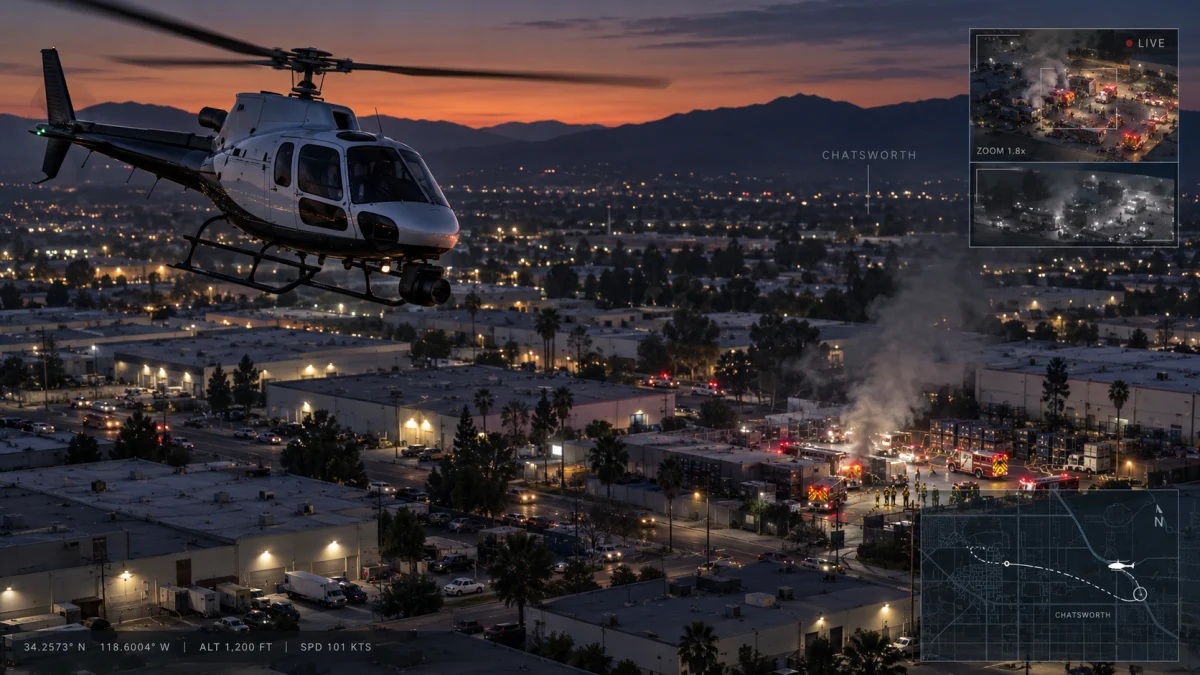
NBC4 and Telemundo 52’s NewsChopper4 crashed in Chatsworth while covering a deadly Metro bus collision on September 15, 2026. Aerial journalist Eliana Moreno, pilot George Marciniw and 29-year-old Edy Fernando Gutiérrez Mejia, who was on the ground, were killed.
Several major uncertainties from the first hours after the crash have now been resolved. The Federal Aviation Administration has officially identified the accident aircraft as N358TV, and FAA registration records identify it as a 2004 Eurocopter AS350 B2, serial number 3788. Two other people injured on the ground survived and have since been discharged from the hospital.
The biggest question remains unanswered:
Why did NewsChopper4 crash?
The National Transportation Safety Board has begun examining the wreckage, maintenance records, weather, pilot training and other evidence. Investigators have also elevated the helicopter’s final live video and audio to a central part of the investigation after hearing sounds consistent with the engine changing speed and cockpit tones that were likely advisories to the pilot.
That is important evidence.
It is not yet a cause.
Update — September 17, 2026
The investigation has moved forward substantially since this article was first published.
The FAA’s preliminary accident notice now formally identifies the crashed helicopter as N358TV. The notice records the Eurocopter AS350 as destroyed and lists three fatalities: one flight crewmember, one passenger and one person on the ground. FAA registry records identify N358TV more specifically as a 2004 Eurocopter AS350 B2, serial number 3788, registered to Tiny Bubbles Aviation Inc. in Pacoima. NBC4 identifies Angel City Air as the owner and operator of NewsChopper4.
The NTSB has also provided its first substantive information about the helicopter’s final recording. Investigator-in-Charge Fabian Salazar called the video “probably the most important piece of evidence” investigators have discovered so far. He said investigators could hear sounds consistent with the engine changing speed as well as cockpit tones likely serving as advisories to the pilot. The NTSB wants a pristine copy sent to its recorder laboratory for sound-spectrum analysis.
That strengthens the evidence that something abnormal was occurring during the helicopter’s final moments. It does not establish that the engine failed, identify the warning tone or determine what initiated the emergency.
A newly effective FAA airworthiness directive also deserves scrutiny. AD 2026-16-01, effective September 10, applies to AS350B2 helicopters manufactured before May 15, 2023. N358TV was manufactured in 2004, so the aircraft falls within the directive’s model-and-manufacture-date applicability. The directive addresses possible inverted installation of an engine flange on the main-gearbox engine coupling, a condition the FAA says could interrupt power transmission to the main gearbox and main rotor if not detected and corrected.
But there is still no public evidence that N358TV actually had that condition, that the condition contributed to the crash, or even whether the required inspection had already been completed.
There are also new developments in the separate Metro bus collision that NewsChopper4 was covering. The road crash killed two people, not three. The SUV driver, 36-year-old Bailee Lynn Rios, survived and has now been charged with two counts of second-degree murder, along with driving-under-the-influence and reckless-driving charges. Prosecutors allege she was impaired while driving at high speed in the wrong direction before running a red light and striking the Metro bus. The charges are allegations, and Rios is presumed innocent unless proven guilty.
What happened in Chatsworth?
The helicopter crash was the second deadly emergency to unfold in Chatsworth within roughly two hours.
At about 5 p.m. on September 15, a gray 2004 Ford Expedition was traveling south in the northbound lanes of De Soto Avenue when, according to LAPD, its driver ran a red light at Nordhoff Street and struck an eastbound Metro bus.
The impact killed two bus passengers. They were later identified as Daniel Castillo, 46, and Gage Weida, 31. One passenger was fully ejected from the bus and another was partially ejected, according to LAPD.
LAFD counted eight patients from the collision: two people pronounced dead and six people transported to hospitals. Prosecutors subsequently said at least five other people were injured, while Rios herself also required medical treatment.
Rios has since been charged with two counts of second-degree murder as well as DUI and reckless-driving offenses. Prosecutors allege she was under the influence of drugs and speeding before the collision. Those allegations will be tested through the criminal court process.
Several television news helicopters arrived over Chatsworth to cover the bus collision.
At 6:57 p.m., LAFD received a report of a helicopter down at 9151 North Mason Avenue. First-arriving crews found the aircraft between commercial buildings, with the post-crash fire exposing nearby vehicles. Fifty-six firefighters responded. Four automobiles and two storage containers were damaged, but the fire did not spread into the surrounding buildings.
Three people were killed.
NBC4 subsequently confirmed that the aircraft was NewsChopper4 and that aerial journalist Eliana Moreno and pilot George Marciniw were aboard. The third person killed was Edy Fernando Gutiérrez Mejia, 29, who was on the ground.
LAFD’s initial written incident update listed one surviving patient transported from the helicopter scene. Later information established that two people on the ground were injured. Guatemala’s Ministry of Foreign Affairs subsequently said the two survivors were Guatemalan nationals and that both had been discharged from the hospital. All three Guatemalan nationals affected by the helicopter crash were from Cuilapa, Santa Rosa.
Five people therefore died across the two separate Chatsworth incidents that evening: two in the Metro bus collision and three in the helicopter crash.
What is confirmed — and what is not?
The factual picture is now considerably firmer than it was during the first hours after the crash.
| Claim | Current status |
|---|---|
| A helicopter crashed at 9151 N. Mason Avenue at about 6:57 p.m. | Confirmed by LAFD |
| Three people died in the helicopter crash | Confirmed |
| Eliana Moreno and George Marciniw were aboard | Confirmed by NBC4 |
| Edy Fernando Gutiérrez Mejia, 29, was killed on the ground | Confirmed through the Los Angeles County Medical Examiner identification reported by NBC4 |
| Two additional people on the ground survived | Confirmed |
| Both surviving ground victims were discharged from the hospital | Confirmed by Guatemala’s Foreign Ministry |
| The helicopter was NewsChopper4 | Confirmed by NBC4 and Telemundo 52 |
| NewsChopper4 was owned and operated by Angel City Air | Confirmed by NBC4 |
| The accident aircraft was N358TV | Confirmed by the FAA accident notice |
| N358TV was a 2004 Eurocopter AS350 B2, serial 3788 | Confirmed by FAA registry records |
| FAA AD 2026-16-01 applies to its model and manufacture date | Confirmed |
| The defect addressed by that directive existed on N358TV | Unknown |
| N358TV had or had not already complied with the inspection requirement | Not publicly established |
| The helicopter suffered an engine, gearbox or drivetrain failure | Not established |
| The cockpit advisory tone has been definitively identified | Not established |
| The NTSB has determined the cause | No |
| The preceding Metro collision killed two people | Confirmed |
| Bailee Lynn Rios survived the Metro collision | Confirmed |
| Rios has now been formally charged | Confirmed |
Two of the largest early uncertainties are therefore gone.
We know which helicopter crashed.
We know who was aboard.
The remaining questions are largely technical.
Was this NBC4’s NewsChopper4?
Yes.
NBC4 confirmed after the crash that the helicopter was NewsChopper4, which provided aerial news coverage for both NBC4 Los Angeles and Telemundo 52. NBC4 identifies Angel City Air as the company that owned and operated the helicopter.
That distinction matters because phrases such as “NBC helicopter” or “NBC4 helicopter” describe how viewers knew the aircraft and the journalism it performed. They do not necessarily identify the legal registrant of the aircraft.
The FAA registry lists Tiny Bubbles Aviation Inc. as N358TV’s registered owner, while NBC4 says NewsChopper4 was owned and operated by Angel City Air. Those statements are not inherently contradictory. Aircraft registration, beneficial ownership and operational control can involve distinct corporate roles, and determining those relationships is different from determining which aircraft crashed.
The aircraft identification itself is no longer uncertain.
It was N358TV.
Why are people calling it both an NBC and a Telemundo helicopter?
Because both descriptions refer to the same aerial news operation.
NewsChopper4 provided aerial coverage for NBC4 Los Angeles and Telemundo 52 Los Angeles. The two stations publicly acknowledged their shared loss after the crash.
So references online to an “NBC helicopter,” “NBC4 helicopter,” “Telemundo helicopter” or NewsChopper4 are not evidence of several different aircraft being confused.
They refer to the same helicopter and crew serving the two stations.
Who were Eliana Moreno and George Marciniw?
Eliana Moreno was an aerial journalist whose voice was familiar to Southern California viewers during coverage of police pursuits, wildfires, severe weather, traffic and breaking news.
NBC4 says Moreno was born in Orange County, graduated from Chapman University in 2010 with a degree in broadcast journalism and political science, and joined the Angel City Air helicopter team in September 2010.
George Marciniw was the pilot of NewsChopper4. He grew up in Southern California and graduated from Burbank High School in 1974. NBC4 says Marciniw and Moreno had been flying together since 2023.
Both were Angel City Air employees.
The third person killed was Edy Fernando Gutiérrez Mejia, 29, who was on the ground when the helicopter came down. The Los Angeles County Medical Examiner identified him after the crash. Guatemala’s Foreign Ministry said the deceased Guatemalan national was in the United States as a tourist and was from Cuilapa, Santa Rosa.
Two other Guatemalan nationals from Cuilapa were injured on the ground and survived. Both have since been discharged from the hospital.
Was the crashed helicopter N358TV?
Yes.
This is no longer an open-source identification that needs to be hedged.
The FAA’s preliminary accident notice formally identifies the aircraft involved in the September 15 Chatsworth crash as N358TV. The notice lists the aircraft as a Eurocopter AS350, records it as destroyed and reports one flight-crew fatality, one passenger fatality and one ground fatality.
The FAA aircraft registry provides the more specific airframe information:
- Registration: N358TV
- Manufacturer: Eurocopter
- Model: AS 350 B2
- Year: 2004
- Serial number: 3788
- Aircraft type: Rotorcraft
- Engine type: Turboshaft
- Engine manufacturer: Turbomeca
- Engine model: Arriel series
- Registered owner: Tiny Bubbles Aviation Inc., Pacoima, California
Before the FAA accident notice appeared, public ADS-B tracking, historical photographs and aviation records strongly pointed to N358TV as NewsChopper4.
Those sources were useful early evidence.
They are no longer needed to carry the identification themselves.
The FAA has now done that.
What the registration still cannot tell us is why N358TV crashed.
A newly effective FAA directive deserves scrutiny — but it does not establish the cause
One technical fact deserves particular attention because of its timing.
FAA Airworthiness Directive 2026-16-01 became effective on September 10, 2026, five days before the crash.
The directive applies to several Airbus Helicopters models, including AS350B2 helicopters manufactured before May 15, 2023. N358TV was manufactured in 2004, so the confirmed accident aircraft falls within that applicability definition.
The reason for the directive is significant.
The FAA said reports had been received of an incorrectly installed engine flange on the main-gearbox engine coupling. The issue involved the flange being installed in an inverted orientation.
According to the FAA, if that condition were not detected and corrected, it could result in a loss of power transmission to the main gearbox and main rotor and potentially lead to loss of control of the helicopter.
That language understandably attracts attention after a fatal helicopter accident.
But it is essential to separate three different statements:
The directive applies to N358TV’s model and manufacture date. That is established.
The condition described in the directive existed on N358TV. That is not established.
The condition caused this crash. That is not established.
The directive did not say that every covered AS350B2 had an incorrectly installed flange. It required operators to inspect the main-gearbox engine coupling to determine whether the installation was correct.
It was also not an emergency grounding order.
The incorporated EASA requirements call for the one-time inspection within 165 flight hours or 13 months, whichever comes first, unless the inspection had already been completed. If an incorrect installation is discovered, corrective action is required before the next flight. The U.S. directive instructs operators to use the FAA directive’s effective date for the applicable compliance period.
That means an otherwise compliant covered helicopter could legally have been flying five days after the FAA rule took effect while still inside its inspection window.
There is another complication.
During the FAA rulemaking process, an industry commenter argued that the applicability was too broad because higher-time helicopters may already have had engines or main gearboxes replaced. The FAA declined to narrow the rule because it could not determine which helicopters had undergone those replacements and acknowledged that many main gearboxes may have been replaced over their service lives.
That makes N358TV’s actual maintenance history particularly important.
Publicly available information still does not establish:
- whether N358TV had already complied with AD 2026-16-01;
- whether its main gearbox or engine had previously been changed;
- whether the specific engine coupling implicated by the directive was installed on the aircraft at the time of the crash;
- whether its flange was correctly oriented;
- or whether any part of the main-rotor drivetrain contributed to the accident.
So the directive belongs in this investigation.
It does not belong in a headline claiming that the FAA had warned about the cause of the NewsChopper4 crash.
The evidence does not support that conclusion.
The useful question is narrower:
What do N358TV’s maintenance and component records show about compliance with AD 2026-16-01, its engine coupling, main gearbox and any previous component replacements or inspections?
That is a question the NTSB can answer from the aircraft’s records and wreckage.
What does the final live feed actually tell us?
The helicopter’s final live transmission has become one of the most important pieces of evidence in the federal investigation.
At a September 16 briefing, NTSB Investigator-in-Charge Fabian Salazar said the recording contains sounds consistent with the engine changing speed and cockpit tones that were likely advisories to the pilot.
He described the video as “probably the most important piece of evidence” investigators had discovered so far and said the NTSB wanted a pristine copy sent to its recorder laboratory for sound-spectrum analysis.
That is a major change from the first hours after the crash, when the recording could only be described as potentially useful.
Investigators themselves are now treating it as important evidence.
But what the recording proves remains limited.
The NTSB has not publicly identified the exact cockpit tone.
It has not said the engine failed.
It has not determined whether the apparent change in engine speed was the initiating event, a consequence of another failure, part of an emergency maneuver or something else.
NBC4 also interviewed aviation-safety instructor Jeff Guzzetti, who interpreted the warning as possibly related to low rotor RPM and said the helicopter’s descent appeared consistent with an autorotation attempt. That is relevant expert analysis, but it is not an NTSB finding.
That distinction matters.
A video and audio recording may help investigators reconstruct timing, aircraft movement, engine sounds and the sequence of audible warnings.
It does not directly provide actual rotor RPM, engine output, hydraulic pressure, drivetrain loads, fuel-system parameters or the complete cockpit indication history.
Sound-spectrum analysis may extract considerably more information than someone casually listening to a compressed recording online.
Until that work is done, the responsible conclusion is:
The final recording documents signs of an in-flight problem. It does not yet identify the problem.
Do we know that the engine failed?
No.
The NTSB has now said the recording contains sounds consistent with the engine changing speed.
That is not the same statement as “the engine failed.”
Federal investigators have not announced an engine failure, hydraulic failure, main-gearbox failure, drivetrain separation, fuel-system problem, rotor failure or any other specific initiating event.
And that remains true despite the apparent engine-speed change, the cockpit advisory tones and the newly relevant FAA airworthiness directive.
Helicopter emergencies can produce similar-looking final moments for very different reasons. An unexpected descent can involve engine power, drivetrain components, rotor speed, flight controls, aerodynamic conditions or an emergency maneuver undertaken in response to something that happened earlier.
Investigators arrived at the crash site Wednesday and began examining the wreckage. The NTSB says it will also examine maintenance logbooks, weather information, pilot training, witness evidence and the final recording. Salazar said at the briefing that he was not aware of a dedicated recorder aboard the helicopter, although investigators had not yet completed their examination of the wreckage.
The NTSB generally expects to publish a preliminary report within about 30 days.
A preliminary report should provide more factual information.
It should not be confused with the final determination of probable cause, which normally comes much later.
For now, there is evidence that something changed during NewsChopper4’s final moments.
There is not yet enough evidence to say exactly what changed first or why.
Does this crash show that helicopters are unusually dangerous?
It shows something considerably narrower.
A catastrophic helicopter accident can occur in a professional operation involving an experienced crew and a widely used aircraft.
It does not, by itself, establish the accident rate for news helicopters or tell us the risk associated with every other helicopter operation.
We examined that distinction more broadly in How Often Do U.S. Military Helicopters Crash? The Real Data Behind Training Accidents. Military mishap data are useful for understanding aviation risk, but military statistics cannot simply be transplanted onto civilian aviation because the aircraft, missions, exposure, operating environments and even the definitions of a reportable accident are different. Read the sherafy.com helicopter-safety analysis
The same caution works in reverse.
One fatal civilian news-helicopter crash does not demonstrate that police, medical, utility, tour, military and private helicopter operations all carry the same risk.
In fact, the longer-term U.S. civilian helicopter safety trend had been improving before this accident. The FAA says the industry recorded a 2024 fatal-accident rate of 0.45 per 100,000 flight hours and an overall accident rate of 3.05 per 100,000 hours, both the lowest in 25 years.
Those numbers do not minimize what happened in Chatsworth.
They simply prevent one extraordinary and devastating accident from being turned into an unsupported statistical conclusion about an entire category of aviation.
The AS350 connection does not establish a cause either
The accident aircraft is now confirmed as N358TV, a 2004 Eurocopter AS350 B2, part of the Airbus/Eurocopter Écureuil or AStar family.
Knowing the exact model is important because investigators can compare the wreckage and maintenance history against type-specific service information, airworthiness directives, component histories and known failure modes.
That includes AD 2026-16-01.
But identifying an aircraft type is not the same thing as identifying a failure.
The AS350 family has accumulated a substantial operating history across news gathering, law enforcement, tourism, utility work, emergency operations and private aviation.
A widely operated aircraft family will inevitably accumulate accidents arising from different mechanical, operational, environmental and human factors.
The correct sequence is:
Determine what happened to this helicopter, then determine why.
Not:
Find a known issue involving similar helicopters and assume that issue happened here.
That distinction is especially important when a newly effective airworthiness directive appears to fit one possible interpretation of the final video.
Possibility is not proof.
The ground fatality makes this accident especially consequential
The crash did not affect only the people who chose to board the helicopter.
Edy Fernando Gutiérrez Mejia, 29, was killed on the ground.
Two other people on the ground were injured and later discharged from the hospital. Guatemala’s Foreign Ministry says all three were Guatemalan nationals from Cuilapa, Santa Rosa.
That matters to the eventual safety discussion.
News helicopters routinely operate over populated metropolitan areas precisely because major collisions, wildfires, police pursuits and breaking-news events occur in populated areas.
The risk therefore extends beyond the aircraft and its occupants.
It would still be premature to conclude from this crash that conventional news helicopters should be eliminated or replaced wholesale by drones. Helicopters can cover long distances, remain airborne for extended periods, reposition rapidly and carry equipment and crews that small drones cannot simply duplicate under current operational and regulatory constraints.
But if investigators ultimately identify a preventable mechanical, maintenance or operational failure, the death and injuries on the ground will necessarily be part of the discussion about how that risk should be managed.
That discussion should follow the evidence.
It should not outrun it.
What investigators need to establish next
The aircraft-identification question is resolved.
The investigation can now concentrate on the aircraft itself.
One immediate issue is N358TV’s maintenance and component history.
Investigators can determine whether AD 2026-16-01 had already been complied with, whether the engine or main gearbox had previously been replaced or serviced, and whether the engine-coupling configuration addressed by the directive was present and correctly installed.
They can then compare those records with the actual wreckage.
The final live recording is another major evidence stream.
The NTSB wants a pristine version for laboratory sound-spectrum analysis. That could help investigators characterize the engine-speed changes and cockpit advisory tones with much greater precision than is possible from copies circulating online.
Investigators will also examine weather, pilot training, witness accounts, surveillance video, available flight-tracking information and physical evidence from the crash site.
Several other news helicopters were operating over the Metro collision, which means other aerial crews may have had unusually useful perspectives on NewsChopper4’s final movements.
The evidence may eventually support one of the mechanical explanations already circulating.
It may point somewhere else.
At this stage, both possibilities remain open.
The bottom line
Two separate deadly events unfolded in Chatsworth on September 15, 2026.
The first was the collision between an SUV and a Metro bus. Bus passengers Daniel Castillo, 46, and Gage Weida, 31, were killed. SUV driver Bailee Lynn Rios, 36, survived and has since been charged with two counts of second-degree murder along with DUI and reckless-driving offenses. Prosecutors allege she was impaired, speeding and traveling in the wrong direction before running a red light and hitting the bus. Those allegations remain subject to the criminal court process.
The second was the crash of NewsChopper4 while its crew covered that collision.
Aerial journalist Eliana Moreno and pilot George Marciniw were killed aboard the helicopter. Edy Fernando Gutiérrez Mejia, 29, was killed on the ground. Two other people on the ground survived and have been discharged from the hospital.
The FAA has now officially identified the helicopter as N358TV. FAA registry records establish that it was a 2004 Eurocopter AS350 B2, serial number 3788.
The NTSB has also established that the helicopter’s final live recording contains sounds consistent with the engine changing speed and cockpit tones likely serving as advisories to the pilot. Investigators consider that recording a major piece of evidence and plan laboratory analysis.
And there is a legitimate maintenance question involving FAA Airworthiness Directive 2026-16-01.
Because N358TV was a 2004 AS350 B2, the directive applies to its model and manufacture date.
But applicability is not causation.
No public evidence currently establishes that N358TV had the incorrectly installed engine flange addressed by the directive, that the aircraft had failed to comply with the inspection requirement, or that the engine coupling or main-rotor drivetrain caused this accident.
Likewise, an audible change in engine speed is not an official finding of engine failure.
The evidence has moved forward substantially since the night of the crash.
We now know which helicopter crashed, who was killed, who survived, and which evidence federal investigators consider particularly important.
We still do not know why NewsChopper4 went down.
That is the line the evidence currently supports.
References and Further Reading
Crash, victims and investigation
Los Angeles Fire Department — Aircraft Crash/Crash Imminent, Incident #1526, September 15, 2026. Primary emergency-response record establishing the 6:57 p.m. crash time, 9151 N. Mason Avenue location, three fatalities, fire damage and federal investigative handoff. Los Angeles Fire Department incident record
NBC Los Angeles — “3 dead after helicopter providing coverage for NBCLA, Telemundo 52 crashes in Los Angeles,” September 15-16, 2026. Confirms NewsChopper4, Angel City Air, Eliana Moreno, George Marciniw and the shared NBC4/Telemundo 52 aerial operation. NBC Los Angeles crash report
NBC Los Angeles — “Video of live coverage ‘most important’ evidence in crash investigation, NTSB says,” September 16-17, 2026. Reports NTSB Investigator-in-Charge Fabian Salazar’s statements concerning engine-speed sounds, cockpit advisory tones, sound-spectrum analysis, wreckage examination and other investigative evidence. NBC Los Angeles NTSB briefing report
Guatemala Ministry of Foreign Affairs — “MINEX brinda seguimiento consular a guatemaltecos afectados por accidente de helicóptero en Los Ángeles,” September 17, 2026. Confirms that three Guatemalan nationals were affected, one died and the two survivors were discharged from the hospital. Guatemala Foreign Ministry statement
Aircraft identification and technical issues
Federal Aviation Administration — AIN Notices Report, September 16, 2026. Official preliminary accident notice identifying N358TV as the aircraft involved in the September 15 Chatsworth accident and recording the aircraft as destroyed with three fatalities. FAA preliminary accident notice
Federal Aviation Administration — Aircraft Registry, N358TV. Official registration record identifying N358TV as a 2004 Eurocopter AS 350 B2, serial number 3788, registered to Tiny Bubbles Aviation Inc. FAA N358TV registry record
Federal Aviation Administration — Airworthiness Directive 2026-16-01, Airbus Helicopters. Final rule addressing possible inverted installation of an engine flange on the main-gearbox engine coupling in specified AS350 and EC130 helicopters. The directive became effective September 10, 2026. FAA AD 2026-16-01
European Union Aviation Safety Agency — AD 2023-0127, Main Rotor Drive — Main Gear Box Engine Coupling — Inspection. The underlying European directive requiring inspection within 165 flight hours or 13 months, whichever occurs first, and corrective action before further flight if an incorrect installation is found. EASA AD 2023-0127
Related Metro bus collision
Los Angeles Fire Department — Physical Rescue Incident #1299, September 15, 2026. Primary response record documenting eight patients from the Metro collision, with two deaths and six hospital transports. LAFD Metro collision record
Los Angeles Police Department — “Driver Faces Murder Charges Following Fatal Crash That Left Two Dead,” September 16, 2026. Official police account of the wrong-way SUV, red-light violation, Metro bus collision, two fatalities and initial murder arrest. LAPD collision report
Associated Press — “The driver who slammed into an LA bus before a news helicopter crash is charged with murder,” September 17, 2026. Reports the filing of two second-degree murder counts against Bailee Lynn Rios and prosecutors’ allegations that she was speeding and impaired. Associated Press charging update
Broader helicopter-safety context
Federal Aviation Administration — “Say ‘Helo’ to the USHST,” May 20, 2026. FAA overview of U.S. Helicopter Safety Team efforts and civilian helicopter accident trends, including the 2024 fatal-accident rate of 0.45 per 100,000 flight hours. FAA helicopter-safety overview
sherafy.com — “How Often Do U.S. Military Helicopters Crash? The Real Data Behind Training Accidents.” Broader examination of helicopter mishap statistics and why military accident rates should not be treated as interchangeable with civilian-helicopter risk. Read the sherafy.com analysis
Editorial currency note: This remains an active federal aviation investigation. The next major factual milestone should be the NTSB preliminary report, followed by any findings concerning N358TV’s maintenance history, AD 2026-16-01 compliance, engine, main gearbox, rotor-drive system, flight controls and laboratory analysis of the final recording. The FAA airworthiness directive should not be described as causally connected to the crash unless investigators establish that connection.