
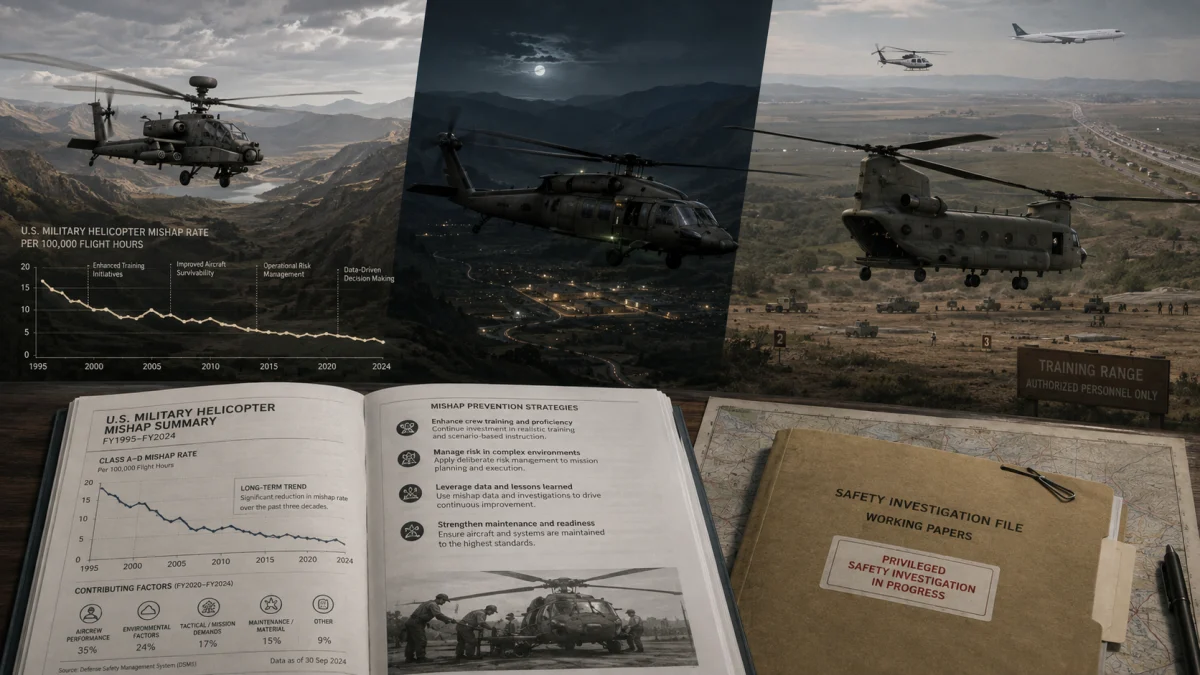
Yes, U.S. military helicopters really do crash during routine training and other noncombat operations—and not just rarely enough to dismiss every incident as a freak accident.
But several very different claims tend to get bundled together when this subject goes viral.
Military helicopters do suffer serious accidents. Some happen on U.S. soil. Training itself can be hazardous. Pilot experience, maintenance, supervision and mechanical failures have all contributed to accidents. The Army has experienced periods when its most serious aviation mishap rate rose sharply.
What the evidence does not establish is that expensive military helicopters are inexplicably falling from the sky because they are poorly built, or that Americans only fail to hear about the accidents because the Pentagon secretly makes the crashes disappear.
The truth is more complicated—and more interesting.
Government records show a persistent military aviation safety problem, dramatic swings between good and bad years, genuine shortcomings in training and accident-data systems, and a deliberate system that keeps portions of military safety investigations confidential.
In other words:
The crashes are real. The suggestion that the crashes themselves are secretly hidden is not supported. But parts of what the military learns about why those crashes happened really can be withheld from the public.
And before comparing any of the numbers, there is one especially important distinction to understand.
A "Class A mishap" does not necessarily mean a helicopter crashed and killed someone
Military aviation statistics use terms that sound more intuitive than they actually are.
The Department of Defense classifies mishaps from Class A downward according to severity. Under the current standard, a Class A mishap includes an event in which:
- government or other property damage totals at least $2.5 million;
- a DoD aircraft is destroyed; or
- someone is killed or suffers permanent total disability.
A Class B mishap generally begins at $600,000 in property damage or can involve permanent partial disability or hospitalization of three or more people.
That means a Class A aviation statistic is not the same thing as a fatal-crash statistic.
A helicopter can have a Class A mishap with no fatalities because it was destroyed or sustained sufficiently expensive damage. Conversely, the word crash is sometimes used loosely for events that military safety officials would categorize more precisely as mishaps.
That distinction matters enormously when comparing military aviation with civilian helicopters, general aviation or commercial airlines.
So how often do U.S. military helicopters actually have accidents?
There is no single public number that cleanly answers "how many U.S. military helicopters crash each year."
The Army, Air Force, Navy and Marine Corps maintain different fleets and safety organizations. Mishaps are broken into different severity classes. Flight hours change from year to year. Combat losses are different from ordinary safety mishaps. And Department of Defense accident data have historically not been standardized as well as one might expect.
But we do have unusually good data for several major military helicopter fleets.
A 2023 Government Accountability Office investigation examined the Apache, Black Hawk, Chinook and Lakota fleets in the Active Army and Army National Guard from fiscal years 2012 through 2021.
GAO counted 720 Class A through D noncombat helicopter mishaps in the Active Army and 273 in the Army National Guard over those ten years.
Those numbers do not mean 993 helicopters were destroyed.
Most were lower-severity mishaps.
For the most serious Class A category, GAO calculated a rate of:
| Component | Class A helicopter mishap rate |
|---|---|
| Active Army | 1.7 per 100,000 flight hours |
| Army National Guard | 0.9 per 100,000 flight hours |
The difference was statistically significant.
When GAO examined the Army and Air National Guard together, it identified 298 noncombat helicopter accidents from FY2012 through FY2021. Approximately 45 were serious accidents, and 28 National Guard personnel died in helicopter accidents during the period.
So there is a real phenomenon underneath the viral discussions.
Military helicopters experience noncombat accidents regularly enough that Congress, GAO and the military’s own safety organizations have repeatedly studied the problem.
The Army can go from a very bad year to a very good one remarkably quickly
Looking only at one dramatic year can create the wrong impression.
Army Aviation had 15 Class A flight mishaps in FY2024, giving it a rate of 1.90 per 100,000 flight hours.
That was the Army’s highest Class A flight-mishap rate since FY2007 and the greatest number of Class A flight mishaps since FY2014. Nine soldiers, one contractor and one U.S. Customs and Border Protection agent died in flight mishaps that year.
Then the numbers changed dramatically.
In FY2025, the Army recorded only five Class A flight mishaps, for a rate of 0.66 per 100,000 flight hours.
The Army described that as the third-best Class A flight-mishap rate in the recorded history of Army Aviation.
That swing is one reason claims such as "military helicopters are always crashing" are too simplistic.
The danger is real.
It is not constant.
Recent Army Class A flight-mishap rates
| Fiscal year | Class A flight mishaps | Rate per 100,000 flight hours |
|---|---|---|
| FY2023 | 9 | 1.08 |
| FY2024 | 15 | 1.90 |
| FY2025 | 5 | 0.66 |
The Army’s five-year average entering FY2025 was approximately 1.00 per 100,000 hours.
And that brings us to an important question.
What does "1.9 mishaps per 100,000 flight hours" actually mean?
Rates per 100,000 hours are excellent for comparing aviation fleets because they adjust for how much those aircraft actually fly.
They are terrible at helping most people visualize risk.
One way to translate them is to ask how many accumulated fleet flight hours correspond statistically to one event.
At the Army’s FY2024 rate of 1.90 Class A mishaps per 100,000 flight hours, that works out to roughly:
one Class A event for every 52,600 accumulated flight hours.
At FY2025’s much lower rate of 0.66:
roughly one for every 151,500 flight hours.
This does not mean an individual helicopter will crash after flying that many hours. It is an aggregate fleet rate. Hundreds or thousands of aircraft contribute flight hours to the denominator.
But it makes the difference between 1.90 and 0.66 easier to grasp.
FY2024 was not merely a year with a few more memorable headlines. The Army experienced serious aviation mishaps at roughly three times the FY2025 rate per hour flown.
The current Apache problem is considerably worse than the Army-wide number
As of September 4, 2026, the most concerning current trend involves the Army’s AH-64 Apache attack helicopter.
Through August 15, five Class A Apache flight mishaps had occurred in FY2026.
Using approximately 80,171 Apache flight hours reported through that date, CNN calculated a Class A rate of about 6.24 mishaps per 100,000 flight hours.
That is approximately:
one Class A event for every 16,000 accumulated Apache flight hours.
FY2024 had been even higher, at approximately 7.02 Class A mishaps per 100,000 Apache flight hours.
That is a genuinely elevated rate.
It is also one reason readers should distinguish the current Apache story from claims about every military helicopter.
The AH-64 has recently performed substantially worse than Army Aviation overall.
The August 2026 Fort Hood Apache crash added urgency
On August 12, 2026, an AH-64E Apache crashed near Salado, Texas, while conducting a maintenance test flight following a 250-hour post-phase inspection.
Two soldiers were killed.
The Army Combat Readiness Center said the accident was the Army’s ninth Class A aviation mishap of FY2026 and above the total reached at the equivalent point the previous year.
Two days later, the Army temporarily suspended Apache training flights nationwide.
The Army said the stand-down would remain in place while it sought a better understanding of the accident’s cause.
Training resumed on August 19 after the Army reviewed flight operations and safety procedures, although the formal accident investigation remained open.
That crash occurred against the backdrop of a separate and potentially serious mechanical issue involving some AH-64E main transmissions.
Internal Army safety information reviewed by Defense One indicated that certain transmissions could suffer an internal failure capable of causing loss of tail-rotor thrust, electrical power and hydraulics.
However, this distinction is critical:
The existence of a transmission defect does not prove that it caused every recent Apache mishap.
Indeed, a U.S. official told Defense One that the transmission problem had been eliminated as a causal factor in the August Fort Hood crash. The Army’s formal investigation into that crash nevertheless remained ongoing.
Army safety reporting also indicated that slightly more than half of FY2026 Apache mishaps across severity classes were primarily attributed to human error, while a catastrophic transmission failure had been identified in at least one Class A mishap.
That is exactly why it is dangerous to reduce military aviation accidents to either "bad pilots" or "bad helicopters."
Real accidents frequently involve combinations of people, machines, training, maintenance, supervision and environment.
How dangerous does this look compared with civilian helicopters?
This is where comparisons can illuminate the numbers—but also where they can become misleading very quickly.
In 2024, the U.S. civilian helicopter industry recorded:
| Civilian helicopter metric | 2024 rate per 100,000 flight hours | Rough accumulated hours per event |
|---|---|---|
| All accidents | 3.05 | ~32,800 |
| Fatal accidents | 0.45 | ~222,000 |
The FAA called 0.45 the industry’s lowest fatal-accident rate in 25 years.
At first glance, someone might compare the civilian 0.45 with the Army’s 1.90 in FY2024 and conclude military flying was more than four times as deadly.
That would be wrong.
The numerator is different.
The 0.45 civilian figure counts fatal accidents.
The 1.90 Army figure counts Class A mishaps, which can qualify because of expensive damage or destruction of the aircraft even if nobody dies.
They are related measures of serious aviation safety outcomes, but they are not measuring the same event.
The more useful conclusion is broader:
Civilian helicopters also experience accidents at measurable rates. Military aviation is not uniquely capable of crashing simply because the aircraft are expensive or advanced. But military crews often operate in substantially more demanding flight environments.
General aviation gives us another useful benchmark
Across U.S. general aviation—not just helicopters—the overall accident rate in 2023 was approximately 3.86 accidents per 100,000 flight hours, while the fatal accident rate was about 0.65 per 100,000 hours.
That corresponds to roughly one fatal general-aviation accident per 154,000 accumulated flight hours.
Again, the definitions differ from the Army’s Class A system.
But the comparison makes an important conceptual point:
A rate around one serious event per 100,000 flight hours is not an absurd number in aviation.
It can represent a fleet that flies enormous numbers of hours while still experiencing a small but meaningful number of catastrophic events.
Commercial airlines exist on an entirely different safety scale
Large scheduled passenger airlines are the wrong comparison for tactical military helicopter flying operationally—but they are useful for showing just how extraordinarily safe modern airline travel has become.
The NTSB calculated that from 2001 through 2017, U.S. Part 121 air carriers had a fatal-accident rate of only 0.006 per 100,000 flight hours.
That is approximately one fatal accident for every 16.3 million flight hours.
So when someone hears that a helicopter fleet suffers one serious mishap per tens of thousands of accumulated flight hours, it can sound alarming compared with their experience flying commercially.
There is a reason.
A passenger jet flying from Los Angeles to New York is generally not practicing low-altitude tactical maneuvering at night, landing in unprepared terrain, flying formation, conducting gunnery, operating close to obstacles or deliberately practicing emergency procedures.
Those are fundamentally different risk environments.
Cars and motorcycles show why the denominator matters
Transportation statistics can become nonsense if their denominators are ignored.
In 2024, 39,254 people died in U.S. traffic crashes, corresponding to 1.19 deaths per 100 million vehicle miles traveled.
That cannot legitimately be placed next to "0.66 mishaps per 100,000 flight hours" and divided to declare one mode a certain number of times safer than another.
One measures fatalities per distance traveled.
The other measures severe mishaps per time flown.
They also count different outcomes.
Within road travel itself, however, the comparison becomes much cleaner. NHTSA reports that in 2024, motorcyclists were almost 27 times as likely to die per vehicle mile traveled as passenger-car occupants.
That is an actual apples-to-apples exposure comparison.
The larger lesson is important:
A big-looking accident count tells you very little without knowing how much exposure produced it.
Ten crashes in a fleet that flies 50,000 hours represents a very different safety problem from ten crashes in a fleet that flies 5 million.
Even within the Army, ordinary road vehicles kill far more soldiers by raw count
There is another useful perspective buried in the Army’s own FY2024 safety report.
Nine soldiers died in Army aviation flight mishaps that fiscal year.
During the same year, 70 soldiers died in off-duty motor-vehicle incidents: 36 involving four-wheeled vehicles and 34 involving motorcycles.
That does not prove driving is seven or eight times riskier than Army aviation. We do not have equivalent exposure denominators in those figures.
But it does show how perception works.
A military helicopter crash that kills several crew members can become national news.
A soldier killed in an ordinary automobile accident rarely does.
Raw media visibility and actual aggregate mortality are not the same thing.
If these helicopters are so advanced, why do they crash at all?
This is probably the most intuitive argument in the viral version:
The military spends enormous amounts of money. Its aircraft contain advanced sensors, redundant systems, powerful engines and sophisticated flight controls. Shouldn’t they stay in the air?
The premise contains a misunderstanding.
Safety technology reduces risk.
It does not repeal physics, human limitations or operational risk.
Military helicopters are designed specifically to perform missions civilian pilots generally try to avoid.
Depending on the aircraft and mission, training can involve low-level terrain flight, night-vision goggles, formation flying, confined landing zones, degraded visual environments, gunnery, sling loads, hoist operations, rapidly changing aircraft configurations and deliberate simulation of emergencies.
The Army’s own mishap-investigation guidance describes accidents as interactions among human beings, machines and environment, and warns investigators against assuming an accident has one simple cause.
A state-of-the-art helicopter flown close to the ground at night is still being flown close to the ground at night.
Better technology improves the odds.
It does not make the activity equivalent to cruising at altitude in a commercial airliner.
"Human error" does not simply mean the pilot screwed up
Government accident reports frequently identify human error as a major factor in military aviation accidents.
That can sound like an easy way to blame dead pilots.
The underlying safety framework is broader than that.
GAO found that Army and Air National Guard noncombat helicopter accidents from FY2012 through FY2021 were predominantly associated with human factors including failure to follow training standards, overconfidence, poor communication and lack of situational awareness.
But military accident analysis also considers organizational deficiencies.
An error in the cockpit may ultimately trace back to inadequate training, weak supervision, unrealistic scheduling, deficient procedures, insufficient maintenance support or a systemic experience gap.
The Army’s investigation handbook specifically directs investigators to look beyond an individual’s active failure and identify system inadequacies elsewhere in the organization and chain of command.
That distinction matters.
"Human error" is not always synonymous with "bad pilot."
Army aviator experience really did decline
One of the more significant findings from the Army’s investigation of its recent safety problems was a decline in pilot experience.
The Army Combat Readiness Center compared active-force aviation records from 2013 and 2023 and found that the average flight experience across the force had declined by approximately 300 hours per aviator over that decade.
The Army cautioned that experience was not identified as a cause in every mishap, but described the overall decline as a hazard that had to be considered.
There was another telling change in the force.
Army safety analysis reported that the ratio of senior to junior aviation warrant officers had shifted substantially—from approximately one senior officer for every four junior officers in 2016 to one for every 8.5 junior officers by September 2022.
The significance is not merely that younger pilots exist.
Experienced pilots also train, mentor, supervise and correct less experienced aviators.
A fleet can possess extraordinary technology while losing some of the human experience needed to use that technology safely under demanding conditions.
The Army found a specific training gap—and the accident rate subsequently fell
FY2024’s spike also produced a particularly revealing finding.
Several accidents involved unexpected right yaw or loss of tail-rotor effectiveness. Data from affected aircraft showed crews had not applied sufficient left pedal to arrest the yaw.
The Army consequently made power management and loss-of-tail-rotor-effectiveness response major subjects of an Army-wide aviation safety stand-up.
The FY2025 annual assessment later credited closing that training gap with helping bring the Class A rate back below 1.0 per 100,000 flight hours.
The rate fell from 1.90 in FY2024 to 0.66 in FY2025.
That does not prove one training change caused the entire improvement.
But it provides powerful evidence against a simplistic narrative that military helicopter accidents are just inevitable mechanical failures in defective aircraft.
Training mattered.
Sometimes the machine really is the problem
The opposite simplification is also wrong.
Military institutions can sometimes lean heavily on the language of human error, but aircraft and components really do fail.
The ongoing AH-64E transmission issue is an obvious example.
Army safety information described a possible internal main-transmission failure capable of disrupting tail-rotor thrust, electrical power and hydraulics—three systems with potentially severe consequences for helicopter control.
And the Army’s FY2025 safety assessment reported that among less severe Class C aviation mishaps, leading events included power-plant failures or malfunctions and system failures or malfunctions.
The correct question is therefore rarely:
Was it the pilot or the machine?
A better accident investigation asks how the entire chain of events interacted.
Are military helicopter crashes hidden from the public?
Not in the way the viral claim implies.
The Army publicly maintains mishap statistics. It publishes annual safety assessments. It releases Preliminary Loss Reports after fatalities. It operates Flightfax, an aviation-safety publication that openly discusses mishap patterns and lessons learned.
Its statistics page explicitly states that Army mishap figures come from the official Army mishap database and formal reports submitted by Army organizations.
The August 2026 Fort Hood Apache accident, for example, was publicly acknowledged by Fort Hood, the Army Combat Readiness Center and Army Public Affairs.
The nationwide Apache training stand-down was publicly announced.
So was the resumption of training flights.
That is difficult to reconcile with the broad suggestion that the public does not hear about military helicopter crashes because their existence is deliberately concealed.
Then why don’t most people hear about them?
Because publicly available and nationally prominent are not the same thing.
A military helicopter mishap can be announced by an installation, recorded by the Army safety system, covered by local media and discussed by defense publications without becoming a major national story.
That happens constantly across government.
A fatal accident involving one military aircraft at a training range may be enormously important to the families and unit involved while receiving relatively little national coverage.
A collision involving a civilian passenger aircraft over a major American city will predictably receive vastly more attention.
That asymmetry does not require a government information operation to explain it.
News organizations make editorial decisions according to scale, novelty, proximity, public consequence and audience interest.
There is also simply too much news for every military training accident to become a national headline.
But this is where the viral claim brushes against something real.
Parts of military crash investigations really are intentionally kept private
The crash may be public.
The military safety investigation is another matter.
Department of Defense Instruction 6055.07 establishes a category known as privileged safety information.
Army Regulation 385-10 similarly protects material produced during safety investigations, including confidential witness information and investigators’ deliberative work.
That can include:
| Investigation material | Treatment |
|---|---|
| Basic fact that an accident occurred | Generally public |
| Aircraft type | Usually public |
| Date and general location | Usually public |
| Casualties | Usually public |
| Basic factual circumstances | Often releasable |
| Raw nonprivileged evidence | Potentially releasable |
| Confidential witness statements | Protected |
| Draft and final safety findings | Privileged |
| Investigators’ causal conclusions | Privileged |
| Safety-board recommendations | Privileged |
| Investigators’ analyses and notes | Privileged |
Army regulations specifically identify draft and final findings, evaluations, opinions, conclusions, accident causes, recommendations and analyses as privileged safety information.
DoD rules say privileged safety information generally may be released only under specified circumstances or with authorization from the Secretary of Defense.
So this statement is substantially accurate:
"The military keeps parts of helicopter accident investigations from the public."
This statement is not established by the evidence:
"The military secretly hides the helicopter crashes themselves."
Those are very different claims.
Why would the military deliberately protect accident information?
There is a legitimate safety rationale.
The military operates a safety-investigation system partly designed to encourage candid testimony.
A pilot, mechanic or commander may be more willing to explain exactly what went wrong if a safety statement cannot later be repurposed automatically for punishment, litigation or career consequences.
That can help investigators identify dangerous practices before another crew dies.
Safety investigations therefore serve a different purpose from legal or disciplinary investigations.
Army rules allow separate legal investigations, particularly after Class A mishaps, while protecting the privileged safety process.
That does not mean the system is beyond criticism.
It means the secrecy has an identifiable institutional purpose other than simply concealing embarrassment.
But there are genuine military aviation transparency problems
Rejecting a sweeping cover-up allegation should not turn into pretending the Pentagon’s accident-data system is perfectly transparent.
It isn’t.
GAO reported in 2018 that military safety centers did not collect standardized information for a significant number of agreed-upon aviation mishap data elements.
It also found disagreement over the sharing of causal information, including human-factor data, which limited the Pentagon’s ability to analyze trends across the services.
Some of that has improved.
GAO says DoD implemented new standardized safety-data procedures in April 2024.
But another recommendation—clarifying Pentagon-level access to and analysis of human-factor causal information—remained open as of August 3, 2026.
There have been more basic data failures as well.
In a later review of Special Operations training accidents, GAO said the Army Combat Readiness Center and Naval Safety Command could not provide accident narratives containing contributing factors for 30 of 73 Class A and B accidents examined because of data-quality problems.
Army officials had previously attributed missing narratives to possibilities including improper data entry, failure to forward final reports and records lost during migration between databases.
That is not evidence of a conspiracy to hide crashes.
It is evidence that the military’s accident-record system has suffered meaningful completeness, standardization and transparency problems.
Both facts can be true at once.
No, the Army is not spending "$1 billion per helicopter"
Another claim sometimes attached to this argument is that the military is purchasing individual helicopters for "billions with a B."
That is not remotely accurate for aircraft such as the Black Hawk.
Army budget documents have recently placed the UH-60M Black Hawk’s gross weapon-system unit cost at roughly $30 million to $33 million, depending on fiscal year and procurement accounting.
In 2022, the Army signed a multiyear agreement expected to provide 120 H-60 Black Hawk helicopters for approximately $2.3 billion.
The entire contract could rise to approximately $4.4 billion if options for additional aircraft were exercised.
That is probably one source of confusion.
A multibillion-dollar helicopter program is not the same thing as a multibillion-dollar helicopter.
Those contracts can include large numbers of aircraft, spare equipment, engines, avionics, logistical support and other program costs.
The helicopters are enormously expensive.
They are not generally billion-dollar individual machines.
Does any of this justify saying "never get in a helicopter"?
No.
The military data cannot support that conclusion.
An Army Apache flying tactical training at low altitude is not a reasonable stand-in for every helicopter operation in America.
Civilian helicopter missions themselves also vary enormously.
A sightseeing flight, offshore transport flight, emergency medical flight, law-enforcement mission and utility flight can involve very different operating environments and risk profiles.
The best available national civilian data show that the U.S. helicopter fatal-accident rate reached 0.45 per 100,000 flight hours in 2024, the lowest recorded in 25 years.
That does not make helicopter flight risk-free.
It does demonstrate why military training crashes cannot simply be extrapolated into a universal warning that people should never board a helicopter.
Putting all the numbers in perspective
Here is the cleanest way to understand the major aviation rates discussed in this article:
| Operation | Measure | Rate per 100,000 flight hours | Rough fleet hours per event |
|---|---|---|---|
| Active Army helicopters, FY2012–21 | Class A mishaps | 1.7 | ~58,800 |
| Army National Guard helicopters, FY2012–21 | Class A mishaps | 0.9 | ~111,000 |
| Army manned aviation, FY2024 | Class A flight mishaps | 1.90 | ~52,600 |
| Army manned aviation, FY2025 | Class A flight mishaps | 0.66 | ~151,500 |
| AH-64 Apache, FY2026 through Aug. 15 | Class A flight mishaps | ~6.24 | ~16,000 |
| U.S. civilian helicopters, 2024 | All accidents | 3.05 | ~32,800 |
| U.S. civilian helicopters, 2024 | Fatal accidents | 0.45 | ~222,000 |
| U.S. general aviation, 2023 | Fatal accidents | 0.65 | ~154,000 |
| U.S. Part 121 airlines, 2001–17 | Fatal accidents | 0.006 | ~16.3 million |
These rows should not be treated as perfectly interchangeable risk measures. Military Class A mishaps, civilian accidents and fatal accidents have different definitions. The table is intended to show scale, not manufacture a mathematically false ranking.
The Apache figure is also a partial-year FY2026 rate calculated from reported flight hours rather than a completed fiscal-year Army statistic.
Claim-by-claim verdict
| Claim | What the evidence shows |
|---|---|
| U.S. military helicopters crash during routine training | True. Serious noncombat accidents occur regularly enough to be a persistent military safety issue. |
| Fatal crashes happen on U.S. soil | True. Numerous documented examples exist, including the August 2026 Fort Hood Apache accident. |
| Only cheap, poorly maintained tour helicopters crash | False. Modern military helicopters also suffer serious accidents. |
| Military helicopters cost around $1 billion each | False. A modern Black Hawk is generally measured in tens of millions of dollars, not billions. |
| Expensive, state-of-the-art helicopters should essentially never crash | Misleading. Advanced technology reduces risk but military crews deliberately conduct hazardous operations and training. |
| Human error causes many military helicopter accidents | Supported, but "human error" includes organizational, training, maintenance and supervisory failures—not merely bad pilots. |
| Mechanical failures also cause military helicopter accidents | True. The current Apache transmission problem is one documented example, although it has not been shown to cause every recent Apache mishap. |
| Military helicopter crashes are secretly concealed from the public | Unsupported. Mishaps and fatalities are routinely recorded and publicly acknowledged. |
| Parts of military safety investigations are intentionally withheld | True. DoD and Army regulations protect substantial categories of safety-investigation information. |
| Military accident records have had serious data-quality problems | True. GAO has repeatedly documented incomplete and inconsistent safety data. |
| Therefore nobody should ever ride in a helicopter | Not supported. Military tactical aviation statistics cannot be generalized to every civilian helicopter operation. |
The bottom line
The viral version gets one important thing right before making several unsupported leaps.
U.S. military helicopters really do suffer serious accidents during training and other noncombat operations. Some occur on American soil. During bad periods, the accident rate can rise substantially. The Army’s own records show genuine problems involving pilot experience, training, supervision, maintenance and mechanical failures.
The current Apache numbers are especially concerning. Through mid-August 2026, its Class A mishap rate was several times the overall Army Aviation rate seen in FY2025.
But none of that establishes that the military is secretly hiding the existence of helicopter crashes.
Those accidents are recorded. Fatal mishaps are announced. Army safety statistics are publicly available. Major incidents routinely receive local, military and sometimes national coverage.
What is deliberately protected is more nuanced: portions of military safety investigations, including confidential testimony, investigators’ causal findings, recommendations and analyses.
And there is a second legitimate transparency problem. Government auditors have repeatedly found deficiencies in the Pentagon’s ability to collect, standardize and preserve aviation-safety information across its enormous bureaucracy.
That leaves us with a conclusion considerably more complicated than either extreme.
Military helicopter crashes are not imaginary freak accidents.
They are not evidence that every helicopter is extraordinarily dangerous.
And there is no evidence that the military secretly erases the crashes from public view.
The more defensible conclusion is that military helicopter aviation combines extraordinarily capable machines with unusually demanding missions, imperfect human organizations and a safety-investigation system deliberately designed to keep some of its most important internal analysis confidential.
The crashes are real. The cover-up claim is not established. And the space between those two statements is where the actual story is.
References and Further Reading
U.S. military helicopter accident data
GAO — National Guard Helicopters: Additional Actions Needed to Prevent Accidents and Improve Safety The strongest broad federal review of Army and Air National Guard helicopter accidents from FY2012 through FY2021, including accident rates, causal factors, deaths and comparisons with the Active Army.
U.S. Army Combat Readiness Center — FY2024 Annual Assessment of the Army Safety Program Primary Army source for FY2024 Class A aviation mishaps, rates, fatalities and aircraft-specific trends.
U.S. Army Combat Readiness Center — FY2025 Annual Assessment of the Army Operational Safety Program Primary source documenting the fall from 15 Class A flight mishaps in FY2024 to five in FY2025 and the Army’s analysis of the training changes involved.
Current 2026 Apache safety issue
U.S. Army Combat Readiness Center — August 2026 Fort Hood Aviation Mishap Preliminary Loss Report Army account of the August 12 maintenance test-flight crash that killed two soldiers and became the ninth Class A Army aviation mishap of FY2026.
U.S. Army — Army Orders Temporary Apache Stand-Down Following Fatal Fort Hood Crash Official announcement suspending AH-64 training operations after the accident.
U.S. Army — Army Resumes AH-64 Apache Flight Training Operations Official August 19 announcement that Apache training flights were resuming while the crash investigation remained open.
Defense One — Army Probes Apache Transmission Problem Reporting based on internal Army safety material describing the AH-64E main-transmission issue and its potential effects on tail-rotor thrust, hydraulics and electrical power.
Military safety investigations and transparency
Department of Defense Instruction 6055.07 — Mishap Notification, Investigation, Reporting, and Record Keeping Primary DoD policy governing mishap investigations and privileged safety information.
U.S. Army Combat Readiness Center — Freedom of Information Act Information for Accident Reports Explains the Combat Readiness Center’s role as the repository and release authority for Army safety accident reports.
GAO — Military Aviation Mishaps: DOD Needs to Improve Its Approach for Collecting and Analyzing Data Documents long-running problems with standardization, causal-factor information and Pentagon-wide aviation-safety analysis. The page also provides current implementation status for GAO’s recommendations.
GAO — Special Operations Forces: Additional Oversight Could Help Mitigate High-Risk Training Accidents Documents missing accident narratives and data-quality problems affecting serious military training-accident analysis.
Civilian aviation comparisons
FAA — Say “Helo” to the U.S. Helicopter Safety Team FAA source for the 2024 U.S. civilian helicopter accident and fatal-accident rates.
FAA — General Aviation Safety Fact Sheet Provides recent general-aviation fatal accident rates and historical context.
NTSB — Survivability of Accidents Involving Part 121 U.S. Air Carrier Operations Provides long-run commercial-airline accident and fatal-accident rates per 100,000 flight hours.
Highway comparison
NHTSA — 2025 Traffic Death Estimates and Final 2024 Fatality Data Official source for 2024 U.S. traffic deaths and fatalities per 100 million vehicle miles traveled.
NHTSA — Motorcycle Safety Provides the per-mile comparison showing motorcyclists were almost 27 times as likely as passenger-car occupants to die in a crash in 2024.
Aircraft cost
U.S. Army — Army Signs Multiyear Production Contract for Black Hawk Helicopters Official Army description of the approximately $2.3 billion agreement for an expected 120 Black Hawks, useful for separating total program contracts from individual aircraft cost.
Editorial currency note: Military mishap statistics and the 2026 AH-64 investigations remain active subjects. FY2026 is not yet complete, and the cause of the August 12, 2026 Fort Hood Apache crash remains under formal investigation as of September 4, 2026. This article should be updated when the Army releases additional findings or final FY2026 aviation statistics.