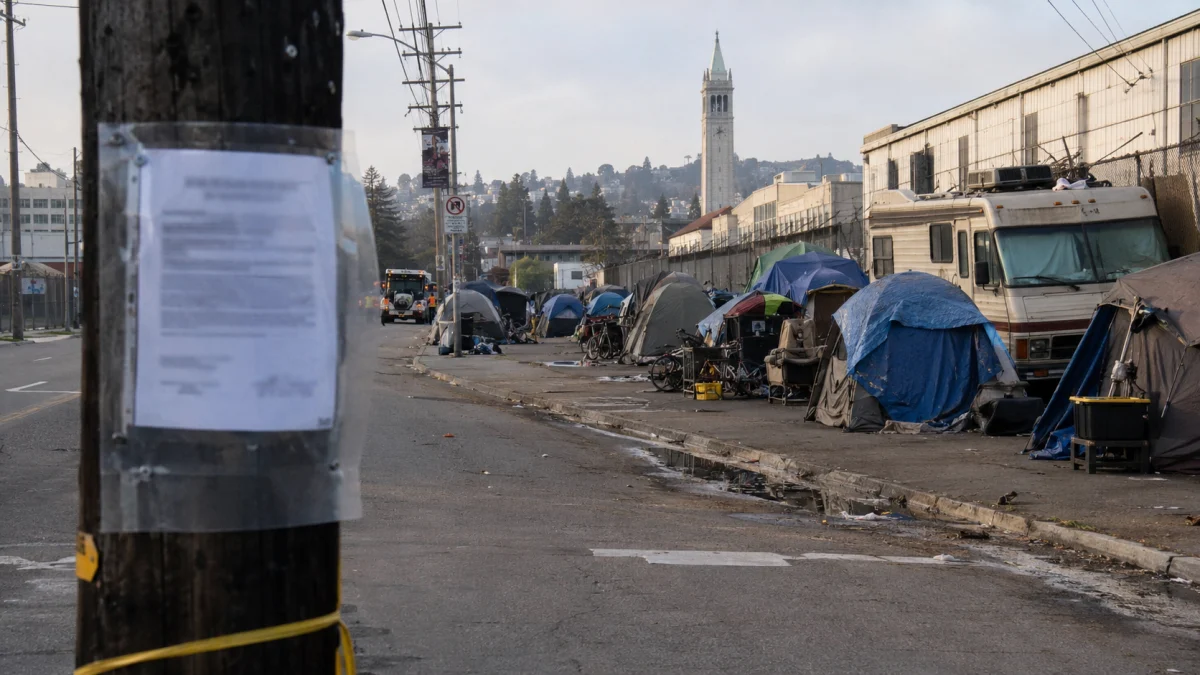
A sprawling homeless encampment around Eighth and Harrison streets in Berkeley went viral in August 2026, prompting an obvious question:
Why isn’t Berkeley simply clearing it?
The short answer is that Berkeley has been trying to.
And, as of August 2026, the city is no longer categorically prohibited from closing the encampment. Berkeley has notified residents that closure is scheduled to begin September 8.
What federal courts have prevented Berkeley from doing is clearing the site without complying with other laws governing disabled residents, notice, tents, vehicles, and personal property.
That distinction matters because of the Supreme Court’s 2024 decision in City of Grants Pass v. Johnson. The ruling was widely understood as freeing Western cities to remove homeless encampments. It did eliminate a major Eighth Amendment barrier to enforcing generally applicable public-camping laws.
But it did not give cities unlimited authority over homeless people or their possessions.
The Berkeley litigation has increasingly been about something Grants Pass did not decide:
What can a government do to a disabled person’s tent, vehicle, and belongings when it clears an encampment, and what accommodations must it make along the way?
The court has also rejected some of the Berkeley Homeless Union’s most sweeping arguments. It has not ruled that residents have a right to remain at Eighth and Harrison indefinitely. It has not ordered Berkeley to provide everyone permanent housing before a sweep. And it has accepted the city’s evidence that conditions at the encampment present a serious public-health problem warranting closure.
That combination explains why the site could remain for so long while the city simultaneously had a legal path to eventually clear it.
And it makes the viral version of the story considerably more complicated than either “Berkeley refuses to enforce the law” or “a judge says homeless people have a right to stay.”
The Viral Video Showed a Real Problem, but Not Its History
ABC7 reporter Lyanne Melendez posted video of the Harrison Street encampment after dropping her son off at UC Berkeley housing in August. The footage rapidly spread online, attracting millions of views and criticism of Berkeley, California, and local homelessness policy.
The encampment itself, however, was not new. Tents and vehicles have occupied portions of the industrial West Berkeley corridor for years.
By late June, a Berkeley survey counted roughly 80 unsheltered residents there. The site has also generated longstanding complaints involving fires, blocked rights-of-way, waste, rodents, and other safety problems. Court records describe complaints from businesses and neighbors involving theft, fires, hazardous debris, fights, and other disturbances.
So the visual conditions that caused the video to spread were not something Berkeley officials had just discovered.
In fact, the documentary record shows that the city had already made a formal decision to target the Harrison corridor nearly two years earlier.
Berkeley Changed Its Policy After Grants Pass — and Specifically Targeted Harrison
This is an important part of the story because it contradicts one of the simplest explanations circulating online.
On September 10, 2024, less than three months after the Supreme Court decided Grants Pass, the Berkeley City Council adopted an updated encampment policy.
Berkeley retained its general preference for offering interim shelter when practicable. But the new policy expressly authorized enforcement even when a shelter offer was not practicable in six categories involving fire hazards, imminent health hazards, public nuisances, dangerous proximity to traffic, authorized city work, and interference with public or utility construction and maintenance.
Then the council went further.
It formally determined that the Harrison Corridor — defined to include Harrison Street between Ninth and Seventh streets and Eighth Street north of Harrison — met all six health-and-safety exceptions and “should therefore be prioritized for enforcement.”
The vote was 8-1.
That happened after Grants Pass.
So whatever explains the continued existence of the encampment, it is difficult to argue from the public record that Berkeley’s government simply ignored the Supreme Court decision or adopted a policy of refusing to clear Harrison.
The city had officially selected it for enforcement.
What happened next was litigation over how that enforcement would occur.
What Grants Pass Actually Decided
The Supreme Court’s holding in City of Grants Pass v. Johnson was narrower than much of the political shorthand surrounding it.
The Court held that enforcing generally applicable laws regulating camping on public property does not constitute cruel and unusual punishment under the Eighth Amendment.
The decision rejected the Ninth Circuit’s earlier Martin v. Boise framework, under which cities faced substantial limits on punishing people for sleeping outside when adequate shelter was unavailable.
That was a significant change.
But it was not a declaration that every method of encampment enforcement is lawful.
The majority itself emphasized that other constitutional doctrines continue to constrain state and local governments, including due process, fair notice, equal protection, and other protections. States and cities also remain subject to ordinary federal statutes.
That distinction is the key to understanding Berkeley.
Grants Pass largely answered this question:
May a city enforce a generally applicable anti-camping law without violating the Eighth Amendment merely because the person being punished is homeless?
It did not decide whether Berkeley may destroy someone’s wheelchair, confiscate an individual’s belongings without notice, tow a vehicle used as shelter without considering disability-related circumstances, or refuse a reasonable accommodation required by the Americans with Disabilities Act.
Those are different legal questions.
And those are much closer to the questions that eventually controlled the Harrison litigation.
Berkeley Ordered the Encampment Closed Before the Lawsuit Stopped It
The city manager ordered a full closure of the Harrison encampment on December 18, 2024.
Berkeley posted notices in January 2025 directing residents to leave by February 10 and warning that the encampment would be permanently closed and vehicles could be towed.
The Berkeley Homeless Union then sued.
On February 14, 2025, a federal judge granted a temporary restraining order stopping the scheduled clearance while the residents’ claims were litigated.
Those claims focused heavily on disabled residents and the ADA.
The plaintiffs argued, among other things, that some residents physically could not pack or move their belongings; that particular tents or vehicles served disability-related needs; that people would lose essential shelter and property during enforcement; and that Berkeley’s normal rules could not simply be applied identically to residents whose disabilities made compliance materially different.
Importantly, those arguments did not depend upon the Eighth Amendment theory the Supreme Court had rejected in Grants Pass.
Then Berkeley Made a Mistake That Strengthened the Case for Judicial Oversight
On June 4, 2025, with a preliminary-injunction hearing only six days away, Berkeley began another abatement operation.
It did so without giving residents fresh notice.
Judge Edward Chen stopped the operation and issued an unusually direct explanatory order the following day.
“This action violated due process,” he wrote.
The January notices were no longer enough, Chen concluded, because litigation had intervened, a previous restraining order had been issued and lifted, and a new hearing was already scheduled.
Residents reasonably expected notice before an operation that could remove them and result in property being taken or destroyed.
That episode is worth emphasizing because it makes the history harder to reduce to “an activist judge repeatedly stopped Berkeley from cleaning up.”
At least one consequential shutdown occurred because Berkeley commenced an abatement without fresh notice under circumstances the judge expressly found violated due process.
That has nothing to do with a constitutional right to camp indefinitely.
It is ordinary procedural due process: before the government takes or destroys property, the affected person generally must receive legally adequate notice and an opportunity to respond.
The Public-Health Problem at Harrison Is Also Real
The other side of the record matters just as much.
The federal court did not conclude that Berkeley invented the health hazards as a pretext to remove homeless residents.
Leptospirosis, a bacterial disease commonly transmitted through urine from infected rats, was identified in rats around the Harrison Street encampments after sick dogs in the area raised alarms.
Berkeley says testing by Alameda County Vector Control confirmed the bacteria in rats trapped there in December 2025.
The city’s public-health guidance says the risk to members of the general public is low, but conditions are different for people living amid rat harborages, standing water, mud, and limited sanitation.
The court examined that dispute in detail.
The Berkeley Homeless Union argued that the city could address the rodent problem through narrower measures rather than clearing the entire encampment. Berkeley submitted public-health evidence arguing that partial measures would not adequately eliminate the risk.
Judge Chen found Berkeley’s evidence persuasive.
He concluded that rats, contaminated soil, standing water, creek drainage, and rodent harborages created a plausible and serious human-health risk and that the city was justified in treating the problem urgently.
The Homeless Union had not presented sufficient competing expert evidence to create a factual dispute over the need for widespread abatement.
The court described full closure as “well-advised if not absolutely required” as a public-health measure.
That is an important finding.
The federal judge who imposed restrictions on Berkeley’s cleanup also agreed that Berkeley had a substantial reason to conduct one.
There is no contradiction there.
A city can have a legitimate — even compelling — reason to close a dangerous encampment while still being constitutionally prohibited from accomplishing that goal through unlawful seizures, inadequate notice, or disability discrimination.
Berkeley Also Spent Money Trying to Move Harrison Residents Indoors
Another simplistic claim does not fit comfortably with the court record: that Berkeley merely left the encampment alone while providing no alternative.
Evidence submitted by the city and summarized by Judge Chen stated that Berkeley spent roughly $5 million on a master lease of the Campus Motel as low-barrier, non-congregate shelter intended for Harrison residents.
According to that evidence, the Harrison corridor accounted for one in five of Berkeley’s shelter offers to encampment residents citywide.
The city represented that every plaintiff then before the court had been offered a Campus Motel unit and declined it. The court noted that the plaintiffs did not dispute that characterization.
That does not establish that every person who has lived at Harrison was offered suitable housing, nor does declining a particular placement waive someone’s constitutional rights.
But it does undermine a blanket description of the case as Berkeley refusing to offer shelter while a court prevented any enforcement.
The court also noted that Berkeley had at various times provided dumpsters, trash pickup, portable toilets, showers, and laundry services.
The dispute increasingly became not whether Berkeley had done anything, but whether the city could lawfully finish the closure.
The April 2026 Ruling Was a Major Win for Both Sides — on Different Questions
Judge Chen’s April 3, 2026 summary-judgment ruling is probably the single most useful document for understanding the case.
It rejected the Berkeley Homeless Union’s broadest theory of relief.
The judge ruled that the ADA did not require Berkeley to postpone the Harrison cleanup indefinitely until every affected resident could be guaranteed non-congregate shelter or housing.
Requiring such a guarantee, the court found, could effectively stop an urgent public-health operation for an indefinite period and fundamentally alter the city’s program.
But Berkeley lost on several narrower questions involving disabled residents.
The court held that aspects of Berkeley’s sidewalk-space enforcement, vehicle practices, refusal to provide physical moving assistance, and property-storage procedures violated the ADA or required additional constitutional safeguards.
That is essentially the entire case in miniature:
The plaintiffs lost the argument that Berkeley must house everyone before clearing Harrison. They won the argument that Berkeley cannot disregard individual disabilities and property rights while doing it.
What Accommodations Did the Court Actually Require?
The permanent injunction entered on August 20 makes the answer unusually concrete.
For Berkeley Homeless Union members whose documented disabilities prevent them from independently packing or moving their belongings during an abatement, Berkeley must provide reasonable physical assistance.
Non-contaminated property covered by the order must be stored for at least 90 days.
Essential survival property — including tents, sleeping equipment, and basic clothing — that cannot safely be handled because it is contaminated and therefore must be destroyed has to be replaced.
Berkeley does not have to require its employees to handle observably wet, muddy, or plausibly contaminated property, and the court specifically recognized the city’s legitimate need to protect workers from leptospirosis exposure.
For tents, the city must consider disability-related needs and the physical dimensions of the location rather than automatically destroying shelter under a rigid space rule.
The injunction treats a six-foot pedestrian path as presumptively reasonable on most sidewalks, while requiring individualized consideration where disability issues arise.
Vehicles used as shelter receive another individualized analysis.
Before towing, impounding, or destroying one belonging to a Berkeley Homeless Union member, Berkeley must identify more than an ordinary parking violation, expired registration, or inoperability.
The city must make a fact-specific finding of an actual traffic obstruction or concrete health or safety threat, give notice and an opportunity to address it, and consider reasonable less-restrictive alternatives.
And before an enforcement action resulting in seizure or destruction of a member’s property, the city must generally provide at least 72 hours’ written notice.
Those are substantial restrictions.
But none creates an absolute right to remain at Eighth and Harrison.
What the Judge Specifically Refused to Order Berkeley to Do
The August 20 permanent injunction is equally revealing for what it denied.
Judge Chen expressly ruled that the ADA does not require Berkeley to wait until non-congregate shelter or permanent housing becomes available before conducting an abatement.
It does not require the city to establish enforcement-free zones.
It does not require Berkeley to create city-sanctioned encampments.
It does not require a citywide map showing unhoused people where they may establish new encampments.
It does not require Berkeley to install individualized sanitation or utilities at relocation sites.
And it does not establish a general 14- or 30-day notice requirement beyond the constitutional notice rules the court imposed.
That makes statements such as “the judge ruled Berkeley has to provide housing before anyone can be removed” incorrect.
He ruled almost the opposite.
The Property Issue Did Not Arise in a Vacuum
A separate but related federal lawsuit, Prado v. City of Berkeley, helps explain why property seizure became such a prominent issue in Chen’s courtroom.
In July 2026, Chen certified portions of a proposed class action challenging Berkeley’s property-handling and disability-accommodation practices.
The court cited data produced by the city showing that, over nearly three years, Berkeley enforcement operations disposed of approximately 959,800 pounds of material across 52 encampment closures, 34 deep-cleaning operations, and 11 RV closures.
During those operations, the city issued only 34 Property Inventory Notices, the formal notices used to document stored belongings and tell owners how to retrieve them.
That number should be interpreted carefully.
It does not mean a federal court found that Berkeley unlawfully destroyed 959,800 pounds of protected personal property.
Some of that material may have been trash, hazardous waste, abandoned debris, or property legally subject to disposal.
But Chen expressly regarded the discrepancy between the enormous volume discarded and the small number of formal storage notices as relevant context for evaluating how Berkeley’s system operated in practice.
That makes the storage requirements in the Harrison case look considerably less arbitrary.
They arose against a documented broader dispute over whether Berkeley’s encampment operations adequately distinguish disposable material from possessions the Constitution protects from unreasonable seizure and destruction.
Why Was the Encampment Still There in August?
After the April ruling, Berkeley and the Homeless Union continued fighting over implementation.
The city said staff had been visiting Harrison regularly, offering equipment, services, and disability accommodations.
A late-June city survey covered 82 residents. According to court records reported by the San Francisco Chronicle, 40 requested tents and 24 requested packing assistance, which Berkeley approved.
Berkeley nevertheless attempted to schedule another full closure for August 3.
On July 30, Judge Chen issued another short temporary restraining order preventing the city from acting under the newly posted closure and fire-hazard notices until an August 13 hearing.
It was a temporary procedural order pending consideration of the Homeless Union’s request for a preliminary injunction, not a final ruling that the encampment could never be closed.
At the August 13 hearing, Chen rejected a longer-term effort to stop the closure.
Instead, he ordered the city and Homeless Union to work through a final relocation problem involving disabled residents who had been approved for accommodations involving larger tent footprints.
The judge directed representatives to inspect potential locations together before an August 27 deadline.
He also made clear that approving an individual location would not create a formal city-sanctioned encampment.
Most importantly, Chen wrote that he expected the Harrison encampment would “in short order, be abated.”
That is difficult to reconcile with the idea that the federal court has decided Harrison must remain.
The August 20 Permanent Injunction Changes the Answer to “Why Can’t Berkeley Clear It?”
On August 20, Chen entered final judgment and converted the relevant protections into a permanent injunction applying to Berkeley Homeless Union members throughout Berkeley.
The ruling simultaneously confirmed both sides of the story.
The Homeless Union had prevailed on ADA and constitutional claims involving tents, vehicles, relocation assistance, storage, and property.
But the court again rejected an indefinite pause, guaranteed non-congregate shelter, enforcement-free zones, and sanctioned encampments.
Berkeley therefore has a lawful path to close Harrison.
On August 25, residents received new notices stating that closure would begin September 8.
The better question is no longer literally “Why can’t Berkeley clear the encampment?”
It is:
Why did clearing it take so long, and what must Berkeley do differently when it finally does?
The answer is now in the court orders.
Did Grants Pass Fail to Give Berkeley the Power People Thought It Did?
Not exactly.
Grants Pass did what the Supreme Court said it did: it eliminated an Eighth Amendment rule that had substantially restricted local enforcement of generally applicable camping laws when adequate shelter was unavailable.
That is a major governmental power.
But “cities may enforce camping laws” and “cities may dispose of people’s shelter and property however they choose” are completely different propositions.
Berkeley’s case illustrates the difference unusually well.
The Supreme Court removed one constitutional obstacle.
Berkeley then encountered others.
The Americans with Disabilities Act still exists.
The Fourth Amendment still constrains unreasonable government seizures.
The Fourteenth Amendment still requires due process.
And a person’s inability to claim an Eighth Amendment right to camp at a particular location does not transform every object the person owns into garbage the government may summarily destroy.
Nothing in Grants Pass says otherwise.
So Who Is Actually Right About the Viral Encampment?
“Berkeley refuses to clear the camp.”
The record does not support that as a complete explanation.
Berkeley formally prioritized Harrison for enforcement in September 2024, ordered a full closure that December, posted notices in January 2025, and has repeatedly returned to court seeking to conduct the abatement.
“An activist judge ruled homeless residents can’t be removed.”
Also misleading.
Chen has expressly rejected an indefinite moratorium and a housing-before-enforcement requirement, accepted Berkeley’s public-health case for closure, and stated that Harrison should be abated “in short order.”
“The Supreme Court already ruled cities can clear homeless camps.”
Substantially true as a description of the Eighth Amendment issue, but incomplete as a description of municipal power.
Grants Pass did not erase the ADA, due process, or constitutional property protections.
“Disabled residents have a legal right to remain at Eighth and Harrison.”
That is not what the final judgment says.
They have rights to qualifying accommodations and protections during enforcement. Those rights do not amount to an indefinite entitlement to occupy Harrison.
“Berkeley exaggerated the health emergency just to remove them.”
The Homeless Union has disputed aspects of the city’s characterization, but the evidentiary record currently cuts strongly against dismissing the health problem as fabricated.
The federal court found the leptospirosis and environmental evidence serious and found Berkeley justified in pursuing a broad abatement.
Those distinctions are where most short explanations of this controversy break down.
What Happens on September 8?
Under the current posture of the case, Berkeley can proceed with closing the Harrison encampment, but it must operate within the permanent injunction.
That means providing required notice, following the court’s individualized procedures for certain tents and vehicles, accommodating qualifying disabilities, helping residents who cannot physically move their belongings, storing qualifying property, and replacing certain essential survival items that must be destroyed because they cannot safely be handled.
The Berkeley Homeless Union can return to court if it believes the city violates those requirements.
That possibility does not itself suspend the closure or establish a permanent right to stay.
There is one immediate reason this article may require an update: Judge Chen has scheduled a status conference for 9:00 a.m. Pacific on August 28, less than two weeks before the announced closure date.
Unless that or a later court action changes the situation, September 8 will be the first major test of whether Berkeley can finally do what the court has repeatedly said it may do:
Close the encampment without ignoring the rights of the people being displaced.
The Bottom Line
The viral images from Eighth and Harrison make Berkeley look inexplicably powerless.
It isn’t.
The city has had substantial authority to regulate and ultimately remove the encampment, particularly after Grants Pass. It also has strong evidence of genuine fire, sanitation, and public-health problems at Harrison.
What Berkeley did not receive from the Supreme Court was immunity from every other constitutional and federal law governing enforcement.
That is why the best way to understand the Harrison case is not as a battle over whether homelessness is legal.
It is a battle over how government may exercise its unquestionably real enforcement power once disabled people, shelters, vehicles, and personal property are involved.
Berkeley can clear Eighth and Harrison.
The year-and-a-half court fight has largely been about the conditions under which it is allowed to do so.
References and Further Reading
Primary Court Records
U.S. Supreme Court — City of Grants Pass v. Johnson (2024) — The controlling Supreme Court opinion. Its actual holding concerns the Eighth Amendment and enforcement of generally applicable public-camping laws; it does not eliminate other constitutional or statutory protections.
U.S. District Court — Berkeley Homeless Union v. City of Berkeley, April 3, 2026 Summary Judgment Order — The central merits ruling addressing ADA accommodations, leptospirosis, shelter requests, vehicles, tents, moving assistance, property storage, and constitutional claims.
U.S. District Court — June 5, 2025 Explanatory Order Ceasing Abatement — Judge Chen’s explanation for stopping Berkeley’s June 4 operation after finding that proceeding without fresh notice violated due process.
U.S. District Court — July 30, 2026 Temporary Restraining Order — Temporarily stopped closure under Berkeley’s July notices pending the August preliminary-injunction hearing.
U.S. District Court — August 20, 2026 Final Judgment and Permanent Injunction — The most important current order. It defines what Berkeley must do during enforcement and, equally importantly, what the city is not required to provide.
U.S. District Court — Prado v. City of Berkeley, July 14, 2026 Class-Certification Order — Related litigation containing city-produced data about property disposal, storage notices, and Berkeley’s broader encampment-enforcement framework.
Berkeley Policy and Public-Health Records
City of Berkeley — September 10, 2024 Encampment Policy and Council Action — Berkeley’s post-Grants Pass policy establishing health-and-safety exceptions to its shelter-offer practice.
City of Berkeley — September 10, 2024 Annotated Council Agenda — Records the council’s 8-1 determination that the Harrison corridor met all six listed health-and-safety exceptions and should be prioritized for enforcement.
City of Berkeley Public Health — Leptospirosis Information — City public-health information on rat testing, transmission, precautions, and the Harrison-area investigation.
Current Reporting and Chronology
KALW — Berkeley Homeless Union Wins Permanent Protections for Its Members — Confirms the August 25 posting of notices announcing a September 8 closure and summarizes the final injunction.
Berkeley Scanner — City Must Hit the Streets to Find Homeless Tent Sites, Judge Says — Detailed contemporaneous reporting from the August 13 hearing, including Chen’s refusal to continue blocking closure and the final relocation-site process.
San Francisco Chronicle — This Bay Area Encampment Went Viral for Its Size. Here’s Why Cleanup Efforts Dragged On — Current reporting on the viral video, approximate camp population, and residents’ experiences as closure approaches.
ABC7 — Viral Video Sparks New Debate Over Berkeley Homeless Encampment — The viral-news context that drove renewed national attention to Eighth and Harrison.
Editorial currency note: This article reflects the federal docket and publicly available reporting through late August 27, 2026. A federal status conference is scheduled for August 28 at 9:00 a.m. Pacific, and Berkeley’s presently announced closure date is September 8, 2026. Either could produce developments requiring an update.