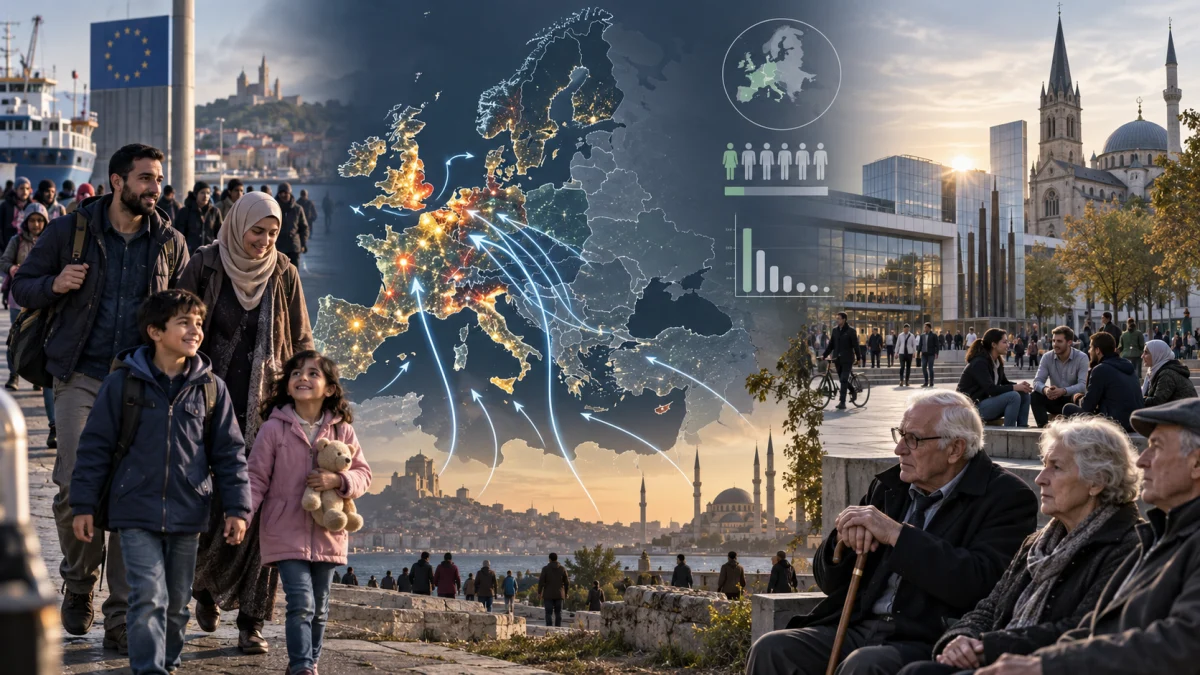
Europe’s Muslim population is growing, but the available demographic evidence does not show Muslims “taking over Europe” in the sense of approaching a continental majority or controlling European society.
The change itself is real. Muslims have increased as a share of Europe’s population. Immigration has been an important driver. European Muslims are substantially younger than Europeans overall, and Muslim fertility has historically been higher in many countries. Religious identity also appears to remain relatively durable in some European Muslim populations. And because Muslims are concentrated unevenly, demographic change is much more visible in some cities and neighborhoods than a Europe-wide average suggests.
But several different phenomena are routinely collapsed into the phrase “Muslim takeover”: population growth, immigration, religious observance, cultural influence, political power and eventual numerical majority. They are not the same thing.
Pew Research Center’s latest harmonized estimate places about 46 million Muslims in its European region in 2020, roughly 6% of the population. That was up from about 5.3% in 2010. During the same decade, however, Christianity’s share fell by about eight percentage points while the religiously unaffiliated share rose by seven. Muslim growth was real, but Europe’s much larger religious transformation was secularization.
The long-term future is less certain. Pew’s famous 2017 study produced Muslim shares of 7.4%, 11.2% and 14% in 2050 under three different migration scenarios. None approached a Muslim majority. But those figures are scenarios from an older study using a different definition of Europe, not current 2026 forecasts. Pew now explicitly says updated projections beyond 2020 are not yet available.
That leaves a more nuanced conclusion than either “nothing is happening” or “Europe is becoming Muslim.”
Europe is undergoing significant and uneven demographic and religious change. What that change ultimately produces depends on migration, fertility, age structure, religious retention, intermarriage, secularization, government policy and events that have not happened yet.
What Does “Muslims Taking Over Europe” Actually Mean?
“Taking over” is not a demographic category, so the claim has to be separated into propositions that can actually be tested.
| Claim | What the evidence supports |
|---|---|
| Muslims are becoming a larger share of Europe | Yes |
| Immigration is an important reason | Yes |
| Muslims have a younger age structure | Yes |
| Muslim fertility has been higher in many European populations | Yes, but the gap varies and changes over time |
| Some European cities and neighborhoods are changing much faster than Europe overall | Yes |
| Muslim religious identity necessarily disappears after a generation or two | No |
| Muslims are on course to become a majority of Europe by 2050 | Not supported |
| Christianity’s decline is mainly the result of people becoming Muslim | No |
| A growing Muslim population automatically means Muslim political control | No |
| European culture and institutions can be affected by Muslim population growth | Yes, but that is different from demographic or political takeover |
That distinction matters because a person can make a correct observation—such as “the Muslim population is growing”—and then attach a conclusion that the observation does not establish.
How Many Muslims Actually Live in Europe?
The best current cross-European estimate is not really a 2026 number.
Pew’s most recent global religious-demography project, published in 2025, reconstructs the population as of 2020. It estimates approximately 46 million Muslims among 753 million people in Europe, or around 6%.
The Muslim population increased by about 16% in absolute numbers from 2010 to 2020, while its share of Europe’s population rose by about 0.7 percentage points.
That distinction between the date of publication and the date being measured is important.
There is no authoritative census conducted simultaneously across Europe that can tell us, to a decimal point, “Europe is X% Muslim in September 2026.” Different countries collect religious information differently, some do not ask about religion in their censuses at all, and harmonized international estimates necessarily lag behind the present.
Even “Europe” does not always mean the same thing
Another source of confusion is that major demographic studies use different geographic definitions.
Pew’s 2025 report defines Europe as 42 countries and territories, including Russia, Albania, Bosnia-Herzegovina, Kosovo and other Balkan states. It places Turkey and Cyprus in its Asia-Pacific region for that particular global classification.
Its famous 2017 Muslim projection study used something else entirely: the then-28 members of the European Union plus Norway and Switzerland. That included the United Kingdom and Cyprus but excluded Russia, Albania, Bosnia-Herzegovina, Kosovo and several other European states.
So these two statements:
“Europe was 6% Muslim in 2020.”
and
“Europe could be 14% Muslim in 2050.”
do not describe the same geographic population.
That does not make either statistic wrong. It makes comparing them without explaining the denominator misleading.
“Muslim” Also Does Not Mean “Immigrant”
Several categories commonly used in this debate are treated as though they were interchangeable when they are not.
| Term | What it measures |
|---|---|
| Muslim | Religious identity or affiliation |
| Immigrant | Migration history |
| Foreign-born | Place of birth |
| Non-EU citizen | Citizenship |
| Arab | Ethnic, cultural or linguistic identity |
| Middle Eastern or North African | Geographic ancestry or origin |
| Refugee or asylum seeker | A legal or protection category |
Europe contains Muslim populations that predate modern immigration by centuries, particularly in the Balkans and parts of Eastern Europe.
A European-born child of Pakistani Muslim parents is not an immigrant. An immigrant from India, Ukraine, China or Brazil is not necessarily Muslim. A Bosniak Muslim whose family has lived in Europe for generations cannot sensibly be described as evidence of recent Muslim immigration.
Eurostat illustrates the scale of the category problem. On January 1, 2025, 46.7 million EU residents had been born outside the EU, while another 18 million had been born in a different EU country. Those are migration statistics, not religious statistics.
Why Is Europe’s Muslim Population Growing?
At its simplest, the number of Muslims changes through the same demographic mechanisms as any other population:
Muslim population change = births − deaths + immigration − emigration + religious switching
And Muslim share depends on another variable:
Muslim share of Europe = Muslim population ÷ total European population
That denominator matters. A minority group’s percentage can increase because the group is growing, because the rest of the population is shrinking, or because both processes are occurring simultaneously.
Immigration has been a major driver
Pew’s latest reconstruction says migration was a major contributor to Muslim growth in Europe from 2010 to 2020. The region’s Muslim population increased by about 6.2 million, including an estimated 3.5 million Muslims born outside Europe; nearly 1 million came from Syria.
The older 2017 study was able to decompose an earlier period more explicitly.
Between mid-2010 and mid-2016 in its EU-plus-Norway-and-Switzerland region, Pew estimated that Muslim population growth reflected about:
| Component | Estimated effect |
|---|---|
| Net migration | +3.5 million |
| Births minus deaths | +2.9 million |
| Net religious switching | −160,000 |
About 60% of the increase in that period therefore came from net migration.
The switching estimate deserves more caution than the migration and natural-increase figures. Pew acknowledged that surveys in many countries contained too few people raised Muslim to estimate switching out of Islam reliably, and its Western European modeling relied partly on better French data as a proxy.
The broad conclusion is nevertheless clear: migration and natural increase have mattered much more to recent Muslim population growth than conversion.
Most Muslim migration was not refugee migration
The refugee crisis dominates the political image of Muslim migration to Europe, but even during the exceptional 2010–2016 period most Muslim arrivals in Pew’s analysis were not refugees.
Pew estimated that about two-thirds of Muslim migrants arriving during that period were regular migrants rather than refugees. Overall, approximately 46% of regular migrants were Muslim, compared with 78% of those who received or were expected to receive refugee status.
People came for employment, study, family reunification and other reasons in addition to asylum.
Nor were all migrants Muslim. Pew estimated that about 47% of all migrants arriving in its study region during that period were non-Muslim.
Migration also changes over time
This is why long-term projections are so difficult.
The extraordinary Syrian refugee movement of the mid-2010s did not simply continue unchanged forever. EU+ countries recorded about 822,000 asylum applications in 2025, 19% fewer than in 2024 and the lowest total since 2021. Syrian applications fell particularly sharply, from roughly 151,000 in 2024 to 42,000 in 2025.
At the same time, Europe continues to experience large migration flows for completely different reasons. By early 2026, around 4.5 million people displaced from Ukraine were benefiting from temporary protection in the EU.
The lesson is not that migration is ending. It is that “future migration” is not one stable number or one stable religious composition.
Wars end. New wars begin. Governments change rules. Labor shortages change. Countries of origin change. Migrants return home or move elsewhere.
A projection that assumes one unusual migration period continues for decades can therefore be useful as a stress test without being a likely forecast.
Are Muslim Birth Rates Really Higher?
This claim has a factual basis, but it is often presented badly.
In Pew’s 2015–2020 modeling assumptions for its 30-country European study, the estimated total fertility rate was approximately 2.6 children per Muslim woman and 1.6 per non-Muslim woman.
That was a large difference: about one additional child per woman.
But three qualifications are essential.
First, those numbers describe a modeling period that began more than a decade ago. They should not be presented as measured 2026 European fertility rates.
Second, the gap was never uniform across Europe. Pew estimated much smaller Muslim/non-Muslim fertility differences in countries such as Germany and little difference in Bulgaria and Greece, while other countries had larger gaps.
Third, fertility among immigrant-origin populations changes.
Fertility does not remain frozen from generation to generation
Research on immigrant fertility across Europe repeatedly finds heterogeneity, not one universal trajectory.
A 2019 review in Demographic Research found that some descendants of immigrants had fertility similar to the native-born comparison population, some lower and some substantially higher.
A 2025 UK study reached a similarly complicated conclusion. Pakistani and Bangladeshi women who had migrated to Britain as children showed elevated fertility across birth orders, while patterns among later-generation groups differed substantially by ancestry and generation. The authors found no single convergence pattern across all groups.
So two simplistic claims should both be rejected.
It is not sound to assume that a Muslim/non-Muslim fertility difference observed in one period will compound unchanged for the next 75 or 150 years.
But it is also not sound to assume that every fertility difference automatically disappears within one generation.
The evidence supports partial and uneven adaptation, shaped by origin, education, socioeconomic circumstances, marriage patterns, generation and destination country.
Age Structure May Matter as Much as Fertility
One of the most important demographic facts in this debate receives surprisingly little attention.
Europe’s Muslims are younger.
In Pew’s 2020 broad-Europe estimate, the median Muslim was about 34 years old, compared with 42 for Europe overall and 45 for Christians.
That produces what demographers call population momentum.
Imagine two populations with exactly the same fertility rate. One has a large share of adults aged 20 to 35. The other has many more people over 65.
Even with identical fertility, the younger population will usually produce more births and experience fewer deaths in the near term simply because more of its members are entering the stages of life when children are born.
Pew explicitly found this effect in its earlier European projections: the Muslim population would have continued increasing as a share of the population even under a hypothetical scenario in which future migration stopped completely.
This also explains why “fertility is converging” does not mean “the Muslim share will immediately stop rising.”
Europe’s Aging Population Changes the Denominator
Europe’s broader demographic trajectory matters too.
Eurostat’s latest EUROPOP2025 baseline projects the EU population—not all of geographic Europe—to rise slightly from about 451.8 million in 2025 to a peak around 453.3 million in 2029, then fall to roughly 445 million in 2050 and 398.8 million by 2100.
Those are themselves “what-if” projections based on assumptions about fertility, mortality and migration, not guarantees.
But they demonstrate an important mathematical point.
If one population is relatively young and another is old enough that deaths exceed births, the younger population can gain percentage share without anything resembling exponential population growth.
That is why a rising Muslim percentage cannot be interpreted from the numerator alone.
Will Muslims Become a Majority of Europe by 2050?
There is no credible demographic basis in the major projection work examined here for saying Muslims are on course to become a majority of Europe by 2050.
The most famous analysis is Pew Research Center’s 2017 Europe’s Growing Muslim Population study.
It began with an estimated 25.8 million Muslims, or 4.9%, in the EU’s then-28 countries plus Norway and Switzerland in mid-2016.
Pew then modeled three scenarios.
| Scenario | Assumption | Muslim share in 2050 |
|---|---|---|
| Zero migration | All future migration into the region stops | 7.4% |
| Medium migration | Regular migration continues; refugee flows stop | 11.2% |
| High migration | Regular migration continues and the extraordinary 2014–2016 refugee flow continues indefinitely | 14.0% |
Even the highest scenario left Muslims at roughly one person in seven.
And Pew was explicit about what the exercise meant: the scenarios were not attempts to predict exactly what would happen. The high scenario deliberately extended historically unusual refugee flows indefinitely to show what that assumption would produce.
By the time the report was published, Pew noted that those refugee flows had already begun declining.
These are not the latest 2050 forecasts
This is an important correction to countless articles and social-media posts.
Pew revised its underlying 2010 religious estimates when it published its much larger 2025 demographic reconstruction. It now warns readers that its earlier long-range projections use baseline estimates that have since changed.
Its current note states that new projections past 2020 are not yet available.
So it is inaccurate in 2026 to write:
“Pew predicts Europe will be 14% Muslim in 2050.”
The accurate formulation is:
Pew’s 2017 high-migration scenario produced a 14% Muslim share in 2050 for the EU-28 plus Norway and Switzerland, under assumptions that included continuing the exceptional 2014–2016 refugee flow indefinitely.
That sounds less dramatic because it is more precise.
Could Europe Become Muslim-Majority Eventually?
Over an unlimited timescale, demographic evidence cannot honestly provide a categorical answer.
There is a major difference between saying:
“Current evidence does not show Europe approaching a Muslim majority.”
and:
“Europe can never become majority Muslim.”
The first is supported. The second would require knowing future migration, birth rates, religious retention, secularization, intermarriage, wars, economic conditions and government policy across generations.
We do not.
The further a projection extends into the future, the more assumptions it contains.
A distant religious-demography projection effectively depends on something like:
future Muslim population = current population + future births − future deaths + future immigration − future emigration + future religious switching
And each term depends on other uncertain variables.
Migration depends on law, economic demand, conflicts and politics.
Fertility changes across generations.
Religious identity can strengthen, weaken or change.
Intermarriage can alter religious transmission.
Destination societies themselves change.
Even Europe’s total population is uncertain decades into the future.
Specific claims that a particular European country will become Muslim-majority in 2085, 2125 or 2200 should therefore be read primarily as conditional model outputs: if the assumptions continue, the equation produces the date.
They are not observations from the future.
Why Does “6% Muslim” Look Wrong in Some European Cities?
Because continental averages conceal enormous local variation.
England and Wales provide unusually good census data.
In the 2021 census, Muslims represented 6.5% of England and Wales.
In London, they represented 15.0%.
In Tower Hamlets, the Muslim share was 39.9%. Blackburn with Darwen was 35.0%, and Newham was 34.8%.
All of those numbers can be true simultaneously.
Someone living in a part of London where one-third or more of residents identify as Muslim is observing a demographic environment that looks nothing like the European average.
It would be misleading to answer that person’s observation merely by saying, “Europe is only 6% Muslim.”
But the reverse mistake is just as serious.
A neighborhood that is 40% Muslim does not mean its country is 40% Muslim, much less that Europe is.
A continental average should not be used to dismiss rapid local demographic change. A rapidly changing neighborhood should not be used to describe an entire continent.
Age distribution can amplify that perception further. Because Muslim populations are younger, their share among school-age children, young parents or certain working-age populations can exceed their share of the total population.
Is Islam Replacing Christianity in Europe?
Christian affiliation is declining dramatically in much of Europe. Muslim affiliation is increasing. But the evidence does not show that Muslims account for most of Christianity’s decline.
Pew’s broad European estimates make the arithmetic unusually clear.
Between 2010 and 2020:
| Religious group | Change |
|---|---|
| Christians | Down about 8 percentage points, to 67% |
| Religiously unaffiliated | Up about 7 points, to 25% |
| Muslims | Up about 0.7 points, to 6% |
The dominant religious shift was from Christian affiliation toward no religious affiliation.
England and Wales show the same pattern even more clearly.
From 2011 to 2021, Christianity fell from 59.3% to 46.2%. “No religion” rose from 25.2% to 37.2%. Islam rose from 4.9% to 6.5%.
Islam gained 1.6 percentage points while Christianity lost 13.1.
So it is reasonable to say both that Christian Europe is becoming substantially less Christian and that Muslims are becoming a larger minority.
It is not reasonable to infer from those simultaneous trends that Islam is responsible for most of Christianity’s decline.
The numbers point overwhelmingly toward secularization.
Will European Muslims Eventually Become Secular Too?
There is evidence of secularization among some Muslim populations, but the assumption that later generations inevitably converge to the very low religiosity of secular Europeans is too simple.
France offers a striking example.
In the 2019–2020 Trajectories and Origins survey covering adults aged 18 to 59 in metropolitan France, 91% of people raised in Muslim families still identified with their parents’ religion. The corresponding retention figure was 67% among people raised Catholic.
That is France, not Europe as a whole, and it measures affiliation rather than every dimension of religious practice. But it demonstrates that Muslim identity can remain highly persistent in a strongly secular society.
A 2023 study using European Social Survey data from 15 Western European countries also found a more complicated pattern than simple secular assimilation. While native populations became less religious overall from 2002 to 2018, the researchers found increasing religiosity on several measures among both first- and second-generation Muslims, which they described as some evidence of religious revival.
Other research has found decline in some Muslim populations and dimensions of religiosity.
The defensible conclusion is therefore not that European Muslims will remain permanently as religious as today’s first generation, nor that Islam inevitably disappears through assimilation.
Religious transmission among European Muslims appears comparatively strong, but it varies by country, generation, education, family structure, social environment and how religiosity is measured.
Religious Identity Is Not the Same as Religious Practice
Demographic datasets usually classify religion by identity or affiliation.
That does not tell us whether someone attends a mosque, prays regularly, supports conservative religious doctrine, favors secular government or considers religion central to daily life.
Germany illustrates the difference.
A major German Federal Office for Migration and Refugees study estimated 5.3 million to 5.6 million Muslims with migration backgrounds from predominantly Muslim countries in 2019, equal to approximately 6.4% to 6.7% of Germany’s population. Among surveyed Muslims, 82% described themselves as very or somewhat religious.
At the same time, the same study found substantial indicators of ordinary social integration: 79% rated their German-language ability as good or very good, rising to 93% among German-born Muslims, and 65% reported frequent friendships with people without migration backgrounds. The researchers concluded that religion’s independent role in the integration differences they studied was often overstated.
A person can therefore remain Muslim—and even strongly religious—while simultaneously being linguistically, economically or socially integrated.
“Integration” Is Not One Thing
Arguments over whether Muslims are “integrating into Europe” often fail because different people mean completely different things by integration.
Language proficiency is one measure.
Employment is another.
Educational achievement, residential segregation, friendship networks, intermarriage, religious practice, identification with the country, views on sexuality, family roles, democratic institutions and gender equality are all separate dimensions.
They do not have to move together.
Research on Muslim migrants’ gender attitudes provides a useful example. A study of more than 4,000 Muslim migrants in six Western European countries found different trajectories depending on what value was being measured. Support for women’s equality in the public sphere and for sexual liberalization increased over time and generations, while attitudes toward family-role divisions followed a different pattern. Greater religiosity also related differently to different categories of values.
That makes broad claims like “Muslims have integrated” or “Muslims refuse to integrate” analytically weak.
Integration can advance in one dimension while religious or cultural differences remain strong in another.
Does Muslim Population Growth Mean European Culture Will Change?
To some extent, of course it can.
A larger population naturally becomes more visible.
Mosques, halal businesses, Islamic schools, religious clothing, Ramadan observance, burial practices and Muslim civic organizations have become more prominent parts of public life in many European countries.
Political and legal disputes have followed over matters including religious accommodation, headscarves, education, mosque construction and the relationship between Muslim organizations and the state.
Research reviewing Western European integration finds real changes in institutional arrangements as Muslim communities seek recognition and European legal systems decide how existing religious-freedom and anti-discrimination principles apply to Islam.
Calling all of that imaginary would be wrong.
Calling all of it a “takeover” would also be wrong.
Countries routinely change culturally as their populations change. The presence of Catholic, Jewish, Protestant, Orthodox, Hindu, Sikh and secular populations has also shaped European societies at different times and places.
The important questions are more specific: Which practices are changing? How widespread are they? Are accommodations voluntary or legally required? Are constitutional rules changing? What do Muslims themselves believe?
Those questions require their own evidence.
Does Muslim Population Growth Mean Muslim Political Control?
Population growth can increase political influence.
That is a reasonable inference.
A larger group can contain more voters, produce more candidates, support more institutions and matter more to political parties. Geographic concentration means a minority can also become electorally significant in particular municipalities or parliamentary constituencies while remaining a relatively small share nationally.
But population share alone cannot tell us how much political power a group has.
It does not reveal citizenship, voting eligibility, turnout, party preference, political organization or ideological agreement.
Most importantly, “Muslim” is a religious identity, not a political party.
European Muslims differ by ancestry, class, generation, religiosity, denomination, education and political ideology. Sunnis, Shiites, Alevis, secular Muslims, converts, Bosniaks, Albanians, Turks, Arabs, Pakistanis, Bangladeshis, Africans and European-born descendants of immigrants cannot be converted into one political actor simply by adding them together in a demographic table.
Nor does a Muslim voter supporting an ordinary European party constitute evidence of an effort to establish an Islamic state.
A claim of an actual political “takeover” would require evidence of control over governing institutions or displacement of the existing constitutional order—not simply a rising minority population.
What About Political Islam and Extremism?
This question should not be hidden inside population statistics.
Islamist political movements and violent jihadist organizations exist. European governments monitor, prosecute and sometimes ban organizations or individuals they regard as extremist or threatening to constitutional order.
But that establishes the existence of extremist currents, not that European Muslims collectively support them.
The same evidentiary rule applies in the opposite direction: demographic statistics cannot prove that political Islam is harmless either.
The size, ideology, organizational capacity and public support of a political movement must be measured directly.
Demography can tell us how many people identify as Muslim. It cannot tell us what those people politically believe.
Discrimination and Social Backlash Are Also Part of the System
Integration does not occur in a laboratory.
The EU Agency for Fundamental Rights surveyed 9,604 self-identified Muslims across 13 EU countries and reported in 2024 that 47% said they had experienced racial discrimination during the preceding five years. The survey covered specific Muslim immigrant and descendant populations and should not be treated as a census of every European Muslim, but it demonstrates that exclusion is not a trivial variable.
Social science literature suggests that minority identity is shaped not only by what families transmit internally but by how majority societies respond to the minority.
That creates a plausible feedback mechanism:
demographic growth → greater visibility → political reaction or discrimination → stronger minority identification in some people → stronger perception of separateness → further political polarization
That is a possible social mechanism, not an inevitable cycle and not proof that discrimination causes extremism.
But it shows why demographic integration cannot be understood purely by asking what immigrants and their descendants do. The receiving society also influences the outcome.
Which Concerns About Europe’s Muslim Population Are Supported by Evidence?
Several concerns or observations frequently associated with this debate have a legitimate factual basis.
Muslim population growth is real. It is measurable across Europe.
Immigration can materially alter religious composition. Recent European history demonstrates that clearly.
Higher fertility and a younger population can continue increasing Muslim population share even without large future migration.
Muslim religious identity can persist strongly across generations. The evidence does not support assuming automatic secularization.
Some municipalities are undergoing much larger demographic changes than national averages reveal.
Population growth can increase cultural and political influence without requiring a national majority.
Meaningful value differences can persist in some areas even while other measures of integration improve.
None of those propositions requires denying the evidence.
But several much stronger claims do not follow:
| Stronger claim | Problem |
|---|---|
| Europe is close to becoming Muslim-majority | Current data do not show this |
| Europe will be Muslim-majority by 2050 | Major Pew scenarios did not approach it |
| All or most immigrants are Muslims | False category equivalence |
| Muslim growth explains Christianity’s collapse | Secularization is far larger |
| Muslim identity tells us someone’s political ideology | It does not |
| Today’s fertility difference can be projected unchanged for a century | Demographically unsound |
| One high-Muslim city represents Europe | Geographic extrapolation |
| A continental average disproves major local change | Equally misleading |
What Would Have to Happen for Europe to Become Muslim-Majority?
This is ultimately an arithmetic question before it is a political one.
Starting from a minority share, reaching more than 50% would require some combination of sustained conditions over many decades: substantial net Muslim migration, high religious retention, favorable age structure, continued natural increase, lower demographic growth among everyone else and potentially a persistent fertility difference.
But the importance of each factor changes over time.
If immigration falls, the trajectory changes.
If migration shifts toward different origin countries, it changes.
If Muslim fertility converges more quickly, it changes.
If religious switching accelerates, it changes.
If intermarriage increases, transmission patterns may change.
If Europe attracts much more non-Muslim migration, the denominator changes.
If Europe’s overall fertility recovers, it changes again.
This is why extraordinarily distant predictions should make readers more skeptical rather than less.
A demographic model can accurately answer:
“What happens if these assumptions continue?”
It cannot guarantee:
“These assumptions will continue.”
So, Are Muslims Taking Over Europe?
Not in the sense that the phrase normally implies.
Europe is not currently close to being Muslim-majority, and the major demographic scenarios most often cited in this debate did not project a Muslim-majority Europe by 2050.
But stopping there would leave out too much.
Europe’s Muslim population has grown. Immigration has been a major reason. Muslims are younger, fertility has historically been higher in many Muslim populations, and those forces create demographic momentum. Muslim identity also appears capable of strong intergenerational transmission. In some cities and neighborhoods, demographic change is already far greater than the continental average suggests.
Those are real changes and should not be minimized.
What does not follow is that population growth equals political control, that Muslim identity equals Islamist politics, or that the decline of Christianity proves Europe is being converted to Islam.
The largest religious transformation documented across Europe from 2010 to 2020 was actually the movement away from Christianity toward no religious affiliation. Muslims grew from a relatively small base while European secularization occurred on a much larger scale.
The phrase “Muslims are taking over Europe” therefore compresses several separate trends into a conclusion the demographic evidence does not establish.
The more accurate description is less dramatic but more consequential:
Europe is experiencing genuine, uneven and potentially long-lasting demographic change. Its Muslim population is likely to remain an increasingly important part of that story. Exactly how large that population becomes—and what its growth means culturally or politically—depends on migration, fertility, religious retention, integration, secularization and policies that future Europeans have not yet chosen.
That answer leaves room for both facts that are uncomfortable to minimize and claims that are too speculative to present as facts.
References and Further Reading
- Pew Research Center — How the Global Religious Landscape Changed From 2010 to 2020: Religion in Europe. Latest harmonized cross-European religious estimates used for the 2020 population baseline, religious change and age structure. Pew: Religion in Europe, 2010–2020
- Pew Research Center — Global Religious Change Methodology. Explains source selection, regional definitions, religious identity measurement and the 42-country definition of Europe used in the 2025 report. Pew methodology
- Pew Research Center — Factors Driving Religious Change, 2010–2020. Provides the latest analysis of migration’s contribution to European Muslim population growth. Pew: factors driving religious change
- Pew Research Center — Europe’s Growing Muslim Population. The 2017 study behind the 7.4%, 11.2% and 14% 2050 scenarios, including assumptions about migration, fertility, age and religious switching. Pew: Europe’s Growing Muslim Population
- Pew Research Center — Religious Composition by Country, 2010–2050. Includes Pew’s 2025 warning that earlier baselines have been revised and that new projections beyond 2020 are not yet available. Pew projection table and update note
- Eurostat — EU Population Diversity by Citizenship and Country of Birth. Current official statistics on foreign-born and non-EU-born EU residents; useful for distinguishing migration from religion. Eurostat: population by citizenship and birthplace
- Eurostat — EUROPOP2025 Population Projections. Latest EU long-range population projection framework and sensitivity assumptions for fertility, mortality and migration. Eurostat population projections
- European Union Agency for Asylum — Latest Asylum Trends: 2025 Annual Analysis. Current asylum figures showing how the scale and national composition of European asylum migration changes over time. EUAA 2025 asylum trends
- Office for National Statistics — Religion, England and Wales: Census 2021. Primary census evidence for national, London and local Muslim population shares and for the much larger rise of religious non-affiliation. ONS Census 2021 religion data
- German Federal Office for Migration and Refugees — Muslim Life in Germany 2020. Large government study of Muslim demographics, religiosity, language skills, social contacts and integration in Germany. BAMF: Muslim Life in Germany 2020
- INSEE — Religious Diversity in France: Intergenerational Transmissions and Practices by Origins. Primary French statistical analysis documenting religious affiliation, secularization and intergenerational Muslim religious retention. INSEE: religious diversity and transmission in France
- Kulu, Milewski, Hannemann & Mikolai — A Decade of Life-Course Research on Fertility of Immigrants and Their Descendants in Europe. Peer-reviewed review showing substantial heterogeneity rather than a single immigrant fertility trajectory. Demographic Research fertility review
- Baek, Kulu, Christison & Fiori — Fertility Differences Across Immigrant Generations in the United Kingdom. 2025 evidence showing that convergence differs substantially by migrant generation and origin group. Demographic Research UK fertility study
- Guveli & Platt — Religiosity of Migrants and Natives in Western Europe 2002–2018: Convergence and Divergence. Cross-national study complicating the assumption that later-generation Muslim religiosity necessarily converges toward secular native populations. European Journal of Population study
- Koenig — Religious Diversity, Islam, and Integration in Western Europe. Scholarly review of religious identity, social boundaries, discrimination and institutional accommodation. Koenig review of Islam and integration
- European Union Agency for Fundamental Rights — Being Muslim in the EU. Large 2024 survey on Muslim experiences of discrimination across 13 EU countries. FRA: Being Muslim in the EU
Editorial currency note: Religious-composition estimates, migration levels, asylum flows and demographic projections change as new censuses, surveys and projection rounds are released. The latest harmonized Europe-wide religious baseline used here describes 2020, while migration and general population statistics have been updated through 2025–2026. Long-range figures should always be read together with their geographic definitions and scenario assumptions.