
Humans are not literally artificial intelligence.
We were not engineered, compiled or trained by another known technological civilization. The human brain is a biological organ produced through evolution, development and a lifetime of interaction with the world.
But that straightforward answer hides a much more interesting question.
If a human brain and an artificial neural network can both take information, discover patterns, learn relationships, make predictions and produce behavior, what exactly makes one intelligence “real” and the other “artificial”?
The easy answer is biology.
The harder answer is that biology may have nothing to do with intelligence as a category.
We already accept that an artificial heart can perform the real function of pumping blood. An artificial leg can produce real movement. A synthetic chemical can produce the same molecular effect as one extracted from a plant.
So if a machine genuinely learns, reasons, predicts or solves a problem, does calling that process artificial mean the intelligence itself is somehow counterfeit?
Or does it merely describe how the system came into existence?
That distinction has become harder to ignore because the boundary between biology and computing is already beginning to blur.
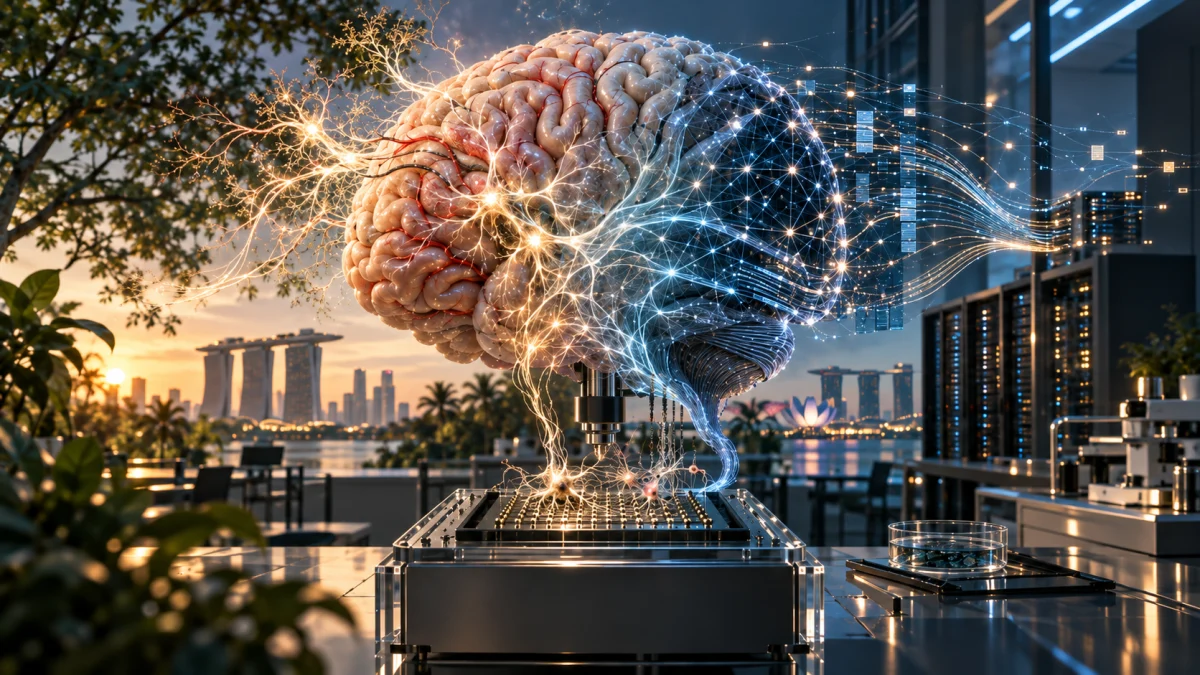
Singapore now has a research installation in which living human neurons derived from stem cells are interfaced with silicon hardware and software. The National University of Singapore describes its 20-unit CL1 installation as a biologically integrated computing system in which electrical interfaces communicate with living neural networks. NUS Medicine’s Biological Data Centre announcement (NUS Medicine)
We recently examined what that system actually does in our Singapore brain-cell biological-computing investigation. Singapore’s Brain-Cell Data Center: What It Actually Does
It is still experimental. It is nowhere close to being a human brain in a server rack.
But the experiment makes an old philosophical question suddenly physical:
What happens when the distinction between a computer and a brain is no longer the same as the distinction between silicon and living cells?
The human brain is not a computer. It also computes.
The phrase “the brain is a computer” can be either useful or badly misleading depending on what someone means by computer.
The human brain is clearly not a laptop made of meat.
There is no CPU sitting behind your forehead. Memories are not files stored at fixed addresses. Neurons are not microscopic transistors. The brain does not execute software instructions sequentially through a conventional processor-and-memory architecture.
But under a broader definition of computation, the comparison becomes much more reasonable.
Brains continually transform information about the outside world and the body into new internal states and behavior. Light hitting the retina eventually changes patterns of neural activity. Sound waves become language. Chemical concentrations become hunger. Past experience changes how future input is interpreted.
The National Academies noted this distinction decades ago: the brain is plainly unlike a conventional serial digital computer, while still performing functions that reasonably qualify as computation under broader definitions. (National Academies)
And the machinery doing this is astonishing.
The widely cited estimate is roughly 86 billion neurons in an adult human brain, based on postmortem measurements published in 2009. That number should not be mistaken for a universal census of every human brain: the original study used only four adult male brains, and more recent scientific discussion has emphasized the uncertainty around treating 86 billion as an exact population value. Azevedo and colleagues’ original neuron-count study (DOI)
Those neurons form connections through an estimated tens to hundreds of trillions of synapses, depending on what tissue and assumptions are used. Even individual neurons are considerably more sophisticated than the simple on-or-off units sometimes used to explain them. Dendrites perform substantial local processing, synapses change strength, cellular chemistry influences signaling, and electrical activity unfolds through both discrete spikes and continuous biological processes. (Frontiers)
Calling this network a “computer” is therefore not obviously wrong.
Calling it just a computer is where the metaphor begins losing information.
Your neurons are not binary switches
One of the most persistent oversimplifications about the brain is that neurons work like ones and zeroes.
An action potential does have an all-or-none quality once it is triggered. But that is only one part of what a neuron is doing.
A neuron can receive thousands of inputs distributed across elaborate branches called dendrites. The timing, location and strength of those inputs matter. Ion channels behave dynamically. Synapses can strengthen or weaken. Neuromodulators change how whole circuits operate. Previous activity can change how future signals are handled.
The output spike may look digital.
Much of the machinery that determines whether, when and how that spike occurs is not.
Modern neuroscience increasingly treats individual neurons themselves as sophisticated computational systems rather than simple threshold switches. (ScienceDirect)
Then multiply that complexity across billions of cells whose connections are continually being modified.
Learning does not merely place another file into storage.
Learning physically changes the system doing the learning.
That fact becomes important when we compare a brain with ChatGPT.
What actually happens when you type something into ChatGPT?
There is something almost comical about the interface.
You type:
Why do people dream?
A few seconds later, several paragraphs appear.
The experience feels conversational enough that it is tempting to imagine a digital mind somewhere receiving the question, thinking about it and then typing its answer back.
The underlying process is both less human and more remarkable than that.
Modern GPT systems descend from a class of neural-network architecture called the Transformer, introduced in the 2017 paper Attention Is All You Need. Transformers became exceptionally powerful because they can mathematically determine which parts of a sequence are relevant to other parts while processing language at enormous scale. Attention Is All You Need (arXiv)
Suppose you type a sentence into ChatGPT.
The text is first represented as tokens, which are numerical pieces of language. Tokens may correspond to words, portions of words, punctuation or other patterns.
Those tokens are converted into numerical representations called vectors.
The model then passes those representations through many layers of mathematical transformations.
A mechanism called attention helps determine which pieces of the input are relevant to one another. The word “attention” is slightly dangerous here because it sounds psychological. A transformer is not necessarily paying attention in the conscious sense. It is performing a mathematical operation that changes how strongly different pieces of information influence one another.
Eventually the model calculates a probability distribution over possible next tokens.
Perhaps one continuation has a calculated probability of 28 percent, another 17 percent, another 9 percent, and thousands of alternatives progressively less.
One token is selected.
Then the process happens again.
And again.
That repeated prediction process eventually produces the sentence you read.
“It just predicts the next word” is true, but incomplete
Critics of large language models sometimes summarize the entire technology as:
It is just predicting the next word.
Technically, that observation points toward something important.
Historically, GPT models have indeed been pretrained by learning to predict what comes next in enormous collections of text. OpenAI’s description of GPT-4 states explicitly that its base model was trained to predict the next word in documents before subsequent post-training shaped its behavior toward user instructions. OpenAI’s GPT-4 training description (OpenAI)
But the word just is doing an extraordinary amount of work.
Imagine becoming exceptionally good at predicting what humans will say next across textbooks, computer programs, scientific papers, novels, conversations, mathematical proofs and descriptions of the physical world.
You cannot accomplish that simply by memorizing which adjective commonly follows blue.
Good prediction increasingly requires learning deeper regularities.
Grammar helps predict language.
Facts help predict language.
Cause and effect help predict language.
A model of what humans generally believe helps predict language.
Some representation of logic helps predict arguments.
Some representation of programming helps predict computer code.
Relationships between concepts help predict unfamiliar sentences containing those concepts.
The prediction objective is simple.
The internal structures that emerge while optimizing it do not have to be.
That is one reason the description “statistical autocomplete” can simultaneously be technically related to reality and deeply misleading.
Training an AI and using an AI are two different things
Another major difference between humans and current language models appears here.
During training, enormous numbers of examples are processed. When the model makes predictions that differ from the training target, an optimization process adjusts the model’s parameters, or weights, so future predictions become better.
Across vast numbers of training steps, useful patterns become encoded throughout the network.
After pretraining, systems can undergo additional training intended to make them better at following instructions and behaving usefully. OpenAI’s InstructGPT work, for example, used human demonstrations and human preferences to help steer model behavior toward responses people preferred. Training Language Models to Follow Instructions With Human Feedback (arXiv)
When you later ask the deployed model a question, the basic process is inference.
The existing model is being used to calculate an answer.
That ordinary interaction is not equivalent to your brain learning from a conversation by physically modifying synapses.
Current ChatGPT systems can also use additional reasoning computation, tools, retrieval, images, audio and other components. Not every architectural detail of current frontier systems is publicly disclosed, so claims about the precise internals of whichever ChatGPT model happens to be running today should stop where the public evidence stops.
But the central distinction remains important.
A human brain is continuously modified by living.
A conventional deployed language model generally performs inference using parameters established before that particular conversation.
Those are very different forms of existence.
Your brain never really leaves the training environment
A human does not finish training and then enter deployment.
You are training now.
Reading this sentence changes neural activity in your brain. Remembering part of it tomorrow may involve lasting changes in the strength and organization of neural connections. Synaptic plasticity remains one of the central biological mechanisms studied in learning and memory. (Nature)
You are also receiving information that no conventional text model experiences directly.
Pressure from the chair beneath you.
The orientation of your head.
Blood glucose.
Heart rate.
Temperature.
Pain.
Hormonal state.
Signals from your lungs, stomach, muscles and cardiovascular system.
Modern neuroscience describes interoception, the nervous system’s monitoring of internal bodily conditions, as deeply involved in homeostasis, motivation, cognition and behavior. The Coding Logic of Interoception, Annual Review of Physiology (Annual Reviews)
Your brain is therefore not an isolated reasoning box being periodically handed prompts.
It is part of a living control system.
It must keep that system alive.
Hunger may be more philosophically important than it sounds
Consider hunger.
An LLM can explain hunger brilliantly.
It can describe ghrelin, hypothalamic regulation, glucose metabolism, appetite and evolutionary theories of feeding.
But a human brain participates in hunger.
Changing concentrations of chemicals alter the body’s internal state. Sensory pathways communicate those changes. Neural systems interpret them. Attention changes. Motivation changes. Behavior changes.
The organism eventually does something about the problem or suffers the consequences.
That distinction exposes something difficult about our ordinary use of the word understanding.
Does understanding require possessing the correct relationships among concepts?
Or does it require being the kind of thing to which those concepts can happen?
A language model can construct an excellent description of pain.
A nervous system can hurt.
Those may someday turn out to be two versions of the same underlying phenomenon.
They may turn out to be fundamentally different.
Science does not yet possess a definitive test that settles the question.
Then Singapore put living neurons inside the computer
This is why biological computing is more philosophically important than the novelty of a computer that needs nutrients.
Cortical Labs’ earlier DishBrain experiment grew networks of human and mouse neurons on electrode arrays and connected them to a simplified Pong environment.
Electrical stimulation conveyed information about the game. Neural activity influenced the paddle. Feedback from the environment returned to the cells.
The cultures exposed to the structured closed loop improved their performance in ways the control conditions did not. The peer-reviewed DishBrain study in Neuron (DOI)
That does not demonstrate that a dish of neurons was sitting there enjoying Pong.
It demonstrates something narrower and scientifically substantial:
Living neuronal networks can be connected to an artificial environment and adapt their activity through experience.
Singapore’s newer biological-computing project moves the idea into a more standardized computing platform. NUS says its installation combines stem-cell-derived human neurons, microelectrode arrays and conventional computing infrastructure. (NUS Medicine)
At that point, asking whether the machine is biological or artificial begins producing an awkward answer:
Both.
Perhaps we copied intelligence before we understood it
Artificial neural networks have always carried an admission in their name.
Neural network.
Early AI researchers borrowed an extremely simplified idea from biology: units receive inputs, weight them and produce outputs.
Modern neural networks have moved far beyond those early abstractions, but they remain only distant cousins of biological nervous systems.
And yet the stripped-down abstraction worked remarkably well.
We did not first solve the brain and then reproduce it.
We took a tiny conceptual fragment of what brains appeared to do, translated it into mathematics, ran it on silicon and kept scaling it.
That process eventually produced machines capable of writing software, translating languages, manipulating abstract concepts, explaining scientific papers and conducting extended conversations.
There is something humbling about that.
Perhaps intelligence is more substrate-independent than we assumed.
Or perhaps we have built systems that reproduce some outward products of intelligence without reproducing the deeper phenomenon itself.
Both possibilities remain open.
Evolution looks strangely like training, until the analogy breaks
This is where the provocative idea that humans themselves resemble an advanced AI becomes useful, provided we remember that it is an analogy.
No engineer trained Homo sapiens.
Evolution has no known programmer, foresight or objective document.
Natural selection is not sitting somewhere calculating gradients.
But evolution does create a process in which variations that function more successfully in a particular environment tend to propagate.
Across immense spans of time, nervous systems capable of more useful perception, prediction, memory, social coordination and behavior could affect reproductive success.
The result is a brain born with enormous amounts of biological structure already present.
Then lifetime experience reshapes that structure further.
From far enough away, the pattern has an eerie resemblance to machine learning:
A system begins with an architecture.
Experience changes it.
Successful patterns persist.
Future behavior is shaped by accumulated history.
But the mechanisms underneath are radically different.
Evolution changes populations across generations.
Machine-learning training numerically optimizes parameters.
Human learning changes living neural systems during a single lifetime.
The analogy is therefore illuminating only so long as we do not mistake it for literal equivalence.
What do we actually mean by intelligence?
This turns out to be surprisingly difficult.
There is no universally accepted scientific definition of intelligence that resolves every case.
Researchers Shane Legg and Marcus Hutter began their influential survey of machine intelligence with essentially that problem: despite enormous attention to intelligence, there was no single agreed definition suitable for every kind of possible intelligent system. They ultimately emphasized themes including learning, adaptation, goals and performance across different environments. Universal Intelligence: A Definition of Machine Intelligence (arXiv)
That suggests a useful way forward.
Instead of asking whether something possesses a mystical substance called Intelligence, we can ask what capabilities actually exist.
Can the system learn?
Can it generalize beyond examples it has already encountered?
Can it construct useful models of unfamiliar situations?
Can it solve novel problems?
Can it adapt when the environment changes?
Can it plan?
Can it detect its own errors?
Can it pursue goals?
Can it transfer knowledge between domains?
These questions have measurable answers.
And once intelligence is treated as a collection of capabilities rather than membership in a sacred category, the biological-versus-artificial distinction becomes less decisive.
A machine may possess some forms of intelligence and lack others.
So can a human.
Intelligence is not the same thing as consciousness
This may be the most important distinction in the entire discussion.
Intelligence concerns abilities.
Consciousness concerns experience.
A calculator can outperform nearly every human at long arithmetic without anyone assuming that division feels like something to the calculator.
A language model makes the issue harder because language is the medium humans normally use to reveal their internal mental lives.
If a machine says:
I understand why that frightened you.
the sentence resembles the kind of evidence we normally accept from another human.
But language by itself cannot establish that the machine experienced an internal feeling accompanying those words.
Scientists do not currently possess an agreed test for machine consciousness. Researchers working specifically on AI consciousness have therefore proposed examining architectural and functional indicators derived from competing scientific theories rather than simply asking an AI whether it feels conscious. Identifying Indicators of Consciousness in AI Systems (PubMed)
The careful position is neither:
“Of course ChatGPT is conscious.”
nor:
“A computer could obviously never be conscious.”
The evidence currently does not justify the first statement, while the scientific problem of consciousness is too unresolved to treat the second as a law of nature.
That uncertainty is real.
And probability does not make something unintelligent
There is another trap here.
People sometimes dismiss LLMs because their outputs are probabilistic.
But human brains are not deterministic logic engines either.
Neural transmission contains noise. Sensory evidence is incomplete. Humans routinely estimate uncertain situations and make predictions based on imperfect information.
Biological decision-making and modern theories of perception are filled with uncertainty.
So “the system uses probabilities” cannot by itself separate intelligence from non-intelligence.
The real questions concern what those probabilities represent, how the representations are formed and what the system can do with them.
A weather model is probabilistic.
A poker player is probabilistic.
A physician deciding between two possible diagnoses is reasoning under probability whether or not the physician consciously writes down Bayes’ theorem.
Probability is not the opposite of thought.
Often it is what thought looks like when information is incomplete.
The human brain’s strangest advantage may be efficiency
Whatever philosophical status we eventually grant artificial intelligence, biology remains extraordinarily difficult to reproduce efficiently.
The brain represents only a small fraction of total body mass but accounts for roughly 20 percent of resting human metabolism, with much of its energy devoted to electrical signaling and synaptic activity. Attwell and Laughlin’s neural energy-budget analysis (Sage Journals)
Yet within that biological energy budget, the nervous system handles vision, language, movement, motor control, memory, continual learning, social behavior, spatial reasoning and bodily regulation simultaneously.
Comparisons between brain energy and AI energy are frequently exaggerated because there is no fair one-to-one computational benchmark between them.
Still, the underlying engineering mystery is legitimate.
Biology performs remarkably sophisticated adaptive computation under severe energy constraints.
That is one reason researchers are trying everything from neuromorphic chips to actual living neural cultures.
We may have spent seventy years trying to build intelligence by making machines more powerful when evolution spent hundreds of millions of years making computation more economical.
But humans possess something an LLM does not: a life
A person’s intelligence cannot easily be separated from the continuity of that person’s existence.
Your childhood happened to the same organism reading this sentence.
Yesterday’s fatigue influenced today’s decisions.
Someone’s expression changed your emotional state.
An injury can permanently alter cognition.
Your memories influence who you trust.
Your expectations change what you notice.
Your actions alter an environment that later changes you.
Human intelligence therefore exists inside an ongoing causal loop:
world changes brain, brain changes body, body changes world, world changes brain.
An LLM conversation can mimic pieces of that loop.
It is not presently the same kind of loop.
That difference may prove central to consciousness.
It may prove mostly incidental.
We do not yet know.
Perhaps “artificial intelligence” was always a misleading name
The phrase was useful when intelligent behavior and artificial machinery seemed easy to distinguish.
Now it carries baggage.
Artificial flowers are not flowers.
Artificial vanilla may not come from vanilla beans.
Artificial light is still genuinely electromagnetic radiation.
So which kind of artificial is artificial intelligence?
If a machine calculates, nobody calls it artificial calculation.
If it discovers a mathematical proof, the proof does not become artificial mathematics.
If it identifies a previously unknown protein interaction correctly, the molecular relationship does not become artificial biology.
Perhaps the same will eventually happen to intelligence.
We may discover that artificial describes the construction of the system, not the reality of the cognitive process occurring inside it.
That would not make an AI human.
It would not give it emotions.
It would not prove consciousness.
It would simply mean that intelligence is something matter can do under more than one arrangement.
The more unsettling possibility is that intelligence was never uniquely ours
For most of human history, the comparison was unavailable.
People could compare human intelligence with other animals, but every known example of intelligence still emerged from biology.
Now we have a second experiment running.
Not another species.
Another substrate.
And that changes the philosophical question.
For years we asked:
Can machines become intelligent like humans?
A more interesting question may be:
How much of what humans call intelligence was ever uniquely human to begin with?
Language?
Machines manipulate it.
Pattern recognition?
Machines perform it.
Strategic planning?
Machines increasingly perform versions of it.
Learning?
Machines learn, although not biologically.
Creativity?
The definition becomes uncomfortable as soon as machines produce things humans did not explicitly specify.
None of this proves equivalence.
It forces us to divide a single vague concept into its actual components.
That may ultimately be AI’s greatest contribution to the study of intelligence.
Not creating something completely alien.
Showing us how much we never understood about ourselves.
Maybe the brain is not the opposite of AI. Maybe it is the other example.
The phrase “human versus artificial intelligence” suggests two opposing categories.
Nature over here.
Machine over there.
Singapore’s living-neuron computers already make that division look dated.
The brain is biological.
An LLM is digital.
A biological computer is both.
A future system may contain synthetic neurons, digital neural networks, conventional processors, sensory systems and living tissue inside one cognitive architecture.
At that point, asking whether the intelligence is “natural” or “artificial” may become about as useful as asking whether a modern airplane is more closely related to a bird or a calculator.
The interesting question will be what the system can actually do.
And eventually, perhaps, what it experiences.
So are humans the advanced AI?
Scientifically, no.
There is no evidence that humans are artificial constructs in the ordinary meaning of artificial intelligence. Evolution is not an AI training run conducted by some known external engineer.
But as a thought experiment, the comparison leads somewhere worthwhile.
Humans are adaptive information-processing systems running on biological hardware that rewires itself through experience.
We receive incomplete inputs.
We construct models.
We predict.
We make mistakes.
We update.
We generalize from examples.
We inherit structure from processes that occurred before we existed.
Then we spend a lifetime modifying that inherited architecture with experience.
The remarkable thing about artificial intelligence may therefore not be that engineers have finally invented intelligence from nothing.
It may be that we have begun reconstructing fragments of a phenomenon nature was already performing inside us.
And now that we have created a second way of doing some of those things, we are being forced to decide what we meant by intelligence all along.
Perhaps the line that matters was never human intelligence versus artificial intelligence.
Perhaps there are several different lines:
intelligence and consciousness;
learning and experience;
prediction and understanding;
simulation and embodiment;
competence and agency;
computation and subjective existence.
Those boundaries do not all have to fall in the same place.
A machine could be intelligent without being conscious.
A biological network could learn without being a person.
A system could understand relationships without experiencing emotions.
Or our categories may someday prove inadequate altogether.
For now, the most scientifically defensible conclusion is also the most philosophically interesting:
We know that brains produce intelligence. We now know that engineered systems can reproduce a growing number of behaviors we associate with intelligence. We do not yet know which properties of the human mind require biology, which require embodiment, which require consciousness, and which require nothing more mysterious than the right organization of information and matter.
That uncertainty should not diminish what the human brain is.
It makes the brain considerably more interesting.
Because while we are trying to build artificial intelligence, we are simultaneously discovering that we have been carrying an extraordinary intelligence system inside our skulls the entire time.
We simply never had another one to compare it with.
References and Further Reading
Neuroscience and Biological Intelligence
“Equal Numbers of Neuronal and Nonneuronal Cells Make the Human Brain an Isometrically Scaled-Up Primate Brain” — Azevedo et al., Journal of Comparative Neurology The influential 2009 study behind the widely quoted estimate of roughly 86 billion neurons in the adult human brain.
“An Energy Budget for Signaling in the Grey Matter of the Brain” — Attwell and Laughlin Foundational analysis of the metabolic cost of neuronal signaling and why energy constraints matter to neural computation.
“A Dendro-Centric View of Cognition in the Behaving Brain” — Annual Review of Neuroscience A recent review explaining why neurons should not be reduced to simple point-like switches and how dendrites themselves participate in computation.
“The Coding Logic of Interoception” — Annual Review of Physiology Reviews how nervous systems monitor internal bodily conditions and how those signals influence cognition, motivation and behavior.
Artificial Intelligence and Language Models
“Attention Is All You Need” — Vaswani et al. The foundational Transformer paper underlying the architecture family that transformed modern language modeling.
OpenAI’s GPT-4 Research Overview Explains the published training principle of next-token prediction followed by post-training intended to better align model behavior with user intent.
“Training Language Models to Follow Instructions With Human Feedback” — Ouyang et al. The InstructGPT research showing how supervised demonstrations and human preference feedback can transform a pretrained language model into a more useful instruction-following system.
Biological Computing
NUS Medicine: Biological Data Centre Prototype in Singapore Primary institutional description of the 20-unit Singapore project using living stem-cell-derived neurons integrated with computing hardware.
“In Vitro Neurons Learn and Exhibit Sentience When Embodied in a Simulated Game-World” — Neuron The DishBrain research demonstrating adaptive behavior in cultured neural networks connected to a closed-loop Pong environment. The paper’s use of “sentience” should not be read as establishing human-like subjective consciousness.
sherafy.com: Singapore’s Brain-Cell Data Center Is Real — But the “Half the Cost” Claim Needs Context Our detailed examination of what the Singapore system actually contains, what living neural cultures can currently do, and where viral claims exceed the available evidence.
Intelligence and Consciousness
“Universal Intelligence: A Definition of Machine Intelligence” — Legg and Hutter A foundational attempt to separate intelligence from specifically human implementation and formalize it in terms of agents operating successfully across environments.
“Identifying Indicators of Consciousness in AI Systems” — Butlin et al., Trends in Cognitive Sciences A contemporary framework for investigating machine consciousness without treating fluent language as sufficient evidence of subjective experience.
Editorial currency note: AI architectures and biological-computing systems are advancing rapidly. Specific ChatGPT implementations, biological-computing hardware and commercial claims may change. The neuroscience principles discussed here are substantially more stable, while claims about current frontier AI reflect publicly available information through September 2026.