
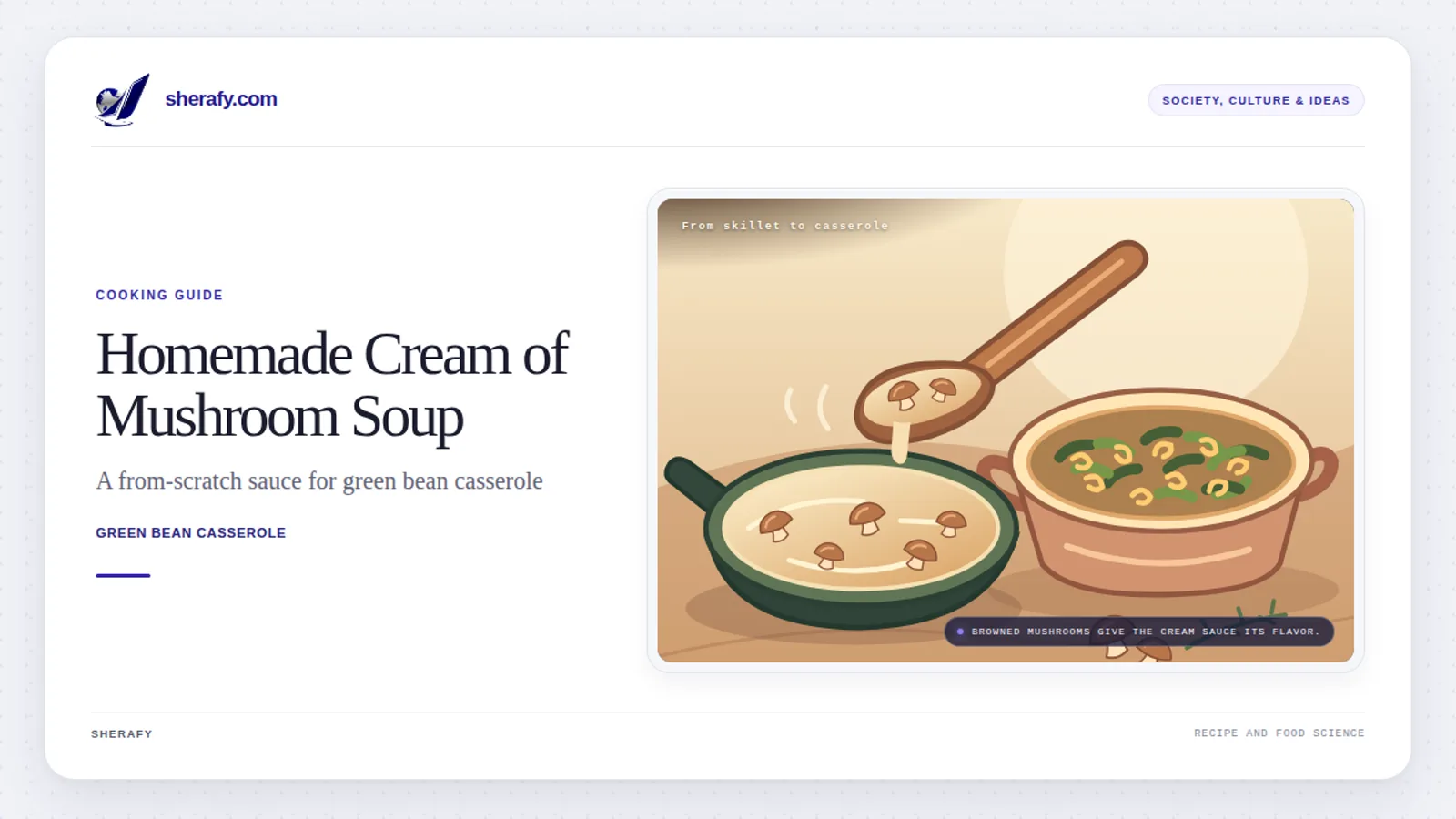
The best substitute for canned cream of mushroom soup in green bean casserole is a homemade mushroom cream sauce made with browned mushrooms, butter, chicken stock, evaporated milk, heavy cream, and a simple thickening agent.
Unlike ordinary cream of mushroom soup, this version is deliberately concentrated to produce a rich, creamy casserole without excess liquid. It also allows you to control the amount of sodium, mushrooms, and dairy rather than relying on the proportions of a commercially prepared product.
Whether the grocery store has run out of canned soup or you simply want to improve a traditional Thanksgiving recipe, this homemade alternative requires approximately 30 minutes and uses common kitchen ingredients.
One batch is designed to replace one 10.5-ounce can of condensed cream of mushroom soup and the additional half cup of milk normally required in green bean casserole.
Homemade Cream of Mushroom Soup Recipe
| Recipe Details | Value |
|---|---|
| Preparation time | 10 minutes |
| Cooking time | 20–25 minutes |
| Total time | 30–35 minutes |
| Target yield | Approximately 1¾ cups |
| Casserole servings | 6 |
| Green beans accommodated | 4 cups, cooked |
| Difficulty | Easy |
Ingredients
| Ingredient | Amount |
|---|---|
| White button mushrooms | 8 oz (227 g) |
| Unsalted butter | 2 tablespoons |
| Yellow onion, finely minced | ¼ cup |
| Fresh garlic, minced | 2 cloves |
| Unsalted chicken stock | ½ cup |
| Evaporated milk | ½ cup |
| Heavy cream | ¼ cup |
| All-purpose flour OR potato starch | 2 tablespoons flour OR 1 tablespoon potato starch |
| Dried thyme | ¼ teaspoon |
| Onion powder | ¼ teaspoon |
| Ground black pepper | ¼ teaspoon |
| Ground nutmeg | One small pinch |
| Salt | To taste |
For a baked casserole, flour is generally the more forgiving thickener. Potato starch is an excellent alternative when flour is unavailable or a gluten-free sauce is desired. Instructions for both methods are included below.
Optional Flavor Enhancers
The following ingredients can enhance the sauce, although none is necessary:
- ¼ teaspoon Worcestershire sauce for additional savory depth.
- A small pinch of monosodium glutamate (MSG) to enhance umami.
- ½ teaspoon fresh lemon juice to balance the richness.
- 1 teaspoon finely ground dried porcini mushrooms for a more pronounced mushroom flavor.
- A small amount of Dijon mustard for subtle complexity.
If reducing sodium is a priority, account for the sodium contributed by Worcestershire sauce, MSG, and mustard.
The base recipe is designed to obtain most of its flavor from the mushrooms themselves.
How to Make Cream of Mushroom Soup From Scratch
Step 1: Prepare the Mushrooms
Clean the mushrooms and trim away any dry or discolored ends. Both the stems and caps can be used.
Finely chop approximately two-thirds of the mushrooms and more coarsely chop the remaining third.
The smaller pieces distribute mushroom flavor throughout the sauce, while the larger pieces provide texture and make the finished casserole noticeably different from one prepared with canned soup.
Step 2: Brown the Mushrooms
Melt the butter in a wide skillet over medium to medium-high heat. Add the mushrooms and cook for approximately 8–12 minutes, stirring occasionally.
The mushrooms will initially release water. Continue cooking until most of that moisture has evaporated and the mushrooms develop golden-brown surfaces.
Avoid overcrowding the skillet. If necessary, cook the mushrooms in two batches. Reduce the heat if the butter begins to burn.
Do not proceed simply because the mushrooms have softened. Browning is one of the most important steps in developing the flavor of the finished sauce.
Step 3: Add the Aromatics
Reduce the heat to medium.
Add the finely minced onion and cook for approximately 3 minutes, or until softened.
Add the garlic, thyme, onion powder, black pepper, and a tiny pinch of nutmeg. Cook for another 30–60 seconds until fragrant.
Nutmeg is particularly effective in cream sauces, but it should remain a background flavor rather than becoming individually recognizable.
Step 4: Prepare the Thickening Base
Choose one of the following methods.
If using all-purpose flour:
Sprinkle 2 tablespoons of flour over the mushrooms and aromatics. Stir continuously for approximately 1–2 minutes to cook the flour.
If the mixture is excessively dry, add another teaspoon of butter.
Gradually pour in the chicken stock while stirring to prevent lumps. Scrape the bottom of the skillet to incorporate the flavorful browned deposits.
If using potato starch:
Reserve 2 tablespoons of cold chicken stock for the starch slurry.
Add the remaining chicken stock directly to the mushrooms. Scrape the bottom of the skillet and allow the liquid to simmer briefly.
Do not add the potato starch yet.
Step 5: Add the Dairy
Pour in the evaporated milk and heavy cream.
Stir until combined and bring the mixture to a gentle simmer. Cook for approximately 3–5 minutes, allowing the flavors to combine and some of the excess moisture to evaporate.
Avoid a vigorous boil.
If using flour, continue simmering gently until the sauce has thickened and no longer tastes of raw flour.
Step 6: Finish Thickening the Sauce
If using potato starch, combine it with the reserved cold chicken stock in a small bowl. Stir until completely smooth.
Gradually pour the slurry into the mushroom mixture while stirring. Add enough to achieve a thick, creamy consistency.
Remove the sauce from the heat once it thickens. Potato starch can lose some of its thickening power during prolonged cooking.
If using flour, no additional starch is necessary.
The finished mushroom sauce should generously coat the back of a spoon. It should be thick but still pourable.
Aim for approximately 1¾ cups of finished sauce. If the yield is slightly higher, reserve the excess rather than automatically adding more liquid to the casserole.
Step 7: Taste and Adjust the Seasoning
Taste the sauce before adding salt.
Remember that commercially prepared crispy fried onions, canned green beans, and other casserole ingredients may already contain substantial amounts of sodium.
If the sauce tastes excessively rich or flat, a small amount of lemon juice can brighten the flavor without making it noticeably acidic.
For a smoother, more uniform consistency, blend approximately one-third of the finished sauce and stir it back into the remaining mixture.
This step is optional but can produce a particularly luxurious texture.
How Much Homemade Cream of Mushroom Soup Replaces One Can?
The traditional Campbell's green bean casserole recipe combines a 10.5-ounce can of condensed cream of mushroom soup with half a cup of milk and four cups of cooked green beans.
The homemade recipe above is designed to replace both the condensed soup and the additional milk.
| Traditional Recipe | Homemade Replacement |
|---|---|
| 1 can condensed soup + ½ cup milk | Approximately 1¾ cups homemade sauce |
| 2 cans condensed soup + 1 cup milk | Approximately 3½ cups homemade sauce |
| 3 cans condensed soup + 1½ cups milk | Approximately 5¼ cups homemade sauce |
| 4 cans condensed soup + 2 cups milk | Approximately 7 cups homemade sauce |
These are practical substitution targets rather than exact manufacturing equivalents.
Do not add the additional milk called for in the original casserole recipe unless the homemade sauce is unusually thick.
Adding the full amount of milk again can result in a watery casserole.
If substituting this sauce in a different recipe that calls for undiluted condensed soup, reduce the other liquids accordingly or concentrate the mushroom sauce further before thickening it.
Green Bean Casserole Without Canned Soup
Once the homemade mushroom sauce is prepared, assembling the casserole is straightforward.
Ingredients
| Ingredient | Amount |
|---|---|
| Cooked, thoroughly drained green beans | 4 cups |
| Homemade cream of mushroom sauce | Approximately 1¾ cups |
| Crispy fried onions | 1⅓ cups |
| Ground black pepper | To taste |
| Unsalted butter for greasing | As needed |
Approximately 1½ pounds of fresh green beans can be used to prepare this casserole. Frozen or canned green beans are also suitable.
Soy sauce, which appears in the traditional recipe, is optional and can be omitted to reduce sodium.
Instructions
- Preheat the oven to 350°F (177°C).
- If using fresh green beans, trim and blanch them in boiling water for approximately 2–4 minutes, depending on their thickness and desired tenderness.
- Transfer the green beans to ice water to stop the cooking process, then drain thoroughly.
- Combine the green beans, homemade mushroom sauce, and half of the crispy fried onions.
- Transfer the mixture to a lightly greased 1½- to 2-quart casserole dish.
- Bake uncovered for approximately 25 minutes, or until the mixture is hot and bubbling around the edges.
- Distribute the remaining crispy fried onions evenly across the surface.
- Return to the oven for another 5–10 minutes, until the topping is golden brown. Check that the center reaches 165°F (74°C) with a food thermometer.
- Allow the casserole to rest for 5–10 minutes before serving.
The resting period allows the sauce to settle and helps prevent liquid from pooling on the serving plate.
Why This Recipe Works: The Food Science
A successful homemade cream of mushroom sauce depends on three separate processes: flavor development, dairy enrichment, and liquid thickening.
Understanding these processes makes it easier to modify the recipe without compromising the finished casserole.
Browning Mushrooms Develops Flavor That Salt Cannot Replace
White button mushrooms belong to the species Agaricus bisporus and naturally contain compounds associated with umami, the savory taste found in mushrooms, meat, aged cheese, and concentrated broths.
A 2019 study published in Food Chemistry examined how cooking affects the amino acids and nucleotides responsible for the umami characteristics of cultivated and wild mushrooms.
Additional research examining white button and cremini mushrooms identified naturally occurring glutamate and other compounds that contribute to their savory flavor and demonstrated how cooking methods influence their flavor profiles.
When mushrooms are heated, they release moisture. As that moisture evaporates, their surfaces can reach temperatures that encourage browning reactions, including the Maillard reaction.
These reactions produce additional aromatic compounds and a more complex flavor.
The browned deposits left behind in the skillet, known as fond, can then be dissolved with stock and incorporated into the sauce.
Simply boiling mushrooms in milk misses much of this opportunity for flavor development.
This becomes particularly important when reducing sodium. A well-developed mushroom base requires less reliance on salt to make the finished dish taste satisfying.
Why Use Evaporated Milk and Heavy Cream Together?
Evaporated milk and heavy cream perform complementary functions.
Under the U.S. federal standard of identity for evaporated milk, evaporated milk is produced by partially removing water from milk and must contain at least 23% total milk solids by weight.
These concentrated milk solids contribute body and dairy flavor.
Heavy cream contributes additional milk fat, producing a richer mouthfeel and smoother texture.
| Dairy Ingredient | Primary Contribution |
|---|---|
| Whole milk | Mild dairy flavor and liquid |
| Evaporated milk | Concentrated milk solids and body |
| Heavy cream | Richness and smooth mouthfeel |
| Half-and-half | Intermediate richness |
| Sweetened condensed milk | Unsuitable because of its added sugar |
Using evaporated milk and heavy cream together creates a sauce that is richer than one prepared exclusively with regular milk without requiring the entire dairy component to consist of heavy cream.
Evaporated milk should not be confused with sweetened condensed milk. They are not interchangeable in this recipe.
Potato Starch vs. Cornstarch vs. Flour
The choice of thickening agent affects both the initial consistency of the mushroom sauce and its behavior during baking.
| Thickener | Starting Amount | Advantages | Limitations |
|---|---|---|---|
| All-purpose flour | 2 tbsp | Traditional creamy consistency; forgiving during extended cooking | Contains gluten; requires cooking |
| Potato starch | 1 tbsp | Thickens quickly; naturally gluten-free | Can lose viscosity during prolonged heating |
| Cornstarch | 1 tbsp | Accessible; smooth texture; naturally gluten-free | Can weaken during extended heating |
| Arrowroot starch | 1 tbsp | Naturally gluten-free | Not ideal for some dairy-heavy sauces |
Starches thicken liquids through a process called gelatinization. When heated in the presence of water, starch granules absorb moisture and swell, increasing the viscosity of the surrounding liquid.
However, different starches respond differently to heat and extended cooking.
As explained in America's Test Kitchen's guide to culinary thickeners, potato starch begins thickening before a liquid reaches a simmer but can lose some of its thickening ability when cooked for too long.
For a casserole that will undergo an additional 30 minutes of baking, flour is generally the more forgiving choice.
Potato starch remains a practical alternative, particularly when preparing a gluten-free sauce. Thoroughly draining the green beans becomes especially important when using it.
Chicken Stock or Beef Stock?
Both can be used, but chicken stock is generally preferable for traditional green bean casserole.
| Stock | Flavor Profile | Best Application |
|---|---|---|
| Chicken stock | Mild and balanced | Traditional green bean casserole |
| Beef stock | Darker and more assertive | Mushroom gravy and beef dishes |
| Vegetable stock | Light and plant-forward | Vegetarian casseroles |
| Mushroom stock | Earthy and mushroom-forward | More pronounced mushroom flavor |
Beef stock can make an excellent mushroom sauce, but its stronger flavor may compete with the green beans and dairy.
For a vegetarian version, substitute unsalted vegetable or mushroom stock.
How Much Sodium Is in Canned Cream of Mushroom Soup?
According to the manufacturer's published nutrition information for Campbell's regular condensed cream of mushroom soup, a standard serving contains 860 milligrams of sodium, with approximately 2.5 servings per 10.5-ounce container.
This translates to approximately 2,150 milligrams of sodium in a single can.
For comparison, the FDA's Daily Value for sodium is 2,300 milligrams.
One can therefore contains approximately 93% of the general daily sodium reference amount, although the can is normally distributed across multiple servings when used in a casserole.
Sodium Comparison Across Canned Mushroom Soup Varieties
| Campbell's Product | Sodium per Labeled Serving | Approximate Sodium per Can | Sodium per Casserole Serving* |
|---|---|---|---|
| Regular | 860 mg | 2,150 mg | 358 mg |
| 25% Less Sodium | 640 mg | 1,600 mg | 267 mg |
| Heart Healthy | 410 mg | 1,025 mg | 171 mg |
| Unsalted | 50 mg | 125 mg | 21 mg |
Assumes one standard can distributed across six equal casserole servings. Excludes sodium from all other ingredients. Per-can estimates are calculated using the manufacturer's approximately 2.5 servings per container.
Sources: Campbell's published nutrition labels for Regular Cream of Mushroom Soup, 25% Less Sodium Cream of Mushroom Soup, Heart Healthy Cream of Mushroom Soup, and Unsalted Cream of Mushroom Soup.
The regular condensed soup alone can contribute approximately 358 milligrams of sodium to each serving of a six-serving casserole before accounting for soy sauce, milk, fried onions, or canned green beans.
Homemade soup is not automatically lower in sodium. Its sodium content depends on the stock, dairy products, seasonings, and amount of salt used.
The advantage is that each of those ingredients can be controlled independently.
How to Make Lower-Sodium Green Bean Casserole Without Sacrificing Flavor
The most effective approach is to develop flavor before adding salt.
Use unsalted butter, unsalted chicken stock, fresh mushrooms, garlic, onion, thyme, and black pepper. Brown the mushrooms thoroughly and incorporate the flavorful residue from the skillet into the sauce.
If additional salt is necessary, add it incrementally.
| Added Table Salt | Approximate Sodium Added to Entire Recipe | Added Sodium per Serving of 6 |
|---|---|---|
| None | 0 mg | 0 mg |
| ⅛ teaspoon | 288 mg | 48 mg |
| ¼ teaspoon | 575 mg | 96 mg |
| ½ teaspoon | 1,150 mg | 192 mg |
| 1 teaspoon | 2,300 mg | 383 mg |
These figures are approximate and assume ordinary table salt. Different salt crystal sizes can change the amount of sodium contained in a measured teaspoon.
Additional Ways to Reduce Sodium
- Use fresh or unseasoned frozen green beans.
- Choose no-salt-added canned green beans when fresh ones are unavailable.
- Drain and rinse regular canned green beans.
- Check the sodium content of commercially prepared fried onions.
- Omit the soy sauce found in many traditional casserole recipes.
- Use unsalted stock rather than assuming reduced-sodium stock contains little sodium.
- Taste the assembled casserole mixture before adding more salt.
The FDA's guidance on reducing dietary sodium identifies commercially prepared and packaged foods as important contributors to sodium intake.
Replacing the canned soup addresses one source, but the total sodium content of the casserole depends on every ingredient.
A lower-sodium version is also not necessarily lower in calories or saturated fat. The butter and heavy cream in this recipe are included deliberately for culinary quality.
How to Prevent Watery Green Bean Casserole
Excess moisture is one of the most common problems encountered when making green bean casserole from scratch.
Unlike commercially manufactured condensed soup, homemade mushroom sauce does not have a standardized concentration. Its consistency depends on how much moisture is released from the mushrooms, how long the liquid is reduced, and which thickening agent is used.
| Problem | Likely Cause | Solution |
|---|---|---|
| Watery mushroom sauce | Insufficient evaporation | Cook off mushroom moisture before adding dairy |
| Liquid pooling in the casserole | Wet green beans | Drain thoroughly and pat dry if necessary |
| Sauce becomes thin during baking | Thickener breaks down during extended heating | Consider a flour-based sauce |
| Sauce is too thin before baking | Excess stock or milk | Reduce before thickening |
| Sauce is gummy | Excess starch | Gradually add a small amount of milk or stock |
| Sauce contains lumps | Starch added incorrectly | Use a cold slurry or gradually incorporate liquid into flour |
| Casserole tastes bland | Insufficient mushroom browning | Develop deeper color before adding liquids |
| Fried onions become soggy | Topping added too early | Reserve the topping for the final baking stage |
| Casserole tastes too salty | Multiple salted ingredients | Use unsalted stock and delay additional seasoning |
| Sauce tastes excessively rich | Too much cream or insufficient balance | Add a small amount of stock or lemon juice |
The mushroom sauce should be slightly thicker than the desired finished casserole consistency before it enters the oven.
Green beans can release additional moisture during baking, particularly if they were previously frozen.
Ingredient Substitutions
This recipe can be adapted to accommodate different pantry ingredients and dietary requirements.
| Missing Ingredient | Suitable Replacement |
|---|---|
| White button mushrooms | Cremini, baby bella, or chopped portobello mushrooms |
| Chicken stock | Vegetable, mushroom, or mild beef stock |
| Evaporated milk | Half-and-half or whole milk, with additional reduction if needed |
| Heavy cream | Half-and-half or additional evaporated milk |
| Potato starch | Cornstarch or all-purpose flour |
| Fresh garlic | ¼ teaspoon garlic powder |
| Yellow onion | Shallots or white onion |
| Dried thyme | Approximately ¾ teaspoon fresh thyme |
| Butter | Olive oil or another suitable cooking oil |
White button mushrooms, cremini mushrooms, and portobello mushrooms are forms or maturity stages of the same cultivated mushroom species, Agaricus bisporus.
Expensive specialty mushrooms are not necessary to produce a flavorful cream of mushroom sauce.
Frequently Asked Questions
Can I Make Green Bean Casserole Without Cream of Mushroom Soup?
Yes. A homemade mushroom cream sauce made with browned mushrooms, stock, dairy, and a thickening agent can replace commercially prepared condensed cream of mushroom soup.
Other cream sauces can also work, although they will change the characteristic flavor of the dish.
Can I Use Regular Milk Instead of Evaporated Milk?
Yes. Whole milk is a suitable substitute.
Because ordinary milk contains more water relative to milk solids, the sauce may require additional reduction or a small adjustment to the thickener.
Can I Use Heavy Cream Instead of Evaporated Milk?
Yes, but the resulting sauce will be considerably richer.
Replacing both dairy components with heavy cream may produce an unnecessarily heavy casserole. A combination of ordinary milk and heavy cream is generally a better alternative.
Can I Make Cream of Mushroom Soup Without Flour?
Yes. Potato starch and cornstarch can both thicken mushroom soup without flour.
Mix the starch with a small amount of cold stock before adding it to the hot sauce. This helps prevent lumps.
Potato starch should be added near the end of cooking because prolonged heating can reduce its thickening ability.
Is Homemade Cream of Mushroom Soup Gluten-Free?
It can be.
Potato starch and cornstarch are naturally gluten-free, provided the remaining ingredients do not contain gluten or experience problematic cross-contact.
Check the labels on commercial stock, Worcestershire sauce, and crispy fried onions. Traditional fried onion toppings frequently contain wheat flour.
Is Homemade Cream of Mushroom Soup Vegetarian?
The recipe becomes vegetarian when vegetable or mushroom stock is substituted for chicken stock.
If using Worcestershire sauce, check the ingredients. Traditional Worcestershire sauce frequently contains anchovies.
Can I Make the Mushroom Sauce the Day Before Thanksgiving?
Yes. Prepare the mushroom sauce, cool it promptly, and refrigerate it in a covered container.
A flour-thickened version is particularly suitable for advance preparation and reheating.
The casserole can also be assembled ahead of time and refrigerated before baking. Keep the final fried onion topping separate until the last stage of cooking.
A refrigerated casserole may require additional baking time.
According to USDA food safety guidance, perishable cooked foods should generally be refrigerated within two hours and used within three to four days.
Can I Freeze Homemade Cream of Mushroom Soup?
Yes, although dairy-based sauces may separate or develop a grainy texture after freezing and thawing.
For better quality, freeze the cooked mushroom and stock base before adding the dairy and thickener. Complete the sauce after thawing it safely in the refrigerator.
Can I Eat This as Regular Cream of Mushroom Soup?
Yes. The recipe is deliberately concentrated for casserole use.
To serve it as a standalone soup, gradually add additional chicken stock, milk, or a combination of both until it reaches your preferred consistency.
Adjust the seasoning afterward.
Can I Use This Recipe in Other Casseroles?
Yes. Homemade cream of mushroom sauce can be used in numerous dishes that traditionally rely on canned condensed soup, including:
- Tuna noodle casserole.
- Chicken and rice casserole.
- Potato casserole.
- Beef stroganoff.
- Mushroom pork chops.
- Creamy pasta dishes.
- Chicken pot pie.
- Scalloped potatoes.
Adjust the amount of sauce and other liquids according to the requirements of each recipe.
The Bottom Line
Canned cream of mushroom soup is a convenient ingredient, but it is not an essential one.
Fresh mushrooms, properly browned in butter and combined with stock, evaporated milk, heavy cream, and a suitable thickener, can produce a rich homemade alternative using ordinary kitchen ingredients.
Making the sauce separately also gives the cook control over its consistency, richness, mushroom content, and sodium level before assembling the casserole.
The greatest improvement does not come from an expensive ingredient or an unusual seasoning.
It comes from treating the mushrooms as the source of the flavor rather than treating the can as the source of the sauce.
References and Further Reading
Food Science and Culinary Technique
- The Effect of Cooking on Umami Compounds in Wild and Cultivated Mushrooms — Food Chemistry, 2019 — Original research examining how cooking affects amino acids and nucleotides associated with the savory taste of mushrooms.
- The Impact of Roasting and Steaming on Savory Flavors in Agaricus bisporus Mushrooms — Research examining how cooking methods influence the flavor compounds of white button and cremini mushrooms.
- 21 CFR § 131.130 — Evaporated Milk — The U.S. federal standard defining evaporated milk and its minimum milk solids and milk fat requirements.
- Getting to Know: Thickeners — America's Test Kitchen — Practical culinary guidance concerning starch-based thickening agents and their performance during cooking.
- How to Sauté Mushrooms — Mushroom Council — Industry cooking guidance addressing pan temperature, browning, and overcrowding.
Original Recipe and Manufacturer Nutrition Information
- Campbell's Original Green Bean Casserole Recipe — The traditional ingredient proportions, cooking temperature, and baking instructions used as the basis for the homemade substitution.
- Campbell's Regular Condensed Cream of Mushroom Soup — Manufacturer-published nutrition and ingredient information for regular condensed mushroom soup.
- Campbell's 25% Less Sodium Cream of Mushroom Soup — Manufacturer nutrition information for the reduced-sodium formulation.
- Campbell's Heart Healthy Cream of Mushroom Soup — Manufacturer nutrition information for the reduced-fat and lower-sodium formulation.
- Campbell's Unsalted Cream of Mushroom Soup — Manufacturer nutrition information for the no-salt-added alternative.
Nutrition and Food Safety
- Sodium in Your Diet — U.S. Food and Drug Administration — Federal guidance on dietary sodium, nutrition labeling, and practical methods of reducing sodium consumption.
- How Do I Handle Leftovers Safely? — USDA Food Safety and Inspection Service — Federal food safety recommendations for refrigeration, cooling, and storage of cooked foods.
Editorial note: Commercial nutrition information was reviewed in November 2026. Product formulations may change. The homemade recipe is developed from established culinary techniques; preparation times, final yield, and consistency may vary with ingredients and cooking equipment.