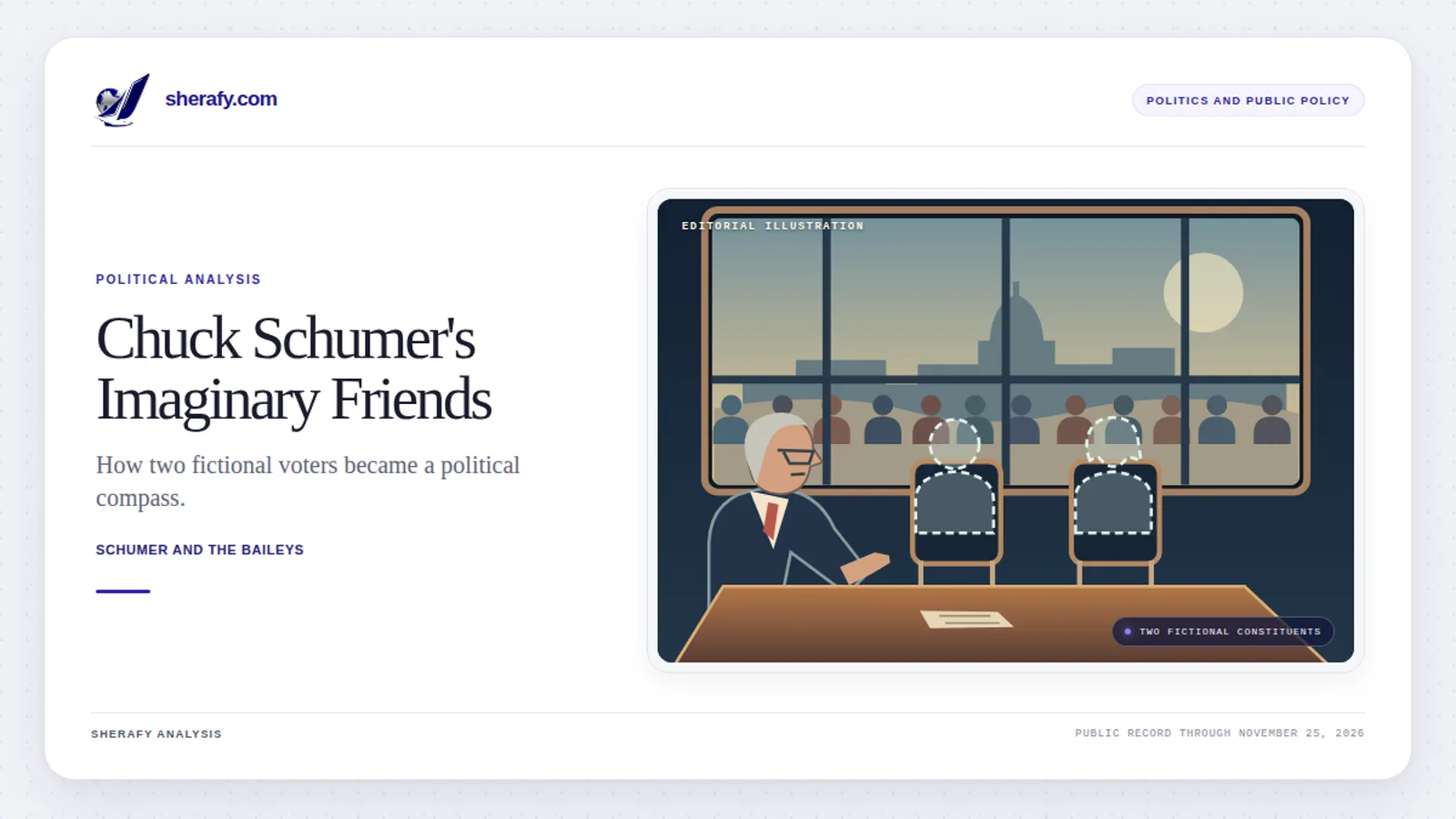
Yes, Chuck Schumer really does have imaginary friends. Their names are Joe and Eileen Bailey, and for decades, the New York senator has described consulting this fictional couple when developing legislation, evaluating political issues, interpreting election results, and determining what he believes ordinary Americans want from their government.
Schumer has invented their occupations, income, children, political preferences, personal anxieties, voting histories, and even their reactions to presidential administrations. He has encouraged other Democratic candidates to develop their own equivalent imaginary constituents.
None of this was uncovered through leaked documents or an anonymous whistleblower. Schumer has discussed the practice openly since at least 2006, devoted much of a 2007 book to the family, and continued referring to them in interviews as recently as March 2025.
The most concerning aspect of this story is not simply that one of America's most powerful politicians invented an imaginary family. It is that when Schumer was directly challenged about how he knew these fictional people represented actual Americans, his explanation exposed a fundamental problem with the political philosophy he had constructed around them.
Who Are Chuck Schumer's Imaginary Friends?
Joe and Eileen Bailey are a fictional married couple living in Massapequa, a suburban community on Long Island, New York.
Originally named Joe and Eileen O'Reilly, they were created by Schumer to embody his understanding of the typical middle-class American household. Their surname was subsequently changed to Bailey to give the characters broader national appeal.
Schumer has developed their fictional biographies in considerable detail over the years.
| Characteristic | Joe and Eileen Bailey |
|---|---|
| Residence | Massapequa, Long Island, New York |
| Marital status | Married |
| Children | Three |
| Age in 2007 | 45 |
| Joe's occupation | Insurance industry employee |
| Eileen's occupation | Part-time administrative employee |
| Household income in 2007 accounts | Approximately $70,000–$75,000 |
| Political affiliation | Independent swing voters |
| Financial concerns | Property taxes, college tuition and economic security |
| Cultural outlook | Relatively traditional |
| Political behavior | Alternates between Republican and Democratic candidates |
Their biographies have changed somewhat between Schumer's public descriptions. In 2006, Eileen worked part-time in a school. By 2007, she worked in a physician's office.
During a March 2007 interview with The New Yorker, Schumer discussed the couple's restaurant preferences, patriotism, attitudes toward terrorism, and what kind of facial hair Joe would never have.
He told the interviewer:
“They're real for me. I love the Baileys.”
The Baileys are not actual political advisers, constituents, campaign researchers, or members of a focus group. Their entire existence, including their opinions about American politics, originates with Schumer himself.
When Did Chuck Schumer Invent the Baileys?
Accounts differ regarding precisely when Schumer first developed the characters. A 2010 profile traces the underlying concept to his early political career, while other accounts associate their development with his 1998 Senate campaign against Republican incumbent Alfonse D'Amato.
What is well established is that Schumer introduced the fictional family to his campaign staff in 1998 and subsequently made them a prominent part of his public political philosophy.
The history of Chuck Schumer's imaginary friends
| Year | Documented development |
|---|---|
| 1998 | Schumer introduces the fictional family into his Senate campaign strategy. |
| 2006 | Publicly acknowledges consulting Joe and Eileen and encourages other Democratic candidates to develop similar fictional constituents. |
| 2007 | Publishes Positively American, a political manifesto centered on winning voters like the Baileys. |
| 2010 | Describes their continued presence in his thinking about legislative priorities. |
| 2017 | Assigns the family detailed voting decisions and reactions to Donald Trump's presidency. |
| 2021 | Discusses their changing political preferences while explaining his legislative strategy as Senate majority leader. |
| 2025 | Suggests that the fictional couple probably supported Trump in the 2024 presidential election. |
This is not a decades-old campaign anecdote that Schumer subsequently abandoned.
The public record demonstrates that the Baileys remained part of his political thinking across multiple presidential administrations, economic crises, election cycles, and changes in his own leadership responsibilities.
The 2006 Interview That Revealed the Fundamental Problem
On July 28, 2006, The American Prospect published an unusually revealing transcript of a discussion with Chuck Schumer.
Schumer was explaining how Democrats could reconnect with middle-class Americans when he acknowledged:
“I have fictional people in my head.”
He explained that he mentally consulted the couple before taking political action, including on issues where he personally disagreed with them.
Political commentator Matt Stoller then asked Schumer an entirely reasonable question: How did he know that Joe and Eileen actually represented average Americans?
Schumer responded:
“It's an axiom not a postulate.”
In this context, Schumer was treating the couple's representativeness as a foundational assumption rather than a proposition requiring independent demonstration.
He cited his electoral success, experience in public office, and ability to build legislative coalitions as reasons to trust his political instincts.
Stoller pressed further. Given demographic changes across the country, what evidence would cause Schumer to reconsider whether the fictional family accurately represented the American population?
Schumer answered:
“I've made them the average family since they're fictional.”
That response deserves considerably more attention than it has historically received.
Inventing a family and declaring it representative does not establish that it represents anyone. A fictional household does not become statistically representative because its creator intends it to be.
Schumer acknowledged that his instincts could be wrong, but the exchange provided no independent methodology for measuring the accuracy of the Baileys' assigned preferences.
This was an opportunity to explain how the model was validated against the electorate. Instead, Schumer largely appealed to his own judgment and previous political success.
The essential problem with the Baileys was identified publicly in 2006. Two decades later, the family was still part of Schumer's political vocabulary.
How the Baileys Became Part of Democratic Political Strategy
In January 2007, Schumer published Positively American: Winning Back the Middle-Class Majority One Family at a Time, written with Daniel Squadron.
The book was intended to provide Democrats with a strategy for regaining and maintaining political power. At its center was Schumer's fictional suburban household.
According to the publisher's description, the book uses the Baileys to frame a series of public policy proposals addressing economic security, technological change, globalization, and the concerns Schumer associated with middle-class families.
Schumer was not an obscure political commentator developing a hypothetical campaign strategy. He had chaired the Democratic Senatorial Campaign Committee during the party's successful 2006 effort to regain control of the Senate.
His responsibilities included recruiting candidates, raising campaign funds, and helping determine the direction of Democratic Senate campaigns.
The significance of the Baileys therefore extended beyond Schumer's personal political habits. He was actively promoting his approach to other politicians.
The practice also continued after the book's publication.
In a 2010 profile by Elizabeth Kolbert in The New Yorker, Schumer stated:
“The Baileys are always in my head.”
The profile documented how Schumer credited his imaginary constituents with inspiring legislation and speeches throughout his political career.
What Policies Have Chuck Schumer's Imaginary Friends Influenced?
There is no publicly available comprehensive record identifying every legislative decision Schumer attributes to the Baileys.
However, his interviews and published political platform establish connections between the fictional family and numerous consequential policy discussions.
| Policy area | Documented connection |
|---|---|
| Same-sex marriage | Schumer described consulting the couple despite disagreeing with their presumed position. |
| National security | He invoked their hypothetical judgment when defending the CIA's human intelligence program. |
| Property taxes | Presented tax relief as a central priority for the family. |
| Higher education | Emphasized tuition-related financial assistance within his middle-class agenda. |
| Immigration | Included immigration enforcement among proposals intended to appeal to voters like the Baileys. |
| Economic stimulus | Discussed their presumed financial needs when explaining pandemic-era relief. |
| Political campaigns | Encouraged Democratic candidates to develop equivalent fictional voters. |
| Presidential elections | Assigned the couple voting decisions and explanations for those decisions. |
| Crime | Attributed their presumed support for Trump in 2024 primarily to concerns about public safety. |
These connections appear across Schumer's 2006 discussion, his 2007 interview, his published political platform, and subsequent interviews.
The evidence establishes that Schumer has used the Baileys to frame political judgments and policy priorities. It does not establish that their imagined preferences were the sole determining factor behind every associated legislative decision.
That distinction matters. The documented practice is extraordinary enough without attributing decisions to the fictional couple that cannot be independently traced to them.
Did Chuck Schumer's Imaginary Friends Prevent Universal Healthcare?
The claim that Schumer's imaginary friends are responsible for the United States not having universal healthcare has circulated online.
There is an important historical basis for the criticism, although the broader causal claim goes beyond the available evidence.
The omission of universal healthcare from Schumer's political manifesto
In March 2007, political journalist Michael Tomasky published a review of Schumer's book in The New York Review of Books.
Tomasky identified several major national priorities absent from Schumer's principal policy proposals, including universal healthcare, poverty reduction, global warming, and the reconstruction of New Orleans following Hurricane Katrina.
His criticism was that the agenda focused excessively on the immediate interests Schumer attributed to the Baileys, rather than addressing broader national problems that required political leadership.
This is significant because the criticism predates contemporary internet discourse by nearly two decades.
The concern that Schumer's fictional household could narrow the Democratic Party's policy ambitions was raised when the book was originally published.
Schumer's actual healthcare voting record
The subsequent legislative record complicates the claim that Schumer personally prevented universal healthcare.
On September 29, 2009, during negotiations over the legislation that would eventually become the Affordable Care Act, the Senate Finance Committee considered two proposals to establish a public health insurance option.
The official committee voting record establishes the following:
| Proposal | Schumer's vote | Committee result |
|---|---|---|
| Rockefeller public-option amendment | Yes | Failed 8–15 |
| Schumer public-option amendment | Yes; co-sponsor | Failed 10–13 |
Schumer's proposal was a more market-oriented alternative to Senator Jay Rockefeller's plan. It would have required negotiating reimbursement rates with healthcare providers rather than initially using Medicare reimbursement rates, as explained in contemporary reporting by ABC News.
A public insurance option is not the same as universal healthcare or a single-payer system. Nevertheless, the record demonstrates that Schumer supported expanding government-backed health insurance during the 2009 negotiations.
The evidence supports criticism of the limitations of his original political platform. It does not establish that the Baileys personally prevented universal healthcare from becoming law.
What actual Americans want from their healthcare system
The more revealing comparison is between the political assumptions attributed to hypothetical moderate voters and the preferences expressed by real Americans.
A November 2025 Pew Research Center survey of 10,357 American adults found substantial support for government responsibility in ensuring healthcare coverage.
| Population | Supports government responsibility for universal healthcare coverage |
|---|---|
| All American adults | 66% |
| Democrats and Democratic-leaning independents | 90% |
| Republicans and Republican-leaning independents | 41% |
| Lower-income Republicans and Republican leaners | 60% |
| Middle-income Americans | 62% |
Among all adults, 35% preferred a single national government insurance program, while 31% supported ensuring coverage through a combination of public and private programs.
Among Democrats and Democratic leaners, 52% supported a single national insurance program.
These distinctions are important because universal coverage and single-payer insurance are different policy objectives.
The findings nevertheless expose a problem with reflexively treating government involvement in healthcare as politically unviable.
Even within the Republican electorate, support varies substantially according to economic circumstances. A single fictional household cannot capture those differences.
More recently, KFF's analysis of the 2026 midterm elections found that approximately six in ten voters were very concerned about healthcare costs. Healthcare was also the issue on which Democrats held their strongest advantage over Republicans in perceived competence.
These are measurable political preferences expressed by actual people.
They are substantially more useful than speculating about what Joe and Eileen might find acceptable.
Chuck Schumer's Suburban Voter Strategy and the 2016 Election
The 2016 presidential election provides a concrete example of the dangers of overconfidence in assumptions about swing voters.
In July 2016, Schumer told The Washington Post that Democratic gains among moderate suburban Republicans around Philadelphia would more than compensate for losses among working-class Democrats in western Pennsylvania.
He believed suburban Republican and Republican-leaning voters were a particularly important opportunity for Hillary Clinton.
The outcome was considerably different from what Democratic leaders anticipated.
According to the official 2016 Electoral College results maintained by the National Archives, Trump won Pennsylvania, Michigan, Wisconsin, and Ohio.
The assumption that suburban gains would be sufficient to secure Pennsylvania proved unsuccessful as a statewide electoral strategy.
This does not mean the Baileys caused Hillary Clinton's defeat. Nor does it establish that pursuing suburban voters is inherently ineffective.
It demonstrates something more specific: Schumer publicly expressed confidence in a theory about voter behavior that did not deliver the expected electoral outcome.
A political strategy built around a presumed swing voter requires continual empirical testing. Electoral defeat should trigger an examination of the underlying assumptions, not merely a revision of the fictional character's political history.
What Schumer subsequently said about the Baileys makes this particularly interesting.
Chuck Schumer Changed His Imaginary Friends' Voting History
One of the most revealing findings emerges when Schumer's descriptions of the Baileys are compared across interviews.
In a March 2017 New Yorker profile, Schumer described Joe voting for Trump in 2016 and Eileen voting for Hillary Clinton.
He also explained how the couple felt about their decisions after Trump entered office. Joe was experiencing reservations, while Eileen had become more confident that she had made the right choice.
By April 2021, the story was different.
During an interview on The Ezra Klein Show, Schumer said that both Joe and Eileen had voted for Trump in 2016. He explained that Joe continued supporting Trump in 2020, while Eileen switched to Biden.
In March 2025, speaking with journalist Lulu Garcia-Navarro on The New York Times' The Interview, Schumer suggested that the couple probably voted for Trump again in 2024, principally because of crime.
The changing electoral history of Joe and Eileen Bailey
| Election | Joe Bailey | Eileen Bailey | When the account was given |
|---|---|---|---|
| 2016 | Donald Trump | Hillary Clinton | March 2017 |
| 2016 | Donald Trump | Donald Trump | April 2021 |
| 2020 | Donald Trump | Joe Biden | April 2021 |
| 2024 | Probably Donald Trump | Probably Donald Trump | March 2025 |
The discrepancy concerning Eileen's 2016 vote is particularly noteworthy.
In 2017, she had voted for Hillary Clinton. Four years later, she had apparently voted for Donald Trump.
We cannot determine whether this inconsistency resulted from faulty recollection, a deliberate change to the character, or an informal storytelling discrepancy.
But that uncertainty illustrates the methodological problem.
Real historical voting data exists independently of the politician interpreting it. An imaginary voter's history can change depending on how the politician remembers or reconstructs it.
There is no ballot, survey response, interview recording with Eileen herself, or independent witness against which her alleged political transformation can be checked.
The same person is responsible for creating the voter, assigning her preferences, and interpreting what those preferences mean.
What Did Real Voters Care About in 2024?
In his March 2025 interview, Schumer attributed the Baileys' probable support for Trump primarily to crime.
Crime was indeed important to many American voters. However, actual survey data reveals a much broader distribution of concerns.
A September 2024 Pew Research Center survey asked registered voters which issues were very important to their presidential vote.
| Issue | All registered voters | Harris supporters | Trump supporters |
|---|---|---|---|
| Economy | 81% | 68% | 93% |
| Healthcare | 65% | 76% | 55% |
| Supreme Court appointments | 63% | 73% | 54% |
| Foreign policy | 62% | 54% | 70% |
| Violent crime | 61% | 46% | 76% |
| Immigration | 61% | 39% | 82% |
| Gun policy | 56% | 59% | 53% |
| Abortion | 51% | 67% | 35% |
| Racial and ethnic inequality | 37% | 56% | 18% |
| Climate change | 37% | 62% | 11% |
Respondents could identify multiple issues as very important.
The economy ranked above violent crime nationally and among supporters of both presidential candidates.
Healthcare was particularly important among Democratic voters, while immigration ranked higher among Republican voters.
This national survey does not establish what motivated any particular Long Island household. It does, however, demonstrate why reducing the electorate's political behavior to a single character's presumed motivations is inadequate.
Different Americans experience different problems, assign different importance to them, and respond differently to proposed solutions.
Understanding those differences is a central responsibility of political leadership.
Why Inventing the Average American Is a Bad Substitute for Research
There is nothing inherently unusual about using fictional examples to explain complicated issues.
Researchers, designers, economists, and political strategists routinely construct hypothetical scenarios. A political campaign might develop a voter persona to communicate findings obtained from demographic research, interviews, surveys, and election data.
The credibility of such a model depends on how it was constructed, validated, and updated.
There is a fundamental difference between creating a fictional character to illustrate what research has established and using that character's imagined opinions as a source of evidence about the population.
| Evidence-based voter model | Fictional voter guided primarily by intuition |
|---|---|
| Begins with information collected from real people | Begins with the creator's assumptions |
| Represents measured characteristics and preferences | Reflects assigned characteristics and preferences |
| Can be compared with independent data | Requires external validation to establish accuracy |
| Makes errors identifiable | Can conceal errors through changes to the narrative |
| Can be replicated or challenged by other researchers | Depends heavily on the creator's judgment |
| Recognizes uncertainty and population differences | Risks oversimplifying those differences |
Schumer has also described consulting actual constituents and using polling. There is no basis for claiming that the Baileys constitute his only source of political information.
The concern is that his public explanations have repeatedly elevated these fictional constituents into a source of political judgment without demonstrating how their individual preferences were independently validated.
Even if Schumer gives the Baileys political opinions contrary to his own, those opinions remain products of his imagination.
That is not independent disagreement.
Nor is it independent evidence.
Research Shows Politicians Frequently Misunderstand Their Constituents
The broader problem exposed by Schumer's imaginary family has been extensively documented in political science.
Politicians can maintain systematically inaccurate beliefs about public opinion even when they have considerable political experience, access to professional staff, and frequent interactions with constituents.
The systematic overestimation of conservative public opinion
In 2018, political scientists David E. Broockman and Christopher Skovron published Bias in Perceptions of Public Opinion among Political Elites in the American Political Science Review.
The researchers analyzed surveys involving 3,765 state legislative politicians across nine policy issues.
They found that politicians from both major parties substantially overestimated constituent support for conservative positions, with Republican politicians exhibiting the larger bias.
The researchers also identified evidence suggesting that differences in which citizens contact politicians may contribute to these distorted perceptions.
The importance of this finding extends beyond partisan politics.
A politician can sincerely believe that a particular policy is too progressive for their constituents while significantly underestimating how much support it actually enjoys.
Political experience alone does not guarantee an accurate understanding of the electorate.
Congressional staff also misjudge public opinion
Alexander Hertel-Fernandez, Matto Mildenberger, and Leah C. Stokes examined a similar problem in Legislative Staff and Representation in Congress, published in the American Political Science Review.
The researchers found systematic errors in congressional staffers' estimates of constituent preferences.
Staffers who relied more heavily on conservative organizations and business interest groups for policy information exhibited more distorted perceptions.
The study also identified the influence of staffers' own beliefs on their estimates of public opinion.
This creates an additional concern about representative government. The political system can develop an inaccurate understanding of ordinary Americans through the very institutions intended to communicate their preferences.
An imaginary household does not solve that problem. Without independent validation, it risks reproducing it.
The Psychology Behind Imaginary Political Constituents
Several established psychological and methodological concepts help explain why Schumer's approach deserves scrutiny.
False consensus effect
The false consensus effect describes the tendency to overestimate how widely other people share one's beliefs.
A politician may assume that a particular position reflects common sense simply because it appears reasonable within their own social or professional environment.
Confirmation bias
Confirmation bias involves giving greater attention or weight to information that supports an existing belief.
A politician who expects middle-class Americans to oppose ambitious government programs may interpret encounters with skeptical voters as confirmation, while discounting evidence of widespread support.
Selection bias
The Americans who have direct access to elected officials are not necessarily representative of the population.
Frequent political donors, lobbyists, activists, business leaders, and unusually engaged constituents may have substantially different interests from people who rarely interact with political institutions.
Unfalsifiability
An assumption becomes difficult to challenge when there is no clear independent test that could establish it as incorrect.
Schumer's fictional family presents this problem in an unusually visible form. Their opinions, motivations, personal history, and subsequent reactions can all be revised by their creator.
These concepts do not constitute a psychiatric diagnosis of Schumer. Nor do the cited political science studies directly measure his personal decision-making.
They explain why replacing independently testable evidence with subjective representations of public opinion creates a serious risk of error.
The Americans Missing From Schumer's Imaginary Family
There is another problem with choosing a relatively comfortable suburban household as the central representation of the American electorate.
Whose experiences are missing?
A family that worries about property taxes and college tuition may have substantially different political priorities from a family that cannot afford rent, a patient facing medical bankruptcy, a disabled adult attempting to navigate public benefits, or a worker employed in an industry offering little job security.
Retirees, renters, rural households, younger workers, caregivers, immigrants, and people living in poverty experience government in different ways.
Their political preferences cannot reliably be inferred from the imagined experiences of a suburban insurance employee and his spouse.
Nor should their interests be treated as secondary merely because political strategists believe another demographic is more electorally valuable.
There is a difference between identifying a persuadable voting bloc for campaign purposes and treating that voting bloc as the representative citizen for public policymaking.
The former is an electoral strategy. The latter raises questions about whose interests government exists to serve.
Winning elections is necessary to govern. It is not, by itself, an adequate definition of governing well.
Why the Baileys Matter in the 2026 Senate Leadership Contest
The history of Schumer's imaginary constituents has renewed relevance as Democrats reconsider their congressional leadership following the 2026 midterm elections.
Maryland Senator Chris Van Hollen announced on November 12, 2026, that he would challenge Schumer for the position of Senate majority leader.
The leadership election is scheduled for December 1, 2026, according to Associated Press reporting on the contest.
Democrats regained control of the Senate in the midterms, meaning Schumer's leadership cannot accurately be characterized as an uninterrupted history of electoral failure.
But electoral success does not place a political leader's methods beyond scrutiny.
The leadership contest presents an opportunity to examine how Democratic leaders identify public priorities, whose interests receive institutional attention, and whether the party's approach to representation reflects the needs of its actual electorate.
For further analysis of the contest and its accountability implications, see:
- Why Chris Van Hollen Should Replace Chuck Schumer as Senate Majority Leader
- Why Is the Senate Majority Leader Vote Secret? What Voters Cannot Verify
Does Chuck Schumer Actually Believe the Baileys Are Real?
Schumer has repeatedly acknowledged that Joe and Eileen Bailey are fictional.
His statements establish that he mentally consults them and has developed a detailed account of their personalities and political preferences. They do not establish that he believes they physically exist.
There is also no credible clinical evidence supporting an inference that the practice demonstrates schizophrenia or any other psychiatric disorder.
Speculation about his mental health is unnecessary and distracts from a legitimate issue that can be evaluated using the public record: the quality of his political judgment and the evidentiary standards underlying it.
The public does not need access to Schumer's medical records to question whether his assumptions about American voters are reliable.
It can examine his interviews, policy proposals, legislative record, electoral predictions, and the actual preferences of his constituents.
Frequently Asked Questions
Are Chuck Schumer's imaginary friends real people?
No. Joe and Eileen Bailey are fictional constituents invented by Schumer. Although they live in a real Long Island community within his fictional narrative, they are not an actual married couple advising him.
What are the names of Chuck Schumer's imaginary friends?
They are Joe and Eileen Bailey. Schumer originally called them Joe and Eileen O'Reilly before changing their surname.
How long has Chuck Schumer had imaginary friends?
The fictional family was incorporated into Schumer's Senate campaign in 1998, although some accounts trace its conceptual origins further back. Schumer continued discussing the Baileys in 2025.
What book did Chuck Schumer write about his imaginary friends?
The book is Positively American: Winning Back the Middle-Class Majority One Family at a Time, published in January 2007 and written with Daniel Squadron.
Did Chuck Schumer's imaginary friends vote for Donald Trump?
According to Schumer's various accounts, Joe supported Trump in 2016 and 2020. Eileen's reported 2016 vote differs between his 2017 and 2021 interviews. In 2025, Schumer suggested both probably supported Trump in the 2024 election.
Did Chuck Schumer's imaginary friends oppose universal healthcare?
Universal healthcare was absent from the principal policy agenda centered on the Baileys in Schumer's 2007 book, a criticism documented at the time. However, the available evidence does not establish that the fictional couple caused universal healthcare legislation to fail. Schumer subsequently supported a public insurance option in 2009.
Does Chuck Schumer still use the Baileys?
As of November 2026, the most recent interview identified in this research in which Schumer explicitly discussed the couple took place in March 2025.
Has John Oliver covered Chuck Schumer's imaginary friends?
Yes. HBO's Last Week Tonight with John Oliver has covered Schumer's imaginary constituents, bringing renewed public attention to a practice that had already been documented in interviews and political reporting for decades.
The Real Problem With Chuck Schumer's Imaginary Friends
The extraordinary nature of the Baileys makes the story easy to dismiss as an eccentric personal habit.
It should not be dismissed.
Schumer has publicly described using fictional people to help determine what real Americans want. He has attributed political preferences to them, developed legislative priorities around their presumed concerns, revised their electoral histories, and encouraged other politicians to adopt similar fictional representations.
When challenged about whether those people actually represented Americans, he largely relied on the authority of his own political instincts.
The underlying danger extends beyond Chuck Schumer and the Democratic Party.
Political leaders can become so confident in their understanding of the public that they stop distinguishing what people actually want from what they have decided people must want.
They can declare policies unrealistic, unpopular, or politically impossible without adequately testing those assumptions against the electorate.
An imagined moderate can become a convenient justification for rejecting policies that real people support.
An imagined consensus can take precedence over measurable public opinion.
And an imagined electorate can become easier to satisfy than an actual one.
Representative democracy does not require politicians to agree with every constituent or mechanically follow every opinion poll. It does require them to remain accountable to a population that exists independently of their own assumptions.
Joe and Eileen Bailey will never lose their health insurance. They will never face eviction, accumulate medical debt, or struggle to afford groceries.
They will never attend a town hall to tell Chuck Schumer that he has misunderstood them.
They will never demand better representation.
And they will never vote him out of office.
Real constituents can tell a politician when he is wrong. Imaginary constituents can only tell him what he imagines they would say.
References and Further Reading
Original Statements, Interviews and Political Writings
- What Would Joe and Eileen Do? — The American Prospect, July 28, 2006 — The foundational public transcript documenting Schumer's imaginary constituents, his political use of the couple, and Matt Stoller's challenge concerning their representativeness.
- Positively American: Winning Back the Middle-Class Majority One Family at a Time — Chuck Schumer with Daniel Squadron, 2007 — Publisher information for Schumer's political manifesto organized around the concerns of his fictional middle-class family.
- Positively American — Google Books Preview — Bibliographic information and a preview of the original book, including its policy chapters.
- Schumer Courts Middle Class in His New Book — Roll Call, January 22, 2007 — Contemporary reporting on the Baileys' political role and the evolution of their fictional biographies.
- Imaginary Friends — Jeffrey Goldberg, The New Yorker, March 2007 — Original interview documenting Schumer's elaborate descriptions of the Baileys and their association with policy priorities.
- The Senator and the Street — Elizabeth Kolbert, The New Yorker, August 2010 — Documents Schumer's continued use of the fictional family and his account of its historical origins.
- Can Chuck Schumer Check Donald Trump? — Elizabeth Kolbert, The New Yorker, March 2017 — Records the fictional couple's 2016 voting history and Schumer's description of their reactions to Trump's presidency.
- How Chuck Schumer Plans to Win Over Trump Voters — The Ezra Klein Show, April 30, 2021 — Original interview in which Schumer discusses the Baileys' changing economic concerns, voting history, and preferences concerning government assistance.
- Chuck Schumer on Democrats, Antisemitism and His Shutdown Retreat — The Interview, March 16, 2025 — Schumer's discussion with Lulu Garcia-Navarro, including his assessment of the fictional family's likely 2024 vote.
- Transcript of Schumer's March 2025 Interview — Podscripts — Third-party transcription providing searchable access to the interview's discussion of the Baileys at approximately 34 minutes.
Congressional Records and Election Results
- Results of Executive Sessions on America's Healthy Future Act of 2009 — U.S. Senate Committee on Finance — Official committee voting records documenting Schumer's support for both public-option amendments considered on September 29, 2009.
- 2016 Electoral College Results — National Archives — Official presidential election results used to evaluate the outcome of the 2016 Democratic electoral strategy.
- Charles Ellis Schumer — U.S. House of Representatives History, Art & Archives — Official congressional biography documenting Schumer's political career and leadership positions.
Political Science and Public Opinion Research
- Bias in Perceptions of Public Opinion among Political Elites — David E. Broockman and Christopher Skovron, American Political Science Review, 2018 — Peer-reviewed research documenting systematic conservative overestimation in politicians' perceptions of constituent preferences.
- Legislative Staff and Representation in Congress — Alexander Hertel-Fernandez, Matto Mildenberger and Leah C. Stokes, American Political Science Review, 2019 — Research examining congressional staffers' inaccurate estimates of public opinion and the role of information sources.
- Issues and the 2024 Election — Pew Research Center, September 2024 — Survey data measuring the relative importance of major policy issues among American registered voters and presidential candidate supporters.
- Most Americans Say Government Has a Responsibility to Ensure Health Care Coverage — Pew Research Center, December 2025 — National survey distinguishing support for universal coverage from preferences concerning public and private insurance systems.
- Health Care in the 2026 Midterm Election — KFF — Analysis of healthcare affordability concerns, voting behavior, and political party preferences during the 2026 midterms.
Independent Reporting and Contemporary Criticism
- The Democrats — Michael Tomasky, The New York Review of Books, March 15, 2007 — Contemporary criticism of Schumer's Bailey-centered political agenda, including its omission of universal healthcare and other major national priorities.
- In Final 100 Days, Clinton and Trump to Chart Different Paths to White House — The Washington Post, July 30, 2016 — Contemporary reporting documenting Schumer's expectations concerning suburban Republican voters during the 2016 presidential election.
- Senate Finance Committee Rejects Public Option Proposal in Health Care Bill — ABC News, September 29, 2009 — Explains the differences between the Rockefeller and Schumer public-option proposals.
- Democrats Who Swept Into the Senate Promised Change. A Leadership Vote Is Testing Them Early — Associated Press, November 2026 — Current reporting on the contested Senate Democratic leadership election and its implications.
Editorial currency note: This article reflects publicly available interviews, legislative records, election results, and research reviewed through November 25, 2026. Statements concerning the forthcoming Senate leadership election are subject to subsequent developments. Descriptions of the Baileys' political preferences represent preferences attributed to fictional characters by Schumer, not independently collected voter data.