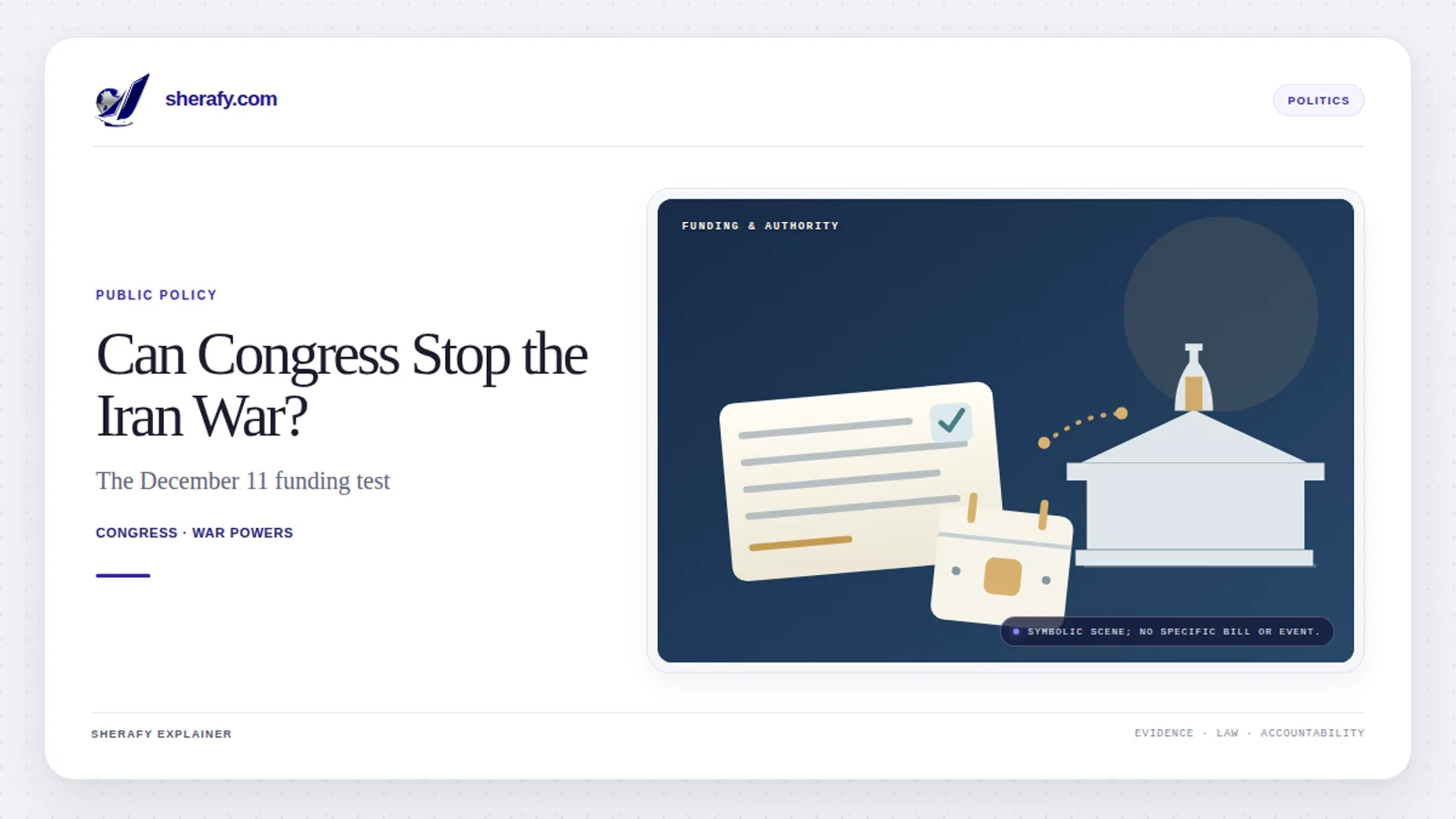
# Can Congress Stop the Iran War? The December 11 Funding Trap Behind Cenk Uygur's Warning
Yes, Congress can legally restrict funding for military operations against Iran. But passing an antiwar resolution, refusing a government spending bill, and enacting an actual prohibition on combat expenditures are three different things. The first has already happened. The second could trigger a shutdown without stopping the fighting. The third requires legislation that can survive a Republican-controlled Congress and President Donald Trump's veto power.
That distinction is at the center of a fast-approaching political test. Under P.L. 119-103, the current continuing-appropriations law, temporary funding expires December 11, 2026; the Congressional Research Service explains the law's coverage and duration. Democrats won both chambers in the November 3 midterms, according to the Associated Press's election-call chronology, but the new Congress does not convene until January. In the meantime, lawmakers must decide whether the next spending agreement should restrict U.S. combat operations against Iran.
On November 12, commentator Cenk Uygur made a striking prediction. The supplied material identifies a post from that date, but its original X permalink could not be independently confirmed in this review; the analysis below treats it as an attributed forecast, not as proof. He warned that Democratic leaders would remain in place, Congress would fail to cut off war funding during the lame-duck session, Trump and Defense Secretary Pete Hegseth would escalate the war, and the incoming Democratic majority would then argue that funding could not be interrupted while troops were fighting. Uygur suggested that such an outcome would show events had been planned in advance.
The forecast is worth investigating. There is documented pressure from Israeli Prime Minister Benjamin Netanyahu for renewed U.S. military action. There is also evidence that senior Trump aides considered military escalation after the midterms, long before Uygur posted his prediction. But there is not yet evidence establishing a jointly scripted Israeli-American plan to preserve Democratic leadership and manipulate congressional funding decisions.
The more troubling possibility does not require one. Political incentives, donor relationships, presidential veto power, legislative procedure, and the reluctance to confront an ongoing war can reinforce one another without a written conspiracy.
Here is what the public record actually establishes, what history teaches, and how to determine who is responsible for the decisions that come next.
The answer in five findings
- Congress has already voted to direct the removal of U.S. forces from unauthorized hostilities with Iran. The House passed H.Con.Res. 86 in June, and the Senate agreed to it 50-48. The administration disputed its legal effect, and the conflict continued. The official enrolled resolution is public.
- December 11 is a real negotiating deadline, not an automatic war-ending date. The present continuing resolution expires that day. A lapse in appropriations is not equivalent to an enacted prohibition on combat spending.
- Some Democrats are already demanding a funding restriction. Senators Chris Van Hollen, Michael Bennet, Tammy Duckworth and Bernie Sanders released an explicit November 12 commitment. Senator Tim Kaine is working on legislative language, according to Roll Call. Other leaders are less specific about whether they will force the issue in December.
- Netanyahu's push for military escalation is documented, but Trump's agreement is not. Axios reported on November 13 that Netanyahu was pressing for renewed operations while Trump had resisted that request.
- History shows both possible outcomes. Congress imposed a consequential combat-funding cutoff in 1973. In 2007, lawmakers ultimately funded the Iraq War after a presidential veto. In 2019, Trump vetoed a bipartisan Yemen war-powers measure, and Congress failed to override him. The details of the legislative instrument determine the result.
Why Cenk Uygur's prediction is plausible, but not proof of a secret plan
Uygur's November 12 post laid out five predicted developments: the retention of Hakeem Jeffries and Chuck Schumer; no effective lame-duck funding cutoff; a substantially larger war with Iran; a future Democratic argument that the fighting is too advanced to stop; and media attacks on Americans who question Israeli influence.
It is possible to agree that this political sequence is a serious risk without agreeing that its occurrence would prove advance coordination.
A forecast can be accurate because the forecaster recognizes existing incentives. A politician may prefer avoiding a shutdown. A president may oppose restraints on military operations. A foreign government may seek U.S. support. A congressional leader may prefer preserving an established governing coalition. A president may escalate before a new Congress arrives. If those preferences converge, the resulting policy can be remarkably predictable even without secret instructions.
The distinction is not a defense of those outcomes. It is how to investigate their cause.
The question is not whether the prediction sounds believable. It is which decisions are already documented, which decisions remain open, and what evidence would establish responsibility.
What happened before the December funding confrontation?
The chronology matters because key parts of the scenario predate Uygur's post.
| Date | What happened | Why it matters |
|---|---|---|
| February 28, 2026 | U.S. and Israeli strikes on Iran began the major conflict. | The predicted development is renewed escalation, not the start of a war. |
| April-June | A ceasefire and later U.S.-Iran memorandum of understanding briefly offered a diplomatic path; the agreement subsequently collapsed. | The conflict has already alternated between fighting and attempted negotiation. |
| June 3 and June 23 | The House and Senate, respectively, agreed to H.Con.Res. 86 directing the removal of forces from unauthorized Iran hostilities, with specified defensive exceptions. | Congress registered opposition without securing an enforceable withdrawal. |
| September 2 | Reuters reported that Trump aides wanted to avoid escalation before the midterms and could revisit military options afterward. | Post-election escalation was under discussion well before Uygur's forecast. |
| September 15 | The House passed another Iran war-powers measure, H.Con.Res. 93, 220-204. | Congress repeated its opposition; the Senate had not yet completed its consideration. |
| November 3 | Democrats won control of the incoming House and Senate. | They will have stronger agenda-setting power in January, not during the outgoing session. |
| November 9 | Jeffries and Schumer publicly pledged to stop the Iran war. | Their own statement creates a standard against which later decisions can be measured. |
| November 12 | Four senators announced they would not accept a short-term funding deal without restrictions on Iran operations. | The funding fight is not merely hypothetical. |
| November 13 | Axios reported that Netanyahu was pressing Trump to resume military operations, while Trump had resisted. | There is evidence of Israeli pressure, not evidence that it has prevailed. |
The war chronology and June-September congressional actions are documented in the Congressional Research Service's U.S. Conflict with Iran report, the House Clerk's June roll call, the Senate's June roll call, and the House calendar's official resolution histories. The Associated Press called Democratic control of both chambers after the November 3 election in its official election-call chronology. The September election-timing report came from Reuters. The leadership pledge is preserved in Jeffries and Schumer's November 9 statement.
A September report that officials might reconsider escalation after Election Day does not prove they decided to escalate. It does establish that the timing question was already part of the administration's reported internal discussions.
Congress already voted to end the hostilities. Why didn't it work?
This is the most important overlooked fact in the story.
On June 3, 2026, the House approved H.Con.Res. 86 by 215-208. On June 23, the Senate agreed 50-48. The official enrolled text directs the president to remove U.S. forces from hostilities against Iran unless Congress specifically authorizes the use of force, while preserving a limited exception for necessary defense against imminent attack.
The resolution did not end the fighting. Why?
A concurrent resolution is not the same as a law
A concurrent resolution is agreed to by both chambers but is not sent to the president for signature or veto. The Iran measure relies on Section 5(c) of the 1973 War Powers Resolution, which originally contemplated Congress directing the removal of troops through that procedure.
In 1983, however, the Supreme Court's decision in INS v. Chadha created a major constitutional problem for legislative veto mechanisms that bypass presentation to the president. The Court did not specifically decide the validity of Section 5(c) in that case. But the Congressional Research Service's analysis of the War Powers Resolution describes the concurrent-resolution withdrawal provision as constitutionally suspect after Chadha.
The Trump administration adopted that position explicitly. In its June 23 statement opposing H.Con.Res. 86, it argued that the measure lacked the force of law and impermissibly intruded on presidential authority.
That is the administration's legal position, not a Supreme Court judgment directly striking down this specific resolution. Still, it helps explain why the vote did not create the same practical constraint as a statute prohibiting the use of funds.
A majority vote against a war is not necessarily a legally effective order to stop it.
What about the War Powers Resolution's 60-day limit?
The War Powers Resolution also contains a separate provision requiring the president to terminate certain uses of armed forces within 60 days, with a possible 30-day extension, unless Congress provides the required authorization or another statutory condition applies. That limit is distinct from Section 5(c)'s concurrent-resolution mechanism.
It is not a simple stopwatch that starts whenever television coverage calls an operation a war. The law ties its timing to reports submitted or required under Section 4(a)(1), and administrations have long contested how "hostilities" and reporting obligations apply to particular missions. The Iran conflict's ceasefires, renewed fighting and executive assertions of authority make the legal dispute even more fact-specific. The CRS War Powers Resolution guide explains the disputed trigger and enforcement history.
A serious legal assessment must address those questions, but it would be misleading to claim the mere passage of 60 calendar days automatically shut down all military activity.
Another Senate war-powers vote is scheduled
On September 15, the House approved H.Con.Res. 93, another measure addressing unauthorized hostilities with Iran. A November 9 Senate unanimous-consent agreement, recorded in the official Senate calendar, calls for a vote on that measure by November 20.
That would be a meaningful recorded decision. It should not, however, be confused with a vote on a new, enforceable war-funding prohibition. Nor should a vote's scheduling be treated as proof of its ultimate result.
What actually happens on December 11, 2026?
The Continuing Appropriations and Extensions Act, 2027, enacted September 2, provides temporary federal appropriations through December 11. Absent new appropriations, some government activities could face a funding lapse beginning December 12.
That deadline gives lawmakers leverage because keeping government agencies funded usually requires legislation that both chambers and the president can accept. But it is not an on-off switch for the war.
There is another distinction buried in the debate over "billions for the war." The Congressional Research Service's September Iran report cites a Congressional Budget Office estimate that U.S. military operations had cost $38 billion through August 1, 2026. That is a dated estimate of costs incurred, not a single existing account labeled "Iran war" and not the amount automatically made available by the December spending deal. Military activity draws on multiple appropriations and authorities. A meaningful restriction must be written to reach them.
Four possible outcomes must be distinguished:
| Outcome | What it means for the Iran war |
|---|---|
| Congress passes another continuing resolution without an Iran restriction. | Agencies receive continued temporary appropriations under that law. Military operations may continue using available funds and authorities. The bill need not contain a line explicitly labeled "Iran war funding" to matter. |
| Congress passes a continuing resolution with a targeted combat-spending prohibition. | If signed or enacted over a veto, the restriction could legally constrain specified operations. Its real effect depends on its scope, exceptions, effective date and treatment of previously available funds. |
| Congress fails to pass a spending bill. | A government shutdown or partial shutdown may follow, but military activities supported by other available appropriations or applicable emergency exceptions may continue. A shutdown is not a surgical defunding mechanism. |
| Congress enacts a separate binding war restriction. | A stand-alone law could impose withdrawal requirements or prohibit specified expenditures, subject to veto, constitutional disputes and implementation. It need not wait for a continuing-resolution deadline. |
The Government Accountability Office's shutdown guidance explains why already available multiyear or no-year funds can continue supporting activities during a lapse. Some work can also continue under narrow exceptions to the Antideficiency Act, including activities necessary to protect human life and government property.
So when someone says Congress can "defund the war," the next question is essential: Which money, for which activities, under what legal restriction?
What would an effective war-funding prohibition need to address?
Congress would have to decide whether its language reaches funds from previous laws as well as future appropriations. It would also need to define what is prohibited: offensive airstrikes, ground operations, naval actions, logistical support, or some combination. Exceptions for protection of U.S. personnel, withdrawal, medical evacuation and responses to imminent attacks would require careful drafting.
These choices are not trivial loophole-hunting. The legal coverage determines whether the measure reaches the conduct lawmakers say they want to stop.
As of this article's November 14 research cutoff, Senator Tim Kaine was developing legislative language, but a finalized, agreed congressional restriction had not been established by the records reviewed here. No hypothetical wording should be mistaken for an introduced bill.
Could a longer spending deal postpone the confrontation?
Yes, politically, although not by removing Congress's legal powers.
Roll Call reported that the administration was considering a stopgap measure potentially lasting until March 2027. No final decision had been announced. A longer agreement without an Iran-specific restriction could reduce the immediate leverage of another funding deadline after Democrats take power in January.
The new Congress could still introduce restrictions, hold hearings, or pursue separate legislation. But it might have fewer must-pass spending negotiations in which to demand a concession.
That is why the length of the next spending agreement matters alongside the actual language about military operations.
Can Democrats force a funding cutoff if Republicans still control Congress?
Not by themselves during the lame-duck session.
Republicans currently control the House and Senate, and Trump remains president. A proposal must survive the relevant House and Senate procedures and either obtain his signature or win enough votes to override a veto. In the Senate, many ordinary legislative measures also face a 60-vote cloture hurdle.
House Appropriations Chairman Tom Cole has indicated that Republicans do not intend to send Trump a spending package they expect him to veto, according to Roll Call's November 12 reporting.
These are genuine constraints. It would be misleading to claim Jeffries or Schumer could single-handedly enact a war-funding ban.
But inability to guarantee enactment does not mean inability to act. Minority leaders and individual senators can propose restrictions, demand recorded votes where procedures allow, make government funding contingent on negotiations, and publicly identify the terms they are willing to accept. Once Democrats take control in January, they will have greater power to set agendas, organize committees, conduct oversight and advance legislation, even though they will still face Trump's veto.
The accountability test must therefore distinguish an unsuccessful effort to pass a restriction from a decision not to pursue one.
Three historical examples explain why the distinction matters
The argument that lawmakers cannot interrupt war funding once combat begins is not supported as a universal rule by American history. But history also shows that congressional opposition is not enough unless lawmakers can overcome the president and enact an effective measure.
Cambodia, 1973: Congress used a funding cutoff that took effect
The United States was already conducting combat operations in Indochina when Congress enacted restrictions preventing appropriated funds from financing specified U.S. combat activities after August 15, 1973. The funding cutoff was part of legislation signed into law by President Richard Nixon, and U.S. bombing of Cambodia ended on the deadline.
The Congressional Research Service's history of military funding cutoffs reproduces the operative funding restrictions and explains how Congress used appropriations to constrain military activity.
The lesson is specific: when Congress enacts a binding prohibition that reaches the relevant money and operations, an ongoing war does not make the power of the purse disappear.
Iraq, 2007: Democrats won Congress, but the president vetoed withdrawal conditions
After Democrats won the 2006 midterms amid frustration with the Iraq War, Congress approved a supplemental funding package that included withdrawal provisions. President George W. Bush vetoed it on May 1, 2007. The House failed to override the veto on May 2.
Later that month, Congress approved a revised package providing roughly $120 billion in supplemental appropriations without the earlier Iraq withdrawal timetable. Bush signed it May 25. The CRS account of the FY2007 supplemental documents the sequence.
This is a direct warning against assuming that an antiwar election result automatically produces an end to war funding. A congressional majority can oppose a war, attempt restrictions, lose a veto confrontation, and ultimately approve continued funding.
Yemen, 2019: Trump vetoed a bipartisan withdrawal measure
Congress passed a joint resolution directing the removal of U.S. forces from unauthorized hostilities affecting Yemen. Unlike the 2026 Iran concurrent resolutions, the measure went to the president. Trump vetoed it on April 16, 2019. On May 2, the Senate voted 53-45 to override, short of the required two-thirds majority.
The official Senate veto-override record and CRS history of congressional action on Yemen establish that result.
Taken together, these cases answer the practical question better than the slogan "Congress controls the purse" or the counter-slogan "the president controls the military."
Congress has tools. Whether those tools work depends on the legislation, the votes, and the willingness to sustain a confrontation.
Is Netanyahu trying to draw Trump into a larger Iran war?
There is direct contemporary reporting that Netanyahu is pressing for renewed U.S. military action. There is not, at present, direct evidence that the pressure has succeeded.
On November 13, Axios reported that Mossad director Roman Gofman was in Washington for meetings with senior U.S. officials while Netanyahu urged Trump to resume military operations against Iran. According to the report, Trump had resisted the requests and favored maintaining naval and economic pressure while exploring a deal. Gulf governments also reportedly preferred delaying major escalation.
The same reporting describes a volatile Israeli political transition. After the October 27 election, Netanyahu lacked a parliamentary majority, and opposition leader Gadi Eisenkot had been tasked with trying to form a government. Some Israeli opposition figures expressed concern that renewed fighting could affect that transition. Their concern is not proof that Netanyahu has decided to provoke war for domestic political gain.
There is also an independent American timeline. On September 2, Reuters reported, citing four people familiar with discussions, that senior Trump aides wanted to avoid a major escalation before November's elections and might reconsider after the vote. Reuters explicitly cautioned that a return to full-scale war was not certain.
These reports support the assessment that the risk of renewed escalation is real. They do not establish that the U.S. president has surrendered decision-making authority to Netanyahu, or that congressional leaders have agreed to a common plan.
The difference matters precisely because U.S. officials possess agency. If Washington escalates, the public should demand the actual U.S. decision record: who recommended the operation, under what claimed authority, with what stated objective, and after what consultation with Congress.
What about AIPAC money and the Hegseth impeachment controversy?
Political influence is relevant to the investigation, but only if the financial and legislative records are kept separate.
In a related sherafy.com examination of Elect Democratic Women and the AIPAC money trail, federal filings documented $2.35 million in transfers from United Democracy Project, the super PAC affiliated with the U.S.-based American Israel Public Affairs Committee, to EDW Action Fund during the 2025-2026 cycle. Those transfers were roughly 24% of EDW Action Fund's reported gross receipts through October 14. They do not establish that AIPAC paid for a particular November reception, directed any member's vote, or acted on instructions from Israel's government.
The distinction between a U.S. advocacy organization, an affiliated super PAC, a separate political committee, and a foreign government is not cosmetic. Each relationship requires its own evidence.
Uygur also predicted political protection for Defense Secretary Pete Hegseth. On November 10, the House voted 211-204 to refer an impeachment resolution concerning Hegseth to committee. The House Clerk's official roll call records 18 members absent, including 11 Democrats. This was a vote on referral, not a final vote to impeach. A companion sherafy.com investigation reconstructs the missing votes and attendance questions.
Those are legitimate accountability subjects. They are not automatic proof of a coordinated effort to preserve Hegseth, and they should not be treated as substitutes for examining the approaching Iran appropriations bill.
What have Schumer, Jeffries and other Democrats actually promised?
There is no need to guess at every leader's position. Several commitments and unresolved choices are on the public record.
On November 9, Chuck Schumer and Hakeem Jeffries jointly stated that the incoming Democratic Congress had a mandate to stop the war in Iran. The statement did not specify binding legislative text or a December negotiating condition.
On November 12, Van Hollen, Bennet, Sanders and Duckworth went further. They said a short-term spending package should restrict the administration from using appropriated funds to continue the war. Kaine said he was drafting language for that effort.
Other party figures have not made the same procedural commitment. Roll Call reported that Senate Appropriations leader Patty Murray supported language to stop the war but had not committed to forcing the fight in December rather than after Democrats take power. Jeffries deferred to House appropriations leader Rosa DeLauro's assessment of what could be negotiated before December 11.
There is also a leadership dispute that Cenk's forecast cannot treat as settled. On November 13, Chris Van Hollen announced a challenge to Schumer for Senate Democratic leader. Schumer remains a formidable incumbent, but the outcome of the internal leadership election was not known at this article's cutoff. Our separate Senate leadership comparison explains the broader policy and voting-record dispute.
This leaves a measurable difference between a promise, a proposal, an attempted vote and a law. Leaders should be judged on the actual stage they reach, not just the speeches they give or the outcomes they cannot unilaterally control.
Do voters want the Iran war to end?
The available polling suggests substantial public opposition to continuing the conflict, although no single survey establishes why every voter chose a particular candidate.
In the November 4-6 Economist/YouGov survey of registered voters, 64% preferred ending the Iran war as quickly as possible, even if some U.S. objectives remained unachieved. 23% preferred continued fighting until all objectives were achieved, and 12% were unsure. The survey included 3,166 registered voters; the figures are rounded.
The same survey found that 60% regarded the decision to go to war in Iran as wrong, compared with 23% who regarded it as right. YouGov's post-election analysis also found a strong association between opposition to the war and voting for Democratic House candidates.
Those results do not give Congress a blank check to disregard legal or operational consequences. They do give elected officials a compelling reason to explain, in public and in detail, why any decision to continue the war is necessary and why proposed alternatives would not work.
The recursive test: coordinated plan or predictable institutional behavior?
There are at least three explanations for how Uygur's predicted sequence could unfold. They should be evaluated against different kinds of evidence.
| Explanation | What would support it | What the evidence currently establishes |
|---|---|---|
| Coordinated strategy | Direct communications, explicit commitments or documented arrangements linking Israeli requests to U.S. leadership and funding decisions. | Israeli pressure and U.S. political relationships are documented. A shared operational plan is not. |
| Converging incentives | Different actors independently favoring the same outcome: escalation, avoiding a shutdown, preserving leadership or postponing a vote. | Several of those incentives are observable and fit the available reporting. They do not prove causation in an individual vote. |
| Institutional bargaining | Decisions explained by Republican control in December, a presidential veto threat, Senate procedure, funding already available and risks associated with a shutdown. | These are real constraints. They do not explain, by themselves, whether every possible alternative was pursued. |
A prediction coming true is not proof of the first explanation. If political actors are already publicly signaling their incentives, some outcomes may be foreseeable without hidden coordination. The stronger test is whether newly released communications, legislative negotiations or recorded decisions distinguish one explanation from the others.
Equally, an absence of a leaked memo is not proof that influence does not exist. Evidence of incentives and relationships can support a careful inference. But inference has to stop where the record stops.
Criticism of Netanyahu's government, Israeli policy, U.S. military support, or American political financing is not inherently antisemitic. Nor should criticism of a foreign government's influence be converted into an unsupported allegation that Jewish Americans collectively direct U.S. policy. Governments, donors, politicians and voters are separate actors. That separation makes an investigation more accurate, not less forceful.
A scorecard for Cenk Uygur's prediction
Rather than argue indefinitely about whether his post was prophetic, readers can test its components against future public records.
| Claim | Status on November 14, 2026 | Evidence that would test it |
|---|---|---|
| Jeffries and Schumer remain in leadership. | Unresolved. Senate leadership is contested; future conference decisions remain pending. | Leadership election results and any available member statements. |
| No effective Iran war-funding cutoff advances in the lame-duck session. | Unresolved. Senators are preparing restrictions; the December negotiations have not concluded. | Published amendment text, committee actions, procedural votes and final funding legislation. |
| Trump and Hegseth dramatically escalate the war before the new Congress. | Unresolved. Pressure and discussions are reported; renewed major operations have not been established by those reports. | Official military announcements, operational records and independently verified chronology. |
| Democratic leaders later say it is too late to restrict funding during combat. | Future claim. No such post-January justification can yet be observed. | Attributable statements, proposed alternatives and actual votes after January 3. |
| Media broadly label people noticing the alleged scheme antisemitic. | Not a sufficiently specific forecast as phrased. It lacks a defined sample and clear criteria. | Identifiable statements and a consistent method distinguishing criticism of state policy from prejudice against Jews. |
Even if several elements occur, the additional claim that events were "pre-scripted" requires evidence of planning or coordination. It does not follow automatically from the sequence.
The next four dates that matter
November 20, 2026: Under the Senate's November 9 agreement, a vote on H.Con.Res. 93 must occur by this date. The result will show the Senate's position on a war-powers measure, not necessarily its position on a binding funding cutoff.
Early December 2026: Senate Democrats are expected to choose their leader. That decision affects priorities and floor strategy in the incoming Congress, but does not alter Republican control during the remaining lame-duck session.
December 11, 2026: The current continuing resolution expires. The actual text, duration and vote history of any replacement funding law will be the central evidence for evaluating whether Congress attempted to restrict the war.
January 3, 2027: The new Congress is scheduled to begin. Democratic majorities can exert substantially greater agenda-setting and oversight power, while the president retains his veto.
The public accountability record should track who proposed a restriction, its exact wording, who controlled whether it advanced, who voted on it, what alternatives existed, and what ultimately became law. A promise without those details is not yet a policy outcome.
Frequently asked questions
Can Congress stop President Trump's war with Iran?
Congress can pass legislation directing withdrawal or restricting the use of federal funds for specified combat operations. But such legislation must survive both chambers and presidential presentment, or win a two-thirds veto override. The president may also raise constitutional objections. Congress cannot guarantee an end to fighting by passing a nonbinding resolution alone.
Can Democrats defund the Iran war on December 11?
They can demand or propose a targeted funding restriction as part of December negotiations. They cannot enact one by themselves while Republicans control both chambers and Trump is president. The legal effect would depend on the final enacted language, not merely on a political statement about ending the war.
Would a government shutdown automatically stop military operations in Iran?
No. Activities backed by available appropriations can continue, and limited exceptions can apply during a funding lapse. The GAO's shutdown guidance explains why stopping a continuing resolution is not equivalent to prohibiting combat expenditures.
Why didn't the June 2026 war-powers vote end the fighting?
H.Con.Res. 86 passed both chambers, but it was a concurrent resolution rather than a law presented to the president. The administration argued that its withdrawal mechanism lacked binding force after INS v. Chadha. The separate 60-day War Powers Resolution provision also raises disputed questions about qualifying hostilities and reporting triggers. Congress has other legislative and appropriations tools, but their effectiveness depends on enactment and enforcement.
Could Trump veto a bill cutting off war funding?
Yes. A statutory funding restriction ordinarily must be presented to the president, who may veto it. Congress would need two-thirds of each chamber to override. Trump's 2019 veto of a Yemen war-powers joint resolution is a documented example of this obstacle.
Is Cenk Uygur right about an Israeli plan to escalate the Iran war?
His warning identifies a real risk, but his central allegation of a prearranged plan is unproven. Reporting establishes that Netanyahu is pressing for renewed U.S. operations and that U.S. officials have considered post-election escalation. Reporting also indicates Trump has so far resisted Netanyahu's requests. Those facts support scrutiny, not a conclusion of secret coordination.
Could Congress still act if a new spending bill runs into March 2027?
Yes. A longer continuing resolution would not eliminate Congress's power to legislate, investigate or attach restrictions to other measures. It could, however, postpone another immediate spending deadline and change the leverage available to lawmakers seeking concessions.
Does an election victory give a congressional majority the power to end a war immediately?
No. A majority can control agendas and pass measures, but the Senate's procedural rules, the president's veto and existing funding arrangements can prevent the majority's policy from taking legal effect. Voters can still evaluate whether their representatives made serious, documented efforts to use the powers available to them.
The real test is not whether the prediction comes true
Cenk's forecast captures a serious danger: an unpopular war can survive an election that changes congressional control, not because voters are irrelevant, but because government action passes through institutions with their own incentives and obstacles.
The constitutional obstacles are not imaginary. Trump can veto a law. Republicans control the outgoing Congress. A shutdown can hurt people without ending a military mission. None of those facts excuses a leader from explaining what was attempted, what failed, and what was traded away.
History has already answered the claim that a war becomes legally untouchable once fighting begins. Congress imposed a combat-funding cutoff in 1973. It also failed to sustain withdrawal conditions in 2007 and failed to override a presidential veto in 2019. There is no magical point at which appropriations cease to be Congress's business.
What remains unanswered is how today's leaders will use that power.
Americans do not need proof of a secret script to demand a public accounting of every consequential decision. The legislation, votes and funding records will show who tried to stop the war, who blocked those efforts, and who decided that continuing it was acceptable.
References and Further Reading
Primary congressional and government records
- Congressional Research Service: U.S. Conflict with Iran (updated September 18, 2026). Documents the conflict's chronology, objectives, costs, congressional war-powers activity and appropriations issues. Its military and cost figures reflect the report's cutoff, not necessarily November 14 totals.
- U.S. Government Publishing Office: H.Con.Res. 86, enrolled resolution (June 23, 2026). Primary text of the measure agreed to by both chambers, including the withdrawal directive and defensive exception. The House Clerk roll call and Senate roll call record the 215-208 and 50-48 votes.
- House Calendar: Legislative history of Iran war-powers resolutions (October 9, 2026). Official House action histories for H.Con.Res. 86, 89 and 93, including vote totals.
- U.S. Senate Calendar: Agreement to consider H.Con.Res. 93 (November 12, 2026, page 2). Records the November 9 agreement to hold a Senate vote by November 20.
- Continuing Appropriations and Extensions Act, 2027, P.L. 119-103 (September 2, 2026), and the Congressional Research Service overview (September 17, 2026). The statute establishes the temporary funding period; CRS explains its coverage and duration.
- Government Accountability Office: Shutdowns and Lapses in Appropriations. Explains the Antideficiency Act, still-available appropriations and exceptions during funding gaps.
- Congressional Research Service: The War Powers Resolution, Concepts and Practice. Explains the division of constitutional war powers and why the concurrent-resolution mechanism is contested after INS v. Chadha.
- U.S. House Clerk: Roll Call 317 on Hegseth impeachment referral (November 10, 2026). Official vote tally and member-by-member participation.
Historical evidence
- Congressional Research Service: Congressional Use of Funding Cutoffs Since 1970 (January 16, 2007). Documents the 1973 Indochina combat-funding restrictions and other military funding cutoffs.
- Congressional Research Service: FY2007 Supplemental Appropriations (July 2, 2007). Reconstructs the Iraq-war supplemental, Bush's veto and the subsequent enactment without the original withdrawal timetable.
- U.S. Senate: May 2, 2019 Yemen War Powers Veto Override Vote. Primary record of the failed 53-45 vote to override Trump's veto.
Statements, polling and independent reporting
- Van Hollen, Bennet, Sanders and Duckworth: Statement on Iran Funding (November 12, 2026). Direct evidence of their commitment to demand restrictions in a short-term funding package.
- Jeffries and Schumer: Joint Democratic Leadership Statement (November 9, 2026). Records their public pledge to stop the war. The Associated Press election-call chronology documents the Democratic wins in both chambers on November 3 and 4.
- The Economist/YouGov Poll: November 4-6, 2026 Crosstabs (questions 45 and 46). Original wording and detailed results on whether the war was justified and whether it should end quickly.
- Reuters: Trump Aides Seek to Keep Iran War Quiet Before Midterms (September 2, 2026). Original reporting about internal discussions of electoral timing and possible post-election escalation.
- Axios: Israeli Spy Chief in Washington as Netanyahu Presses Trump (November 13, 2026). Reporting on Israeli pressure, Trump's resistance and Israel's political transition.
- Roll Call: Democrats Mull Iran War Funding Cutoff Strategy (November 12, 2026). Reporting on Kaine's legislative drafting, Democratic leadership positions and possible continuing-resolution duration.
Related sherafy.com investigations
- Who Funds Elect Democratic Women? The AIPAC Money Trail and the Hegseth Vote. Distinguishes documented committee transfers from unsupported claims about payment for a specific event or individual voting motive.
- 11 Democrats Missed the Pete Hegseth Impeachment Vote. Reconstructs the official vote and procedural consequences without conflating referral and impeachment.
- Why Chris Van Hollen Should Replace Chuck Schumer as Senate Majority Leader. Examines the policy and leadership comparison separately from the Iran funding mechanism.
Editorial currency note: The evidence and political status described here were checked through November 14, 2026. Future military operations, votes, funding bills and leadership elections can change the assessment. Poll figures are dated to their fieldwork, and the September CRS conflict report is not a real-time casualty or cost tracker. Cenk Uygur's prediction is drawn from his November 12 social-media post supplied to sherafy.com; its original post URL was not independently confirmed for inclusion in this source list.
16:9 Featured Image Prompt: Editorial investigative illustration, widescreen 16:9. A sharply lit, realistic view of the U.S. Capitol's congressional chamber in the foreground, with an open appropriations bill and a visible but unmarked calendar page on a desk. In the background, two distinct translucent layers: a distant military aircraft silhouette over a desert horizon and the faint outline of the White House. The visual metaphor is congressional control over funding and war decisions, not a secret conspiracy. Moody neutral slate and muted gold palette, professional geopolitical briefing style, substantial clean negative space for website crops, no politicians' faces, no national flags, no explosions, no fabricated documents, no text, no logos, no sensational imagery.