Open Source Ecology is trying to do for heavy machinery what an Erector Set does for model building: create different machines from a shared collection of reusable parts. Its engineers have built modular tractors, detachable hydraulic power units and machines that press soil into construction blocks. They have also published plans for other people to study and reproduce.
But there is an important limit to the analogy. You cannot download a finished, universally interchangeable set of 50 construction machines and start assembling them like a toy. The working prototypes are real; the complete industrial system remains a development goal. Open Source Ecology’s own 2026 assessment says most of its proposed machinery is not yet a standardized, commercially mature product.
The interesting story is what the project’s machinery actually shares, how those parts can work together, and how far the idea has progressed beyond the original workshop.
What Is Open Source Ecology?
Open Source Ecology (OSE) was founded in 2003 by Marcin Jakubowski, a physicist who turned to farming and became frustrated with the cost and complexity of equipment. His idea was to make industrial machinery easier to fabricate, maintain and improve by releasing its engineering documentation openly.
In a 2011 TED talk, Jakubowski described a proposed set of 50 machines for building and supporting a small, technologically capable community. He called it the Global Village Construction Set (GVCS).
The machine list spans farming, construction, fabrication, power and transportation. It includes a tractor, bulldozer, backhoe, compressed-earth block press, CNC cutting equipment, sawmill, generator and other equipment. The number 50 represents the project’s proposed inventory, not 50 completed designs ready for commercial use.
The concept is more ambitious than making a cheaper tractor. OSE wants the machines to share parts and, where practical, help manufacture or repair one another.
How Does the Giant Erector Set Idea Work?
The approach has three distinct layers. They should not be confused with one another.
1. A frame assembled from standard steel pieces
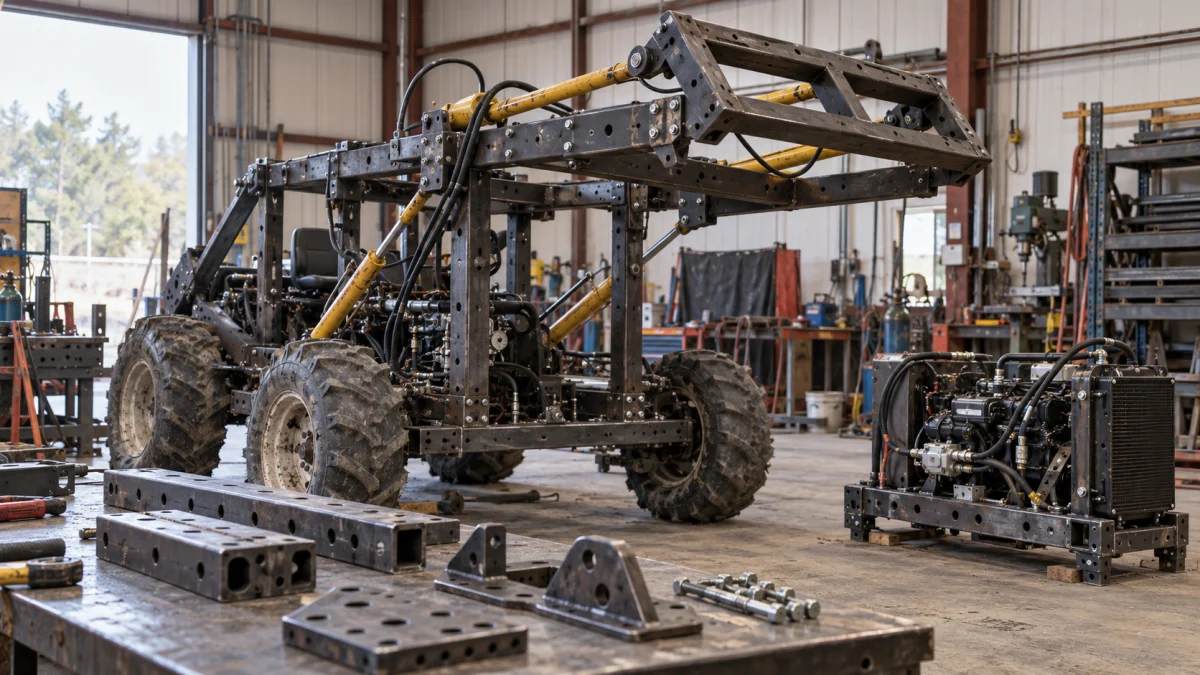
OSE’s LifeTrac tractor is the clearest physical example. Rather than relying entirely on a custom vehicle frame, several LifeTrac iterations use square steel tubing, plates and bolts to form a configurable structure.
OSE describes 4-by-4-inch structural tubing and bolt-together connections as fundamental building blocks. Its stock-tubing documentation gives examples using quarter-inch-wall steel sections with predrilled holes.
That is where the Erector Set comparison becomes literal: repeated structural pieces can be connected in different arrangements. A damaged member may also be replaceable without scrapping the entire machine.
This is not a claim that any arrangement of beams is structurally safe. Different machines place different bending, twisting and shock loads on the same parts. Connections, welds, axle loads and frame geometry still require engineering analysis.
2. A detachable hydraulic power unit
OSE’s second major building block is the Power Cube, a self-contained unit combining an engine, hydraulic pump, fluid reservoir and associated hardware.
Its basic operating principle is straightforward:
Engine turns pump → pump pressurizes hydraulic fluid → fluid drives a motor or cylinder → machinery moves or applies force.
A compatible Power Cube can supply power to more than one kind of machine. For example, OSE has used this approach with its tractor and compressed-earth block press. The project’s 2012 assembly report documents Power Cube builds and describes its use with LifeTrac.
There is a practical restriction: hydraulic systems must match in pressure, flow, fittings, controls and required power. Quick-connect hoses make attachment easier; they do not make an undersized pump capable of operating every machine.
Sharing a power unit also creates a capacity tradeoff. Running a tractor and a separate press at the same time would require sufficient hydraulic power and a compatible circuit; moving one Power Cube between machines does not give both machines independent power.
3. Attachments and shared fabrication tools
Loader buckets, implements and other assemblies can give one base machine different jobs. That is familiar territory: conventional tractors and skid steers already use interchangeable attachments and hydraulic couplers.
OSE’s more unusual proposition is to extend this logic into the chassis, power system and manufacturing process, while publishing the underlying design files.
A CNC cutting table can help make repeatable steel brackets and plates. A welding shop can build frames. Standardized components can simplify repairs. OSE’s LifeTrac Construction Set describes a much wider family of possible vehicles based on shared modules.
However, a proposed bulldozer configuration in a design library is not proof that a functioning tractor can be converted into a safe, production-ready bulldozer in a few minutes. Some combinations are demonstrated hardware; others remain design intentions.
What Is Actually Interchangeable?
The most useful way to understand the system is to separate reusable parts from complete machine functions.
| Building block | What can be reused | What still has to be checked or redesigned |
|---|---|---|
| Steel tubing and connection plates | Structural members with matching dimensions and hole patterns | Frame strength, geometry, joints and load paths |
| Power Cube | An engine-and-pump assembly serving compatible hydraulic equipment | Pressure, flow, power rating, cooling and controls |
| Hydraulic components | Certain hoses, motors, cylinders and fittings | Ratings, mounting, contamination control and safe operation |
| Loader attachments | Tools with compatible mechanical and hydraulic interfaces | Lift capacity, stability and attachment-specific hazards |
| Design files and workshop tooling | CAD models, cut patterns and manufacturing methods | Material availability, tolerances, quality control and testing |
The result is closer to a common engineering platform than to a single machine that magically changes into every item on the list.
A Real Example: From Moving Soil to Making Building Blocks
The clearest demonstration of the system is OSE’s early earth-building work.
A compressed-earth block building project needs soil handling, soil preparation and a method of forming blocks. OSE developed several machines to address those separate tasks:
- LifeTrac moves soil and other materials around the worksite.
- A soil pulverizer breaks up and prepares suitable material.
- The Liberator compressed-earth block press uses hydraulic force to compact prepared soil into blocks.
- Power Cube units can provide hydraulic power to compatible equipment.
OSE reports using its tractor, soil pulverizer and brick press in its 2013 Microhouse work. The Liberator documentation records multiple versions of the press, construction uses and historical production runs.
In December 2012, OSE organized a one-day brick-press production run. That is a meaningful fabrication demonstration, but the event involved an organized team and parts prepared in advance. It does not establish that one inexperienced person can build the machine from raw materials in a day.
Nor does pressing soil blocks amount to building a code-compliant house. Block suitability, structural design, foundations, moisture protection, utilities and local approvals are separate requirements.
What Has Been Built, and What Hasn’t?
OSE’s documentation is extensive, but it contains records from different years and product versions. A page calling an older design a "release" does not necessarily mean it meets the project’s newer standards for repeatable manufacturing, support and commercial deployment.
The following is a conservative reading of the public record as of October 2026:
| Project | Evidence of progress | Important limitation |
|---|---|---|
| LifeTrac tractor | Working prototypes, field demonstrations and builds outside OSE’s Missouri workshop | Not established as a broadly validated, mass-produced tractor line |
| Power Cube | Multiple versions assembled and used to run other equipment | Not a universally compatible power source or a mature product line across all applications |
| Liberator brick press | Documented builds, production runs and use in OSE construction projects | Old design versions, historical sales descriptions and current manufacturing readiness should not be conflated |
| D3D 3D printers | OSE says it built and sold several dozen printers | OSE says operations were paused when resources shifted to housing |
| Seed Eco-Home | OSE reports completing and selling a production home in 2026 | A housing milestone does not establish completion of the 50-machine construction set |
| Full Global Village Construction Set | A defined inventory, designs and prototypes at different stages | The integrated 50-machine, product-grade system does not yet exist |
The classifications are based primarily on OSE’s 2026 completion review. That review is the organization’s own assessment, not a third-party certification of machinery performance, economic competitiveness or safety.
Can other people reproduce the designs?
There is evidence that some can. In March 2012, Polytechnic School in Pasadena documented two students, Hayden Betts and Daniel Leon, raising money and organizing a LifeTrac build based on OSE plans. In September, OSE reported that their team had completed a LifeTrac III, although its announcement also described work still needed on the machine.
This is a credible example of fabrication outside the original OSE workshop. It is not evidence of long-term commercial tractor reliability.
More recently, an OSE-hosted project log dated August 2026 reported that a LifeTrac 6 pilot assembled in Tema, Ghana, moved under its own power and underwent a dig-and-carry test. The log identifies a local fabrication partnership and lists repeatable production, field validation and service support as further work. We did not establish an independent long-term performance assessment for that pilot.
These examples support a narrower but significant conclusion: OSE machinery can be built beyond its founding workshop. Replication at scale, with consistent quality and dependable support, remains a different challenge.
How Much Does an Open-Source Tractor Cost to Build?
OSE has published strikingly low historical materials figures. Its LifeTrac I record lists about $4,000 in materials for the first prototype, completed in 2008. A later LifeTrac II bill of materials totals $7,693, including a listed 27-horsepower Power Cube and several tractor components.
These are useful historical records, not 2026 build quotes. They also are not equivalent to the delivered price of a tested commercial tractor.
A meaningful cost comparison would include:
- Steel, hydraulic hardware, engine, fittings and consumables.
- Fabrication and assembly labor, including the builder’s own time.
- Cutting, welding, machining and lifting equipment, or outsourced shop charges.
- Shipping, taxes, rework and testing.
- Safety engineering and modifications needed for the intended use.
- Maintenance, replacement parts, downtime and support over the machine’s life.
A fabricator with a well-equipped shop could have a very different cost from a first-time builder buying tools and learning how to use them. The two machines must also be compared at similar capacity, reliability and safety levels.
OSE’s low-price approach is worth investigating. But a low bill of materials does not, by itself, demonstrate a cheaper machine over its useful life. The public sources reviewed here do not establish a current, independently audited, apples-to-apples ownership-cost advantage over equivalent commercial equipment.
Does "Open Source" Mean Anyone Can Just Download and Build One?
It means the design is intended to be available for people to study, modify, make and share, subject to its applicable licenses. It does not mean the finished machine is free, simple to manufacture or automatically safe.
The Open Source Hardware Association emphasizes access to editable design files, not just photographs or a parts list. For a tractor, useful documentation would include CAD files, fabrication drawings, a bill of materials, assembly instructions and design revisions.
OSE publishes materials through its plans index, which links historical construction-kit documentation, design genealogies and replication records. Builders should confirm which version each file describes before attempting fabrication.
Open designs may also incorporate purchased components whose internal designs are not open. Buying a commercial engine, bearing or hydraulic valve does not contradict the overall concept, but it does limit how independent a local builder can be from suppliers.
OSE states that it uses CC BY-SA 4.0 for designs and GPLv3 for software. Licenses and rights should be checked for the specific project files being reused. Open-source rights do not automatically grant permission to use another organization’s trademarks.
The Safety Question Cannot Be Skipped
The biggest weakness in the toy analogy is that a full-size machine can injure or kill someone if a part fails.
This is not an abstract concern. OSE’s LifeTrac documentation contains a historical warning that structural engineering analysis had not been performed on the LifeTrac III or IV. Its LifeTrac I record also describes an articulated joint that cracked during testing and was redesigned.
Those disclosures apply to the versions and periods described; they should not be casually generalized to every later machine. They do show why a successful workshop demonstration is not the same as independently validated safety.
Heavy equipment needs appropriate evaluation of frame strength, braking, steering, stability, moving parts and hydraulic hazards. In covered U.S. agricultural employment settings, OSHA’s tractor rollover-protection rule also imposes requirements, with defined scope and exceptions. Other rules may apply depending on the machine, location and use.
An open-source hardware license, or even a certification that a design is openly documented, should never be mistaken for a machinery safety certification.
Why Has the 50-Machine Vision Taken So Long?
A prototype answers one question: Can this arrangement of parts perform the intended task?
A reproducible product has to answer harder questions: Can unfamiliar builders assemble it correctly? Will its parts meet consistent specifications? Can it operate reliably for years? Can customers obtain replacements and repairs? Can a manufacturer make it at a sustainable price?
In its current GVCS explanation, OSE estimates roughly $1 million of development per fully realized technology, or about $50 million across 50. Those are OSE planning estimates, not audited historical spending or a firm budget. The organization identifies 2028 as an aim for its GVCS 1.0 release, not a guaranteed delivery date.
OSE also says that in 2020 it redirected its main development effort toward making the Seed Eco-Home a complete product, rather than progressing every machine simultaneously. That strategic shift helps explain why the original 50-machine plan has advanced unevenly.
The underlying difficulty is familiar to industrial manufacturers: engineering a machine is one job; engineering a reliable process for other people to manufacture it is another.
So, Is Open Source Ecology a Practical Alternative to Buying Machinery?
For most buyers today, no. For capable fabricators, engineering educators and experimental workshops, parts of the project may be genuinely useful.
The practical benefit is access to a body of designs that can be examined, adapted and used to build or repair equipment. The more ambitious benefit would be a shared industrial toolkit in which compatible modules reduce dependence on specialized proprietary components.
Neither benefit should be inflated into a claim that open-source machines are universally cheaper, more durable, environmentally superior or safer than commercial alternatives. Those outcomes depend on the specific design, how it is built and how it performs over time.
Open Source Ecology’s strongest achievement is not a finished civilization in a box. It is the demonstration that some substantial machines can be designed around shared components, documented openly and reproduced by people outside the original development team.
The remaining test is whether that approach can become a dependable manufacturing system rather than a collection of impressive prototypes. That is the difference between a giant Erector Set as an engineering experiment and one as an everyday industrial tool.
References and Further Reading
Original Plans and Engineering Records
- Global Village Construction Set overview: Open Source Ecology. Explains the proposed 50-machine inventory and the modular, interconnected design goal. Includes older progress descriptions, which should not be read as current product availability.
- LifeTrac tractor design: Open Source Ecology. Describes the bolt-together frame, structural members, hydraulic drive and intended machine variations.
- Power Cube technical page: Open Source Ecology Wiki. Details the detachable engine-and-hydraulic power concept and historical revisions.
- Liberator compressed-earth block press: Open Source Ecology Wiki. Historical specifications, bills of materials and applications; much of the text is dated and should not be treated as a current sales offer.
- LifeTrac I history and testing notes and LifeTrac II materials list: Primary historical records supporting the prototype cost examples and documented engineering lessons.
Development Status and Independent Builds
- Global Village Construction Set completion status, 2026: OSE’s own appraisal of product maturity and unfinished production engineering. Important for distinguishing working prototypes from commercial releases.
- Polytechnic School students’ LifeTrac project, March 2012: Original school announcement documenting an effort to reproduce the tractor from OSE plans.
- Completed student LifeTrac build, September 2012: OSE’s subsequent account of the build and remaining mechanical work.
- LifeTrac 6 Ghana pilot log, August 2026: Project-team reporting of the Ghana pilot, not an independent durability or commercial-readiness assessment.
- OSE’s 2015 retrospective: Historical account of brick-press production runs, replication efforts and the project’s development challenges.
Independent Standards and Historical Context
- Open Source Hardware Definition: Open Source Hardware Association. Establishes what open design rights and editable documentation mean.
- OSHWA open hardware FAQ: Explains how source files, licensing and purchased closed components fit into open hardware.
- OSHA rollover-protection requirements for covered agricultural tractors: U.S. Occupational Safety and Health Administration. Relevant legal and engineering safety context, not blanket certification criteria for every DIY machine.
- Open Source Ecology: Construction Set for a Global Village: WIRED, November 2012. Useful contemporary coverage of the early project and its ambitions; reported historical savings claims are not substitutes for current independent cost testing.
Editorial currency note: Reviewed October 26, 2026. OSE’s specifications, version histories, product availability and development schedule may change. Claims drawn from the project’s own records are attributed as such; no independent certification of the full machinery system is implied.