
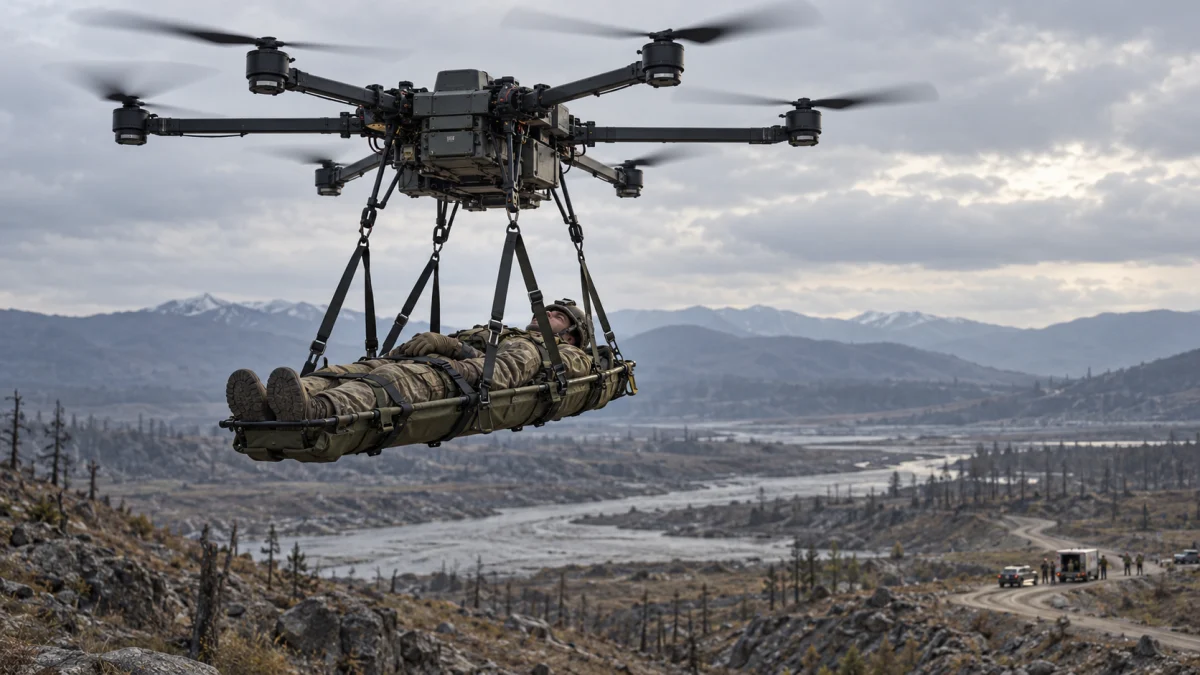
Yes, a drone can evacuate a wounded soldier. Ukrainian forces have documented a successful battlefield extraction using a large, remotely piloted hexacopter. The rescue took place on October 4, 2026, and was publicly announced on October 19. But it was not a fully autonomous flying ambulance: a human operator flew the aircraft, the casualty had to attach himself to the lifting equipment, and a ground robot and conventional vehicle completed the journey to medical care.
That distinction matters. An unmanned aircraft can carry a person without being autonomous, and it can evacuate a patient without providing medical treatment. Several companies and military research programs are now working on more sophisticated systems, including stretcher-carrying drones, enclosed medical cabins, and remotely supervised robotic care. Their demonstrated capabilities remain very different from their advertised ambitions.
The central question is no longer simply whether a drone can lift a wounded soldier. It is whether a complete uncrewed rescue system can retrieve, transport, monitor, and safely hand off patients under conditions where conventional evacuation is too dangerous or impossible.
Did a drone really rescue a wounded Ukrainian soldier?
Yes. On October 19, Ukraine’s armed forces released footage showing a wounded soldier securing himself beneath a heavy multicopter and being flown from an isolated position. Defense intelligence publication Janes identified the event as the first documented battlefield casualty evacuation of a wounded soldier by an unmanned aerial vehicle.
The aircraft was the Heavy Shot Ayudag-6, a six-rotor heavy-lift drone developed by Ukrainian manufacturer Gurzuf Defence. The participating units included elements of Ukraine’s 30th Separate Mechanized Brigade, 92nd Separate Assault Brigade, and supporting formations. The military confirmed that an operator from the 30th Brigade controlled the aircraft remotely, rather than leaving the rescue to an AI system. The soldier survived and entered treatment and rehabilitation, according to the Ukrainian military’s account carried by ArmyInform.
The rescue was more than a single drone flight
In original interviews published by Ukrainian defense outlet Oboronka, journalist Yurii Denysiuk reconstructed the operation with the rescued soldier, aircraft developer, and participating personnel.
The soldier, Kostiantyn Vlasenko, callsign Magura, had spent 491 days at an isolated position. He was seriously wounded and unable to leave independently. Attempts to reach him by land had failed. A specialized harness and instructions were delivered beforehand so that he could attach himself when the aircraft arrived.
The aircraft carried him to an intermediate receiving position. A remotely controlled ground vehicle called Myrotvorets subsequently transported him about eight kilometers before he was transferred to a conventional vehicle and taken to a medical stabilization point. The operation required extensive preparation and multiple participating teams. It did not eliminate people from the rescue chain; it reduced the need to send rescuers directly into the most inaccessible portion of it.
That is the more meaningful breakthrough. The successful mission connected several different technologies into one practical evacuation route, and the airborne segment crossed ground that other vehicles had been unable to reach.
Was the soldier carried 62 kilometers through the air?
That is not established by the available account. Gurzuf Defence reported a mission time of 1 hour, 14 minutes, 36 seconds and a distance of 62 kilometers. It did not identify 62 kilometers as the distance flown with the soldier attached.
Oboronka’s more detailed reporting describes an approximately 16-kilometer operational distance, a battery change at an intermediate position, the subsequent pickup, and the ground-robot transfer. These accounts are not necessarily contradictory: one figure can describe the aircraft’s wider mission while another describes a specific part of the extraction. However, the public evidence does not establish a precise passenger-carrying flight distance.
This is an important warning against a common reporting shortcut: mission range, total distance traveled, and distance traveled with a human payload are not interchangeable measurements.
Nor does one successful mission establish a fleetwide rescue rate. Gurzuf Defence co-founder Pavlo Feldblium explicitly characterized airborne extraction as a high-risk, last-resort option requiring preparation for each individual situation. His manufacturer statement does not portray routine, mass-scale aerial casualty evacuation as an established capability.
What is a CASEVAC drone, and how is it different from MEDEVAC?
CASEVAC means casualty evacuation. It refers to moving a wounded, injured, or sick person away from a point of danger, commonly on a vehicle not specifically assigned and equipped as a medical ambulance.
MEDEVAC, or medical evacuation, generally refers in U.S. military doctrine to evacuation on dedicated medical platforms with appropriately trained personnel and en route medical care. As the U.S. Army’s casualty evacuation doctrine explains, CASEVAC supplements limited medical evacuation resources rather than replacing the medical evacuation system.
| Question | CASEVAC | MEDEVAC |
|---|---|---|
| Primary purpose | Get the casualty out of danger or to further care | Transport a patient within a dedicated medical evacuation system |
| Vehicle | Can be a vehicle or aircraft of opportunity | Dedicated medical vehicle or aircraft |
| Medical care during transport | May be absent or limited | Medical personnel and equipment are part of the service |
| Drone example | A heavy-lift cargo drone temporarily used to extract a soldier | A proposed dedicated unmanned medical aircraft with validated patient-care capability |
These are doctrinal distinctions, not judgments about whether a rescue was worthwhile. In an emergency, rapid transport with no onboard medic may be the only alternative to leaving a casualty behind. Conversely, an aircraft described by its manufacturer as a medical evacuation drone does not automatically meet the U.S. Army’s MEDEVAC standard.
There is a separate legal distinction too. Whether a vehicle qualifies for the protections applicable to medical transport under international humanitarian law depends on its assignment, use, control, and other applicable conditions, not merely on whether someone calls the mission CASEVAC or MEDEVAC.
How does a CASEVAC drone actually carry a human?
A person-carrying rescue drone is typically a heavy-lift unmanned aircraft, not a small camera drone. A multirotor uses several propellers and motors to generate sufficient lift to hover, move, and descend vertically. That allows it to reach confined or inaccessible places without a runway.
But moving a human changes the engineering problem considerably.
Payload is not the same as practical rescue capacity
A manufacturer’s maximum lifting figure does not establish how far an aircraft can carry that weight, in what weather, or with what safety margin. Power demand, batteries or fuel, wind, air density, reserves, and the extra mass of a stretcher or medical capsule all affect real-world performance.
The Ayudag-6 has been associated with a 130-kilogram demonstrated lifting load, but the reported achievement involved a short-duration test. A maximum lift demonstration is not a certification that the aircraft can safely carry a 130-kilogram patient over an operational route in all conditions. Janes reported the 130-kilogram test and the documented rescue as separate milestones.
Other considerations include redundancy, attachment integrity, landing stability, the effect of a moving passenger on the aircraft’s balance, and what happens if propulsion or communications fail while a person is airborne.
Three basic patient-transport designs
1. Suspended harness. A casualty hangs beneath the aircraft using a lifting and attachment system. The configuration avoids the mass of an enclosed cabin, but offers relatively little protection from weather, airflow, or accidental contact with the environment. It may require the patient to help secure the harness, as in the Ukrainian rescue.
2. Stretcher module. The casualty is secured on a platform or stretcher attached to the aircraft. This provides a defined patient position and can simplify transfer, although stability, loading, and protection remain engineering challenges.
3. Enclosed medical compartment. A dedicated capsule offers greater potential for patient protection, monitoring, and onboard equipment. It also increases the carried mass and system complexity. Germany’s Grille program and its associated medical robotics research are pursuing aspects of this design.
These designs serve different priorities. A suspended extraction can be adapted quickly when the immediate problem is reaching one stranded person. A cabin-based platform is more promising for a repeatable medical system, but is harder to engineer, maintain, and validate.
What if the wounded soldier is unconscious?
This is one of the hardest practical questions. A drone that depends on a patient climbing into a harness or closing their own attachments cannot independently retrieve an unconscious person. Someone or something still has to position, secure, and stabilize the patient.
Possible solutions include rescuers at the pickup point, purpose-built loading mechanisms, robotic ground vehicles, or integrated stretcher capsules. They introduce additional equipment, complexity, and safety requirements. There is no basis in the available evidence to claim that the October Ukrainian rescue demonstrated autonomous pickup of an unconscious casualty.
Are CASEVAC drones autonomous, or are humans still flying them?
Unmanned does not mean autonomous. It only means no pilot is physically aboard the aircraft.
Some drones are steered continuously by remote operators. Others can follow programmed routes, hold position, detect navigation problems, or execute a return procedure. AI may assist those functions, but that does not mean the entire rescue happens independently.
A useful way to assess the technology is to separate five capabilities:
| Capability | What it means | What it does not establish |
|---|---|---|
| Remote operation | A pilot controls the aircraft from elsewhere | Autonomous flight |
| Automated flight | Software performs functions such as stabilization or waypoint following | Independent casualty retrieval |
| Assisted autonomous navigation | Onboard systems help navigate when some positioning or communications inputs are degraded | Reliable operation in every environment |
| Automated contingency response | A defined system response can occur after certain failures | Guaranteed safe handling of a patient |
| End-to-end autonomous rescue | A system can retrieve, secure, transport, and transfer a casualty with appropriate clinical oversight | It is proven safe without extensive real-world evidence |
This is an explanatory framework, not an official military or aviation certification scale.
The Ayudag-6 rescue was remotely piloted. Ukraine’s military identified a human operator, and no public source establishes that AI independently executed its pickup or transport.
SkyFall’s StarGate incorporates more advanced navigation assistance. The Associated Press, which observed a field demonstration on October 14, 2026, reported that the drone is manually operated but includes AI-assisted functions for operation under degraded satellite navigation conditions. SkyFall also described a possible autonomous return response after total communication loss. Those are manufacturer claims about particular functions, not proof that the vehicle can independently collect a wounded person and deliver them to medical care.
The distinction is especially important because an autonomous flight could still depend on humans to decide whether the patient should fly, prepare the patient, secure the stretcher, monitor deterioration, and complete the handoff.
Which casualty evacuation drones exist in 2026?
Several programs have reached demonstrations, trials, or limited operational milestones. Their evidence should be compared by what has actually occurred, not just by published specifications.
| System | Reported capability or purpose | Strongest publicly documented milestone | What remains unproven |
|---|---|---|---|
| Heavy Shot Ayudag-6, Gurzuf Defence, Ukraine | Heavy-lift modular hexacopter, adapted with a person-lifting system | Successful, remotely piloted extraction of a wounded soldier on October 4, 2026 | Routine operational reliability, independently autonomous rescue, standardized patient safety |
| StarGate, SkyFall, Ukraine | Manufacturer claims up to 150 kg payload and 15 km one-way range; stretcher-based module | AP-observed weighted-stretcher flight; submitted for frontline evaluation in October 2026 | Verified rescue outcomes, sustained field performance, fully autonomous patient pickup |
| Grille X4, Avilus, Germany | Enclosed casualty transport; research literature describes up to 135 kg patient weight and a 51 km aircraft range | Demonstrator program and first Grille X4 flight in June 2026 | Operational combat evacuation, patient-level clinical outcomes, autonomous medical care |
| FC-100, Flowcopter, United Kingdom | Heavy-lift aircraft with remote operation and automated navigation features | U.S. Army exercise in Poland using a test dummy in May 2026 | Actual injured-patient rescue and demonstrated medical safety |
| HEXA-based CASEVAC project, LIFT Aircraft and Near Earth Autonomy, United States | Development project for modular blood delivery and personnel retrieval | A U.S. Army SBIR Phase II award in 2024 | Operational deployment, casualty evacuation performance, end-to-end autonomy |
| Cormorant, Tactical Robotics, Israel | Enclosed unmanned aircraft conceived for cargo and patient evacuation | Demonstration using a medical mannequin in 2018 | Documented real battlefield rescue or routine medical service |
How to read this table: Specifications are published targets or manufacturer-reported capabilities unless independently tested. A dummy flight, an aircraft test, a development contract, and an actual rescue are different kinds of evidence. A reported range may also describe one-way flight, total aircraft range, or a particular payload condition. They should not be ranked as though they were measured under the same test protocol.
StarGate: purpose-built for an aerial stretcher evacuation
StarGate is significant because it was designed around patient transport rather than adapted from an unrelated cargo mission. In the October 2026 AP demonstration, the aircraft lifted a weighted stretcher representing a casualty. SkyFall reported a one-way range of 15 kilometers, a cruising speed of 65 km/h, and a top speed of 105 km/h.
Its developers also described software and equipment intended to preserve navigation and control under adverse conditions. But the independent demonstration did not establish a battlefield patient survival rate, and military evaluators had not published meaningful frontline performance data. The difference between a manufacturer’s test and repeatable casualty extraction remains substantial.
Grille: the aircraft is part of a medical transport system
Germany’s Avilus Grille takes a different approach. An April 2026 Bundeswehr contract covered two demonstrator systems, testing, and operator training. Janes recorded the Grille X4’s first flight in June 2026.
A collaborative 2026 research paper in Aerospace Systems describes 175 kilograms of total carried payload, including a medical capsule and a patient weighing up to 135 kilograms, with a stated 51-kilometer range. Other public summaries have described a 135-kilogram payload without the same breakdown. Because the definitions differ, a responsible comparison should identify exactly what is being weighed rather than use the largest number as a patient capacity.
The system is designed to work with monitoring and ground transport equipment, but a research architecture and demonstration program are not evidence of clinically validated routine service.
Flowcopter and the United States: trials, not confirmed battlefield rescues
In May 2026, U.S. soldiers observed the Flowcopter FC-100 during the Saber Strike exercise in Poland. Official U.S. Army video and Stars and Stripes reporting document a casualty-transport demonstration using a test dummy.
Separately, a 2024 U.S. government award record shows a $1,648,541 Phase II Small Business Innovation Research award to LIFT Aircraft for a modular delivery and CASEVAC concept based on the HEXA airframe, developed with Near Earth Autonomy. The award establishes funded research, not completed field deployment. It is also a contract amount, not a per-aircraft price.
These programs make clear that interest in uncrewed casualty transport is international. They do not establish that autonomous airborne ambulances have become standard equipment.
Why didn’t this technology appear sooner?
The underlying concept is not new. In 2018, Israeli company Tactical Robotics demonstrated its Cormorant uncrewed aircraft transporting a medical training mannequin. WIRED reported the demonstration at the time. The project envisioned carrying casualties in an enclosed compartment, but a mannequin demonstration was not a completed rescue of a wounded combatant.
The bigger change is the convergence of more powerful cargo drones, electronic flight-control systems, remote operation, medical robotics, and an urgent battlefield need. Drone surveillance and attacks can make conventional evacuation routes exceptionally dangerous. In Ukraine, unmanned ground vehicles already perform evacuation and logistical tasks, but they cannot cross every obstacle.
An August 2026 BMJ Military Health analysis describes how contested routes and persistent surveillance complicate the familiar assumption that a casualty can always be moved quickly through a predictable chain of care. The familiar golden hour remains a useful way to communicate the urgency of appropriate trauma treatment, but a one-hour evacuation cannot simply be assumed feasible on every battlefield. Drones are being investigated partly because the time and risk involved in reaching the wounded have changed.
Can a CASEVAC drone safely carry a critically wounded person?
Sometimes, potentially. Not for every patient, and not merely because the aircraft has enough lifting power. The central question is whether a patient can tolerate the trip without hands-on treatment, and whether the aircraft and transfer process are reliable enough for the circumstances.
A wounded person may require continuous management of breathing, bleeding, circulation, pain, or other complications. Motion, positioning, exposure, delayed loading, or inability to communicate can add risk. An unconscious patient might need interventions during transport that a bare cargo platform cannot provide.
An important study helps quantify why this matters. In Military Medicine, researchers examined 1,267 records of patients evacuated after combat injuries between 2011 and 2014:
- 46.6% received at least one recorded lifesaving intervention during transport or were placed in that category under the study’s classification rules.
- More than 78% experienced at least one documented en route complication, including conditions such as significant pain or abnormal physiological measurements.
- About 15% had neither a recorded lifesaving intervention nor a documented en route complication.
These figures are not failure rates for drones. The patients were transported by the medical evacuation systems of the period, and the study was retrospective. Its classification of lifesaving interventions also depended on documentation that was not always specific about precisely when an intervention occurred. The authors suggested that selected casualties might be suitable for uncrewed transport, while emphasizing the need for further research.
The useful conclusion is narrower than either extreme. Not every casualty needs continuous intervention during every minute of evacuation, but the absence of an onboard medic removes the ability to respond immediately if a patient deteriorates. Risk assessment, triage, and stabilization before movement therefore matter at least as much as aircraft speed.
A 2025 narrative review in Military Medicine also highlighted the scarcity of high-quality, combat-specific evidence on uncrewed patient transport, including unresolved physiological, operational, and patient handoff issues.
Would a faster drone save more lives?
It could when it substantially shortens a dangerous delay and the patient can tolerate the journey. But that is a plausible benefit, not a demonstrated population-level survival improvement from the current generation of CASEVAC aircraft.
To prove it, researchers would need evidence of patient outcomes, including injury severity, time to care, interventions delivered, complications, and survival, compared with realistic alternatives. A single dramatic rescue cannot answer that question.
Could a drone monitor or treat a patient during flight?
Researchers are trying to build systems that do more than move a stretcher.
The European Defence Fund-backed iMEDCAP project is developing a concept in which unmanned ground vehicles and aircraft share a standardized patient capsule. The proposed architecture includes physiological monitoring, telemedicine, and selected robotic interventions under continuous physician oversight.
In an August 2026 proof-of-concept paper in Aerospace Systems, the researchers described experimental robotic systems for tasks such as applying controlled tourniquet pressure and performing simulated image-guided procedures. These demonstrations include technical test settings and anatomical simulators. They do not establish that an AI system has independently treated a severely wounded patient during an actual battlefield flight.
This distinction between autonomy in transportation and autonomy in medicine is fundamental. The aircraft might navigate automatically while a clinician still makes treatment decisions. A mechanical system might execute a selected intervention remotely without deciding independently that it is medically appropriate.
A genuinely useful airborne medical service requires the transport and medical components to work together reliably. It also needs clear responsibility for clinical decisions, medical-device validation, and procedures when communications fail.
Why use a drone instead of a helicopter or a ground robot?
The answer depends on the casualty, route, equipment, and risk. No platform is best in every situation.
| Evacuation method | Potential advantage | Principal limitation |
|---|---|---|
| Crewed medical helicopter | Trained personnel and substantial medical capability during flight | Exposes aircraft crew and medical personnel; may be unable to access high-risk areas |
| Uncrewed ground vehicle | Avoids carrying aircrew or drivers into dangerous terrain; can support stretcher or protected transport | Vulnerable to blocked roads, mud, craters, mines, water obstacles, and long journeys |
| Suspended-load aerial drone | Can cross terrain barriers without placing a rescue crew at the pickup point | Exposed passenger, limited medical care, loading difficulty, demanding flight safety requirements |
| Enclosed CASEVAC aircraft | Potentially better patient containment, monitoring, and integration with care | Additional mass, cost, complexity, and validation requirements |
The October Ukrainian rescue illustrates why these systems may complement one another. A flying drone handled the inaccessible segment. A ground robot handled the next stretch. Conventional transport took the soldier into the medical care system.
The key operational advantage is therefore not that a drone makes all other rescue vehicles obsolete. It is that an uncrewed aircraft may provide an additional route when a critical link in the existing evacuation chain fails.
What can go wrong during aerial casualty evacuation?
Manufacturers and military planners must account for more than simply whether a vehicle can remain aloft while carrying the nominal load.
Mechanical reliability. Multiple propulsion components and flight-control systems can reduce some single-point failures, but the existence of redundant components is not proof of an acceptably low accident rate. An aircraft carrying a person must be judged by the consequences of failure for that person.
Weather and exposure. Wind, precipitation, cold, turbulence, and propeller airflow can affect stability and passenger condition. A suspended patient may face risks that would not appear in an ordinary cargo flight.
Communications and navigation. Military environments can interfere with satellite navigation and wireless links. Automated contingency behavior matters, but an aircraft’s ability to fly home does not necessarily mean that it can reach a medically appropriate location with a patient aboard.
Loading and transfer. Attaching a harness, transferring a stretcher, or positioning an unconscious casualty can become a harder problem than the flight itself. Errors during these stages may have immediate consequences.
Operational evidence. Publicly available rescue footage tells us that a mission succeeded. It usually does not tell us how many flights failed, how often equipment malfunctioned, how many attempted rescues were aborted, or which patients were considered unsuitable.
The best-supported description of aerial CASEVAC in October 2026 is therefore a demonstrated but still high-risk and incompletely validated capability, rather than a routine substitute for conventional medical evacuation. Ukraine’s state-backed defense innovation initiative Brave1 has also described heavy-lift aerial rescue as a last-resort option in comments reported by Business Insider.
How much does a casualty evacuation drone cost?
Public prices are limited and do not provide an apples-to-apples basis for comparing complete systems.
For StarGate, SkyFall told the Associated Press that a system would cost at least $50,000, depending on configuration. The company also described a goal of producing up to 1,000 units monthly by the end of 2026. The price is an estimate, not a verified procurement contract, and the output figure is a target, not a documented production rate.
A responsible operating-cost comparison would also include replacement aircraft, battery or fuel logistics, spare parts, transport vehicles, operator training, patient modules, medical equipment, maintenance, reliability, and the personnel needed at pickup and receiving points.
The strongest economic argument for these systems may eventually be that they can reach places conventional crews cannot safely enter. But credible cost-effectiveness claims will need verified performance and patient-outcome data, not just a headline unit price or a comparison with the purchase cost of a crewed helicopter.
Are CASEVAC drones protected under the Geneva Conventions?
They can qualify for legal protection as medical aircraft, but they are not automatically protected just because they carry someone who is wounded. The precise requirements depend on the applicable international humanitarian law rules and the aircraft’s assignment, use, and operating circumstances.
Under Article 8 of Additional Protocol I, a medical transport may be military or civilian, and its medical assignment may be permanent or temporary. The essential condition is that it be assigned exclusively to medical transportation for the relevant period under a competent authority. Article 24 establishes the general protection of qualifying medical aircraft.
That means a vehicle’s previous use does not, by itself, resolve its status during a later rescue mission. The ICRC’s 2025 commentary on Geneva Convention IV, Article 22 explains that temporary exclusive medical assignments are possible and that uncrewed aircraft may fall within the relevant concept of medical aircraft. The commentary addresses civilian medical aircraft; military medical transports also require consideration of the corresponding Geneva Convention and Additional Protocol rules.
There are important limitations. Article 26 of Additional Protocol I recognizes that medical aircraft in contact zones face particular risks, including where advance agreements are absent. Article 28 restricts using medical aircraft to gain military advantage and prohibits carrying intelligence-gathering equipment for that purpose.
Simply adding a red cross or calling an aircraft a medical drone does not settle its legal status. Conversely, it would be wrong to assume that every unarmed rescue mission flown by a formerly military aircraft automatically loses medical protection.
The publicly available information is not sufficient to determine the specific protected status of the Ayudag-6 during the October 4 mission. That question requires a more detailed legal and operational record than rescue footage and promotional statements provide.
Could these systems become civilian flying ambulances?
The same underlying technology could eventually help civilian responders reach isolated patients after floods, earthquakes, wildfires, or hazardous-material incidents. A remotely operated aircraft might cross a washed-out road or reach a remote location while limiting rescuer exposure.
But the leap from technical demonstration to civilian medical service is substantial. Aviation certification, airspace integration, noise, operating rules, medical-device oversight, liability, insurance, patient protection, and accessibility would all need to be addressed. An aircraft that can lift a mannequin or complete an emergency military extraction is not thereby approved to transport civilian patients routinely.
Research such as iMEDCAP establishes a useful technical direction, not a near-term guarantee of autonomous ambulances appearing over cities.
What would prove that autonomous CASEVAC is ready for routine use?
A credible claim of routine readiness would require more than a flight demonstration, manufacturer video, or one successful rescue. At minimum, independent evaluation would need to establish:
- Representative rescue success rates: Attempts, successful retrievals, aborted missions, failures, and conditions under which the system was not used.
- Patient outcomes: Complications and survival, assessed against injury severity and realistic alternatives.
- Verified autonomy: Exactly which tasks the aircraft and loading system perform without intervention, and which still require a human pilot, medic, or ground crew.
- Aircraft safety: Reliability with representative human loads, adverse weather, system faults, and foreseeable communications failures.
- Medical readiness: Evidence that monitoring, stabilization, treatment, and clinical handoffs work as intended.
- Operational sustainability: Training requirements, maintenance burden, availability, repairability, and the real cost per completed evacuation.
- Legal and regulatory compliance: Clear rules for the aircraft’s medical assignment, safe operation, accountability, and protection where applicable.
These are proposed evidence requirements, not a formal certification checklist. They help separate a credible operational claim from a prototype announcement.
The October 2026 Ukrainian extraction conclusively shows one thing of considerable importance: an unmanned aircraft can carry a wounded person out of a battlefield position that ground rescue could not reach. It does not show that the complete rescue can be left to an AI, that every casualty can tolerate such transport, or that the method can be repeated safely on a large scale.
The future of CASEVAC is likely to involve coordinated systems rather than one miraculous machine: ground robots, heavy-lift aircraft, patient capsules, remote clinicians, and conventional ambulances connected into an evacuation chain. The most important measure of progress will not be how futuristic the drone looks. It will be whether more wounded people can reach appropriate medical care alive, with less risk to everyone involved.
References and Further Reading
Original Ukrainian rescue records and independent reporting
- Gurzuf Defence, October 19, 2026: Heavy Shot Ayudag-6 casualty evacuation announcement. Original manufacturer account, including the reported 62-kilometer mission distance, duration, rescue configuration, and explicit warnings against treating aerial rescue as routine. Manufacturer claims require attribution.
- Yurii Denysiuk, Oboronka, October 19, 2026: Detailed interviews and rescue reconstruction. Original Ukrainian-language reporting based on interviews with the soldier, developers, and participating personnel. Especially valuable for the multi-stage evacuation sequence and the distinction between flight distance and total mission activity.
- Ukrainian ArmyInform, October 19, 2026: First drone evacuation report. Military-linked account identifying the units involved and confirming remote piloting and the casualty’s reported recovery.
- Janes, October 19, 2026: Ukraine records first documented UAV CASEVAC. Specialist defense reporting providing independent contextual identification of the aircraft and the significance of the published footage.
- Jake Epstein, Business Insider, October 20, 2026: Heavy-lift rescue as a last resort. Reporting on the operational limitations of aerial rescue and comments from Ukraine’s Brave1 innovation initiative.
Aircraft programs, official demonstrations, and technical research
- Samya Kullab, Associated Press, October 15, 2026: SkyFall StarGate field demonstration. Independent observation of a weighted-stretcher demonstration, with attributed range, payload, cost, and navigation claims. Also documents the absence of mature frontline performance data.
- Avilus: Bundeswehr contract for Grille rescue-drone demonstrators. Original account of the German demonstrator program, including its purpose, two systems, training, and trials.
- Janes, June 2026: Grille X4 maiden flight. Independent aviation reporting on the Grille X4 flight milestone and published design specifications.
- Schmidbauer et al., Aerospace Systems, August 13, 2026: Integrated autonomous medical evacuation proof of concept. Peer-reviewed technical framework for combining air and ground robots with a patient capsule, telemedical monitoring, and experimental robotic treatment. The authors are participants in the funded research project, and clinical implementation remains unvalidated.
- U.S. Army V Corps, DVIDS, May 2026: Flowcopter medical evacuation demonstration. Original government video record of the Flowcopter exercise in Poland.
- U.S. Small Business Innovation Research program: LIFT Aircraft medical payload and CASEVAC award. Original 2024 government funding record for the HEXA-based modular medical delivery and personnel retrieval project.
- Jack Stewart, WIRED, May 26, 2018: Tactical Robotics Cormorant demonstration. Historical reporting showing that autonomous patient-transport aircraft concepts and mannequin demonstrations long predate the 2026 rescue.
Military medicine and evacuation doctrine
- U.S. Army Medical Center of Excellence, July 2021: Casualty evacuation doctrine. Authoritative introduction to the doctrinal role of CASEVAC and its relationship to dedicated medical evacuation.
- Maddry et al., Military Medicine, 2021: Patients potentially amenable to unmanned aerial evacuation. Retrospective review of 1,267 casualty transports, including documented interventions and complications. It does not measure drone transport safety directly.
- Nowadly et al., Military Medicine, 2025: Medical implications of unmanned aircraft in combat. Review of medical supply, casualty evacuation, flight safety, and patient handoff challenges, with explicit limitations in the evidence base.
- BMJ Military Health, August 2026: Medical timelines in large-scale combat. Analysis of how contested routes and persistent surveillance affect evacuation planning and the feasibility of traditional medical timelines.
International humanitarian law
- ICRC treaty database, Additional Protocol I, Article 8: Definitions of medical transport. Defines medical transportation and the conditions for permanent or temporary assignment of medical transports.
- ICRC treaty database, Additional Protocol I, Articles 24, 26, and 28. Primary treaty rules on medical aircraft protection, risks in contact zones, and restrictions on military misuse. See also Article 26 and Article 28.
- ICRC, 2025 Commentary on Geneva Convention IV, Article 22. Explains the scope of medical aircraft protection, including uncrewed aircraft and temporary exclusive medical assignment; the commentary’s specific Convention IV context should be distinguished from protections for military medical aircraft.
Editorial currency note: This article reflects public information available through October 20, 2026. Battlefield operations, manufacturer specifications, contracts, production capacity, medical validation, and regulatory requirements may change. Figures are identified as independently documented, officially reported, or manufacturer-stated where possible; a new test or claim should not be treated as operational validation without supporting evidence.