Editorial verification: October 19, 2026. This article incorporates published case reporting, current Florida statutory references, federal technical research and additional Florida facial-recognition policies. It distinguishes confirmed case outcomes from the still-unreleased details of the facial-recognition search and arrest-warrant evidence.
A Jacksonville father was arrested at work in May 2025 because another man used his photographs while sending sexually explicit messages to an undercover officer posing as a 13-year-old girl. The father, identified publicly only as Nick, did not send the messages. The sender was Richard Steven Cook, a former friend who had previously been convicted after a similar undercover investigation by the same sheriff’s office.
As Kate Payne established in a September 28, 2026, investigation for The Florida Trib, Jacksonville investigators identified the man shown in two photographs but did not adequately establish who controlled the online account that sent them. They arrested Nick before seeking the account records that later helped identify Cook.
The case has been described as an AI facial-recognition wrongful arrest. That shorthand misses the most important distinction: a system can correctly identify the person pictured and still provide no evidence that the person pictured committed the offense. Identifying a face, identifying an account operator and proving criminal conduct are separate investigative tasks.
There is a limit to what the public record establishes about the technology itself. Nick recalled detectives telling him they used facial recognition, according to The Florida Trib. The precise search logs, the software’s candidate ranking, the similarity score (if any) and the materials submitted to the arrest-warrant judge have not been independently examined for this article. The record supports a serious investigative failure; it does not establish that the algorithm returned a false facial match.
How Did a Jacksonville Father Get Arrested for Someone Else’s Messages?
Nick was working as a supermarket assistant manager on May 22, 2025, when two Jacksonville Sheriff’s Office (JSO) deputies arrived at his workplace. His supervisor pointed him out. Deputies handcuffed him in front of customers and coworkers, took him away for questioning and accused him of using an internet service to solicit someone he believed was a child.
The alleged solicitation occurred through Skout, a social and dating app. An account using the name “Steven” had exchanged explicit messages with an undercover detective posing as a 13-year-old. During the conversation, the account sent two photographs depicting Nick. Investigators traced those photographs to Nick, but the person operating the account was Cook, whose middle name was Steven.
The Skout profile itself showed a different photograph, one Nick recognized during his interrogation as depicting Cook. Nick told officers that Cook was a former friend, that the two were still connected on Facebook and that Cook had been arrested for a similar offense. The fact that a former friend could access Nick’s images was a plausible alternative explanation for why the account sent them.
Cook’s history was not imaginary or impossible to discover. According to the court records examined by The Florida Trib, JSO had investigated Cook in 2018 after he sent sexual messages to an officer posing as a 14-year-old. He pleaded guilty in 2019 to unlawful use of a two-way communications device. A subsequent probation violation resulted in imprisonment.
Nick faced charges of solicitation of a child via computer and unlawful use of a two-way communications device. The applicable 2025 Florida law, § 847.0135(3), and § 934.215 generally classify those offenses as third-degree felonies. Under § 775.082, a third-degree felony ordinarily carries a maximum of five years in prison per count, subject to applicable sentencing provisions. The charges against Nick were ultimately dropped.
His arrest was connected to the multiagency Operation Rescue Our Children sting, but one detail matters for accurate retellings: Nick was not among the 24 men named in the JSO’s May 22 announcement. The Florida Trib reported that his arrest occurred after the press announcement. He should not be presented as one of those publicly announced arrestees.
What Did Police Check Before Arresting Nick?
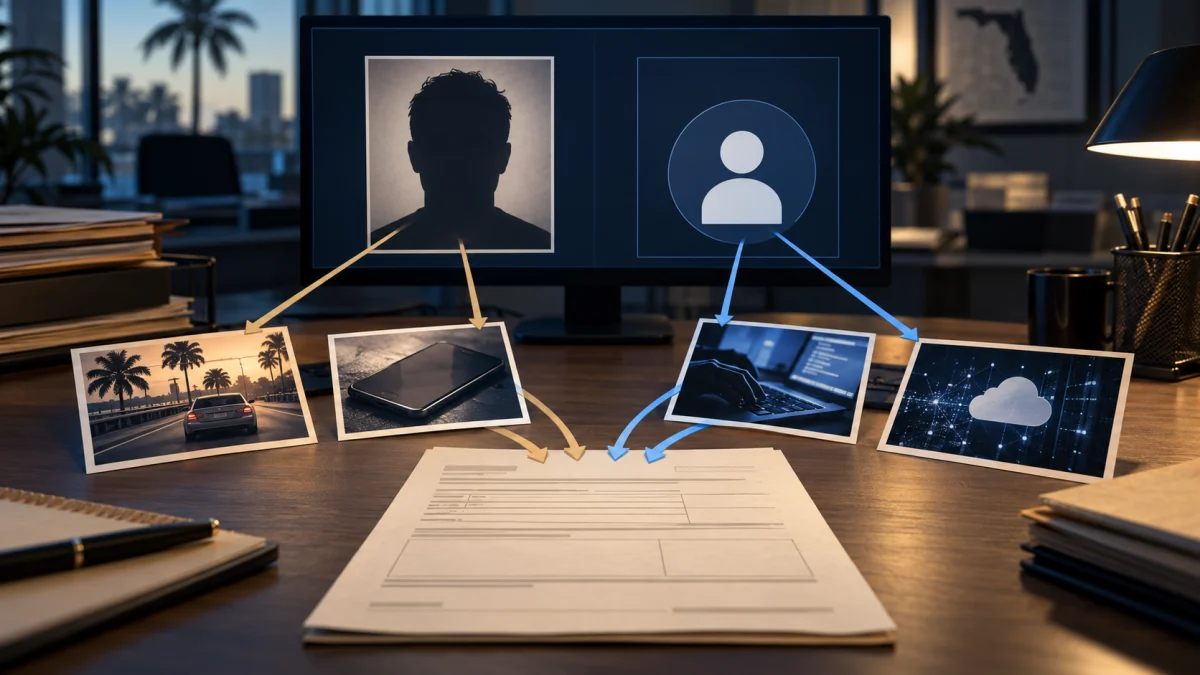
The decisive issue is not whether Nick was the person in the photographs. He was. The issue is what linked him to the person typing the messages.
The Florida Trib reviewed police and court records and identified the following sequence:
- The Skout account used Cook’s middle name, “Steven,” and displayed a profile photograph unlike the two photographs of Nick sent in the chat.
- Investigators apparently identified Nick through the images, then obtained a warrant for his arrest. Nick said police told him they had used facial recognition.
- When questioned, Nick identified the account’s profile photograph as Cook, disclosed their connection and directed detectives toward Cook’s previous case.
- According to the case records examined by The Florida Trib, investigators issued the first subpoena for the account’s registration information the day after Nick’s arrest. Subsequent records connected the account to an email address Cook had used in his earlier case.
- On July 31, 2025, officers confronted Cook, who admitted using photographs of former friends, including Nick, in the online exchange.
The last two findings are especially important, but they must be interpreted correctly. Information existing in an agency’s files is not necessarily information an individual detective had retrieved before making a decision. The earlier Cook case was already in JSO’s records; the account registration information was acquired later. It would be inaccurate to claim that the 2025 investigators possessed every later-discovered fact before the arrest.
The stronger conclusion is that the available reporting identifies no sufficient pre-arrest corroboration connecting Nick himself to the Skout account or the messages. In the original investigation, George Washington University law professor Andrew Ferguson, who reviewed case documents for The Florida Trib, characterized the incident as a policing failure rather than primarily a technology malfunction.
The alternative explanation investigators needed to test
At least two competing possibilities existed once the photographs surfaced:
- Nick was operating the account and sending photographs of himself.
- Someone else was operating the account and sending photographs copied from Nick.
Photographic identification could help establish whose face appeared in the images. It could not distinguish those two explanations. The different profile photograph, the “Steven” username and Nick’s account of his former friendship provided reasons to test the second possibility. A registration email, account activity, device records, communications history or corroborated admission could offer evidence about account use that the photographed face alone could not.
This does not mean every possible lead must be exhausted before an arrest. Probable cause does not require proof beyond a reasonable doubt. But the evidence still has to support a reasonable belief that the person arrested committed the suspected crime. Identifying an image’s subject does not automatically do that.
Timeline: The Arrest Came Before the Account Subpoena
The dates below are based principally on The Florida Trib’s reconstruction of police and court records. The timing and contents of the initial sting announcement are separately confirmed by JSO.
| Date | What happened | Why it matters |
|---|---|---|
| 2018-2019 | JSO investigated Cook in a separate online-solicitation case; he pleaded guilty in 2019 to unlawful use of a two-way communications device. | Investigators had an earlier agency case associated with the eventual offender. |
| May 14, 2025 | Cook, using the name “Steven” on Skout, began messaging an undercover officer posing as a 13-year-old and sent two photographs of Nick. | The photos identified the person depicted, not who operated the account. |
| May 22, 2025 | Deputies arrested Nick at his workplace. | Nick lost his freedom before detectives obtained the account information later used to link the messages to Cook. |
| May 23, 2025 | Investigators issued their first subpoena for information about the Skout account, according to the case records reported by The Florida Trib. | The account investigation began yielding different identity evidence after the arrest. |
| July 31, 2025 | Cook admitted that he used other people’s photographs in the exchange. | His admission corroborated the impersonation explanation. |
| August 1, 2025 | Prosecutors dropped Nick’s charges. | The case against the innocent father ended. |
| August 4, 2025 | A judge ordered the case expunged, describing the arrest as made contrary to law or by mistake. | The justice system recognized an arrest-record error, but the public disclosure problem was not promptly fixed. |
| October 17, 2025 | JSO arrested Cook. | Months elapsed between Nick’s arrest and the offender’s arrest. |
| 2026 | Cook pleaded guilty and received a 40-month prison sentence. | The prosecution ultimately proceeded against the person who sent the messages. |
Reasonable inference: The sequence indicates investigators followed the photographic identity lead to an arrest before pursuing account evidence that later pointed to another man. It does not by itself establish the officers’ motives, the contents of the warrant affidavit or the particular influence of a facial-recognition similarity score on the judge. Those would require additional records.
How Can Facial Recognition Get the Face Right but the Arrest Wrong?
Facial-recognition software compares visual features in one image against images in a reference database. A one-to-many search can return candidate photographs for an investigator to review. The National Institute of Standards and Technology’s 1:N face-recognition evaluation measures identification errors and describes investigative workflows in which people examine candidate lists. Algorithms can produce false candidates, and human review is not itself proof of criminal responsibility.
Florida agencies use a shared facial-recognition system known as FACESNXT, hosted by the Pinellas County Sheriff’s Office. The Florida Trib reported that the database offered access to approximately 15 million mugshot images and 25 million driver’s-license photographs. These are reported image totals, not 40 million individually identified people. The publicly reviewed records do not conclusively establish which facial-recognition search was run in Nick’s investigation.
There are two different failure modes:
False facial identification: A system returns a candidate who is not actually the person appearing in the searched image. Accuracy, image quality and human assessment are central questions.
False attribution of conduct: A system correctly identifies the person pictured, but police incorrectly conclude that this person created, transmitted or controlled the content containing the picture. More accurate face-matching software cannot solve that second problem.
What the evidence could and could not prove
| Evidence | What it could help establish | What it could not prove alone |
|---|---|---|
| Photographs sent in the Skout conversation | Which person was pictured | Who sent the images or wrote the messages |
| A facial-recognition candidate identifying Nick | A possible identity for the face in the photos | That Nick used the Skout account |
| The account’s profile image | Which person the profile appeared to depict | Who controlled the account at a particular moment |
| An account registration email linked to Cook | A connection between Cook’s known information and the account | That Cook personally authored every message |
| Login, device and communication records | Links among an account, devices and activity | Conclusive attribution to a human user without context and corroboration |
| Cook’s later admission | Direct evidence of his use of the photographs and messages | What each investigator knew before Nick’s arrest |
Repeating an image match is not independent corroboration of the crime. A second face search might provide more confidence that Nick appeared in the photos. It would still not establish that he wrote the messages.
This case also did not depend on an AI-generated deepfake. The relevant photographs were real photographs of Nick used by someone else. That distinction matters because ordinary photographs can be copied and misused without synthetic-image technology.
Can Police Arrest Someone Based Only on Facial Recognition?
A facial-recognition lead by itself does not establish that the person identified committed a crime. An arrest must satisfy the Fourth Amendment’s probable-cause standard, assessed from the reasonably trustworthy facts and circumstances available to officers. The Supreme Court explained the totality-of-the-circumstances approach in Illinois v. Gates. In Maryland v. Pringle, the Court further explained that probable cause to arrest must be grounded in a reasonable belief of guilt particularized to the person arrested. That case involved physical evidence in a vehicle, not an online account, so it provides a general constitutional principle rather than a ruling on facial recognition.
Probable cause is lower than the standard needed to convict someone at trial. Officers do not have to disprove every innocent possibility before making an arrest. But they need facts connecting the suspect to the offense. A photograph can identify its subject without establishing who controlled the account that transmitted it.
There is no single federal statute categorically declaring every arrest involving facial recognition illegal. The Constitution, Florida law and individual police policies impose different kinds of requirements. The legal assessment of any particular arrest requires the complete evidentiary record, including the warrant application.
What Florida’s published FACESNXT policies actually say
Official policies issued by other Florida departments demonstrate that the limits of face searches have long been recognized:
- The St. Petersburg Police Department’s April 2022 General Order II-47 says facial recognition is an investigative tool, a positive search result alone does not establish probable cause, and investigators must corroborate the lead before an arrest. It also sets out search review and auditing procedures.
- The North Miami Police Department’s 2022 FACESNXT procedure requires consideration of other relevant evidence and prohibits using the face-search result as the sole determinant of probable cause or as the sole basis to obtain an arrest or search warrant.
- The Tallahassee Police Department’s General Order 15, revised June 4, 2025, explicitly refers to its memorandum of understanding with Pinellas County, the FACESNXT host agency. It says investigative action must rest on an officer’s own identification and not solely on the search result. It also requires independent follow-up and supervisory oversight.
These are not authenticated copies of JSO’s policy applicable to Nick’s May 2025 arrest. They show how other Florida departments documented safeguards, including obligations linked to the shared system’s host agency. Tallahassee’s cited revision was issued after Nick’s arrest; it should not be presented as a rule governing that earlier JSO investigation.
The sheriff’s own statements make the unresolved Jacksonville question more pointed. After a separate facial-recognition-linked wrongful arrest, Sheriff T.K. Waters told Action News Jax in July 2025 he would reject a facial-recognition hit presented as the entire probable-cause basis. In a July 2026 interview with Jacksonville Today, he reiterated that officers do not arrest people on facial-recognition results alone.
The contradiction worth investigating: JSO’s leadership described facial recognition as a lead requiring corroboration. Yet the available account of Nick’s arrest identifies no adequately corroborated connection between Nick and the person who sent the messages before he was taken into custody. What exactly did detectives submit to the judge as that connection?
This is an accountability question, not a claim that we have obtained JSO’s full search log or warrant affidavit. And an official statement endorsing a safeguard is not, by itself, proof of whether the safeguard was followed in a particular case.
Florida’s evidence-authentication rule, § 90.901, is a related but different issue: it addresses the showing needed to establish what evidence purports to be when offered in court. It is not the arrest-warrant standard and should not be cited as though it governs probable cause. The broader lesson remains that identifying the image’s subject is distinct from proving who authored a digital communication.
Is This the Same as Other Jacksonville Facial-Recognition Wrongful Arrests?
No. The cases share a warning about overinterpreting an identification lead, but their reported mechanisms are different.
Robert Dillon: an allegedly wrong face match
Robert Dillon was arrested in 2024 after Jacksonville Beach Police, working with information generated through JSO, linked him to a suspect recorded at a Jacksonville Beach restaurant. In a federal lawsuit filed in June 2026, Dillon alleged that the facial-recognition candidate was wrong, a subsequent photo lineup reinforced the error and officers failed to disclose contradictory information, including evidence about his location.
The federal court transferred the case to the Jacksonville Division in July 2026. That transfer was a procedural ruling, not a judgment resolving the misconduct allegations. Jacksonville Beach Police is a separate department from JSO, although the suit involves multiple agencies.
Jalil Richardson: a disputed match compounded by identification procedures
In June 2026, Action News Jax documented the case of Jalil Richardson, a North Carolina father who spent nearly three months detained after being accused of involvement in a Jacksonville vehicle crime. The charges were dismissed. Richardson’s family pointed to employment records showing that he was working in North Carolina when the offense occurred.
JSO disputed the description of facial recognition as the only investigative step, stating that an eyewitness later identified Richardson from a photo lineup. That additional step matters, but it does not automatically settle whether the lineup independently corroborated the original lead or carried forward the same error. The full sequence and reliability of each identification need to be assessed on their own merits.
The common lesson is not that every algorithm failed in the same way. Wrongful arrests can result from incorrect candidates, weak images, flawed witness procedures, ignored contradictions or mistaken assumptions about who created an online communication. One precaution does not address every mechanism.
The U.S. Government Accountability Office’s 2024 review of federal agencies reinforces the institutional stakes: it found gaps in facial-recognition-specific civil-rights policies and training among the agencies examined. GAO did not audit Nick’s investigation or the Jacksonville Sheriff’s Office for that report.
Charges Dropped, Record Ordered Expunged, Family Still Harmed
The consequences did not stop with Nick’s release from jail.
He spent one night in custody. Afterward, a judge’s restrictions prohibited contact with his two young daughters for approximately six weeks, including phone or video conversations. One daughter was three years old; the other was only seven months old at the time of his arrest. Nick could not live in the family home for nearly three months.
According to Nick and his wife, who spoke with The Florida Trib, he recorded videos of himself reading children’s stories so his older daughter could hear him at bedtime. The family estimated approximately $45,000 in lost wages and legal costs. They also described additional financial strain, including an electronic-monitoring expense of $105 a week. The $45,000 figure is the family’s estimate, not a court-awarded sum or an independently audited total.
Prosecutors dropped Nick’s charges on August 1, 2025. Three days later, a judge ordered his case expunged after determining the arrest had been made contrary to law or by mistake. Yet The Florida Trib found that records carrying sensitive identifying information remained publicly accessible through the Duval County Clerk of Courts website for more than a year. The clerk’s office acknowledged the failure and removed the records after reporters inquired.
Why dismissal is not the same as clearing the public record
Dropping charges ends a prosecution; it does not, by itself, complete every record-correction or confidentiality process. Florida distinguishes between several forms of relief. Section 943.0581 provides a process concerning nonjudicial records of arrests made contrary to law or by mistake. Section 943.0585 addresses a separate court-ordered criminal-history expunction process. The Florida Department of Law Enforcement describes these as distinct routes.
The fact that a judge ordered Nick’s case expunged does not establish which statutory mechanism was used, what exact directions the clerk received or why the public website remained accessible. Those questions depend on the order and records of its implementation, which have not been independently inspected for this article.
The family’s account also raises unresolved questions about institutional accountability. They told The Florida Trib that they were informed the lead detective had been placed on administrative leave pending dismissal. The reporting did not independently confirm a termination. It found records indicating that the detective had applied for a deferred retirement arrangement, while JSO did not provide the requested clarification of her employment status. A family’s report of a promised disciplinary outcome is not the same as a confirmed disciplinary finding.
Even after dismissal and attempted record correction, the time Nick lost with his children, the legal bills and the reputational damage remained.
Could Someone Use Your Photos and Get You Arrested?
Someone can copy your photographs and use them in an account without your consent. That does not make you responsible for what they do. Nick’s case shows how a person can nevertheless become the subject of a wrongful investigation if the account user’s identity is confused with the image’s subject.
There is no reliable way to make every public image impossible to copy. A reverse-image search may reveal copies indexed on accessible websites, but it cannot reliably discover photographs exchanged privately through direct messages or closed accounts. Account security protects against unauthorized access to your own account; it cannot prevent an impersonator from creating a separate account using your picture.
If you discover an impersonating account, preserve its visible URL, dates, screenshots and relevant messages before reporting it through the platform’s impersonation process. If police contact you about a serious allegation linked to online activity, seek qualified legal counsel promptly and preserve relevant records. Do not delete or alter potential evidence.
None of this transfers responsibility from investigators to the innocent person whose photograph was taken. Posting a photo is not evidence that you sent every message in which that photo later appears.
What Safeguards Could Have Prevented Nick’s Wrongful Arrest?
The immediate safeguard was not a better facial-recognition search. It was an investigation of the allegation that actually mattered: who operated the Skout account when the incriminating messages were sent?
A sound investigation would have treated the face result, if used, as one lead among several, then looked for independent evidence connecting the named suspect to the activity. That may include account registration and recovery information, reliable login and device records, witness statements, relevant account messages, a suspect’s own records and evidence that contradicts the initial hypothesis. None of those items is necessarily conclusive alone.
At the warrant stage, the decision-maker needs the facts supporting probable cause, not an unexamined assumption that a person shown in an image must have sent it. Within the department, documented search purposes, traceable system activity, supervisory review and meaningful investigation of errors can help reveal when an identification lead is being used beyond its evidentiary limits.
Florida’s public-records statute, § 119.07, generally provides a path to request nonexempt government records; JSO publishes a public-records request process. For independent follow-up reporting, the most important records to seek are the facial-recognition policy in force in May 2025, any lawfully disclosable query and audit records associated with this case, the nonexempt portions of warrant-approval procedures and any completed review of the investigation. Exemptions, privacy protections and fees may limit what can be obtained. This is not an assurance that a person can retrieve an individual detective’s entire search history for free.
What remains unknown as of October 19, 2026: the precise face-search output, the complete information included in Nick’s arrest-warrant application, the Jacksonville policy specifically applicable to this investigation and any independently verified final disciplinary disposition.
The case does not require an invented motive or an imagined software malfunction to explain its central failure. Detectives identified Nick in borrowed photographs and arrested him. After they obtained account information and questioned Cook, the case against Nick collapsed and Cook admitted sending the pictures.
Facial recognition may have answered whose face was on the screen. It did not answer who was behind the screen. That was the question the investigation needed to resolve before an innocent father lost his freedom.
References and Further Reading
Original Reporting and Official Case Context
- Kate Payne, “How AI-powered bungling by Florida cops cost a father his freedom and $45,000” (The Florida Trib, September 28, 2026). The original investigation, based on interviews and police and court records. Principal source for Nick’s arrest, Cook’s role, the chronology and family consequences. The article discloses funding from the Organized Crime and Corruption Reporting Project (OCCRP).
- Jacksonville Sheriff’s Office, “24 Men Arrested in Operation R.O.C.: Rescue Our Children” (May 22, 2025). Official agency announcement establishing the sting’s public timeline and list of arrestees; Nick was not among the 24 listed.
- Logan MacDonald, “AI, Wrong Guy” (Action News Jax, July 10, 2025). Original reporting and interview with Sheriff Waters about facial recognition and probable cause following a separate wrongful arrest.
- Dan Scanlan, “Q&A | Jacksonville Sheriff T.K. Waters discusses the jail, police shootings and more” (Jacksonville Today, July 10, 2026). Independent interview recording Waters’ later statement that facial-recognition results alone do not justify arrest.
Facial-Recognition Policies and Research
- St. Petersburg Police, General Order II-47: Facial Recognition Software, FACESNXT (2022). Published departmental policy identifying positive search results as leads that must be corroborated, with logging and review requirements.
- North Miami Police, Standard Operating Procedure 400.23: FACESNXT (2022). Separate department’s requirements for evaluating results and avoiding sole reliance on a facial-recognition candidate in warrant decisions.
- Tallahassee Police, General Order 15: Facial Recognition Program (revised June 4, 2025). Published policy citing a memorandum of understanding with FACESNXT’s Pinellas County host and requiring independent investigation. Not JSO’s policy; its latest revision followed Nick’s arrest.
- National Institute of Standards and Technology, Face Recognition Technology Evaluation: 1:N Identification. Technical evaluation of one-to-many identification, candidate review and false-positive or false-negative search outcomes. It does not measure guilt or digital-account ownership.
- U.S. Government Accountability Office, Facial Recognition Technology: Federal Law Enforcement Agency Efforts Related to Civil Rights and Training (GAO-24-107372, 2024). Federal-agency oversight and training review; not a study of the Jacksonville investigation.
Law, Public Records and Comparison Cases
- Illinois v. Gates, 462 U.S. 213 (1983), U.S. Supreme Court. Explains the totality-of-the-circumstances framework for probable cause to issue a search warrant.
- Maryland v. Pringle, 540 U.S. 366 (2003), U.S. Supreme Court. Explains the person-specific inquiry for probable cause to arrest, while recognizing that reasonable inferences depend on the totality of circumstances.
- Florida Statutes § 847.0135 (2025) and § 934.215 (2025). The offense provisions relevant to Nick’s 2025 charges.
- Florida Statutes § 775.082 (2025). General sentencing ceilings, including ordinary third-degree felony maximums.
- Florida Statutes § 90.901 (2025). Trial evidence authentication provision, distinct from the probable-cause standard for arrest.
- Florida Statutes § 943.0581 (2026), § 943.0585 (2026) and the Florida Department of Law Enforcement’s seal-and-expunge guidance. Different administrative and judicial criminal-history record procedures. These documents do not by themselves establish the exact procedure applied to Nick’s sealed matter.
- ACLU of Florida, Dillon v. City of Jacksonville Beach (filed June 2026). Complaint summary and context for a distinct alleged facial-recognition misidentification; allegations remain subject to litigation.
- U.S. District Court, Dillon v. City of Jacksonville Beach, venue-transfer order (July 27, 2026). Procedural order transferring venue; not a merits decision.
- Yona Gavino, reporting on Jalil Richardson (Action News Jax, June 2, 2026) and JSO’s response reported by Action News Jax. Sources for a separate wrongful arrest and the department’s explanation of additional investigative measures.
- Florida Statutes § 119.07 (2026) and JSO public-records requests. Governing access rules and the sheriff’s official request process, subject to exemptions and possible fees.
Related sherafy.com Research
- Can the Public Access Flock Camera Data? Why Police Should Have to Justify Every Search. Related examination of auditability and automated law-enforcement searches. Automated license-plate recognition and facial recognition are distinct technologies.
Reporting and attribution note: This article is sherafy.com‘s independent synthesis and legal-technical analysis of publicly available reporting and primary documents. sherafy.com did not interview Nick, obtain his expunged case file, inspect FACESNXT query logs or independently review his arrest-warrant application. Claims concerning interviews and nonpublic case records are attributed to Kate Payne’s original reporting for The Florida Trib. The family’s surnames and other identifying details are intentionally omitted to avoid amplifying a false accusation.
Editorial currency note (October 19, 2026): The criminal-offense statutes above are linked to their 2025 versions because the underlying incident occurred in 2025. Legal remedies and public-records law are linked to the current 2026 versions. Policies, litigation, agency employment actions and court-record access can change. The factual record should be updated if new official documents establish the face-search output, warrant evidence, applicable JSO policy or a disciplinary disposition.