
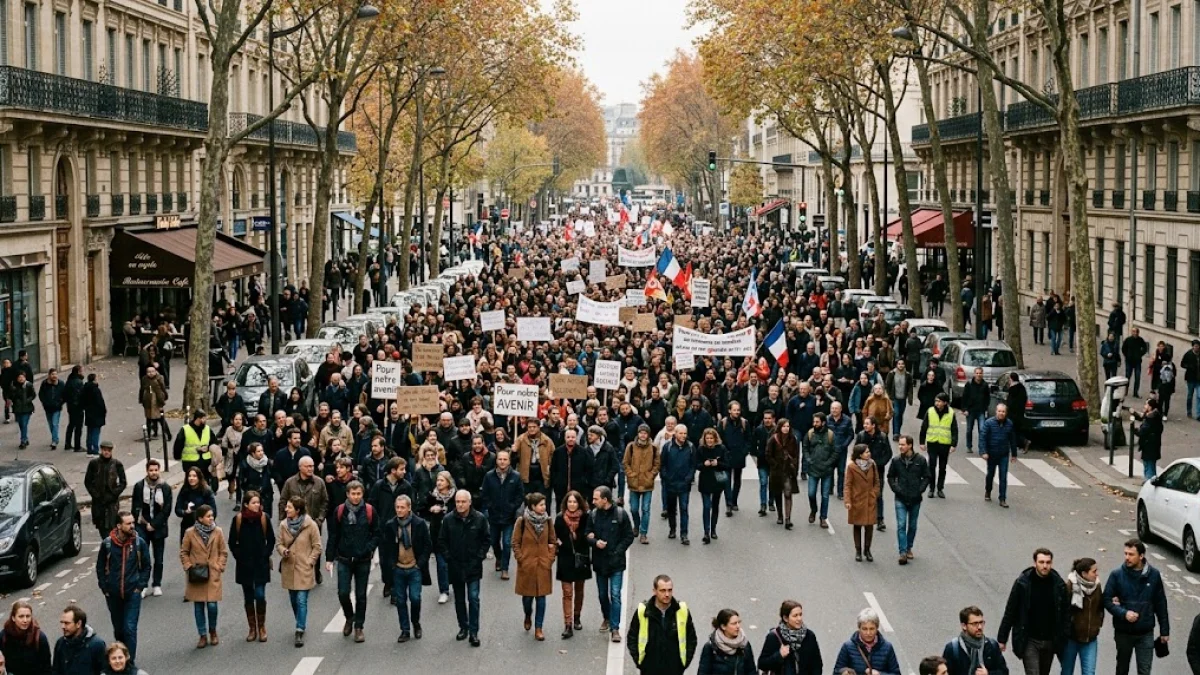
France’s October 2026 protests brought together two initially distinct movements: anger over soaring fuel prices and a student-led campaign against problems in public education. Labor unions, students, Yellow Vest supporters and other demonstrators gathered nationwide on October 17. Most marched peacefully, but serious violence erupted in several cities, with shops looted, vehicles burned and public buildings attacked.
The underlying grievances are not difficult to document. French government figures show diesel prices rose 44.1% over the year to September, compared with 3.1% overall consumer-price inflation. An Education Ministry study found that 9.8% of scheduled teaching hours at public secondary schools were not delivered in the 2024–25 school year, mostly because absent teachers were not replaced. Those statistics describe genuine problems, though neither explains by itself why particular people committed acts of violence. INSEE’s September inflation report and the Education Ministry’s teaching-time study establish the figures.
The harder questions are how these movements converged, why the violence spread, and whether the authorities’ explanations and proposed remedies withstand examination of the evidence.
What Happened in France on October 17, 2026?
French Interior Minister Laurent Nuñez estimated that 550,000 people attended 110 demonstrations across the country on Saturday, October 17. Organizers, including student groups and unions, put the turnout at 800,000. These are rival estimates, not two separate crowds. Nuñez’s estimate included about 110,000 in Paris. The Associated Press documented the marches and violent incidents, while Le Monde reported the differing counts.
| Reported measure | Figure and qualification |
|---|---|
| National demonstration turnout | 550,000 according to the Interior Ministry; 800,000 according to organizers |
| Number of marches | 110, according to the Interior Ministry |
| People arrested | 2,397 in a consolidated Interior Ministry count reported October 18 |
| Police officers and gendarmes reported injured | 997, including seven seriously, according to the same ministry count |
| Businesses affected | At least 3,000 damaged or looted, according to a preliminary government estimate on October 19 |
The October 18 arrest and police-injury figures were reported by RTL. The government’s October 19 crisis-meeting transcript gives the preliminary business-damage estimate. These figures may be revised. An arrest is not a conviction, and the reported police-injury figure is not a complete count of all injuries to demonstrators, bystanders and emergency personnel.
In Paris, groups throwing projectiles and fireworks clashed with officers, who used tear gas and water cannons. Looting and vehicle fires were reported around Place de la République and other areas. Violence also occurred in Lyon, Marseille, Bordeaux and numerous other cities.
One of the gravest incidents was in Limoges, where a fire devastated the nineteenth-century city hall. The city’s official statement confirmed the attack, while Limoges Métropole explained how municipal services would continue after the destruction. The damaged building was both a historic landmark and an operating public institution.
These incidents were severe. They do not establish that everyone attending the nationwide demonstrations endorsed, participated in or organized the violence.
How Did Two Different Protest Movements Come Together?
First, students protested conditions in their schools
The education protests developed in September, before the October 17 nationwide marches. A dispute over missing staff at Lycée Antoine-de-Saint-Exupéry in Créteil, southeast of Paris, became an early focal point. Teachers protested around September 17, and student blockades subsequently helped spread the campaign to other schools.
That sequence is supported by an October 7 National Assembly committee hearing, in which Education Minister Édouard Geffray identified the Créteil school as an origin of the movement, and by TF1’s reporting from the school. The exact date assigned to the first student blockade varies by account, but the broader chronology is clear. Classes later resumed at the original Créteil school after local staffing requests were addressed, according to TF1, even as protests spread elsewhere.
Students raised concerns about teachers who were not replaced, crowded classrooms, damaged or poorly maintained buildings, long school days and the pressure associated with Parcoursup, France’s postsecondary admissions platform. Their demands were not identical from one school to another.
Separately, an October 17 fuel-price call spread online
A second mobilization emerged around the cost of fuel. In a September investigation, Le Monde traced early calls for an October 17 demonstration to a September 7 TikTok video from an account known as V2. The creator proposed a Saturday protest over pump prices. Yellow Vest imagery then spread through social platforms, including posters generated with artificial intelligence.
Le Monde found newly created or renamed accounts promoting the date, some displaying signs of coordinated posting. But coordinated online promotion is not proof of foreign interference or a plan to commit violence. At the time of its September reporting, the outlet said France’s foreign digital-interference monitoring service, Viginum, had detected only minor, low-reach opportunistic amplification from abroad.
By mid-October, student organizations and unions were also supporting October 17 demonstrations. The CGT labor union called for higher wages and pensions, lower prices and better public services. Yellow Vest supporters drew on the memory of the 2018 protests, which also began amid anger about fuel costs and expanded into wider economic grievances. Associated Press reporting describes this convergence.
The distinction matters: a social-media call helped popularize the date, but it did not create the school staffing problem or the fuel-price shock. Nor does the origin of a protest date identify the people responsible for subsequent riots.
How Much Have Fuel Prices Increased, and Why?
France’s official September 2026 consumer-price figures help explain why a seemingly moderate national inflation rate can coexist with severe financial pressure on people who drive frequently.
| Price category | Change from September 2025 to September 2026 |
|---|---|
| Diesel | +44.1% |
| Gasoline | +25.7% |
| Energy overall | +21.3% |
| Consumer prices overall | +3.1% |
Source: INSEE, final consumer-price statistics published October 15, 2026.
Overall inflation measures changes across a broad basket of spending. It does not mean every price rose 3.1%. A household dependent on a diesel vehicle, a commercial driver or a business with substantial transportation costs can experience the fuel-price surge much more directly than the headline figure suggests.
The increase was not just about crude oil
The French government’s September fuel-support announcement linked the renewed rise in fuel prices to disruption around the Strait of Hormuz, the United States–Iran conflict and refining constraints.
There is a more specific economic explanation. In an October 13 Banque de France analysis, researchers estimated that pressure on refining capacity accounted for about 60% of the cumulative rise in French petroleum-product prices from February to August 2026. That is a model-based estimate for a particular period, not a claim that refining caused 60% of September’s annual diesel inflation.
The mechanism is important. Motorists buy refined gasoline and diesel, not crude oil. When refinery capacity or supplies of particular products are constrained, pump prices may remain elevated even if crude-oil prices do not move by the same proportion.
What relief has the government promised?
On October 7, France’s Finance Ministry announced a plan to release 10 million barrels of diesel from strategic stocks. It projected an average pump-price reduction of 12 to 18 euro cents per liter for three months. But the government’s explanation of the program specifies November 2026 through January 2027 as the intended operating period.
That timing is essential. On October 17, demonstrators were protesting prices they were already paying; the newly announced relief was not yet scheduled to take effect. Even once the release begins, the estimated savings must be checked against observed retail prices rather than treated as guaranteed. For illustration, a 12–18-cent reduction would save roughly €6–€9 on a 50-liter fill-up, if fully passed through to the consumer.
France had also announced targeted fuel assistance for affected sectors earlier in September. The claim that the government had offered no response would therefore be inaccurate. The more useful question is whether the measures reach the people bearing the costs, in sufficient amounts, at the time they need relief.
Are French Schools Really Missing Teachers?
Yes, although the frequently repeated figure needs careful interpretation.
The Education Ministry’s statistical office, DEPP, reported in April 2026 that 9.8% of scheduled teaching hours at public secondary schools were not delivered during 2024–25. That comprised:
- 7.5 percentage points because absent teachers were not replaced, amounting to approximately 15.4 million teaching hours.
- 2.3 percentage points because schools were completely closed.
This is a measure of lost scheduled teaching time, not a finding that 9.8% of all teacher positions were empty, or that every student personally missed exactly one-tenth of their lessons. The study covered an earlier school year and cannot be presented as a direct measurement of October 2026 conditions. The study’s coverage also excluded Mayotte in 2024–25 because of disruption to data collection.
Nevertheless, it demonstrates that the issue existed before the current protests. The national average also conceals considerable variation: the 10% of schools with the most undelivered instruction lost more than 15% of scheduled hours, while the least affected 10% lost less than 5%.
Why were replacement teachers available while classes still went uncovered?
This is one of the most revealing records in the story.
At an October 14 National Assembly session, Education Minister Geffray discussed a pool of approximately 3,000 replacement teachers who had not yet been assigned to posts requiring replacement or were working in support roles elsewhere. He acknowledged that deployment had not been optimized and said the ministry was mobilizing the pool.
That does not mean 3,000 teachers were doing nothing, nor does it prove all of them could fill every vacancy. A mathematics teacher and a history teacher are not interchangeable, and staffing must account for subject, location, qualifications and availability. It does, however, raise a concrete administrative question: how much missed instruction was due to insufficient personnel, and how much resulted from failures to match available personnel to schools in need?
Geffray also said the ministry was seeking 920 additional staff, including contract teachers for difficult-to-fill specialties, and that 170 contractors had been recruited by the time of his October 14 answer. These were reported steps and recruitment counts, not proof that all outstanding classes had regained their teachers.
Students are concerned about more than vacancies
The government opened an anonymous national consultation for high-school students in October. According to Le Monde‘s report on an early analysis of 60,277 contributions, roughly 70% mentioned schedules or the organization of the school day, 48.2% raised building or physical-environment concerns, and 27.2% discussed teacher replacement or qualifications.
These categories overlap, and the voluntary submissions are not a representative national opinion poll. They nonetheless show why reducing the student movement to a single demand for more teachers would miss significant parts of what students reported experiencing.
Is France Cutting Teachers While Increasing Education Spending?
The proposed 2027 budget contains both an increase in total education funding and a reduction in one category of teaching positions. Those figures are not mutually exclusive.
According to the Education Ministry’s original 2027 budget dossier:
| Proposed 2027 change | What it means |
|---|---|
| €64 billion in ministry funding, excluding state pension contributions | €1.2 billion more than 2026 on a comparable basis |
| Net reduction of 1,588 teacher full-time equivalents | Includes a net reduction of 1,250 in public education |
| 3,041 additional teacher-trainee and student-teacher posts | Positions associated with teacher-training reforms, not equivalent to 3,041 additional fully deployed classroom teachers |
| 1,804 additional student-support and protection posts | Includes disability-support staff and other educational or health-related roles |
| Net increase of 3,257 posts overall | The net personnel change across the categories covered by the ministry’s proposal |
The ministry cites falling enrollment as a rationale for adjusting teacher staffing. It forecasts roughly 180,000 fewer pupils at the 2027 school-year opening, with demographic declines concentrated in some levels of education.
That explanation deserves consideration. Fewer students can reduce demand for some teaching positions. But a national enrollment decline does not automatically eliminate shortages in specific subjects, schools or regions. Nor do additional training positions immediately replace an absent classroom teacher.
There is also an important procedural distinction: the 2027 budget remains a proposal as of October 19, 2026. Its staffing and expenditure figures are not yet the final enacted budget, and a proposed increase in ministry credits does not demonstrate that every school has received the staff or repairs it needs.
Who Was Responsible for the Rioting?
The documented violence is real. The identity, organization and motivations of everyone involved remain more difficult to establish.
French officials have attributed some attacks to radical far-left groups and others to opportunistic looters. In Associated Press reporting on October 19, policing researcher Sebastian Roché distinguished politically motivated attacks on symbolic commercial targets from theft intended primarily to obtain goods. He also questioned whether France’s relatively small, loosely structured far-left militant milieu could explain violence on this scale by itself.
Those observations suggest why a single label may fail. Rioting can involve people with different objectives acting in the same area, without one command structure. That is an analytical possibility, not a final determination about specific criminal cases.
On October 19, Prime Minister Sébastien Lecornu said in an official government briefing that security services believed some ultra-left groups intended to prolong disorder into the 2027 presidential campaign. The public briefing did not itself supply the underlying intelligence needed to independently establish that wider alleged plan. The claim should be attributed to the government, not repeated as a proven explanation for all the violence.
The legal evidence will come from particular incidents: videos authenticated to their locations and times, witness accounts, forensic findings, charging documents and court outcomes. Being present at a protest does not establish participation in a crime. Equally, the existence of peaceful demonstrators does not diminish the seriousness of attacks on residents, businesses, police or public buildings.
Why Did Police Lose Control, and What About Injured Protesters?
The policing question has two parts: whether authorities adequately prepared for a large, decentralized demonstration, and whether the force used against individuals was lawful and proportionate.
Le Monde reported on police preparations and the dispersed confrontations. The protests combined authorized marches with shifting groups operating beyond established routes. Violence broke out in numerous locations, making it difficult for officers to protect both demonstrators and potential targets. On October 19, Nuñez acknowledged that police had lost control in some cities; he offered his resignation, which President Emmanuel Macron refused. Euronews reported the Élysée’s decision.
Operational difficulty is a plausible explanation for some failures, but it is not an independent audit of command decisions. Questions remain about prior intelligence, deployment, local tactics and how officers responded to different kinds of incidents.
The scrutiny must also include serious injuries sustained by civilians. In Saint-Étienne, a 17-year-old lost a hand after an explosion involving a grenade during the October 17 disturbances. TF1 reported the opening of an investigation, and local reporting on October 19 said police and gendarmerie oversight bodies were examining the exact circumstances. The weapon’s precise identification, sequence of events and legal responsibility should not be treated as settled ahead of those findings.
The Interior Ministry’s reported tally of injured officers is important, but it cannot substitute for a complete and comparable record of demonstrator and bystander injuries. Assessing the policing response requires both.
What Is the French Government Doing Now?
The October 19 government crisis briefing announced several immediate responses:
- Criminal investigations: Lecornu described additional investigators, including roughly 200 in the Paris police area to examine images and identify suspects. Investigations and prosecutions are not convictions.
- Localized curfews: The government directed prefects to consider limited restrictions in areas affected by repeated violence, rather than a nationwide curfew. Paris authorities announced overnight restrictions in specified areas, according to Associated Press.
- Business support: Officials announced work on emergency assistance, insurance coordination and temporary employment measures for affected firms. The specific implementation and eligibility rules were still being developed.
- Review of policing: Macron ordered scrutiny of failures in anticipation and security planning, while the government considered changes to tactics and deployment.
The same briefing did not announce a nationwide state of emergency. It presented localized measures as the more immediate response while leaving other legal options under consideration.
Meanwhile, National Assembly President Yaël Braun-Pivet announced on October 18 that she would propose an investigative commission at the October 20 conference of parliamentary leaders. Its proposed scope includes violent groups, police planning, intelligence and public-order strategy. As of this article’s October 19 update, the commission had been proposed, not yet established.
What Is Established, and What Still Needs Evidence?
| Question or claim | Current assessment |
|---|---|
| Did genuine economic and school grievances precede October 17? | Verified. INSEE, DEPP, parliamentary proceedings and reporting from schools document them. |
| Did the October 17 date spread through TikTok and AI-generated posters? | Supported by original reporting. This explains part of the mobilization, not the riots’ criminal organization. |
| Did most demonstrators participate in violence? | Not supported. Extensive peaceful marches and distinct violent incidents were documented. |
| Were radical far-left groups involved? | Authorities allege involvement in some incidents. Responsibility for individual acts requires case-specific evidence. |
| Was there an externally directed foreign operation behind the protests? | Not established by the available evidence. Early Viginum findings cited by Le Monde did not show substantial foreign amplification at that stage. |
| Have the announced fuel and education measures solved the grievances? | Not established. Some measures remain planned, and current school-level outcomes have not been fully demonstrated. |
| Is responsibility for the most serious civilian injuries settled? | No. Formal investigations are ongoing. |
These distinctions are not semantic. They determine whether an explanation helps readers understand the events or simply turns unproven allegations into another headline.
What Happens Next?
Student organizations have called for further demonstrations on Thursday, October 22, and Saturday, October 24. Activists seeking to revive the Yellow Vest movement have also announced further Saturday action, according to Associated Press. These are announced plans, not confirmed future attendance figures.
Three things can be checked against records rather than rhetoric.
First, fuel prices: France’s planned strategic diesel release is scheduled for November through January. Its actual effect must be measured at the pump, accounting for changes in underlying wholesale prices and refining conditions.
Second, schools: The Education Ministry’s student consultation remains open through October 23, with a national summary expected later in October. More important than the number of submissions will be the schools’ actual staffing, the recovery of missed lessons and whether the problems students reported are fixed.
Third, accountability: Police and judicial investigations, official injury data, public-order reviews and any parliamentary commission will determine how much of the October 17 violence can be reliably attributed to particular individuals or organizations, and what failures, if any, occurred within government planning or policing.
The October 17 demonstrations were neither one uniform political movement nor one uniform riot. They were the convergence of economic anger, education grievances and decentralized organizing, alongside serious acts of violence whose full responsibility is still being investigated. Any credible account must hold those realities together without using one to erase another.
Frequently Asked Questions
Why are people protesting in France in October 2026?
The principal issues include sharply higher fuel prices, rising living costs, inadequate conditions in schools, missing or unreplaced teachers, and demands for wages, pensions and functioning public services. Student and fuel-price protest movements converged for national demonstrations on October 17.
How many people protested in France on October 17?
The Interior Ministry estimated 550,000 participants in 110 marches. Organizers reported 800,000. The difference reflects competing crowd counts, not evidence of separate events.
Did the Yellow Vests return?
Yellow Vest symbols, activists and demands were visible in the mobilization. But October 17 was not simply a centrally organized restart of the original 2018 movement. Its online call and subsequent coalition were more diffuse.
Did TikTok or AI cause the riots?
No available evidence establishes that. TikTok helped spread the October 17 date, and AI-generated posters circulated. Neither fact proves that the people posting them organized or caused violent incidents.
Is France under a state of emergency?
Not as of this article’s October 19 update. The government announced or authorized more localized public-order measures, including curfews in affected areas, while discussing additional options.
Did France cut its education budget?
The proposed 2027 ministry budget increases funding by €1.2 billion on a comparable basis while providing for a net reduction of 1,588 teacher full-time equivalents and additions in other staff and training categories. It is therefore inaccurate to describe the overall proposed budget simply as a cut, or to equate its personnel increase with more fully deployed classroom teachers.
References and Further Reading
French Government Data and Primary Records
- INSEE: September 2026 Consumer Price Index, Final Results (October 15, 2026). The official source for annual diesel, gasoline, energy and general inflation changes.
- Banque de France: Why Fuel Prices Do Not Always Follow Crude-Oil Prices (October 13, 2026). Economic analysis estimating the contribution of refining constraints to the February–August rise in petroleum-product prices.
- Education Ministry, DEPP: Scheduled Teaching Time Not Delivered in 2024–25 (April 2026). Underlying statistics and methodological limits for lost secondary-school instruction.
- National Assembly: Hearing on High-School Blockades (October 7, 2026). The education minister’s account of the movement’s origins and proposed replacement-teacher response.
- National Assembly: Proceedings of October 14, 2026. Primary record of the minister’s statements about the replacement pool and recruitment figures.
- Education Ministry: Proposed 2027 Education Budget, Original Dossier (October 1, 2026). Details total credits, teacher staffing, training positions and demographic assumptions.
- Finance Ministry: Strategic Diesel-Reserve Release Announcement (October 7, 2026). The original 10-million-barrel announcement and estimated pump-price reduction.
- French Government: When the Diesel-Price Relief Is Supposed to Begin (updated October 9, 2026). Specifies the planned November–January period.
- French Government: Prime Minister’s October 19 Crisis Briefing. Transcript of measures announced, government allegations, policing discussion and preliminary commercial-damage figures.
- National Assembly Presidency: Proposed Commission of Inquiry (October 18, 2026). Establishes the proposed October 20 consideration and intended investigative scope.
- City of Limoges: Official Statement on the City Hall Fire (October 17, 2026). Municipal confirmation of a major attack on a public building.
Independent Reporting and Verification
- Associated Press: October 17 Protests, Clashes and Looting. On-scene reporting distinguishing large peaceful marches from specific violent incidents.
- Associated Press: How the Riots Unfolded and the Government Responded (October 19, 2026). Updated coverage of investigations, policing debates and the range of actors involved.
- Le Monde: How the October 17 Call Emerged on TikTok (September 16, 2026). Original investigation of the early video, AI-generated posters and Viginum’s preliminary observations.
- Le Monde: Early Results from the Student Consultation (October 9, 2026). Reports the concerns found in an initial, self-selected sample of student submissions.
- RTL: Consolidated Arrests and Police-Injury Figures (October 18, 2026). Attributes the arrest and law-enforcement injury counts to the Interior Ministry.
- Le Progrès: Saint-Étienne Injury and Investigations (October 19, 2026). Local reporting on proceedings and the investigation into the teenager’s injury.
Editorial currency note: This article reflects records and reporting available on October 19, 2026. Arrests, injuries, damaged-property estimates, police findings, proposed public-order measures, budget figures and future fuel-price effects may change. The latest case-specific evidence should be checked before treating an allegation as a finding.