

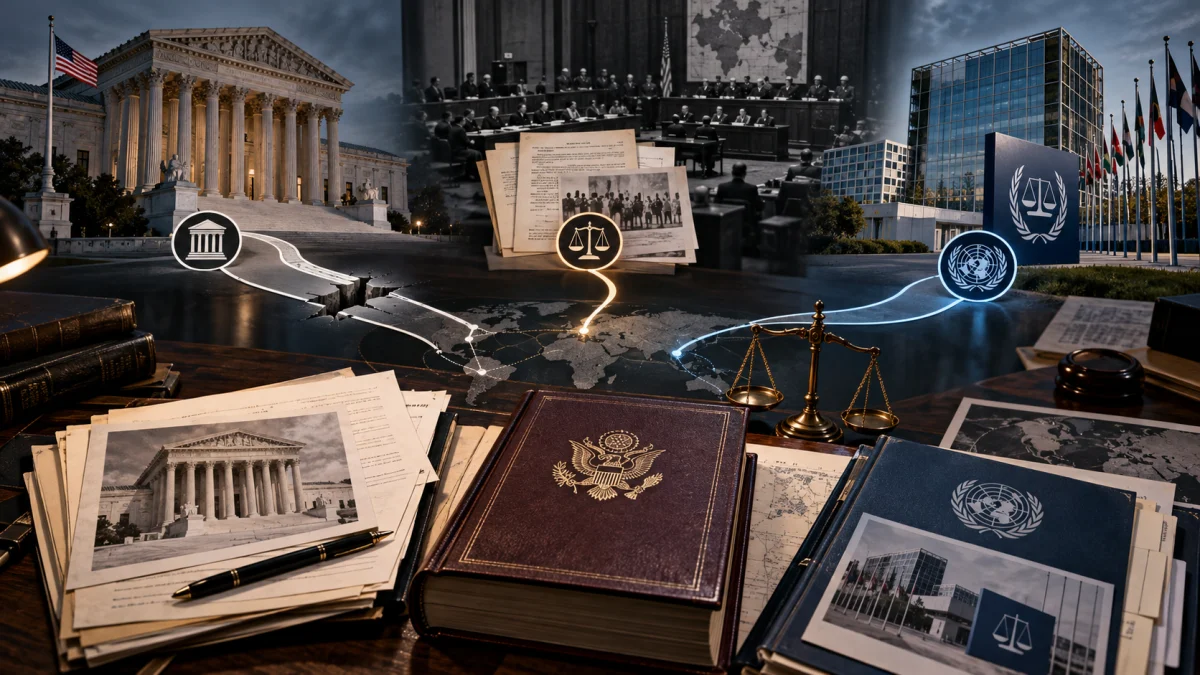
The United States has federal laws against genocide, war crimes, torture, conspiracies against constitutional rights and abuses committed under color of law. What it still does not have is a standalone federal criminal offense for crimes against humanity.
That distinction matters.
It means claims that America has “no way” to hold its own officials accountable are too broad. American officials can be investigated, sued or prosecuted under multiple bodies of law depending on what they allegedly did, where they did it, what office they held and which legal rights or criminal statutes apply.
But the opposite response is also incomplete.
The absence of a federal crimes-against-humanity statute is a real and long-recognized hole in U.S. law. The American Bar Association continues to identify the United States as lacking such a domestic statute, and former State Department officials have testified that existing offenses do not fully substitute for one. American Bar Association Working Group on Crimes Against Humanity State Department testimony on the gap in U.S. crimes-against-humanity law
That is the useful question hiding underneath increasingly common calls for an “American Nuremberg”:
If U.S. officials participated in conduct serious enough to be described as crimes against humanity, what legal mechanism could actually hold them responsible?
The answer is not “nothing.”
It is also not “Nuremberg.”
It is a fragmented system of criminal statutes, civil-rights laws, private lawsuits, constitutional immunities, international jurisdiction and institutional discretion, with one conspicuous federal offense still missing.
Does the United States Have a Crimes Against Humanity Law?
Not as a standalone federal criminal offense.
Under the modern international-law formulation used by the International Criminal Court, crimes against humanity include specified acts such as murder, extermination, enslavement, imprisonment, torture, sexual violence, persecution and enforced disappearance when committed as part of a widespread or systematic attack directed against a civilian population, with the required knowledge of that attack. Cornell Legal Information Institute explanation of crimes against humanity
The United States criminalizes many of those underlying acts.
What it does not currently criminalize at the federal level is crimes against humanity as such: the broader international offense that treats qualifying acts as components of a widespread or systematic attack against civilians.
That difference separates crimes against humanity from both genocide and war crimes.
| Crime | Armed conflict required? | Distinguishing legal feature |
|---|---|---|
| Crimes against humanity | No | Specified acts forming part of a widespread or systematic attack directed against civilians |
| War crimes | Yes, an armed-conflict connection is central | Serious violations of the laws of armed conflict |
| Genocide | No | Specific intent to destroy, in whole or substantial part under U.S. law, a protected national, ethnic, racial or religious group |
Federal genocide law is codified at 18 U.S.C. §1091. 18 U.S.C. §1091 — Genocide Federal war-crimes law is principally codified at 18 U.S.C. §2441. 18 U.S.C. §2441 — War crimes
The distinction is not merely about terminology.
A systematic campaign against civilians can qualify as a crime against humanity even outside a war. And unlike genocide, a crimes-against-humanity prosecution does not require proving the special intent to destroy a protected group.
That is precisely why former State Department Ambassador-at-Large for Global Criminal Justice Beth Van Schaack told Congress that the missing statute leaves conduct potentially punishable internationally without an equivalent federal charge covering the overall crime.
Why Does That Matter If Murder, Torture and Kidnapping Are Already Crimes?
Because criminal law does not operate simply by asking whether something terrible happened.
It asks which offense applies, which court has jurisdiction, what elements prosecutors can prove and whether the statute reaches conduct committed in that place by that defendant.
Suppose someone participated abroad in an organized campaign of imprisonment, forced displacement, persecution and killings against civilians.
Some individual acts might violate U.S. law.
Others might not fall within federal jurisdiction.
And prosecuting a collection of underlying offenses is legally different from prosecuting the broader criminal project as a widespread or systematic attack on a civilian population.
The missing federal crimes-against-humanity offense therefore matters most when conduct is systematic but does not fit cleanly within the jurisdiction or elements of another atrocity statute.
The point is not that murder becomes legal because Congress failed to enact a crimes-against-humanity statute.
It is that the federal criminal code still lacks an offense designed specifically to capture the larger pattern.
The United States Does Already Have an Atrocity-Crimes Framework
The gap should not be confused with a blank space.
Genocide
Under 18 U.S.C. §1091, genocide is a federal crime when someone acts with the required specific intent to destroy, in whole or substantial part, a national, ethnic, racial or religious group through specified conduct. 18 U.S.C. §1091 — Genocide
That intent requirement is demanding.
Mass killing can be horrific without necessarily satisfying the legal definition of genocide.
War crimes
The War Crimes Act, 18 U.S.C. §2441, criminalizes specified war crimes and grave breaches under defined jurisdictional circumstances. 18 U.S.C. §2441 — War crimes
Importantly, the law is substantially broader today than it was only a few years ago.
Congress enacted the Justice for Victims of War Crimes Act in January 2023. The amended statute now allows federal jurisdiction when an alleged war-crimes offender is present in the United States, even if neither the offender nor victim is American and the alleged crime occurred elsewhere. Justice for Victims of War Crimes Act — Public Law 117-351
That correction is important because older explainers still describe the narrower pre-2023 jurisdictional rule.
There is another detail worth knowing: where the offender’s presence in the United States is the sole jurisdictional basis, §2441 requires high-level Justice Department certification before prosecution proceeds.
Torture
Federal law also criminalizes certain torture committed outside the United States under 18 U.S.C. §2340A. Jurisdiction exists when the alleged offender is a U.S. national or when the alleged offender is present in the United States, regardless of nationality. 18 U.S.C. §2340A — Torture
These statutes demonstrate why “America made sure there is no way to hold anyone accountable” does not survive close examination.
But they also demonstrate the opposite problem:
Congress has repeatedly built federal jurisdiction for genocide, torture and war crimes without yet creating the corresponding crimes-against-humanity offense.
Congress Expanded War-Crimes Jurisdiction in 2023 but Left the Crimes-Against-Humanity Gap Open
That legislative history is unusually revealing.
Before 2023, the federal War Crimes Act generally required a much stronger American connection through the victim or alleged offender.
The bipartisan Justice for Victims of War Crimes Act changed that. Its stated purpose was to broaden who could be prosecuted for war crimes, and the current statute reaches an alleged offender found in the United States regardless of nationality.
But Congress did not simultaneously create a crimes-against-humanity offense.
That omission was not because nobody had proposed one.
Sen. Dick Durbin, joined initially by Sens. Patrick Leahy and Russ Feingold, introduced the Crimes Against Humanity Act of 2009, S. 1346, specifically to create a federal offense and prevent the United States from becoming a safe haven for perpetrators. The Senate Judiciary Committee later reported an amended version, but the proposal never became law. GovInfo record for S. 1346, the Crimes Against Humanity Act of 2009
So the federal gap is not hypothetical.
Congress has considered filling it.
It simply has not done so.
Does U.S. Law Treat Government Abuse Only as “Isolated Incidents”?
No.
That claim is one of the important places where the viral version of this argument goes too far.
Federal law explicitly contains a mechanism for addressing certain patterns or practices of government misconduct.
Under 34 U.S.C. §12601, it is unlawful for governmental authorities to engage in a pattern or practice of conduct by law-enforcement officers, or specified juvenile-justice officials, that deprives people of federally protected rights. The Attorney General can bring a civil action seeking equitable or declaratory relief to eliminate that pattern or practice. 34 U.S.C. §12601 — Police pattern-or-practice cause of action
That is systemic by definition.
But there is a major structural limitation:
an individual victim does not personally control a §12601 case.
The statute gives the enforcement authority to the Attorney General acting for the United States.
That creates a more precise accountability problem than saying the law cannot recognize systematic abuse at all.
It can.
But for this particular mechanism, the institution empowered to challenge the government is itself part of the federal government.
Can Federal Prosecutors Charge Individual Government Officials?
Yes, where the elements of federal criminal law are satisfied.
Two Reconstruction-era statutes remain especially important.
18 U.S.C. §241 criminalizes conspiracies to injure, oppress, threaten or intimidate people in the exercise of federally protected rights. 18 U.S.C. §241 — Conspiracy against rights
18 U.S.C. §242 makes it a federal crime for someone acting under color of law to willfully deprive a person of rights protected by the Constitution or federal law. 18 U.S.C. §242 — Deprivation of rights under color of law
The Justice Department notes that §242 can reach police officers, jail officials, judges, prosecutors and other public officials when its elements are established. DOJ Civil Rights Division statutes and law-enforcement misconduct authority
Again, these are real accountability mechanisms.
They are not substitutes for a crimes-against-humanity statute because they address different legal wrongs and require different elements.
Can Victims Sue Government Officials Themselves?
Sometimes.
Here the answer changes significantly depending on whether the official is state or local versus federal.
State and local officials
42 U.S.C. §1983 creates a civil cause of action against persons who, acting under color of state law, deprive someone of federally protected rights. 42 U.S.C. §1983 — Civil action for deprivation of rights
That statute is one of the principal legal tools used in constitutional civil-rights litigation.
It is not unlimited. Immunity doctrines, municipal-liability rules and other requirements can determine whether a particular claim succeeds.
Federal officials
The situation is more restrictive for damages claims directly against federal officials for constitutional violations.
The Supreme Court recognized a judge-created remedy in Bivens v. Six Unknown Named Agents, but it has repeatedly declined to expand Bivens into new contexts.
In Goldey v. Fields, decided in 2025, the Court again described recognition of new Bivens actions as a disfavored judicial activity and reversed a lower-court decision that had permitted a new constitutional damages claim to proceed. Goldey v. Fields — Supreme Court opinion
That produces a genuine asymmetry:
Congress created a broad statutory damages vehicle for many state and local constitutional violations. There is no comparably broad federal statute allowing damages actions against federal officers for every constitutional violation.
That is a much stronger and more accurate critique than saying citizens have no civil remedy at all.
What If the Official Is the President?
Presidential immunity adds another layer.
In Trump v. United States, the Supreme Court held in 2024 that former presidents have:
- absolute immunity from federal criminal prosecution for conduct within their conclusive and preclusive constitutional authority;
- at least presumptive immunity for other official acts;
- no presidential criminal immunity for unofficial acts.
Trump v. United States — Supreme Court decision
That does not mean a president has general immunity from every crime.
Nor does the decision itself resolve every conceivable issue involving state law, international jurisdiction, impeachment or foreign courts.
It resolves a particular constitutional question about federal criminal prosecution of a former president for presidential conduct.
Any serious discussion of accountability at the highest level of the U.S. government now has to account for that framework.
Could the International Criminal Court Prosecute an American?
This is where simple internet answers become especially unreliable.
The United States is not a party to the Rome Statute.
But under the International Criminal Court’s jurisdictional framework, nationality is not the only way the Court claims jurisdiction.
The ICC states that it may generally exercise jurisdiction over genocide, crimes against humanity or war crimes when qualifying crimes are committed:
- by a national of a State Party;
- on the territory of a State Party;
- in a state that has separately accepted the Court’s jurisdiction; or
- pursuant to a qualifying U.N. Security Council referral.
International Criminal Court — How the Court works and when it has jurisdiction
That territorial route is why the statement “the ICC can never prosecute an American because the United States never joined” is incomplete.
An accused person’s nationality and the territory where the alleged crime occurred are separate jurisdictional questions under the Rome Statute framework.
The current U.S. government rejects that application to Americans
The U.S. government’s position is different.
In July 2026, the Justice Department stated that because the United States has not consented to the Rome Statute, it rejects ICC jurisdiction over Americans and will not cooperate with ICC proceedings against U.S. persons. Justice Department statement rejecting ICC jurisdiction over U.S. persons, July 2, 2026
The correct answer is therefore not to pretend one of those positions does not exist.
The ICC’s published jurisdictional framework allows territorial jurisdiction over conduct occurring in a State Party even when the accused is a national of a nonmember state. The current U.S. government rejects the Court’s authority over Americans.
That is the dispute.
The ICC Is Also Not a World Police Force
Even where ICC jurisdiction exists, another misconception appears quickly.
The ICC is intended to complement rather than replace national courts. Under the principle of complementarity, national jurisdictions bear primary responsibility, and the ICC generally proceeds when relevant states are unwilling or unable genuinely to investigate or prosecute. ICC explanation of complementarity
The Court also does not have its own police force.
It depends heavily on states to arrest suspects, transfer defendants and otherwise enforce its decisions.
That practical reality matters almost as much as the theoretical jurisdiction.
A court order and physical custody are different things.
What Is the “Hague Invasion Act”?
The nickname refers to part of the American Servicemembers’ Protection Act of 2002.
Under 22 U.S.C. §7427, the President is authorized to use “all means necessary and appropriate” to secure the release of certain U.S. or allied persons detained by, on behalf of or at the request of the ICC. 22 U.S.C. §7427 — Authority concerning persons detained by the ICC
The phrase “Hague Invasion Act” is a nickname, not the law’s formal title.
The statutory language is nevertheless unusually broad and reflects the longstanding conflict between parts of the U.S. government and the ICC over jurisdiction and sovereignty.
Could Another Country Prosecute a U.S. Official?
Potentially, depending on that country’s laws, the offense, jurisdictional rules, immunities and whether authorities can obtain custody over the accused.
Some countries recognize forms of universal jurisdiction, particularly for serious international crimes. The principle allows national courts, under applicable domestic law, to exercise jurisdiction over certain crimes even without the ordinary territorial or nationality connection. International Committee of the Red Cross explainer on universal jurisdiction
That does not mean an American official can automatically be arrested anywhere in the world.
Whether a prosecution can proceed may depend on the prosecuting country’s statute, presence or custody requirements, immunity doctrine, extradition law, evidence and the specific international crime alleged.
There is no single worldwide criminal court system with automatic enforcement.
Did Nuremberg Only Happen Because Nazi Germany Collapsed?
Nuremberg itself did.
That part of the analogy has real historical substance.
Germany surrendered in May 1945. The United States, United Kingdom, Soviet Union and France signed the London Agreement and Charter on August 8, creating the International Military Tribunal.
The Nuremberg trial opened on November 20, 1945. Each of the four Allied powers supplied a judge and prosecution team. U.S. Holocaust Memorial Museum history of the International Military Tribunal at Nuremberg
In other words, Nazi Germany did not decide to investigate itself.
The tribunal was created by victorious foreign powers after Germany had been militarily defeated and occupied.
So if someone says:
“Nuremberg was possible because the regime had collapsed and outside powers controlled the accountability process,”
that is historically accurate.
What does not follow is:
“Therefore accountability for international crimes always requires total regime collapse.”
Modern systems work differently.
Domestic prosecutions, foreign prosecutions, universal jurisdiction, hybrid courts and the International Criminal Court all provide mechanisms that did not exist in their modern forms in 1945.
Calling every possible future prosecution an “American Nuremberg” therefore creates the wrong mental model.
Why an “American Nuremberg” Is Probably the Wrong Legal Analogy
Nuremberg combined several unusual conditions at once:
- Germany had suffered total military defeat.
- Its previous regime no longer controlled the courts.
- Allied powers physically controlled German territory.
- The defendants were in Allied custody.
- The victorious powers created the tribunal itself.
- International criminal law was entering a new institutional era.
A modern prosecution involving U.S. officials would almost certainly arise through different machinery.
It might involve a federal prosecution.
It might involve state or civil litigation.
It might involve a foreign national court exercising jurisdiction recognized by its own law.
It could involve the ICC where the Court claimed territorial or other jurisdiction, while confronting U.S. opposition and practical enforcement obstacles.
Those are all materially different from recreating Nuremberg.
The better question is therefore not:
“When do we get our Nuremberg Trials?”
It is:
“Which institution has lawful jurisdiction over the alleged conduct, and who has the power to make that jurisdiction real?”
American Accountability Law Was Not Designed in One Moment
There is another problem with saying the American legal system was simply “designed this way.”
American institutions undeniably emerged from a country that practiced slavery, dispossessed Indigenous peoples, restricted citizenship and political power, and protected systems of racial hierarchy for generations.
But modern American accountability law was not created in one constitutional moment and frozen there.
Some of its most important federal civil-rights mechanisms were created specifically because earlier institutions had failed to protect Black Americans from organized racial violence and abuses of state power.
The modern survivors of Reconstruction legislation include 18 U.S.C. §§241 and 242 and 42 U.S.C. §1983. Congress enacted the Enforcement Acts during Reconstruction to enforce newly recognized constitutional rights and confront terror and voter suppression, including violence associated with the Ku Klux Klan. Congressional Constitution Annotated history of Reconstruction enforcement legislation National Archives overview of the Enforcement Acts of 1870–1871
That history does not erase the systems those laws were responding to.
It demonstrates something more complicated:
American legal history contains both institutions that preserved unequal power and later institutions explicitly created to restrain it.
The accountability problem is therefore not adequately explained by saying either “the system works” or “the system was built only to prevent accountability.”
The useful question is which part of the system controls a particular case, what remedies it permits, and who has authority to invoke them.
Does the First Amendment Simply Protect “Extremism”?
Not exactly.
American law generally does not criminalize an ideology merely because government officials regard it as extremist.
That is a consequence of unusually strong constitutional protection for political advocacy.
Under Brandenburg v. Ohio, advocacy of force or illegal conduct generally cannot be prohibited as incitement unless it is directed toward producing imminent lawless action and is likely to produce it. Congressional Constitution Annotated — Brandenburg and the modern incitement rule
But protected advocacy is not the same thing as protected criminal conduct.
Conspiracy, assault, murder, threats satisfying the relevant legal standards, deprivation of rights under color of law and other crimes do not become immune merely because the perpetrator has an ideological motive.
So saying “extremism is protected by free speech” compresses several different questions into one.
Belief and advocacy receive extensive protection. Crimes do not become constitutionally protected merely because they are ideological.
The U.S. Accountability Matrix
The easiest way to understand the system is to stop looking for one universal accountability law.
There isn’t one.
| Alleged conduct or route | U.S. mechanism | Can it reach officials? | Can it address systemic conduct? | Who drives the case? | Important limitation |
|---|---|---|---|---|---|
| Genocide | 18 U.S.C. §1091 | Potentially | Yes, where statutory elements are met | Federal prosecutors | Requires specific genocidal intent |
| War crimes | 18 U.S.C. §2441 | Potentially | Can reach multiple offenses | Federal prosecutors | Requires qualifying war crime and jurisdiction; presence-only cases require high-level certification |
| Certain overseas torture | 18 U.S.C. §2340A | Potentially | Usually focused on individual criminal responsibility | Federal prosecutors | Statutory definition and jurisdiction requirements |
| Conspiracy against federal rights | 18 U.S.C. §241 | Yes | Can address coordinated conduct | Federal prosecutors | Must involve protected federal rights |
| Willful deprivation of rights under color of law | 18 U.S.C. §242 | Yes | Primarily individual criminal liability | Federal prosecutors | Requires willfulness and deprivation of a protected right |
| Law-enforcement pattern or practice | 34 U.S.C. §12601 | State/local governmental law-enforcement conduct within statutory scope | Yes | Attorney General | Individual victims cannot independently bring the federal government’s §12601 action |
| State/local constitutional violations | 42 U.S.C. §1983 | Yes | Sometimes | Private plaintiff | Immunity and other doctrines can limit liability |
| Federal constitutional violations | Bivens doctrine | In limited circumstances | Limited | Private plaintiff | Supreme Court strongly restricts new Bivens contexts |
| Federal criminal prosecution of former president | Ordinary federal criminal law plus presidential-immunity doctrine | Depends on conduct | Depends | Federal prosecutors | Core acts absolutely immune; other official acts at least presumptively immune; unofficial acts not protected by presidential immunity |
| Crimes against humanity as a standalone federal offense | No general federal offense | No charge under that label | This is the statutory gap | — | Underlying acts may still violate other laws |
| International Criminal Court | Rome Statute system | ICC framework says potentially, if jurisdictional requirements are met | Yes | ICC Prosecutor/Court | U.S. is not a party, current U.S. government rejects ICC jurisdiction over Americans, and ICC depends on state cooperation |
| Foreign national court | Country-specific law / universal or other jurisdiction | Potentially | Potentially | Foreign authorities | Varies by country; immunity, evidence, presence and custody can be decisive |
This is why both absolutist narratives fail.
The American government is not legally incapable of prosecuting its own officials.
Nor does the existence of scattered statutes mean every systematic state crime has an obvious criminal vehicle.
Accountability depends heavily on classification.
A Recent War-Crimes Case Shows Why the Labels Matter
The distinction between war crimes and crimes against humanity is not academic.
In sherafy.com‘s recent examination of the Hashim Thaçi judgment, the former Kosovo president and other defendants were convicted of serious war crimes while being acquitted of crimes-against-humanity charges because prosecutors did not establish the additional broader attack required for that offense beyond a reasonable doubt. Why Was Hashim Thaçi Convicted? Kosovo War Crimes, the KLA and His 25-Year Sentence Explained
The underlying conduct can therefore be criminal while the crimes-against-humanity charge still fails.
Similarly, sherafy.com‘s examination of genocide allegations in Sudan explains why genocide has its own demanding intent requirement rather than simply serving as a synonym for extreme civilian killing. Is There a Genocide in Sudan? What the Evidence Shows
Those distinctions matter even when the underlying conduct is horrifying.
International criminal law is built around proving particular crimes, not selecting whichever label sounds most severe.
Why This Question Matters More in 2026
The crimes-against-humanity gap is not merely historical.
The international community is currently negotiating toward a dedicated global convention on prevention and punishment of crimes against humanity.
The U.N. General Assembly authorized a diplomatic conference process in 2024. A preparatory committee held its first session from January 19 through January 30, 2026. A second preparatory session is scheduled for April 2027, followed by substantive diplomatic conferences planned for 2028 and 2029. United Nations crimes-against-humanity diplomatic conference process
In other words, governments around the world are currently negotiating over exactly the category of crime the U.S. federal code still does not contain as a standalone offense.
That makes the American gap increasingly difficult to treat as an obscure historical technicality.
So Can U.S. Officials Be Prosecuted for Crimes Against Humanity?
The most accurate answer is:
Not in a U.S. federal prosecution under a standalone offense called “crimes against humanity,” because Congress has not enacted one.
But that is only the first sentence.
The same conduct might still be prosecuted under federal laws covering war crimes, genocide, torture, civil-rights violations, homicide, sexual violence, trafficking, conspiracy or other offenses if the facts and jurisdictional requirements fit.
State or local officials can face private constitutional litigation under §1983.
Federal officials may face more limited constitutional damages claims under existing Bivens precedent.
Certain patterns of unconstitutional state or local law-enforcement conduct can be challenged by the Justice Department under §12601.
Former presidents now operate under the criminal-immunity rules established in Trump v. United States.
Foreign courts may possess their own jurisdiction over some international crimes.
And the ICC’s framework can reach crimes committed on qualifying territory even when an accused is a national of a nonmember state, although the current U.S. government rejects the Court’s jurisdiction over Americans and the ICC lacks an independent enforcement arm.
There is no one switch labeled ACCOUNTABILITY.
There are multiple switches controlled by different institutions.
Some can be activated by victims.
Some only by prosecutors.
Some depend on the Attorney General.
Some depend on foreign states.
Some depend on international jurisdiction.
Some are restricted by immunity doctrines.
And one major switch — a general federal crimes-against-humanity offense — still does not exist.
The Bottom Line
Waiting for a literal American version of the Nuremberg Trials misunderstands both Nuremberg and modern American law.
Nuremberg followed Germany’s military defeat and occupation. Outside powers created the tribunal, controlled the territory and had custody of the defendants.
Modern accountability does not universally require those conditions.
But neither does American law provide one simple mechanism capable of placing “the state” itself on trial.
Instead, the United States has accumulated layers of criminal law, constitutional remedies and institutional checks over generations: Reconstruction civil-rights statutes, federal atrocity laws, private civil actions, Justice Department pattern-or-practice authority and modern international mechanisms.
Some are powerful.
Some are narrow.
Some depend heavily on the same government institutions whose conduct may be under scrutiny.
And some categories remain missing altogether.
The most important missing category is unusually clear:
The country that helped prosecute crimes against humanity at Nuremberg still has no standalone federal criminal offense for crimes against humanity.
That does not prove that American officials cannot be held accountable.
It tells us something more useful:
Before asking when America will get its own Nuremberg, ask who has jurisdiction, what offense actually applies, who controls the prosecution, what immunities exist and whether the law is capable of describing the alleged wrongdoing for what it is.
That is where the real accountability question begins.
References and Further Reading
U.S. Criminal Law and Accountability Mechanisms
18 U.S.C. §1091 — Genocide, Cornell Legal Information Institute
Current federal genocide statute and its specific-intent requirement.
18 U.S.C. §2441 — War Crimes, Cornell Legal Information Institute
Current War Crimes Act, including the expanded 2023 jurisdictional provisions.
Justice for Victims of War Crimes Act, Public Law 117-351 — GovInfo
Primary legislative record for the 2023 expansion of federal war-crimes jurisdiction.
18 U.S.C. §2340A — Torture, Cornell Legal Information Institute
Federal offense covering specified torture committed outside the United States and its jurisdictional provisions.
18 U.S.C. §241 — Conspiracy Against Rights, Cornell Legal Information Institute
Federal criminal civil-rights conspiracy statute.
18 U.S.C. §242 — Deprivation of Rights Under Color of Law, Cornell Legal Information Institute
Federal criminal statute addressing willful constitutional or federal-rights violations committed under color of law.
34 U.S.C. §12601 — Police Pattern or Practice, Cornell Legal Information Institute
Authorizes the Attorney General to seek relief against specified patterns or practices of unconstitutional law-enforcement conduct.
42 U.S.C. §1983 — Civil Action for Deprivation of Rights, Cornell Legal Information Institute
The principal statutory civil remedy for many constitutional violations committed under color of state law.
Crimes Against Humanity and the Federal-Law Gap
American Bar Association Working Group on Crimes Against Humanity
Current overview of the absence of a U.S. domestic crimes-against-humanity statute and efforts to address the gap.
Ambassador Beth Van Schaack — Senate Judiciary Committee Testimony on Crimes Against Humanity
Detailed former U.S. government explanation of why existing criminal statutes do not fully replace a crimes-against-humanity offense.
S. 1346 — Crimes Against Humanity Act of 2009, GovInfo
Official legislative record showing Congress previously considered creating a standalone federal offense.
Presidential and Federal-Official Liability
Trump v. United States — Supreme Court decision
The 2024 decision establishing absolute immunity for core constitutional presidential acts, at least presumptive immunity for other official acts and no presidential criminal immunity for unofficial acts.
Goldey v. Fields — Supreme Court opinion
The Court’s 2025 decision continuing its restrictive approach toward extending Bivens damages remedies into new constitutional contexts.
International Criminal Court
International Criminal Court — How the Court Works
Official ICC explanation of territorial, nationality and Security Council routes to jurisdiction, as well as the Court’s dependence on state cooperation.
ICC Assembly of States Parties — Complementarity
Explains the principle that national jurisdictions retain primary responsibility and the ICC operates as a court of last resort.
U.S. Justice Department — Rejecting ICC Jurisdiction Over U.S. Persons, July 2, 2026
Current U.S. executive-branch position disputing the ICC’s authority over Americans.
22 U.S.C. §7427 — Authority Regarding Persons Detained by the ICC
The statutory provision behind the commonly used “Hague Invasion Act” nickname.
Nuremberg and Historical Accountability
International Military Tribunal at Nuremberg — U.S. Holocaust Memorial Museum
Documents the tribunal’s creation by the four Allied powers, its defendants, charges and chronology following Germany’s surrender.
The Nuremberg Trial and the Tokyo War Crimes Trials — State Department Office of the Historian
Historical account of the London Agreement, Nuremberg Charter and Allied tribunal structure.
Reconstruction and Civil-Rights Enforcement
Congressional Constitution Annotated — Reconstruction Enforcement Legislation
Explains the Reconstruction legislation from which modern federal civil-rights statutes including §§241, 242 and 1983 developed.
National Archives — Enforcement Acts of 1870–1871 and Reconstruction Civil Rights
Historical context for federal efforts to protect Black voting rights and confront Klan violence and intimidation.
Speech and Extremism
Congressional Constitution Annotated — Brandenburg and the Incitement Standard
Authoritative summary of the First Amendment distinction between protected advocacy and punishable incitement.
Current International Treaty Process
United Nations — Diplomatic Conference on Prevention and Punishment of Crimes Against Humanity
Official record of the ongoing 2026–2029 process toward a dedicated legally binding international instrument on crimes against humanity.
Editorial currency note: This article reflects U.S. federal law, Supreme Court precedent, the current U.S. executive-branch position on the International Criminal Court and the U.N. crimes-against-humanity treaty process as of September 28, 2026. Statutes, court precedent, international proceedings and executive policies can change.