Yes. Arnon Milchan really did perform clandestine work for Israel before becoming one of Hollywood’s most successful film producers and financiers. He publicly acknowledged working for Israel’s secret Bureau of Scientific Relations, commonly known as LAKAM or Lekem, and his activities were connected to Israel’s secret nuclear-weapons procurement effort. Contemporary coverage of Milchan’s 2013 Israeli television interview described him as an Israeli intelligence operative who assisted the country’s nuclear project.
The rest of the viral story gets more complicated.
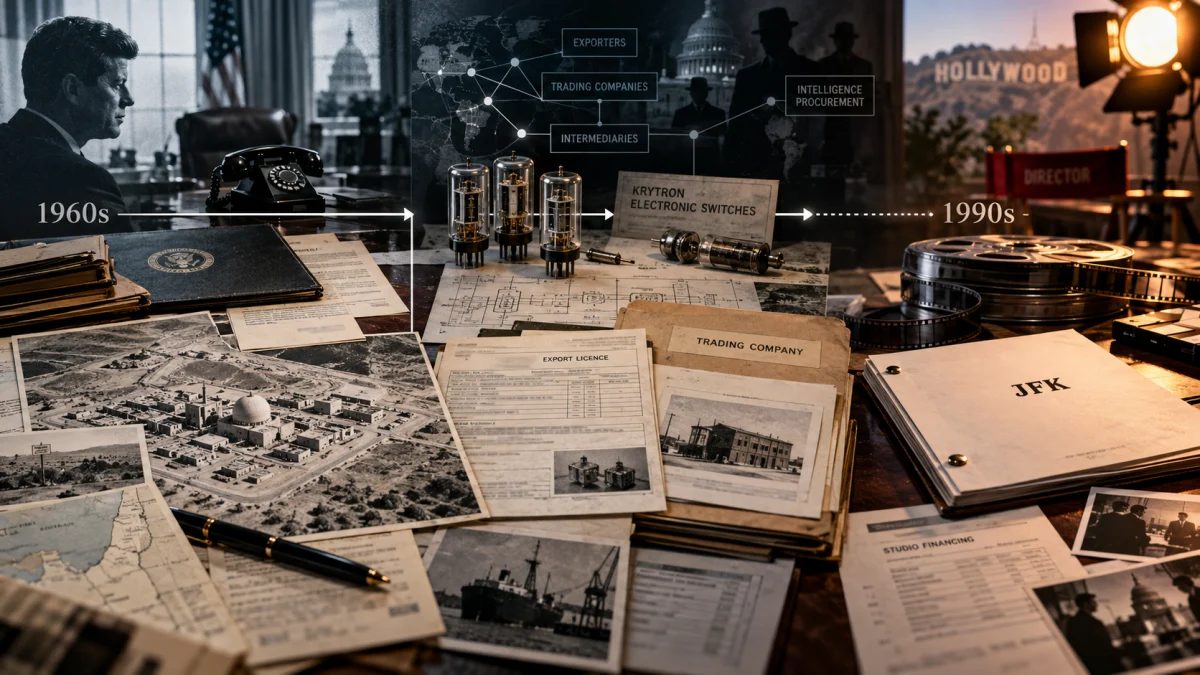
A company Milchan owned, Heli Trading, was the Israeli recipient of roughly 800 American-made krytrons, ultrafast electronic switches that had civilian and conventional military applications but could also be used in nuclear-weapon detonators. American engineer Richard Kelly Smyth illegally exported the devices without the required licenses and was later convicted. Contemporary court-related reporting also recorded that Smyth had previously told a U.S. intelligence official that Milchan had requested krytrons be sent to Israel. Milchan, however, was never charged and denied involvement in the illegal shipments.
Then there is the John F. Kennedy connection.
Declassified U.S. records show that Kennedy repeatedly pressured Israeli leaders over the Dimona nuclear facility and demanded recurring American inspections capable of determining whether Israel was moving toward weapons-grade plutonium production. Decades later, Milchan became the executive producer and one of the financiers of Oliver Stone’s JFK, a movie centered on Kennedy’s assassination and the forces that may have opposed his policies.
The publicly available screenplay does not appear to discuss Kennedy’s confrontation with Israel over Dimona: searches of the script for both “Israel” and “Dimona” return no matches.
That coincidence is legitimately remarkable.
What has not been established is the final leap often made online: that Milchan used his position on JFK to make Oliver Stone suppress that history.
Stone was directly asked about Milchan in 2025 and denied it. According to a video and transcript published after Stone appeared before a congressional task force on the JFK records, Stone said Milchan “did not interfere in any way on the film” and characterized his involvement as financial. The House Oversight Committee independently confirms that Stone appeared before the task force on April 1, 2025.
The documented story is therefore already extraordinary without adding something the evidence does not prove.
What the Evidence Actually Shows
| Claim | What the evidence supports |
|---|---|
| Arnon Milchan secretly worked for Israel | Verified. Milchan publicly acknowledged working for Israel’s Bureau of Scientific Relations. |
| Milchan was a Mossad agent | Misleading. The organization identified in the record is LAKAM/Lekem, not Mossad. |
| His work was connected to Israel’s nuclear program | Verified. Milchan acknowledged clandestine procurement work, and contemporary accounts of his 2013 interview explicitly connect it to Israel’s secret nuclear effort. |
| Milchan helped Israel obtain uranium | Supported by Milchan’s own account. He said his South African relationships were used in part to help Israel obtain uranium. |
| Israel illegally obtained hundreds of American krytrons | Verified. Richard Kelly Smyth was prosecuted for sending roughly 800 without required U.S. export authorization. |
| The krytrons went to a company owned by Milchan | Verified. The recipient was Heli Trading. |
| Records connect Milchan personally to krytron requests | Supported. Court-related reporting says Smyth told a U.S. intelligence official in 1975 that Milchan had requested krytrons. |
| Milchan was convicted in the krytron case | False. He was not charged. Smyth was prosecuted and convicted. |
| Kennedy pressured Israel over the Dimona nuclear facility | Verified by declassified U.S. records. |
| Milchan helped finance and executive-produced Oliver Stone’s JFK | Verified. |
| JFK does not develop Kennedy’s Dimona confrontation | Supported. The publicly available screenplay contains no apparent reference to Israel or Dimona. |
| Milchan forced Stone to omit it | Not established. Stone has explicitly denied that Milchan influenced the film’s content. |
| These facts show Israel was involved in Kennedy’s assassination | No. Nothing in the evidence examined here establishes that connection. |
Was Arnon Milchan Really an Israeli Spy?
The simplest answer is yes, although “Israeli intelligence operative” is more precise.
Milchan spent years denying that characterization publicly. But in 2013, while speaking to Israeli investigative television program Uvda, he acknowledged work for Israel’s Bureau of Scientific Relations, the clandestine organization commonly known as LAKAM or Lekem.
The Jewish Telegraphic Agency reported that Milchan acknowledged serving the now-defunct organization and assisting Israel’s secret nuclear project. The Guardian likewise reported that Milchan discussed his former life as an Israeli secret agent and arms dealer and that former Israeli President Shimon Peres acknowledged recruiting him.
Milchan did not portray the work as something he regretted.
He described it as service to his country and said he was proud of it.
That makes the viral description of Milchan as an “Israeli spy” broadly defensible.
But calling him a Mossad spy is imprecise.
Was Arnon Milchan Mossad?
There is an important distinction here.
Milchan’s acknowledged organization was LAKAM, not Mossad.
LAKAM was a secret Israeli organization focused on obtaining scientific, technical and defense-related information and equipment abroad. Reports about Milchan’s admission identify the organization as Israel’s Bureau of Scientific Relations and connect its work to sensitive military technology and the country’s nuclear program.
“Mossad” is sometimes used online as shorthand for virtually any clandestine Israeli activity.
That does not make it historically accurate.
The more precise description is:
Arnon Milchan was an Israeli clandestine procurement and intelligence operative who worked for LAKAM.
What Did Arnon Milchan Actually Do for Israel?
Milchan’s activities went considerably beyond simply passing along occasional information.
In his 2013 interview, he discussed clandestine arms and technology procurement and acknowledged using international business relationships in service of Israeli government objectives. Contemporary reporting on the interview connected his activities directly to Israel’s secret nuclear program.
CBS reported that Milchan described himself as integral to the nuclear effort, while accounts of his activities included attempts to cultivate technically valuable American contacts.
One particularly uncomfortable part of the story involved apartheid-era South Africa.
Milchan told Uvda that he had used connections to promote South Africa’s apartheid government in exchange for assistance obtaining uranium for Israel. The Guardian reported that admission directly.
That should be distinguished from more expansive claims made in biographies and later retellings.
There is strong evidence for Milchan’s broader clandestine procurement role. Specific allegations about individual operations should still be evaluated operation by operation rather than treated as proven merely because his intelligence work is established.
The krytron case provides an unusually useful example because the American side generated an extensive legal and journalistic record.
What Were the “Nuclear Triggers” Connected to Arnon Milchan?
The devices were called krytrons.
Calling them simply “nuclear triggers” is understandable, but incomplete.
Krytrons are extremely fast electronic switches capable of producing precisely timed electrical pulses. They can have nonnuclear applications. Contemporary reporting described uses including strobe systems and other electronics.
They can also be used in the firing systems of nuclear weapons.
That potential military application was why exporting them from the United States required government authorization.
The distinction matters.
The evidence does not show that every krytron is inherently a nuclear-weapons component. It shows that the technology was sensitive enough that the United States restricted its export, that hundreds were shipped to Israel without the necessary authorization, and that their potential nuclear use was a central concern in the case.
The Richard Kelly Smyth Krytron Case
The person prosecuted by the United States was Richard Kelly Smyth, an American engineer and businessman who operated Milco International.
In May 1985, a federal grand jury indicted Smyth over illegal exports of 810 krytrons to Israel. Prosecutors alleged that the devices had been shipped in multiple transactions without the required State Department licenses and had been falsely described in export documentation.
The Israeli recipient was Heli Trading, a company owned by Arnon Milchan.
Smyth fled before his original trial, remained a fugitive for years, was eventually arrested in Spain and returned to the United States. He later pleaded guilty and was sentenced in the case.
That much is straightforward.
The harder question is how directly Milchan himself was connected to the procurement.
Records Put Milchan Closer to the Krytron Procurement Than Merely Owning the Recipient Company
It would be misleading to leave the story at:
Milchan happened to own the Israeli company that received the devices.
Contemporaneous evidence goes further.
A detailed 1986 Washington Post investigation reported that in 1975, years before the illegal shipments charged in Smyth’s indictment, Smyth sought a U.S. license to export 400 krytrons to Heli Trading.
According to a prosecutor’s letter filed in the court record, Smyth had previously spoken with a U.S. intelligence official and said that Arnon Milchan had requested that a certain number of krytrons be sent to Israel.
Smyth initially applied for permission.
A U.S. nuclear regulatory official questioned the size of the proposed shipment. Smyth reduced the requested quantity and eventually withdrew the application. According to the later federal indictment, hundreds of krytrons were subsequently shipped without the required licenses.
A 1985 Washington Post report also quoted a Milco employee who said Milchan had participated in purchasing the krytrons from their American manufacturer.
Those records make the connection substantially stronger than the vague statement that one of Milchan’s companies appeared somewhere downstream.
They still do not justify rewriting the legal record.
Arnon Milchan Was Never Convicted in the Krytron Case
Milchan was not charged in Smyth’s prosecution.
That point is important because viral versions regularly collapse several distinct facts into one sentence and leave the impression that Milchan himself was convicted of smuggling nuclear triggers.
He was not.
Milchan denied knowing about the illegal krytron order. In a 1992 interview with the Los Angeles Times, he said he had nothing to do with Smyth’s Milco company and knew nothing about the krytron transaction.
Years later, reporting on Smyth’s prosecution said Milchan continued to deny involvement in the krytron deal, while acknowledging that he had allowed the Israeli government to use Heli Trading as a conduit for business with the United States.
Those denials have to remain part of the record.
But they also exist alongside contemporaneous evidence showing that Smyth had identified Milchan years earlier as the person requesting krytrons.
The responsible conclusion is therefore neither extreme:
Milchan was not convicted or charged in the illegal krytron-export case. But the historical record connects him more directly to krytron procurement than merely being the uninvolved owner of the company receiving the devices.
Was John F. Kennedy Really Pressuring Israel Over Its Nuclear Program?
Yes. This part is not speculative. It is extensively documented in declassified U.S. government records.
Kennedy was deeply concerned about nuclear proliferation generally and about Israel’s secretive nuclear project at Dimona specifically.
Research published by the Wilson Center using declassified American records shows that Kennedy repeatedly pushed Israeli leaders for meaningful inspections and sought assurances that Dimona would not be used to create a military nuclear capability.
By 1963, that pressure became particularly direct.
On June 15, 1963, Kennedy approved a letter intended for Israeli Prime Minister David Ben-Gurion.
The letter demanded inspections that would meet standards capable of resolving doubts about Dimona’s peaceful purpose. Kennedy wanted an inspection that summer, another in June 1964 and further visits at approximately six-month intervals.
The instructions were unusually specific.
American scientists were to receive access not simply to the reactor itself but to all areas of the Dimona complex, including related facilities such as any plutonium-separation plant.
Why six months?
The same State Department document explains the technical concern.
U.S. officials believed a reactor intended to produce weapons-grade plutonium could be operated on a fuel cycle of roughly six months, making recurring inspections necessary if American scientists were to determine what Dimona was actually doing.
This was not a vague disagreement over energy policy.
The Kennedy administration was specifically worried about nuclear weapons proliferation.
Kennedy’s Famous Ben-Gurion Letter Was Never Delivered
This is an important correction to many online retellings.
Kennedy’s June 15 letter was prepared for Ben-Gurion, but it was not delivered.
Ben-Gurion resigned as prime minister on June 16. A State Department footnote states explicitly that the letter was held because of his resignation.
That means claims that Ben-Gurion received Kennedy’s June 15 ultimatum and then immediately resigned because of it overstate what the documentary record establishes.
The timing can legitimately raise historical questions.
It does not change the mechanics: according to the U.S. record, Ben-Gurion did not receive that particular letter before resigning.
Kennedy did not abandon the issue.
Kennedy Sent the Demand to Levi Eshkol Instead
After Levi Eshkol became prime minister, Kennedy returned to the Dimona issue almost immediately.
A July 4, 1963 letter instructed the U.S. ambassador to convey Kennedy’s demand to Eshkol.
Again, Kennedy called for an inspection that summer, another in June 1964 and subsequent visits every six months.
Again, he required access to the full Dimona complex, including fuel-fabrication facilities and any plutonium-separation plant.
The document also explains why American officials believed those intervals mattered: they were attempting to distinguish peaceful reactor operation from a cycle capable of producing weapons-grade plutonium.
Whatever later theories have accumulated around Kennedy, Israel and his assassination, Kennedy’s conflict with Israeli leaders over Dimona does not depend on conspiracy literature.
It is in the official American diplomatic record.
Where Arnon Milchan and Oliver Stone’s JFK Enter the Story
Nearly three decades later, Oliver Stone began making JFK, his sprawling 1991 film about the Kennedy assassination.
Arnon Milchan entered the project as a major financial participant.
The American Film Institute identifies Milchan as the film’s executive producer and reports that his Regency Enterprises joined the project with additional financing, helping increase the budget to approximately $40 million.
Milchan was therefore not merely someone whose name was loosely associated with the movie.
His company helped finance it.
And according to Milchan himself, he read the project before investing.
In a lengthy 2008 interview, Milchan recalled Warner Bros. approaching him about a difficult project called JFK. He said he read it, considered its conspiracy theories and became interested in the unresolved national-security questions surrounding Kennedy’s assassination.
That makes the coincidence more substantial than simply discovering decades later that an unrelated Hollywood executive happened to appear in the credits.
Milchan consciously participated in financing a film about Kennedy.
By that point, he also had a clandestine history tied to the very Israeli nuclear program that Kennedy had pressured Israeli governments over.
Both facts are documented.
Did JFK Discuss Kennedy’s Confrontation With Israel Over Dimona?
Not in the publicly available screenplay examined for this article.
The script hosted by the Internet Movie Script Database is extensive. Its opening alone reviews the Bay of Pigs, the CIA, Cuba, Vietnam, organized crime, nuclear testing and other conflicts surrounding Kennedy’s presidency.
Yet searches of that screenplay for “Israel” and “Dimona” produce no matches.
That makes the omission real enough to discuss.
It does not, by itself, establish why the material was omitted.
A three-hour film cannot include every conflict of Kennedy’s presidency, and JFK was already dealing with an enormous number of alleged motives, institutions and historical disputes.
The relevant question is therefore not:
Was Dimona omitted?
It apparently was.
The relevant question is:
Is there evidence that Arnon Milchan caused it to be omitted?
That is where the viral story outruns the evidence.
Did Arnon Milchan Make Oliver Stone Leave Israel Out of JFK?
There is currently no evidence establishing that he did.
The suspicion does not arise from nowhere.
Consider the documented sequence:
- Kennedy repeatedly pressured Israel over Dimona.
- Milchan later acknowledged clandestine work connected to Israel’s nuclear procurement program.
- Milchan read the JFK project.
- His company provided additional financing.
- Milchan became the movie’s executive producer.
- The publicly available screenplay does not discuss Kennedy’s Dimona confrontation.
That is an unusual collection of facts.
But a collection of facts is not evidence of an undocumented conversation, order or act of censorship.
And Oliver Stone has now addressed the question directly.
Oliver Stone Says Milchan Did Not Interfere With JFK
On April 1, 2025, Stone appeared as a witness before the House Oversight Committee’s Task Force on the Declassification of Federal Secrets during a hearing on JFK records. The committee’s official hearing page confirms Stone’s participation.
Afterward, journalist Sam Husseini asked Stone when he learned about Milchan’s Israeli intelligence background.
Stone said it was after making the film.
When Husseini pressed him about Milchan’s involvement, Stone said Milchan “did not interfere in any way on the film.” Stone described Warner Bros. as the principal force behind the project and said Milchan came in as a financial partner and did not express opinions about the film’s content.
Stone also acknowledged that he knew Milchan was an important Israeli figure and suspected he had intelligence connections, but said he did not know the specifics of what Milchan had done.
A second person reportedly asked Stone essentially the same question shortly afterward.
Stone again said Milchan had played a financial role and had not influenced the focus of the film.
That does not magically prove that no influence of any kind could ever have occurred.
It establishes Stone’s account, and Stone is the person who wrote and directed the film.
Absent documentary evidence contradicting him, the responsible conclusion is that there is no demonstrated basis for claiming Milchan censored the Dimona story out of JFK.
The Coincidence Is Still Extraordinary
Rejecting an unsupported conclusion does not require pretending the underlying facts are ordinary.
They are not.
One of the executive producers and financiers of perhaps the most famous film ever made about John F. Kennedy’s assassination had previously conducted clandestine procurement work connected to Israel’s nuclear ambitions.
Kennedy, meanwhile, had spent part of his presidency aggressively pressing Israeli leaders for credible access to Dimona precisely because his administration was concerned that the facility could support a nuclear-weapons program.
Milchan later acknowledged his covert work.
He also acknowledged reading JFK before investing in it.
The film does not appear to discuss the Kennedy-Dimona confrontation.
Those facts are sufficiently interesting without inventing the missing bridge between them.
Does This Mean Israel Was Involved in JFK’s Assassination?
No such conclusion follows from the evidence presented here.
There is a difference between establishing a potential political conflict and establishing responsibility for an assassination.
Kennedy unquestionably had conflicts with numerous governments, intelligence agencies, military officials, organized-crime figures, political factions and business interests during his presidency.
Demonstrating that Israel had a serious policy dispute with Kennedy over nuclear proliferation does not demonstrate that Israel participated in killing him.
Likewise, discovering that an Israeli intelligence operative later financed a movie about the assassination does not retroactively establish a role in the assassination itself.
Oliver Stone made essentially the same distinction after being asked about the subject in 2025. He acknowledged that Kennedy opposed an Israeli nuclear weapon but said he could not speculate about whether that had anything to do with Kennedy’s death.
That line is important.
The Kennedy-Dimona confrontation is historical fact.
An Israeli role in the assassination is a separate claim requiring separate evidence.
Nothing reviewed for this article establishes it.
Was Arnon Milchan the Producer of Fight Club?
Milchan was specifically an executive producer of Fight Club.
The distinction is worth making because viral descriptions commonly call him simply “the producer of Fight Club.”
The American Film Institute lists Fox 2000 Pictures and New Regency Productions as the film’s production companies and identifies Art Linson, Ceán Chaffin and Ross Grayson Bell as its producers. Other film-credit databases identify Milchan as executive producer.
Milchan founded Regency and became one of Hollywood’s most influential film financiers, with credits across an unusually large catalogue of major films.
So the basic viral hook is fair:
A man associated at executive-producer level with Fight Club really did have a previous career performing clandestine work for Israel.
The precise credit is simply “executive producer.”
What the Viral Arnon Milchan Story Gets Right and Wrong
The video that prompted renewed interest in this story gets a surprising amount right.
Arnon Milchan was an Israeli intelligence operative
Correct.
Milchan acknowledged clandestine work for LAKAM, Israel’s Bureau of Scientific Relations.
His activities were connected to Israel’s nuclear program
Correct.
Contemporary reporting on his admission explicitly ties his procurement activities to Israel’s secret nuclear effort.
Milchan helped Israel obtain uranium
Supported by his own account.
Milchan said his relationships with apartheid South Africa were used in part to secure uranium for Israel.
He procured “nuclear triggers”
Needs qualification.
The devices were krytrons. They had civilian and conventional military uses but could also function in nuclear detonators. Roughly 800 were illegally exported to Israel by Richard Kelly Smyth.
Milchan was connected to those krytrons
Yes, more strongly than simply owning the recipient company.
Heli Trading was Milchan’s company, and contemporaneous court-related reporting states that Smyth previously told a U.S. intelligence official that Milchan had requested krytrons.
Milchan was convicted of smuggling them
Incorrect.
Smyth was prosecuted and convicted. Milchan was not charged and denied involvement in the illegal shipments.
JFK was concerned about Israel’s nuclear program
Correct.
His administration demanded recurring inspections of Dimona specifically designed to determine whether the facility could support production of weapons-grade plutonium.
Milchan executive-produced JFK
Correct.
AFI lists him as executive producer and documents Regency’s additional financing of the project.
The movie omitted Kennedy’s Dimona confrontation
Supported by the available screenplay.
Neither “Israel” nor “Dimona” appears in the searchable script examined for this article.
Milchan caused the omission
Not established.
Stone directly denies that Milchan interfered with the film. No documentary evidence reviewed for this article demonstrates otherwise.
The connection proves Israel was involved in Kennedy’s assassination
No.
The documented facts establish Kennedy’s nuclear-policy confrontation with Israel and Milchan’s later involvement in JFK. They do not establish responsibility for Kennedy’s assassination.
The Bottom Line
The internet version of this story does not need much embellishment.
Arnon Milchan really did perform clandestine work for Israel. His activities were connected to sensitive military and nuclear procurement. His company was involved in the chain through which hundreds of restricted American krytrons were illegally shipped to Israel. Contemporary records tie Milchan personally to earlier requests for the devices, although he was never charged in the case and denied involvement in the illegal exports.
John F. Kennedy really did pressure Israeli governments over the Dimona nuclear facility. His administration wanted recurring inspections specifically capable of determining whether Israel could be producing weapons-grade plutonium.
And decades later, Milchan really did help finance and executive-produce Oliver Stone’s JFK.
The available screenplay does not discuss Kennedy’s confrontation with Israel over Dimona.
That is a fascinating and legitimate historical coincidence.
What the evidence does not currently establish is that Milchan used his financial position to make Oliver Stone leave the subject out. Stone explicitly denies it, and no document located for this investigation proves otherwise.
That distinction matters.
There is no reason to weaken a remarkable documented story by presenting the one part we cannot prove as though it were already settled.
References and Further Reading
Kennedy, Dimona and Primary U.S. Government Records
Kennedy’s June 15, 1963 proposed letter to David Ben-Gurion — U.S. Department of State, Foreign Relations of the United States
The primary State Department record showing Kennedy’s demand for recurring inspections, access to the full Dimona complex and the technical concern about weapons-grade plutonium production. Its footnote also confirms that the letter was not delivered after Ben-Gurion resigned.
Kennedy’s July 4, 1963 letter to Levi Eshkol — U.S. Department of State, Foreign Relations of the United States
The primary record showing Kennedy renewing his demand for detailed, recurring inspections after Eshkol became Israeli prime minister.
Kennedy, Dimona and the Nuclear Proliferation Problem: 1961–1962 — Wilson Center
A document-driven historical reconstruction by Avner Cohen and William Burr explaining Kennedy’s broader concern about Dimona and nuclear proliferation.
Milchan’s Israeli Intelligence Work
“Fight Club” Producer: I Was an Israeli Operative — Jewish Telegraphic Agency
Contemporary reporting on Milchan’s 2013 Uvda interview and his acknowledgment of work for Israel’s Bureau of Scientific Relations and the nuclear project.
Arnon Milchan Reveals Past as Israeli Spy — The Guardian
Reports Milchan’s acknowledgment of clandestine activities, Shimon Peres’s role in recruiting him, and Milchan’s description of his South African relationships and uranium procurement.
Inside Film Producer Arnon Milchan’s Secret Spy Past — CBS News
Contemporary American coverage of Milchan’s public acknowledgment and the nuclear-procurement claims surrounding his activities.
Krytrons, Heli Trading and Richard Kelly Smyth
Computer Expert Used Firm to Feed Israel Technology — The Washington Post, 1986
One of the strongest contemporaneous accounts. It details Smyth’s relationship with Milchan, Heli Trading, the 1975 krytron license application and the court-record statement that Milchan had requested krytrons.
L.A. Man Indicted in Export of Potential Nuclear Bomb Component to Israel — The Washington Post, 1985
Contemporaneous coverage of Smyth’s indictment and the illegal shipments to Heli Trading.
A Mogul’s Bankroll — and Past: Arnon Milchan — Los Angeles Times, 1992
An extensive profile documenting Milchan’s ownership of Heli Trading, Smyth’s allegations and Milchan’s denial that he knew about the krytron orders.
Orange County Man Extradited From Spain After 16 Years — Los Angeles Times
Documents Smyth’s return to the United States after years as a fugitive and summarizes the krytron charges.
Engineer Sentenced in Nuclear Trigger Case — Los Angeles Times
Documents Smyth’s conviction and sentencing and again identifies Heli Trading as the Milchan-owned recipient.
JFK, Oliver Stone and Milchan’s Film Role
JFK — American Film Institute Catalog
Authoritative film-history record identifying Milchan as executive producer and documenting Regency Enterprises’ additional financing of the film.
JFK Full Credits — American Film Institute
Confirms Milchan’s executive-producer credit.
An Interview With Arnon Milchan — Cigar Aficionado, 2008
Milchan’s own account of reading JFK, becoming interested in the project and participating in its financing.
JFK Screenplay — Internet Movie Script Database
The publicly available screenplay reviewed for references to Israel and Dimona.
Oliver Stone’s 2025 Response
Task Force on the Declassification of Federal Secrets: The JFK Files — U.S. House Committee on Oversight and Government Reform
Official congressional record confirming Stone’s April 1, 2025 testimony before the JFK-records task force.
Oliver Stone Questioned About Israeli Spy Executive Producing His “JFK” Film — Decensored News
Contains video and transcript of Stone being directly asked about Milchan after the congressional hearing. Stone says Milchan played a financial role and did not interfere with the film’s content.
Film Credit Context
Fight Club — American Film Institute Catalog
Identifies New Regency as a production company and distinguishes the film’s credited producers.
Editorial note: This article distinguishes primary records, contemporaneous reporting, Milchan’s own later statements and subsequent interpretation. Historical documents can establish Kennedy’s Dimona policy and the Smyth prosecution with substantial precision. No source located for this article establishes that Milchan influenced Oliver Stone to remove the Kennedy-Israel nuclear dispute from JFK.