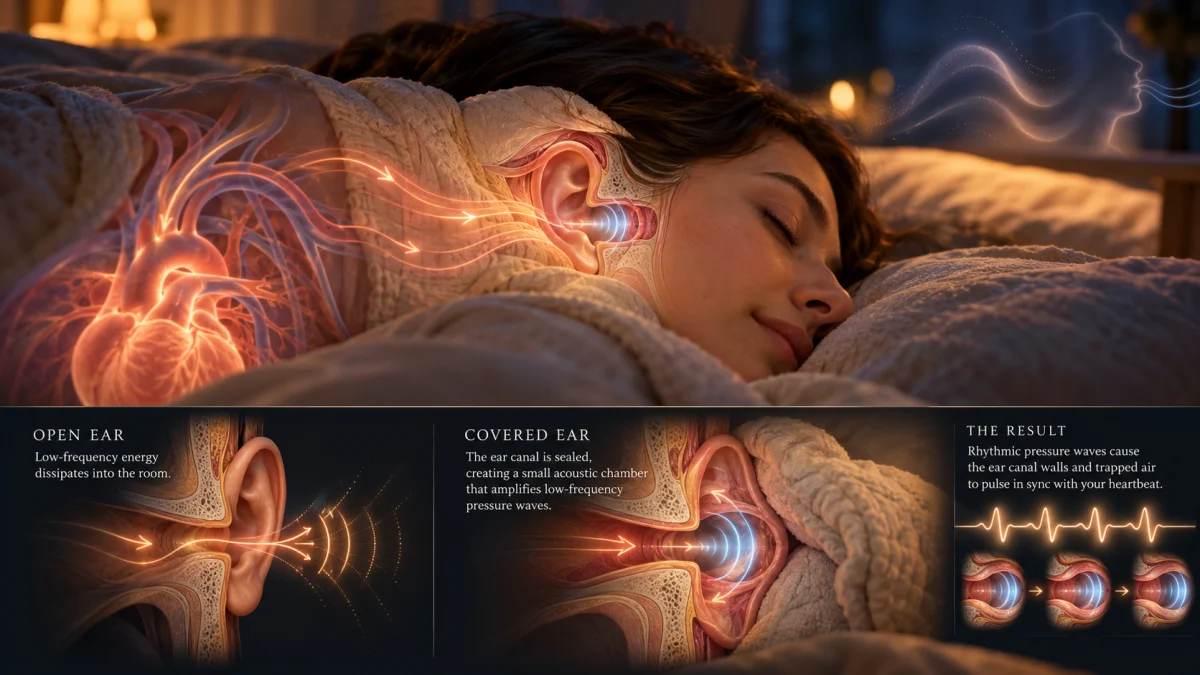
Yes. That rhythmic thumping, whooshing or strangely “panting” sound you hear when your ear is covered can really be your own heartbeat.
If it appears when your ear is pressed into a pillow, cupped by your hand, covered by a blanket or sealed with an earplug, and disappears when the ear is uncovered, there is a surprisingly well-studied explanation.
Blocking the external ear canal creates what acoustics researchers call the occlusion effect. Very-low-frequency vibrations generated inside your body can suddenly produce much larger pressure changes inside the sealed ear canal, making sounds you normally ignore or cannot hear become audible.
And researchers have actually measured this using people’s heartbeats.
As a child, I had no scientific vocabulary for any of this. I just knew that if I lay in exactly the right position with a blanket or hand forming a little cup over my ear, I could sometimes hear something that sounded uncannily like a dog panting directly into my ear.
The rhythm was the clue.
When my heart was beating faster, the panting sped up. When my heart rate slowed, so did the sound.
Years later, the explanation became obvious: I was hearing a signal generated by my own cardiovascular system.
The part that turns out to be more complicated is exactly what component of the heartbeat we are hearing and why covering an ear makes it so much louder.
Scientists Have Actually Recorded This
This phenomenon is not merely an anecdote.
In a particularly relevant study published in Ear and Hearing, researchers placed a miniature microphone inside the ear canals of people with normal hearing. At the same time, they recorded each participant’s carotid pulse so they could synchronize the microphone recordings with individual heartbeats.
The researchers then compared what happened when the ear canal was open with what happened when it was physically occluded.
The effect was enormous.
According to the original study by Michael Stone and colleagues, the average occlusion effect reached approximately 40 decibels at frequencies below 40 Hz. Some individual recordings reached approximately 50 dB below 20 Hz.
Most importantly for anyone who has experienced this:
With the ear canal occluded, the heartbeat became audible to most of the participants.
These were not people recruited because they complained about hearing their hearts.
They were otologically and audiometrically normal participants being used to study the acoustics of an occluded ear canal.
So if you have ever covered your ear in just the right way and suddenly discovered that your body apparently contains its own tiny bass drum, researchers have reproduced essentially the same phenomenon under controlled conditions.
Why Does Covering Your Ear Make Your Heartbeat So Much Louder?
The key is the occlusion effect.
You have probably noticed other examples without realizing they are related. Put tight earplugs in and your own voice can suddenly sound boomy. Chewing becomes louder. Footsteps can seem to travel through your head.
The same general physics can affect cardiovascular sounds.
Your heartbeat creates mechanical activity throughout the body. Those vibrations and pressure waves can reach the tissues surrounding the external auditory canal.
When the canal is open, the small pressure changes produced by movement of the canal walls do not necessarily generate much audible sound at the eardrum.
But covering the opening changes the acoustics.
Research on soft-tissue conduction and the occlusion effect describes the more compliant soft-tissue and cartilaginous portions of the ear canal as vibrating in response to internally generated body vibrations. Once the canal is closed, those movements produce pressure variations in the trapped air. Those pressure variations can then move the eardrum and ultimately stimulate the inner ear. A 2021 review in Audiology Research describes this mechanism in detail.
The simplified chain looks like this:
heartbeat → pressure and tissue vibrations → ear-canal wall moves → sealed air pressure changes → eardrum moves → you hear the pulse
With an open ear canal, much of that low-frequency pressure is not acoustically trapped in the same way.
With a properly sealed canal, it can become dramatically more prominent.
How large is the effect?
The 2014 experiment found an average occlusion effect of about 40 dB below 40 Hz, with some measurements reaching about 50 dB below 20 Hz.
Decibels are logarithmic, so that is not a trivial increase.
A 40 dB increase in sound pressure corresponds to approximately 100 times the pressure amplitude.
That helps explain how something ordinarily buried beneath the threshold of perception can suddenly become impossible to ignore when your ear happens to be sealed in exactly the right position.
Are You Literally Hearing Blood Flow?
You are hearing a real cardiovascular signal. But saying that you are simply hearing “blood rushing through an artery next to your ear” is probably too specific.
This is where the science has become more interesting.
The 2014 Ear and Hearing paper described the recorded signal as sounds from the heartbeat and blood flow, transmitted through the body to the walls of the ear canal.
That explanation remains plausible as part of what is happening.
But researchers studying modern in-ear cardiovascular sensing have cautioned that the exact physical origin of the signal is not completely settled.
A 2026 Nature Communications study on measuring cardiac stroke volume through in-ear audio summarizes the disagreement explicitly. Earlier work interpreted these in-ear signals as heart sounds associated with nearby blood flow. More recent research suggests they may instead be strongly related to local pressure changes produced by heartbeat-driven pressure waves.
The authors’ conclusion is appropriately cautious: whether the signal is best understood as conventional heart sounds, blood-flow-related sound or pressure-wave activity remains uncertain, but the relationship to cardiac activity itself is clear.
So the strongest answer is:
You really can hear a signal generated by your heartbeat and cardiovascular system. That signal may include effects of blood movement, mechanical tissue vibration and heartbeat-generated pressure waves. The exact mixture is still being studied.
Is the Sound Coming From Your Carotid Artery?
Not necessarily.
The carotid artery is an obvious suspect because it runs through the neck and carries a strong arterial pulse toward the head.
It was also used in the 2014 experiment. Researchers simultaneously measured the carotid pulse so they could line up the ear-canal recording with each heartbeat.
But that does not establish that the sound you perceive is simply acoustic noise radiating from the carotid artery into your ear.
The signal can propagate through tissues, involve movement of the ear-canal walls, and reflect pressure waves associated with cardiovascular activity.
So while “I can hear my pulse” is well supported, “I can hear blood rushing through my carotid artery” goes farther than the evidence allows.
Why Does It Sound Like a Dog Panting Instead of “Lub-Dub”?
There is no recognized medical phenomenon called the “dog panting sound.” That is simply the closest description I had for it.
But there is a good reason the heartbeat heard this way does not necessarily resemble the familiar lub-dub sound associated with a stethoscope on the chest.
You are not listening to your heart from the chest.
You are detecting a cardiovascular signal after it has traveled through the body, interacted with surrounding tissues and been heavily shaped by the acoustics of an occluded ear canal.
The strongest components are extremely low frequency. The 2014 occlusion experiment found its largest effects below about 40 Hz, while the 2026 in-ear sensing study describes the relevant cardiac signals as concentrated below roughly 50 Hz.
That transmission and filtering can change the subjective character of what you hear.
One person may describe it as:
- thumping;
- pounding;
- whooshing;
- pumping;
- rushing;
- breathing;
- or, apparently, a small invisible dog panting beside their head.
The important clue is not the exact timbre.
It is the rhythm.
If the sound speeds up when your pulse speeds up and slows when your pulse slows, that strongly suggests that whatever you are perceiving is synchronized with cardiovascular activity.
Why Is It So Easy to Notice in Bed?
A bed creates nearly perfect conditions for discovering this accidentally.
First, a pillow, hand or folded blanket can form a partial or complete seal around the external ear canal.
Second, the surrounding environment is usually quiet. External sounds that would normally mask faint internal signals have disappeared.
Third, small changes in head position can dramatically change how well the ear is sealed. Move a centimeter and the sound may vanish. Roll back into the same position and it returns.
That explains one of the stranger aspects of the experience: it can feel as though you have discovered a secret sound that exists only at one precise angle.
The underlying heartbeat was there the entire time.
What changed was the acoustic environment of the ear.
Earplugs and Sealed Earbuds Can Cause the Same Effect
You do not need a blanket or pillow.
A well-sealed earplug, hearing-aid fitting or in-ear headphone can create similar acoustic conditions.
In fact, the original 2014 research was motivated partly by problems associated with closed hearing-aid fittings. The authors noted that a strong low-frequency occlusion effect could make users hear unwanted internal sounds, including their own heartbeat and footsteps.
This also explains why putting in earplugs can occasionally seem to make the world quieter while making your own body considerably louder.
External sounds are being attenuated at the same time that certain internally transmitted low-frequency signals are becoming more prominent.
Researchers Are Now Deliberately Turning Earbuds Into Heart Sensors
There is a wonderful technological twist to all of this.
The signal that can make an earplug annoying is also useful.
Modern earbuds increasingly contain inward-facing microphones for features such as active noise cancellation. Researchers have realized that those microphones can capture the same low-frequency cardiac signals that become prominent when the ear canal is sealed.
The 2026 Nature Communications study used custom earbud hardware to record in-ear cardiovascular signals from 23 healthy volunteers.
The researchers showed that peaks in the in-ear signal corresponded with heart activity measured using ECG. They then trained a system to estimate stroke volume, the amount of blood ejected by the heart with each contraction, from the earbud audio.
Across previously unseen participants, the system achieved a mean absolute error of 5.24 milliliters and a strong correlation with its reference measurements.
This does not mean ordinary consumer earbuds are suddenly substitutes for cardiovascular testing.
It means something much more relevant to our original mystery:
The strange internal heartbeat signal that becomes audible when your ear is properly sealed is real enough that researchers can record it, analyze it and extract physiological information from it.
A blanket accidentally cupped over your ear is obviously not a medical sensor.
But the underlying phenomenon is closely related.
Is This Pulsatile Tinnitus?
Not necessarily.
That distinction is worth making because searching for almost any phrase involving “hearing my heartbeat in my ear” quickly leads to pages about pulsatile tinnitus.
The terminology itself can become confusing.
The American Tinnitus Association distinguishes “somatosounds” from tinnitus. Somatosounds are real noises generated by processes occurring within the body. The organization notes that pulsatile sounds are often somatosounds and that historically some were described as “objective tinnitus.”
That distinction fits the phenomenon discussed in this article particularly well.
If you can deliberately make the sound appear by covering or sealing your ear, and it disappears when you remove the seal, the occlusion effect provides a straightforward physical explanation.
That is different from suddenly developing a heartbeat-synchronous sound that occurs repeatedly with your ear open.
When the distinction matters
This article should not be used to explain away a new persistent pulse-synchronous sound.
If you begin hearing your heartbeat or a rhythmic whooshing without covering your ear, particularly if it is persistent, strongly one-sided, or accompanied by hearing changes, balance problems or visual symptoms, it is worth discussing with a healthcare professional.
ENT Health, the patient-information service of the American Academy of Otolaryngology-Head and Neck Surgery Foundation notes that persistent pulse-synchronous tinnitus can occasionally have an identifiable cardiovascular or vascular cause and recommends medical evaluation.
That is the edge case, however, not the explanation we need to impose on every person who discovers that pressing an ear into a pillow makes their pulse audible.
Open Ear vs. Covered Ear
| What is happening | Ear open | Ear covered or sealed |
|---|---|---|
| Heartbeat generates internal pressure and tissue vibrations | Yes | Yes |
| Vibrations reach structures around the ear canal | Yes | Yes |
| Ear-canal wall can vibrate | Yes | Yes |
| Low-frequency pressure is strongly trapped in the canal | Much less | Yes |
| Eardrum receives a much larger low-frequency pressure signal | Usually no | Can occur |
| Heartbeat becomes consciously audible | Usually unnoticed | Sometimes |
The heart does not suddenly begin producing a new sound when you cover your ear.
You change the listening apparatus.
The Childhood Clues Were Surprisingly Good
Long before knowing any of the terminology, there were three clues pointing toward the answer.
The sound appeared only when the ear, blanket, hand and sleeping position lined up correctly.
Its rhythm matched the heartbeat.
And when the heart rate changed, the rhythm changed with it.
Those observations lead remarkably close to what researchers eventually measure with microphones and cardiovascular sensors.
The missing vocabulary was:
occlusion effect.
Internally generated cardiovascular signal.
Soft-tissue and mechanical conduction.
And perhaps somatosound, depending on which terminology is being used.
The childhood explanation that “I must somehow be hearing my blood pumping” was therefore basically right.
The scientific version is simply more interesting.
The Bottom Line
If you hear a rhythmic thumping, whooshing or “dog panting” sound when your ear is covered by a hand, pillow, blanket, earplug or tightly sealed earbud, you may genuinely be hearing your own heartbeat.
The strongest evidence suggests that cardiovascular activity creates low-frequency pressure and tissue vibrations that reach the ear canal. Normally those signals are faint. Seal the canal, however, and the occlusion effect can dramatically increase the low-frequency pressure reaching the eardrum.
Researchers have measured increases around 40 dB at very low frequencies, and most normal-hearing participants in one controlled experiment could hear their heartbeat once the canal was occluded.
Exactly how much of the perceived signal represents blood-flow sound versus heartbeat-generated pressure waves and mechanical tissue vibration is still being investigated.
But the central mystery has a satisfying answer:
The sound is real. The heartbeat is real. And by accidentally covering your ear in just the right way, you can turn your own ear canal into a crude little cardiovascular listening chamber.
References and Further Reading
Experimental Evidence and Ear Acoustics
A Technique for Estimating the Occlusion Effect for Frequencies Below 125 Hz — Ear and Hearing / PubMed
Michael A. Stone, Anna M. Paul, Patrick Axon and Brian C. J. Moore. The key experimental study for this article. Researchers recorded heartbeat- and blood-flow-related signals with miniature microphones inside normal participants’ ear canals, synchronized the measurements to the carotid pulse, and quantified the large low-frequency increase produced by occlusion.
How Is the Cochlea Activated in Response to Soft Tissue Auditory Stimulation in the Occluded Ear? — Audiology Research / PubMed
Miriam Geal-Dor and Haim Sohmer. Reviews the proposed soft-tissue conduction mechanism by which internally generated vibrations reach the external ear canal, create pressure in an occluded canal and ultimately stimulate the auditory system.
Modern In-Ear Cardiovascular Sensing
Measuring Cardiac Stroke Volume Through In-Ear Audio Sensing — Nature Communications (2026)
Kayla-Jade Butkow and colleagues. Demonstrates that cardiac signals recorded from sealed in-ear devices can be used to estimate stroke volume. The paper also discusses the unresolved question of whether the recorded waveform is best understood as conventional heart sound, blood-flow-related sound or local pressure waves generated by cardiovascular activity.
Tinnitus and Somatosound Terminology
15 Things You Might Want to Know About Somatosounds — American Tinnitus Association
Audiologist John A. Coverstone explains the distinction between tinnitus arising from the auditory system and real internally generated sounds, or somatosounds, produced by bodily processes.
Tinnitus — ENT Health, American Academy of Otolaryngology-Head and Neck Surgery Foundation
Provides clinical guidance on tinnitus and explains why persistent pulse-synchronous tinnitus warrants medical evaluation, particularly when it occurs independently of deliberately covering or occluding the ear.
Editorial note: This article explains a reproducible acoustic phenomenon in which covering or sealing the external ear canal makes internally generated cardiovascular signals more audible. It does not diagnose the cause of persistent heartbeat-synchronous sounds occurring when the ear is open.