
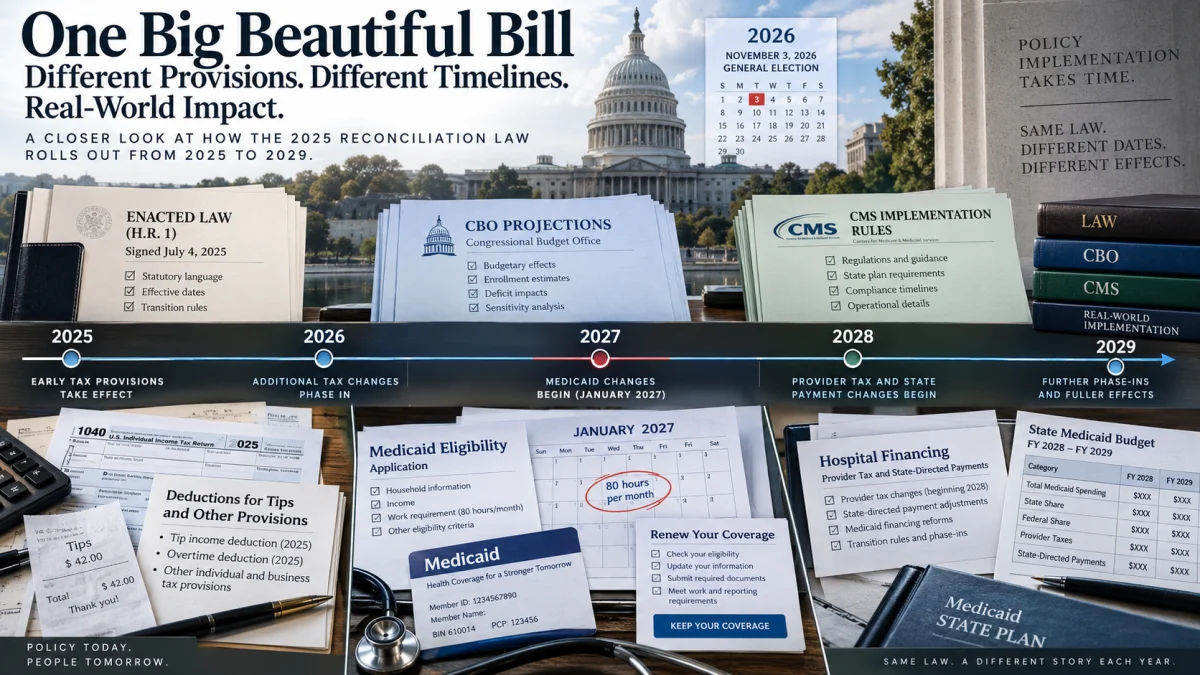
Yes, several of the most consequential Medicaid changes in the 2025 reconciliation law begin around January 2027, immediately after the 2026 midterm election cycle. The Congressional Budget Office also projects that the law’s Medicaid spending reductions are overwhelmingly concentrated in fiscal year 2027 and later.
But a viral claim circulating online goes further. It argues that Republicans deliberately delayed the law’s most painful provisions until after the election so voters would not feel them beforehand and might later blame Democrats.
The dates are real. That motive is not established by the evidence we found.
The legislative history actually complicates the theory: an earlier version of the Medicaid work requirement would not have started until 2029. Conservative House Republicans objected to waiting that long and successfully pressured party leaders to move the requirement forward to the end of 2026 and beginning of 2027 because they wanted the bill’s spending reductions to occur sooner.
At the same time, the final law undeniably has an unusual political and economic rhythm. Several visible tax benefits were available beginning in 2025. Major Medicaid eligibility restrictions arrive later. Other Medicaid financing reductions do not fully ramp up until 2028 and beyond.
The result is a law whose effects look very different depending on when someone encounters it.
And one important part of the viral explanation is simply wrong: the enhanced Affordable Care Act premium subsidies expired at the end of 2025 under previously enacted law. Public Law 119-21 did not schedule those enhanced subsidies to disappear in January 2027.
Here is what the law actually does, when it happens, and what we can reasonably conclude about the timing.
The law operates on three different clocks
President Donald Trump signed H.R. 1 into law as Public Law 119-21 on July 4, 2025. The official statute is available through the U.S. Government Publishing Office’s Public Law 119-21 record.
It did not create a single implementation date.
Instead, its major provisions unfold across several years.
| Period | What happens |
|---|---|
| 2025–2026 | Several tax deductions and extensions become available immediately or retroactively, including the qualified-tips deduction. Other health, immigration, SNAP, student-loan and tax provisions also begin taking effect. |
| Late 2026–2027 | Major Medicaid eligibility changes converge, including nationwide community-engagement requirements and six-month eligibility redeterminations for the ACA expansion population. |
| 2028 and later | Medicaid provider-tax and state-directed-payment restrictions increasingly affect financing, while temporary tax provisions such as the qualified-tips deduction approach their scheduled expiration. |
That structure matters because people can accurately describe the same law in seemingly contradictory ways.
Someone receiving a new tax deduction in 2025 may experience an immediate benefit.
Someone affected by Medicaid eligibility rules may not experience the most important change until 2027.
A hospital or state Medicaid agency may see financing effects that continue increasing years after that.
All three can be consequences of the same law.
The Medicaid spending reductions really are heavily back-loaded
This is one of the clearest findings in the underlying federal estimates.
CBO’s October 2025 supplemental analysis of the Medicaid provisions projects approximately $914.6 billion in lower federal Medicaid outlays from fiscal years 2025 through 2034.
Here is CBO’s estimated annual change in Medicaid outlays:
| Fiscal year | Estimated Medicaid outlay change |
|---|---|
| 2025 | -$45 million |
| 2026 | -$16.847 billion |
| 2027 | -$46.747 billion |
| 2028 | -$62.661 billion |
| 2029 | -$92.944 billion |
| 2030 | -$111.441 billion |
| 2031 | -$128.616 billion |
| 2032 | -$139.659 billion |
| 2033 | -$150.708 billion |
| 2034 | -$164.965 billion |
Source: Congressional Budget Office supplemental Medicaid cost estimate for Public Law 119-21.
Using CBO’s annual figures, about 98% of the projected 2025–2034 Medicaid outlay reductions occur in fiscal year 2027 or later.
That is an original calculation from CBO’s published table, and it needs one important qualification.
Federal fiscal year 2027 starts on October 1, 2026, before the November midterm election. Therefore, it would be inaccurate to say that 98% of the Medicaid reductions occur "after Election Day."
What the numbers establish is narrower and still significant:
The Medicaid spending reductions are overwhelmingly back-loaded into fiscal 2027 and later rather than occurring immediately after the law was enacted in July 2025.
CBO separately estimates that the Medicaid chapter will reduce federal deficits by approximately $886.8 billion over 2025–2034 and increase the number of uninsured people by 7.5 million in 2034, relative to its baseline. These are projections, not observed outcomes, and CBO explicitly warns that state responses and implementation choices create substantial uncertainty.
January 2027 is a genuine Medicaid breakpoint
The viral claim is on strong factual ground when it identifies January 2027 as an important date.
Under the current CMS Medicaid community-engagement implementation rule, applicable states generally must begin enforcing the new requirement by January 1, 2027, although states may start sooner and limited implementation extensions are possible.
The rule generally applies to certain Medicaid adults ages 19 through 64 in the ACA expansion group and specified waiver populations.
Affected people generally must demonstrate at least 80 hours per month of qualifying activity through employment, qualifying work programs, community service, education or combinations of qualifying activities. Certain people are excluded or exempt, including specified pregnant, medically frail and other protected populations.
States must also verify compliance.
If the state cannot verify that someone has satisfied the requirement or qualifies for an exception, CMS requires a notice and an opportunity to establish compliance or exempt status.
This distinction is important because the policy is not simply:
Does this person work?
It also becomes:
Can the eligibility system verify that this person works or qualifies for an exception?
Those are not necessarily the same question.
CMS itself expects millions fewer people to be enrolled
By 2026, this was no longer only an outside estimate from critics of the law.
CMS published its own regulatory-impact analysis.
The agency projects that implementation of the community-engagement rule will reduce Medicaid enrollment by approximately 2.3 million people in fiscal year 2027 and by roughly 3.1 million to 3.3 million in subsequent years.
CMS also projects approximately $350.3 billion less federal Medicaid spending over ten years and $41.6 billion less state spending under its modeled implementation scenarios.
CMS explicitly says its enrollment estimate includes two populations:
- people who do not satisfy the requirement; and
- people who do satisfy it or qualify for an exception but do not successfully demonstrate their compliance or exemption.
That second category is critical to understanding how the policy works.
CMS also stresses that its estimates are uncertain because state choices about verification frequency, hardship exceptions and implementation can materially alter the results.
CBO expects administrative barriers to account for significant coverage losses
CBO reaches a similar conclusion through a different model.
For the community-engagement provision itself, CBO estimates that about 2.9 million people in 2034 will lose Medicaid because they do not meet the requirement or qualify for an exception.
But CBO projects another 2.8 million could lose Medicaid because the requirement adds steps to the application and verification process.
After accounting for interactions and alternative coverage, CBO estimates this provision will increase the uninsured population by about 5.3 million in 2034 and reduce federal deficits by approximately $317 billion over 2025–2034.
That does not mean 5.3 million people are simply refusing to work.
CBO says most Medicaid enrollees subject to the provision are expected either to satisfy the activity requirement or qualify for an exception. Its model nevertheless anticipates substantial coverage loss because verification itself can become an eligibility barrier.
That distinction tends to disappear in political descriptions of "work requirements."
Six-month Medicaid renewals could matter almost as much to some families
The new work requirement receives most of the attention, but another January 2027 change deserves much more scrutiny.
Section 71107 requires states to conduct Medicaid eligibility redeterminations for ACA expansion adults every six months instead of annually beginning in January 2027.
CBO estimates that about 10% of that population will no longer have Medicaid coverage after the first six-month redetermination.
Its modeling makes an especially important distinction:
- about 30% of the people losing coverage under this provision are expected to actually be ineligible at redetermination;
- about 70% are projected to lose coverage for procedural reasons such as missed paperwork, communication problems or difficulty navigating reenrollment.
CBO estimates this provision alone will increase the uninsured population by approximately 700,000 people in 2034 and reduce federal deficits by about $58 billion over the budget window.
This is why "Medicaid cuts" can be an incomplete description of what changes.
Some savings arise because eligibility rules narrow.
Some arise because financing rules change.
And some occur because people who might otherwise remain eligible fall out of the program during more frequent administrative reviews.
Do Medicaid work requirements actually increase employment?
Supporters describe community-engagement requirements as a way to encourage work, self-sufficiency and economic participation. CMS has explicitly presented those objectives as part of its justification for the policy.
The empirical evidence from previous state experiments is less clear.
Arkansas became the first state to enforce Medicaid work requirements in 2018. A peer-reviewed two-year follow-up published in Health Affairs found that about 18,000 adults had lost Medicaid coverage by April 2019 and found no increase in employment over 18 months.
A separate 2025 analysis using national survey data found Arkansas’s policy was associated with a 4.4-percentage-point increase in uninsurance among the targeted age group while finding no statistically significant employment change.
Georgia provides another, more recent example. A 2025 BMJ quasi-experimental study examining the state’s Pathways to Coverage program found no significant employment increase during its first 15 months. Compared with South Dakota, which expanded Medicaid without a work requirement, Georgia experienced substantially smaller Medicaid coverage gains, again without a statistically significant difference in employment.
Those state experiences are not perfect forecasts for a nationwide policy. Arkansas and Georgia used different rules, populations and administrative systems, and the new federal framework contains its own exemptions and verification procedures.
But the evidence so far supports a cautious conclusion:
Prior Medicaid work-requirement experiments have produced much clearer evidence of coverage loss and administrative friction than of increased employment.
The national rollout will provide substantially more evidence beginning in 2027.
Not everything waits until 2027
It would also be wrong to tell readers that nothing consequential happens before the midterms.
Some provisions took effect in 2025 or 2026, and some states chose to implement Medicaid work requirements early.
Nebraska began enforcing the federal requirement in May 2026. Montana planned a July 2026 start, Iowa a December 2026 start, and Arkansas announced a softer implementation beginning in July while postponing disenrollments for noncompliance until January 2027, according to KFF’s Medicaid work-requirement implementation tracker.
Other parts of Public Law 119-21 also affect Medicaid and CHIP before January. For example, CMS guidance implementing new restrictions on federal Medicaid and CHIP matching funds for certain noncitizens identifies an October 1, 2026 start date.
So the defensible statement is not:
Everything unpopular was postponed until after the election.
It is:
Several of the law’s largest nationwide Medicaid eligibility changes converge around January 2027, while other provisions take effect both before and after that date.
So why was the Medicaid requirement delayed until 2027?
This is where the legislative history becomes particularly important.
The initial House committee proposal did not require nationwide Medicaid work requirements until January 2029. Contemporary analyses of that proposal documented that date.
Fiscal conservatives within the Republican House caucus objected to the bill’s back-loaded savings.
After negotiations, House leaders moved the work requirement forward by roughly two years, to the end of 2026 and beginning of 2027.
Rep. Chip Roy, one of the conservative holdouts, later described the change in his own words. In a May 22, 2025 statement explaining his vote, Roy said he and other "budget hawk" Republicans had accelerated Medicaid work requirements three years from 2029 to 2026.
More importantly for understanding motive, Roy immediately complained that the overall legislation still produced large deficits in its first five years while generating more of its savings later, writing that lawmakers needed to "bring forward more savings." His statement is an interested party’s account, but it is useful primary evidence about what at least one central negotiator was demanding.
Contemporaneous reporting likewise described the accelerated work requirement as a concession to conservative lawmakers seeking deeper and earlier spending reductions.
That chronology poses a problem for the simplest version of the viral theory.
If the sole objective were to keep the policy invisible to voters for as long as possible, the original 2029 date would have accomplished that more effectively.
Instead, Republican holdouts pressured leadership to make the policy effective sooner.
Was January 2027 deliberately chosen to get past the midterms?
There is a legitimate question here, but there is an important difference between chronology and proof of motive.
Here is what the documentary record establishes:
| Proposition | What the evidence shows |
|---|---|
| Major national Medicaid eligibility changes begin around January 2027 | Documented. CMS and CBO identify January 2027 as a major implementation date. |
| That date falls after the 2026 midterm election cycle | Documented chronology. |
| Medicaid spending reductions are heavily back-loaded | Documented. About 98% of CBO’s projected 2025–2034 Medicaid outlay reductions occur in FY2027 or later. |
| Some highly visible tax benefits began much sooner | Documented. The qualified-tips deduction, for example, is available beginning with tax year 2025. |
| Republican lawmakers knew that much of the bill’s savings occurred later | Documented. Rep. Roy publicly complained about back-loaded savings during the negotiations. |
| Conservatives pushed the Medicaid work requirement from 2029 to roughly the beginning of 2027 | Documented. |
| The January 2027 date was specifically chosen to deceive midterm voters | Not established by the evidence reviewed. |
| Democrats will control Congress in January 2027 or the White House in January 2029 | Unknown. Those are future electoral outcomes, not facts embedded in the law. |
Political incentives can coexist with administrative and budgetary considerations. Legislators are not unaware of election calendars.
But identifying an incentive is not the same thing as proving that incentive caused a particular statutory date.
The strongest evidence-based conclusion is therefore more restrained:
The law unquestionably back-loads much of its Medicaid impact, and several major eligibility changes begin shortly after the 2026 elections. But the public legislative record we reviewed does not establish that January 2027 was selected specifically to deceive voters. It also shows conservative lawmakers actively moving an even later 2029 implementation date forward because they wanted spending reductions to arrive sooner.
That is less dramatic than the viral version. It is also considerably harder to knock down.
The ACA premium-subsidy claim mixes up two different policies
One of the viral video’s biggest factual problems involves Affordable Care Act premium tax credits.
The enhanced ACA subsidies did not disappear in January 2027 because H.R. 1 scheduled them to expire then.
The enhanced credits originated with the American Rescue Plan Act in 2021 and were later extended by the Inflation Reduction Act through the end of 2025.
Congress did not extend them again, so they expired after December 31, 2025.
KFF’s explanation of the ACA premium-tax-credit changes notes that the enhanced credits had expired by 2026 and that many Marketplace consumers consequently became eligible for less financial assistance.
KFF’s broader analysis of Public Law 119-21 makes another important technical point: because expiration was already scheduled under existing law, the disappearance of the enhanced subsidies was not scored as a new policy change produced by H.R. 1.
That does not mean the 2025 Congress had no ability to extend them. Congress could have changed the law and chose not to.
It means something narrower:
The viral claim incorrectly combines the previously scheduled expiration of enhanced ACA subsidies with separate Medicaid and Marketplace changes enacted in Public Law 119-21.
The distinction matters if the goal is to know which law caused which change.
"No tax on tips" really does expire after 2028
This part of the viral claim is substantially grounded in the statute.
The new qualified-tips deduction applies for tax years 2025 through 2028, according to the Internal Revenue Service’s guidance on the provision.
Eligible workers can deduct up to $25,000 of qualifying tips, subject to income phaseouts and other rules.
But the phrase "no tax on tips" is political shorthand rather than a literal description of the tax code.
The IRS itself notes that tips remain subject to income and payroll-tax rules generally; the new law provides a deduction against qualifying tip income rather than erasing every possible tax on every tip.
Under current law, the deduction ends after the 2028 tax year.
No president has to actively "take it away" in 2029. Unless Congress changes the statute beforehand, the sunset happens automatically.
And it happens regardless of which party controls Congress or the White House at that time.
Some major tax provisions are permanent
The viral video’s contrast between temporary worker deductions and permanent tax provisions is based on something real, although describing the permanent provisions simply as "tax cuts for billionaires" loses important detail.
The Joint Committee on Taxation’s 2026 explanation of Public Law 119-21 shows that the law permanently extended several major provisions that otherwise would have changed after 2025.
Among them:
| Provision | Treatment under Public Law 119-21 |
|---|---|
| Individual income-tax rate schedules created under the 2017 tax law | Made permanent. |
| Increased standard deduction | Expiration removed and amounts increased. |
| Qualified-business-income deduction under Section 199A | Made permanent. |
| Unified estate and gift tax exemption | Permanently increased to an inflation-indexed $15 million beginning in 2026. |
| Qualified-tips deduction | Temporary, 2025–2028. |
These provisions do not all benefit the same taxpayers and should not be collapsed into one category.
The standard deduction, for example, is widely used. The estate-tax exemption affects a much smaller and wealthier population. The qualified-business-income deduction applies to eligible pass-through business income. The individual rate schedule spans multiple income levels.
The more useful question is therefore not whether "the billionaire cuts are permanent."
It is:
Which tax changes are permanent, which are temporary, and who is eligible for each one?
On that narrower question, the asymmetry is real: several major tax-code changes were made permanent while prominent provisions marketed to workers, including the qualified-tips deduction, have statutory expiration dates.
How much of this came from Project 2025?
The claim that the entire reconciliation law simply "implemented the Heritage Foundation’s agenda" is too broad to establish as a factual statement.
But one major overlap is unmistakable.
The Heritage Foundation-led Project 2025 Mandate for Leadership explicitly recommended that a future administration add Medicaid work requirements and give states broader authority to adopt work incentives for certain adults.
That language appears directly in the Project 2025 Mandate for Leadership document.
Public Law 119-21 subsequently created a nationwide statutory community-engagement requirement for specified Medicaid populations.
That establishes genuine policy overlap.
It does not, by itself, establish that Heritage wrote the provision, dictated its effective date or originated every health-policy change in the law.
Those are separate historical questions requiring separate evidence.
The later Medicaid financing changes matter too
January 2027 is not the end of the story.
Some of the largest structural Medicaid financing changes ramp up after that.
For example, the law restricts states’ use of health-care provider taxes to finance their share of Medicaid. For ACA expansion states, CBO explains that the relevant threshold begins declining from 6% to 5.5% in 2028 and eventually reaches 3.5% in 2032.
CBO estimates this provision will reduce federal deficits by approximately $182.7 billion over 2025–2034 and increase the uninsured population by about 1.1 million people in 2034, after accounting for state responses in its model.
Another provision limits certain state-directed Medicaid payments.
Existing payments above the new limits can generally continue through fiscal year 2028, after which the limits phase downward. CBO estimates approximately $149.4 billion in lower federal Medicaid outlays through 2034 from that provision.
This helps explain why the overall Medicaid spending curve steepens over time.
The work requirement is important, but the law’s long-run Medicaid effect cannot be understood from the work requirement alone.
The complete timeline in plain English
The simplest way to understand the law is not "everything starts in 2027."
It is this:
2025
Public Law 119-21 is enacted on July 4.
Several tax provisions are made available for 2025, including the temporary qualified-tips and qualified-overtime deductions. Major elements of the 2017 tax structure are extended or made permanent.
2026
Tax changes continue appearing on returns and in withholding.
The enhanced ACA premium tax credits expire under their previously scheduled sunset because Congress does not extend them.
Some Medicaid-related provisions begin before the midterms. Several states also move ahead with early implementation of the new work requirement.
January 2027
This is the major Medicaid eligibility breakpoint.
For most applicable states:
- community-engagement requirements begin;
- ACA expansion Medicaid eligibility generally moves to six-month redeterminations;
- additional eligibility, verification and Marketplace interactions begin taking effect.
CMS and CBO expect these changes to reduce Medicaid enrollment substantially, although exact results will depend on implementation and individual circumstances.
2028
Medicaid financing restrictions become more significant.
Provider-tax thresholds begin ratcheting downward, while limits affecting state-directed payments begin moving toward their longer-run levels.
The qualified-tips deduction remains available for tax year 2028.
After 2028
The qualified-tips deduction expires under current law.
Medicaid financing restrictions continue phasing in.
Permanent tax provisions remain in effect unless a future Congress changes them.
A future Congress can change any of this
One final part of the viral narrative needs clarification.
A statutory sunset is not the same thing as a future administration actively repealing a benefit.
Likewise, calling a tax provision "permanent" does not mean it can never be changed.
Congress can extend a temporary deduction.
Congress can allow it to expire.
Congress can repeal, modify or replace a provision previously described as permanent.
A future president can sign or veto legislation passed by Congress.
So if the qualified-tips deduction disappears after 2028 under current law, the immediate legal reason will be that Congress originally wrote an expiration date into the provision and no subsequent law changed it.
Who controls the government at that point is a separate political question that cannot be known in advance.
What the viral claim gets right and wrong
The circulating video combines several strong observations with several claims that go beyond the evidence.
| Viral claim | What the evidence actually shows |
|---|---|
| Major Medicaid changes were delayed until around 2027 | Largely correct. January 2027 is a major nationwide implementation point. |
| Medicaid work requirements start in 2027 | Generally correct nationally, although some states started earlier and limited extensions can occur. |
| The law’s Medicaid effects are heavily back-loaded | Correct. Roughly 98% of CBO’s projected Medicaid outlay reductions occur in FY2027 or later, although FY2027 begins before the midterm election. |
| Enhanced ACA premium subsidies disappear in January 2027 because H.R. 1 delayed them | Incorrect. The enhanced credits expired after 2025 under previously enacted law; Public Law 119-21 contains separate health-insurance changes. |
| "No tax on tips" expires after 2028 | Correct under current law, although the provision is a qualified federal income-tax deduction rather than a blanket elimination of every tax on tips. |
| Some major tax provisions are permanent | Correct. Several 2017-era tax provisions and other tax rules were made permanent. |
| Project 2025 called for Medicaid work requirements | Correct. The proposal appears explicitly in its policy document. |
| Republicans chose January 2027 specifically so voters would not notice until after the midterms | Possible political interpretation, but not established by the evidence reviewed. The legislative record also shows conservative Republicans moving the requirement forward from 2029 in pursuit of earlier savings. |
| Democrats will be in control when the changes arrive | Unknown. Future election outcomes are not part of the statute. |
Bottom line
There is a real story underneath the viral post, but it is more complicated than a hidden timer set to go off after an election.
Public Law 119-21 is deliberately staggered as legislation. Some provisions begin quickly. Others require states and federal agencies to build new eligibility and verification systems. Some Medicaid financing reductions phase in over many years. Temporary tax benefits expire while other tax provisions remain permanent.
The practical result is unmistakable: some of the most consequential nationwide Medicaid eligibility changes arrive around January 2027, and CBO’s projected Medicaid spending reductions are overwhelmingly concentrated in fiscal 2027 and later.
That chronology is worth scrutiny.
But chronology alone does not prove an electoral deception strategy.
In fact, the legislative record shows that the work requirement was originally scheduled for 2029 and that conservative Republicans successfully demanded an earlier start because they believed the bill’s savings were already too back-loaded.
The stronger criticism does not require inventing a motive.
The law itself, CBO’s projections and CMS’s own estimates already show what matters: beginning around 2027, millions of Americans will encounter new Medicaid eligibility and verification requirements; federal Medicaid spending will begin declining much more sharply; and both CBO and CMS expect some people who otherwise meet the rules or qualify for exceptions to lose coverage because of administrative compliance problems.
That is what is actually written into the policy.
And unlike predictions about who voters will blame several years from now, it is something we can verify today.
References and Further Reading
Primary Law and Congressional Analysis
Public Law 119-21 — U.S. Government Publishing Office The official enacted text and legislative-history record for H.R. 1, approved July 4, 2025.
Supplemental Cost Estimate for the Medicaid Provisions of Public Law 119-21 — Congressional Budget Office CBO’s detailed estimate of annual Medicaid spending effects, coverage changes, six-month eligibility redeterminations, community-engagement requirements, provider taxes and state-directed payments.
General Explanation of the Tax Provisions of Public Law 119-21 — Joint Committee on Taxation The authoritative congressional tax explanation covering permanent and temporary provisions, effective dates, income-tax rates, the standard deduction, Section 199A and estate and gift taxation.
Federal Implementation Guidance
Medicaid Community Engagement Requirement Interim Final Rule — Centers for Medicare & Medicaid Services CMS’s June 2026 explanation of who is subject to the federal Medicaid work/community-engagement requirement, qualifying activities, exemptions and the general January 1, 2027 implementation date.
Federal Register Regulatory Impact Analysis for the Medicaid Community Engagement Rule CMS’s own modeling of expected enrollment reductions, federal and state spending changes and administrative compliance effects.
IRS Guidance on Tax Deductions for Working Americans and Seniors Official IRS explanation of the qualified-tips and qualified-overtime deductions, including their 2025–2028 duration, limits and eligibility conditions.
ACA and Medicaid Implementation Context
KFF: Health Provisions in the 2025 Federal Budget Reconciliation Law Useful separation of provisions actually enacted through Public Law 119-21 from the independently scheduled expiration of enhanced ACA premium tax credits.
KFF: Tracking Implementation of Medicaid Work Requirements Tracks state-by-state implementation, including states that began or planned enforcement before January 2027.
Evidence on Medicaid Work Requirements
Medicaid Work Requirements in Arkansas: Two-Year Impacts on Coverage, Employment, and Affordability of Care — Health Affairs/PubMed Peer-reviewed evaluation finding substantial coverage loss but no increase in employment during Arkansas’s earlier experiment.
The Impact of Arkansas Medicaid Work Requirements on Coverage and Employment — Health Services Research/PubMed A 2025 quasi-experimental analysis finding increased uninsurance without a statistically significant employment effect.
Insurance Coverage and Employment After Medicaid Expansion With Work Requirements — The BMJ Peer-reviewed study of Georgia’s Pathways to Coverage program, providing more recent evidence about coverage and employment outcomes under a work-requirement model.
Legislative History and Policy Origins
Rep. Chip Roy Statement on House Passage of H.R. 1 — Office of Rep. Chip Roy An interested-party primary source that is particularly useful for reconstructing the internal conservative push to move Medicaid work requirements forward from 2029 and obtain earlier budget savings.
Project 2025: Mandate for Leadership — Heritage Foundation The primary advocacy document establishing that Project 2025 explicitly proposed Medicaid work requirements. Its inclusion documents the proposal itself and should not be treated as independent evidence about the effects of the enacted law.
Editorial currency note: Medicaid implementation rules, state implementation dates, hardship exceptions, federal guidance and tax law can change. This article reflects federal law and publicly available implementation information reviewed through September 18, 2026. State-specific Medicaid beneficiaries should verify current requirements with their state Medicaid agency.