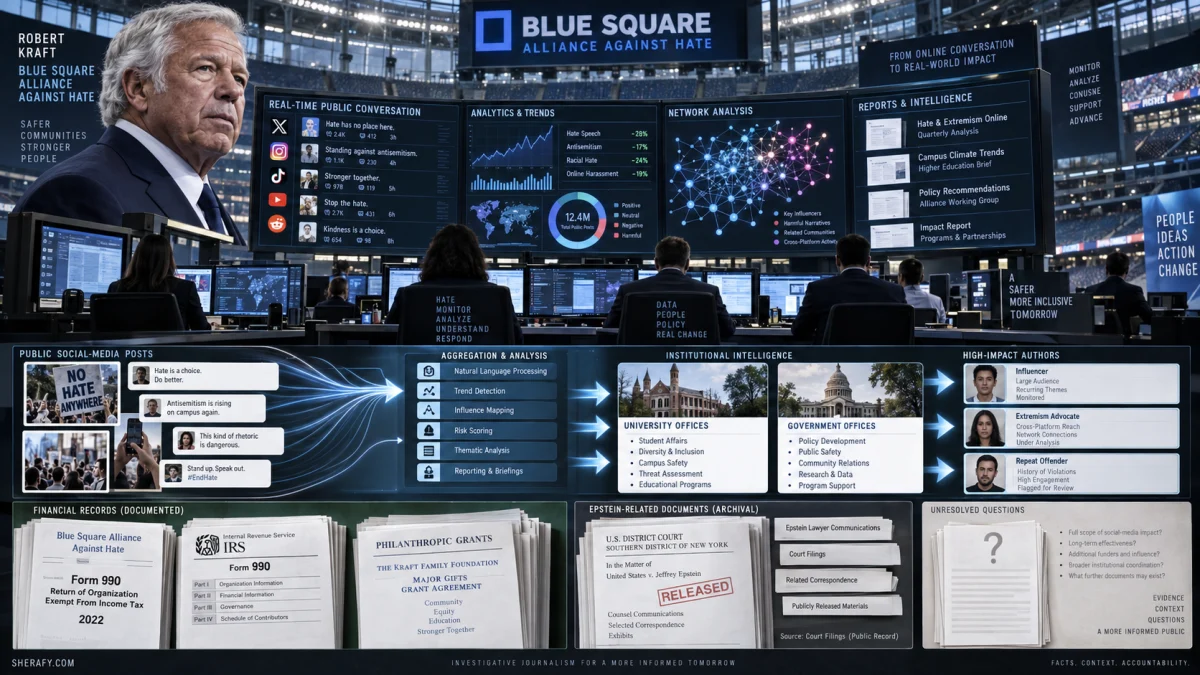
Robert Kraft’s Blue Square Alliance Against Hate is not simply an anti-hate advertising campaign.
Its own public materials describe a large-scale social-media monitoring operation based at Gillette Stadium that analyzes online conversations about antisemitism, Judaism and Israel. The organization says it now analyzes more than 1 billion posts per day. It offers university presidents and government officials what it calls "critical intelligence," including high-impact posts, the authors behind them, faculty members whose posts are generating attention, and alerts before an online issue becomes viral or develops into a real-world incident.
That is documented by Blue Square Alliance’s own university and local-government program page and its published Command Center methodology.
The money behind the operation is also substantial. IRS-derived records show that the organization reported about $135.4 million in 2024 revenue, $62.8 million in expenses and $211.1 million in year-end assets. Two Rales-linked foundations reported 2024 grants to the organization totaling $49.371 million, while a separate $25 million grant from the Norman R. Rales and Ruth Rales Foundation appears in that foundation’s 2023 filing rather than 2024.
And the Jeffrey Epstein connection involving Kraft is more unusual than simply having a name appear in a document dump. Newly released communications show Epstein actively trying to place his own longtime Florida lawyer, Jack Goldberger, on Kraft’s defense team after Kraft was charged with soliciting prostitution in 2019. Goldberger subsequently joined Kraft’s defense, discussed Kraft’s legal representation with Epstein, thanked Epstein for his help, and later received a message from Epstein warning about an unspecified "past issue with Kraft" that "may come to light."
The released records we reviewed do not show direct communications between Kraft and Epstein and do not establish that Kraft participated in Epstein’s crimes. But the lawyer connection should not be minimized either. Epstein was not merely commenting from afar. He was trying to influence who represented Kraft, and the lawyer he promoted later discussed Kraft’s case with him.
The strongest public-interest story, however, is not an Epstein guilt-by-association theory. It is the documented combination of money, mass monitoring, person-level reporting to powerful institutions, national advertising and deliberate search-engine influence.
This investigation was prompted in part by Jack Jones, who publishes as Quadzilla at Revolutionary Dirtbag. Jones identified several of the relationships worth examining. We independently retraced the major claims through nonprofit filings, court decisions, Blue Square Alliance’s own materials, the Epstein-document reporting and federal-court evidence involving Canary Mission. Where a claim could not be independently elevated from a lead to established fact, we have not presented it as one.
What is Blue Square Alliance Against Hate?
Blue Square Alliance Against Hate is the organization formerly known as the Foundation to Combat Antisemitism, or FCAS. Robert Kraft established it after receiving the Genesis Prize in 2019. The organization formally adopted the Blue Square Alliance name in 2025.
Its mission and milestones page says its digital monitoring capabilities, powered by Brandwatch, launched in 2020 and that its Command Center operates at Gillette Stadium.
The organization describes itself as nonpartisan and says its mission is to move Americans who are not already engaged on antisemitism into active opposition to Jewish hate and other forms of hate.
There is nothing inherently improper about an advocacy group studying public social-media activity. The public-interest question begins with what happens after that monitoring identifies individual speakers, and which institutions receive the resulting intelligence.
The Command Center monitors far more than isolated hate slurs
Blue Square’s published methodology says the Command Center tracks more than 1 billion posts per day across social-media platforms and analyzes conversations involving antisemitism, Judaism and Israel. Its system uses Brandwatch social-listening technology and information from partner organizations.
That distinction matters.
This is not a database limited to explicit Nazi slogans or direct threats. The collection universe includes broad online conversations involving Israel and Judaism, after which Blue Square applies its analytical methods to identify trends, categories and material it considers antisemitic or otherwise important.
Blue Square’s own 2024 retrospective said the Command Center registered 1.13 billion posts during that year and that the largest share of the monitored discussion concerned Israel and the Israel-Hamas war, followed by the Holocaust and college-campus activity. That annual figure is a measure of conversations captured in that particular analysis, not the same thing as the much larger current daily feed the organization says its technology can process.
The organization’s more recent methodology is also more sophisticated than simply keyword matching. In a 2025 article describing its experiments with AI classification, Blue Square said it used an annotation framework adapted from the Decoding Antisemitism Lexicon and the IHRA working definition. It instructed models to distinguish policy criticism of Israel from antisemitism and to classify genuinely ambiguous material as not antisemitic.
That is relevant evidence against the simplistic claim that Blue Square openly defines all criticism of Israel or all pro-Palestinian speech as antisemitism.
It does not resolve the transparency problem. The organization is still applying an advocacy group’s classification system to a vast political and social conversation and then providing person-level information to institutional decision-makers.
What Blue Square says it gives university presidents
The most important source in this investigation may be Blue Square Alliance’s own description of its university service.
Blue Square says it provides custom data to university presidents about online conversations involving their campuses. It describes this information as "critical intelligence" intended to help leaders respond to Jewish hate, Judaism- and Israel-related conversations, and emerging events.
Its public page says universities can receive:
| Blue Square offering | What the organization says it includes |
|---|---|
| Local conversation monitoring | Volume and trends involving a university, antisemitism, Judaism and Israel |
| Topic analysis | Categories, phrases and hashtags gaining attention |
| High-impact posts | Specific social-media posts reaching the most people |
| Person-level information | Authors of posts with recent impact, explicitly including faculty |
| Early-warning alerts | Emails when a conversation begins to spread before it becomes viral or develops into a real-world incident |
| Comparative intelligence | Comparisons between one campus and similar universities |
| Executive analysis | Summaries explaining major themes and what is driving conversation spikes |
That is materially different from publishing an annual hate-speech report.
It is an institutional intelligence product that can identify speakers.
Blue Square also says it provides similar custom information to "government and community leaders" about online discussion in their cities and states. Its website says government officials use the reports to guide strategy, respond to events, educate departments and measure their efforts.
The public-facing materials we reviewed do not clearly explain which universities and government bodies receive person-level reports, what retention rules apply to information about named speakers, whether people identified in reports can challenge a classification, whether recipients may forward the data to law enforcement, or what safeguards govern downstream use.
Those are not conspiracy questions. They are ordinary accountability questions about a privately funded organization providing intelligence on political and social speech to institutions capable of disciplining people, affecting employment, controlling campus access or exercising government authority.
Is this actually surveillance?
There is no evidence in the materials we reviewed that Blue Square is hacking accounts, intercepting private messages or secretly accessing communications unavailable to ordinary users or commercial data providers.
Its documented operation is large-scale monitoring and analysis of online material, apparently centered on public or commercially accessible data.
But "the posts were public" does not end the civil-liberties analysis.
A public post read by another person is one thing. A system that continuously ingests enormous volumes of speech, identifies influential authors, categorizes their activity and packages that information for university presidents or government officials is something more consequential.
The difference is aggregation, persistence, classification and institutional use.
That is why the most useful question is not whether Blue Square is conducting secret electronic interception. We found no evidence of that.
The question is what happens when a wealthy private advocacy organization becomes an information intermediary between millions of online speakers and institutions with real power over them.
Blue Square also works to shape what people find on Google
The Command Center is not only observing the information environment.
It is trying to influence it.
A 2026 visit to the Gillette Stadium operation reported by the Jewish Telegraphic Agency found that roughly a dozen analysts monitor trends, produce research and use search-engine optimization so Blue Square material can rise in Google results. Blue Square executives described wanting people researching viral claims or antisemitic memes to encounter their explanations rather than alternative sources.
SEO is not wrongdoing. Newsrooms, companies, governments, nonprofits and sherafy.com all optimize useful material so people can find it.
The significance is institutional scale and combined capability: Blue Square simultaneously monitors what is spreading, identifies the people driving discussion, produces counter-messaging, buys national advertising and works to place its own explanations prominently in search.
That makes it both an observer of public discourse and an active participant in shaping it.
The money is large, and most of the organization is not an external-grant program
The organization’s 2024 IRS-derived financial record in ProPublica Nonprofit Explorer shows:
| 2024 figure | Amount |
|---|---|
| Revenue | $135,445,765 |
| Contributions received | $128,145,863 |
| Expenses | $62,817,948 |
| Tax-exempt-purpose expenditures / charitable disbursements | $58,799,243 |
| Year-end assets | $211,093,673 |
| Year-end net assets | $206,464,306 |
One tax term needs clarification. "Charitable disbursements" does not mean Blue Square handed $58.8 million to outside charities. A private foundation can count qualifying spending on its own tax-exempt operations and programs.
IRS-derived data compiled by Cause IQ identifies only three external grants made by the organization in the 2024 filing: $36,000 to Jews of Color Initiative, $25,000 to Tree of Life, and $10,000 to Congregation Agudas Achim, or $71,000 total.
That does not make the remaining spending improper. It tells us what kind of organization this is.
Blue Square is primarily running its own campaigns, research, monitoring, partnerships and communications rather than functioning mainly as a pass-through grantmaker.
The scale of its communications spending is independently visible even without relying on disputed line-item interpretations of the tax return. Blue Square announced a $10 million national media campaign in October 2025, and its 2026 Super Bowl campaign was reported as a $15 million effort.
The viral investigation that prompted this article cites additional 2024 expense categories for advertising, production and merchandise. We are not using those exact supplemental-schedule figures as independently established here because we were not able to retrieve the underlying expense schedule in a stable primary format during this audit. The broader conclusion does not depend on them.
The Rales funding is enormous, but the viral 2024 total mixes tax years
This was the largest factual correction required after our first draft.
The claim circulating online is that roughly $74 million of Blue Square’s 2024 revenue came from Rales-family foundations.
The underlying grants are real, but the year attribution is not that simple.
Indian Paintbrush Foundation’s 2024 filing, whose chairman, director and president is Steven M. Rales, reports a $37.5 million general-support grant to the Foundation to Combat Antisemitism in 2024.
Glenstone Foundation reported an $11.871 million grant to FCAS dated November 25, 2024. Glenstone identifies Mitchell and Emily Wei Rales as its founders.
Those two clearly documented 2024 Rales-linked grants total $49.371 million.
A separate Norman R. Rales and Ruth Rales Foundation grant record reports a $25 million general-support grant to FCAS in 2023, not 2024.
Adding all three produces roughly $74.37 million, but calling that entire amount "2024 Rales funding" collapses different grant years and should not be done without a recipient-side accounting reconciliation showing when each contribution was recognized.
The bigger Rales relationship is actually more substantial than that one-year argument suggests.
In December 2023, Blue Square announced a $100 million commitment from the Norman and Ruth Rales Foundation, matched by another $100 million commitment from Kraft, for a combined $200 million expansion of the organization’s work. Blue Square said the money would support larger digital and social reach, television and multimedia campaigns, research capabilities and partnerships.
So the defensible conclusion is not that one family supplied exactly $74 million of Blue Square’s 2024 revenue.
It is that Rales-family philanthropy has been one of the organization’s major financial pillars, involving tens of millions in reported grants plus a much larger long-term commitment.
What the Epstein files actually show about Kraft
This is the other section where the earlier version understated the documentary record.
In February 2019, Florida authorities charged Kraft with two misdemeanor counts of soliciting prostitution following a hidden-camera investigation at the Orchids of Asia Day Spa in Jupiter.
Newly released Epstein communications show that Jack Goldberger, an attorney who had represented Epstein in his 2008 Florida criminal case, messaged Epstein after news of Kraft’s case broke.
Goldberger wrote that Kraft had been charged and suggested the story could take local attention away from Epstein. Epstein replied that he was trying to have Kraft hire Goldberger.
Goldberger did end up joining Kraft’s defense team.
The communications did not stop with the referral.
The next day, Goldberger told Epstein that Kraft had decided he wanted Goldberger and another lawyer to handle the matter. Goldberger discussed competing legal advice around Kraft, said he would provide factual details when he had them, and ended the message by thanking Epstein for his help.
Later, Goldberger complained to Epstein that Kraft was "driving me crazy." Epstein then told Goldberger that there was a "past issue with Kraft" he needed to know about because it "may come to light." The released message does not explain what Epstein meant.
The Boston Globe reported that the released material contained no direct Kraft-Epstein communications and no direct reference showing the two together.
That evidentiary boundary matters, but it should not obscure what is established.
Established: Epstein actively tried to get his own former lawyer hired by Kraft; Kraft subsequently hired him; that lawyer discussed Kraft’s legal-defense situation with Epstein and thanked Epstein for his help; and Epstein later claimed knowledge of an unspecified past issue involving Kraft.
Not established by the records we reviewed: why Epstein wanted the lawyer placed on Kraft’s team, what the unspecified "past issue" was, whether Kraft knew Epstein was facilitating the introduction, whether Kraft communicated directly with Epstein, or whether Kraft had any involvement in Epstein’s sexual-abuse or trafficking crimes.
That is a much stronger and more precise description than either "Kraft was in the Epstein files" or "there is no meaningful connection."
What happened to Kraft’s Florida prostitution case?
Kraft was charged. He was not convicted, and contrary to wording in some Epstein messages, he was not arrested.
Police had secretly installed non-audio video cameras in massage rooms at the spa. The Florida Fourth District Court of Appeal’s opinion in State v. Kraft upheld suppression of the recordings because the surveillance failed constitutional requirements designed to minimize the recording of innocent conduct.
The appellate court described cameras recording continuously and documented innocent customers being recorded during lawful massages. It held that total suppression of the videos was constitutionally warranted.
With the central video evidence excluded, prosecutors dropped the misdemeanor charges in 2020.
That produces two facts that should not be blurred together.
Kraft was not convicted of solicitation.
But the dismissal was not a factual acquittal after a court found the alleged conduct did not occur. The prosecution lost access to crucial evidence because police obtained it through surveillance the courts found constitutionally defective.
That legal history is important context for understanding why the charge disappeared without pretending the underlying allegation was judicially disproven.
What about the claim that Mitchell Rales appears in an Epstein flight record?
This remains below our threshold for stating as independently verified fact.
The viral investigation points to reporting about a handwritten record said to identify "MITCHEL RALES" on a July 2008 demonstration flight associated with an Epstein aircraft, shortly after Epstein’s Florida conviction.
During this audit, we were able to trace secondary references to the alleged House Oversight document but did not independently retrieve a sufficiently reliable primary copy of the specific flight record to confirm both the entry and the person’s identity.
That does not prove the claim is false.
It means it remains a lead rather than a fact we are willing to build the article around.
If the underlying congressional record can be independently authenticated and matched to Mitchell Rales, this section can be updated.
Why the Canary Mission comparison is not hypothetical
The closest documented precedent is not Blue Square itself. It is Canary Mission.
Canary Mission compiles profiles of students, professors and activists it associates with anti-Israel or antisemitic activity. During federal litigation over the Trump administration’s treatment of noncitizen student protesters, sworn testimony revealed that immigration officials used Canary Mission as an investigative source.
According to trial materials collected by the Knight First Amendment Institute in AAUP v. Rubio, an ICE official testified that the government assembled a "Tiger Team" in early 2025 and told it to examine a Canary Mission list containing roughly 5,000 people. The team rapidly produced more than 100 investigative reports; later trial reporting described around 200 reports over the broader effort. Government dossiers highlighted pro-Palestinian speech and associations and incorporated Canary Mission material.
That history matters because it demonstrates a mechanism, not because it proves a Blue Square connection.
A privately assembled database about political speech can migrate into government decision-making and acquire consequences its subjects never anticipated when they made a public post.
We found no public evidence establishing that Blue Square Alliance supplied its reports to ICE or the State Department for immigration enforcement.
That sentence is not a defense of Blue Square. It is the line between documented risk and an allegation for which we do not currently have evidence.
The public-interest reason to scrutinize Blue Square is precisely that its own website already says it identifies posts and authors for government officials and university leaders. The Canary Mission episode shows why the rules governing that information matter.
Project Esther makes the broader political context impossible to ignore
The comparison with Project Esther also needs precision.
Project Esther, published by the Heritage Foundation in October 2024, describes a broad campaign against what it labels a "Hamas Support Network" within the U.S. pro-Palestinian movement.
Its stated desired effects and necessary conditions include removing supportive faculty or staff, denying organizations access to campuses, restricting protest permits, making people unwilling to join demonstrations, undermining faculty credibility, identifying visa violations and deporting foreign organization leaders and members.
Those are not interpretations imposed by critics. They appear in the document itself.
We have separately examined how those ideas intersect with federal campus actions, immigration enforcement and civil-rights investigations in our investigation of the Trump administration’s campus-antisemitism cases.
There is an obvious functional overlap between some of Project Esther’s desired capabilities and what Blue Square openly offers: network awareness, monitoring of online narratives, identification of influential speakers, institutional reporting and rapid response.
But overlap is not evidence of coordination.
We found no evidence that Blue Square Alliance is part of Project Esther, supplies Project Esther with data, or operates under Heritage Foundation direction.
That distinction makes the critique stronger, not weaker. We do not need a secret organizational merger to ask whether multiple public and private systems are creating an ecosystem in which political speech is mapped, classified and routed toward institutions capable of imposing consequences.
The Macklemore dispute is what brought this back into public view
The current attention around Kraft intensified after Gillette Stadium blocked Macklemore from appearing on Ed Sheeran’s tour following Macklemore’s pro-Palestinian performance and comments.
We have already reconstructed that dispute in detail in Why Was Macklemore Dropped From Ed Sheeran’s Tour? Who Actually Made the Decision? and examined the underlying speech dispute separately in Why Are People Mad at Macklemore? Palestine Backlash Explained.
The relevant point here is narrower: Kraft is not merely funding an abstract anti-hate campaign. He has recently exercised direct control over access to a major venue in a dispute centered on where pro-Palestinian political expression ends and antisemitism begins.
That makes Blue Square’s institutional speech-monitoring system newly relevant to a much wider audience.
After Macklemore announced $1 million in donations to Palestinian-aid organizations and challenged Kraft, Kraft announced a $2 million commitment to address the humanitarian crisis. As of September 17, 2026, the publicly announced recipients had not been specified.
There is no evidence supporting claims that the money therefore must be going to Israel or to some hidden recipient. The accurate statement is simpler: the destination had not yet been publicly disclosed.
The strongest critique does not require a conspiracy theory
There is enough documented here without inventing a hidden command structure.
Blue Square Alliance is a wealthy, billionaire-founded private organization that:
- analyzes online conversations at enormous scale;
- explicitly includes Israel-related discourse within its monitoring universe;
- provides university presidents with specific high-impact posts and information about the authors, including faculty;
- provides similar data to government and community leaders;
- issues early-warning alerts before issues become viral or spill into real-world incidents;
- conducts national advertising campaigns costing millions of dollars;
- and deliberately uses SEO to influence which explanations people encounter in search.
Its 2024 tax record shows more than $135 million in revenue and more than $211 million in assets. Rales-linked philanthropy accounts for tens of millions in documented grants and is part of a larger $100 million Rales commitment announced in 2023.
The Epstein records separately show something that deserves scrutiny on its own terms: Epstein actively helped place his former lawyer into Kraft’s 2019 criminal defense, the lawyer subsequently discussed Kraft’s defense with Epstein and thanked him for his help, and Epstein claimed knowledge of an unexplained prior issue involving Kraft.
None of that proves an Epstein criminal conspiracy involving Blue Square.
It does reveal how concentrated wealth, elite social networks, philanthropy, institutional access and information power can intersect in ways the public has a legitimate interest in understanding.
The question sherafy.com considers most important now is not whether every person in this network can be connected by a red string on a conspiracy board.
It is much more concrete:
Who gets Blue Square’s person-level intelligence, what standards determine who is flagged, what happens to those reports after they leave Gillette Stadium, and what safeguards exist when a private advocacy group’s classifications reach universities or government officials?
Blue Square’s public materials tell us that those reports exist.
They do not yet give the public enough information to answer all of those questions.
What remains unanswered
The public-facing records we reviewed leave several questions that Blue Square Alliance, participating universities and government recipients could answer directly:
- Which universities, cities, states and government offices currently receive Blue Square reports or alerts?
- What person-level information is included beyond a public account name and post?
- How long are author-level records retained?
- Can a person learn whether they have appeared in a report and challenge an incorrect classification?
- Are recipients permitted to forward Blue Square material to police, immigration authorities, employers or other institutions?
- Has Blue Square ever supplied person-level reports to a federal law-enforcement or immigration agency?
- What percentage of monitored Israel-related political speech is ultimately categorized as antisemitic, adjacent, neutral or protected policy criticism?
- What human review occurs before a named person is surfaced to an institutional recipient?
- Which donors have restrictions, reporting rights or strategic involvement attached to their grants?
- What exactly did Jeffrey Epstein mean by the "past issue with Kraft" he told Goldberger might emerge?
Those questions do not presume the answers.
They identify the missing information needed to understand a system that already exists.
References and Further Reading
Blue Square Alliance primary materials
Blue Square Alliance – Universities & Local Government Antisemitism Data
The organization’s most important public description of its institutional intelligence service. It says reports identify high-impact posts and authors, including faculty, and are used by university and government leaders.
Blue Square Alliance – Mission & Milestones
Documents the launch of the organization’s Brandwatch-powered monitoring capabilities and the Command Center at Gillette Stadium.
Blue Square Alliance – Operation Epic Fury Command Center Report
Provides the organization’s current methodology and states that the Command Center tracks more than 1 billion posts daily across social platforms while analyzing conversations about antisemitism, Judaism and Israel.
Blue Square Alliance – Testing Next-Generation AI to Better Detect Antisemitism
Useful methodological context. Blue Square says its test framework distinguishes policy criticism of Israel from antisemitism and gives genuinely ambiguous material the benefit of the doubt.
Blue Square Alliance – 2025 $10 Million "When There Are No Words" Campaign
Primary documentation of one of the organization’s large national media buys.
Command Center reporting and search influence
Washington Jewish Week / JTA – Inside the Antisemitism Command Center at Gillette Stadium
A 2026 visit to the operation describing its roughly dozen analysts, Brandwatch monitoring, billion-post scale and deliberate use of SEO to move Blue Square resources upward in Google results.
Financial records and donor funding
ProPublica Nonprofit Explorer – Blue Square Alliance Against Hate Corp.
IRS-derived 2024 financial data showing $135.4 million in revenue, $62.8 million in expenses and $211.1 million in assets.
Cause IQ – Foundation to Combat Anti-Semitism / Blue Square Alliance
IRS-derived grant and financial data, including the three disclosed 2024 external grants totaling $71,000 and major foundation funding.
Indian Paintbrush Foundation – 2024 Filing and Grants
Shows the $37.5 million 2024 grant to FCAS and identifies Steven M. Rales in the foundation’s leadership.
Glenstone Foundation – 2024 Filing and Grants
Reports the $11.871 million 2024 grant to the Foundation to Combat Antisemitism.
Glenstone – About
Identifies Mitchell and Emily Wei Rales as Glenstone’s founders.
Norman R. Rales and Ruth Rales Foundation – Grant History
Places the $25 million FCAS grant in 2023, an important correction to claims that combine it with 2024 Rales-linked grants.
Blue Square Alliance – $200 Million Kraft/Rales Commitment
Blue Square’s December 2023 announcement of a $100 million Norman and Ruth Rales Foundation commitment matched by $100 million from Kraft.
Kraft, Epstein and the Florida case
The Boston Globe – Epstein Wanted His Lawyer to Represent Kraft in Florida Case
Reports the released communications showing Epstein trying to place Jack Goldberger on Kraft’s defense team, Goldberger later thanking Epstein for his help, and Epstein referring to an unspecified "past issue with Kraft."
Florida Fourth District Court of Appeal – State of Florida v. Robert Kraft
The appellate opinion explaining why hidden-camera evidence was suppressed and documenting the constitutional minimization problem in the spa surveillance.
Canary Mission, federal enforcement and Project Esther
Knight First Amendment Institute – AAUP v. Rubio Daily Trial Updates
Summarizes sworn testimony that an ICE team used a roughly 5,000-name Canary Mission list to investigate student protesters and produce investigative reports.
Knight First Amendment Institute – Trial Evidence on Political-Speech Investigations
Provides additional detail on the government dossiers, including their focus on pro-Palestinian speech and use of Canary Mission material.
Heritage Foundation – Project Esther
The primary policy document. Its stated desired effects include faculty removal, campus restrictions and protest restrictions, while its necessary conditions include visa violations and deportation of foreign participants it places within its targeted network.
Current Kraft/Macklemore context and related sherafy.com reporting
sherafy.com – Why Was Macklemore Dropped From Ed Sheeran’s Tour?
Our evidence-based reconstruction of the venue pressure, Kraft’s confirmed Gillette decision, the promoter’s role and the still-unproven multi-stadium coordination allegation.
sherafy.com – Why Are People Mad at Macklemore? Palestine Backlash Explained
Separates Macklemore’s actual statements and performance from the competing claims about whether his political speech crossed into antisemitism.
sherafy.com – Did Trump Make Up Campus Antisemitism Claims? What the Whistleblower Evidence Shows
Our deeper examination of Project Esther, federal campus enforcement, immigration, Title VI and whistleblower evidence concerning the administration’s university campaign.
JTA – Robert Kraft Pledged $2 Million to Aid Palestinians Amid Macklemore Row
Documents Kraft’s September 2026 pledge and the fact that the eventual recipients had not yet been publicly identified when the story was published.
Original investigative lead
Jack Jones / Quadzilla – "The Epstein Connected Billionaire Behind this Stop Antisemitism Superbowl Ad"
The investigation that prompted this audit and connected several records worth independently checking. sherafy.com verified the central documentary threads separately and did not carry forward claims that could not be independently substantiated at the required level.
Editorial currency note: This article reflects public records and reporting available through September 17, 2026. Blue Square Alliance’s programs, nonprofit filings, Epstein-document releases, federal litigation and Kraft’s announced humanitarian donation may continue to develop. Material updates should be incorporated into this URL rather than split into a competing page serving the same search intent.