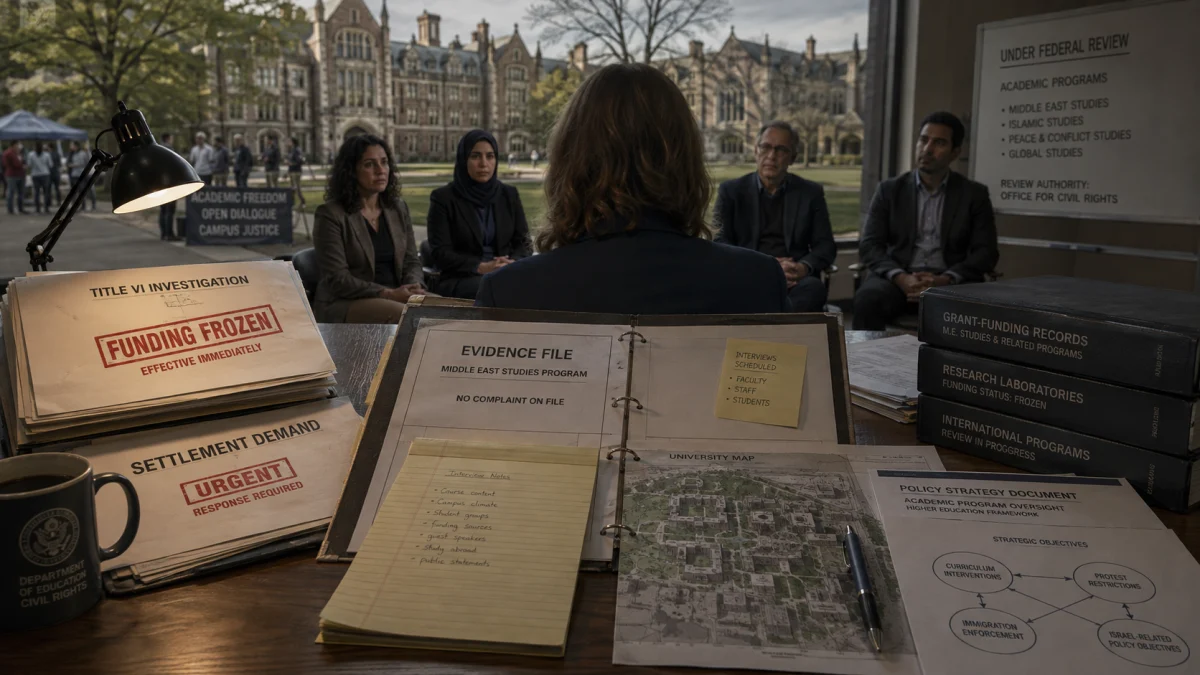
The strongest evidence now available indicates that key parts of the Trump administration’s “systemic campus antisemitism” case were built backward: universities were targeted and financially punished before investigators established the civil-rights violations supposedly justifying those actions, and when career investigators could not produce the desired findings, political leadership allegedly refused to accept their conclusions.
Brown University provides the clearest example. A newly released whistleblower disclosure from former Justice Department civil-rights attorney Haley Van Erem says the investigative team completed an extensive review and concluded that Brown had not violated Title VI. According to the disclosure, an HHS official later explicitly agreed that there was “not a Title VI violation” but nevertheless said there was no way a letter clearing Brown would be approved.
The disclosure goes further. Van Erem says officials expanded investigations because the evidence they had gathered was insufficient to support the findings they wanted. She became concerned that HHS was trying to “manufacture facts” at Brown. Investigators were instructed to interview Middle East Studies professors—particularly Muslim faculty—including a professor who, according to Van Erem, had not been accused of antisemitic conduct. An official allegedly explained that the purpose was not to obtain relevant information but to see “what he will say.” Career investigators interpreted that as an attempt to elicit a statement that could be labeled antisemitic.
Those same lawyers proposed investigating allegations of anti-Muslim discrimination to apply Title VI consistently.
Leadership did not pursue those proposals.
The whistleblower allegations do not stand alone. In September 2025, a federal judge examining the Trump administration’s funding campaign against Harvard concluded that the government had used antisemitism as a “smokescreen for a targeted, ideologically-motivated assault” on universities. In August 2026, a second federal judge dismissed the Justice Department’s Title VI case against Harvard, finding that the government’s later allegations were too “isolated and episodic” to establish continuing institutional noncompliance.
Taken together, the emerging record raises a much larger question than whether individual protesters sometimes said offensive things.
Was the federal government genuinely investigating institutional discrimination—or was “systemic antisemitism” being used as the legal justification for a political campaign to discipline universities, suppress pro-Palestinian activity, scrutinize Muslim academics, reshape Middle East scholarship and force institutions to accept unrelated administration priorities?
The documents increasingly support the second explanation.
Who is Haley Van Erem?
Haley Van Erem spent nearly a decade as a career attorney in the Justice Department’s Civil Rights Division.
In March 2025, she and other DOJ lawyers were involuntarily assigned to the Department of Health and Human Services’ Office for Civil Rights to work on university Title VI investigations being conducted through the Trump administration’s Task Force to Combat Anti-Semitism.
On August 17, 2026, attorneys from the Government Accountability Project submitted a protected whistleblower disclosure on Van Erem’s behalf to congressional committees, the U.S. Office of Special Counsel, and the inspectors general of DOJ and HHS.
The disclosure says Van Erem reasonably believes officials engaged in violations of law or regulation, gross mismanagement, waste and abuse of authority.
Importantly, her attorneys say additional former DOJ attorneys can corroborate her account and have submitted their own protected disclosures.
The central accusation is straightforward:
Political leadership allegedly determined enforcement outcomes before career investigators had collected and evaluated the evidence.
That allegation is supported throughout the disclosure by dates, meetings, quotations, emails and descriptions of specific investigative decisions.
How a Title VI investigation is supposed to work
Understanding Title VI makes the whistleblower allegations much easier to evaluate.
Title VI prohibits discrimination based on race, color or national origin in programs receiving federal financial assistance. Federal guidance applies those protections to discrimination involving shared ancestry and ethnic characteristics, including discrimination affecting Jewish, Israeli, Muslim, Arab and Palestinian students.
A university does not become legally responsible simply because somebody on its campus says or does something discriminatory.
For a hostile-environment Title VI case, investigators ordinarily have to establish that the conduct was sufficiently serious to interfere with access to an educational program, that the institution knew or reasonably should have known about it, and that the institution failed to take prompt and effective corrective action.
Federal agencies are then supposed to investigate, develop a factual record, give the institution an opportunity to respond and determine whether a violation occurred. If investigators conclude that enforcement is unwarranted, regulations require the agency to notify the institution. Terminating federal funding carries additional procedural protections.
The difference between that system and the process Van Erem describes is stark:
| Evidence-led civil-rights enforcement | What the whistleblower says happened |
|---|---|
| Receive credible allegations | Select universities for extraordinary pressure |
| Gather documents and interview relevant witnesses | Freeze or threaten funding before investigations were complete |
| Determine whether Title VI was violated | Search for evidence capable of supporting the desired finding |
| Clear the institution if evidence is insufficient | Refuse to approve a no-violation finding |
| If a violation exists, negotiate remedies tied to it | Seek broad settlements affecting unrelated university policies |
| Escalate enforcement if voluntary compliance fails | Use access to federal money itself as the primary leverage |
The most important inversion is simple:
The punishment appears to have preceded the proof.
Brown is the clearest evidence that the case was being manufactured
Van Erem’s disclosure actually labels its Brown section:
“Title VI Investigation at Brown Motivated by Bias Rather than Evidence.”
She says she became increasingly concerned that HHS had a political motive to “manufacture facts” because investigators did not have documented evidence supporting the case leadership apparently wanted to build.
There was an additional procedural oddity. When investigators asked what supported the HHS investigation beyond a media story, an HHS attorney reportedly said they were “99% sure” there were no Brown Title VI complaints in HHS’s complaint system.
There had been earlier complaints involving Brown at the Department of Education, which had already investigated them and reached a resolution agreement. Rather than simply coordinate around that existing record, however, the new HHS process developed separately.
The Brown team eventually conducted interviews and reviewed the relevant evidence.
Its conclusion was not ambiguous.
According to the disclosure, investigators found insufficient evidence to establish a Title VI violation. Brown’s responses to the potentially relevant incidents they examined had been prompt and effective—the exact question Title VI requires investigators to evaluate.
Van Erem recommended the legally ordinary result: issue Brown a notice that no violation had been found.
Leadership refused.
One official reportedly explained that higher-level officials would never accept that outcome because “everything is sequenced.” The disclosure says officials initially intended Harvard to become the first example, then turned toward Columbia when Harvard would not settle, with Brown potentially next.
On May 8, according to Van Erem, the issue became explicit.
An official said Brown would be pushed toward a voluntary resolution agreement despite there being no findings. Van Erem objected that the legally correct response was a notice of no violation.
The official reportedly acknowledged that there was “not a Title VI violation” at Brown but said:
“There’s no way we’re going to get a letter of no violation cleared.”
Van Erem then posed the obvious problem: if investigators could not find a violation, what exactly were they supposed to recommend Brown do to remedy it?
The official reportedly had no answer.
That sequence is difficult to reconcile with a neutral fact-finding process.
It suggests that Brown’s guilt was politically necessary even after the government’s own investigators concluded that Brown was not legally guilty of what the government was alleging.
The Muslim-professor fishing expedition
The most disturbing portion of the Brown investigation may be what happened after investigators encountered problems establishing the government’s case.
According to Van Erem, HHS official Daniel Shieh proposed systematically interviewing Middle East Studies professors, particularly Muslim faculty.
One professor had previously attracted the interest of another senior official.
Van Erem says investigators were told the purpose of interviewing him was not “to get information” but to see “what he will say.”
To Van Erem’s knowledge, no complaint accused that professor of antisemitic activity.
Career DOJ attorneys repeatedly objected to placing Middle East Studies professors who were unrelated to complaints on the witness list. Leadership refused to remove all of them.
The disclosure says the career lawyers understood the effort as potentially intimidating and rooted in Islamophobic assumptions: Muslim and Middle East Studies professors were apparently being treated as likely sources of antisemitic statements because of who they were or what they studied, rather than because evidence connected them to a civil-rights violation.
Then comes an important comparison.
The DOJ assignees suggested opening investigations into allegations of anti-Muslim bias on campuses, arguing that consistent civil-rights enforcement required examining those claims too.
Leadership did not pursue the proposals.
That asymmetry matters.
The government was not simply applying an unusually aggressive interpretation of Title VI to every vulnerable group. According to the career investigators themselves, Muslim academics were being treated as investigative targets while proposals to investigate discrimination against Muslims were ignored.
When the evidence was insufficient, officials allegedly expanded the investigation to find more
Another passage in the disclosure illustrates the backward logic particularly well.
According to Van Erem, Shieh privately acknowledged that the facts uncovered at university medical schools would not justify a Title VI finding.
His proposed solution was not to close those cases.
It was to expand the investigations from the medical schools to the entire universities “in order to substantiate a finding.”
Career DOJ lawyers objected that the proposed 45-day timetable was inadequate for the enormous amount of evidence necessary to establish a serious institutional Title VI violation.
That is not how an evidence-led investigation normally operates.
If the question is genuinely whether a violation occurred, insufficient evidence can produce a negative conclusion.
If the objective instead is to produce a violation finding, insufficient evidence becomes a reason to keep expanding the search until something useful appears.
Van Erem says she increasingly believed officials were doing the latter.
“Pulling money is the tool”
The funding chronology makes the same pattern difficult to ignore.
On March 7, 2025, the administration canceled approximately $400 million in Columbia grants and contracts. On March 10, the Education Department announced that 60 universities had received letters warning of potential Title VI enforcement.
Yet the whistleblower says the investigations supposedly supporting some of these actions had not been completed.
According to the disclosure, Shieh explained the strategy with unusual clarity:
“The goal is compliance, but pulling money is the tool.”
Another official allegedly discussed forcing schools to disgorge federal money. Van Erem also recounts a comment that someone examining the government’s contractual powers had realized “we could really do some damage with this.”
In other words, federal research money was not merely a remedy to be considered after establishing unlawful discrimination.
It was the leverage.
That distinction becomes especially important because universities depend on federal grants for medical research, public-health work, scientific laboratories and long-term projects that can collapse when funding suddenly stops.
A university does not have to believe the government’s legal case is strong to capitulate. It only has to believe that fighting Washington will cost more than surrendering.
Brown eventually settled—with no finding that Brown broke the law
Brown reached an agreement with the federal government on July 30, 2025.
The agreement restored frozen research funding and permanently closed pending federal reviews.
Brown’s own official description states plainly that the government had never informed the university of any finding that Brown violated the law. The final agreement contained no admission or finding of wrongdoing.
One point from some viral commentary needs correction: Brown did not pay a $50 million fine to the federal government.
Instead, it committed $50 million over ten years to Rhode Island workforce-development organizations selected by Brown.
But correcting that detail does not make the underlying sequence less troubling.
Brown says the federal freeze had implications for hundreds of millions of dollars in research funding. It negotiated while reimbursements on active grants were being withheld, and the settlement closed investigations without a finding of wrongdoing.
Even more revealingly, the agreement included administration priorities that had little obvious connection to the supposed campus-antisemitism emergency, including provisions involving admissions, DEI, transgender athletics and gender-related medical care for minors.
That breadth supports the argument that the civil-rights investigation had become a vehicle for something larger.
Harvard refused—and a federal judge called the antisemitism rationale a “smokescreen”
Harvard’s confrontation produced the strongest independent judicial examination of the government’s strategy.
In April 2025, the administration presented Harvard with sweeping conditions for maintaining its financial relationship with the federal government.
The formal demand letter required external audits of university viewpoints and programs, elimination of DEI initiatives and government-approved scrutiny of academic units including the Center for Middle Eastern Studies, Department of Near Eastern Languages and Cultures, human-rights programs and other academic centers.
It contemplated reports about individual faculty members and government involvement in determining sanctions.
Harvard rejected the demands.
Within hours, the administration announced a freeze of roughly $2.2 billion in grants and $60 million in contracts.
Harvard sued.
In September 2025, U.S. District Judge Allison Burroughs ruled that the administration’s funding actions violated the First Amendment, Title VI requirements and administrative law.
Her conclusion about motive was unusually direct.
After reviewing the administrative record, Burroughs said it was difficult to conclude anything other than that officials had used antisemitism as a “smokescreen for a targeted, ideologically-motivated assault” on leading universities.
The court also observed that most of the government’s demands concerned governance, staffing, hiring and admissions—issues that did not logically follow from the stated civil-rights rationale.
This is important because it independently corroborates the basic architecture Van Erem later described from inside the government:
enormous punishment first, sprawling ideological demands second, legally sufficient Title VI investigation somewhere behind both.
Then the Justice Department’s Harvard Title VI case was dismissed
The administration continued pursuing Harvard.
In March 2026, the Justice Department filed a separate Title VI enforcement lawsuit.
On August 13, 2026—just days before Van Erem’s disclosure became public—U.S. District Judge Richard Stearns dismissed it.
The government’s amended complaint relied overwhelmingly on older events. Stearns found the later allegations too “isolated and episodic” to plausibly establish continuing institutional noncompliance with Title VI.
More damagingly, the court said the complaint contained no factual allegations plausibly establishing noncompliance after the government gave Harvard the formal notice required for the enforcement action.
The judge also rejected the government’s apparent theory that Title VI enforcement should function as punishment.
Congress designed the statute to bring recipients into legal compliance—not simply to penalize institutions for refusing to obey broader governmental commands. Stearns specifically noted that failing to comply with the government’s preferred demands is not itself a rational basis for finding a Title VI violation.
That distinction cuts directly to the heart of the whistleblower allegations.
The alleged Harvard settlement terms went even further
Van Erem describes another set of Harvard proposals that were never publicly presented in the same way as the April 11 demand letter.
She says HHS Acting General Counsel Sean Keveney briefly showed her proposed settlement terms on his computer.
According to her disclosure, those proposals included:
- installing a provost to oversee curriculum;
- eliminating DEI programs;
- placing Harvard endowment money into trusts that the government could potentially seize;
- and investing in programs in Israel.
Van Erem says she saw no information connecting those sweeping provisions to specific Title VI findings. She raised concerns that several proposals had no direct connection to the supposed discrimination investigation and that government-controlled curriculum monitoring posed First Amendment problems.
These should be described precisely: they are proposed settlement terms Van Erem says she personally saw, not necessarily a finalized demand formally delivered to Harvard.
But if her account is substantiated, they significantly deepen the question of what the administration was actually trying to accomplish.
A requirement that Harvard invest in Israel is not an obvious remedy for an American university’s supposed failure to comply with domestic civil-rights law.
Neither is restructuring an endowment so federal officials might seize it.
Columbia shows how the pressure campaign could reshape a university
Columbia followed a different path.
The administration canceled approximately $400 million in federal funding in March 2025. Columbia subsequently implemented major reforms and eventually signed a settlement requiring $200 million in payments to the federal government, plus a separate $21 million settlement resolving EEOC matters.
In exchange, most terminated research grants were reinstated and Columbia regained access to billions of dollars in current and future federal research funding. Columbia did not admit wrongdoing.
Columbia is not identical to Brown. Van Erem’s disclosure says investigators encountered evidence of discrimination during the Columbia investigation.
But that does not resolve the procedural problem.
The disclosure says findings and funding actions were moving on an accelerated timetable before adequate factual and legal review had been completed. Career attorneys identified allegations presented as facts that were unsupported, derived from news reports or lawsuits, or implicated constitutionally protected First Amendment activity.
And the resulting federal pressure reached deeply into Middle East scholarship.
Columbia appointed a senior vice provost with authority to conduct a review of regional-studies programs, beginning specifically with the Middle East.
The programs named for review included the Center for Palestine Studies, Institute for Israel and Jewish Studies, Middle Eastern, South Asian and African Studies, Middle East Institute, Tel Aviv and Amman global hubs, and Columbia’s Middle East policy program.
The review was instructed to evaluate whether educational offerings were sufficiently “comprehensive and balanced”, along with leadership, curriculum and faculty processes.
That is an extraordinary distance from the simple proposition that federal investigators were making sure students had equal access to an education.
The federal funding confrontation was now influencing how one of America’s major research universities structured the study of Israel, Palestine and the broader Middle East.
Project Esther makes the ideological pattern much easier to understand
The crackdown did not emerge in an intellectual vacuum.
On October 7, 2024—months before Trump returned to office—the Heritage Foundation published Project Esther: A National Strategy to Combat Antisemitism.
The document deserves considerably more scrutiny than it has received.
Project Esther does not confine itself to discriminatory harassment against Jewish people.
Its executive summary characterizes anti-Israel, anti-Zionist and broadly pro-Palestinian organizations in the United States as part of what it calls a “Hamas Support Network”, effectively treating a large political movement as terrorist-support infrastructure.
It explicitly identifies changing U.S. support for Israel as the movement’s strategic objective.
The document then turns to academia.
Project Esther describes professors in social sciences and Middle East/North Africa or Islamic Studies programs as broadly “antisemitic and hostile to Israel.”
Its desired outcomes include:
- purging what it labels Hamas-supporting propaganda from curricula;
- removing or firing supportive faculty and staff;
- restricting or denying campus access to organizations;
- restricting protest permits;
- identifying students and foreign faculty for visa violations;
- deporting foreign participants;
- and making potential demonstrators afraid to associate with targeted organizations.
The document openly says Heritage hoped its project would become a public-private partnership “when a willing Administration occupies the White House.”
A few months later, Trump occupied the White House.
His January 29 executive order mobilized executive agencies around campus antisemitism and explicitly instructed the State, Education and Homeland Security departments to develop mechanisms involving foreign students and staff, including potential removal from the United States.
Then came funding cancellations, investigations of dozens of universities, immigration enforcement involving activists, federal demands concerning Middle East programs, and—according to Van Erem—the deliberate targeting of Muslim and Middle East Studies professors.
The overlap is not something critics have to infer entirely from the outside.
Heritage itself now says the Trump administration’s actions “closely mirrored the recommendations in Project Esther.”
That does not establish that Heritage officials secretly issued orders to DOJ or HHS.
It establishes something more concrete: a detailed preexisting political blueprint called for targeting the same kinds of organizations, professors, academic programs, protesters and foreign students who subsequently became targets of federal policy—and the organization that wrote the blueprint publicly claims the administration followed it closely.
This was also a fight over Zionism, Israel and Palestine
One of the most consequential features of this campaign is the gradual collapse of distinctions between several very different things:
discrimination against Jewish people;
criticism of Israel;
anti-Zionism;
Palestinian political advocacy;
Middle East scholarship;
and alleged support for Hamas.
Project Esther explicitly links these categories.
The Trump White House’s own January 2025 fact sheet similarly moved between combating antisemitism, targeting “pro-Hamas” demonstrations, deporting foreign protesters and emphasizing Trump’s political support for Israel.
Federal pressure on universities subsequently reached programs teaching Middle Eastern history and politics, Palestine-focused academic centers, faculty viewpoints, student protest organizations and immigration status.
And according to Van Erem, one proposed Harvard settlement would even have required investment in Israel.
That does not establish that the Israeli government secretly directed the operation, nor does the available record identify a command chain from any foreign government or lobbying organization to the officials conducting these investigations.
There is no need to invent one.
The documented record is already significant: American officials used American governmental power in ways that aligned closely with a political program explicitly designed to weaken anti-Zionist and pro-Palestinian activity and protect the U.S.-Israel relationship.
That is an evidence-based description of the policy outcome.
What was the crackdown actually trying to accomplish?
The available evidence points to several overlapping objectives rather than one simple motive.
Coerce universities through financial dependency
The whistleblower repeatedly describes officials discussing funding not as the final consequence of a proven violation but as the instrument for obtaining compliance.
“The goal is compliance, but pulling money is the tool” may be the most concise description of the strategy in the entire disclosure.
Force ideological and institutional changes unrelated to proven Title VI violations
Harvard was told to change governance, hiring, admissions, DEI programs and academic oversight.
Brown’s eventual agreement included administration priorities involving admissions and transgender policy.
Columbia changed disciplinary systems and governance and subjected Middle East programs to special review.
Judge Burroughs later pointed to precisely this mismatch when she concluded that the antisemitism rationale functioned as a smokescreen.
Reshape the boundaries of Israel-Palestine discourse
Project Esther treated broad anti-Zionist and pro-Palestinian politics as components of a terrorist-support network.
Federal actions then focused unusually heavily on Palestinian organizations, Middle East Studies, foreign students and political protests connected to Israel’s war in Gaza.
Create examples that would encourage other institutions to surrender
Van Erem says officials discussed making Harvard the first example.
When Harvard resisted, Columbia became the next candidate.
Brown was potentially next.
That framing makes the settlements valuable beyond the individual universities: once one elite institution capitulated, every other university could see the price of resistance.
Why the anti-Muslim element cannot be treated as a footnote
This story has frequently been framed exclusively around whether the government went too far while trying to protect Jewish students.
The whistleblower evidence requires a broader civil-rights analysis.
The career lawyers themselves reportedly believed that Muslim professors were being selected on the assumption that their religion or academic field made them likely to hold objectionable views.
They warned that the interviews appeared rooted in Islamophobic assumptions.
They proposed investigating anti-Muslim discrimination too.
Leadership declined.
That is not incidental.
If the disclosure is substantiated, a federal civil-rights operation nominally created to fight discrimination was simultaneously profiling Muslim academics as potential sources of wrongdoing without an evidentiary predicate.
There is an uncomfortable historical familiarity to that mechanism: identify a politically disfavored community, assume ideological danger from identity or association, conduct fishing expeditions, and convert statements or affiliations into evidence supporting state intervention.
That deserves scrutiny on its own terms.
What is established, what is alleged and what is reasonable to infer?
The evidence is unusually strong for a story that became public only days ago, but different pieces carry different evidentiary weight.
Established by public records and court decisions: federal funding was frozen or canceled before the full enforcement process described by Title VI was completed; Brown ultimately settled with no finding or admission of wrongdoing; Columbia paid the government $200 million and accepted sweeping policy changes in exchange for restoration of federal funding; Harvard was subjected to broad ideological and curricular demands; Judge Burroughs ruled Harvard’s funding freeze unlawful and described antisemitism as a smokescreen; Judge Stearns later dismissed DOJ’s separate Title VI enforcement case; and Project Esther openly advocated targeting pro-Palestinian organizations, Middle East/Islamic Studies faculty, protests and immigration status.
Detailed whistleblower allegations not yet finally adjudicated: officials knowingly pursued predetermined results; Brown’s investigators were blocked from issuing a no-violation letter; Muslim professors were targeted without evidence of wrongdoing; officials sought to “manufacture facts”; funding was consciously used to force settlements regardless of findings; and proposed Harvard settlement terms included seizable endowment trusts and investments in Israel.
Reasonable inference from the total record: in at least some of the administration’s highest-profile university cases, the allegation of systemic institutional antisemitism functioned less as an investigative conclusion than as a preselected justification for a wider political project involving academic control, pro-Palestinian activism, Middle East scholarship, immigration, DEI and institutional obedience.
That inference does not depend on trusting a single commentator or viral video.
It emerges from the chronology, the government’s own demands, university agreements, internal whistleblower testimony, Project Esther’s published blueprint and two separate federal court decisions.
The administration disputes the whistleblower
The Justice Department has defended the investigations.
A DOJ spokesperson told CBS News that Van Erem did not work on university investigations “while at the DOJ” and said the department stands behind the integrity of the investigations.
That response does not resolve the central factual dispute because Van Erem’s disclosure says she remained a DOJ career attorney while being involuntarily detailed to HHS specifically to conduct these investigations. Her reassignment is also described in independent reporting.
The allegations nevertheless remain whistleblower allegations unless and until documentary production, inspector-general review, testimony or litigation independently verifies each one.
That process is now beginning.
House Judiciary Committee Ranking Member Jamie Raskin has demanded records and testimony concerning the university investigations, communications with the White House, the targeting of Muslim faculty and the cancellation of federal funding. Van Erem and additional former DOJ attorneys have also made protected disclosures to the Office of Special Counsel and agency inspectors general.
The larger scandal is not one university investigation
The deeper issue is what happens when civil-rights law becomes an instrument for achieving political outcomes that the law itself does not authorize.
Title VI is powerful because the federal government can condition enormous amounts of money on compliance with civil-rights protections.
That power assumes something fundamental:
The government investigates first and punishes second.
If political officials reverse that order—selecting enemies, cutting funding, demanding ideological concessions and then directing career lawyers to construct the necessary civil-rights case afterward—the problem goes far beyond Harvard, Brown or Columbia.
The precedent would allow any future administration to do the same thing with another protected group and another political target.
A Republican administration could invoke discrimination to attack universities whose politics it dislikes.
A Democratic administration could use another civil-rights theory to punish institutions on the right.
The underlying abuse would be identical.
Civil-rights enforcement becomes credible only when the evidence determines the outcome.
Once the desired outcome determines which evidence the government goes searching for, civil-rights law stops functioning as protection and starts functioning as leverage.
Bottom line
The new whistleblower evidence substantially changes what we know about the Trump administration’s campus antisemitism campaign.
At Brown, career investigators allegedly completed their work and concluded there was no Title VI violation. An official reportedly agreed with that conclusion while simultaneously saying Brown would not be permitted to receive a no-violation finding.
When officials lacked sufficient evidence elsewhere, investigators say leadership expanded the scope in an attempt to substantiate findings.
Muslim and Middle East Studies professors were reportedly placed on interview lists despite lacking connections to complaints, with one interview intended simply to see “what he will say.”
The career lawyers themselves described the approach as rooted in Islamophobic assumptions.
Hundreds of millions of dollars were frozen before investigations reached legally sufficient conclusions.
The resulting demands extended far beyond discrimination complaints into curriculum, faculty viewpoints, DEI, admissions, protests, immigration and university governance.
A federal judge independently concluded that antisemitism had been used as a smokescreen for a broader ideological assault.
And years before the whistleblower disclosure became public, Project Esther had already laid out a plan to weaken pro-Palestinian organizations, remove sympathetic academics, restrict protests, pursue foreign students and faculty, and target Middle East and Islamic Studies—while explicitly hoping for cooperation from a future friendly White House.
Heritage now says the Trump administration closely mirrored that plan.
So the most accurate description of the emerging evidence is not merely that the administration “overreacted” to campus antisemitism.
In key cases—most clearly Brown—the evidence indicates that the systemic civil-rights case used to justify federal punishment was manufactured from the top down: the conclusion came first, the financial punishment followed, and investigators were left searching for facts capable of supporting a decision political leadership had already made.
That is the reality the whistleblower disclosure puts on the table.
And it is considerably more serious than a debate over campus speech.
References and Further Reading
Primary Whistleblower Record
Haley Van Erem — Protected Whistleblower Disclosure Concerning Title VI Enforcement, Investigative Integrity and Federal Civil Rights Laws — The August 17, 2026 primary disclosure submitted by the Government Accountability Project on behalf of former DOJ civil-rights attorney Haley Van Erem. Contains the detailed chronology, Brown findings, Muslim-professor interviews, internal quotations and proposed Harvard settlement terms.
House Judiciary Committee — Investigation Into Whistleblower Allegations of Predetermined University Title VI Investigations — Congressional summary of Van Erem and other whistleblower disclosures and the committee’s requests for records and testimony.
Federal Court Decisions
President and Fellows of Harvard College v. HHS — September 3, 2025 Memorandum and Order — Judge Allison Burroughs’ ruling finding Harvard’s funding freeze unlawful under the First Amendment, Title VI and administrative-law principles and describing the government’s antisemitism rationale as a “smokescreen.”
United States v. President and Fellows of Harvard College — August 13, 2026 Order Dismissing Title VI Enforcement Action — Judge Richard Stearns’ decision finding DOJ had not plausibly alleged continuing institutional noncompliance with Title VI.
Government and University Records
Trump White House — Additional Measures to Combat Anti-Semitism, January 29, 2025 — The executive order directing federal agencies to expand campus-related enforcement and develop immigration-related measures involving foreign students and staff.
U.S. Department of Education — Letters to 60 Universities Under Investigation for Antisemitic Discrimination — Official March 10, 2025 announcement showing the nationwide scale of the administration’s enforcement initiative.
Federal Government’s April 11, 2025 Demand Letter to Harvard — Primary document detailing demands involving viewpoint audits, Middle East academic programs, DEI, hiring, admissions and university governance.
Brown University — Agreement Restoring Federal Research Funding and Closing Compliance Reviews — Brown’s detailed explanation confirming no finding or admission of wrongdoing and clarifying that its $50 million commitment funds Rhode Island workforce organizations rather than the federal government.
Columbia University — Resolution With the Federal Government — Official description of Columbia’s $200 million settlement and restoration of federal research funding.
Columbia University — March 2025 Middle East and Regional Studies Reforms — Primary document detailing special review of the Center for Palestine Studies, Institute for Israel and Jewish Studies, Middle East programs, curriculum and faculty processes.
U.S. Department of Education — Title VI Shared-Ancestry and Ethnic-Characteristics Guidance — Federal guidance explaining Title VI protections involving Jewish, Israeli, Muslim, Arab, Palestinian and other shared-ancestry communities.
Project Esther and the Ideological Blueprint
The Heritage Foundation — Project Esther: A National Strategy to Combat Antisemitism — Heritage’s October 2024 strategy document describing anti-Zionist and pro-Palestinian organizations as a Hamas-support network and proposing pressure on faculty, academic programs, protests and immigration status.
The Heritage Foundation — Statement That Trump Administration Actions Closely Mirrored Project Esther — Heritage’s own retrospective statement claiming that the administration’s actions against antisemitism and the “pro-Hamas movement” closely followed Project Esther’s recommendations.
Independent Reporting
Associated Press — Whistleblower Alleges Political Pressure and Lack of Evidence in University Antisemitism Probes — Independent August 2026 reporting on the disclosure, the university settlements and the administration’s response.
CBS News — Former DOJ Lawyer Alleges Trump Administration Abused University Investigative Process — Includes DOJ’s response to Van Erem and additional reporting on her reassignment to HHS.
Editorial currency note: This article reflects documents and reporting available through August 20, 2026. Van Erem’s disclosure and corroborating whistleblower submissions are now before Congress, the Office of Special Counsel and agency inspectors general. Additional records, testimony, court proceedings or investigative findings could materially expand or alter what is publicly known.