The newly revealed story about JD Vance and Hillary Clinton is more consequential than another embarrassing quote from a politician’s past.
According to new reporting by Vanity Fair, Vance did not merely criticize Donald Trump from the sidelines in 2016. He repeatedly sought a connection to Hillary Clinton’s senior adviser Jake Sullivan and ultimately spoke with him, offering advice about how Clinton could recover working-class voters and avoid losing Midwestern states to Trump.
Five years later, Vance entered Republican electoral politics as an increasingly committed Trump ally.
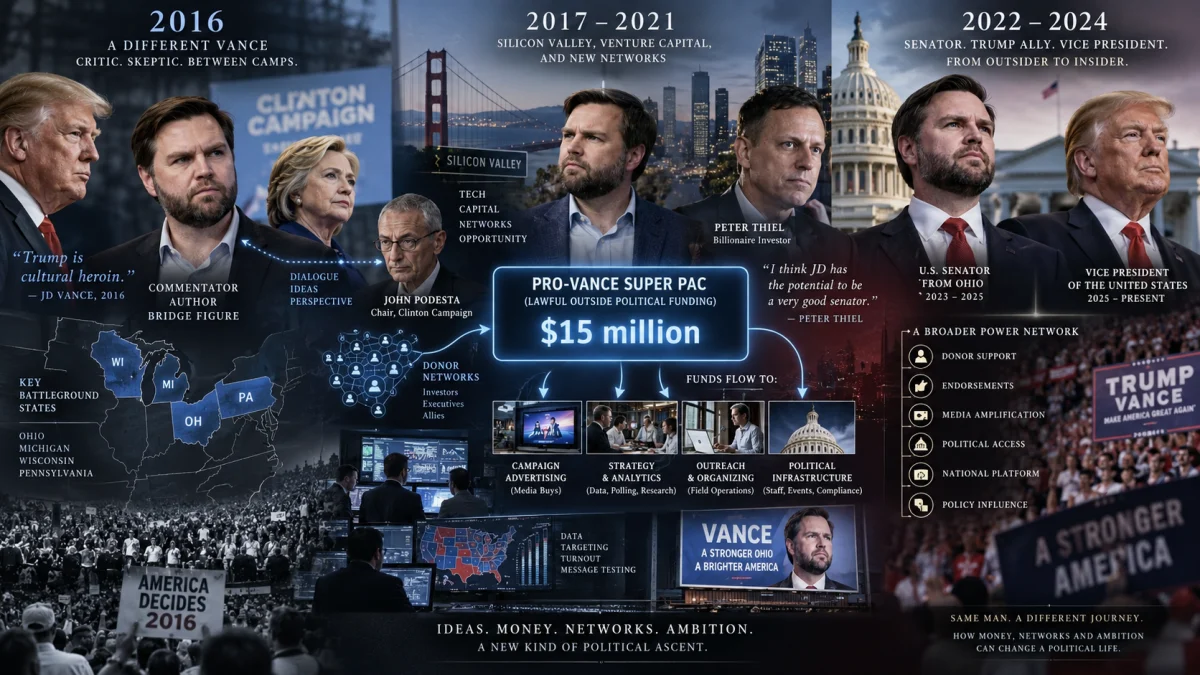
Then billionaire Peter Thiel, Vance’s former employer, mentor and investor, put $15 million into the super PAC supporting Vance’s 2022 Senate campaign. Trump endorsed him. Vance won the Republican primary, won the Senate seat, became Trump’s 2024 running mate and is now vice president. The Washington Post’s detailed reconstruction of Vance’s Thiel network
There is no evidence that Hillary Clinton’s campaign paid Vance in 2016. That viral version of the story goes beyond the available evidence.
But stopping the analysis there would miss what is actually important.
The American political system does not require a billionaire to slide a politician a check labeled CHANGE YOUR BELIEFS. Political money operates far more effectively than that. It can determine who has the resources to become viable, who gains access to powerful networks, whose message gets repeated millions of times, who can survive a primary and which political identities are rewarded with a future.
Vance’s extraordinary political evolution provides a unusually clear case through which to examine that system.
What JD Vance reportedly told Hillary Clinton’s campaign
Vance’s opposition to Trump in 2016 has been public knowledge for years.
He described himself as a "Never Trump guy," called Trump "reprehensible" and an "idiot," and privately wondered whether Trump might become "America’s Hitler." PBS News and PolitiFact have documented those remarks and Vance’s subsequent reversal.
The September 16, 2026 Vanity Fair report adds something different.
According to a person who says they acted as an intermediary, Vance repeatedly asked to be connected with Jake Sullivan, then one of Clinton’s most senior advisers.
The intermediary recalled Vance saying that he disliked Clinton but disliked Trump more and believed Clinton could still prevent a Trump victory. Vance reportedly identified Ohio, Michigan, Wisconsin and Pennsylvania as states where Clinton urgently needed to reconnect with voters. Vanity Fair’s original reporting details the account.
He allegedly urged Clinton to address her Iraq War vote and speak directly to communities that had borne the consequences of the war.
Vance and Sullivan eventually spoke directly roughly six weeks before the election, according to the report.
A separate source close to Sullivan did not remember the entire Blue Wall discussion but did corroborate that Vance pressed Sullivan over Clinton’s politically damaging "basket of deplorables" remark and urged the campaign to fix the problem. Mediaite’s report reproduces the relevant details and response from Vance’s office.
Vance spokesperson Taylor Van Kirk rejected Vanity Fair’s characterization that Vance was trying to elect Clinton. She said Vance "never worked for a campaign" and argued that he was urging politicians from both parties to pay attention to working-class communities.
That is a dispute about how to characterize his intent.
It is not a categorical denial that the conversation with Sullivan occurred.
Vance saw the electoral danger Clinton missed
The historical irony is difficult to miss.
Trump went on to win Ohio, Michigan, Wisconsin and Pennsylvania.
Michigan, Wisconsin and Pennsylvania were the breakthrough that demolished what Democrats had treated as their Midwestern "Blue Wall" and effectively handed Trump the presidency.
The person who would eventually become Trump’s vice president had reportedly been warning Clinton’s campaign about precisely that vulnerability.
That alone makes the new reporting newsworthy.
But the more revealing story begins afterward.
Vance’s conversion to Trump was not immediate
Vance’s current explanation for his transformation is that he reassessed Trump after seeing him govern.
Changing one’s political beliefs is not inherently suspicious. Politicians, like everyone else, can genuinely change their minds.
The chronology nevertheless creates problems for a simple conversion story.
Previously disclosed private messages show that Vance was still sharply criticizing Trump’s performance in 2020, near the end of Trump’s first term.
The Washington Post reported that Vance wrote in February 2020 that Trump had "thoroughly failed to deliver" on economic populism apart from a disjointed China policy. In June, Vance predicted that Trump would probably lose to Joe Biden.
And one particular observation from those private conversations is striking in hindsight.
Vance reportedly argued that Trump’s wealthy donors would probably remain loyal because Trump had "served their interests" in office. The Washington Post’s authenticated-message reporting contains the remark.
Vance therefore understood the donor-politician relationship in structural terms before he became an elected politician himself.
By the following year, he was running for Senate.
Peter Thiel was already part of Vance’s world
The story becomes more complicated—and more interesting—when Peter Thiel enters it.
Thiel did not suddenly discover Vance after Vance became MAGA.
Vance heard Thiel speak at Yale Law School in 2011 and later described the event as enormously influential. By 2016, while Vance was publicly opposing Trump and reportedly talking to Clinton’s campaign, Vance was already working as a principal at Mithril Capital, one of Thiel’s investment firms. The Washington Post traces Vance’s employment at Mithril from April 2016 to March 2017.
That matters.
It means the evidence does not support a simplistic story in which Thiel wrote Vance a giant check and instantly converted an anti-Trump politician into a Trump supporter.
The relationship was older than the transformation.
But the relationship subsequently became much more consequential.
In 2019, Vance co-founded the venture firm Narya Capital. Washington Post reporting found that at least 15 percent of its initial capital came from Thiel.
Then came electoral politics.
Peter Thiel put $15 million behind Vance’s Senate campaign
When Vance sought Ohio’s open U.S. Senate seat, Thiel became the dominant financial force behind the outside group supporting him.
During the 2021–2022 cycle, Thiel contributed $15 million to Protect Ohio Values, the super PAC created to support Vance’s candidacy. Washington Post reporting documents the $15 million contribution, while CBS News separately documented the same total.
The Federal Election Commission identifies Protect Ohio Values as the outside political committee involved in supporting Vance’s campaign and maintains the committee’s filings and subsequent enforcement records.
For perspective, Thiel’s money was not a token endorsement.
It provided the financial infrastructure necessary to make a political newcomer competitive in an expensive statewide Republican primary.
Trump then provided another crucial resource: his endorsement.
CBS reported that a Fox News poll conducted after Trump’s endorsement had Vance at 23 percent, more than double the 11 percent he had registered in an earlier March poll. Vance subsequently won the primary.
The sequence is worth stating plainly.
Vance moved from anti-Trump author and commentator, to Republican candidate embracing Trump, to beneficiary of extraordinary billionaire-funded outside spending and Trump’s endorsement, to U.S. senator.
Two years later, Trump put him on the presidential ticket.
That does not require imagining a secret contract.
The visible system is already powerful enough.
Money in politics does not need to look like a bribe
Public discussion of political money is often trapped by an absurdly narrow standard.
Someone raises a concern about a donor giving millions of dollars to advance a politician’s career. The response becomes: Can you prove the donor explicitly ordered the politician to take Position X in exchange for Check Y?
That is a bribery test.
It is not a serious description of how political influence generally works.
Political money can purchase something more fundamental than a single vote: access, attention, viability and dependency.
Researchers Joshua Kalla and David Broockman demonstrated the access effect experimentally.
In a randomized field experiment involving 191 congressional offices, a political organization requested meetings for constituents. Some offices were told that the constituents were campaign donors; others were simply told they were constituents. The American Journal of Political Science study describes the randomized experiment.
When offices knew the people seeking meetings were donors, senior policymakers became available three to four times more often. The authors’ paper reports that result directly.
Nothing in that experiment required a bribe.
The money changed access.
That matters because access determines who gets to make the argument in the room.
Political scientists Justin Fox and Lawrence Rothenberg have explicitly modeled this problem as "influence without bribes": legislators can care simultaneously about policy and the fundraising consequences of their decisions without anyone ever entering an enforceable quid-pro-quo agreement. Their Political Analysis paper lays out the noncontracting model.
And broader research by Martin Gilens and Benjamin Page examined 1,779 U.S. policy issues and found that economic elites and organized business interests had substantial independent relationships with policy outcomes, while the preferences of average citizens showed little or no independent effect once the other groups were accounted for. Their Perspectives on Politics study presents the analysis.
That study does not tell us that every campaign contribution purchases a policy.
It tells us something more uncomfortable: political influence is distributed very unequally.
Money can determine who becomes a politician in the first place
The fixation on whether donors "buy votes" also ignores an earlier stage of the process.
Money helps decide who gets close enough to cast the vote at all.
A wealthy patron can finance the candidate who would otherwise disappear in a crowded primary.
A super PAC can keep that candidate on television.
A business network can provide introductions, advisers, fundraisers and elite validation.
A political benefactor can make a risky candidacy financially plausible.
Those mechanisms do not dictate every thought inside a politician’s head. They do something arguably more important: they shape the population of politicians who survive.
The system therefore does not need politicians to be literal puppets.
It rewards adaptability.
An ambitious politician learns which messages attract funding, which alliances create opportunities, which positions close doors and which transformations open them.
Calling those politicians "empty shells" captures the public anger but misses the deeper institutional problem.
The system doesn’t require emptiness.
It requires responsiveness to incentives.
Vance’s story is unusually revealing because the incentives are visible
Vance’s chronology is particularly instructive because so much of it is documented.
In 2016, he considered Trump dangerous enough to oppose publicly and, according to the new reporting, privately offered advice to Clinton’s team about stopping him.
In 2020, he was still privately criticizing Trump’s economic record.
By 2021, he was running for office as a Trump-aligned Republican.
Between 2021 and 2022, Thiel poured $15 million into the super PAC supporting that campaign.
Trump endorsed him.
Vance won.
By 2024, a network of wealthy technology executives was advocating for Vance to become Trump’s running mate. The Washington Post reported that Thiel, David Sacks and others in Vance’s Silicon Valley orbit pushed his candidacy for vice president.
Vance was selected.
Today he is vice president.
There is no need to invent facts around that chronology.
The chronology is the story.
Even Vance described politics as a strategic game
One line from Vance’s old private correspondence deserves more attention than it has received.
While discussing politics with Kevin Gallagher in 2020, Vance wrote:
"You’re playing a strategic game … the same as me."
The Washington Post authenticated and reported the correspondence.
There is nothing inherently scandalous about political strategy. Anyone trying to accomplish anything in politics must think strategically.
But placed next to Vance’s transformation, his comments about wealthy Trump donors, his later Senate campaign and the enormous financial support surrounding his rise, the phrase captures something larger about professional politics.
Political careers are strategic games.
Money determines an enormous amount about who has enough pieces on the board to keep playing.
This is not only a JD Vance problem
Reducing the phenomenon to one Republican politician would let the system itself off too easily.
Mega-donor politics exists across American political factions, even though the balance of donor support varies substantially by election and party.
And the concentration is increasing.
A September 2026 Financial Times analysis found that more than one-third of roughly $2.8 billion raised in the current federal election cycle came from just 20 mega-donors. Sixteen of those top 20 were backing Republicans in the current cycle; major Democratic mega-donors remain part of the same financing system.
The 10 largest billionaire donors alone had already contributed more than $734 million toward the 2026 midterms by late August, according to a Forbes analysis of federal records.
That is not a political marketplace in which every citizen participates on remotely equal terms.
A voter has a ballot.
A billionaire can have a ballot, a super PAC, a political network, a fundraising apparatus, millions of dollars in advertising and privileged access to the people who write laws.
Those are fundamentally different quantities of political power.
So did money turn JD Vance into a Trump loyalist?
The available record cannot tell us what happened inside JD Vance’s mind.
It can tell us something more concrete.
Vance’s public and private positions changed dramatically over a period in which his ambitions shifted from commentator and investor to Republican candidate.
His eventual political identity aligned with the coalition necessary for him to win a Republican primary.
A billionaire mentor and former employer supplied an extraordinary amount of financial support to the outside group backing that campaign.
Trump supplied a politically valuable endorsement.
The combination helped take Vance from first-time candidate to U.S. senator.
A network that included some of the same technology elites later advocated for his placement on the presidential ticket.
And Vance became vice president.
None of those facts becomes unimportant merely because nobody has produced a written contract saying exactly what political position was exchanged for exactly which dollar.
That would be the wrong standard.
The real problem is what the system rewards
People often complain that politicians seem willing to say almost anything necessary to stay in power.
The more useful question is why the political system rewards that behavior.
Campaigns require extraordinary quantities of money.
Money is concentrated.
The people capable of supplying enormous quantities of it consequently possess something ordinary voters do not: the ability to make a candidacy materially more viable.
That creates an environment in which ideological flexibility can become a career advantage.
A politician does not necessarily wake up one morning and decide to abandon every belief for a donor.
The adaptation can happen gradually.
The politician discovers which arguments receive applause.
Which television appearances generate attention.
Which positions attract donors.
Which allies provide introductions.
Which ideological communities can supply an audience.
Which endorsements unlock voters.
Which version of himself has a future.
Eventually, the incentives and the identity may become difficult even for the politician to separate.
That is what makes JD Vance’s trajectory worth examining.
The remarkable part is not simply that Donald Trump’s current vice president once opposed him.
It is that the same politician reportedly tried to help Hillary Clinton’s campaign defeat Trump, remained privately critical of Trump’s performance years later, then entered a political ecosystem in which billionaire funding, Trump’s endorsement and an increasingly MAGA identity all pointed toward the same destination.
American politics does not need secret envelopes of cash to create profound conflicts between representation and money.
The machinery is largely operating in public.
We simply stopped being surprised by it.
References and Further Reading
New Reporting on Vance and the Clinton Campaign
Vanity Fair — “God and Vance at Yale” Chris Whipple’s September 16, 2026 profile contains the newly reported account of Vance seeking contact with Jake Sullivan, his reported advice to Clinton’s campaign and the vice president’s spokesperson’s response.
Mediaite — JD Vance reportedly advised Clinton’s campaign on beating Trump in Midwestern states Provides an independent summary of the new Vanity Fair reporting and reproduces the relevant response from Vance’s office.
Vance’s Political Evolution
PBS News / PolitiFact — Fact-checking JD Vance’s past statements and relationship with Trump Documents Vance’s 2016 Never Trump statements, deleted criticism and later public reversal.
The Washington Post — Vance’s 2020 private messages criticizing Trump’s record Reports previously undisclosed messages showing that Vance continued criticizing Trump’s economic performance much later than 2016.
The Washington Post — Vance messages, wealthy donors and the “strategic game” remark Contains Vance’s reported observation about Trump’s wealthy donors remaining supportive because Trump had served their interests and his description of politics as a strategic game.
Peter Thiel, Political Funding and Vance’s Rise
The Washington Post — Inside the Peter Thiel network that helped launch JD Vance Detailed reconstruction of Vance’s relationship with Thiel, Mithril Capital, Narya Capital, the $15 million in super PAC funding and the technology network surrounding Vance.
CBS News — The billionaire who fueled JD Vance’s rapid rise Documents Thiel’s $15 million in contributions to Protect Ohio Values and his longstanding relationship with Vance.
Federal Election Commission — Protect Ohio Values PAC records for the 2022 cycle Primary federal campaign-finance records for the outside political committee supporting Vance.
Federal Election Commission — MUR 8009, Protect Ohio Values and JD Vance for Senate Primary FEC enforcement record concerning allegations involving the super PAC and Vance’s campaign. The commission ultimately dismissed the relevant allegations or failed to obtain sufficient votes to pursue others.
Research on Political Money and Influence
American Journal of Political Science — “Campaign Contributions Facilitate Access to Congressional Officials” Randomized field experiment finding that congressional offices provided substantially greater access to senior policymakers when they knew meeting participants were campaign donors.
Political Analysis — “Influence without Bribes: A Noncontracting Model of Campaign Giving and Policymaking” Explores how fundraising incentives can influence policymaking without requiring explicit agreements between donors and politicians.
Perspectives on Politics — “Testing Theories of American Politics: Elites, Interest Groups, and Average Citizens” Analysis of 1,779 policy issues finding substantially greater independent influence associated with economic elites and organized business interests than with average citizens.
Current Campaign-Finance Context
Financial Times — U.S. billionaires and mega-donors in the 2026 midterms September 2026 analysis of the increasing concentration of federal campaign fundraising among a small number of wealthy donors.
Forbes — Largest billionaire donors in the 2026 midterms Uses federal election records to quantify hundreds of millions of dollars in current-cycle billionaire political giving.
Editorial currency note: Campaign-finance totals continue to change as new FEC reports and independent-expenditure filings are submitted. Figures in this article reflect records and reporting available as of September 17, 2026.