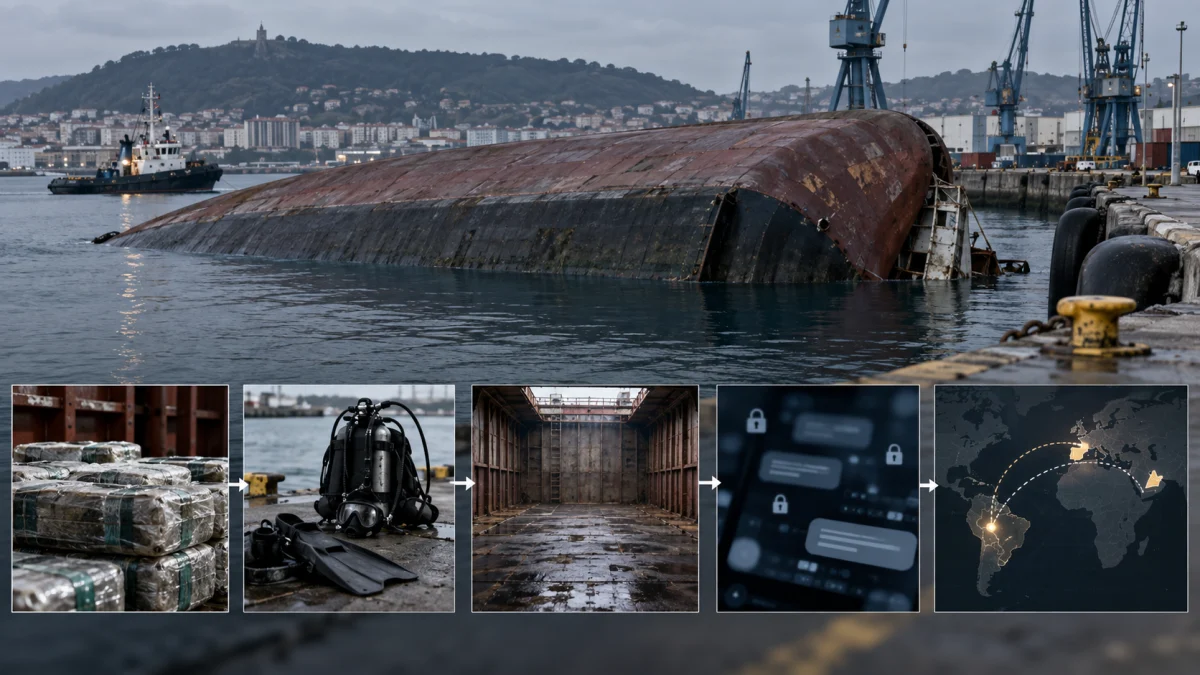
Spanish police now say criminals recovered a hidden 1,650-kilogram cocaine shipment from the Nehir after the vessel ended up semi-submerged in the port of Gijón. The available evidence strongly supports the existence of a second large cocaine load and shows that criminals tried to retrieve drugs from the vessel. But the increasingly popular version of the story—traffickers deliberately sank their ship and later sent divers back for exactly 1.65 tons—is more certain and more orderly than the public record allows.
What is firmly established is already extraordinary.
When Spanish authorities boarded the Nehir on February 22, 2021, they found roughly 1.84 metric tons of cocaine. Someone among the crew then deliberately opened several points through which seawater entered the ship, forcing police to abandon the search. Contrary to early reports, however, the vessel did not immediately sink. It capsized, remained afloat upside-down and was eventually towed to Gijón.
Evidence accumulated that another roughly 1,650 kilograms had been hidden elsewhere aboard. Criminals were later caught preparing an underwater recovery attempt. When authorities finally stabilized and searched the vessel in 2023, the missing cocaine was gone. A 2026 Swedish trafficking case added encrypted-message evidence supporting the existence of the second shipment and, according to reporting based on that judgment, indications that access to the relevant hold had been forced.
Spanish police now state that criminals successfully entered the vessel and recovered the hidden drugs. Europol uses more cautious language, saying members of the network are suspected of having done so.
The most defensible conclusion is therefore narrower but still striking:
The second cocaine shipment probably existed, and criminal removal is now the strongest explanation for why it vanished. But the publicly available evidence does not yet reconstruct a proven successful diving operation, identify who carried it out, establish exactly when it happened, or show that sinking the ship for later underwater recovery was the original plan.
What actually happened when police boarded the Nehir?
The Nehir was a 52.75-meter merchant vessel sailing under the flag of Palau. According to the factual findings reproduced in Spain’s Supreme Court judgment, its nine crew members had agreed to transport cocaine and followed instructions transmitted through an encrypted communications system.
After leaving Mauritania, the ship sailed toward Colombia and Suriname. The court found that two separate vessels delivered cocaine to the Nehir on two different occasions at sea. The drugs were then supposed to be taken toward Galicia and transferred to another boat for delivery ashore.
Colombian anti-narcotics authorities had warned Spain that the Nehir might be carrying roughly 3,000 kilograms of cocaine.
At approximately 7:36 a.m. on February 22, 2021, Spanish forces located the vessel in international waters at coordinates 45.20 N, 7.09 W. Its automatic identification system was off and its navigation lights were extinguished. Spanish authorities had obtained permission from Palau to board the vessel.
Police found 92 bales containing 1,834 brick-shaped packages.
The court recorded two groups:
- 1,731 packages weighing 1,734.387 kilograms, with average purity of 82.97 percent;
- 103 additional packages weighing 103.201 kilograms, with average purity of 76.29 percent.
Together, that was approximately 1,837.6 kilograms of cocaine-containing material. Adjusting for purity, the court calculated 1,517.75 kilograms of pure cocaine.
That distinction explains some of the apparently contradictory numbers surrounding the case.
Why do reports say 1.5 tons, 1.8 tons, three tons or 3.5 tons?
They are often measuring different things.
| Figure | What it refers to |
|---|---|
| About 3,000 kg | Colombian intelligence estimate before the boarding |
| 1,837.6 kg | Approximate physical weight recorded in the Spanish judgment |
| 1,835 kg | Rounded figure used by Spanish police in 2026 |
| 1,517.75 kg | Purity-adjusted quantity of cocaine calculated by the court |
| About 1,650 kg | Second shipment investigators say remained hidden |
| About 3.49 metric tons | Approximate combined physical weight of both alleged loads |
The first Spanish Interior Ministry announcement complicated matters further by saying authorities had seized “close to three tonnes” from the vessel. The later judicial record establishes that roughly 1.84 tonnes of material were actually recovered.
That early discrepancy is useful evidence of why breaking police statements should not automatically be treated as the final factual record.
Did the Nehir actually sink during the police raid?
No.
This is one of the clearest errors in many retellings of the story.
The Spanish Interior Ministry initially said the crew flooded the ship and that it sank completely within a little more than two hours.
The later court record is explicit that this did not happen.
Police had to evacuate because someone among the crew opened several water-ingress points at the stern, producing an imminent danger of sinking. But the Nehir instead capsized and remained afloat in an inverted position, with its keel above water and its upper structure submerged.
It was subsequently towed to Gijón, where it was finally berthed on March 6, 2021.
That does not mean later references to the Nehir as a “sunken ship” are entirely false. Over time, the damaged vessel became increasingly semi-submerged at its berth. By 2023 the Spanish government described it as partially sunken and presenting a significant pollution hazard.
The accurate sequence is:
deliberate flooding → capsize → vessel remains afloat upside-down → tow to Gijón → later semi-submersion
That is considerably different from “the traffickers sank the ship at sea.”
Why did the crew deliberately flood the ship?
The immediate effect is not in serious doubt: it stopped police from continuing their search.
Spain’s Supreme Court record says officers could not search for additional drugs because they had to evacuate the vessel after someone among the crew opened several water-ingress points.
The Interior Ministry’s original 2021 explanation was that the crew intended to eliminate evidence.
In its September 8, 2026 account, Spanish police went further. They specifically attributed the leak to the captain and said he caused the vessel to sink in order to conceal the remaining 1,650 kilograms of cocaine.
Those claims are not necessarily contradictory. Preventing police from finding the remaining cargo would itself be a way of protecting or concealing evidence.
But there is an important evidentiary difference.
The judicially established facts say someone among the crew opened the water inlets. The newer police account identifies the captain personally. The public 2026 release does not disclose the evidence behind that more specific attribution.
There is also no public evidence establishing that the original plan was:
sink the ship → leave the cocaine underwater → send divers back later.
That sequence may sound ingenious in hindsight, but the actual events make it less obvious. The vessel remained afloat, fell into government custody and was towed into a Spanish commercial port. Attempting to retrieve cocaine from it afterward would expose another criminal team to substantial risk.
A more straightforward inference is that flooding was intended to terminate the police search, after which traffickers faced the unexpected problem of salvaging a valuable shipment that had escaped immediate seizure.
Was another 1.65 tons of cocaine really aboard?
No police officer ever recovered that second shipment, so its existence cannot be proved in the same direct way as the 1.84 tonnes actually seized.
But the cumulative evidence for a second load is strong.
First, Colombian intelligence had already warned Spain that the Nehir might be transporting around three tonnes, substantially more than officers ultimately recovered.
Second, Spain’s courts established that the Nehir received cocaine in two separate at-sea deliveries from two different vessels.
Third, reporting on the 2023 prosecution says crew members acknowledged that approximately 1,650 kilograms more had remained aboard.
And fourth, a separate Swedish prosecution later provided an independent evidentiary route back to the missing shipment.
In July 2026, Stockholm District Court convicted a 53-year-old Swedish man of four exceptionally serious narcotics offenses involving more than 2,300 kilograms of cocaine. The court publicly confirmed that one charge involved a cocaine transport from Suriname to Spain and that the prosecution relied heavily on EncroChat and Sky ECC communications, supported by other evidence.
Spanish reporting that reviewed the Swedish judgment identifies the man as Jonas Falk and says the Suriname-to-Spain charge was the Nehir‘s 1,650-kilogram second cargo. According to that report, the judgment describes the cocaine as stored in a sealed compartment below deck and says Falk planned and coordinated its transport and intended reception in Spain.
The Swedish decision is a first-instance judgment, and the public court summary does not itself name the Nehir. Those qualifications matter.
Still, when the Swedish encrypted-message evidence is combined with the Spanish court’s finding of two separate loading operations, the earlier intelligence estimate and crew accounts, the proposition that a second major shipment existed is considerably stronger than a standalone police assertion.
Did traffickers really try to dive into the ship?
Yes. There is strong reporting of at least one organized underwater recovery attempt.
But it apparently failed.
In early 2022, investigators monitoring a suspected criminal organization followed 11 people from Vizcaya to the area near Llumeres beach in Asturias.
According to El Confidencial, the group had brought a small boat, diving equipment and motorized underwater propulsion devices. Investigators believed they intended to enter the Nehir and retrieve the cocaine its owners believed remained aboard.
Then the operation abruptly stopped.
The suspected divers prepared their equipment but turned around, abandoned the boat and gear, and returned toward Vizcaya. Investigators suspected they may have realized they were under surveillance.
This episode establishes something important:
Criminals were willing to mount a serious underwater operation to recover the missing cargo.
It does not establish that this group later succeeded.
That distinction is being lost in some modern retellings of the case.
What happened when Spain finally searched the ship?
By 2023, the deteriorating Nehir had become more than an evidence problem.
It was also an environmental hazard.
Spain’s Council of Ministers approved an emergency contract worth €776,069.80 to stabilize, refloat and ultimately dispose of the vessel. The government cited the risk of uncontrolled fuel leakage, worsening winter weather and disruption to the port. Stabilizing the ship would also allow authorities to carry out outstanding investigative work.
That distinction matters: Spain did not spend €776,000 solely to search for cocaine.
Once the vessel could be inspected, police conducted an intensive search in February 2023.
They found no trace of the missing shipment.
By then, investigators were seriously considering the possibility that somebody had already entered the vessel and removed it.
So what probably happened to the missing cocaine?
The public evidence does not provide a video, confession or identified recovery crew showing exactly what happened.
But several facts now point in the same direction:
- Authorities expected substantially more cocaine than they initially recovered.
- A Spanish court established that the ship received two separate cocaine deliveries.
- Crew members deliberately flooded the vessel, forcing police to stop searching.
- Crew accounts reportedly described another roughly 1,650 kilograms aboard.
- Criminal groups subsequently tried to organize underwater recovery.
- Authorities eventually searched the vessel and found no second shipment.
- Encrypted communications later supported the existence of the separate 1,650-kilogram trafficking operation.
- Reporting quoting the Swedish judgment says investigators found indications that access to the cargo hold had been forced.
- Spanish police now state that criminals actually recovered the hidden load.
No single one of those facts proves a successful underwater recovery.
Taken together, however, they make criminal removal the strongest available explanation.
The alternatives become increasingly difficult to reconcile with the total record. One would have to suppose, for example, that the second load never existed despite several independent strands of evidence supporting it, or that it disappeared through some unrelated mechanism despite documented criminal efforts to retrieve it.
That still does not justify converting an inference into a witnessed event.
Did divers successfully recover all 1,650 kilograms?
That is not publicly established to the same standard as the underlying cocaine shipment.
Spain’s September 2026 Interior Ministry release is categorical. It says the hidden 1,650 kilograms “was subsequently recovered by the criminals” after they entered the sunken vessel at Gijón.
Europol’s account of the same investigation is more restrained. It says members of the criminal network are suspected of subsequently entering the vessel and recovering the hidden shipment.
That difference in wording is significant.
The available public evidence establishes a known attempted diving operation, but that particular attempt apparently ended before the group entered the water.
We have not found a publicly disclosed:
- successful recovery date;
- identified recovery team;
- surveillance record showing the removal;
- confession from successful divers;
- recovered portion of the second shipment;
- or detailed forensic reconstruction establishing that all 1,650 kilograms left the ship in a single operation.
So the careful formulation is:
Spanish police say criminals successfully recovered the missing cocaine, and the cumulative evidence strongly supports criminal removal. But the public record does not yet prove the popular version that an identified team of divers recovered exactly 1.65 tons in a documented underwater operation.
Was the sinking itself planned so the cocaine could be recovered later?
There is no good public evidence for that theory.
What is established is much simpler: officers were searching the vessel, someone aboard deliberately caused major flooding, and that flooding forced them to stop.
The later effort to recover the second load may have been planned after the original trafficking operation failed.
That interpretation fits the chronology better than imagining that criminals deliberately intended from the outset to turn a seized merchant ship in a guarded Spanish port into an underwater cocaine storage facility.
The distinction matters because the stranger version of a story is not automatically the more accurate one.
How did the Nehir case lead to the “Banca de Dubái”?
The missing cocaine story eventually expanded into something much larger.
Spanish police say investigators followed the people and money behind the Nehir operation, including specialized cryptocurrency analysis conducted with Europol and experts from several countries through Europol’s OTF TOKEN task force.
According to Spain’s Interior Ministry, that work allowed investigators to identify the payment for the cargo carried aboard the Nehir.
Europol says investigators gradually moved upward through the criminal chain, connecting the cocaine transport to other suspected trafficking operations and then to people suspected of financing shipments and laundering the proceeds.
That financial trail ultimately exposed what authorities call the “Banca de Dubái,” or “Dubai Bank.”
It was not a licensed bank by that name.
What is the Banca de Dubái?
Authorities describe it as a clandestine international financial network that provided underground banking services to organized-crime groups.
Its purpose was essentially to solve a recurring problem for large trafficking organizations: enormous amounts of value must be made available in different countries to purchase drugs, finance transport and eventually move or disguise the proceeds.
An underground banking network can accomplish that through brokers and offsetting financial relationships rather than requiring every customer’s money to travel directly from one conventional bank account to another.
That also explains an apparent contradiction in the case.
A system described as operating “outside the banking system” can still ultimately touch:
- ordinary bank accounts,
- businesses,
- property,
- cash,
- cryptocurrency,
- or other assets.
“Underground banking” describes the clandestine transfer and settlement arrangement. It does not mean its participants must avoid every regulated financial institution at every stage.
Spanish police say the network could quickly make large amounts of money available to trafficking organizations in different countries and later introduce profits into the legal economy through complex financial and property transactions.
What happened in the 2026 Banca de Dubái operation?
The main Spanish enforcement action occurred on July 22, 2026, although authorities publicly detailed the investigation on September 8.
Spanish police say 21 people have been arrested in total in connection with alleged offenses including participation in a criminal organization, drug trafficking and money laundering. They also issued 19 international arrest warrants.
Authorities identified, seized or froze assets worth approximately €20 million, including:
- 48 properties valued at more than €14 million;
- luxury vehicles worth more than €1.6 million;
- 121 bank accounts containing about €2.3 million;
- more than €39,000 in cash;
- watches, jewelry, luxury bags and mobile phones.
Reuters independently reported the 21 arrests and approximately €20 million in assets identified in the operation.
The investigation remains active, and arrests are not convictions.
There is also a minor discrepancy between the agencies: Spanish police report 14 arrests in Spain and seven foreign warrants executed, while Europol reports 15 arrests in Spain and six executed abroad. Both give the same total of 21.
The public material does not explain the difference.
Did the Banca de Dubái really launder $2 trillion in cryptocurrency?
That has not been established from the material currently public.
A Spanish Interior Ministry media advisory issued before the September 8 briefing said investigators had identified approximately €20 million in real-estate assets and “movimientos de criptomonedas de dos billones de dólares.”
In Spanish numerical usage, dos billones means two trillion dollars.
But the detailed police release later that day does not repeat or explain the $2 trillion number. Its cryptocurrency section instead discusses the investigative work that identified payment associated with the Nehir cargo. Europol’s detailed account likewise does not prominently substantiate a claim that the “Dubai Bank” laundered $2 trillion.
Without knowing:
- which cryptocurrency addresses were counted;
- the measurement period;
- whether the figure represents gross transaction volume;
- whether the same assets were counted through repeated transfers;
- how the wallets were attributed;
- or what proportion investigators actually consider criminal proceeds,
it would be misleading to report that the network “laundered $2 trillion.”
The defensible statement is that a preliminary Spanish government notice referred to $2 trillion in cryptocurrency movements, without publicly explaining what that figure measures.
What is proven, what is alleged, and what remains unknown?
Established or very strongly supported
- The Nehir transported cocaine toward Spain.
- Its crew received cocaine during two separate at-sea loading operations.
- Spanish authorities seized approximately 1.84 metric tons.
- Someone among the crew deliberately opened water-ingress points.
- The resulting danger forced police to stop searching.
- The vessel did not initially sink; it capsized and remained afloat upside-down.
- A second large shipment, reported as approximately 1,650 kilograms, is strongly supported by multiple lines of evidence.
- Criminals attempted an underwater operation to recover cocaine from the vessel.
- Authorities later searched the Nehir and found no second shipment.
- The wider investigation eventually exposed an international underground-banking network.
Current police allegations or investigative conclusions
- The captain personally caused the leak.
- His purpose was specifically to conceal the second 1,650-kilogram shipment.
- Criminals later successfully entered the vessel and recovered that shipment.
- Many of the people arrested in the wider 2026 case participated in the alleged trafficking or money-laundering network.
Still publicly unresolved
- Exactly when the missing cocaine was removed.
- Who carried out the successful alleged recovery.
- Whether the documented 2022 dive team had any connection to whoever ultimately succeeded.
- Exactly how the ship was entered.
- Whether all 1,650 kilograms were recovered.
- Whether later underwater retrieval was contemplated when the crew originally flooded the ship.
- What evidence allowed investigators to attribute the flooding specifically to the captain.
- What the government’s unexplained $2 trillion cryptocurrency figure actually measures.
The bottom line
The sensational version of the Nehir story contains a substantial core of truth, but it compresses five years of investigation into a sequence that the available evidence does not fully prove.
The crew really did deliberately flood the ship. Police really did have to abandon their search. There is now strong evidence that another roughly 1.65 tons of cocaine remained hidden aboard. Criminal groups really did try to mount an underwater recovery operation. The cocaine really was gone when authorities eventually searched the vessel. And Spanish police now say criminals succeeded in recovering it.
What is not established is the neat cinematic version in which traffickers intentionally sank the vessel as a planned underwater stash and later sent a known team of divers back to recover exactly 1,650 kilograms.
The more evidence-based conclusion is less tidy but more compelling: flooding the Nehir prevented police from completing their search; a second shipment appears to have escaped seizure; criminals subsequently tried to recover it; and the total pattern of evidence now strongly favors the conclusion that somebody eventually removed it.
Following the people and money behind that failed cocaine delivery ultimately carried investigators much farther than the wreck itself—to an alleged international financial infrastructure authorities call the Banca de Dubái.
And that is why a cargo ship boarded in the Atlantic in 2021 became the starting point for an international underground-banking investigation announced more than five years later.
References and Further Reading
Court records and official sources
Spanish Supreme Court — STS 529/2024, June 5, 2024 The Supreme Court judgment reproduces the established facts of the Nehir prosecution, including the two at-sea cocaine deliveries, exact seizure weights, deliberate water ingress, capsize and tow to Gijón. The text is available through the vLex legal database. Read STS 529/2024
Spanish Ministry of the Interior — September 8, 2026 Banca de Dubái investigation announcement Primary source for the current Spanish police position that another 1,650 kilograms were concealed aboard and later recovered, as well as the financial investigation, arrests and seized or frozen assets. As a law-enforcement statement in an active investigation, allegations concerning unconvicted suspects should remain attributed. Read the September 2026 Interior Ministry announcement
Spanish Ministry of the Interior — February 23, 2021 Nehir announcement Useful as the contemporaneous account of the raid, but subsequent court findings corrected its preliminary claims that approximately three tonnes had been seized and that the ship sank completely during the operation. Read the original 2021 Interior Ministry announcement
Spanish Council of Ministers — February 14, 2023 Nehir refloating decision Primary government record for the €776,069.80 emergency contract, the vessel’s semi-submerged condition, environmental risks and the purpose of stabilizing, investigating and ultimately disposing of the ship. Read the Council of Ministers record
Stockholm District Court — July 28, 2026 cocaine-trafficking judgment announcement, case B 12587-25 Confirms the conviction of a 53-year-old man for four major cocaine offenses, including a Suriname-to-Spain transport, and explains that EncroChat and Sky ECC evidence played a central role. Read the Stockholm District Court announcement
Europol — September 8, 2026 underground-banking investigation Important independent institutional wording from a participating agency. Europol describes the alleged recovery of the second Nehir shipment more cautiously than Spanish police, saying network members are suspected of entering the vessel and recovering it. Read Europol’s investigation summary
Independent and specialist reporting
Diario de Pontevedra — Swedish court evidence in the Nehir case, August 19, 2026 Reports directly from the Swedish judgment, including the 1,650-kilogram shipment, encrypted-message evidence and indications that access to the vessel’s hold had been forced. It also records the defense challenge to the lack of physical evidence of an underwater recovery. Read the Diario de Pontevedra investigation
El Confidencial — attempted underwater recovery of the Nehir cargo, February 1, 2023 Detailed reporting on the suspected Vizcaya group found with a boat, dive equipment and underwater propulsion devices. The reported operation was abandoned before the group retrieved the cargo. Read El Confidencial’s report on the attempted recovery
Diario de Pontevedra — February 2023 search of the refloated Nehir Reports that investigators completed an intensive search without finding the missing cocaine, an important point in evaluating the later criminal-recovery theory. Read the report on the 2023 search
Cadena SER — March 2023 Nehir crew convictions Contemporary reporting on the crew’s convictions and statements that approximately 1,650 kilograms more had been aboard. Read Cadena SER’s report
Reuters — September 8, 2026 Banca de Dubái operation Independent English-language coverage corroborating the 21 arrests, approximately €20 million in identified assets and the link between the 2021 Nehir investigation and the alleged underground banking network. Read the Reuters report via Internazionale
Editorial currency note: This article reflects publicly available evidence through September 9, 2026. The Banca de Dubái investigation remains open, international warrants remain outstanding, and allegations against people who have not been convicted should not be treated as findings of guilt. The Swedish trafficking judgment discussed above is a first-instance decision.