
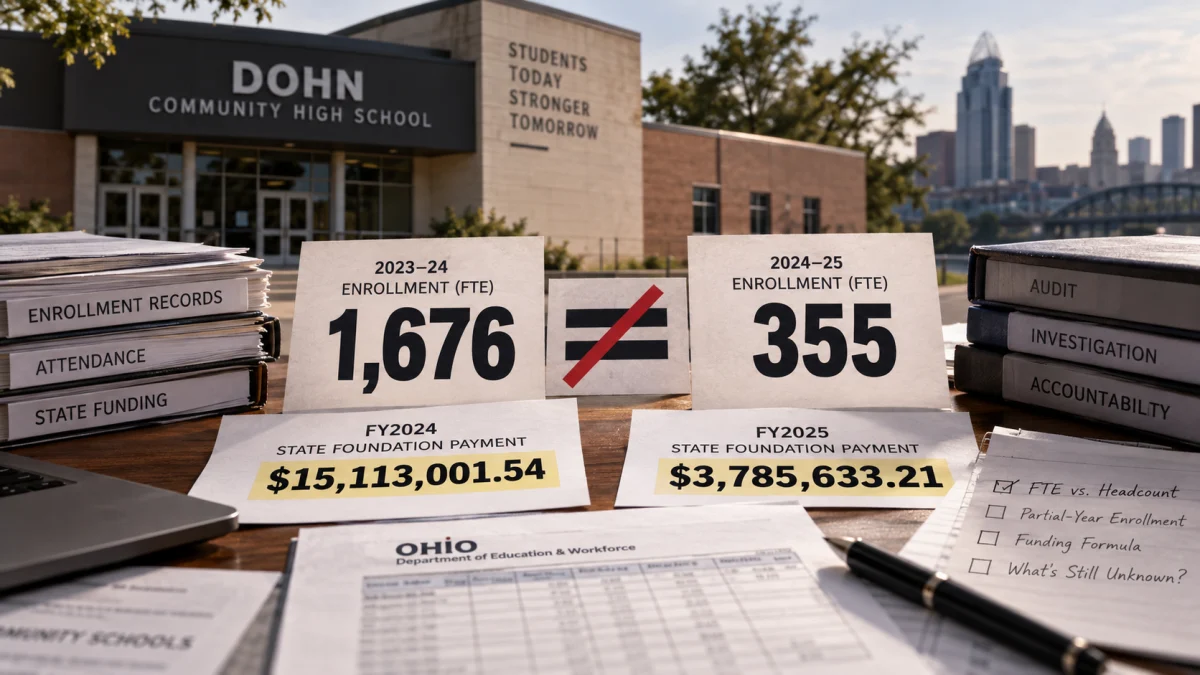
No public record reviewed so far establishes the amount Dohn Community High School received because of allegedly inflated enrollment.
What can be established is unusually large.
Ohio’s final community-school payment records show Dohn at $15,113,001.54 for fiscal year 2024 and $3,785,633.21 for fiscal year 2025. That is a decline of $11,327,368.33, or 75.0%. Separately, Ohio enrollment data cited by WVXU show Dohn’s annual enrollment figure falling from 1,676 in 2023–24 to 355 in 2024–25, a decline of 1,321, or 78.8%.
But neither subtraction is a fraud calculation.
Dohn permanently closed and ceased operations on March 31, 2025, so FY2025 was not a full operating year. And Ohio’s published methodology for its community-school enrollment-history series says that, beginning in 2016–17, enrollment in that table is reported as student full-time equivalency from payments, not simply as a one-day count of individual students. (Ohio Auditor)
The strongest defensible conclusion is therefore:
Dohn’s public funding and payment-derived enrollment measure collapsed after 2024, and a federal indictment now alleges that former operator Leondo Ramone Davenport overstated full-time enrollment to increase school revenue. But the state has not publicly released the corrected student-level FTE or recovery calculation needed to determine the actual enrollment-related overpayment.
The $11.33 million drop is real—but it is not the alleged fraud loss
The Ohio Department of Education and Workforce’s FY2024 Final #2 report lists Dohn Community at $15,113,001.54. The FY2025 Final #2 report places Dohn among closed community schools and lists $3,785,633.21.
| Ohio record | FY2024 | FY2025 | Change |
|---|---|---|---|
| Annual enrollment-history figure | 1,676 | 355 | −1,321, or −78.8% |
| Final state foundation payment | $15,113,001.54 | $3,785,633.21 | −$11,327,368.33, or −75.0% |
The table shows the scale of the change. It does not show what caused every dollar of it.
FY2025 differs from FY2024 in at least two obvious ways: Dohn had far fewer reported FTE and it stopped operating on March 31 rather than remaining open through the full school year. Those factors make the $11.33 million decline useful context, but an invalid substitute for a formal overpayment calculation. (Ohio Auditor)
What exactly are Davenport and Ballew accused of?
On September 3, 2026, a federal grand jury indicted former Dohn superintendent and operator Leondo Ramone Davenport and contractor Jonathan Larry Ballew.
The Justice Department says the eight-count indictment alleges that, from 2021 through 2024, Ballew submitted false or fraudulent invoices through companies he controlled, Davenport authorized Dohn to pay them, and Ballew returned part of the proceeds to Davenport. Prosecutors allege that more than $8 million went from Dohn to Ballew and more than $4 million flowed back to Davenport. The defendants are charged with wire fraud and engaging in monetary transactions in property derived from unlawful activity. Both are presumed innocent unless proven guilty. (Department of Justice)
The enrollment allegation is related but distinct.
WCPO, reporting directly from the indictment, says it also alleges that Davenport overstated the number of full-time students enrolled at Dohn to increase the school’s revenue and further the scheme. WVXU likewise reports that prosecutors allege enrollment was inflated to pull in additional state and federal revenue. (WCPO 9 Cincinnati)
That creates three numbers that should not be merged:
More than $8 million: alleged payments to Ballew-controlled entities.
More than $4 million: alleged money returned to Davenport-controlled entities.
Enrollment-related overpayment: not publicly quantified.
Calling the $8 million figure an enrollment-fraud amount would be inaccurate.
Does 1,676 versus 355 mean Dohn had 1,321 fake students?
No. Nothing currently public establishes that.
WVXU found the 1,676 and 355 figures in Ohio Department of Education and Workforce data. But Ohio’s published notes for its Community School Enrollment History table explain that, starting with 2016–17, the enrollment series is reported as student full-time equivalency from payments. The Department also says community-school funding is calculated using FTE reported through its enrollment system. (WVXU)
Ohio law during the years at issue further required the Department to adjust payments for students enrolled for less than a full school year. A student’s percentage of FTE was based on the share of the school’s annual learning opportunities attributable to that student’s enrollment. (Ohio Laws)
That matters because FTE is not the same thing as unique headcount.
A student enrolled for only part of a year can contribute less than 1.0 FTE. A highly transient school can therefore serve more individual people over the course of a year than its annual FTE total suggests.
So:
1,676 − 355 = 1,321 fewer annual enrollment/FTE units.
It does not equal:
1,321 proven fictitious students.
That distinction does not disprove prosecutors’ allegation. It simply prevents a number derived from two aggregate reports from being mistaken for a student-by-student fraud finding.
Why did Dohn reportedly have around 600 students near closure if the annual figure was 355?
Because the numbers are measuring different things—and were reported at different times.
In February 2025, Dohn management told WCPO the school was serving roughly 550 to 600 students. When Dohn announced its abrupt March closure, WLWT reported enrollment of about 650. WCPO subsequently described nearly 600 students needing to find new schools. (WCPO 9 Cincinnati)
The state’s 355 figure, by contrast, comes from the annual community-school enrollment-history series whose published methodology uses payment-derived FTE.
Dohn also stopped operating on March 31.
Those facts make it entirely possible for a school to have roughly 600 people enrolled shortly before closing while ending the year with a substantially lower aggregate FTE measure. The early closure can explain part of that difference because Ohio adjusts FTE for less-than-full-year enrollment. Student entry and withdrawal dates can create additional differences. (Ohio Laws)
What the aggregate records cannot tell us is exactly how much each factor contributed.
That requires the student-level data.
A separate court filing raises a more serious 1,600-versus-600 question
There is stronger evidence of a possible enrollment problem than the simple 1,676-to-355 comparison.
The Cincinnati Enquirer reported, citing court filings arising after Davenport’s removal, that Dohn officials had expected its financial position to be supported by high enrollment and that the school was receiving state funding for a student population of approximately 1,600. According to those filings, officials later learned Dohn had only about 600 students enrolled, and Davenport was accused of having “misrepresented” the enrollment numbers. (AOL.com)
That is significant.
It is also still an allegation contained in court filings, not a completed Ohio FTE review establishing that approximately 1,000 students were fictitious.
Several questions remain before those two numbers can be converted into a loss figure: Were they measured on the same date? Was one an annualized FTE measure and the other a point-in-time headcount? When did particular students enroll or withdraw? What documentation supported their continued enrollment? How much funding was associated with each questioned student?
Those are not technicalities. They determine the answer.
Dohn’s own records show funded enrollment had been climbing
The alleged discrepancy also sits against a longer growth trend.
In management’s discussion included with Dohn’s FY2022 financial report, the school said its “funding level” enrollment increased from 1,080 in FY2021 to 1,479 in FY2022. The same section said foundation payments rose from $8.73 million to $12.87 million and attributed part of that increase to enrollment.
The next year’s management discussion said Dohn reached 1,610 funded students in FY2023, and that its November 2023 FY2024 count had risen to 1,670 FTE. It stated that the enrollment increase helped raise foundation payments.
There is an important source-quality caveat: those enrollment narratives appear in management’s discussion and analysis, which the reports explicitly label “Unaudited.” The FY2023 financial statements themselves report $15.75 million in foundation revenue, but the narrative enrollment explanations were representations by school management rather than independent audit findings about the legitimacy of every student record.
That makes the earlier numbers relevant historical evidence, but not proof that the growth was genuine—or fraudulent.
Why can’t we calculate the loss from an average dollars-per-student figure?
Because Ohio community-school funding is not a single flat payment attached to every name on an enrollment list.
During the relevant period, Ohio law required the Department to adjust payments for students enrolled for less than a full year and separately report characteristics including special-education status, career-technical participation, English-learner status and economic disadvantage. Those variables can affect funding calculations. (Ohio Laws)
As a result, even after investigators identify unsupported FTE, the correct loss is not necessarily:
unsupported FTE × one average dollar amount.
The defensible calculation requires identifying the affected students and periods, correcting the underlying FTE and then recalculating the funding components associated with those records.
Anything else risks manufacturing a precise number from incomplete data.
Dohn’s 22+ adult program does not simply explain the regular enrollment figure
Dohn also operated an adult dropout-recovery program for people age 22 and older.
That program matters because it could otherwise appear to explain why Dohn’s overall activity was much larger than its traditional high-school population.
But Ohio law treated those adults as a separate reporting and funding stream during the years at issue.
The version of Ohio Revised Code §3314.38 effective in October 2023 required an eligible adult’s enrollment to be reported on an FTE basis in addition to the school’s regular enrollment report. The Department separately certified adult enrollment and attendance and could pay up to $5,000 per participant per year, based on completion of graduation requirements. (Ohio Laws)
The 22+ program therefore cannot simply be added to—or used to explain away—the ordinary community-school FTE numbers.
Ohio replaced that statutory scheme effective July 1, 2026, but the older version governs the years being examined here.
Can the alleged federal overpayment be calculated?
Not from the 1,676 and 355 figures.
WVXU reports that the enrollment allegation involved obtaining additional state and federal revenue. But federal education grants use their own allocation rules.
Ohio’s own community-school reporting notes explain that federal Title allocations are based in part on federal census formulas and are designed around specific eligible populations. They are not simply the school’s current annual FTE multiplied by one federal per-student rate. (WVXU)
A defensible federal-loss figure would therefore require identifying the specific federal programs affected, the data used to determine Dohn’s allocations, any corrected counts, how much Dohn actually drew or spent, and whether money was subsequently returned.
No such enrollment-related federal-loss figure has been made public in the records reviewed for this article.
Ohio has a process that can produce the number we actually need
Ohio law provides for enrollment reviews of community schools.
Under the version of Ohio Revised Code §3314.08 in effect during FY2024, the Department could review a community school’s enrollment and issue written findings. If the review determined that the school owed money to the state, the statute provided an appeal process and ultimately allowed the Department to deduct the amount from school payments. (Ohio Laws)
Community-school contracts were also required to contain an attendance policy automatically withdrawing a student who, without a legitimate excuse, failed to participate in 72 consecutive hours of offered learning opportunities. (Ohio Laws)
Those rules show why the missing evidence is student-level rather than merely aggregate.
To determine Dohn’s actual enrollment overpayment, investigators would need to reconstruct the chain from:
student identity and eligibility → enrollment and withdrawal dates → required supporting documentation → valid FTE → applicable funding → amount actually paid.
Once that work is complete, the question becomes calculable.
Has Ohio published a Dohn enrollment repayment figure?
Not that sherafy.com could locate as of September 4, 2026.
The latest Dohn financial audit posted by the Ohio Auditor of State covers FY2023. The Auditor’s accompanying review states explicitly that an investigation was still ongoing and that results could be reported later.
The Justice Department’s September 3 announcement also quotes Ohio Auditor Keith Faber saying his office’s investigation continues. (Department of Justice)
The records reviewed for this article did not reveal a publicly released FY2024 or FY2025 Dohn enrollment-review finding, corrected student-level FTE total, or final state recovery amount attributable specifically to inflated enrollment.
That is the record that would turn the current evidence from “large discrepancy” into “quantified loss.”
What is established, alleged and still unknown?
| Established by records | Alleged or reported from court filings | Not yet established publicly |
|---|---|---|
| Ohio’s annual enrollment-history figure fell from 1,676 to 355 | Davenport overstated full-time enrollment to increase Dohn’s revenue | Number of unsupported or fictitious students |
| Final state payments fell from $15.113 million to $3.786 million | Separate filings say Dohn was funded around 1,600 when officials later found roughly 600 enrolled | Corrected FY2024 FTE |
| Dohn ceased operations March 31, 2025 | More than $8 million allegedly went to Ballew-controlled entities | State overpayment caused specifically by inflated enrollment |
| The 22+ adult program was separately reported and funded | More than $4 million was allegedly returned to Davenport-controlled entities | Federal overpayment caused specifically by enrollment |
| Ohio’s Auditor investigation remains ongoing | The indictment remains unproven | Whether any particular portion of the $11.33 million payment decline represents fraud |
That last column is the important one.
The evidence is strong enough to establish a major discrepancy and strong enough for prosecutors to allege intentional enrollment inflation. It is not strong enough yet to attach an exact taxpayer-loss figure to that allegation.
Did Dohn have 1,321 fake students?
That has not been established.
The 1,321 number is the mathematical difference between two annual Ohio enrollment-history values. Ohio’s published methodology describes that series as payment-derived FTE, not a literal count of unique students present on a particular day.
Did Dohn get $11.33 million from fake enrollment?
No public finding says that.
The $11.33 million figure is the decline between Dohn’s FY2024 and FY2025 final state foundation payments. FY2025 was also a shortened operating year because Dohn closed March 31.
It should be reported as a funding decline, not an overpayment or fraud loss.
How many students did Dohn actually have?
There is no single public number that answers every version of that question.
Ohio’s annual enrollment-history series shows 1,676 for 2023–24 and 355 for 2024–25. Near the school’s closure, Dohn leadership and local reporting placed the actual point-in-time population around 550 to 650 students. Those figures can differ because they measure enrollment differently and at different times. (WVXU)
More importantly, separate court filings reportedly say officials discovered roughly 600 enrolled students after Dohn had been receiving state funding based on a population around 1,600. Whether that discrepancy represents improper FTE—and how much money it affected—remains unresolved. (AOL.com)
Did the alleged enrollment inflation cause Dohn to close?
That has not been established either.
Dohn officials cited “insurmountable financial challenges” when announcing the March 31 closure. The school was also under an Ohio Auditor investigation, and the federal indictment now alleges a separate multimillion-dollar invoice-and-kickback scheme. (WLWT)
Enrollment may prove to be an important part of Dohn’s financial collapse. But the public evidence does not justify reducing the closure to a single cause.
The bottom line
The dramatic numbers are real:
1,676 to 355 in Ohio’s annual enrollment-history series.
$15.11 million to $3.79 million in final state foundation payments.
$11.33 million less state funding year over year.
And federal prosecutors’ charging document, according to reporting from the indictment, alleges that Davenport deliberately overstated full-time enrollment to increase Dohn’s revenue. (WCPO 9 Cincinnati)
But the simplest viral interpretation—1,321 fake students produced $11.33 million in improper funding—is not supported by the evidence.
The FY2025 school year was shortened by Dohn’s March 31 closure. Ohio’s annual enrollment series uses an FTE/payment methodology rather than simple headcount. And no publicly released enrollment review has yet identified which student records were unsupported and recalculated what Ohio should actually have paid.
The size of the funding collapse is known. The amount attributable to allegedly inflated enrollment is not.
That is the number to watch next.
References and Further Reading
Primary and authoritative records
U.S. Department of Justice — Grand jury indicts former community school superintendent, business partner in $8 million fraud scheme — Primary federal announcement of the September 3, 2026 indictment, alleged $8 million in payments, alleged $4 million in kickbacks, charges and presumption of innocence.
Ohio Department of Education and Workforce — FY2024 Community School Final #2 Payments — Official state payment report listing Dohn’s FY2024 Final #2 amount at $15,113,001.54.
Ohio Department of Education and Workforce — FY2025 Community School Final #2 Payments — Official report listing Dohn among closed community schools with an FY2025 Final #2 amount of $3,785,633.21.
Ohio Department of Education and Workforce — Annual Reports on Ohio Community Schools — State hub for current and historical enrollment, foundation-funding and federal-funding tables.
Ohio Department of Education — Community School Supplemental Table and Data Notes — Explains that the enrollment-history series has used student full-time equivalency from payments since 2016–17 and describes the relationship between FTE and community-school funding.
Ohio Revised Code §3314.08 — 2023 version governing community-school enrollment and FTE — Governing law during the period at issue, including partial-year enrollment adjustments, FTE calculation and the enrollment-review/recovery procedure.
Ohio Revised Code §3314.03 — 2023 version governing community-school contracts and attendance — Includes the requirement for an attendance policy automatically withdrawing students after 72 consecutive hours of unexcused nonparticipation.
Ohio Revised Code §3314.38 — 2023 version governing the 22+ dropout-recovery program — Shows that adult participants were reported separately from regular enrollment and funded under a distinct system.
Ohio Auditor of State — Dohn Community High School FY2023 Financial Audit — Includes Dohn’s FY2023 financial statements, management-reported FTE information, the March 31, 2025 closure and the Auditor’s statement that its investigation remained ongoing.
Ohio Auditor of State — Dohn Community High School FY2022 Financial Audit — Provides historical financial information and management’s unaudited discussion of the rise in funding-level enrollment.
Reporting on the indictment and enrollment discrepancy
WCPO — Former Dohn Community High School superintendent, contractor charged in federal fraud scheme — Reports directly from the indictment that Davenport allegedly overstated full-time enrollment to increase school revenue and details the federal counts.
WVXU — Former Cincinnati charter school superintendent arrested by the FBI for alleged fraud scheme — Identifies the 1,676 and 355 Ohio enrollment figures and reports the alleged state-and-federal revenue motive.
Cincinnati Enquirer via AOL — Former Dohn charter school superintendent, associate federally indicted — Reports earlier court filings stating that Dohn was receiving state funding based on approximately 1,600 students before officials later found roughly 600 enrolled.
Closure and point-in-time enrollment
WCPO — Dohn Community High School closing, selling the building — February 2025 reporting in which school leadership estimated the population at roughly 550 to 600 students.
WLWT — Dohn Community High School announces March 31 closure, citing finances — Contemporary report confirming the accelerated March 31 closure, the school’s stated financial reason and an enrollment estimate of about 650.
Editorial currency note: This article reflects records and reporting available through September 4, 2026. Davenport and Ballew have been indicted, not convicted. The federal case and Ohio Auditor investigation remain active. A later Ohio enrollment-review finding, corrected FTE calculation, recovery demand, plea, verdict or sentencing loss calculation could materially change the answer.