Italy is not experiencing a spontaneous nationwide revolt in which everyone has stopped working, shopping or paying taxes.
What is actually happening may be more consequential.
Over the past year, Italian workers, unions, students and activists have repeatedly used general strikes and deliberate economic disruption—including stopped trains, obstructed ports, blocked highways and shuttered public services—as a form of political pressure.
The slogan that came to define this strategy is “Blocchiamo tutto”: “Block everything.”
It became nationally visible during massive Gaza solidarity mobilizations in September and October 2025. But organizers did not leave the tactic there. Within weeks, unions were explicitly calling for the same method to be used against the Meloni government’s budget, declining purchasing power, pressure on pensions and public services, and increased military spending.
By May 2026, the union most closely associated with the slogan was again calling a national general strike while simultaneously invoking Gaza, rearmament, the cost of living and workers’ economic power.
The important story, then, is not that Italy has somehow stopped functioning.
It is that economic participation itself is increasingly being treated as a political weapon.
And Italy provides an unusually clear case study of what happens when protesters decide that marching through the streets is not enough.
What does “Blocchiamo tutto” mean?
Blocchiamo tutto literally means “let’s block everything” or “we block everything.”
It is more than a protest slogan.
The strategy combines conventional demonstrations with the withdrawal of labor and disruption of the infrastructure that keeps economic life moving.
That can mean railway workers striking.
Dockworkers restricting access to ports.
Public-sector workers staying off the job.
Students occupying universities.
Demonstrators entering highways.
Transit workers stopping services.
Or workers at economically important chokepoints making it difficult for commerce to continue normally.
That distinction matters.
A government can often tolerate a demonstration that fills a square for an afternoon. A strike that interrupts transportation, freight, schools, government services or industrial production creates a different kind of pressure because it imposes an economic cost.
The underlying logic is straightforward:
Political institutions have formal authority. Workers have leverage because those institutions and the economy still depend on people showing up and doing the work.
That principle predates the current Italian protests by generations. What is notable is how visibly it has re-entered Italian political organizing.
September 22, 2025: “Block Everything” becomes a national event
The slogan burst into national attention during the September 22, 2025 general strike, called by grassroots unions in solidarity with Palestinians in Gaza and the Global Sumud Flotilla.
USB promoted the mobilization under the slogan “Blocchiamo tutto con la Palestina nel cuore”—roughly, “Block everything, with Palestine in our hearts.”
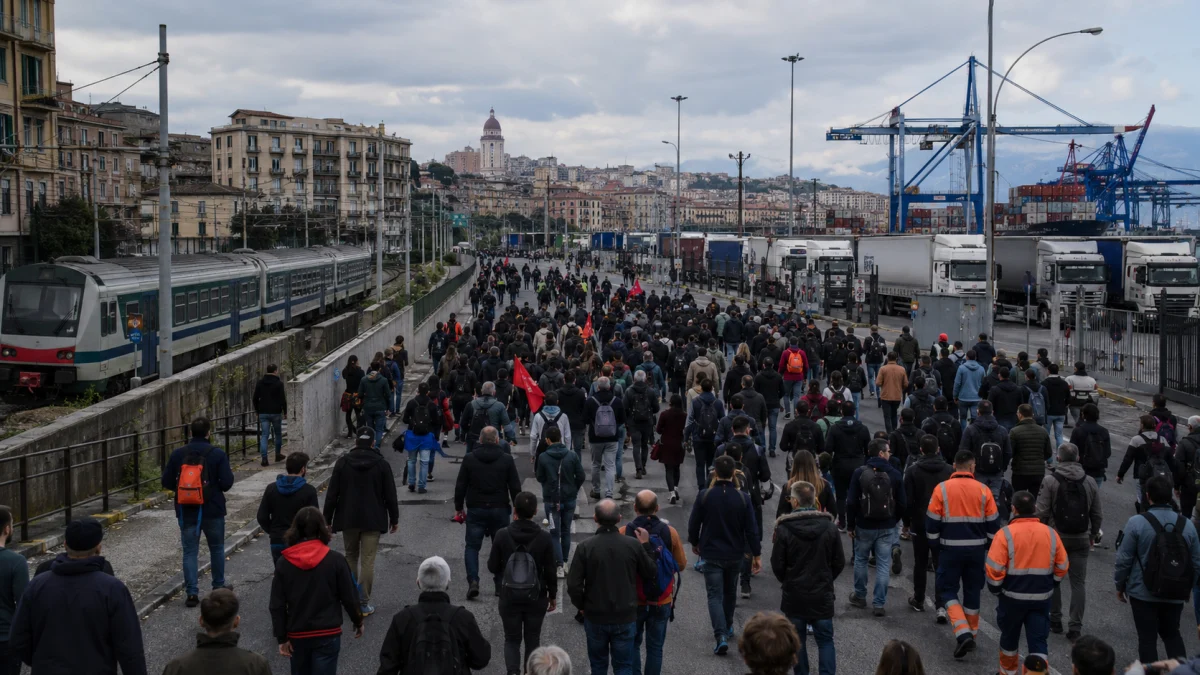
The strike affected railways, local transportation, schools, public services and ports. ANSA reported restricted access at the ports of Genoa and Livorno, cancelled and delayed regional trains in Rome, the closure of Milan’s M4 metro line and disruptions elsewhere around the country. Protesters also blocked highways near Bologna and Pisa, while ports at Genoa, Livorno and Marghera were affected.
Reuters photographs from Genoa independently documented dockworkers participating in the nationwide “Let’s Block Everything” strike and a road near the port being physically blocked.
This was no longer simply a crowd assembled in front of government buildings.
The infrastructure itself had become part of the protest.
October 3 showed how disruptive the strategy could become
Less than two weeks later, the interception of the Global Sumud Flotilla triggered another national general strike.
This time CGIL, Italy’s largest labor confederation, joined USB and other unions.
The October 3 mobilization involved marches in scores of cities alongside serious transportation and infrastructure disruptions.
The A14 motorway was closed near Bologna. Protesters entered the runway area at Pisa airport. Ports at Livorno and Naples were blocked. High-speed and regional rail services suffered delays and cancellations.
The size of the demonstrations became politically contested.
CGIL said more than 2 million people participated in more than 100 demonstrations and estimated average participation in the general strike at roughly 60%.
Italy’s Interior Ministry reported 396,400 participants across 29 demonstrations it counted.
Those figures should not be blended together as though they are measuring precisely the same universe of events. The union’s nationwide estimate was dramatically higher than the government’s count of 29 demonstrations.
The responsible conclusion is narrower:
The October 3 protests were enormous, but there is no single independently established national crowd total.
The physical disruption is much less ambiguous.
Ports, roads, airports and trains were affected across Italy.
And that demonstrated why Blocchiamo tutto was fundamentally different from a slogan encouraging people merely to attend a rally.
Was the October strike legal?
Italy’s Constitution explicitly recognizes the right to strike, stating in Article 40 that it is exercised within the laws regulating it.
That does not make every strike automatically lawful under every circumstance.
Italy places additional requirements on strikes affecting essential public services, including notice requirements and guaranteed minimum services.
That became a major controversy on October 3 because the strike had been announced on extremely short notice following the Flotilla interception.
Italy’s Commission for the Guarantee of Strikes concluded that the general strike violated the statutory notice requirement. The unions disagreed, arguing that Italian law contains an exception allowing immediate strikes in defense of the constitutional order or following serious events threatening workers’ safety.
The dispute did not stop the strike.
The commission subsequently opened proceedings against CGIL, USB, CUB, SGB and several other unions over the lack of notice.
That fight is important because Blocchiamo tutto raises an unavoidable question:
How far can economic disruption go before the state intervenes to protect essential services and the rights of everyone else?
That tension is built into the strategy.
Then something important changed
If the story ended in October, Blocchiamo tutto could reasonably be described as a Gaza solidarity campaign.
It didn’t.
By November, organizers were explicitly talking about applying the same method to Italy’s domestic economy.
On November 28, 2025, USB, Cobas, SGB, CUB and other grassroots unions called another general strike, this time targeting the government’s budget and economic policies.
Their demands included major investment in healthcare, schools, universities and transportation; stabilization of precarious workers; wage increases sufficient to recover lost purchasing power; stronger pensions; and sharp reductions in military spending.
USB made the strategic connection explicit.
In announcing the mobilization, the union called for a return to the “practice of Blocchiamo tutto” that had been used during the Palestinian and Flotilla mobilizations—now as part of its campaign against rearmament and for housing, healthcare, wages and pensions.
That matters.
We do not have to infer that organizers saw Blocchiamo tutto as a reusable political tactic.
They said so themselves.
The causes also did not become cleanly separated. Gaza remained part of the organizing. What changed was the breadth of the argument.
The same mechanism of labor withdrawal and disruption was now being connected to what Italy should spend money on, who should bear the cost of economic pressure and whether workers should accept declining purchasing power while the government commits more resources to defense.
It wasn’t just one activist union
There is another reason not to dismiss the story as a campaign by one radical labor organization.
Two weeks later, on December 12, CGIL held its own national strike against the Meloni government’s proposed 2026 budget.
The organizations were not operating as one unified movement, and we should not pretend otherwise.
But their grievances overlapped substantially.
CGIL demanded greater investment in healthcare, education, affordable housing and workplace safety while focusing heavily on Italy’s low wages. The strike disrupted transportation, healthcare and education around the country.
That tells us something important about the political environment.
Blocchiamo tutto belongs most directly to particular grassroots unions and movements.
But the underlying economic dissatisfaction reaches far beyond them.
Italian workers have a real wage problem
The economic backdrop is where the story becomes much harder to dismiss as ideological theater.
According to the OECD’s 2026 Employment Outlook, Italian real wages increased 1.3% in the first quarter of 2026 compared with a year earlier.
That sounds encouraging until the comparison is widened.
Real wages were still 6.1% below their first-quarter 2021 level.
Among the large OECD economies, Italy had the biggest remaining gap.
And the OECD expects another setback.
Its July forecast projected Italian real wages to fall 0.9% during 2026, followed by growth of only 0.2% in 2027.
This creates an important distinction that gets lost in political arguments about whether Italy’s economy is “doing well.”
A country can have relatively strong employment numbers while its workers remain angry because the money their jobs pay buys less than it did several years ago.
That is not a contradiction.
It is one reason employment statistics alone do not explain political dissatisfaction.
Inflation has returned—but energy is doing disproportionate damage
Italy’s July 2026 consumer-price data adds another layer.
ISTAT reported annual headline inflation of 2.9%.
Core inflation, excluding energy and fresh food, remained substantially lower at 1.6%.
But energy prices were moving very differently.
Regulated energy prices were 14.8% higher than a year earlier, while non-regulated energy prices were up 11.4%.
That distinction matters.
It would be misleading to say Italian prices generally are suddenly rising by double digits.
They are not.
But households can still feel significant pressure when categories such as energy rise dramatically faster than overall inflation.
That helps explain why the cost of living continues to appear beside wages, pensions and rearmament in union demands.
What about taxes?
This is where some versions of the story circulating online appear to outrun the evidence.
The documented Italian actions involve strikes, demonstrations, port restrictions, transportation disruption, occupations and blockades.
The strike proclamations and government records reviewed for this article do not establish a coordinated national campaign in which Italians are collectively refusing to pay their taxes.
Italy’s aggregate fiscal burden is certainly high.
A 2026 Italian Senate review of government fiscal projections put the country’s overall tax-and-social-contribution burden at 42.9% of GDP in 2026, with a projected increase to 43.2% in 2027.
That number should not be confused with an individual’s tax rate. It is an economy-wide measure of compulsory tax and contribution revenues relative to GDP.
There has also been a separate legal fight over tax resistance.
In April 2026, Italy’s Court of Cassation rejected an individual taxpayer’s attempt to withhold or redirect part of his IRPEF liability on conscientious-objection grounds related to military spending and other state policies. The court held that an individual taxpayer does not get to determine how general tax revenue is allocated.
That case is interesting.
It is not evidence of a mass Blocchiamo tutto tax strike.
The real Italian movement does not need that embellishment.
Workers deliberately withdrawing their labor and interfering with economic chokepoints is significant on its own.
Military spending is part of the argument—but the numbers need context
One of the most politically potent claims from the unions is that Italy is prioritizing military expenditure while workers struggle with wages, housing and public services.
There is a real policy change behind that argument.
At NATO’s 2025 Hague summit, Italy and the other allies committed to a new investment target equivalent to 5% of GDP annually by 2035.
But that number is frequently described imprecisely.
The commitment calls for at least 3.5% of GDP for core defense requirements and up to another 1.5% for broader defense- and security-related spending, including areas such as critical infrastructure, civil preparedness, resilience and defense industry investment.
Italy is not currently spending 5% of GDP directly on its military.
The unions’ argument is political rather than mathematical: they contend that a long-term commitment to substantially higher defense-related expenditure will compete with demands for wages, hospitals, schools, pensions and housing.
USB summarized that position in its November strike campaign by arguing that money going toward weapons should instead go toward social priorities.
Whether every additional euro of defense expenditure would otherwise have been spent on those programs is a separate budgetary question.
But the political conflict itself is real.
Workers are being asked to accept one set of national priorities while unions are demanding another.
“Blocchiamo tutto” returned in 2026
This was not a slogan that vanished with the 2025 Gaza demonstrations.
Italy’s national social-security agency, INPS, confirms that USB called another nationwide general strike for May 18, 2026, covering the full day.
USB’s own announcement makes the continuity unmistakable.
The union explicitly referred back to September 22, 2025 and said workers would “block everything again.”
The May campaign once again combined support for the Flotilla and Palestinians with opposition to war and rearmament, complaints about the cost of living and an argument about workers’ role as the people who produce economic wealth.
The formal strike proclamation also cited energy-price increases, wages and pensions failing to keep pace with living costs, money being directed toward rearmament, and demands for spending on healthcare, schools, housing and other services.
That is the clearest evidence of what Blocchiamo tutto has become.
It is not merely a Gaza slogan that transformed into an unrelated domestic movement.
It is a framework linking foreign policy, military spending and household economics through the political power of workers withholding their labor.
Another nationwide general strike followed on May 29, called by CUB, USI-CIT, SGB, SI COBAS and other unions, according to INPS.
These groups do not constitute one centralized movement. Italy’s labor landscape is fragmented, and different unions call strikes for different reasons.
But repeated nationwide work stoppages are now part of the country’s political landscape.
Then Italy’s soldiers and police marched too
One of the more extraordinary demonstrations of 2026 involved people normally identified with the machinery of the state itself.
On July 18, around 6,000 members of Italy’s Army, Navy, Air Force, Carabinieri and Guardia di Finanza participated in a demonstration in Rome organized by defense and security unions.
They demanded better wages, pensions and worker protections.
It was described as the first unified mobilization involving those branches.
This needs to be kept separate from Blocchiamo tutto.
The organizers explicitly characterized their demonstration as nonpartisan and not a strike.
They were not joining a national rebellion against Meloni.
But the event still matters.
When dockworkers, public employees and even members of defense and security institutions are all independently raising complaints about purchasing power, pensions and compensation, the economic dissatisfaction is clearly broader than one activist constituency.
Is Italy turning against Giorgia Meloni?
Not in the simple way that viral posts sometimes suggest.
Prime Minister Giorgia Meloni remains politically formidable.
A YouTrend poll reported by Reuters in July placed her Brothers of Italy party at 26.4%, still making it the country’s largest individual party.
But underneath that headline, there is a significant generational warning for her government.
Reuters reported on August 13 that Meloni’s governing coalition now receives less than 30% support among voters under 35, while the main opposition bloc attracts almost 50% in that age group.
Government approval among under-35s stood at just 25%, compared with 35% among the population overall.
Reuters also reported that Italy has the eurozone’s lowest employment rate among 15-to-24-year-olds and cited Bank of Italy data showing that a young graduate in Germany earns, on average, roughly 80% more than an Italian counterpart.
Those numbers help explain why younger Italians may experience their country’s political economy differently from older voters.
It would still be wrong to conclude that “Italy has rejected Meloni.”
The country remains politically divided.
A more defensible conclusion is that Meloni faces an increasingly serious youth problem while organized labor is simultaneously challenging her government’s economic and spending priorities from another direction.
Those developments overlap.
They are not the same thing.
Italy has another general strike already scheduled
The pattern has not ended.
As of August 28, Italy’s Ministry of Infrastructure and Transport lists a national general strike for October 30, 2026, called by USI-CIT for public- and private-sector employees.
The aviation, railway, local public transit and maritime sectors are excluded from that particular action.
It would be misleading to call that automatically another Blocchiamo tutto strike.
It is being organized by a different union and has different parameters.
But its presence on the official strike calendar is further evidence that nationwide work stoppages remain a recurring feature of Italian labor politics heading into the country’s 2027 election year.
What Italy is actually demonstrating
There is a temptation to romanticize what is happening.
The evidence does not show that Italian citizens have collectively withdrawn from the economy.
It does not show that everyone stopped going to work.
It does not show a nationwide refusal to pay taxes.
And it does not show that Blocchiamo tutto has already forced the Meloni government to reverse its central policies.
Those limitations matter.
But stripping away the exaggeration leaves something genuinely significant.
Workers have repeatedly demonstrated that they can disrupt the systems on which ordinary economic life depends.
Ports do not move goods by themselves.
Trains do not run themselves.
Schools, hospitals, government offices, warehouses, factories and transportation systems are institutions—but they function because human beings operate them.
That gives ordinary workers a form of leverage that elections and street demonstrations do not provide on their own.
The Italian movement’s most consequential idea is therefore also its simplest:
What happens if enough people stop cooperating with business as usual?
For Blocchiamo tutto, the answer so far is that ports can slow, trains can stop, highways can close and political leaders can be forced to respond.
What has not yet been demonstrated is whether that disruption can force durable changes in national policy.
That is the next part of the Italian experiment.
And it is the part worth watching.
Timeline: How “Blocchiamo tutto” developed
| Date | What happened | Why it matters |
|---|---|---|
| Sept. 22, 2025 | Nationwide general strike supporting Gaza and the Global Sumud Flotilla; trains, ports, schools and transit affected | “Blocchiamo tutto” becomes a nationally visible strategy |
| Oct. 3, 2025 | Another general strike after the Flotilla interception; ports, roads, trains and Pisa airport affected | Demonstrates the scale of disruption coordinated labor action can create |
| Nov. 28, 2025 | Base unions strike against the Meloni government’s budget, wages, public-service policy and military spending | USB explicitly calls for reusing the “Blocchiamo tutto” method |
| Dec. 12, 2025 | CGIL holds separate nationwide budget strike | Shows similar economic grievances extend beyond USB |
| May 18, 2026 | USB holds another national general strike | Union explicitly says it will “block everything again,” linking Gaza, rearmament and cost of living |
| May 29, 2026 | Multiple grassroots unions call another general strike | Shows continued national labor mobilization |
| July 18, 2026 | Roughly 6,000 military and security personnel demonstrate in Rome | Separate movement, but notable evidence of wider purchasing-power complaints |
| Oct. 30, 2026 | National USI-CIT general strike scheduled | Shows national strike politics continuing into late 2026 |
The bottom line
If you saw a viral post claiming Italians became so fed up with their government that they simply stopped working and paying taxes, that is not an accurate description of the evidence.
But dismissing the story on that basis would miss what is actually happening.
Italy has experienced a repeated campaign of organized economic non-cooperation in which workers deliberately withdraw their labor and protesters target transportation and commercial chokepoints.
The phrase Blocchiamo tutto emerged prominently from the Gaza solidarity movement.
Then organizers explicitly carried the method into fights over the Italian budget, wages, pensions, public services, military spending and the cost of living.
The country has not “shut down.”
But a growing part of Italian political activism is testing a much older proposition:
When voting and protesting feel insufficient, workers can exercise political power by withholding the labor that keeps the system running.
Whether that ultimately changes Italian policy remains an open question.
The fact that Italians are repeatedly willing to test it is not.
References and Further Reading
Primary and official sources
OECD Employment Outlook 2026: Italy — OECD assessment of Italian employment, real-wage losses and 2026–2027 wage projections.
ISTAT — Consumer Prices, July 2026 — Official Italian inflation data, including headline, core and energy-price changes.
Italian Senate — Article 40 of the Constitution — Constitutional basis for Italy’s right to strike.
Italian Senate — 2026 Fiscal Projections — Government fiscal projections, including Italy’s aggregate tax-and-contribution burden.
INPS — National General Strike, May 18, 2026 — Official confirmation of USB’s nationwide strike.
INPS — National General Strike, May 29, 2026 — Official confirmation of the later multi-union general strike.
Italian Transport Ministry — National Strike Calendar — Official database documenting planned and proclaimed transportation and general strikes.
NATO — Deterrence and Defence — Official explanation of the 2035 5%-of-GDP commitment and its 3.5%/1.5% components.
Union primary sources
USB — November 2025 Call to Revive “Blocchiamo tutto” — Primary evidence that USB explicitly sought to reuse the strategy in its campaign against the budget and rearmament.
USB — General Strike, May 18, 2026 — Primary-source explanation connecting the 2026 strike to the earlier “Blocchiamo tutto” campaign, Gaza, rearmament and cost-of-living concerns.
Reporting and independent verification
ANSA — “Blocchiamo tutto,” Italy Stops for Gaza, September 22, 2025 — Contemporary reporting on the first major nationwide “Blocchiamo tutto” mobilization.
ANSA — October 3 General Strike and Demonstrations — Details on the October strike, disruption and competing participation estimates.
ANSA — November 28 Strike Against the 2026 Budget — Reporting on demands involving wages, public services, precarious employment and military spending.
Euronews — Thousands of Italian Military and Police Personnel March Over Pay and Pensions — Coverage of the separate July 2026 defense and security demonstration.
Reuters via Internazionale — Italy’s Meloni Has a Youth Problem as Election Approaches — Current polling and economic context regarding younger Italian voters.
Editorial currency note: Strike schedules, polling, inflation, government budgets and NATO spending plans can change. This article reflects information available through August 28, 2026.