
No evidence we found proves that scientists erased Jeffrey Epstein’s short-term memories. A widely reproduced 2014 email exchange does show Joi Ito asking Epstein about a technology Epstein had apparently told him he had tried, which Ito described as something “where they erase your short term memory.” Epstein responded by identifying transcranial magnetic stimulation, or TMS.
That is evidence that Epstein apparently made the claim. It is not a clinical record showing that his memory was actually erased.
The more significant story is buried underneath that viral headline.
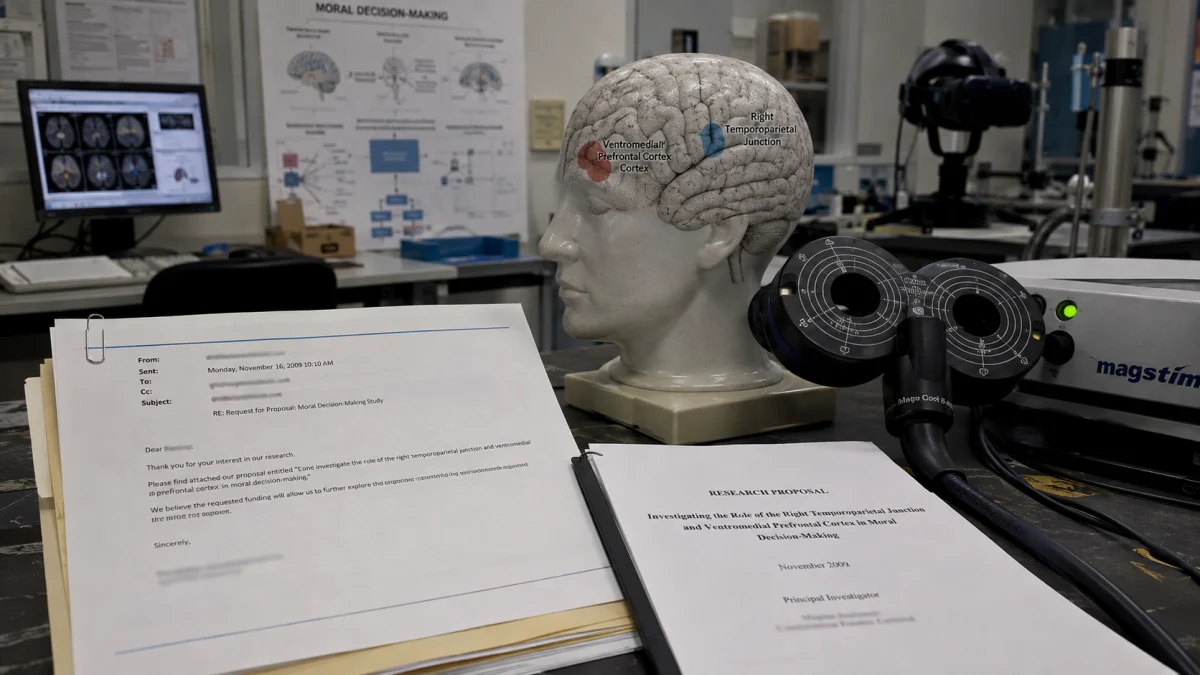
Years earlier, Harvard psychologist Marc Hauser directly asked Epstein whether he would support an ambitious program studying the neural basis of moral judgment. The proposed research involved genetics, people with focal brain lesions, children, animals, imaging, virtual reality and TMS—which Hauser explicitly described to Epstein as allowing “focal suppression of brain function.” Epstein responded by offering to arrange a meeting in Palm Beach.
Then, in 2010, two peer-reviewed moral-cognition studies involving Hauser were published. One examined people with actual damage to the ventromedial prefrontal cortex. The other experimentally used TMS on healthy people to temporarily disrupt activity in the right temporoparietal junction and changed how strongly participants incorporated another person’s intentions into certain moral judgments. Both papers acknowledged Epstein-related support for Hauser.
None of this proves a hidden mind-control program. There is no evidence in the records we reviewed that Epstein used TMS, memory technology or moral-cognition research on victims.
But there is a documented neuroscience paper trail—and it is considerably more substantial than the claim currently circulating on social media.
Reporting credit: This investigation was prompted in part by reporting from neuroscientist and journalist Sheeva Azma of Fancy Comma, whose ongoing Science in the Epstein Files project identified several of the documents and scientific connections examined here. sherafy.com independently traced the underlying records and original scientific literature and reached its own conclusions. Azma says she began systematically investigating science-related material in the Epstein files in February 2026 and has since produced an extensive series on the subject. (Fancy Comma, LLC)
What does the Epstein “memory erasure” email actually say?
The exchange dates to February 2014.
Joi Ito, then director of the MIT Media Lab, asked Epstein about a technology they had apparently discussed previously. In the version of the correspondence reproduced across multiple sources, Ito told Epstein that he had described trying a technology “where they erase your short term memory,” then asked whether the research was published and which laboratory was responsible.
Epstein replied that “trans magnetic stimulation” was the technology and referred generally to work involving trauma and amnesia. Ito then said he would look into it. (LADbible)
That exchange supports three different propositions, and they should not be collapsed into one:
Verified from the correspondence: Ito understood Epstein to have previously said that he had tried such a technology.
Epstein’s own explanation: Epstein identified the technology as transcranial magnetic stimulation.
Not verified: that Epstein actually underwent a procedure that erased memory, that the procedure worked as he described, or even what exact experimental procedure he underwent.
We found no treatment record, physician, laboratory, experimental protocol, before-and-after testing or other independent clinical evidence confirming Epstein’s account.
There is also a provenance problem worth disclosing. Public reproductions of the email have circulated with inconsistent EFTA document numbers. The correspondence itself is strongly corroborated across reproductions, but until the exact original file is resolved in the underlying DOJ archive, sherafy.com is not treating one circulating EFTA identifier as definitively established.
That uncertainty does not invalidate the email. It does mean we should describe what it proves accurately.
Can TMS actually erase a person’s memory?
Not in the way most people understand the word erase.
Transcranial magnetic stimulation uses a coil placed near the scalp to produce rapidly changing magnetic fields. Those fields induce electrical activity in targeted areas of the cerebral cortex. The procedure is noninvasive: surgeons are not opening the skull or physically removing brain tissue. (FDA Access Data)
TMS is a real medical and research technology. The FDA first permitted its marketing for major depression in 2008, expanded its use to certain migraine pain in 2013 and later authorized systems for obsessive-compulsive disorder. (U.S. Food and Drug Administration)
Researchers can also use TMS experimentally to temporarily interfere with or modify particular cognitive processes by stimulating the cortical regions involved.
That is where language such as “virtual lesion” can become misleading outside neuroscience.
A virtual lesion does not mean scientists have burned, cut out or permanently damaged a section of somebody’s brain. It refers to temporarily interfering with the normal contribution of a targeted brain area so researchers can determine what that area does.
Likewise:
temporarily interfering with memory processing is not equivalent to selectively deleting a stored memory.
Modern clinical TMS is not generally considered a memory-loss treatment; major clinical descriptions specifically distinguish it from procedures such as electroconvulsive therapy in this respect. Cleveland Clinic, for example, states that conventional TMS does not cause memory loss or cognitive impairment. (Cleveland Clinic)
So the scientifically responsible answer is:
TMS can influence neural processes involved in memory. The evidence does not establish a technology capable of simply selecting and deleting Epstein’s recent memories on demand.
Four years earlier, Marc Hauser asked Epstein to support research into moral judgment
This is where the story becomes much more concrete.
On September 2, 2009, Marc Hauser, then a Harvard professor of psychology and human evolutionary biology, emailed Epstein about what he called a large-scale project intended to understand the nature of human moral judgments.
The correspondence is preserved as EFTA02436449 and associated pages.
Hauser told Epstein that he had assembled collaborators working across:
- genetics;
- neurobiology;
- behavior;
- development;
- evolution;
- people with focal brain lesions;
- people with genetic mutations producing focal brain damage;
- children;
- animals;
- behavioral genetics;
- brain imaging;
- virtual reality;
- and TMS.
His description of TMS was unusually direct:
“allowing for focal suppression of brain function”
Hauser explained that traditional funding might not support a project of the scale he envisioned and told Epstein that the research could potentially have implications not only for basic science but for clinical applications, politics, law and education.
He then asked whether Epstein was interested.
Epstein answered that he would be happy to arrange a day for Hauser to come to Palm Beach to discuss the proposal.
That is a primary document.
It does not prove Epstein funded the project. It does prove that an established Harvard researcher directly approached a convicted sex offender for support for a major moral-cognition research program and specifically pitched brain stimulation as one of its experimental tools.
This research was not invented for Epstein
An important correction goes in the opposite direction.
Moral cognition was already an established field of scientific research, and Hauser had been pursuing theories about the biological and cognitive foundations of morality for years.
One idea associated with his work was sometimes described as a “universal moral grammar.”
The basic analogy was to language.
Humans appear to acquire enormously complicated grammatical abilities without consciously learning every linguistic rule. Researchers asked whether human moral reasoning might similarly depend on underlying cognitive systems that allow us to evaluate intent, harm, fairness and other social information.
Whatever one thinks about that hypothesis, it is legitimate scientific inquiry.
That context matters because otherwise the correspondence can easily be distorted into:
Epstein asked scientists to figure out how to remove morality.
The documents we reviewed show essentially the reverse chronology.
Hauser already had a scientific program studying morality and approached Epstein as a potential supporter.
That does not make Epstein’s involvement unimportant. It prevents us from falsely assigning him authorship of the scientific agenda.
A later proposal sought about $80,000 for portable moral-judgment experiments
Subsequent correspondence indexed in the released files makes the proposed work more concrete.
Records indexed as EFTA01820416 and EFTA01820568 describe Hauser seeking roughly $80,000 for a portable virtual-reality system that could present moral dilemmas to particularly informative research populations.
Those populations reportedly included people with specific forms of neurological damage, autistic participants, genetically characterized children and populations being studied for traits related to psychopathy. (Paen Project)
There is nothing inherently sinister about studying unusual neurological populations. In neuroscience, such cases can function as natural experiments.
If people with damage concentrated in one part of the brain process a problem differently from otherwise comparable people, that difference can help researchers determine the damaged region’s normal function.
What matters for this investigation is simpler:
Hauser was not merely having abstract conversations with Epstein about morality. He was presenting research plans and discussing financial support.
What we have not found is equally important.
We have not located evidence proving Epstein actually paid the approximately $80,000 requested for that project.
A funding proposal is not a payment.
The two 2010 moral-judgment studies are not the same experiment
This distinction has been blurred repeatedly in social-media discussions.
Two different studies appeared in 2010.
They examined different brain regions.
They used fundamentally different methods.
And only one of them used TMS.
| VMPC lesion study | RTPJ TMS study | |
|---|---|---|
| Publication | Neuron, March 2010 | PNAS, March/April 2010 |
| Brain region | Ventromedial prefrontal cortex | Right temporoparietal junction |
| Participants | People with actual brain lesions | Healthy participants |
| Experimental intervention | None; damage already existed | TMS |
| Primary question | How does VMPC damage alter evaluation of harmful intent? | Does temporary RTPJ disruption change how beliefs and intentions affect moral judgment? |
| Main finding | Attempted harms were judged unusually permissively | Participants placed somewhat less weight on harmful intent |
| Did researchers “switch off morality”? | No | No |
The distinction is essential. (PubMed)
Study one: people with actual ventromedial prefrontal cortex damage
The first paper, published in Neuron, examined nine people with bilateral damage to the ventromedial prefrontal cortex, or VMPC.
Researchers compared them with seven people who had other kinds of brain damage and eight neurologically healthy participants.
The experiment was designed to separate an actor’s intention from the eventual outcome.
Imagine two scenarios.
In one, someone believes a white powder is sugar and accidentally poisons another person.
In another, someone believes the powder is poison and deliberately tries to murder another person—but the substance actually turns out to be sugar, so nobody is harmed.
Most people judge the second person harshly despite the harmless outcome because the intention was murderous.
The VMPC patients reacted differently.
They judged failed attempts to cause harm—including attempted murder—as more morally permissible than the comparison groups. The researchers concluded that the patients were placing unusually little weight on harmful intent and relatively greater weight on the actual outcome. (PubMed)
But the result was selective.
The patients did not simply become immoral or regard every harmful act as acceptable.
And most importantly for the viral Epstein claim:
No TMS was used in this experiment.
These were people with genuine preexisting brain lesions.
Study two: researchers temporarily disrupted the RTPJ with TMS
The second study is more directly relevant to TMS.
Published in Proceedings of the National Academy of Sciences, it targeted the right temporoparietal junction, or RTPJ—not the VMPC.
The RTPJ is strongly implicated in thinking about other people’s mental states: what they believe, what they know and what they intend.
Researchers conducted two experiments using TMS to temporarily disrupt activity in that region before or during participants’ moral judgments. (PubMed)
The effect was narrow but real.
When RTPJ function was disrupted, participants relied somewhat less heavily on an actor’s beliefs and intentions when deciding how morally permissible an action was.
That became particularly visible in cases involving attempted harm.
If someone intended to hurt another person but failed, participants exposed to the experimental TMS manipulation became somewhat more permissive toward the failed attempt.
Again, however:
TMS did not broadly remove morality.
Participants did not suddenly approve of murder, lose all ethical judgment or become incapable of distinguishing right from wrong.
The experiment demonstrated that temporarily changing activity in one brain region could alter the weighting of one important ingredient in moral judgment.
That is scientifically fascinating.
It is also considerably more precise than saying researchers discovered how to make people “less moral.”
Epstein appears in the papers’ funding acknowledgments
This is where Epstein re-enters the scientific record.
The published TMS paper lists Epstein among sources of support associated with Marc Hauser.
The separate VMPC paper likewise acknowledges gift support involving J. Epstein and S. Shuman for Hauser. (PubMed Central (PMC))
That is meaningful evidence.
But a funding acknowledgment has limits.
It tells us that researchers identified Epstein as a source of support associated with Hauser. It does not, by itself, establish:
- exactly when the money was provided;
- whether it directly paid the costs of a particular experiment;
- whether Epstein chose the experimental design;
- whether he influenced the results;
- or whether the support was given before or after his conviction.
Those are separate questions.
And chronology gives us an additional reason to be careful.
The TMS manuscript was received for review by PNAS on December 21, 2009, only a few months after Hauser’s September solicitation to Epstein. That means the experiment was almost certainly already conceived and may have been substantially underway before that particular email exchange. (PubMed Central (PMC))
We therefore cannot responsibly turn:
Hauser asked Epstein to support moral-cognition research, and a subsequent paper acknowledges Epstein support
into:
Epstein ordered Hauser to perform the TMS experiment.
The evidence does not show that.
A foundation inventory contains a dedicated “Dr. Marc Hauser” file
There is another unresolved clue.
An inventory of records belonging to the Epstein-associated COUQ Foundation contains a category labeled “Charitable Contributions/Consulting Agreements.”
Among entries for various people and organizations is:
“Dr. Marc Hauser.”
The inventory is identified as EFTA00299850. (Jmail)
That matters because it suggests that an underlying agreement or contribution file existed.
But the inventory is not the agreement.
From that listing alone, we do not know:
- the amount;
- the date;
- the exact legal arrangement;
- whether it was a consulting agreement or charitable contribution;
- what work it concerned;
- or whether it corresponds to the funding acknowledged in either 2010 paper.
That missing document is one of the most important unresolved records in this story.
Harvard says it accepted no Epstein gifts after his 2008 conviction
There is an apparent contradiction here—but one that has several possible explanations.
Harvard’s later investigation into its relationship with Epstein concluded that he had given the university approximately $9.18 million between 1998 and 2007 and that Harvard accepted no gifts from Epstein after his 2008 conviction.
The report says then-President Drew Faust decided no later than November 2008 that Harvard should stop accepting Epstein’s money. Harvard says another attempt by faculty members to reopen the door to Epstein donations in 2013 was rejected. (Office of the General Counsel)
So how can papers published in 2010 acknowledge Epstein support?
The answer is that publication year is not necessarily funding year.
Research published in 2010 may have been supported by money provided earlier.
Support could also have been associated with an individual researcher rather than a new institutional gift, depending on the arrangement.
And Harvard’s own investigation found that Epstein continued attempting to facilitate donations from other people after the university stopped accepting his money directly. (Harvard University)
Without the underlying Hauser funding agreement, we should not pretend to know which explanation applies.
The defensible conclusion is narrower:
The papers acknowledge Epstein support for Hauser, while Harvard says it accepted no new gifts from Epstein after his 2008 conviction. The exact origin, date and mechanism of the support acknowledged in those papers remain unresolved.
Marc Hauser’s research-misconduct history matters—but it does not automatically invalidate these papers
Hauser’s later scientific misconduct cannot simply be omitted.
In 2010, Harvard concluded that he was responsible for multiple instances of research misconduct. A subsequent federal Office of Research Integrity investigation found fabrication or falsification involving several experiments, much of it concerning cognition and communication in nonhuman primates. (Office of Research Integrity)
Among the federal findings were fabricated data in a study of rule learning by cotton-top tamarins, incorrect or falsified coding, and inaccurate descriptions of experimental methodology. (Office of Research Integrity)
That is serious.
But it does not give us permission to declare every paper Hauser coauthored fraudulent.
The ORI findings we reviewed do not identify either of the two 2010 moral-cognition papers at the center of this investigation as one of the studies in which misconduct was found. Both remain part of the published scientific literature.
That distinction matters.
Hauser’s misconduct is relevant to evaluating his credibility and his relationship with Epstein.
It is not evidence that the VMPC or RTPJ results themselves were fabricated.
Hauser remained in contact with Epstein after the misconduct crisis
The relationship also did not end with the 2009 proposal or the 2010 publications.
In July 2011, correspondence shows Hauser again discussing funding with Epstein, this time around nonprofit educational work involving brain plasticity, self-control and cognitive enhancement.
Hauser described developing computer-based tools intended to assess and improve self-control. One proposed application involved crime prevention and reducing recidivism; the same correspondence shows Epstein advising him to move away from the criminal angle and toward education and charter schools. (EpsteinScan™)
An index of the correspondence describes another Hauser request in the range of approximately $75,000 to $100,000. (Paen Project)
This does not make the earlier TMS research criminal.
It does establish something simpler and relevant:
Hauser and Epstein maintained an ongoing relationship involving ideas about cognition, behavioral intervention and funding after Epstein’s conviction and after Hauser’s own scientific scandal began.
In 2014, Epstein tried to connect an 11-year-old girl with autism/TMS research
Another portion of the Instagram reel checks out particularly well.
On June 1, 2014, Epstein wrote to Harvard mathematician and biologist Martin Nowak asking him to contact a researcher at Harvard Medical School.
Epstein said he needed an appointment for the researcher to work with “a girl of 11 years old” around the end of June.
The material forwarded in the exchange concerned Lindsay Oberman, then conducting research involving TMS and autism at Beth Israel Deaconess Medical Center/Harvard Medical School.
Nowak agreed to follow up. (Yirah.fi)
Additional correspondence connects the request to Sultan Ahmed bin Sulayem, an Epstein associate, and his daughter.
What happened next is important.
According to the contemporaneous correspondence, Oberman explained that the procedure was research and was not an FDA-approved autism treatment for the child. Bin Sulayem subsequently told Epstein that they would pursue another option.
That is not evidence of a secret experimental treatment.
If anything, it shows a scientist drawing an appropriate boundary between research and established clinical care.
The reel described bin Sulayem as an Epstein “co-conspirator.” We have not found evidence sufficient to support that specific characterization, so this article describes him simply as an Epstein associate.
The 2009–2014 chronology is more revealing than any single experiment
Put the verified pieces in chronological order and a clearer picture emerges:
September 2009: Hauser asks Epstein to support a large-scale program studying moral judgment using lesions, genetics, imaging, virtual reality and TMS. Epstein offers to meet.
Late 2009: Hauser discusses more specific moral-cognition research proposals, including a portable virtual-reality project with a budget around $80,000. (Paen Project)
March–April 2010: Two moral-cognition studies involving Hauser are published—one involving real VMPC lesions and another using TMS to disrupt the RTPJ. The papers acknowledge Epstein-associated support for Hauser. (PubMed)
2010: Hauser’s research-misconduct scandal becomes public.
2011: Hauser remains in contact with Epstein and seeks support for additional work involving self-control and brain plasticity. (EpsteinScan™)
February 2014: Ito asks Epstein about a technology Epstein had apparently said he tried “where they erase your short term memory.” Epstein identifies TMS. (LADbible)
June 2014: Epstein uses his academic network to seek contact with an autism/TMS researcher for an 11-year-old girl; the researcher reportedly explains that the intervention remains experimental rather than an approved treatment. (Yirah.fi)
The pattern is real.
The interpretation requires considerably more caution.
Was Epstein building a neuroscience program for manipulating people?
There is currently no evidence sufficient to establish that.
The distinction between facts, inference and speculation is particularly important here.
What is verified
Epstein had extensive relationships with scientists.
Hauser directly solicited him for financial support for moral-cognition research.
The proposed research explicitly included TMS and other methods for studying brain function.
Published moral-cognition papers involving Hauser acknowledge Epstein-related support.
Epstein continued communicating with Hauser.
A 2014 correspondence attributes to Epstein a claim that he had personally tried a TMS-related technology associated with short-term memory.
Later that year he was actively attempting to obtain access to an experimental autism/TMS researcher for an associate’s child.
Those facts deserve scrutiny.
What is reasonable inference
It is reasonable to conclude that Epstein had a persistent and unusually broad interest in neuroscience and human behavior, including research involving morality, cognition, genetics, brain function and technologies capable of experimentally altering neural activity.
It would be artificial to dismiss every item as an unrelated coincidence when the relationships and correspondence recur over years.
What is not established
We found no evidence demonstrating that Epstein:
- commissioned the moral-judgment research to facilitate his crimes;
- used TMS on victims;
- erased victims’ memories;
- erased his own memories successfully;
- developed a technology for suppressing conscience;
- directed the researchers’ scientific conclusions;
- or operated a secret laboratory for controlling human behavior.
Those claims require evidence that has not been produced.
The absence of such evidence does not make Epstein’s documented interest unimportant.
It means the investigation should stop where the evidence stops.
What the viral version gets right—and what it compresses too far
Sheeva Azma’s reporting deserves credit because several of the underlying trails highlighted through her Science in the Epstein Files project survive independent verification.
Her background is particularly relevant here: Fancy Comma identifies Azma as having a bachelor’s degree in Brain and Cognitive Science from MIT and a master’s degree in neuroscience from Georgetown, and describes her as an actively publishing neuroscientist and bylined journalist. (Fancy Comma, LLC)
Her project has also become extensive. In August 2026, Azma said she had compiled 135 Instagram reels from the project into a roughly five-hour video. (Fancy Comma, LLC)
Several central leads check out:
- the Epstein/Hauser moral-neuroscience connection is real;
- Hauser explicitly pitched TMS to Epstein as a method for suppressing localized brain function;
- the TMS moral-judgment study exists;
- Epstein-related support appears in the scientific paper trail;
- and the 2014 attempt to connect an 11-year-old girl with an autism/TMS researcher is documented.
But short-form video compresses several scientifically important distinctions.
The VMPC lesion study and RTPJ TMS experiment are different studies targeting different regions.
The TMS experiment did not demonstrate a generalized reduction in morality.
And the 2014 correspondence does not demonstrate that Epstein actually had his memories erased.
Those corrections do not destroy the underlying story.
They make it harder to dismiss.
What about the other claims involving deception, drugs and optogenetics?
The released files and subsequent reporting contain additional neuroscience-related threads involving subjects such as deception, electrical brain stimulation, drugs that can produce amnesia and Epstein’s contact with scientists working in fields including optogenetics.
Those topics deserve separate investigation.
They should not be stacked together carelessly into a single retrospective theory that Epstein possessed a comprehensive “mind-control program.”
Doing so would take several individually interesting and potentially verifiable stories and convert them into one much larger claim for which the evidence is currently insufficient.
This investigation therefore focuses on the chain for which the documentation is strongest:
Hauser → moral judgment → TMS and lesions → Epstein-associated support → continued neuroscience correspondence → Epstein’s later TMS discussions.
Four important questions remain unanswered
Despite the volume of material now public, several key pieces are still missing.
First: What is the definitive DOJ source file and EFTA identifier for the February 2014 Ito memory correspondence?
Second: What exactly is contained in the COUQ Foundation file labeled “Dr. Marc Hauser”?
Third: Was the approximately $80,000 portable virtual-reality moral-judgment proposal ever funded by Epstein or one of his entities?
Fourth: What exact payment, grant or earlier arrangement produced the Epstein support acknowledged in the two 2010 moral-cognition papers?
Any one of those records could materially change what can be concluded.
Until they surface, uncertainty should be reported as uncertainty.
The bottom line
The viral version of this story starts with an extraordinary claim:
Jeffrey Epstein had scientists erase his short-term memory.
The released evidence does not prove that.
It proves that Joi Ito apparently understood Epstein to have claimed he had tried a technology of that kind and that Epstein identified TMS when asked about it.
But the records lead somewhere considerably more substantial.
A Harvard scientist directly approached Epstein for support for ambitious research into the biological machinery of moral judgment and explicitly proposed TMS as a way of temporarily suppressing localized brain function. Peer-reviewed research involving that scientist subsequently used TMS to alter one component of moral judgment and studied people whose brain damage produced unusually permissive judgments of attempted harm. Those papers acknowledged Epstein-related support for Hauser. Years later, Epstein remained involved in conversations and networking around experimental TMS.
That is not proof of mind control.
It is not proof that neuroscience was used against Epstein’s victims.
And it is not proof that anyone could erase a chosen memory on command.
But neither is it nothing.
The most sensational part of this story—the idea of literal memory deletion—is the part for which the evidence is weakest.
The quieter story sitting in the emails, scientific papers and funding records is the part we can actually document.
References and Further Reading
Primary documents and Epstein records
EFTA02436449 — Marc Hauser’s September 2009 moral-judgment proposal to Jeffrey Epstein — Primary correspondence in which Hauser asks Epstein to support the research program and explicitly describes TMS as permitting focal suppression of brain function.
U.S. Department of Justice — Epstein Library — Official repository for DOJ disclosures and Epstein-file datasets.
EFTA00990566 — Epstein/Nowak correspondence regarding TMS and an 11-year-old girl — Machine-extracted mirror of the released record documenting Epstein’s effort to contact autism/TMS researcher Lindsay Oberman.
EFTA00299850 — COUQ Foundation records inventory — Inventory listing a “Dr. Marc Hauser” file under charitable contributions/consulting agreements.
Original neuroscience research
Young et al. (2010), “Disruption of the right temporoparietal junction with transcranial magnetic stimulation reduces the role of beliefs in moral judgments” — PubMed — Original PNAS TMS experiment targeting the RTPJ.
Young et al. (2010), full text — PubMed Central — Full-text version of the TMS moral-judgment study.
Young et al. (2010), “Damage to ventromedial prefrontal cortex impairs judgment of harmful intent” — PubMed — Original Neuron study of patients with bilateral VMPC lesions.
Young et al. (2010), full text — PubMed Central — Full text including methods, participant groups, results and acknowledgments.
Institutional and regulatory records
Harvard University — Report Regarding Jeffrey Epstein’s Connections to Harvard — Harvard’s investigation concluding that it accepted no new Epstein gifts after his 2008 conviction while some faculty relationships continued.
Harvard Office of General Counsel — Full Epstein Connections Report — Detailed findings on Epstein’s donations, faculty contacts and post-conviction institutional policy.
U.S. Office of Research Integrity — Marc Hauser misconduct findings — Federal findings detailing research misconduct in other Hauser experiments; the two moral-cognition papers discussed above are not identified in those findings.
FDA — TMS authorization for obsessive-compulsive disorder and history of earlier indications — Useful regulatory history showing legitimate clinical applications of TMS.
FDA — Repetitive Transcranial Magnetic Stimulation Systems Guidance — Technical description of how rTMS works and its medical-device framework.
Original reporting that prompted this investigation
Fancy Comma — “Exposing science in the Epstein files is a community effort” by Sheeva Azma — Azma’s account of her ongoing document-based investigation into scientists and science appearing in the released files.
Fancy Comma — Science in the Epstein Files project and Instagram reel archive — Collection describing and linking portions of Azma’s reporting project.
Fancy Comma — “Science in the Epstein files, the movie” — Azma’s compilation of 135 short-form videos from the project.
Editorial currency note: The DOJ Epstein Library remains an evolving public-record corpus. Document indexing, mirrors and EFTA references may be corrected as additional material is cataloged. This article should be updated if the original Ito/TMS email, the underlying COUQ–Hauser agreement or payment records for the discussed proposals are conclusively identified.