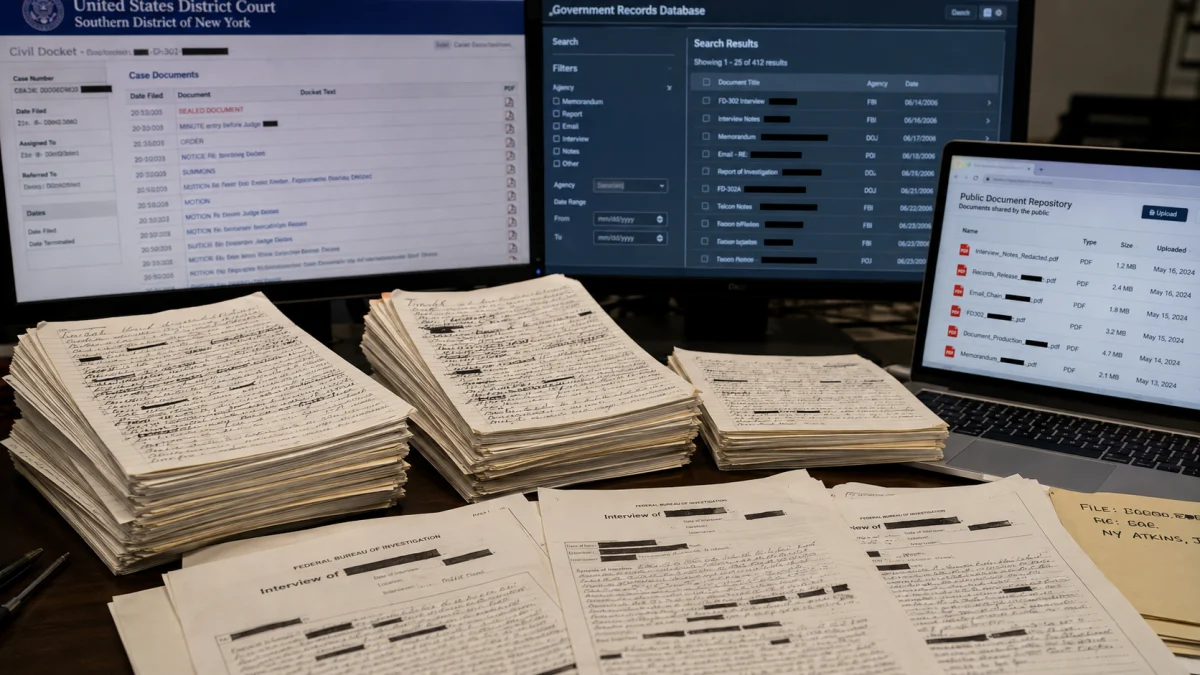
Thirty-seven pages of handwritten FBI interview notes that the Justice Department did not place in its public Epstein library now appear to have been found outside the government’s official release system.
They concern a woman whom the FBI interviewed four times in 2019 after she reported being sexually abused as a child by Jeffrey Epstein and other men.
And the full story is considerably more serious—and more complicated—than either of the simplified versions now circulating online.
The FBI records do not establish that Donald Trump sexually assaulted this woman. They document her allegation that he did. No criminal charge or judicial finding has established the alleged assault as fact, Trump denies wrongdoing, and the specific assault allegation has not been independently corroborated in the public record.
But reducing the case to “an uncorroborated Trump allegation” also leaves out substantial information.
The same woman accused Jeffrey Epstein of repeatedly sexually abusing her beginning around age 13. She accused a man the FBI recorded as “JIM ATKINS (phonetic)” of sexually assaulting her more than once and participating with Epstein in an alleged blackmail scheme involving her mother. She described additional sexual and physical abuse by other men whose names she could not provide. She identified an accountant named Cecil as an alleged participant in the financial manipulation of her mother, although she did not accuse Cecil of sexually assaulting her.
Independent journalists later tracked the “Jim Atkins” description through old business, court and newspaper records and appear to have identified him as Jimmy L. Atkins, an Ohio businessman and educator connected directly to the Hilton Head real-estate company involved in the mother’s embezzlement case. That corroborates important parts of the woman’s account of who Atkins was and how he intersected with her family. It does not independently prove her allegations that Atkins sexually assaulted her or participated in blackmail.
Meanwhile, the Justice Department is fighting in federal court over the underlying handwritten notes. DOJ says it withheld handwritten material because it was substantially similar to the typed FBI reports and because handwriting makes victim-information redactions harder to quality-control. But attorneys challenging DOJ subsequently produced “nearly 100” examples of other handwritten FBI interview notes DOJ had already published; an independent count found 91 entries. DOJ has appealed the preliminary-injunction ruling while the dispute continues.
The law itself makes an unusually important distinction.
The Epstein Files Transparency Act permits DOJ to protect victims’ personally identifiable information. But Congress also expressly prohibited withholding, delaying or redacting Epstein records because of “embarrassment, reputational harm, or political sensitivity,” including when the person involved is a government official, public figure or foreign dignitary.
In other words, the law does not require choosing between protecting survivors and naming powerful people.
It expressly tells the government to do both.
Why We Investigated This
The question that triggered this investigation was not simply, “Did a woman accuse Trump?”
That has been public since March.
The better questions are these:
What exactly did this woman tell the FBI? Who did she accuse? Which parts of her story have been independently checked? What information exists only as allegation? What did the 37 handwritten pages add? Why did DOJ withhold those pages while apparently releasing handwritten notes in other Epstein files? And how did records that were absent from DOJ’s public library apparently end up on an ordinary document-sharing website?
Once those questions are separated, the story becomes both clearer and harder to dismiss.
The 37 Pages Were Not Invented by Internet Sleuths
Researchers did not arrive at the number 37 by looking at a mysterious leak and guessing that pages were missing.
The government’s own document structure established their existence.
The FBI subfile involved here is 3501.045. A prosecution-discovery index associated with the Maxwell case identifies a sequence of four formal FBI interview reports and three corresponding sets of “Interview Notes.”
Those underlying note sets contain 15 pages, 18 pages and four pages.
That is 37 pages.
Separately, researchers and journalists identified a 53-page gap in the secondary Bates numbering associated with this witness’s records. DOJ later published 16 pages containing three previously missing FD-302 interview reports.
Fifty-three minus 16 equals 37.
The remaining 37 pages correspond exactly to the three sets of interview notes already listed in the government’s own index.
That arithmetic matters because it establishes something fundamental:
The existence and expected size of the missing note sets were known before the leaked copies appeared.
Someone fabricating 37 random pages after the fact would have had to reproduce not just the narrative of three government interview reports, but the precise three-document page structure already recorded in federal discovery material.
That does not provide government authentication of the circulating PDFs, but it is substantial evidence supporting their provenance.
The FBI Interviewed Her Four Times
The FBI’s first formal report documents a July 24, 2019 interview.
At that stage, the publicly released 302 did not contain the later detailed Trump assault allegation. Trump nevertheless appeared in an unusual episode involving a photograph. A friend had sent the woman a widely circulated photograph showing Epstein and Trump together. Before showing it to agents, she had cropped Trump out so that only Epstein remained. The FBI report records that agents recognized the original image as showing Epstein and Trump.
The FBI returned for a second interview on August 7.
That report is where the case expands dramatically.
A third interview followed on August 20. A fourth occurred October 16.
The FBI’s own forms emphasize that FD-302s contain neither FBI recommendations nor conclusions. They are reports memorializing what investigators were told.
That distinction runs through everything that follows.
What She Alleged Jeffrey Epstein Did
According to the FBI summaries, the woman said Epstein began sexually abusing her when she was approximately 13.
She described repeated abuse rather than a single encounter. Her account included alcohol and drugs, sexual photographs, manipulation, and what she later understood as grooming.
She also told agents that Epstein used her to locate other young girls who wanted to party, effectively sending her on recruitment “missions.” The August 7 report additionally records her allegation that Epstein possessed explicit photographs of her as a child and used them as leverage in an alleged blackmail scheme involving her mother.
Epstein’s broader sexual abuse of minors is not merely an allegation in the historical sense: he was a convicted sex offender, was federally charged with sex trafficking of minors in 2019, and died before that federal case could go to trial. That does not independently prove every statement this particular woman made about what Epstein did to her.
It does mean her allegation arose in the context of a man whose abuse of underage girls is overwhelmingly documented.
What She Alleged Donald Trump Did
The August 7 FBI report records the woman’s allegation that Epstein took her away from the Hilton Head area when she was somewhere between approximately 13 and 15 years old, traveling by car and/or plane to New York or New Jersey.
She said Epstein introduced her to a wealthy man she identified as Donald Trump.
She described being in a very tall building with unusually large rooms. According to her account, other people were initially present but left when Trump asked them to.
She alleged that Trump made a sexual remark about teaching her how “little girls” were supposed to behave, exposed himself and forced her head toward his penis. She told agents that she resisted by biting him and that Trump then physically struck her and had her removed.
During the August 20 interview, agents returned to the incident. The FBI report records her clarification that she alleged Trump pulled her hair and punched her on the side of the head after she resisted.
She also told the FBI that Trump and Epstein sometimes used terms including “fresh meat,” “untainted” and “not jaded” when referring to girls.
She said there had been two additional interactions with Trump, but during the second interview she asked agents to move away from that subject for the time being.
Her account also went beyond sexual abuse. She alleged that she overheard Epstein and Trump discussing blackmail and said she heard Trump discussing money being washed through casinos and illegal building permits. Those are allegations contained in her FBI interview; we have not found independent public evidence establishing those particular conversations occurred.
That is an example of why the evidence must be broken into individual claims rather than treating an FBI document as a blanket stamp of truth.
The Fourth Interview Is Important
By October 2019, agents explicitly returned to what the FBI report describes as her earlier allegation of sexual contact with the current U.S. president while she was a minor, facilitated through her association with Epstein.
The woman questioned what the point would be in giving additional information when she believed so much time had passed that nothing could be done.
Agents told her that victims should have the opportunity to tell their stories and asked her to consider speaking further. She did not provide the additional Trump details during that meeting.
That is materially different from saying the FBI dismissed her allegation.
The available 302 does not say investigators determined she was lying. Nor does the existence of four interviews establish that investigators concluded she was truthful.
It establishes that they continued interviewing her.
Trump Was Not the Only Other Man She Accused
This is where much of the national discussion has been unnecessarily incomplete.
The August 7 FBI report expressly names another alleged sexual assailant:
“JIM ATKINS (phonetic).”
According to the FBI report, the woman described Atkins as a friend or associate of Epstein whose precise relationship with Epstein was unknown to investigators.
She alleged that Atkins sexually assaulted her on more than one occasion.
She also accused Atkins of participating with Epstein in blackmailing her mother.
The FBI report records a surprisingly detailed description: a white man with gray hair, distinctive ears and a hairy body; probably in his 50s during the relevant period; living in Ohio; and somehow associated with an Ohio college or university. She was unsure of the exact role but remembered something like a dean or the school’s “money guy.”
She said her mother and Atkins had a romantic relationship for roughly a year.
She also described Atkins as wealthy, domineering and connected to real estate.
Those details gave journalists something concrete to investigate.
Who Was “Jim Atkins”?
The FBI did not write “Jimmy L. Atkins.”
It wrote “JIM ATKINS (phonetic).”
That qualifier matters.
But subsequent public-record research appears to have substantially narrowed the identification.
The Post and Courier investigated the woman’s account using court records, historical newspaper coverage, business records and other archival sources. Reporting on that investigation says the newspaper identified the likely man as Jimmy L. Atkins, an Ohio businessman and former educator who later became involved in Hilton Head real estate and died in 2003.
This was not merely a name match.
Historical records reportedly place Jimmy L. Atkins as the owner of the real-estate business where the woman’s mother worked. A 1986 Island Packet report identified Jimmy L. Atkins of Ohio in connection with that company and with the criminal allegations involving the mother’s handling of escrow funds.
Corporate records also connect Jimmy L. Atkins to Betz College and Betz Business School in Cincinnati, where he served as president/director.
That is striking because decades later the woman independently described the “Jim Atkins” she remembered to the FBI as an Ohio man associated with a college—possibly its dean or “money guy.”
Reporting on the Post and Courier investigation says journalists were able to verify roughly 16 surrounding details from her FBI interviews, including information about Atkins’s age, appearance, educational-business connection and relationship to the Hilton Head real-estate affair, as well as facts concerning her mother’s work and embezzlement case.
That deserves to be stated accurately.
It is meaningful corroboration of the surrounding story and of the likely identity of “Jim Atkins.”
It is not corroboration that Jimmy L. Atkins sexually assaulted her.
No court adjudicated that allegation. We have found no independent witness or physical evidence proving it. Atkins died years before the 2019 FBI interviews and therefore could not answer the accusation.
The same distinction applies to the alleged blackmail arrangement.
Records corroborate the mother’s employment, financial trouble, prosecution and Atkins’s direct connection to the real-estate company. They do not independently establish the woman’s explanation that Epstein and Atkins engineered the embezzlement through blackmail involving explicit photographs.
That part remains her allegation.
The Accountant Named “Cecil”
The FBI report identifies another adult in the alleged financial scheme: an accountant whose first name was Cecil and whose last name the woman did not know.
She described Cecil as a Black man who worked with Atkins.
According to her account, Atkins and Cecil helped manipulate or “fix” her mother’s real-estate books, enabling her mother to embezzle money that the witness said was then used to pay Epstein. She alleged that after her mother and Atkins fell out, Atkins, Epstein and possibly Cecil supplied accurate records to the Real Estate Commission.
Cecil should therefore be described as an alleged participant in the financial/bookkeeping component of the witness’s account.
He should not be called an alleged sexual perpetrator. The FBI report we reviewed does not record the woman accusing him of sexually assaulting her.
That is not protecting Cecil. It is describing the allegation accurately.
There has also been online speculation attempting to identify him as other men named Cecil in the Epstein records. The available evidence does not support those identifications. One research project specifically notes that a prominent candidate floated online, Tennessee banker C.H. “Cecil” Butcher Jr., does not match the FBI’s physical description of the accountant.
We will not turn a name match into a sex-crime accusation.
There Were Other Alleged Abusers Whose Names Are Still Unknown
The woman also described abuse by other adult men.
Some are described physically in the FBI material but not identified by name. Her account includes wealthy older men and at least one particularly violent encounter in which she alleged she was beaten and sexually abused.
Those allegations belong in the story because they show that her account to investigators described a broader pattern of being delivered to adult men—not merely encounters with Epstein, Trump and Atkins.
But there is a limit the evidence imposes on us:
The woman did not give investigators names for every alleged abuser.
That is why those men remain unidentified.
It is not because sherafy.com is redacting the names of known perpetrators.
What About the 37 Handwritten Pages—Do They Name More Perpetrators?
After rechecking the available transcriptions, provenance reporting and comparisons against the formal 302s, we found no independently verified new named sexual perpetrator in the 37 leaked pages beyond the adults already identifiable from the official FBI reports.
That is important because unredacted versions of the notes contain many names.
But a name appearing in an FBI agent’s notebook does not mean that person was accused of abuse.
The handwritten pages reportedly identify the protected source herself, her children and relatives, childhood friends, neighbors and people she suggested might corroborate pieces of her account. Some of those names were deliberately excluded from the formal 302s.
Those people should not be published as “Epstein associates” or suspected perpetrators simply because an unredacted document exposed them.
In fact, the existence of potential corroborating witnesses is one of the genuinely important differences between the raw notes and the formal reports.
The Post and Courier reportedly contacted some of the people whose names appeared in the notes. According to Document Zero’s reconstruction, at least one potential witness told the newspaper that the FBI had never contacted her.
That creates a legitimate investigative question:
What corroboration work did the FBI actually perform after recording those names?
We do not yet have the answer.
The Handwritten Notes Are Not a Secret Second Version of the Trump Story
This is another point where viral descriptions are getting ahead of the documents.
Researchers who compared the handwritten pages with the formal FBI summaries report that the basic substance tracks closely.
The Trump allegation is already in the official August 7 302.
The physical-assault clarification is already in the August 20 302.
The references to “fresh meat,” Atkins, the alleged blackmail scheme, the mother’s embezzlement, drugs, Epstein’s behavior and the threatening calls are substantially represented in the formal reports.
Document Zero performed a line-by-line comparison and concluded that the typed reports are often more complete narratively than the handwritten notes.
So the responsible headline is not:
“Secret FBI notes reveal completely new Trump child-assault allegation.”
They do not.
Their significance is different.
Raw investigative notes can preserve names, chronology, leads and details that agents omit when producing a condensed 302. Here, the most consequential reported additions are possible corroboration leads and identities—which is precisely why a properly redacted official release would matter.
How Strong Is the Authentication of the Leaked Notes?
DOJ and the FBI have not publicly authenticated the leaked copies.
That prevents us from calling them conclusively authenticated government files.
But there is considerable evidence that they are what researchers say they are.
First, their three page counts—15, 18 and four—match the three note sets in the government index exactly.
Second, the contents correspond closely to the formal 302s associated with those interviews.
Third, journalists had apparently obtained and reported from handwritten versions before the current internet discovery.
Fourth, a technical analysis by Document Zero found that all three circulating PDFs were generated using the same PDF software and created within a 14-second window on March 6, 2026, suggesting they were exported together. The containers differ from DOJ’s normal public-release PDFs, indicating the documents appear to have been repackaged rather than downloaded directly from the public Epstein Library.
That finding actually fits the provenance problem.
The pages appear consistent with genuine underlying FBI material that passed through some intermediary process.
It does not tell us who performed that export or whether the disclosure was authorized.
Twenty-Two Pages Were Apparently Sitting on Scribd
Independent researcher Amy Gabrielle describes finding handwritten notes associated with this case through ordinary Google searches.
The trail led to Scribd.
A user named “reportoftheday” had uploaded the four-page note set corresponding to one interview. Gabrielle subsequently found the 18-page set on the same account.
Both reportedly carried a March 6 upload date.
That accounts for 22 pages.
Gabrielle did something worth emphasizing: she initially hesitated to make broad claims because she could not authenticate what she had found.
That caution turned out to be useful rather than timid.
Other researchers then began checking the documents against the government indexes and typed FBI reports.
The remaining question was where the third, 15-page file had gone.
The Scribd Trail Leads to Washington Examiner Reporter Kaelan Deese
Document Zero subsequently traced the “reportoftheday” Scribd account to Kaelan Deese, a justice reporter at the Washington Examiner.
There is independent circumstantial support for that identification: the account contains source documents corresponding to Deese’s reporting, and other uploads on the account can be linked to stories he wrote.
More importantly, Document Zero obtained screenshots of messages between Deese and the person who contacted him about the missing material.
According to those screenshots, when asked who operated “reportoftheday,” Deese responded that it was his account and that he used it for uploads.
When asked where the Jane Doe notes came from, he reportedly said that, as best he remembered, most of the material had been sent by a source within DOJ.
When the researcher asked about the missing third set, Deese reportedly located the 15-page file and sent it through Signal.
That would complete the 37-page set:
18 pages + 4 pages + 15 pages = 37 pages.
But there is a necessary evidentiary boundary.
Document Zero itself acknowledges that the message screenshots cannot be definitively authenticated from the screenshots alone. DOJ has not confirmed that an employee supplied these records. Deese has not, in an on-the-record statement we located, publicly explained the full chain of custody.
So sherafy.com‘s conclusion is not:
“DOJ secretly leaked the Trump files to a friendly reporter.”
The evidence does not yet establish that.
The supportable conclusion is:
Reporting backed by message screenshots and account evidence points to a Justice Department source as the origin of at least much of the material. That provenance claim is serious and testable, but DOJ has not confirmed it.
Why the Scribd Story Is an Institutional Problem Either Way
There is an uncomfortable contradiction in the present record.
DOJ has told a federal court that handwritten FBI notes create special difficulty because handwritten victim information is harder to identify, redact automatically and quality-control.
That concern is legitimate.
The versions that apparently circulated outside DOJ demonstrate why: they reportedly exposed the protected woman’s name, her relatives and potential witnesses.
But that produces the opposite question.
If victim privacy made these particular records too dangerous for DOJ to publish in properly redacted form, how did unredacted copies apparently reach a reporter and sit on a public document-sharing service for months?
If the DOJ-source account reported by Document Zero is accurate, was the disclosure authorized?
Who approved it?
Did DOJ know the files contained unredacted victim information?
Were other reporters given copies?
Was the material provided as background?
And why did the public, Congress and a federal judge have to litigate for records that were apparently already circulating outside DOJ?
Those questions do not presume criminal misconduct.
They are the obvious chain-of-custody questions created by the evidence.
Congress Explicitly Said Victims Can Be Protected—but Powerful People Cannot Be Protected From Embarrassment
The Epstein Files Transparency Act removes much of the rhetorical ambiguity surrounding this issue.
Congress authorized DOJ to redact personally identifiable information belonging to victims and private medical or personal material whose disclosure would constitute a clearly unwarranted invasion of privacy.
It also allowed certain other narrow categories, including child sexual-abuse material and temporary, narrowly tailored protection for active investigations.
But Congress separately wrote this prohibition into law:
Records cannot be withheld, delayed or redacted because disclosure would create embarrassment, reputational harm or political sensitivity, including when the affected person is a government official, public figure or foreign dignitary.
That is an unusually direct statutory command.
It also provides the correct editorial principle for reporting these files.
Protecting the identity of a survivor is not the same as protecting the reputation of a president.
Protecting a private childhood friend from being falsely labeled an Epstein accomplice is not the same as removing the name of an adult the witness expressly accused of sexual assault.
Those categories should never have been blended together.
Why DOJ Says It Withheld the Notes
In its July 2 response in Phang v. Blanche, DOJ gave two basic explanations.
First, it said underlying handwritten notes are, by their nature, substantially similar to the final FD-302 reports and had therefore been treated as duplicative.
Second, DOJ argued that handwriting creates additional technical difficulty when screening for victim-identifying information and raises the risk of inadvertently exposing victims.
The second concern deserves to be taken seriously, particularly because DOJ’s enormous Epstein release has already produced documented victim-privacy problems. DOJ’s own Epstein Library currently warns that the scale of the production means nonpublic personal information may inadvertently have been published and asks people to report such exposures.
But difficulty redacting a document is not necessarily authority to withhold it altogether.
And “duplicative” is becoming a harder explanation for DOJ to sustain.
A Federal Judge Ordered DOJ to Produce the Notes or Explain Itself
Journalist and attorney Katie Phang sued the Justice Department in April, alleging violations of the Epstein Files Transparency Act and related administrative-law requirements.
On June 25, U.S. District Judge Emmet Sullivan granted a preliminary injunction. That does not constitute a final judgment on the entire case, but the court concluded that Phang was likely to succeed on key Administrative Procedure Act claims.
Among the records at issue were the FBI notes underlying these four interviews.
Sullivan directed the government to produce specified materials with lawful victim protections or show cause for continued withholding.
As the litigation continued, Sullivan pressed the government on why handwriting could not be manually redacted or handled through another process and why substantially similar material was being treated differently elsewhere.
That question became even more important after an August 13 hearing.
DOJ Said It Was Not Aware of Other Handwritten 302 Notes Being Released
During the August 13 hearing, Judge Sullivan asked government attorney Andrew Block whether other handwritten notes had been published.
Block answered, “To my knowledge, not with respect to the 302s.”
Seven days later, Phang’s lawyers filed a notice with the court.
Their response was concise:
“Defendant’s counsel is not correct.”
The filing provided an example of handwritten FBI interview notes underlying a typed 302 and an exhibit described as containing “nearly 100 additional examples.”
An independent count of that exhibit found 91 distinct entries, spread across six DOJ data sets, with the listed links pointing to DOJ’s own published Epstein files.
That does not automatically prove that all 91 records are identical in sensitivity or legal posture to the disputed Jane Doe notes.
It does, however, materially weaken any broad claim that DOJ simply does not release handwritten interview notes underlying 302s.
The judge ordered DOJ to respond.
DOJ Has Now Appealed
On August 24, DOJ filed a notice of appeal challenging Sullivan’s June 25 preliminary-injunction order.
The D.C. Circuit docketed the appeal as Katie Phang v. Todd Blanche, No. 26-5299, on August 25.
Meanwhile, the district-court dispute continues.
The docket shows DOJ filed its court-ordered response concerning the latest handwritten-note dispute on August 27, ECF No. 37.
As of this article’s preparation on August 28, we could verify the filing and its date through the docket but could not independently retrieve the underlying PDF from the public court mirrors available to us. We therefore will not tell readers what DOJ supposedly argued in that filing based on partisan summaries or social-media posts.
Phang’s reply is due September 3.
That is an example of a distinction worth preserving: transparency means showing readers where the evidence stops, not filling the gap with the answer we expect to find.
What Has Actually Been Corroborated?
“Uncorroborated” is frequently being used in this case as though it means “disproved.”
It does not.
Parts of the woman’s story have been independently corroborated.
Reporting based on the Post and Courier investigation says journalists verified numerous surrounding facts: details of her childhood and family history, her mother’s Hilton Head real-estate work and embezzlement prosecution, the existence and background of the man likely corresponding to “Jim Atkins,” his Ohio educational-business connection, physical details and his direct relationship to the real-estate affair.
Those facts matter because they demonstrate that portions of a decades-old story she gave federal agents could be checked against records and were accurate.
They do not prove the Trump assault.
They do not prove the Atkins assault.
They do not prove that Epstein and Atkins blackmailed her mother with explicit photographs.
Corroboration is not all-or-nothing.
If a witness accurately remembers an employer, criminal case, business owner, college affiliation, concert or geographic detail from decades earlier, that can increase confidence in the surrounding chronology without establishing what happened inside a private room.
The correct conclusion is neither “everything was corroborated” nor “nothing was corroborated.”
It is:
Important surrounding details have been independently verified. The central sexual-assault allegation against Trump has not.
There Is a Real Timeline Problem That Should Not Be Hidden
There is also evidence that cuts against easy acceptance of the Trump allegation.
The woman’s account places the alleged encounter in the early-to-mid 1980s.
Trump and Epstein unquestionably knew one another later. Their social relationship is extensively documented from the late 1980s into the early 2000s. They were neighbors in Palm Beach, socialized together, attended parties and were filmed together at Mar-a-Lago in 1992.
What the public record does not securely establish is that Trump and Epstein knew each other as early as the period of the alleged encounter.
That matters.
It is not proof that they did not.
Relationships normally begin before the first surviving photograph or newspaper reference.
But if the allegation depends on Epstein introducing a teenage girl to Trump around 1983–85, then establishing that Epstein and Trump were actually acquainted at that time would be valuable independent corroboration.
At present, we have not found it.
That should be investigated rather than waved away.
Other Epstein Victims’ Accounts Do Not Resolve This One
Another fact readers deserve to know is that Virginia Giuffre did not accuse Trump of sexually abusing her.
In her posthumous memoir she described meeting Trump at Mar-a-Lago and did not accuse him of wrongdoing. In earlier sworn testimony, she said she did not believe Trump knew about Epstein’s misconduct with underage girls. Other members of Epstein’s household staff likewise gave testimony that did not describe seeing Trump engage in inappropriate conduct.
That is relevant evidence.
It is not an alibi for an alleged event involving a different girl roughly 15 years earlier.
Different witnesses can have completely different experiences with the same person.
Likewise, Ghislaine Maxwell has denied witnessing inappropriate conduct by Trump. Maxwell is also a convicted participant in Epstein’s sex-trafficking operation with obvious reasons to defend both herself and her past social network, so her statements cannot simply be treated as disinterested corroboration.
Including evidence that cuts in different directions is not “both-sides” journalism.
It is how we prevent an investigation from becoming an argument looking for evidence.
Her Civil Epstein Claim Is Also Relevant—but Easy to Misrepresent
The woman later brought claims connected to Epstein as “Jane Doe 4.”
The civil allegations described Epstein transporting her to New York on several occasions and bringing her to gatherings with wealthy men where she said she was treated as “fresh meat.” The complaint alleged that other men violently sexually assaulted her.
There is an important trap here.
The civil pleading does not identify every unnamed prominent man in those allegations as Donald Trump.
Online commentators have attempted to map portions of the anonymous civil complaint directly onto the Trump story.
The complaint itself does not provide enough information to make every such identification.
We will not do it for them.
The FBI interviews are the source for the explicit Trump allegation.
The civil complaint provides relevant evidence that she was making broader allegations about Epstein facilitating abuse by wealthy men.
Those are related records, not interchangeable ones.
What the FBI Documents Prove—and What They Do Not
The clearest way to understand the evidence is to separate the propositions.
| Question | Best-supported conclusion |
|---|---|
| Did this woman report childhood sexual abuse to the FBI? | Yes. Verified. |
| Did the FBI interview her four times? | Yes. Verified. |
| Did she accuse Jeffrey Epstein of repeatedly sexually abusing her? | Yes. Verified as an allegation she made. |
| Did she accuse Donald Trump of sexually and physically assaulting her when she was approximately 13–15? | Yes. Verified as an allegation recorded by the FBI. |
| Did she accuse “Jim Atkins (phonetic)” of sexually assaulting her multiple times? | Yes. Verified as an allegation recorded by the FBI. |
| Has “Jim Atkins” likely been identified as Jimmy L. Atkins? | Strongly supported by independent public-record reporting, but the FBI record itself only says “Jim Atkins (phonetic).” |
| Did she name Cecil as part of the alleged financial manipulation? | Yes. But the reviewed FBI report does not accuse Cecil of sexual assault. |
| Did she describe other alleged abusers? | Yes. Some remain unidentified because she did not provide their names. |
| Have portions of her background and chronology been independently corroborated? | Yes. Multiple surrounding facts have been matched to records. |
| Has her specific Trump assault allegation been independently proven? | No. Not in the public evidence we reviewed. |
| Has it been disproven? | No. The public record does not establish that either. |
| Do the 37 handwritten pages appear to correspond to the missing FBI notes? | Strongly supported by page counts, content, metadata and provenance research; DOJ has not authenticated the circulating copies. |
| Do those 37 pages reveal a newly verified fourth named sexual perpetrator? | Not based on the evidence we could authenticate. |
| Did DOJ officially release the 37 handwritten pages? | No evidence we found shows that they were placed in DOJ’s official Epstein Library. |
| Did a DOJ source provide them to a reporter? | Reported and supported by screenshots attributed to reporter Kaelan Deese, but not confirmed by DOJ and not independently established as fact. |
| Has a court ruled that Trump committed the alleged assault? | No. |
| Has Trump been criminally charged over this woman’s allegation? | No. |
Why “No Charges” Is Not the End of the Analysis Either
It is fair to note that the FBI interviewed the woman in 2019 and no criminal case against Trump emerged from these allegations.
It is not fair to silently convert that fact into:
“The FBI investigated and determined the allegation was false.”
The public records we reviewed do not say that.
Potential statute-of-limitations issues were explicitly discussed during the fourth interview. The alleged events were decades old. Epstein died during the investigation. Potential witnesses and alleged participants may have been deceased, unavailable or difficult to locate.
We do not know the complete prosecutorial analysis.
Therefore the absence of charges is evidence of one thing with certainty:
No charge was brought.
Anything more requires records explaining why.
Those records are exactly the kind of institutional documentation an evidence-based investigation should seek.
The Question DOJ Should Answer Is Not “Do You Believe Her?”
The government’s obligation is not to publicly pronounce this woman truthful or false.
Its obligation is to explain its records.
Why were three of four formal interview reports originally absent from the release?
Why were those reports later published after journalists identified the gap?
Why are the 37 underlying pages still absent from DOJ’s official library?
Why were they treated as “duplicative” when other handwritten FBI interview notes were published?
What lawful redactions are necessary to protect the survivor?
Can those redactions be done manually?
Did the FBI contact the potential corroborating witnesses identified in the raw notes?
What investigative steps were taken regarding “Jim Atkins”?
Did investigators attempt to establish whether Trump and Epstein knew one another during the early-to-mid-1980s period relevant to her allegation?
What happened to the other unidentified alleged perpetrators she described?
And how did apparently unredacted copies of the notes reach people outside the official disclosure process?
None of those questions requires believing the accusation in advance.
They require the government to show its work.
The Strongest Conclusion the Evidence Supports
The social-media version says 37 secret FBI pages suddenly surfaced and expose what DOJ was hiding about Trump.
That description is simultaneously too strong and too shallow.
The Trump allegation itself was already publicly documented in official FBI reports released in March.
The 37 handwritten pages appear to be the underlying investigative notes corresponding to those interviews. They substantially track the typed reports rather than revealing an entirely new accusation.
But the larger file is much richer than the simplified Trump-only story.
The woman accused Jeffrey Epstein of repeated childhood sexual abuse and exploitation.
She accused Donald Trump of a specific sexual and physical assault while she was a minor and said there were two additional interactions she did not fully describe during the August 7 interview.
She accused “Jim Atkins (phonetic)” of sexually assaulting her multiple times and participating with Epstein in an alleged blackmail scheme.
Independent reporting appears to have identified that man as Jimmy L. Atkins and corroborated a striking number of surrounding biographical details connecting him to the woman’s family and the real-estate scandal she described—without proving the abuse allegations themselves.
She identified Cecil as an alleged participant in manipulation of her mother’s financial records.
She described additional alleged abusers whose identities remain unknown.
And the raw FBI notes reportedly preserved potential corroboration leads that the formal reports omitted.
Meanwhile, DOJ withheld those handwritten notes from its official public release as substantially similar and difficult to redact, even as a court filing now points to scores of other handwritten FBI interview-note records that DOJ itself published.
The law Congress enacted explicitly permits protection of victims while explicitly forbidding the government from suppressing records merely to spare public officials or prominent people embarrassment, reputational harm or political sensitivity.
That distinction should govern both DOJ and journalism.
We will not publish a survivor’s identity because an unredacted file accidentally exposed it.
We will not turn private witnesses into perpetrators merely because their names appear in an FBI notebook.
But we also will not erase the names of powerful adults whom a federal record explicitly says were accused of wrongdoing merely because the allegation is politically explosive.
The correct response is not protection.
It is precision.
The FBI documents establish what this woman told federal investigators.
Independent reporting establishes that meaningful portions of her surrounding account can be corroborated.
The documents do not establish that Donald Trump committed the assault she described.
They also do not establish that she fabricated it.
What remains is an allegation serious enough that federal agents interviewed her four times, detailed enough to contain multiple testable leads, and entangled in a disclosure process inconsistent enough that a federal judge is now forcing the Justice Department to explain itself.
The public does not need the government—or the press—to decide what it is allowed to know about powerful people.
It needs the records, legitimate victim redactions, the investigative history and enough context to understand exactly what each piece of evidence does and does not prove.
That is what transparency is supposed to provide.
References and Further Reading
Primary Government and Court Records
Epstein Files Transparency Act — Public Law 119-38 — The controlling federal statute. Section 2 expressly distinguishes permissible victim-privacy redactions from prohibited withholding based on embarrassment, reputation or political sensitivity.
DOJ Epstein Library — DOJ’s official public repository and current privacy notice. The library states it will be updated when additional releasable documents are identified.
FBI Interview No. 1 — EFTA01245620 — The first formal FBI interview report in serial 3501.045.
FBI Interview No. 2 — EFTA02858481 — The principal formal FBI report containing the allegations concerning Trump, Epstein, Jim Atkins and the alleged blackmail scheme.
FBI Interview No. 3 — EFTA02858491 — Follow-up FBI report containing additional physical-assault detail and discussion of the mother’s imprisonment and alleged threats.
FBI Interview No. 4 — EFTA02858495 — The October 2019 interview in which agents again raised the woman’s prior allegation involving Trump.
Phang v. Blanche — June 25 Memorandum Opinion — Judge Emmet Sullivan’s preliminary-injunction ruling in the ongoing Epstein Files Transparency Act litigation.
Phang v. Blanche — Current District Court Docket — Tracks the August handwritten-note filings, DOJ’s August 24 appeal notice and the August 27 response.
Katie Phang v. Todd Blanche — D.C. Circuit Appeal No. 26-5299 — Current appellate docket.
Sen. Sheldon Whitehouse March 9 Preservation Letter — Contemporary congressional correspondence specifically identifying the remaining 37 pages of interview-related material.
Investigative Reporting and Document Reconstruction
The 53 Missing Pages — Document and Bates-Number Reconstruction — Detailed accounting showing how DOJ’s later 16-page release left the three underlying note sets totaling 37 pages.
The Ohio Node — Jim Atkins Document Analysis — Corpus and public-record analysis of the “Jim Atkins (phonetic)” material, including the Jimmy L. Atkins identification and corrections to earlier mistaken internet identifications. The site expressly identifies its report as AI-assisted, so its claims should be checked against linked primary records.
Post and Courier Investigation Summarized by AOL — Corroboration and Jimmy L. Atkins — Secondary access to reporting on the South Carolina newspaper’s public-record investigation and the surrounding facts it verified.
Amy Gabrielle — Discovery of the Scribd Note Sets — First-person account explaining how two of the handwritten files were found and why the researcher initially hesitated to claim they were authentic.
Document Zero — Conservative Journalist Shared Unredacted Trump Accuser FBI Notes — The investigation tracing the Scribd account to reporter Kaelan Deese and reporting the alleged DOJ-source provenance. Its private-message evidence is significant but not government-authenticated.
Document Zero — Technical Authentication and Metadata Analysis — Detailed comparison of the three leaked PDFs, their creation metadata and their content against official FBI summaries.
Analysis of Phang ECF 33’s Handwritten-Note Examples — Independent row-by-row examination of the “nearly 100” examples filed with the court; counts 91 distinct DOJ-linked entries.
Important Context and Counterevidence
Washington Post — Trump and Epstein’s Documented Social Relationship — Historical reporting placing their documented friendship in the late 1980s and later, important when evaluating the earlier chronology alleged by the witness.
Washington Post — 1992 Trump-Epstein Mar-a-Lago Video — Documentary evidence of their later social relationship; it does not establish an early-1980s relationship.
Associated Press — Virginia Giuffre’s Account and Trump — Important countercontext: Giuffre described meeting Trump but did not accuse him of misconduct.
Editorial currency note: This article reflects records and reporting verified through August 28, 2026. Phang v. Blanche is active litigation. DOJ filed ECF No. 37 on August 27; Phang’s reply is presently due September 3. The court may subsequently authenticate, order the production of, or otherwise rule on the disputed FBI handwritten notes. This page should be updated when that occurs.