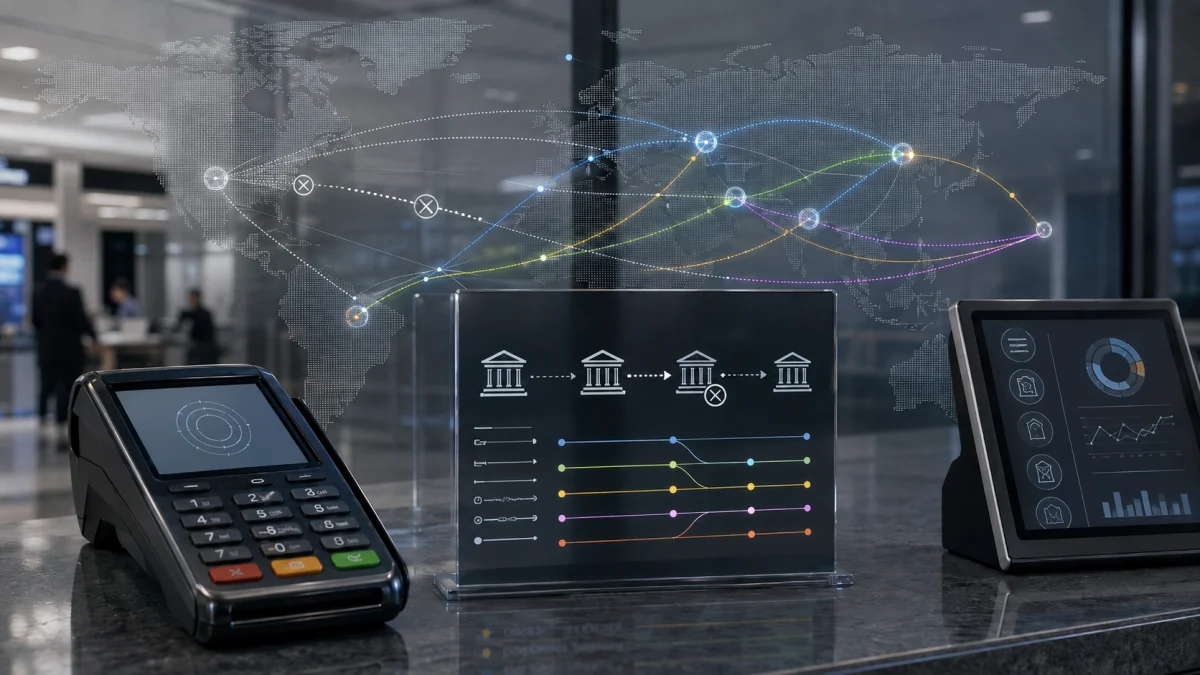
Yes—but not in the way the rhetoric makes it sound.
The United States can impose severe costs on foreign banks and companies that continue certain Iran-related business. It can prohibit their access to U.S. correspondent banks, freeze assets within U.S. jurisdiction, sanction foreign institutions and effectively force internationally connected companies to choose between sanctioned Iranian business and continued access to the American financial system.
What Washington cannot do is simply switch off an entire country’s ability to trade, prevent two foreign countries from settling every transaction outside the dollar, or expel Iran from BRICS.
That distinction has become especially important since August 24, 2026, when Treasury Secretary Scott Bessent launched Operation Economic Outcast and announced that countries would receive deadlines to shut down Iran-related activities identified by the United States. Treasury warned that foreign entities facilitating Iranian money laundering or sanctions evasion could be cut off from the U.S. financial system while expanding the types of Iranian sectors that can trigger secondary sanctions.
Four days later, Washington demonstrated what that threat can look like in practice.
On August 28, FinCEN proposed barring Banque Misr UAE from correspondent banking relationships with U.S. financial institutions. Treasury alleges that the UAE operations of the Egyptian bank processed approximately $1.8 billion between January 2024 and June 2026 for 103 companies potentially connected to Iranian shadow-banking networks. That $1.8 billion figure is Treasury’s assessment, not an independently adjudicated finding. The measure is also still a proposed rule, not a final prohibition, and explicitly applies to Banque Misr’s UAE operations rather than Banque Misr everywhere.
The case is particularly revealing because both Egypt and the United Arab Emirates are BRICS members.
But it does not prove that Washington can economically dictate terms to BRICS as a whole.
The real contest is more complicated:
The United States still controls extraordinarily valuable access points in global finance. BRICS possesses enormous economic weight and increasingly capable alternatives. Neither fact cancels out the other.
And China is where the limits of American financial power become most visible.
What did the United States actually threaten?
Treasury’s language has been unusually sweeping.
Bessent said on August 24 that every country would receive a defined timeline to shut down Iran-related activities identified by Washington and that Treasury would act if governments did not. He specifically said Bank Melli branches should be closed and warned that entities facilitating money laundering for Iran would be removed from the “U.S. dollar system.”
Treasury simultaneously added five sectors to the areas in which Iran-related conduct may expose foreign parties to sanctions: digital assets, technology, gold, aviation and shipping. Those joined existing pressure against Iran’s financial, petroleum and petrochemical sectors. Nearly 60 entities, individuals and vessels were sanctioned in the initial August 24 package.
But there is an important difference between the administration’s political rhetoric and the underlying legal mechanics.
The United States has not announced that every transaction of every kind between Iran and every foreign person is automatically illegal under U.S. law.
Different sanctions authorities cover different persons, sectors and transactions. There are also licenses, exemptions and other exceptions under the broader Iran sanctions architecture.
For foreign institutions, the threat is often instead:
Continue specified sanctioned activity, and the United States may make continued access to the American financial system much more difficult—or impossible.
That is the essence of secondary-sanctions leverage.
What does “cut off from the dollar system” actually mean?
The phrase sounds as if the United States possesses a master switch controlling every dollar on Earth.
It does not.
The actual power is more concrete.
International banks routinely maintain correspondent accounts with banks in other countries. A foreign bank that needs to make dollar payments can rely on a U.S. correspondent bank to settle those transactions through the American financial system.
Washington regulates those U.S. institutions.
That gives it a powerful choke point.
In the Banque Misr UAE case, FinCEN is proposing to prohibit U.S. financial institutions from opening or maintaining correspondent accounts for the bank. U.S. institutions would also have to take steps to prevent foreign correspondent accounts from being used indirectly to process transactions involving Banque Misr UAE.
That is much more precise than saying America can simply “ban a country from dollars.”
A foreign institution could theoretically continue operating outside the United States and conducting some transactions in other currencies. But losing reliable access to U.S. banking can create a much larger problem.
Other banks may decide that dealing with the institution creates too much sanctions or compliance risk. International counterparties may withdraw. Financing can become harder. Dollar settlement becomes more difficult. Insurers, commodity traders and multinational corporations may avoid the institution even where a particular transaction is not itself prohibited.
This is partly a legal effect and partly a network effect.
That network effect is what makes American financial sanctions unusually powerful.
Why GDP alone does not answer the question
This is where the common “BRICS is bigger than America” argument becomes misleading.
BRICS unquestionably represents enormous economic weight.
Official BRICS material from Brazil’s 2025 presidency lists 11 members: Brazil, Russia, India, China, South Africa, Saudi Arabia, Egypt, the United Arab Emirates, Ethiopia, Indonesia and Iran. It estimated that the expanded group represented approximately 39% of global GDP measured at purchasing-power parity, roughly 24% of global trade and nearly half of the world’s population.
Official BRICS material also put the group’s share of global nominal GDP at roughly 28–29% in 2025-era estimates.
That is enormous.
But adding up national GDP does not produce a unified financial system.
BRICS is not analogous to the United States or even the European Union. Official BRICS material describes it as an informal coordination mechanism. It has no constitutive treaty, common budget or permanent secretariat, and major decisions are made by consensus.
There is no BRICS central bank.
There is no unified BRICS treasury.
There is no single BRICS capital market.
And despite years of headlines about a supposed “BRICS currency,” Brazil’s BRICS Sherpa explicitly said in 2025 that a common BRICS currency was not under discussion. The actual work has focused on local-currency settlement and reducing the cost of cross-border payments.
That matters because sanctions power is not determined by a GDP scoreboard.
It is determined by financial-network dependence.
The dollar is far more powerful internationally than the U.S. share of world GDP suggests
The Federal Reserve’s data makes this unusually clear.
In 2024, the United States accounted for about 26.1% of nominal global GDP. Yet the Federal Reserve’s composite index of international currency usage gave the dollar a 64.9% share, compared with 3.1% for China’s renminbi.
The dollar represented approximately:
| Measure | U.S. dollar share |
|---|---|
| Disclosed global foreign-exchange reserves, 2024 | 58% |
| International payments | About 50% |
| International/foreign-currency banking claims | About 55% |
| International/foreign-currency banking liabilities | About 60% |
| Foreign-currency debt issuance | About 60% |
| Global FX transactions involving the dollar, 2022 | About 88% |
The renminbi, by comparison, represented about 2% of disclosed global reserves in 2024.
Those figures explain why the United States can economically pressure institutions in countries with which it has relatively little direct political control.
A bank does not have to be American to care deeply about dollar access.
Its customers might need dollars. Its commodity trades might be invoiced in dollars. Its loans may be dollar-denominated. Its counterparties may depend on American banks. Its investors may hold U.S. assets.
The United States’ advantage therefore comes less from having the world’s largest economy than from sitting near the center of the world’s financial plumbing.
So could BRICS simply ignore Washington?
Not collectively, and not without substantial costs.
But individual BRICS members have dramatically different levels of vulnerability.
A smaller internationally connected bank with valuable U.S. relationships may have an overwhelming incentive to comply.
An institution already isolated from the Western financial system has much less to lose.
A company that conducts most of its business domestically or through China may be more willing to absorb American sanctions risk than a multinational company dependent on New York financing.
And China presents an entirely different problem from a single mid-sized foreign bank.
That is why treating “BRICS” as one economic actor obscures more than it explains.
China is the real stress test
China is Iran’s most important major economic partner and has publicly rejected Washington’s latest pressure campaign.
Beijing condemned the U.S. sanctions approach after Operation Economic Outcast was announced and said it would defend legitimate Chinese interests. At the same time, Washington has so far stopped short of publicly targeting the largest Chinese financial institutions under the new campaign.
That restraint matters.
When Bessent was asked on August 24 why Washington was warning foreign governments rather than immediately imposing its toughest secondary sanctions, he responded:
“Why would I want to blow up the global financial system?”
He went on to describe the delay as a cure period and warning shot before potentially stronger action.
The comment should not be exaggerated into an admission that any new sanctions would literally destroy global finance.
But it does reveal the central constraint.
Sanctions become harder to use as the target becomes more systemically important.
Cutting a small foreign bank away from U.S. correspondent banking is one thing.
Attempting to isolate a major Chinese financial institution that handles enormous volumes of global trade, maintains relationships with banks worldwide and sits inside deeply interconnected supply chains is something else entirely.
The sanction may still hurt the Chinese institution.
It can also hurt everyone connected to it.
That includes companies and financial institutions in countries supposedly doing the sanctioning.
Recent reporting indicates that the administration has deliberately avoided its harshest measures against major Chinese banks while it continues trying to pressure Iran.
That does not mean China is immune.
It means the cost-benefit calculation changes dramatically.
Can China trade with Iran without using dollars?
Yes, at least for some trade.
This is another area where both sides of the argument are routinely overstated.
China already possesses substantial renminbi-based international payment infrastructure. Its Cross-Border Interbank Payment System, or CIPS, processed 5.232 million RMB payment transactions worth 120.3 trillion yuan from January through July 2026, according to CIPS’ own statistics.
That is a real alternative channel for renminbi transactions.
It is not, however, evidence that China has replaced the dollar system.
CIPS is centered on renminbi settlement. It does not replicate the full depth, liquidity, investment markets, financing ecosystem and global acceptance surrounding the dollar.
The Federal Reserve’s data bears this out: China’s economy accounted for 16.8% of nominal world GDP in 2024, while the Fed’s international-currency-use index assigned the renminbi only 3.1%, compared with 64.9% for the dollar.
China therefore has a meaningful ability to route around some American financial pressure.
It does not yet possess a dollar replacement of comparable global reach.
Both statements can be true at the same time.
BRICS is also building alternatives—but there is no BRICS financial escape hatch yet
BRICS itself is working on reducing payment friction between members.
The July 2025 Rio de Janeiro leaders’ declaration instructed finance ministers and central-bank governors to continue work on a BRICS Cross-Border Payments Initiative and explore greater interoperability among member payment systems. It also supported more financing in local currencies.
That work matters.
If Brazil can settle more trade in reais, China in renminbi, India in rupees and other members through interoperable systems, fewer transactions necessarily need to touch dollar infrastructure.
But that is a gradual reduction in dependency—not a single switch that BRICS can flip tomorrow.
There is no common BRICS currency.
There is no unified BRICS payment network capable of replacing the entire dollar ecosystem.
And member countries have different political alliances, financial structures and incentives.
The UAE’s relationship with Washington is not China’s.
India’s is not Russia’s.
Brazil’s is not Iran’s.
Economic size gives the group potential bargaining power. Fragmentation limits how easily that potential turns into coordinated financial power.
Could the U.S. stop BRICS countries from trading with Iran altogether?
No.
Washington can make certain Iran-related trade extraordinarily expensive for participants that care about access to U.S. finance.
That is not the same as possessing jurisdiction over every transaction on Earth.
Imagine a transaction between two non-U.S. companies conducted entirely outside the United States and settled in a non-dollar currency.
America cannot simply make that transaction physically cease to exist.
But if the conduct falls within a U.S. secondary-sanctions authority, Washington may impose a separate consequence on one of those foreign companies or financial institutions—such as denying access to the U.S. financial system.
That creates the choice:
Do business with the sanctioned Iranian party or sector, or preserve access to America.
For decades, many international businesses chose America.
The unanswered question is what happens when the entity being forced to choose increasingly has viable alternatives.
Banque Misr UAE shows both the power and the limit
The August 28 Banque Misr UAE action is almost a perfect real-world example.
FinCEN is not claiming authority to close Banque Misr itself.
It is proposing to use American law to prohibit U.S. financial institutions from maintaining correspondent relationships for Banque Misr’s UAE operation and to prevent indirect access through other foreign correspondents.
That is significant.
But it is also narrower than the phrase “removed from the dollar system” suggests.
Treasury alleges that Banque Misr UAE became an important node in Iranian shadow banking and processed approximately $1.8 billion for potentially connected companies. Banque Misr has not been judicially found responsible for those allegations through this proposed rulemaking, and the public-comment process has not yet concluded.
It is also important not to misstate what happened:
The United States did not sanction Egypt.
It did not sanction the UAE.
It did not expel either country from the global financial system.
And it did not take action against Banque Misr everywhere.
Instead, Washington targeted a particular banking operation through a particular American financial access point.
That precision is exactly why the mechanism works.
Why America’s strongest weapon also creates a long-term problem
There is a strategic contradiction buried inside the sanctions system.
The United States can threaten foreign institutions with dollar exclusion because dollar access is so valuable.
But every time Washington demonstrates that access can be withdrawn for geopolitical reasons, countries that expect future conflict with Washington gain another reason to reduce their dependence on it.
BRICS’ push toward local-currency settlement and more interoperable payment systems is therefore strategically important even if those systems are nowhere near replacing the dollar today.
China’s enormous CIPS volumes demonstrate that meaningful alternative infrastructure already exists.
That does not establish that U.S. sanctions are causing a rapid collapse of the dollar.
In fact, the available evidence points the other way.
The Federal Reserve found that the dollar still represented 58% of disclosed global foreign-exchange reserves in 2024—the same share it held in 2022. The Fed specifically noted that sanctions imposed on Russia after its invasion of Ukraine had not produced a notable reallocation of global reserves away from dollars by that measure.
So the responsible conclusion is narrower:
Weaponizing dollar access creates an incentive to build alternatives. There is not yet strong evidence that those alternatives have displaced the dollar’s overall international dominance.
Those are very different claims.
The sanctions power balance in one table
| Question | Best-supported answer |
|---|---|
| Can the U.S. expel Iran from BRICS? | No. BRICS controls its own membership. |
| Can the U.S. stop every BRICS-Iran transaction? | No. Non-dollar trade outside U.S. jurisdiction can occur, although participants may face secondary-sanctions consequences. |
| Can the U.S. cut a foreign bank off from U.S. correspondent banking? | Yes. The Banque Misr UAE proposal shows the mechanism directly. |
| Can Washington make other banks avoid a sanctioned institution? | Often, yes in practice. Counterparties may withdraw to reduce sanctions and compliance risk. |
| Is BRICS economically large enough to matter? | Absolutely. It represents roughly 39% of global GDP by PPP according to official BRICS data. |
| Does BRICS’ combined GDP neutralize U.S. financial sanctions? | No. GDP size and financial-network centrality are different things. |
| Does BRICS have a common currency? | No. Official BRICS representatives have explicitly said one is not currently under discussion. |
| Can China conduct significant international trade in renminbi? | Yes. CIPS already processes enormous RMB payment volumes. |
| Has the renminbi replaced the dollar globally? | No. Current reserve, banking and international-currency-use data remain overwhelmingly dollar-dominated. |
| Could sanctions accelerate de-dollarization efforts? | Reasonably, yes as an incentive. Evidence that they have already displaced the dollar on a global scale is much weaker. |
| Could the U.S. sanction major Chinese banks? | It has powerful authorities available, depending on the conduct involved. Using them against systemically important Chinese institutions would carry much greater economic and geopolitical costs than targeting smaller banks. |
So who actually has more leverage: the U.S. or BRICS?
There is no useful answer if the question is treated as a contest between two GDP totals.
The United States’ advantage is financial centrality.
BRICS’ advantage is economic scale, resources, trade relationships and the increasing possibility of routing some commerce through systems Washington does not control.
Today, the first advantage is still stronger in global finance.
The dollar remains far more important internationally than America’s share of global economic output would suggest. That makes threats to remove a bank from U.S. financial access credible and potentially devastating.
But that power is not unlimited.
It becomes less effective against actors that already have little U.S. exposure, more complicated when transactions can migrate into local currencies, and potentially dangerous when Washington considers targeting institutions large enough to disrupt global finance itself.
Bessent’s own explanation for providing a warning period captured that dilemma better than most political rhetoric surrounding the announcement:
Why immediately use a weapon if using it at full strength could damage the financial system that gives the weapon its power?
The bottom line
The United States can make continued Iran-related business extremely costly for many banks and companies around the world, including institutions located in BRICS countries.
The August 28 action against Banque Misr UAE demonstrates that this is not an empty threat.
But the United States cannot simply order BRICS to isolate Iran, cannot remove Iran from BRICS, cannot prevent every non-dollar transaction between Iran and other countries, and cannot treat a major Chinese financial institution as though it were an expendable small foreign bank without risking much broader consequences.
That is why the most important question is not:
“Is BRICS now economically bigger than America?”
It is:
“How much of BRICS still needs the financial network America controls?”
For now, the answer is: a great deal.
But substantially less than would have been true in a world without China’s RMB infrastructure, local-currency settlement and active BRICS work on alternative cross-border payment mechanisms.
Washington therefore possesses an extraordinarily powerful weapon—but one whose effectiveness depends on the rest of the world continuing to value access to the system the United States is threatening to deny.
And that is the paradox at the center of Operation Economic Outcast:
The more valuable dollar access remains, the more powerful U.S. sanctions are. The more aggressively that dependence is used as leverage, the stronger the incentive becomes for America’s largest rivals to reduce it.
There is little evidence that BRICS can escape the dollar system altogether today.
There is considerably more evidence that some of its largest members are trying to make sure they will not always have to ask Washington’s permission to move money tomorrow.
References and Further Reading
U.S. Treasury and FinCEN primary documents
-
U.S. Treasury — Treasury Launches Operation Economic Outcast Against Iran — Primary August 24, 2026 announcement describing the deadlines for identified Iran-related activity, expanded secondary-sanctions exposure, new sector determinations and initial sanctions package.
-
U.S. Treasury — Remarks by Secretary Scott Bessent on Operation Economic Outcast — Bessent’s prepared remarks laying out the administration’s financial-isolation strategy and its threat to restrict U.S. financial access.
-
FinCEN — Proposed Rule to Revoke Banque Misr UAE’s U.S. Correspondent Banking Access — Primary description of the August 28 Section 311 proposal and exactly which operations it would affect.
-
U.S. Treasury — Iran’s Access to UAE Banks Targeted Under Operation Economic Outcast — Treasury’s allegations and estimates concerning Banque Misr UAE, including the $1.8 billion figure. These claims are identified in this article as Treasury assessments rather than independently established findings.
-
FinCEN — Notice of Proposed Rulemaking Regarding Banque Misr UAE — Underlying regulatory proposal for readers who want the legal document rather than Treasury’s summary.
Dollar dominance and international finance
-
Federal Reserve — The International Role of the U.S. Dollar, 2025 Edition — Federal Reserve analysis of dollar reserves, international banking, payments, foreign-currency debt and foreign-exchange trading.
-
Federal Reserve — Accessible Data for the International Role of the U.S. Dollar — Data tables supporting the comparison between the United States’ share of global GDP and the much larger international role of its currency.
-
CIPS — Cross-Border Interbank Payment System Statistics — Official Chinese RMB cross-border payment statistics, including the January–July 2026 transaction totals cited above.
BRICS primary documents
-
BRICS Brasil — About the BRICS — Official description of the expanded membership and institutional structure.
-
BRICS Brasil — BRICS Economic and Demographic Data — Official estimates for the group’s share of global GDP, trade and population.
-
BRICS — 2025 Rio de Janeiro Leaders’ Declaration — Primary document describing work on local-currency finance, the BRICS Cross-Border Payments Initiative and payment-system interoperability.
-
BRICS Brasil — Brazilian Sherpa Addresses the BRICS Common-Currency Claim — Official explanation that a common BRICS currency was not under discussion and that the practical focus was local currencies and payment costs.
Independent reporting and context
-
Associated Press — U.S. Targets Banque Misr’s UAE Branches in Iran Isolation Campaign — Independent reporting on the August 28 proposed action, including its limited scope and regulatory status.
-
Washington Post — China Pushes Back on the U.S. Iran Sanctions Campaign — Reporting on Beijing’s response and the U.S.-China dimension of the sanctions strategy.
-
Financial Times — America’s Economic War on Iran Has a China Problem — Analysis of why Chinese economic ties to Iran present a significantly harder enforcement problem than smaller financial intermediaries.
Editorial currency note: This article was researched and verified through August 28, 2026. Operation Economic Outcast is an active and rapidly developing sanctions campaign. The Banque Misr UAE Section 311 measure discussed above was still a proposed rule as of publication, and Treasury’s country-specific deadlines have not been publicly detailed. Sanctions designations, licenses, enforcement actions, BRICS financial initiatives and payment-system statistics should be rechecked when this article is materially updated.