Ratko Mladić died on August 27, 2026, while hospitalized in The Hague, where the former Bosnian Serb military commander was serving a life sentence for genocide, crimes against humanity and war crimes. The UN tribunal overseeing the remnants of the Yugoslavia cases has ordered an inquiry into the circumstances of his death.
But in Foča, Bosnia and Herzegovina, another part of that history is not over.
Dragoljub Kunarac—one of the most consequential convicted perpetrators of wartime sexual violence in modern international law—completed a 28-year prison sentence earlier this year and returned to Bosnia.
He is now standing trial again.
The new case involves a separate set of alleged crimes against humanity committed around Foča in 1992. And since April, Kunarac has been permitted to move within the municipality of Foča while that trial proceeds. His travel remains restricted, he is barred from contacting specified witnesses and other people, and he must report to police three times a week. But he is no longer under house arrest.
That fact is difficult to separate from the place itself.
Foča is where Bosniak women and girls were imprisoned, repeatedly raped, tortured and, in some cases, enslaved during a systematic campaign against the area’s non-Serb population.
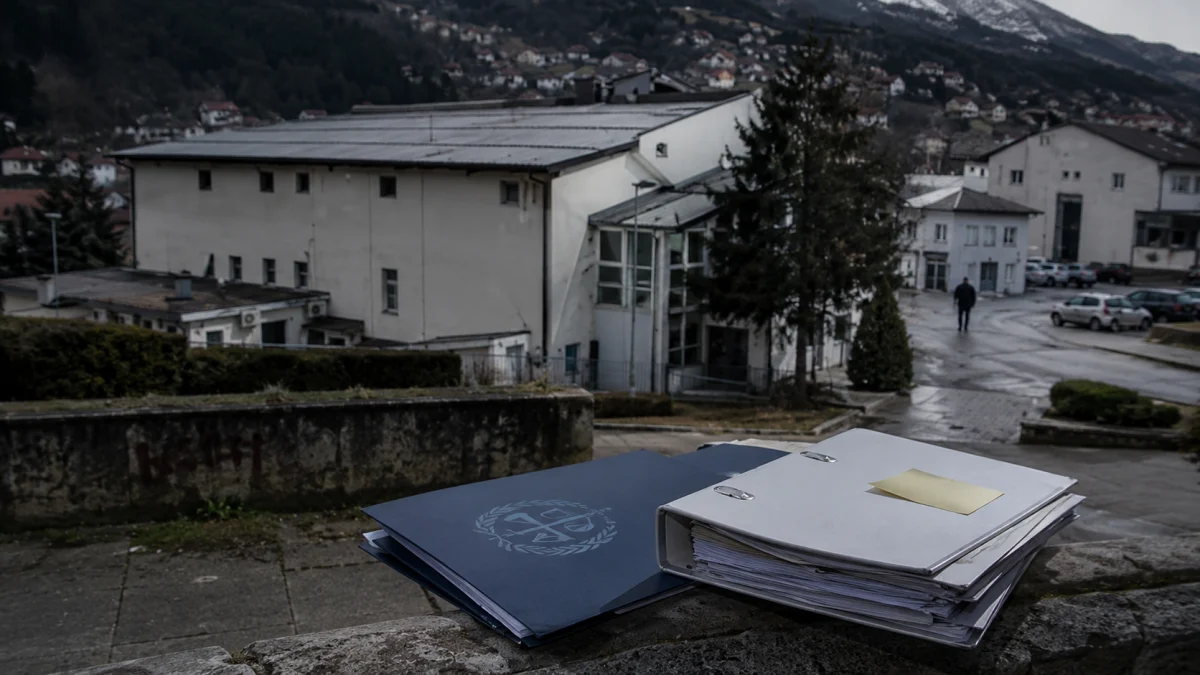
One of the central detention sites was an ordinary municipal sports building called Partizan.
The police station was about 70 meters away.
Today, Partizan is a sports hall again.
There is still no official memorial plaque on the building explaining what happened there.
And nationalist murals honoring figures including Ratko Mladić and Chetnik leader Draža Mihailović have appeared within meters of the site.
A recent on-location video by Las Adelitas Media (@las_adelitas_media) brought that extraordinary juxtaposition back into view.
The social-media video is emotionally forceful. The documentary record behind its central point is worse than any three-minute reel can adequately convey.
Why We Investigated This
The raw question raised by the Las Adelitas Media footage is not whether every sentence in a social-media video should be parsed like courtroom testimony.
It is this:
How can one of the most important sites in the history of prosecuting wartime sexual violence return to ordinary civic life with so little visible acknowledgment of what happened there—while one of the central convicted perpetrators is once again living within the same municipality?
That question becomes more disturbing, not less, when you read the underlying judgments.
Partizan was not merely rumored to have been a rape camp.
Women and girls were detained there.
Armed men repeatedly entered and selected women.
Women were taken away to houses, apartments and other locations.
They were raped.
Some were returned and taken again.
Some were controlled for prolonged periods and treated as the property of the men holding them.
The International Criminal Tribunal for the former Yugoslavia eventually made the Foča cases landmarks of international criminal law.
More than three decades later, the physical landscape tells a very different story about remembrance.
What happened at Partizan?
After Bosnian Serb forces took control of Foča in 1992, Bosniak civilians were detained at a network of locations throughout the municipality.
The ICTY found that this occurred within a broader campaign directed against Foča’s non-Serb population.
Women, children and elderly civilians were held at locations including Foča High School, Buk Bijela and Partizan Sports Hall.
During the core period documented in the tribunal proceedings, at least 72 Muslim civilian women, children and elderly people were detained at Partizan.
The building was in central Foča.
It was roughly 70 meters from the police building.
It was also on slightly higher ground and visible from the surrounding area, including the police building.
That geographic fact matters because women were not quietly disappearing from an isolated rural prison.
The detention facility was operating in the center of town.
According to the tribunal record, armed soldiers came to Partizan and took women and girls away on a regular basis.
They were brought to apartments, houses, military headquarters and other locations where they were raped and otherwise abused.
Some victims were repeatedly removed.
The ICTY described what occurred in Foča in unusually direct language.
Its Trial Chamber found that rape was used by members of Bosnian Serb forces as an “instrument of terror.”
It also described a system in which the perpetrators had effectively been given free rein to sexually abuse Muslim women and girls.
Partizan was one piece of that system.
The scale was much larger than one building
The exact number of victims of sexual violence across Foča is unknown.
TRIAL International’s Bosnia and Herzegovina project estimates that hundreds of women and girls were raped and sexually abused in Foča. It identifies victims ranging from children to elderly women.
The tribunal record documents sexual violence at numerous locations beyond Partizan: Foča High School, houses and apartments, military headquarters, Buk Bijela, Karaman’s house and other detention or captivity sites.
The significance of that network is easy to lose when the story is reduced to a single “rape camp.”
Partizan was horrifying precisely because it was not an isolated anomaly.
Women could be detained in one location, removed by armed men, taken somewhere else, sexually assaulted, returned and then selected again.
The machinery surrounding the crime mattered almost as much as the physical room in which a particular rape occurred.
People had to control the detainees.
People had to guard the buildings.
People had to be able to enter.
Women had to be removed without meaningful resistance from the authorities.
Perpetrators had to believe they could return.
And they did.
What did the police know?
The proximity of Partizan to the police station makes the footage visually shocking.
The court record makes the issue considerably more serious.
The case against institutional knowledge does not rest on the assumption that police officers must have noticed something because the buildings happened to be close together.
Police and military-police involvement appears directly in the historical record.
The ICTY described a situation in which authorities who should have protected the detained women instead failed to protect them, helped maintain the conditions in which the abuse occurred, or participated in mistreatment.
Partizan itself was guarded.
Women were nevertheless repeatedly removed by armed men for sexual assault.
The detention center remained in operation.
The rapes continued.
And the police building remained approximately 70 meters away.
The tribunal ultimately observed that Bosnian Serb forces were able to set up and maintain a detention center for scores of Muslim women next to the municipal police building, from which women and young girls were regularly taken away to be raped.
That is not a speculative allegation based on a modern influencer standing in the street.
It is part of the judicial history of Foča.
Dragoljub Kunarac was personally convicted of rape, torture and enslavement
Kunarac was not convicted merely because he happened to belong to the military force controlling Foča.
The findings against him were personal and specific.
The tribunal found that Kunarac participated in the broader campaign against Foča’s non-Serb population and personally committed serious sexual violence against women detained in the system.
Women were taken from detention facilities to locations used by Kunarac and other soldiers.
The tribunal found him responsible for multiple rapes and acts of torture.
It also found that women were held under circumstances in which they were deprived of meaningful autonomy and treated as if the men controlling them had ownership rights over their lives and bodies.
Kunarac was ultimately convicted of rape, torture and enslavement as crimes against humanity, along with rape and torture as violations of the laws or customs of war.
His 28-year sentence was upheld on appeal.
Foča changed international law on sexual violence
The Kunarac, Kovač and Vuković case became important far beyond Bosnia.
For generations, wartime rape had often been treated as an inevitable byproduct of conflict—a crime committed during war rather than a central instrument through which civilians could be terrorized, controlled and destroyed.
Foča helped change that understanding in international criminal law.
The ICTY’s judgment produced its first convictions for rape as a crime against humanity and its first convictions for enslavement as a crime against humanity.
The enslavement finding was especially significant.
The women involved did not need to be chained to a factory floor or sold through a formal slave market for the law to recognize what was happening to them.
The court considered factors including control over movement, psychological control, coercion, sexual abuse, forced domestic labor and the treatment of women as property.
That helped establish the modern international-law framework for recognizing sexual enslavement.
In other words, the crimes committed in Foča did not simply result in prison sentences.
They helped change the legal vocabulary through which the world prosecutes sexual violence in war.
What happened to all the other perpetrators?
This is one of the hardest questions in the entire Foča record.
Only a limited number of people were ultimately convicted in cases tied to Partizan and the broader system of sexual violence.
Yet the evidence repeatedly describes many more men.
The indictments and testimony refer to groups of soldiers entering detention facilities, women being divided among men, victims being gang-raped and unidentified perpetrators participating alongside defendants who were eventually named and prosecuted.
In one episode described in the Foča proceedings, a victim was subjected to a gang rape involving at least 15 soldiers.
Other women described different men taking them from detention repeatedly.
Some perpetrators were identified.
Some were prosecuted.
Some were convicted.
Others disappear from the historical record as unnamed or uncharged participants.
More than 30 years later, it is impossible to responsibly produce a precise count of how many perpetrators remain alive or where they now live.
But the larger accountability gap is not speculative.
The evidence describes substantially more perpetrators than the justice system ever convicted.
That leaves a question for which there is still no satisfying answer:
What happened to the rest of them?
Partizan is a sports hall again
Partizan survived the war.
It was later renovated with international assistance and returned to community use.
People play sports there today.
There is nothing inherently wrong with reclaiming a building where atrocities occurred. Communities cannot preserve every crime scene exactly as it stood forever.
But reclaiming a place is different from erasing what happened inside it.
Survivors and victims’ organizations have repeatedly sought an official memorial plaque at Partizan.
According to TRIAL International’s documentation of the site, local authorities have not approved those efforts.
Every June 19—the International Day for the Elimination of Sexual Violence in Conflict—survivors and families gather in Foča to commemorate the victims.
The building itself still does not officially tell a visitor why they are there.
That absence becomes more striking when compared with what has been allowed to appear nearby.
War-criminal glorification found space where victims could not
Foča has repeatedly been the site of nationalist imagery honoring figures associated with Serb wartime and ultranationalist movements.
In 2021, Detektor documented murals honoring both Ratko Mladić and Draža Mihailović in the area.
The location is extraordinary.
A representative of Foča’s Bosniak returnee community told Detektor that the Mihailović mural stood approximately 20 meters from Partizan.
The report specifically described the experience of women returning to commemorate what happened at the sports hall and encountering the nationalist imagery beside the site.
The existence of such murals does not tell us what every resident of Foča believes.
It tells us something more concrete:
Nationalist and war-criminal imagery has been able to occupy conspicuous public space near Partizan while survivors have struggled to obtain an official plaque explaining the crimes committed inside it.
That contrast is not invented by social media.
It exists on the ground.
And it is part of why the Las Adelitas footage is so unsettling.
Why is Kunarac back in Foča?
Because his original sentence ended.
Kunarac surrendered to SFOR forces in 1998. He was later convicted by the ICTY and sentenced to 28 years in prison.
He served that sentence, including years in Germany, and was transported back to Bosnia and Herzegovina in February 2026.
That completed the punishment imposed for the crimes adjudicated in his Hague case.
But another prosecution was already waiting.
Bosnia and Herzegovina’s state prosecutor indicted Kunarac in 2018 over separate alleged crimes from July 1992.
Prosecutors accuse him, in his alleged capacity as commander of the VRS special unit known as “Žaga,” of participating with other armed men in the persecution of Bosniak civilians around Kobilja Ravan, Luke and Falovići-Potpeće.
The indictment alleges involvement in the murders of at least six people, torture and severe mistreatment of captured civilians, deportation of Bosniak civilians and the burning of homes and property.
Those are current allegations, not part of the convictions for which he already served 28 years.
Kunarac has pleaded not guilty.
His trial began in March 2026.
Why is he allowed to move around Foča during the new trial?
When Kunarac returned to Bosnia, prosecutors sought his detention.
The Court of Bosnia and Herzegovina declined to jail him pending trial and instead imposed what it called its strictest available prohibition measures.
Initially, those measures included house arrest.
The court also prohibited travel and contact with specified witnesses and other individuals.
Then, in April 2026, the court loosened the movement restriction.
Kunarac’s house arrest was lifted.
Instead, his movement was restricted to the municipality of Foča. His travel ban and contact restrictions remained, and he was ordered to report to the appropriate police station three times a week.
That produces the present-day reality at the center of this story:
A man already convicted of rape, torture and enslavement committed during the Foča campaign is permitted to move within Foča while another crimes-against-humanity case against him proceeds.
There is a legal explanation for how that happened.
That does not make the image any less extraordinary.
As of the latest publicly reported hearing in July, prosecutors were still presenting evidence. The trial was expected to resume in September.
This is not just a story about Ratko Mladić
Mladić’s death is what returned international attention to Bosnia’s war-crimes history this week.
But reducing that history to Mladić would miss what Foča reveals.
International courts convicted senior commanders.
They also prosecuted individual soldiers whose crimes against women helped create new international legal precedent.
Yet criminal trials could never account for every perpetrator, every victim or every community forced to live with what remained afterward.
Foča demonstrates the distance between judicial history and lived memory.
On paper, the record is extraordinarily clear.
A systematic attack was carried out against the area’s non-Serb population.
Women and girls were detained.
They were raped.
Some were enslaved.
Partizan was part of that system.
The police station stood nearby.
Numerous perpetrators appear in the evidence.
Only a fraction were ultimately convicted.
One of the most important defendants served 28 years, returned to Bosnia and is now being prosecuted over additional alleged crimes.
And the building where women were held is once again an ordinary sports hall without an official memorial plaque explaining why it became internationally notorious.
Meanwhile, survivors continue to return.
The most disturbing part of Partizan may be how ordinary it looks today
There is a temptation when looking at historical atrocities to expect the physical place to somehow reveal what happened.
Partizan does not.
It looks like a municipal sports building.
Cars pass it.
People walk nearby.
Homes climb the hills around Foča.
The police station remains part of the ordinary urban landscape.
That normality is precisely what makes the site difficult to process.
Mass atrocities do not always occur in places that look like mass-atrocity sites.
Sometimes they happen in schools.
Hotels.
Apartments.
Police buildings.
Sports halls.
Then the war ends.
Buildings are painted.
Windows are replaced.
Children return.
Traffic resumes.
The landscape becomes ordinary again.
The question is whether the history is allowed to disappear with it.
At Partizan, survivors have spent decades arguing that it should not.
They should not have to compete with murals of convicted war criminals and nationalist icons to make that history visible.
Mladić is dead. The Foča case is still not finished.
Ratko Mladić will never leave the detention system in which he died.
Dragoljub Kunarac already did.
That does not erase the 28 years he spent imprisoned for crimes the ICTY proved beyond a reasonable doubt.
It also does not erase what remains unresolved.
International courts established that women and girls in Foča were subjected to rape, torture and enslavement.
They established that members of Bosnian Serb forces used rape as an instrument of terror.
They established that a detention center holding scores of Muslim women could operate beside the municipal police building while detainees were regularly removed and raped.
They convicted men whose conduct helped change international criminal law.
But a judgment can establish historical truth without producing complete accountability.
A prison sentence can end while survivors continue living with the crime.
A building can reopen while its history remains unmarked.
And a war can have ended more than three decades ago while courts are still hearing evidence about what happened.
That is why the image coming out of Foča now matters.
Mladić’s death closes one defendant’s file.
Foča’s reckoning is not closed at all.
References and Further Reading
Primary court and tribunal records
- IRMCT — Statement on the passing of Ratko Mladić — The UN tribunal’s August 27, 2026 confirmation of Mladić’s death, his final convictions and the inquiry ordered into the circumstances of his death.
- Court of Bosnia and Herzegovina — Restrictions imposed on Dragoljub Kunarac after his return — Primary court record confirming that Kunarac had completed his 28-year Hague sentence and documenting the initial house-arrest, travel and contact restrictions imposed in February 2026.
- Prosecutor’s Office of Bosnia and Herzegovina — Indictment of Dragoljub Kunarac for separate Foča crimes — Primary summary of the current allegations involving killings, torture, deportation and property destruction in July 1992.
- ICTY — Judgment in Kunarac, Kovač and Vuković — Tribunal summary of the landmark Foča judgment, including the systematic attack on non-Serb civilians, sexual violence and the use of rape as an instrument of terror.
- ICTY — Full Kunarac, Kovač and Vuković Trial Judgment — The full judicial record underlying the convictions for rape, torture and enslavement.
- ICTY — Kunarac, Kovač and Vuković Appeals Judgment and sentences — Confirms the rejection of the defendants’ appeals and Kunarac’s 28-year sentence.
Kunarac’s current prosecution
- Detektor — Kunarac’s house arrest lifted and movement restricted to the municipality — Reports the April 2026 decision allowing Kunarac to move within Foča while maintaining other restrictions.
- Detektor — July 2026 testimony in the current Kunarac trial — The latest publicly reported hearing located during this review; the court was expected to resume proceedings in September.
Partizan, victims and public memory
- TRIAL International — Partizan Sports Hall, Foča — Compiles the judicial history of the site, estimates of sexual-violence victims across Foča, convicted perpetrators and the long-running effort to establish an official memorial plaque.
- Detektor — Mladić and Mihailović murals near Partizan and concerns among Foča returnees — Documents nationalist murals in Foča, including a Mihailović mural reported approximately 20 meters from Partizan, and includes testimony from Bosniak returnees.
- Radio Free Europe/Radio Liberty — Draža Mihailović mural beside the site of wartime rape and killings — Earlier reporting on the same memorialization conflict and survivors’ efforts to have Partizan formally marked.
What prompted this investigation
- Las Adelitas Media — On-location report from Foča and Partizan — The field report that brought renewed attention to Partizan, Kunarac, the nearby police building and nationalist imagery around the site.
- Las Adelitas Media on Instagram — Creator profile for the reporting that prompted this review.
Editorial currency note: Dragoljub Kunarac’s current prosecution is ongoing. His movement restrictions, hearing schedule and case status can change and should be rechecked when this article receives a substantive update.