There is not enough publicly available evidence to responsibly declare that 16-year-old Juliana Umba Nzita was murdered.
There is also not enough publicly available evidence to dismiss the questions surrounding her death as conspiracy theories.
Those are not contradictory positions.
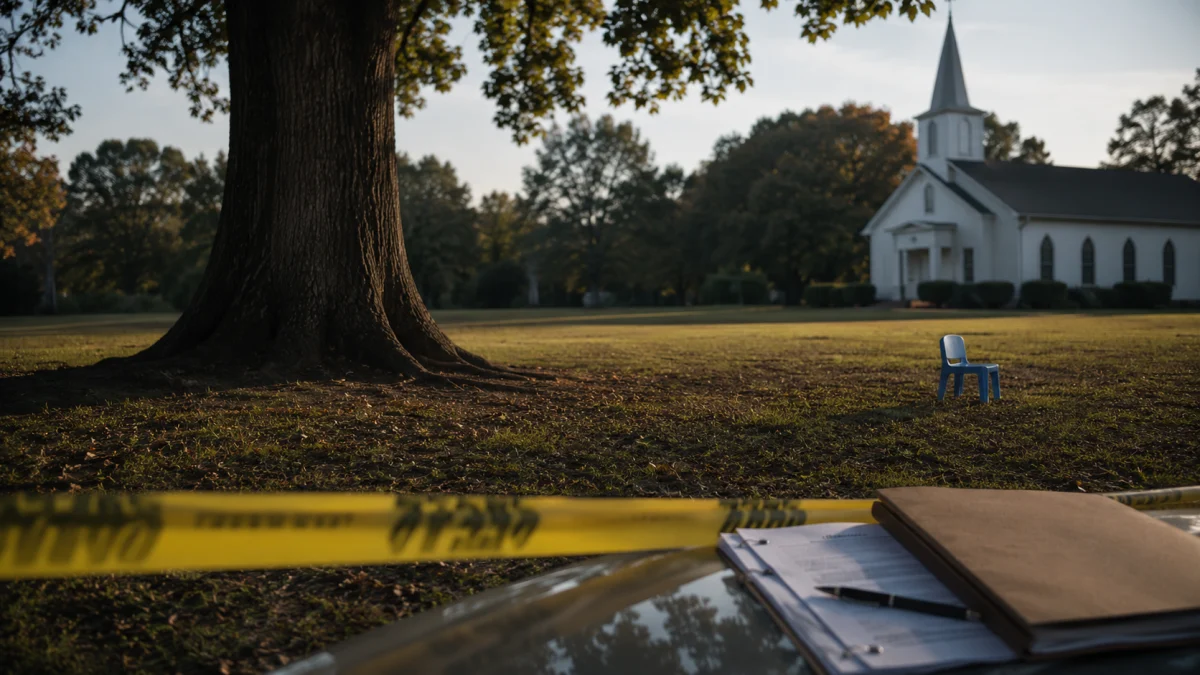
Juliana was found dead on May 8, 2026, on the grounds of the United House of Prayer for All People in north Charlotte, North Carolina. A cargo-style ratchet strap was around her neck and attached to a tree. Her feet were reportedly touching the ground. A small blue chair was nearby.
By the following Monday, the medical examiner had classified her death as suicide. Charlotte-Mecklenburg Police closed its investigation four days later.
No full autopsy had been performed. Police apparently never recovered Juliana’s cellphone. And Kenneth Tolbert—the man who actually discovered her body and recorded the scene before police arrived—says CMPD never interviewed him.
Those facts do not prove homicide.
They do, however, raise a much more defensible question:
How did investigators become sufficiently certain that Juliana killed herself to stop investigating the possibility of homicide?
That question becomes more serious—not less—when the person found hanging from a tree is a Black teenage girl in the American South.
History is not evidence that Juliana was lynched. But history absolutely changes what a competent institution should anticipate when such a scene is discovered. Police should have expected public scrutiny, expected the family to need answers, and built an evidentiary record strong enough to withstand both.
Instead, much of the detailed public explanation came only after The Charlotte Observer began asking questions.
That is the institutional failure worth examining.
What Happened to Juliana Nzita?
Juliana Umba Nzita was 16. Her family had emigrated from the Democratic Republic of the Congo. Relatives described her as gentle and active in church.
They have also openly acknowledged information supporting the possibility of suicide: Juliana had struggled with mental health problems, experienced severe bullying and eventually switched to virtual schooling.
That evidence matters. It should not be hidden simply because it complicates the story.
But mental-health struggles are a risk factor, not a forensic determination of how someone died.
Juliana had been missing for days when Kenneth Tolbert encountered her body around noon on May 8 while walking his dog through wooded church property along West Sugar Creek Road.
According to the Observer’s investigation, Tolbert initially thought he saw someone standing near a tree. As he approached, he realized Juliana was dead.
A ratchet strap commonly used to secure cargo was around her neck. The strap had been wrapped around a leaning tree considerably taller than Juliana. Her feet remained in contact with the ground, and a toddler-sized blue chair was nearby.
Tolbert alerted people at the church and recorded roughly two minutes of the scene on his phone.
He gave church members his name and number for police.
CMPD never contacted him, he told the Observer. It remains unclear whether the person who called 911 ever gave police his information.
That distinction matters. There is no evidence police deliberately refused to speak with Tolbert.
But the result is the same:
The person who discovered the body was never formally interviewed before the case was closed.
What Is Actually Verified?
Several facts are now reasonably well established through the Observer’s reporting and subsequent coverage:
- Juliana was found dead on May 8, 2026, on church property in north Charlotte.
- A ratchet strap was involved in the hanging.
- Her feet were reportedly touching the ground when Tolbert found her.
- A small blue chair was near the body.
- The medical examiner classified the death as suicide within days.
- CMPD closed the investigation four days after that determination.
- No full autopsy was performed before the official suicide determination.
- Police apparently did not recover Juliana’s cellphone.
- Tolbert says CMPD never interviewed him.
- Police say an external examination found no defensive wounds, no evidence of physical or sexual assault and no evidence they interpreted as indicating foul play.
- Police say a tree limb broke during the incident, potentially explaining the position in which Juliana was found.
- Cameras existed on the church property, but CMPD says they captured nothing relevant.
- Juliana’s family disputes the suicide determination and arranged an independent autopsy with DNA analysis.
The latest public reporting located for this article still described that independent review as proceeding; no subsequently released final result was located as of August 18, 2026.
That distinction matters enormously.
The appropriate status of this case is not “murder proven.” It is “officially ruled suicide, with substantial unanswered questions being challenged by the family.”
No, Her Feet Touching the Ground Does Not Prove It Was Homicide
One viral argument needs to be corrected.
It is possible to die by hanging without the entire body being suspended above the ground.
Forensic literature recognizes incomplete or partial suspension, in which a person’s feet, knees, buttocks or another part of the body remains supported. A recent prospective study of hanging deaths explicitly included such cases.
So Juliana’s feet touching the ground does not make suicide physically impossible.
But that correction does not make the broader forensic questions disappear.
A 2026 review in the International Journal of Legal Medicine emphasizes that hanging deaths can present ambiguous findings and that distinguishing suicide, accident and homicide requires a cautious, holistic assessment rather than simplistic rules based on individual physical signs.
That is precisely why the quality of the investigation matters so much here.
The question is not:
Could a person theoretically die by suicide in this position?
The answer is yes.
The real question is:
What evidence established that this particular person did?
Those are profoundly different questions.
“No Defensive Wounds” Is Evidence. It Is Not the Entire Case.
CMPD has offered evidence supporting its conclusion.
According to the department, Juliana’s body showed no defensive wounds and no signs of physical or sexual assault. Investigators said they found no evidence of foul play. Police also said a branch broke during the incident, which could account for aspects of the body’s position that appeared suspicious afterward.
Those findings should be taken seriously.
But they are not equivalent to proving that nobody else was involved.
Forensic research on hanging specifically warns that external findings can be limited and that differentiating suicidal hanging from other scenarios can become extremely difficult when scene evidence is incomplete.
That makes the unexplained investigative gaps more important.
Was the ratchet strap examined for DNA?
Was it examined for fingerprints or other trace evidence where technically feasible?
What did comprehensive toxicology show?
Was Juliana alive when the ligature was applied, and what forensic evidence supports that conclusion?
What was the exact distance between the chair, the ground and the point where the strap was secured?
Was the broken branch documented and reconstructed?
What happened to Juliana’s cellphone?
What is known about her movements during the days she was missing?
Who last communicated with her?
What did investigators establish about how she arrived at the church property?
These are not accusations.
They are basic questions created by the evidence that is currently public.
North Carolina Did Not Automatically Require an Autopsy. That Does Not End the Question.
One part of the online criticism is legally imprecise.
North Carolina law does not require a full internal autopsy every time someone dies by suicide.
Deaths resulting from suicide, homicide, violence or other suspicious, unusual or unnatural circumstances fall under medical-examiner jurisdiction. The medical examiner is required to investigate the cause and manner of death.
But state law permits medical examiners to determine when a full autopsy is advisable and in the public interest. Mecklenburg County likewise explains that not everyone examined by the medical examiner receives an autopsy.
So the strongest criticism is not that authorities necessarily violated an autopsy mandate.
It is this:
Why was a full autopsy considered unnecessary in this particular case?
A 16-year-old had been missing.
She was discovered hanging from a tree in a public outdoor location.
The object around her neck was a cargo ratchet strap.
The person who discovered her had questions about the physical scene.
Her cellphone was apparently missing.
Her family had no connection to the church property where she was found.
And authorities were nevertheless confident enough to certify suicide within days without performing the most comprehensive postmortem examination available.
That exercise of discretion deserves explanation.
“An autopsy wasn’t legally mandatory” is not an answer to whether declining one was a sound forensic decision.
North Carolina Law Required Something Else: Comprehensive Toxicology
There is another detail that deserves much more attention.
Since January 1, 2024, North Carolina law has required the Office of the Chief Medical Examiner to conduct comprehensive toxicology screening in every child death falling under medical-examiner jurisdiction.
Juliana was 16.
Her death unquestionably fell under medical-examiner jurisdiction because it was classified as suicide.
That means the public conversation should not simply ask whether toxicology was performed.
The more precise questions are:
What did the legally required comprehensive toxicology screening find, when were those results available, and what role—if any—did they play in determining Juliana’s manner of death?
North Carolina law also contains specific provisions allowing parents and other authorized family representatives access to finalized medical-examiner reports relating to a deceased child, subject to restrictions that apply while a criminal investigation is active.
Juliana’s family should not have to reconstruct the state’s reasoning from newspaper articles.
They deserve the underlying record.
The Man Who Found Her Body Should Have Been Interviewed
This may be the hardest investigative omission to explain.
Kenneth Tolbert did not merely hear about Juliana’s death.
He found her.
He saw the scene before emergency personnel, investigators and subsequent activity altered it. He recorded video. He could describe the body’s original position, the chair, the tree, the surrounding property and anything else he noticed upon approaching.
His personal theory about what happened could be completely wrong.
That is irrelevant.
Investigators interview witnesses because observations matter even when conclusions do not.
Tolbert told the Observer he could not reach the relevant tree limb himself despite being 5-foot-9 and doubted whether the small chair could have provided sufficient height or support.
Those observations might ultimately have innocent explanations.
Police still should have documented them.
The omission is especially striking because North Carolina lawmakers were already considering legislation designed to prevent premature suicide determinations.
North Carolina Legislators Were Already Trying to Fix This Problem
Senate Bill 847—Tyler’s Law—was filed on April 27, 2026.
On April 28, it passed first reading and was referred through committee.
That happens to be the same date Juliana was reported missing. The timing is coincidental, but the policy overlap is remarkable.
Tyler’s Law would prohibit an official suicide determination until a full investigation had been conducted and documented. Among its requirements would be interviews or attempted interviews of people present at or connected to the death scene.
As of August 18, 2026, the bill has not become law. Its last listed action remains its April 28 referral to the Senate Appropriations/Base Budget Committee.
The legislature was therefore contemplating, before Juliana’s body was even discovered, a statutory safeguard addressing almost exactly the criticism now being made in her case:
Do not formally call a death suicide before the people connected to the scene have at least been interviewed or investigators have documented attempts to interview them.
Whatever happened to Juliana, that proposal suddenly looks much less theoretical.
Did the Investigation Become Anchored on Suicide Too Early?
There is another uncomfortable possibility worth considering.
According to reporting based on the 911 recording obtained by the Observer, the caller described a young woman who had apparently hanged herself.
The caller was not doing anything wrong. A person encountering such a scene naturally tries to describe what appears to have happened.
But the difference between “a person is hanging from a tree” and “a person hanged herself” is the difference between an observation and a conclusion.
That distinction matters because forensic decision-making is not immune to cognitive bias.
Experimental research involving forensic pathologists has shown that medically irrelevant contextual information can influence manner-of-death determinations even among trained professionals. Researchers studying forensic decision-making therefore warn about contextual and confirmation biases that can shape how later evidence is interpreted.
None of this proves that happened in Juliana’s case.
It does establish that premature narrative anchoring is a real forensic problem rather than an invented social-media concern.
Once investigators believe they are examining a suicide, evidence can unconsciously be evaluated through the question, “Does this fit suicide?”
A stronger investigative model starts differently:
What happened here?
Suicide, homicide and accident remain competing hypotheses until enough evidence eliminates the alternatives.
Would This Have Been Handled Differently If Juliana Were White?
Nobody can rerun history with Juliana’s race changed.
So it would be irresponsible to claim as a verified fact that a white teenager would have received a different investigation.
But it would be equally irresponsible to pretend the question is irrational.
Tolbert himself raised the comparison:
“If this were a white girl who was found hanging at a Myers Park church, the police would have been all over this.”
The question is not occurring in a historical vacuum.
The U.S. Department of Justice’s Office of Justice Programs has explicitly recognized the disproportionate disappearance and victimization of Black women and girls and the comparatively limited attention many of their cases receive.
Using FBI data, OJP noted that Black women and girls accounted for more than 36% of female missing-person entries in 2022 despite representing roughly 14% of the U.S. female population.
The FBI’s latest 2025 NCIC report continues to show enormous numbers of missing Black girls and women: 95,682 Black female missing-person records were entered during 2025, including 75,875 involving girls under 18. These are entries, not necessarily unique individuals, because a person can generate more than one entry during a year.
That data cannot tell us whether CMPD treated Juliana differently because she was Black.
It tells us something more limited but still important:
Concern about unequal urgency surrounding missing Black girls is grounded in a documented national problem.
And Juliana was not only Black. She was the teenage daughter of a Congolese immigrant family.
When communities with well-documented reasons for distrusting institutions ask for evidence, institutional leaders should respond with evidence—not simply tell them to trust.
Blind Deference to Police Is Not Oversight
After the Observer’s reporting brought the case wider attention, some Charlotte City Council members expressed alarm.
Council member Kimberly Owens reportedly argued that the death of a young woman of color who had been missing and was then found hanging on church property warranted a different level of response. JD Mazuera Arias criticized the lack of proactive communication and transparency.
That is what elected oversight is supposed to look like: asking questions precisely when government institutions would prefer the issue considered settled.
Institutional trust should be the result of verifiable performance.
It should never be used as a substitute for it.
If the investigation was comprehensive, documenting that should strengthen CMPD’s conclusion.
If important evidence was never collected, transparency will expose that too.
Either outcome is preferable to demanding public confidence in information the public has not been allowed to see.
The Historical Context Cannot Simply Be Edited Out
A Black person hanging from a tree in the American South is not an ordinary visual fact.
For generations, hanging was one of the signature methods of racial terror used against Black Americans.
Charlotte itself has documented that history. Shortly before Juliana’s death, the Charlotte Remembrance Project installed a memorial marker for Willie McDaniel, a Black man lynched near Charlotte in 1929. The marker is part of a larger effort to document racial-terror lynchings and the frequent failure of white authorities to meaningfully investigate them.
That history does not transform every modern hanging death of a Black person into a lynching.
But it changes the responsibilities of institutions encountering one.
Authorities know—or should know—that such a scene will evoke legitimate historical fear.
The appropriate response is therefore more forensic rigor, more documentation and more transparency, not indignation that the public is suspicious.
History is not evidence of Juliana’s homicide.
History is evidence explaining why institutional opacity in her case is exceptionally damaging.
The Broader Issue Is Not “Every Black Person Found Hanging Was Lynched”
Recent cases make the distinction especially important.
In August 2026, 29-year-old Tasia Fortune, a Black mother of four, was found hanging behind an abandoned home in Jackson, Mississippi.
Her family strongly disputes suicide.
But Mississippi authorities have not simply announced that the family’s instincts prove homicide. The body was sent to the state medical examiner for an autopsy, and as of the most recent reporting, cause and manner of death remained under investigation.
In Alabama, Dennoriss Richardson’s 2024 death generated similar distrust. Authorities concluded he died by suicide, while a private autopsy commissioned by his family said it could not definitively determine suicide and recommended a thorough investigation to exclude a staged hanging. The local sheriff requested FBI involvement.
Then consider a very recent North Carolina case that points in the opposite direction.
On August 15, 2026, a 32-year-old Black man was found hanging from a tree in downtown Raleigh.
The circumstances immediately generated suspicion online.
Raleigh police responded by describing specific evidence. Chief Rico Boyce said traffic-camera footage showed the man walking alone toward the tree carrying the electrical cord later involved in his death and showed no other person present during the incident. Police said they had found no evidence that another person contributed to his death, while acknowledging that the medical examiner retained responsibility for the final determination.
That case is instructive.
The public’s initial suspicion did not magically prove homicide.
But authorities also had concrete evidence with which to answer the suspicion.
Video. Timeline. Object. Presence or absence of other people. Medical-examiner review.
That is what evidence-based reassurance looks like.
The lesson from Juliana’s case should not be that police must treat every hanging as murder.
It should be that the more extraordinary the circumstances, the less an institution should expect its conclusion alone to satisfy the public.
What About Claims of “Modern-Day Lynchings”?
Civil-rights organization JULIAN has published a report called A Crimson Record, arguing that some deaths of Black Americans classified as suicides or accidents may actually represent modern racial violence.
The organization identified 70 cases across seven Southern states between 2000 and 2025 that it considers modern-day lynchings.
That number needs to be handled carefully.
It is an advocacy organization’s classification, not a verified count of 70 murders proven to have been lynchings.
Treating all 70 cases as established homicides would repeat the exact evidentiary mistake this article is criticizing—starting with a conclusion and forcing each case into it.
But the report raises a legitimate systemic question:
How often can we independently audit suicide determinations once investigators stop treating a death as potentially criminal?
If a death has been misclassified, the consequences compound rapidly.
Potential witnesses disappear.
Electronic records vanish.
Video is overwritten.
Scenes change.
Physical evidence may be released, destroyed or never collected.
Memories fade.
A premature suicide determination therefore creates an asymmetric risk: if the conclusion is correct, further investigation consumes additional resources; if it is wrong, prematurely ending the investigation can permanently destroy the ability to prove what actually happened.
That asymmetry is why caution matters.
The Viral Version Gets One Important Thing Wrong
Social-media commentary surrounding Juliana’s case sometimes states categorically that Black people do not kill themselves by hanging.
That is false.
Black Americans die by suicide, and hanging is a documented suicide method across racial groups. Research examining racial and ethnic differences in suicide methods has found differences in frequency—for example, Black suicide decedents in one large California study were more likely to use firearms than hanging—but not an absence of hanging deaths.
Correcting that claim does not weaken the case for scrutiny.
It strengthens it.
Juliana’s family should not have to rely on an inaccurate statistical claim to receive a rigorous investigation.
Neither should people concerned about racial injustice.
The argument can stand entirely on documented facts:
A missing 16-year-old girl was found hanging from a tree in an unusual public setting. Her manner of death was determined within days. No full autopsy was performed. Her phone apparently remained missing. The person who discovered her body was never interviewed. And substantial details explaining the government’s confidence emerged only after journalists began pressing for answers.
That is enough.
Juliana’s Mental-Health History Cannot Be Used as a Shortcut
Juliana’s reported struggles with mental health and bullying matter.
They make suicide a plausible hypothesis.
They do not establish suicide as fact.
This distinction is particularly important because almost any suspicious death can be made to look less suspicious if investigators retrospectively identify depression, trauma, relationship problems, financial problems, substance use or another stressor.
Human beings can have suicidal thoughts and still be victims of homicide.
Human beings can also appear happy and die by suicide.
Biography cannot substitute for forensic evidence in either direction.
The purpose of a death investigation is not to determine whether suicide sounds psychologically believable.
It is to determine what physically happened.
Justice Does Not Require Pretending We Already Know the Answer
There is a temptation in cases like Juliana’s to choose a camp.
Either:
Trust the police. It was suicide.
Or:
Trust the family. It was murder.
That binary is intellectually lazy.
A justice-centered approach asks something more demanding:
Has the investigation earned its conclusion?
Right now, based solely on the public record, there are significant reasons to ask for more.
That does not mean CMPD’s conclusion is ultimately wrong.
It means institutional confidence and evidentiary confidence are not the same thing.
If Juliana died by suicide, a rigorous independent review should reinforce that finding and give her family something far more meaningful than “trust us.”
If she did not, every day spent treating the case as conclusively solved risks allowing evidence to disappear.
Either way, more scrutiny is not an attack on justice.
It is justice.
What Should Happen Now?
A reasonable response does not require declaring a lynching or identifying imaginary suspects.
It requires completing—and documenting—the work necessary to remove reasonable doubt about whether another person was involved.
At minimum:
-
Juliana’s family and legal representatives should receive the finalized medical-examiner investigation and toxicology records available to them under North Carolina law.
-
Authorities should explain why a full autopsy was considered unnecessary given Juliana’s age, the unusual scene, her missing-person status and the unresolved cellphone issue.
-
The comprehensive toxicology required under North Carolina law should be accounted for, including when it was completed and whether its results informed the suicide determination.
-
Kenneth Tolbert should be formally interviewed, even now, with his observations separated from his personal conclusions.
-
CMPD should account for the investigation into Juliana’s missing cellphone and explain what efforts were made to reconstruct her communications and movements while she was missing, to the extent disclosure does not compromise legitimate privacy interests.
-
The physical evidence should receive an independent forensic review, including whatever testing was or was not performed on the ratchet strap and other retained evidence.
-
The family’s independent autopsy findings should be compared directly with the government’s examination, with material disagreements investigated rather than dismissed.
-
An outside agency or independent forensic authority should review the complete file if substantial unresolved discrepancies remain.
And North Carolina lawmakers should take another look at Tyler’s Law.
A rule requiring documented investigation before formally classifying an apparent suicide is not anti-police.
It protects families, competent investigators and the integrity of death certification alike.
The Question Charlotte Still Needs to Answer
The central question is not whether social media can prove Juliana Nzita was murdered.
It cannot.
The question is why authorities were prepared to stop asking whether she might have been.
A 16-year-old girl disappeared.
Days later she was found dead, hanging from a tree on church property.
The medical examiner reached a suicide determination within days.
No full autopsy was performed.
The man who discovered her was not interviewed.
Her cellphone apparently was not found.
Her family remains unconvinced.
Those circumstances do not establish homicide.
They establish that skepticism is reasonable.
And when a Black family asks whether their child would have received a more exhaustive investigation if she were white, the answer cannot simply be institutional offense at the question.
American institutions created the history that makes the question possible.
Modern institutions have to earn the trust required to answer it.
Juliana Nzita deserves neither a predetermined murder narrative nor a prematurely closed suicide narrative.
She deserves something much simpler.
A determination strong enough to survive scrutiny.
Until the evidence supporting that determination is complete, transparent and independently defensible, the questions surrounding her death should not be treated as closed.
References and Further Reading
Primary Law and Medical-Examiner Standards
North Carolina General Statutes § 130A-383 — Medical Examiner Jurisdiction — Establishes medical-examiner jurisdiction over suicides, homicides and suspicious, violent, unusual or unnatural deaths.
North Carolina General Statutes § 130A-385 — Duties of the Medical Examiner — Requires inquiry into cause and manner of death and comprehensive toxicology screening for child deaths under medical-examiner jurisdiction; also governs access to records involving deceased minors.
North Carolina General Statutes § 130A-389 — Autopsies — Defines circumstances in which the Chief Medical Examiner or designated pathologist performs an autopsy and confirms that full autopsy is not automatic in every medical-examiner case.
North Carolina Office of the Chief Medical Examiner — Frequently Asked Questions — Explains that external examination, medical history and testing may sometimes substitute for full autopsy and that manner-of-death determinations remain expert opinions that can be contested.
North Carolina Legislative Analysis — Comprehensive Toxicology Screening in Child Deaths — Nonpartisan legislative analysis documenting the January 1, 2024 effective date of mandatory comprehensive toxicology screening in medical-examiner child-death cases.
Juliana Nzita Case Reporting
The Charlotte Observer — “A Black teen found hanged near Charlotte church was a suicide, police say. Questions linger” — The central original investigation establishing the timeline, scene, lack of full autopsy, missing cellphone, uncontacted discovery witness, CMPD’s explanation and the family’s independent review. A syndicated copy was also reviewed for this article.
TheGrio — “Family and community question suicide ruling in death of Black teen found hanged in Charlotte” — Independent follow-up summarizing the family’s objections and unanswered investigative questions.
Blavity — “Family Of Juliana Umba Nzita, Found Hanged In Charlotte, Is Demanding An Autopsy After Suicide Ruling” — Follow-up on the family’s independent autopsy effort and criticism from Charlotte City Council members.
Proposed North Carolina Reform
North Carolina Senate Bill 847 — Tyler’s Law — Proposed legislation requiring a documented investigation before an apparent suicide can officially be classified as suicide, including interviews or attempted interviews of people connected to the scene.
North Carolina General Assembly — Current Status of Senate Bill 847 — Official legislative history showing that, as of publication, Tyler’s Law remains pending and has not become law.
Forensic Science and Suicide Classification
International Journal of Legal Medicine — “Death by hanging: possibilities and limits of medico-legal evidence” — 2026 forensic review explaining why individual findings in hanging deaths can be ambiguous and why manner-of-death classification requires cautious, holistic analysis.
Forensic Sciences — “Autopsy Findings in Hanging: A 10-Year Prospective Study of 660 Cases” — Documents complete and incomplete suspension and illustrates why feet or other body parts remaining supported do not by themselves exclude suicidal hanging.
Journal of Forensic Sciences — “Cognitive bias in forensic pathology decisions” — Experimental evidence involving forensic pathologists showing that contextual information can influence manner-of-death determinations.
Death Studies — “Ethnic variations in suicide method and location” — Documents racial and ethnic differences in suicide method and location while demonstrating why categorical claims that Black people do not die by suicide by hanging are unsupported.
Missing Black Women and Girls
U.S. Department of Justice, Office of Justice Programs — “Shining a Light on the Crisis of Missing or Murdered Black Women and Girls in the United States” — Federal discussion of the disproportionate representation of Black women and girls among missing-person reports and longstanding concerns about inadequate attention to their cases.
FBI — 2025 NCIC Missing Person and Unidentified Person Statistics — Current federal data breaking missing-person entries down by age, sex and race and documenting 2025 figures for Black girls and women.
Broader Hanging-Death Scrutiny
Associated Press — “What we know about the death of Tasia Fortune in Mississippi” — Current reporting on another contested hanging death of a Black woman in the South, where authorities sent the body for autopsy and had not yet determined manner of death.
Associated Press — “Local sheriff asks FBI to investigate death of Black man found hanging in Alabama” — Details the Dennoriss Richardson case and the decision to seek federal review amid family and community distrust.
WRAL — “Police confirm man found dead in downtown Raleigh died by suicide” — A useful contemporary comparison showing authorities responding to public suspicion with specific video and timeline evidence while the medical examiner retained final review.
Axios — “New report says lynching ‘evolved’ in U.S., not ended” — Covers JULIAN’s A Crimson Record and its claim of 70 suspected modern-day lynchings; useful as an advocacy claim requiring independent scrutiny rather than as a verified count of proven murders.
Editorial currency note: This article reflects public records, statutes and reporting available through August 18, 2026. Juliana Nzita’s family’s independent autopsy, additional medical-examiner records, CMPD records or subsequent investigative findings could materially change what is known about the case. The official manner of death remains suicide unless and until the relevant medical examiner amends that determination.