
Yes. ChatGPT now has advertising.
OpenAI began testing ads in the United States on February 9, 2026, for logged-in adults using the Free and Go tiers. It subsequently began expanding the pilot internationally, and on August 11 confirmed that ChatGPT Ads had launched in the United Kingdom, Mexico, Brazil, Japan and South Korea. Plus, Pro, Business, Enterprise and Education plans remain ad-free under OpenAI’s current policy.
But calling these simply “ads in ChatGPT” misses what makes the system unusual.
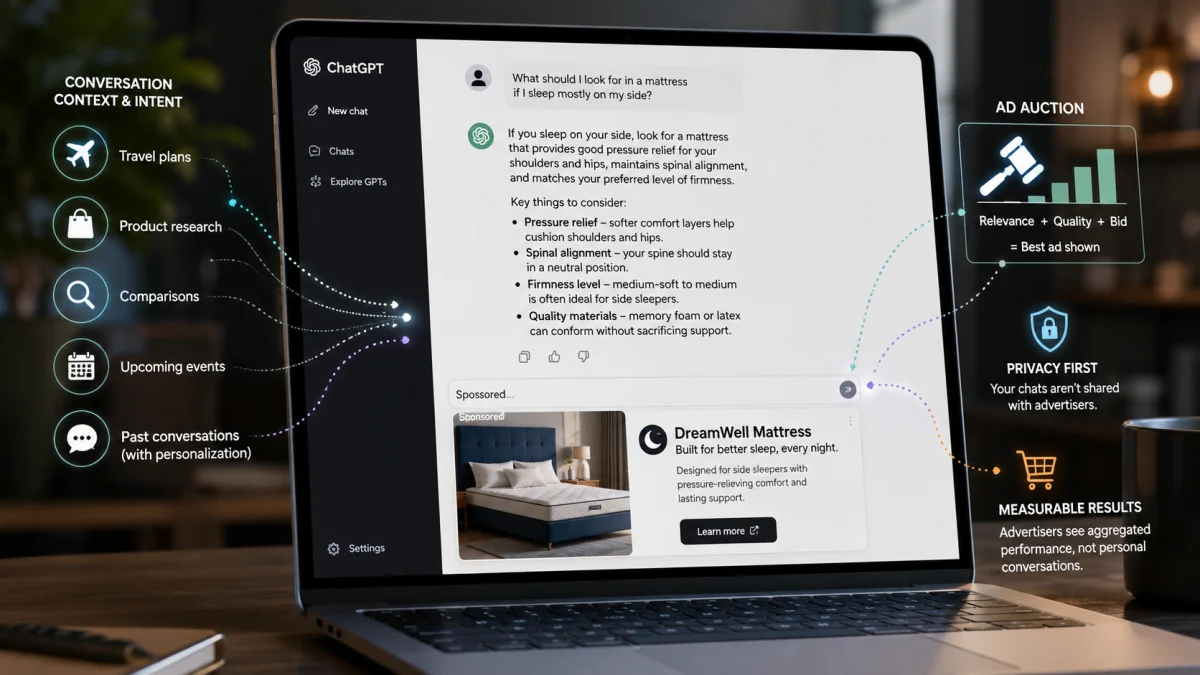
ChatGPT Ads can use the context and intent of your conversation to decide which advertisement might be relevant. If ad personalization is enabled, OpenAI says signals from past conversations, ChatGPT memory and previous ad activity may also contribute.
That makes this meaningfully different from a traditional banner ad—and potentially much closer to the commercial-intent machinery that made Google search advertising so valuable.
It also creates an obvious trust question: if an AI system understands what you are trying to accomplish well enough to select an advertisement, how separate is that commercial system from the answer you came for?
OpenAI says the separation is strict. The public evidence supports some parts of that claim more directly than others.
What Do Ads in ChatGPT Look Like?
For now, the basic format is straightforward.
The ChatGPT response appears first. A separately labeled sponsored placement can then appear below the answer.
According to OpenAI’s advertiser documentation, a ChatGPT ad may include an advertiser name, logo, headline, description, image and landing-page link. OpenAI says ads are visually separated from normal ChatGPT responses rather than written into them.
That distinction is important.
Imagine asking:
What should I look for in a mattress if I sleep mostly on my side?
ChatGPT could answer with information about pressure relief, firmness, body weight and mattress construction.
A mattress advertisement could then appear underneath.
OpenAI’s stated model is that the mattress company purchased the advertising placement, not the answer above it.
That is how the system is supposed to work today.
Which ChatGPT Users See Ads?
OpenAI initially launched ChatGPT Ads for logged-in adult users on its Free and Go tiers.
The company currently says paid Plus and Pro accounts, along with Business, Enterprise and Education plans, do not receive ads. Accounts identified as belonging to users under 18 are also excluded.
Free users in supported regions may also have an Ads-Free Free option.
That sounds contradictory, but the trade-off is simple: OpenAI says users who choose the free ad-free experience receive lower usage limits and reduced access to certain tools, which may include image generation and deep research. Users who want an ad-free experience without those reduced limits can move to a paid tier.
Availability and specific controls vary by country as the system continues expanding.
How Does ChatGPT Know Which Ad to Show You?
This is the part that separates ChatGPT Ads from ordinary display advertising.
OpenAI says its advertising system considers several signals when selecting an ad, including the context and intent of the current conversation, information on the advertiser’s landing page, the advertisement itself and what advertisers call context hints.
Context hints allow advertisers to describe the kinds of conversations in which their product could be relevant.
These are not merely traditional exact-match keywords.
An advertiser selling carry-on luggage might want to reach conversations involving:
“two-week trip to Italy”
“airline carry-on limits”
“packing light for Europe”
“best suitcase for frequent travel”
rather than simply purchasing the keyword luggage.
OpenAI says these hints help its system understand relevance but do not guarantee placement in a particular conversation. Eligible ads then compete through what OpenAI describes as a relevance-weighted, second-price auction.
So money matters.
But OpenAI also says relevance matters.
That combination looks much more like a mature advertising marketplace than a simple experimental banner system.
Can ChatGPT Use Your Past Conversations to Target Ads?
Yes, when ad personalization is enabled.
This is one of the most important facts to understand about the system.
OpenAI says personalized ad selection can incorporate signals from the current conversation as well as selected information from a user’s broader ChatGPT experience, including past chats, memory and prior interactions with advertisements. Users can disable that broader personalization.
Turning personalization off does not necessarily remove advertising.
Instead, OpenAI says ads can still be selected from the context of the conversation you are currently having.
Consider two people asking the same question:
What should I do this weekend?
One has spent months discussing woodworking with ChatGPT.
The other regularly asks about hiking.
If personalized advertising is enabled, those histories could potentially make very different advertisements relevant despite the identical current question.
That is a significantly richer advertising signal than a conventional web search.
Does That Mean Advertisers Can Read Your Chats?
According to OpenAI, no.
This distinction is easy to lose in sensationalized discussions of AI advertising.
There are two separate propositions:
OpenAI’s advertising system can use information derived from your ChatGPT activity to select an advertisement.
That is confirmed by OpenAI’s own documentation.
The advertiser receives your conversations, memories or chat history.
OpenAI says that does not happen.
The company states that advertisers do not receive users’ chats, chat history, memories or personal details and instead receive aggregated information about advertising performance, such as views and clicks. OpenAI also says it does not sell user data to advertisers.
Those claims describe OpenAI’s internal data architecture and policies. They should therefore be understood as OpenAI’s stated practices, rather than as something outside observers can fully verify merely by reading the product documentation.
Still, “ChatGPT can use conversation context to choose an ad” and “advertisers are reading your private chats” are not equivalent claims.
Current evidence supports the first.
OpenAI explicitly denies the second.
Advertisers Can Still Bring Their Own Customer Data
There is another layer that makes ChatGPT Ads resemble established platforms such as Google and Meta.
OpenAI allows advertisers to create custom audiences from their own customer or prospect lists using email addresses or phone numbers.
Those audiences can be used to include or exclude groups from campaigns or change how aggressively an advertiser bids when someone falls within a particular audience. OpenAI currently requires at least 25,000 matched users before a custom audience can be used and says Ads Manager does not reveal individual matched users to the advertiser.
That means conversational relevance is only one part of the system.
An advertiser may already know that an email address belongs to one of its customers, upload that customer list to the platform and use the resulting matched audience when buying ChatGPT ads.
This is standard territory in modern digital advertising, but it is worth understanding because ChatGPT Ads are sometimes described as though they are based only on whatever someone happens to type into a conversation.
They are already more sophisticated than that.
Can Advertisers Pay ChatGPT to Change Its Answers?
OpenAI says no.
This is the most important firewall in the entire advertising system.
OpenAI states that advertising does not influence the answers ChatGPT gives and that advertisements remain separate from the organic response. The company says its answers are generated based on what is most useful to the user rather than which advertiser has paid for placement.
In practical terms, a luggage company should theoretically be able to purchase a sponsored placement beneath a discussion about travel.
It should not be able to purchase this sentence from ChatGPT:
Brand X is the best suitcase you should buy.
There is an important evidence distinction here.
Verified: OpenAI has publicly committed to separating ads from ChatGPT answers, and the visible ad format itself is designed around separate sponsored placements.
Not independently verified: The public cannot inspect every internal ranking, training or serving system and independently establish that commercial incentives have zero influence anywhere in the answer-generation pipeline.
There is currently no evidence presented here that advertisers are buying ChatGPT answers.
But because answer independence is an internal system property, OpenAI’s commitment should be treated as a claim that deserves continuing scrutiny—not as a principle that no longer needs to be checked.
Why ChatGPT Advertising Could Be More Powerful Than Search Advertising
This section is analysis, not an established fact.
Google became extraordinarily valuable because search queries reveal intent.
Someone searching:
best laptop under $1,500
is far more commercially useful to an advertiser than someone passively reading an unrelated webpage.
ChatGPT conversations can contain even richer intent.
Consider:
I travel twice a month, use Photoshop and Chrome all day, don’t play games, want something under four pounds and would rather stay around $1,500.
That single conversation potentially communicates the customer’s product category, budget, priorities, objections, use case and purchasing stage.
A keyword tells an advertising system what someone searched.
A detailed conversation can reveal what someone is actually trying to accomplish and why.
That difference could make conversational advertising extremely valuable.
OpenAI’s own advertiser documentation emphasizes reaching people while they are exploring, comparing and making decisions. Its system is already designed to consider conversation context rather than merely exact keywords.
Whether ChatGPT advertising ultimately approaches the scale or profitability of Google Search remains unknown.
But the commercial logic is obvious.
This Is Already Becoming a Real Advertising Platform
The word “test” can make ChatGPT Ads sound smaller than they currently are.
OpenAI has already introduced a beta self-service Ads Manager through which businesses can create campaigns, set budgets and bids, upload advertisements, manage delivery and review performance. It has also worked with major advertising and agency companies including Dentsu, Omnicom, Publicis, WPP, Adobe, Criteo and others.
Advertisers can buy impressions through CPM campaigns or clicks through CPC campaigns.
OpenAI currently recommends advertisers beginning standard CPC campaigns consider maximum bids around $3 to $5 per click, though actual pricing depends on the auction.
It has since added conversion-optimized CPC campaigns, where the system can optimize ad delivery toward downstream events such as purchases, registrations or lead submissions while still billing the advertiser for clicks.
This is no longer merely a question of whether OpenAI can place an advertisement below a chatbot response.
The machinery of a broader advertising marketplace is being built.
OpenAI Can Measure Whether You Buy Something After Clicking
OpenAI also offers advertiser conversion tracking.
Its current system supports an OpenAI Pixel, a server-side Conversions API or both. These tools can help determine whether someone who clicked a ChatGPT advertisement later completed an action such as making a purchase, registering or submitting a lead.
The documentation also describes advanced matching, through which eligible first-party information may be normalized and hashed to improve conversion measurement when direct click information is incomplete.
As of August 17, 2026, OpenAI says automatic advanced matching became enabled for existing web pixels unless the advertiser opts out. According to OpenAI, raw customer information detected by the pixel is hashed in the browser before being transmitted through that feature.
Again, this is fairly conventional modern advertising infrastructure.
What is unconventional is the environment feeding people into it: a conversation with an AI assistant.
Where Does OpenAI Say Ads Will Not Appear?
OpenAI has created restrictions intended to keep advertising away from sensitive conversations.
Its August 2026 advertising policies prohibit ad placement around numerous categories, including political conversations, suicide and self-harm, personal mental or physical health discussions, emotionally dependent interactions with the AI, child-safety issues, weapons, terrorism and various other unsafe or highly sensitive contexts.
Political advertising itself is also currently prohibited.
Those safeguards matter because contextual advertising becomes much more ethically complicated when the context involves vulnerability.
A person asking:
Which running shoes are good for wide feet?
is an obvious commercial environment.
A person telling an AI they have just received a frightening medical diagnosis is not.
OpenAI’s current policy recognizes that difference.
Whether those safeguards remain equally restrictive as the advertising business grows is a reasonable issue to monitor.
Can You Turn ChatGPT Ad Personalization Off?
Yes, where the relevant controls are available.
OpenAI says users can disable personalized advertising, clear data used for advertising, dismiss ads and inspect information about why a particular ad was shown.
If personalization is disabled, the current conversation can still inform ad relevance, but OpenAI says past chats, advertising history and broader personalization signals will no longer be used in the same way.
That is different from going completely ad-free.
Users who want no advertising can use an eligible ad-free paid tier or, where offered, accept lower Free-tier limits in exchange for a free ad-free experience.
The Biggest Risk Is Not Necessarily Privacy. It May Be Trust.
There is a subtler issue here than whether an advertiser literally receives your chat transcript.
Suppose someone spends 15 minutes asking ChatGPT about mattresses.
The assistant explains firmness, sleeping position, spinal alignment, materials and pricing.
Immediately below that explanation appears:
Sponsored — Mattress Brand X
Technically, the answer and the advertisement may be completely independent.
Psychologically, the separation is less clean.
Some users will inevitably interpret the sponsored product as related to—or even implicitly endorsed by—the advice they just received.
OpenAI explicitly says an advertisement appearing in ChatGPT does not mean OpenAI recommends or endorses that advertiser.
But labels alone do not eliminate association.
This is likely to be one of the central challenges of conversational advertising: the more useful and trusted the assistant becomes, the more commercially valuable the space immediately surrounding its advice becomes.
And the more valuable that space becomes, the more important the firewall between ad selection and answer generation becomes.
Advertising Also Changes OpenAI’s Incentives
OpenAI says it does not optimize ChatGPT for time spent and that user trust and usefulness take precedence over advertising revenue. Its original advertising principles describe subscriptions and enterprise services as core businesses while presenting advertising as another way to support broader access.
That is the stated policy.
The structural incentive is nevertheless worth examining.
A service funded only by subscriptions primarily benefits when users value the product enough to keep paying for it.
An advertising-supported service acquires an additional financial incentive: valuable advertising opportunities become valuable to the platform.
That does not demonstrate that ChatGPT answers are being manipulated.
It means the incentive now exists.
There is nothing unusual about acknowledging that. The same logic applies to every advertising-supported media or technology company.
The appropriate response is not to assume corruption.
It is to maintain transparency and keep watching whether the wall between editorial—or in this case algorithmic—answers and commercial placements actually holds.
Is OpenAI “Selling Your Conversations” to Advertisers?
Based on the currently available evidence, that is an inaccurate way to describe the system.
OpenAI openly acknowledges using conversation context for advertising relevance and, with personalization enabled, using selected signals from broader ChatGPT activity.
That deserves scrutiny on its own terms.
But OpenAI simultaneously states that advertisers do not receive users’ private conversations, memories or chat histories.
Those are materially different practices.
A reasonable criticism would be:
I am uncomfortable with an AI platform using information from my conversations to personalize advertising.
That accurately describes the concern.
Saying:
Companies buying ChatGPT ads can read my private conversations.
is not supported by OpenAI’s published system description or by evidence reviewed for this article.
Being critical does not require making the claim larger than the evidence supports.
Are ChatGPT Ads the Beginning of a Replacement for Google Search Ads?
Possibly—but that conclusion would be premature.
ChatGPT Ads currently operate at a tiny scale compared with the mature global advertising businesses built by Google and Meta.
There is no established evidence yet that conversational ads will produce comparable advertiser returns, auction depth or commercial volume.
But the underlying opportunity is significant.
Search advertising monetized queries.
Social advertising monetized identity, interests and behavior.
Conversational advertising may be able to monetize intent, context and decision-making.
That is a different category of signal.
If conversational AI becomes a major place where people research products, plan trips, compare services, evaluate purchases and make everyday decisions, the advertising opportunity surrounding those conversations could become enormous.
That is reasonable inference.
It is not yet a demonstrated outcome.
So Should ChatGPT Have Ads?
There is nothing inherently unreasonable about funding a free service partly through advertising.
Advanced AI systems require substantial infrastructure, and an advertising-supported option can allow people to use more capable tools without paying a recurring subscription.
The real issue is what advertising is allowed to purchase.
If advertisers can purchase clearly labeled space around an independently generated answer, ChatGPT Ads can function much like other forms of contextual advertising.
If advertisers can ever purchase the substance of the answer itself, the product becomes fundamentally different.
That is the boundary that matters most.
For now, OpenAI says the answer is not for sale.
The advertising platform developing underneath it very much is.
Bottom Line
ChatGPT now has ads for some users, and they are more sophisticated than ordinary banner advertisements.
OpenAI’s advertising system can use the subject and intent of the current conversation when deciding which sponsored placement to show. With personalization enabled, past chats, memory and previous advertising interactions may also contribute.
OpenAI says advertisers themselves do not receive private chats or memories and cannot pay to change ChatGPT’s answers. Those are important commitments, but because they concern OpenAI’s internal systems, the strongest version of those claims ultimately relies on OpenAI maintaining the firewall it says exists.
Meanwhile, the surrounding advertising infrastructure is already becoming substantial: self-service campaigns, auctions, contextual targeting, customer-list audiences, conversion pixels, server-side measurement and conversion optimization are all now part of the platform.
The bigger story, therefore, is not simply that OpenAI added advertisements to ChatGPT.
It is that human conversation itself is becoming an advertising surface.
And if AI assistants increasingly become where people think through purchases and decisions, conversational intent could eventually become one of the most commercially valuable signals on the internet.
The standard users should insist on is simple:
The space around the answer can be sponsored. The answer itself cannot be.
Frequently Asked Questions
Does ChatGPT show ads now?
Yes. OpenAI began testing ChatGPT Ads in the United States on February 9, 2026, and has since expanded the program into additional countries.
Does ChatGPT Plus have ads?
OpenAI currently says Plus, Pro, Business, Enterprise and Education plans are ad-free.
Does ChatGPT use my conversations for advertising?
The current conversation can inform advertising relevance. If personalization is enabled, OpenAI says selected signals from past chats, memory and prior ad interactions may also be used.
Can advertisers see my ChatGPT conversations?
OpenAI says advertisers cannot see your chats, chat history or memories and receive aggregated advertising-performance information instead.
Can a company pay ChatGPT to recommend its product?
OpenAI says no. Sponsored ads are supposed to remain separate from ChatGPT’s generated answers.
Can I turn ChatGPT ads off?
Depending on your plan and region, you may be able to use an ad-free paid plan or choose a more limited ad-free Free experience. Turning off personalization alone does not necessarily remove advertisements.
Are ChatGPT ads based only on keywords?
No. OpenAI says its system considers conversation context and intent along with advertiser-provided context hints and other relevance signals.
Does ChatGPT track whether I buy something after clicking an ad?
Advertisers can use OpenAI’s conversion-measurement tools, including the OpenAI Pixel and Conversions API, to measure actions such as purchases, leads and registrations after eligible ad clicks.
References and Further Reading
OpenAI — ChatGPT Ads Rollout and User Experience
Testing ads in ChatGPT — OpenAI — OpenAI’s primary running announcement for the ChatGPT Ads rollout. It documents the February 9, 2026 U.S. launch, subsequent international expansion, eligible plans, answer-independence policy, use of conversation context for ad matching and OpenAI’s stated privacy protections.
Ads in ChatGPT — OpenAI Help Center — The main user-facing documentation explaining ad personalization, use of past chats and memory, ad controls, ad-free options, advertiser access to data and the distinction between sponsored placements and ChatGPT answers.
Our approach to advertising and expanding access to ChatGPT — OpenAI — OpenAI’s original January 2026 statement of its advertising principles, including its claims regarding answer independence, conversation privacy, user control and its decision not to optimize ChatGPT primarily for time spent.
OpenAI — How the Advertising Marketplace Works
Ads in ChatGPT: The Basics — OpenAI Help Center — The strongest primary source for understanding ad matching and auctions. It explains conversational context and intent, advertiser context hints, CPM and CPC buying, relevance-weighted auctions and advertiser measurement.
New ways to buy ChatGPT ads — OpenAI — Details the development of the beta self-service Ads Manager, CPC buying, agency and ad-technology partnerships and OpenAI’s broader effort to turn the initial experiment into an advertising platform.
Conversion-optimized Campaigns — OpenAI Help Center — Documents OpenAI’s oCPC advertising option, which optimizes click-based campaigns toward downstream outcomes such as purchases, registrations or lead submissions.
OpenAI — Audience Targeting and Measurement
Set up Custom Audiences for your Campaign — OpenAI Help Center — Explains how advertisers can upload customer or prospect lists using email addresses or telephone numbers, use those audiences for campaign eligibility or bid adjustments, and the current minimum audience-size safeguards.
Conversion Measurement — OpenAI Help Center — Documents the OpenAI Pixel, Conversions API, click attribution, advanced matching and modeled measurement used to understand actions that occur after users interact with ChatGPT advertisements.
OpenAI — Advertising Safety and Restrictions
Ad policies — OpenAI — OpenAI’s current rules governing where advertisements may appear and which categories may be advertised, including restrictions involving sensitive conversations, politics, health, self-harm, weapons and other high-risk contexts.
Editorial currency note: ChatGPT Ads are an actively developing product. Geographic availability, plan eligibility, personalization settings, advertiser capabilities, bidding methods, measurement tools and placement restrictions may change. This article was checked against OpenAI’s current published documentation on August 18, 2026. Statements concerning OpenAI’s internal separation of advertising and answer generation are identified as OpenAI’s stated policies rather than independently audited technical findings.