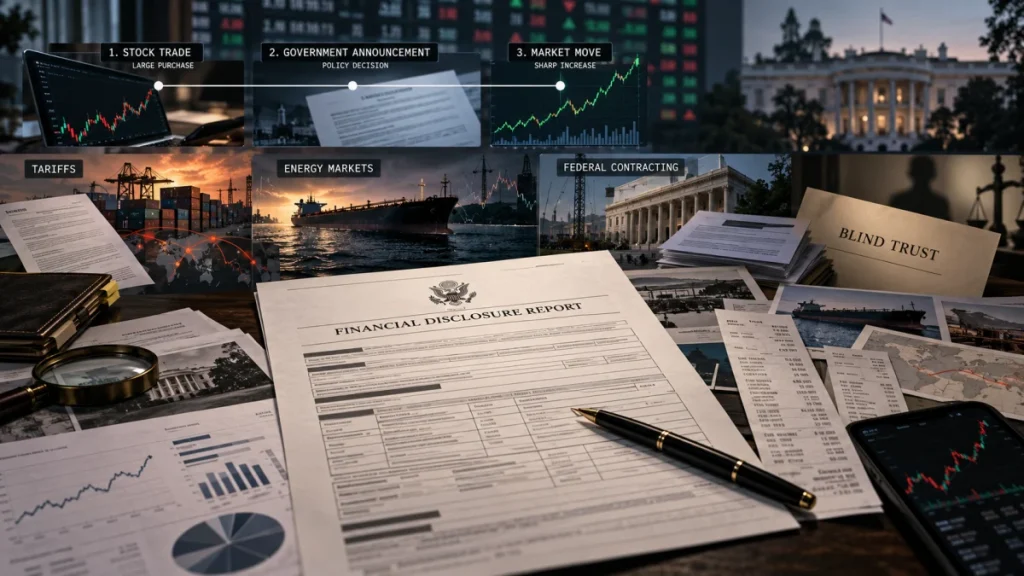

The short answer: Insider trading is illegal for members of Congress. Stock trading itself is not.
The federal law known as the STOCK Act explicitly says members of Congress are subject to insider-trading law and owe a duty of trust regarding material, nonpublic information they obtain through their government work. But Congress stopped short of prohibiting lawmakers from owning or trading individual stocks.
That distinction explains the apparent contradiction.
A senator can legally buy shares of a technology company. A representative can legally sell shares of a bank. Their spouses can generally trade individual stocks too.
What they cannot legally do is make those trades on the basis of material, nonpublic information obtained through their official positions, or otherwise misuse their office for private financial gain. Lawmakers also have to publicly disclose many securities transactions above $1,000.
So the real debate over congressional stock trading is no longer simply:
“Is insider trading illegal?”
It is.
The harder question is whether people who routinely receive market-sensitive government information, write laws affecting entire industries, oversee regulators, approve contracts and spending, and sometimes participate in classified briefings should be permitted to maintain individual financial stakes in the companies affected by those decisions at all.
That is a conflict-of-interest question—and current federal law treats it very differently from proven insider trading.
Congressional stock trading is legal. Congressional insider trading is not.
The phrase “insider trading” is commonly used much more broadly than the legal definition.
Simply possessing information that ordinary investors do not have does not automatically make every stock transaction illegal.
Federal insider-trading law generally concerns buying or selling securities on the basis of material nonpublic information in circumstances involving a breach of a duty of trust or confidence.
“Material” generally means information important enough that a reasonable investor would consider it significant.
“Nonpublic” means the information has not been adequately disclosed to the market.
That means these are very different situations:
| Situation | Generally legal today? |
|---|---|
| A member of Congress owns individual stocks | Yes |
| A member buys or sells a stock based on public information | Yes |
| A spouse buys individual stocks | Yes |
| A member owns shares in an industry affected by legislation they work on | Often yes, although it can create a conflict-of-interest concern |
| A member fails to disclose a reportable stock transaction on time | No — disclosure violation |
| A member trades because of material nonpublic information obtained through congressional duties | No — potentially insider trading |
| A member uses their government position specifically for personal financial gain | Potentially prohibited under ethics rules and other law |
That middle category—legal conduct that nevertheless creates a serious appearance or structural risk of conflict—is where most of the political argument exists.
What the STOCK Act actually changed
Congress enacted the Stop Trading on Congressional Knowledge Act, better known as the STOCK Act, in 2012.
Its title makes it sound like Congress banned stock trading.
It did not.
Instead, the law primarily did two important things.
1. It explicitly placed Congress within insider-trading law
The STOCK Act states that members and employees of Congress are not exempt from federal securities laws.
More importantly, it expressly established that, for purposes of insider-trading law, members and congressional employees owe a duty of trust and confidence to Congress, the federal government, and the American public regarding material nonpublic information obtained through their positions or official responsibilities.
That provision mattered because conventional insider-trading cases normally require prosecutors or the Securities and Exchange Commission to establish a relevant duty.
The STOCK Act eliminated much of the argument over whether congressional information was somehow different.
But the statute did not say:
Members of Congress may not own stocks.
It did not say:
Members of Congress may not trade stocks.
And it did not require lawmakers to place all investments into blind trusts.
Congress chose to police misuse of information, rather than eliminate the underlying financial holdings that can create the opportunity or appearance of misuse.
2. It created much faster disclosure of congressional trades
Members of Congress and certain senior employees must file Periodic Transaction Reports, commonly called PTRs, covering reportable purchases, sales and exchanges exceeding $1,000.
For House filers, the report is due by the earlier of:
- 30 days after the filer becomes aware of the transaction; or
- 45 days after the transaction occurred.
Transactions involving a spouse or dependent child are generally reportable as well.
The Senate operates under the same basic STOCK Act reporting framework.
This is why websites can track congressional stock trades in the first place. Much of the information comes from legally required disclosures.
So what can members of Congress still legally do?
Quite a lot.
A member can generally:
- own individual stocks;
- purchase additional stocks;
- sell stocks;
- own stock options and many other securities;
- allow an investment adviser to manage an account;
- have a spouse who owns and trades securities;
- own companies operating in industries Congress regulates;
- participate in legislation that affects broad categories of businesses in which the member also has an economic interest.
The transactions may trigger disclosure obligations, but disclosure is not the same thing as prohibition.
This is one of the most important facts in the entire debate.
Congress largely uses a disclosure-based conflict-of-interest system for itself.
The House Committee on Ethics explicitly states that no federal statute, regulation, or House rule absolutely prohibits a member from owning assets merely because those assets might conflict with or influence official duties.
That is substantially different from parts of the executive branch.
For example, 18 U.S.C. §208 generally prohibits executive-branch officers and employees covered by the statute from personally and substantially participating in particular government matters in which they or certain related persons have a financial interest, subject to exemptions and waivers.
The statute does not generally place members of Congress under that same executive-branch regime.
Can a member vote on legislation affecting a company they own?
Sometimes, yes.
The House’s own ethics guidance illustrates how different legislative conflicts are treated.
House rules say a member should not vote on a question in which the member has a direct personal or pecuniary interest.
But historically, an interest shared with a broad class of people has generally not been treated the same way.
The House Ethics Manual gives historical examples of lawmakers owning stock in industries while still voting on legislation affecting those industries.
The reasoning is partly institutional.
A member of Congress votes on almost every sector of the economy. Someone owning an index fund, bank stock, energy company, technology company or small business could potentially have a financial interest in hundreds of congressional decisions.
Historically, Congress therefore favored disclosure and case-by-case ethics rules over requiring members to divest everything that could conceivably be affected by federal policy. House ethics guidance notes that mandatory divestiture and broad disqualification proposals were previously rejected in part because lawmakers represent constituents who themselves share many of those economic interests.
Whether that justification remains adequate in an era of instant electronic trading is precisely what reform advocates dispute.
Why disclosure does not eliminate the conflict
The STOCK Act gives the public considerably more information.
It does not eliminate several structural problems.
The public may not learn about a trade for weeks
A reportable transaction can legally remain undisclosed for as long as 45 days after it occurred.
For ordinary ethics oversight, that is relatively fast.
For financial markets, 45 days is an eternity.
A trade can occur before a hearing, government announcement, legislative negotiation, contract decision or regulatory development and become publicly visible only long afterward.
The disclosures frequently report ranges rather than precise amounts
House instructions require filers to report transactions using prescribed value categories rather than necessarily revealing the exact dollar amount involved.
That means the public may know that a transaction fell within a range without knowing precisely how much money changed hands.
This is why credible reporting about congressional trades often uses phrases such as “worth between $X and $Y.”
Those ranges should not be converted into an exact trade value unless better documentation exists.
Many diversified funds do not require individual transaction reports
Transactions involving qualifying mutual funds, exchange-traded funds and certain other widely diversified investment vehicles are generally excluded from PTR reporting.
That makes sense from a conflict perspective: owning a broad-market index fund is significantly different from deciding to purchase shares in one company immediately before Congress takes an action affecting that company.
Most proposed congressional stock-trading bans therefore preserve the ability to own diversified funds.
The ordinary late-filing penalty is small
Under the existing financial disclosure regime, a filer whose required report is more than 30 days overdue is generally subject to a $200 late-filing penalty.
The Senate Ethics Committee also has authority to waive that penalty in extraordinary circumstances.
For a disclosure involving a six- or seven-figure portfolio, $200 is unlikely to function as a major economic deterrent.
That does not mean every late filing was deliberate. Filings can be late because of advisers, paperwork errors, misunderstanding of reporting rules or other mundane reasons.
It does mean the financial consequence for late disclosure can be tiny compared with the transactions being reported.
A STOCK Act violation is not automatically insider trading
This distinction routinely disappears in political arguments.
Someone can violate congressional financial-disclosure requirements without committing insider trading.
For example, filing a transaction report late is a compliance violation.
It does not prove that the underlying trade was based on secret information.
Conversely, a properly disclosed trade is not automatically proof that the transaction was ethically harmless. A lawmaker could make a completely lawful and timely disclosed investment that nevertheless creates an obvious conflict between personal finances and governmental responsibilities.
There are therefore at least four separate categories:
1. Ordinary legal investing
A lawmaker buys or sells an investment based on public information and complies with disclosure requirements.
2. Structural conflict of interest
The lawmaker owns or trades an asset affected by matters within their governmental influence.
That may create legitimate concern without proving wrongdoing.
3. Disclosure misconduct
A lawmaker fails to file required reports, files them late, or submits materially inaccurate disclosures.
That can violate the financial-disclosure laws or congressional rules without establishing insider trading.
4. Insider trading or other corrupt conduct
Evidence establishes that the official actually used protected nonpublic information or official power for unlawful private financial gain.
Only the fourth category supports the strongest accusation.
Congressmen really have been prosecuted for insider trading
The idea that members of Congress are categorically immune from insider-trading law is false.
Former Republican Rep. Christopher Collins of New York, while still serving in Congress, received confidential negative clinical-trial information about Innate Immunotherapeutics, a biotechnology company on whose board he served.
Collins passed the information to his son before it became public. His son and others sold shares and avoided substantial losses.
Collins pleaded guilty and was sentenced to 26 months in prison.
But this example requires an important qualification.
Collins’s inside information came from his private corporate position—not from Congress.
He was prosecuted as a corporate insider who happened to be a congressman.
His conviction therefore proves that lawmakers can be prosecuted for insider trading.
It does not demonstrate successful enforcement of the distinctive STOCK Act provision governing confidential information learned through congressional work.
That distinction matters.
Suspicious-looking trades are not automatically proven misconduct
The other side of the evidentiary problem appeared dramatically during the beginning of the COVID-19 pandemic.
Then-Sen. Richard Burr, who chaired the Senate Intelligence Committee, attracted enormous scrutiny over stock sales made as the seriousness of COVID-19 was becoming apparent.
The Justice Department investigated.
The SEC investigated.
Ultimately, the Justice Department closed its investigation without charges, and the SEC later concluded its investigation without taking enforcement action.
That does not require anyone to believe Burr’s trades were good public policy.
It does require an accurate article to distinguish:
“This transaction created an alarming conflict or appearance”
from:
“This person was proven to have committed insider trading.”
Those are not interchangeable statements.
The same standard should apply regardless of the lawmaker’s political party.
Why congressional insider trading can be difficult to prove
Insider trading is an evidence-intensive offense.
An investigator generally needs more than an unusually profitable trade.
There must be evidence connecting the transaction to specific material nonpublic information and establishing the necessary breach and state of mind under securities law.
That can become especially complicated with Congress.
A lawmaker may simultaneously receive:
- public economic reports;
- constituent information;
- industry briefings;
- committee testimony;
- classified or restricted information;
- private conversations;
- staff analysis;
- lobbyist presentations;
- media reporting; and
- information from personal financial advisers.
The fact that a member possessed confidential government information when a trade occurred does not by itself prove that the information caused the trade.
That evidentiary problem is one reason reformers increasingly argue that proving illegal information use after the fact is the wrong regulatory model.
Their proposed solution is simpler:
Remove the ability to make the conflicting trade in the first place.
The argument for banning congressional stock trading
A prohibition on individual stocks is fundamentally a conflict-prevention rule, not merely another insider-trading rule.
Imagine that a member of a congressional defense committee owns shares in one defense contractor.
Congress then begins confidential discussions about a weapons program that could substantially benefit the company.
Even if the member never buys another share and never sells anything, the member now has two simultaneous interests:
- deciding what is best for national defense and taxpayers; and
- owning an asset that could rise or fall because of that decision.
That is a structural conflict.
It is not proof of corruption.
The point of divestiture is to avoid having to determine afterward whether the private interest affected the official judgment.
Broad mutual funds largely solve this problem because the lawmaker’s finances are no longer dependent on the fortunes of one particular company.
The argument against an absolute ownership ban
There are legitimate counterarguments.
Members of Congress do not surrender all property rights when elected.
Congressional work touches nearly every portion of the economy, making conflict rules harder to draw than for an executive-branch official with responsibility over a narrow agency program.
Historically, Congress also worried that forcing lawmakers to dispose of broad categories of assets could discourage people with careers, businesses and investments from entering public service.
House ethics guidance reflects this older philosophy: transparency allows voters to see a member’s financial interests while restrictions against using public office for private gain address the most serious misconduct.
The modern counterargument is that diversified mutual funds, index funds and similar vehicles now make it possible for lawmakers to participate in economic growth without choosing companies whose fortunes they can personally influence through government.
That is increasingly the direction of proposed legislation.
Congress is now considering actual stock-trading bans
For years, congressional stock-ban proposals repeatedly stalled.
That changed significantly during the 119th Congress.
According to the Congressional Research Service’s survey of legislation, lawmakers introduced numerous competing proposals addressing congressional stock ownership, trading, blind trusts, divestiture and penalties.
As of August 14, 2026, two proposals are particularly important.
H.R. 7008: Stop Insider Trading Act
The House passed H.R. 7008, the Stop Insider Trading Act, on July 22, 2026, by a vote of 232–198.
This is not merely another disclosure bill.
It would generally prohibit members of Congress, their spouses and dependent children from purchasing securities issued by publicly traded companies.
Existing holdings would not simply disappear.
Instead, before selling a covered investment, a member would generally have to publicly disclose the intended sale at least seven and no more than 14 calendar days in advance.
Violations could trigger a fee equal to at least $2,000 or 10% of the transaction, whichever is greater, along with forfeiture of applicable gains.
The legislation contains exceptions for various diversified investments, small businesses, qualifying trusts and certain occupational transactions by spouses or dependent children.
There is another major complication:
The version passed by the House also contains federal voter-photo-identification legislation.
That means senators considering H.R. 7008 are not being presented with a stand-alone congressional stock-trading bill.
The bill was received in the Senate, read twice, and placed on the Senate calendar on August 6, 2026.
It has not become law.
S. 1498: The HONEST Act
The Senate has its own major proposal.
S. 1498, now known in its committee-reported version as the Halting Ownership and Non-Ethical Stock Transactions Act, or HONEST Act, is more sweeping in several respects.
The legislation would cover members of Congress as well as the president and vice president, along with spouses and dependent children.
It would restrict purchases immediately, restrict subsequent sales, and ultimately require covered officials to divest covered investments under the schedule established in the bill.
The Senate Homeland Security and Governmental Affairs Committee advanced the legislation in 2025, and it was reported to the Senate and placed on the legislative calendar in December 2025.
It has not become law either.
Other proposals would require divestment or blind trusts
Another bipartisan approach is the Restore Trust in Congress Act, H.R. 5106.
That legislation would generally prohibit members, spouses and dependents from owning or trading covered investments, while providing mechanisms involving divestment or qualified blind trusts.
A related Senate proposal, S. 3649, would similarly prohibit congressional ownership and trading of covered investments while preserving exceptions for diversified investments and certain special circumstances.
The differences between these proposals are important.
There is bipartisan agreement among many sponsors that the current system is insufficient.
There is not yet agreement about exactly what a replacement should cover—especially whether officials should be permitted to retain existing stocks, use blind trusts, include presidents and vice presidents, exempt spouses whose jobs require securities transactions, or impose mandatory divestiture.
What is the law right now?
As of August 14, 2026, members of Congress can still legally own and trade individual stocks.
The STOCK Act remains the controlling framework.
Congressional insider trading is prohibited.
Many trades over $1,000 must be disclosed.
Individual stock ownership itself remains legal.
H.R. 7008 has passed the House and is awaiting further Senate action, while the Senate’s HONEST Act and other competing proposals remain pending.
Until legislation passes both chambers in identical form and becomes law, no nationwide congressional stock-ownership ban exists.
The simplest way to understand the controversy
The current law asks:
Can we prove that this lawmaker improperly used secret information?
A true congressional stock-trading ban would ask a different question:
Why allow elected officials to put themselves in that position at all?
That is why a politician can legally make a highly profitable stock trade while simultaneously participating in government decisions affecting that company.
The profit is not evidence of insider trading.
The timing is not evidence of insider trading.
Owning the stock is not evidence of insider trading.
Even receiving confidential government information does not, by itself, prove the trade was based on that information.
But none of those facts eliminates the legitimate question of conflict of interest.
That distinction—between provable criminal misconduct and a system that permits avoidable financial conflicts—is the most important thing to understand about congressional stock trading.
The STOCK Act addressed the first problem.
Congress is now debating whether it should finally address the second.
Frequently Asked Questions
Is insider trading legal for members of Congress?
No. The STOCK Act expressly subjects members and employees of Congress to federal insider-trading restrictions and establishes a duty of trust regarding material nonpublic information acquired through government service.
Can members of Congress legally buy stocks?
Yes, under current law. The STOCK Act does not prohibit ordinary purchases or sales of individual stocks, provided the trades are lawful and applicable disclosure requirements are followed.
Do members of Congress have to report their stock trades?
Generally, reportable purchases, sales or exchanges exceeding $1,000 must be disclosed through Periodic Transaction Reports within the STOCK Act’s reporting period. Trades involving spouses and dependent children can also be reportable.
Are congressional stock trades reported immediately?
No. Depending on when the lawmaker learns of the transaction, disclosure can occur as late as 45 days after the trade.
Do lawmakers have to report mutual funds and ETFs every time they trade?
Many transactions involving qualifying mutual funds, ETFs and other widely diversified funds are excluded from periodic transaction reporting.
Has Congress banned stock trading yet?
No. The House passed H.R. 7008 on July 22, 2026, but it has not cleared the Senate or become law. It was placed on the Senate calendar on August 6, 2026.
Does a suspicious congressional trade prove insider trading?
No. A suspicious trade can justify scrutiny, investigation or reform without establishing the elements required for civil or criminal insider-trading liability.
That distinction should be maintained regardless of which politician is involved.
References and Further Reading
Federal law and primary legal sources
Public Law 112-105 — Stop Trading on Congressional Knowledge Act of 2012 — Official text of the STOCK Act, including the congressional duty of trust and confidence and transaction-disclosure provisions.
Public Law 113-7 — Modification of STOCK Act Online Financial Disclosure Requirements — The 2013 law that narrowed portions of the STOCK Act’s online-publication requirements while retaining online disclosure requirements for members and congressional candidates.
18 U.S.C. §208 — Acts Affecting a Personal Financial Interest — Federal conflict-of-interest statute primarily applicable to executive-branch and other specifically covered government personnel; useful for understanding how the congressional framework differs.
SEC — Insider Trading Arrangements and Related Disclosures — SEC explanation of the federal insider-trading framework and the role of material nonpublic information and duties of trust or confidence.
Congressional financial-disclosure and ethics rules
House Committee on Ethics — Financial Disclosure — Current House overview of annual financial disclosure and STOCK Act Periodic Transaction Report requirements.
House Committee on Ethics — Periodic Transaction Report Form and Instructions — Detailed rules covering the $1,000 threshold, transaction-value categories, spouse and dependent-child transactions, and excluded diversified funds.
House Ethics Manual — Statutes and Rules Governing Disclosure of Financial Interests — Important official discussion explaining that House members are not absolutely prohibited from holding potentially conflicting assets.
House Ethics Manual — Member Voting and Other Official Activities on Matters of Personal Interest — Explains House rules and historical precedents involving members voting on matters affecting their financial interests.
House Ethics Manual — Policies Underlying Disclosure — Historical explanation of why Congress adopted disclosure rather than broad mandatory divestiture and recusal requirements.
U.S. Senate Select Committee on Ethics — Financial Disclosure Instructions for Calendar Year 2025 — Current Senate disclosure rules, filing requirements and late-filing penalty information.
Current congressional stock-ban proposals
H.R. 7008 — Stop Insider Trading Act, Senate Calendar Version — Official text of the House-passed 2026 legislation restricting congressional purchases and requiring advance notice before covered stock sales.
House Clerk — July 22, 2026 Roll Call Vote on H.R. 7008 — Official record of the 232–198 House vote.
S. 1498 — Halting Ownership and Non-Ethical Stock Transactions (HONEST) Act — Official Senate-reported legislation imposing broader ownership and trading restrictions on covered federal elected officials and their families.
H.R. 5106 — Restore Trust in Congress Act — Bipartisan House proposal addressing congressional ownership and trading through divestment and other conflict-prevention mechanisms.
Congressional Research Service — Taking Stock of the STOCK Act — CRS overview comparing the STOCK Act with the many stock-trading restriction proposals introduced during the 119th Congress.
Enforcement and case studies
U.S. Department of Justice — Former Congressman Christopher Collins Sentenced for Insider Trading Scheme — Primary federal account of Collins’s criminal insider-trading case and the source of the confidential information involved.
SEC — Christopher Collins and Others Settle Insider Trading Charges — SEC enforcement record detailing the related civil securities case.
Associated Press — SEC Ends Richard Burr Stock-Trading Investigation Without Action — Useful example of the difference between controversial trading circumstances, formal investigation and a finding of actual legal wrongdoing.
Editorial note
This article is current through August 15, 2026. Congressional stock-trading legislation is actively moving through the 119th Congress. H.R. 7008 and S. 1498 could be amended, combined, passed, rejected or superseded. Readers researching the current law should confirm the most recent legislative status before relying on a pending bill’s provisions.