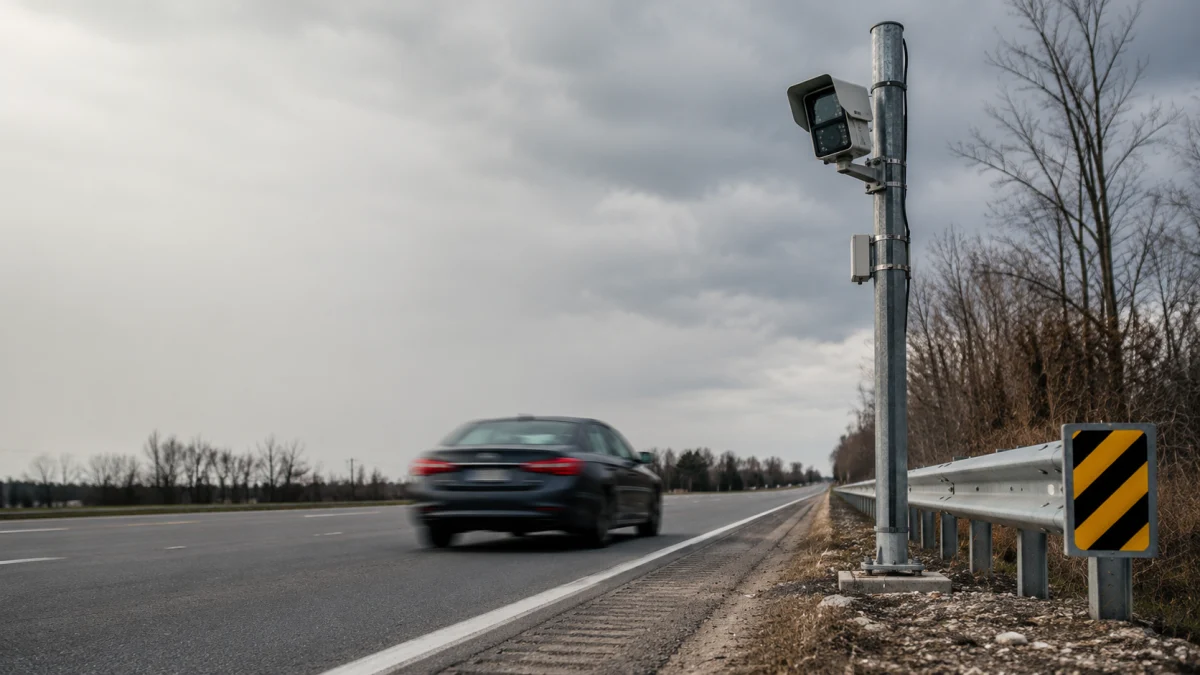
Flock Safety cameras are usually debated as surveillance devices. That debate matters, but it may be overlooking a more immediate question:
Are the poles holding these cameras safe to hit?
Roadside engineering is built around an unpleasant but unavoidable reality: vehicles leave the roadway. Drivers lose control because of ice, mechanical failure, medical emergencies, collisions, poor visibility, roadway defects and ordinary human error.
That is why governments do not ordinarily permit companies to place rigid metal objects wherever they find a convenient view of traffic. Roadside poles, signs, barriers and other structures are subject to location, permitting and crashworthiness requirements intended to prevent a survivable roadway departure from becoming a fatal collision.
Recent reporting has raised credible concerns that some automated license plate reader, or ALPR, installations may not have received that level of scrutiny. In July 2026, Flock confirmed that it was conducting a nationwide audit of its camera installations after a roadside-safety advocate publicized poles allegedly placed too close to roads, guardrails or other safety structures. Flock did not publicly provide WIRED with the audit’s methodology, scope or timeline. (WIRED)
This does not prove that every Flock camera is dangerous or illegally installed. It does establish that roadside safety is a legitimate, unresolved issue—not merely a rhetorical argument against surveillance.
What has actually been verified?
Several points can be stated with confidence.
The Federal Highway Administration defines the roadside “clear zone” as an area beginning at the traveled way that is available for an errant driver to recover, slow down or stop. Its appropriate width depends on traffic volume, speed, slopes and roadway geometry. FHWA guidance says agencies should avoid introducing new fixed objects, including poles and utility cabinets, into that recovery area. (Federal Highway Administration)
Breakaway sign, signal and lighting supports are designed to separate near their bases when struck, reducing the possibility that a rigid pole will abruptly stop or penetrate a vehicle. Roadside barriers and crash cushions similarly undergo standardized testing because their design and installation can determine whether occupants survive a roadway-departure crash.
A Guardian investigation documented one Flock pole in Greene County, Ohio, approximately two feet from the asphalt edge. The Ohio Department of Transportation reportedly said license-plate readers on uncurbed facilities must be at least eight feet from the nearest edge of a travel lane. Flock disputed the premise that it regularly violates safety requirements and said the appropriate installation depends on the roadway, speed, jurisdiction and applicable permitting authority. (The Guardian)
Separate reporting in Fort Worth found Flock cameras installed in public rights-of-way without necessary city permits. City officials raised questions about physical access, utility conflicts and who would assume liability for the installations. Flock responded that it seeks permits when required and employs personnel dedicated to planning, permitting and installation. (KERA News)
Flock’s current standard contract terms also show that installation responsibility is not necessarily confined to one party. Flock advises customers on positioning, collaborates on deployment plans and may reject a location that will not provide adequate camera performance. The customer warrants that it has or will lawfully obtain the authority needed for installation, while Flock authorizes its personnel to perform the installation and promises that its services will be performed professionally and consistently with industry standards. (Flock Safety)
These facts support investigation. They do not support declaring every Flock pole illegal without examining its specific road, location, support system, permit and engineering approval.
What has not been verified?
As of August 5, 2026, I could not locate a publicly documented fatality conclusively attributed to a vehicle striking a Flock camera pole.
Claims that a Flock pole has already decapitated someone, split a vehicle apart or caused a confirmed death should therefore not be published without case-specific evidence.
That does not make the hazard imaginary. Roadside standards are preventive. Governments require clear zones, breakaway supports and crash-tested barriers because engineers already know that rigid roadside objects can produce severe occupant injury.
A city should not need a death certificate before checking whether a privately supplied surveillance pole complies with public-safety requirements.
Why roadside poles are regulated
A vehicle leaving the travel lane still has momentum. Its occupants may survive if the vehicle has enough unobstructed space to slow down, regain control or pass over a yielding object.
A rigid pole can change that outcome by causing:
- An abrupt deceleration that transfers extreme forces to occupants.
- Vehicle rotation, rollover or redirection into another hazard.
- Penetration or deformation of the passenger compartment.
- Interference with a guardrail’s intended movement.
- Snagging beneath a vehicle instead of breaking away cleanly.
- Secondary crashes if the vehicle is redirected into traffic.
The correct roadside treatment generally follows an established order: remove the fixed object, relocate it farther from traffic, redesign it to be traversable or breakaway, or shield it with appropriate crash-tested hardware.
The word “generally” matters. There is no single nationwide distance that automatically determines whether every roadside object is lawful. The applicable standard can change according to road ownership, speed, traffic volume, curbs, slopes, federal-aid status, state design manuals, municipal codes and permit conditions.
Anyone challenging an installation should therefore ask for the actual engineering and permitting record—not simply quote one distance from another state.
Four ways a camera pole can create a roadside-safety problem
1. It is inside the clear zone without an adequate safety treatment
A pole standing within an area intended for vehicle recovery may need to be removed, relocated, made crashworthy or properly shielded.
A black metal pole two feet from a high-speed uncurbed roadway presents a different risk from a camera attached high on an existing structure behind a sidewalk in a low-speed urban area.
2. It is between traffic and a guardrail
A rigid pole should not ordinarily be introduced into the area a guardrail is supposed to protect. A driver may strike the pole before the vehicle reaches the barrier.
3. It is behind a guardrail but too close to it
Being behind a guardrail does not automatically make an object safe. Metal-beam and cable barriers move when struck. FHWA materials explain that barriers have different levels of deflection, with flexible barriers moving more and concrete barriers moving little or not at all. (Federal Highway Administration)
As an engineering inference, a rigid camera pole installed within a barrier’s required working or deflection space could interfere with the barrier’s performance. The site must be evaluated using the specifications for that particular barrier system—not by looking at a photograph and assuming that “behind the rail” is sufficient.
4. It changes the behavior of an existing safety device
Attaching a camera, battery, communications box or solar panel to a breakaway sign support may change its mass, center of gravity or separation behavior.
Roadside hardware is tested in particular configurations. Adding equipment that was not part of the tested assembly can raise legitimate engineering questions. A qualified engineer should determine whether the modified installation remains within the support manufacturer’s approved limits.
Is every questionable Flock installation a violation of federal law?
No.
This is where opponents must avoid weakening their own argument.
FHWA crashworthiness policies apply most directly to specified highway safety hardware used on the National Highway System and to projects involving federal highway funding. The Manual on Uniform Traffic Control Devices primarily governs traffic-control devices. A surveillance camera is not automatically a traffic-control device simply because it faces a road.
The most decisive legal requirements may instead come from:
- State Department of Transportation design manuals.
- State or local right-of-way and encroachment permits.
- Municipal engineering standards.
- Adopted AASHTO guidance.
- Guardrail manufacturer specifications.
- Contractual installation requirements.
- Building, electrical or utility regulations.
- Conditions imposed by the road-owning agency.
The correct claim is therefore not “federal law unquestionably bans every Flock pole.”
It is:
Every roadside Flock installation should be able to produce a permit, a lawful basis for occupying the property, an appropriate engineering review and evidence that its location and support system comply with the standards governing that road.
If the responsible parties cannot produce those records, relocation or removal pending a professional inspection is a reasonable public-safety demand.
Can a person legally remove a Flock camera?
Not by physically taking it down, cutting it, damaging it, repositioning it or interfering with its operation.
A belief that equipment is unconstitutional, unpermitted or hazardous does not ordinarily create a private right to destroy someone else’s property. Recent incidents involving damaged ALPR equipment have produced felony vandalism charges. (WIRED)
Physical interference is also strategically self-defeating. It changes the story from government and corporate compliance to the conduct of the person who damaged the camera.
Lawful removal means removal ordered or authorized by:
- The owner of the road or property.
- A transportation or permitting authority.
- A municipal government.
- The government customer under its contract.
- A court issuing declaratory or injunctive relief.
- Flock or its installer following a safety audit or contract termination.
A dangerous condition should be documented and formally reported—not personally dismantled.
Can Flock Safety be sued over an unsafe camera installation?
Potentially, but merely seeing a questionable pole does not automatically create a viable damages claim.
A successful civil case normally requires a plaintiff with standing, legally recognizable harm, evidence connecting the defendant to the installation and a remedy the court has authority to grant.
Depending on state law and the facts, possible legal theories could include:
Negligent installation or placement
A claimant may argue that a company, contractor or agency failed to use reasonable care when selecting, approving or constructing the installation.
A negligence case ordinarily requires proof of a duty, a breach of that duty, causation and actual damages. A standards violation can be important evidence, but it does not eliminate the need to prove that the defect caused or worsened the claimant’s loss.
Negligence per se
Some states allow the violation of a safety statute or regulation to establish or support breach when the injured person and the injury fall within the law’s protective purpose.
An engineering recommendation, however, is not necessarily a binding statute. The lawyer must identify the exact provision adopted in the jurisdiction and determine its legal effect.
Dangerous condition of public property
When a city, county or state owns or controls the location, state law may permit claims involving a dangerous roadway condition.
Governmental immunity, statutory exceptions, notice requirements and damage limits differ substantially among jurisdictions. Some governments must receive a formal claim within a period much shorter than the ordinary statute of limitations.
Anyone injured in a collision involving a camera pole should contact counsel immediately rather than assuming there is ample time.
Product, component or completed-operations liability
A claim may concern the pole, base, mounting system, installation instructions or completed installation. Whether the case qualifies as product liability, ordinary negligence or both will depend on state law and the respective roles of the manufacturer, vendor and installer.
Public nuisance or injunctive relief
A plaintiff may seek an order requiring a dangerous installation to be removed or corrected before an injury occurs.
This is not an automatic shortcut. Private plaintiffs frequently must demonstrate a concrete, particularized injury or a special harm beyond a generalized concern shared by the public. Some nuisance-enforcement authority is reserved to government officials.
An engineering report, repeated personal exposure to the location, a documented violation and an agency’s refusal to act would produce a stronger case than a bare allegation that the pole “looks dangerous.”
Constitutional and privacy claims
These claims generally challenge the government’s collection, retention, searching or sharing of vehicle-location data rather than the physical pole.
A lawsuit filed in Wichita in July 2026 alleges that the city’s Flock network violates provisions of the Kansas Constitution. The plaintiff seeks declaratory and injunctive relief, including an order stopping the program and deleting collected records. Those remain allegations in a pending case, not a judicial determination that Flock cameras are unconstitutional.
Who might be responsible?
Do not assume that only Flock or only the city is responsible.
Possible parties may include:
- The road-owning city, county or state.
- The police department or purchasing agency.
- Flock Safety.
- An installation contractor or subcontractor.
- The property owner or homeowners association.
- An engineering consultant.
- A utility or pole owner.
- A manufacturer of the support or breakaway assembly.
Flock’s standard terms contemplate participation by both Flock and the customer in selecting and authorizing installation locations. Those contractual provisions may help determine responsibility between them, but a contract between Flock and a city does not automatically resolve the rights of an injured third party. Local tort and contract law will control. (Flock Safety)
The strongest strategy is not random lawsuits
Filing weak lawsuits against every visible camera would be counterproductive.
Physical-hazard cases are highly site-specific. Different roads have different owners, speeds, clear-zone calculations, permit conditions, guardrail systems and installation details. A nationwide class action based solely on pole placement could face major problems because those factual differences matter.
The stronger strategy is to create a disciplined record:
- Identify potentially noncompliant installations.
- Obtain the applicable permits and engineering documents.
- Give the responsible parties formal notice.
- Demand inspection by a qualified transportation engineer.
- Document failures to inspect, correct or disclose.
- Select strong cases involving clear violations, actual damages or credible grounds for injunctive relief.
The objective is not performative litigation. It is to make unsafe installations expensive to ignore and difficult to defend.
How to investigate a Flock camera safely
Do not stand in a travel lane, climb over a barrier, touch the equipment or enter restricted property.
From a lawful and safe location, document:
- The nearest intersection or identifiable location.
- The road name and direction of travel being monitored.
- Whether the road has a curb or open shoulder.
- The approximate posted speed.
- The pole’s position relative to the pavement edge.
- Its position relative to guardrails and guardrail terminals.
- Whether it appears to have a breakaway base.
- Whether equipment is attached to an existing sign or safety support.
- Whether the pole is on public or private property.
- Wide photographs showing the full roadway context.
- Close photographs taken only where they can be obtained safely.
- The date and time of observation.
Do not represent an approximate phone-based measurement as a professional survey. The purpose of initial documentation is to justify an inspection, not to replace one.
Identify the road owner
The road owner determines which standards and complaint procedures apply.
The responsible entity may be a:
- City transportation or public-works department.
- County highway department.
- State Department of Transportation.
- Toll-road authority.
- Private development or homeowners association.
- School, university or other public authority.
- Private property owner.
FHWA maintains a directory of state transportation agencies. Local public-works or engineering departments can usually identify whether a road falls under city, county or state control. (Federal Highway Administration)
Submit a public-records request
Do not ask only for “information about Flock cameras.” Ask for the documents needed to evaluate each installation.
State public-records laws have different names and procedures. The federal Freedom of Information Act does not govern ordinary state and municipal records, so use the name of the applicable state law when possible.
Public-records request template
Subject: Public-records request concerning ALPR installation at [location]
Under the [name of state public-records law], I request electronic copies of the following records concerning the automated license plate reader or surveillance camera located at or near [precise location]:
- All contracts, order forms, amendments and statements of work concerning the device.
- The deployment plan, site plan or document approving its location.
- Right-of-way, encroachment, utility, construction and electrical permits.
- Any traffic-engineering, clear-zone, horizontal-clearance or roadside-hazard analysis.
- Any analysis of guardrail working width, dynamic deflection or terminal clearance.
- Specifications for the pole, base, mounting hardware, solar panel and attached equipment.
- Crashworthiness, breakaway or MASH/NCHRP testing documentation relied upon.
- Inspection, approval, acceptance and maintenance records.
- Communications among the agency, Flock Safety, contractors and property owners concerning placement or safety.
- Certificates of insurance, indemnification agreements and records identifying installers or subcontractors.
- Complaints, collision reports or damage reports involving the device.
- Records generated through any local or nationwide safety audit of the installation.
Please provide the records in their original searchable electronic format when available. If any portion is withheld, identify the specific legal exemption and release all reasonably segregable nonexempt material. Please provide records on a rolling basis if they cannot all be produced at one time.
Send formal notice of the suspected hazard
Notice matters. It gives the agency an opportunity to correct the condition and creates a record showing when responsible officials learned of it.
Send the notice to the road owner, public-works director, traffic engineer, risk manager, city or county attorney, government clerk and purchasing agency. Send a copy to Flock or the identified installer where appropriate.
Roadside-hazard notice template
Subject: Formal notice and inspection request—suspected roadside hazard at [location]
I am providing formal notice of a potentially hazardous roadside camera installation at [location].
The device appears to be [describe observable condition: approximately located near the pavement edge, positioned within a guardrail’s apparent deflection area, attached to an existing breakaway support, lacking an apparent breakaway base, or occupying public right-of-way without visible identification].
I am not asking the agency to reach a conclusion from photographs alone. I request:
- Inspection by a qualified transportation or roadside-safety engineer.
- Identification of the road owner and the party responsible for the device.
- Confirmation of all permits and location approvals.
- Identification of the clear-zone, horizontal-clearance and guardrail criteria applied.
- Documentation establishing that the support and complete installed assembly are appropriate for the location.
- Relocation or removal if the installation cannot be shown to comply.
- Preservation of all records relating to selection, approval, installation, inspection and maintenance of this device.
Please provide a written response describing the inspection findings and corrective action. Deactivating the camera electronically would not eliminate a physical roadside hazard; the response should address the pole and attached hardware.
Where to report a suspected unsafe installation
Start with the agency that owns the road.
Appropriate recipients can include:
- City or county public works.
- Municipal traffic engineering.
- The state DOT district right-of-way or encroachment office.
- The city or county risk-management office.
- The police department administering the contract.
- The city manager or county administrator.
- The elected council or commission.
- The government clerk responsible for records.
- The FHWA state division when a National Highway System or federal-aid issue is plausibly involved.
FHWA maintains a directory of its federal-aid division offices and state transportation contacts. (FHWA Apps)
Ask for a tracking or complaint number. Follow verbal conversations with an email summarizing what was reported, when it was reported and who received it.
What to do after a collision involving a camera pole
Medical care comes first.
After emergency needs are addressed:
- Report the collision and make sure the police report identifies the pole or camera structure.
- Photograph the vehicle, roadway, pole, base, debris, tire marks and surrounding barriers when it is safe and lawful to do so.
- Preserve dash-camera recordings, phone data, vehicle telemetry and witness information.
- Do not allow the damaged vehicle to be destroyed before counsel and experts can inspect it.
- Request 911 audio, body-camera footage, dispatch records and roadway-maintenance records.
- Send evidence-preservation notices to the road owner, purchasing agency, Flock, installer and relevant property owner.
- Determine whether a governmental notice-of-claim deadline applies.
- Consult an attorney experienced in roadway design, municipal liability, personal injury, product liability or wrongful death.
A serious roadway-design case will usually require a transportation engineer, crash reconstructionist or other qualified expert. Internet photographs and generalized federal guidance are not substitutes for a site-specific professional opinion.
How a lawsuit would generally proceed
The exact procedure is state-specific, but a claimant would ordinarily need to:
- Establish standing and injury. Identify property damage, physical injury, repeated personal exposure or another legally recognized harm.
- Identify the controlling standards. Determine the road owner, adopted manuals, permit conditions and specifications for the particular barrier or support.
- Comply with pre-suit requirements. Submit any required governmental claim or statutory notice before the deadline.
- Identify the defendants. Use contracts, permits and installation records to determine who selected, approved, installed, owned and maintained the equipment.
- Retain qualified experts. Establish the applicable standard of care, defect, causation and appropriate correction.
- Select the proper court and remedy. Damages, declaratory relief and injunctions have different jurisdictional and procedural requirements.
- File and serve the complaint. State the facts, causes of action, requested relief and basis for the court’s jurisdiction.
- Seek emergency relief when justified. A temporary restraining order or preliminary injunction requires evidence of imminent harm and satisfaction of demanding legal standards.
- Use discovery. Obtain internal communications, deployment criteria, audit results, prior complaints and installation records.
- Prove causation. Even an improperly positioned pole will not produce liability unless its condition legally caused or increased the claimed injury.
For attorney referrals, use the American Bar Association’s Lawyer Referral Directory. People who meet financial eligibility requirements can locate civil legal-aid organizations through the Legal Services Corporation’s legal-help directory. (American Bar Association)
Complex injury, governmental-liability and injunctive cases are poor candidates for a generic downloadable complaint. A badly framed test case can be dismissed and leave unfavorable precedent for later challengers.
Transparency does not mean making every feed public
Turning ALPR footage into a publicly accessible live feed would not solve the surveillance problem. It would expand it.
Public access to individual vehicle movements could enable stalking, domestic abuse, harassment and private tracking. The answer to selective government access is not universal access to everyone’s movements.
A defensible transparency model would publish:
- Camera locations.
- Ownership and funding.
- Contracts and renewal dates.
- Permits and engineering approvals.
- Retention periods.
- Authorized users and agencies.
- Data-sharing rules.
- Aggregate search statistics.
- Misuse findings and disciplinary outcomes.
- Safety and civil-rights audits.
- Procedures for complaints and removal.
The public should be able to inspect the system of governance without receiving unrestricted access to the people being monitored.
A reasonable minimum policy for every jurisdiction
No new roadside ALPR installation should be activated until the responsible agency publishes or certifies:
- The legal authority to occupy the site.
- The required right-of-way and construction permits.
- A site-specific roadside-safety review.
- The applicable clear-zone or horizontal-clearance determination.
- Guardrail working-width and terminal-clearance verification where relevant.
- The crashworthiness or breakaway basis for the complete installed assembly.
- Identification of the owner, installer and responsible maintenance party.
- Insurance and indemnification coverage.
- A public data-retention and sharing policy.
- A scheduled independent safety and civil-rights audit.
Existing installations that cannot satisfy those requirements should be removed or relocated pending review.
The public-safety principle
Flock cameras are marketed as public-safety infrastructure. That description creates a higher obligation, not a lower one.
Government cannot credibly argue that a surveillance pole makes a community safer while refusing to show whether the pole itself was lawfully permitted, properly engineered and safely installed.
The policy should be simple:
No surveillance device belongs beside a public road unless its owner can prove that it complies with the same safety principles applied to other roadside structures.
Where an installation is unsafe, the remedy is inspection, enforcement, relocation, lawful removal and—when an injury or legally actionable threat is established—civil litigation.
Not vandalism. Not speculation. Not waiting for the first documented death.
Accountability supported by records, engineering and law is harder to dismiss and far more likely to produce permanent change.
Frequently asked questions
Are Flock cameras illegal?
Not categorically. Their legality depends on surveillance law, public procurement, road ownership, permitting, property authority, data practices and the details of each installation.
Can I legally take down a Flock camera that appears dangerous?
No. Report it and seek removal through the road owner, permitting authority, government customer or courts. Do not damage, reposition or interfere with the equipment.
Can I sue Flock merely because a pole appears unsafe?
A questionable installation alone may not provide standing for damages. A pre-injury case may require a particularized injury and evidence supporting injunctive or declaratory relief. Property damage or physical injury can create different claims.
Does every roadside camera need a breakaway pole?
Not necessarily. A device could be located outside the applicable clear zone, attached to an approved structure or properly shielded. The complete site and installation must be evaluated under the governing standards.
Is a pole safe when it is behind a guardrail?
Not automatically. Guardrails need working and deflection space. The proper clearance depends on the barrier design and the site.
What is the fastest lawful route to removal?
Obtain the permit and engineering records, document the suspected defect, give formal notice to the road owner and request an immediate inspection. A clear permit violation can sometimes produce faster action than a broad constitutional argument.
What should I do if my vehicle strikes one?
Seek medical assistance, report the collision, preserve the vehicle and recordings, document the installation and contact qualified counsel immediately. Governmental claim deadlines may apply.
References and Further Reading
Roadside Safety Standards
- Federal Highway Administration — Clear Zones and Horizontal Clearance
Federal guidance on roadside recovery areas, fixed objects and horizontal clearance. - Federal Highway Administration — Roadside Safety Hardware: The Last Line of Defense
Overview of crash-tested roadside hardware, breakaway supports and occupant protection. - Federal Highway Administration — Roadside Design Improvements at Curves
Guidance addressing guardrail behavior, roadside obstacles and barrier deflection. - Federal Highway Administration — Guardrail Basics and Crashworthiness
Explanation of guardrail design, testing and proper roadside installation.
Flock Safety Installation and Contract Terms
- Flock Safety — Terms and Conditions
Current contractual provisions addressing site selection, installation authority, customer responsibilities and professional standards.
Investigative Reporting
- The Guardian — Flock Surveillance Cameras Can Pose a Crash Risk for Drivers
Reporting on potentially unsafe roadside placements and concerns raised by transportation-safety specialists. - WIRED — Flock Safety Camera Installations, Public Backlash and the Nationwide Audit
Coverage of roadside-safety complaints, Flock’s installation audit and the distinction between lawful advocacy and vandalism. - KERA and the Fort Worth Report — Flock Cameras Installed Without Required Right-of-Way Permits
Investigation into unpermitted installations, utility conflicts, public rights-of-way and liability concerns.
Surveillance and Constitutional Litigation
- Kansas Justice Institute — Petition Challenging Wichita’s Automated License Plate Reader Program
Court filing seeking declaratory and injunctive relief against Wichita’s use of Flock license plate readers.
Government and Legal Assistance
- Federal Highway Administration — State Transportation Agency Directory
Contact information for state departments of transportation and roadway authorities. - Federal Highway Administration — Federal-Aid Division Office Directory
Directory for contacting the appropriate FHWA division office about federal-aid roadway concerns. - American Bar Association — Lawyer Referral Directory
State-by-state resources for locating qualified legal counsel. - Legal Services Corporation — Find Civil Legal Help
Directory of nonprofit legal-aid organizations serving financially eligible individuals.