
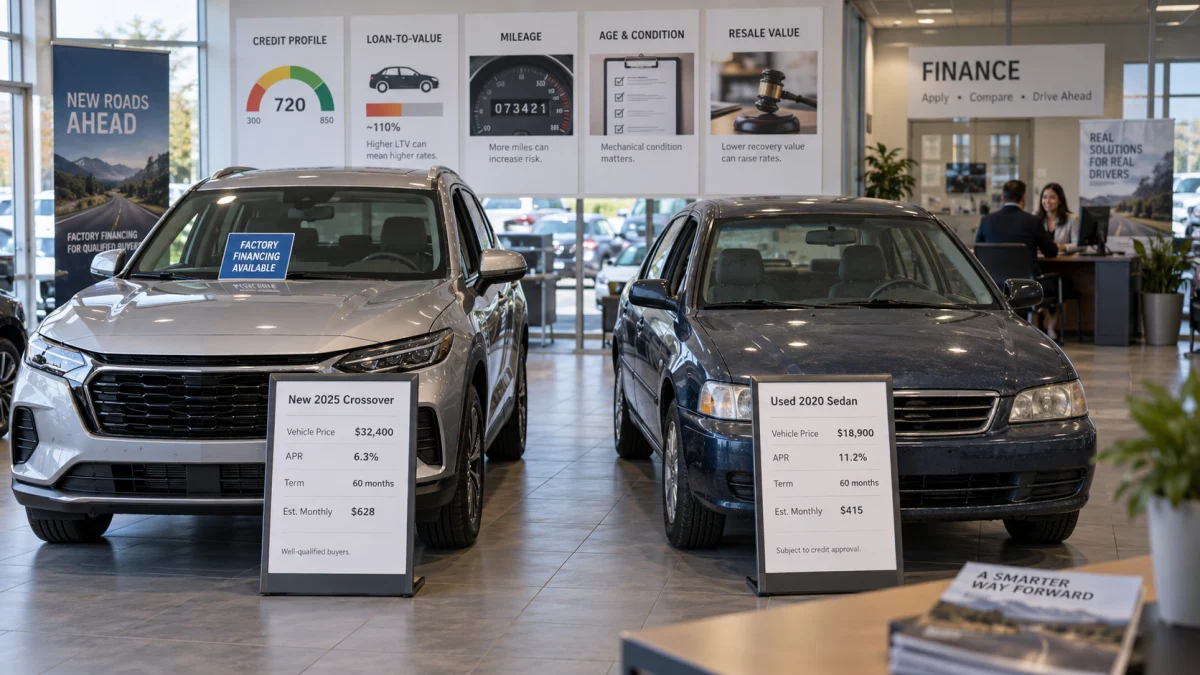
Used-car loan rates are higher than new-car rates for two different reasons that are often mixed together.
First, used-car buyers are somewhat riskier borrowers on average. Their average credit scores are lower.
But that is only part of the explanation. Used vehicles are also different collateral. They have more uncertain values, more mileage and condition variation, shorter remaining useful lives, and historically greater lender losses after default. New cars also have an advantage that has little to do with risk: manufacturers frequently subsidize financing on new vehicles because cheap credit helps them sell cars.
That is why the difference remains even when borrowers are placed in the same broad credit tier.
In the second quarter of 2026, the average U.S. new-car loan carried a 6.35% interest rate, compared with 11.19% for a used vehicle. The average new-car borrower had a VantageScore of 751, versus 688 for the average used-car borrower.[1]
But compare borrowers within the same credit category and the gap is still there:
| Credit tier | New-car APR | Used-car APR | Difference |
|---|---|---|---|
| Super prime, 781–850 | 4.41% | 6.29% | +1.88 points |
| Prime, 661–780 | 6.15% | 8.81% | +2.66 points |
| Near prime, 601–660 | 9.71% | 13.93% | +4.22 points |
| Subprime, 501–600 | 13.52% | 19.10% | +5.58 points |
| Deep subprime, 300–500 | 16.11% | 21.62% | +5.51 points |
Those numbers establish something important: the roughly five-point marketwide difference cannot be explained simply by saying used-car buyers have worse credit.[1:1]
The harder question is what explains the rest.
How Much of the Rate Gap Is Actually the Borrower?
There is no clean national dataset that assigns an exact percentage of the new-versus-used APR gap to every underwriting factor. Auto lenders consider far more than a broad credit-score category: income, debt, repayment history, loan term, down payment, loan-to-value ratio, vehicle age and mileage, lender type and other variables can all matter.
But we can at least estimate how much of the observed difference is associated with the very different credit-tier composition of new- and used-car buyers.
For this calculation, we used Experian-derived Q1 2026 data because both the APR schedule and the distribution of borrowers across credit tiers are available for that quarter.[2]
Among new-car borrowers, approximately 46.9% were super prime, compared with only 24.2% of used-car borrowers. At the other end, subprime and deep-subprime borrowers represented about 20.6% of used financing, compared with roughly 6.9% of new financing.[2:1]
Unsurprisingly, some of the headline rate difference disappears when that borrower mix is accounted for.
A symmetric reweighting of those Q1 figures produces an average new-versus-used rate difference of about 5.05 percentage points. Roughly 2.05 percentage points, or 41%, are associated with the different broad credit-tier composition. About **3.00 percentage points, or 59%, remain as differences in the rate schedules experienced within those categories.
That 59% figure needs an important warning.
It does not mean 59% of the rate gap is caused by the used car itself.
People in the same broad 661–780 "prime" category are not identical borrowers. The remaining difference can include finer differences in creditworthiness, loan-to-value ratios, term lengths, lender mix, dealer financing, vehicle characteristics and manufacturer subsidies.
What the calculation does show is narrower but still useful:
The poorer average credit profile of used-car buyers explains a substantial portion of the rate gap, but it does not explain the whole thing.
There is a genuine financing difference associated with what is being financed and how that financing reaches the consumer.
The Bank Is Not Just Lending to You. It Is Lending Against the Car.
An auto loan is secured debt.
If you stop paying, the lender can repossess the vehicle. What matters then is no longer simply whether you were a good borrower when the loan originated. The question becomes:
How much of the unpaid loan can the lender recover by selling the car?
That creates two different forms of risk.
Default risk is the chance that the borrower stops paying.
Loss severity is how much money the lender loses if that default actually occurs.
The Federal Reserve’s 2026 supervisory stress-test methodology explicitly treats those as separate considerations. Its auto-loan loss model segments loans using vehicle product type, loan age, loan-to-value ratio and borrower credit score. The Fed specifically notes that used vehicles tend to produce higher loss severity than new vehicles.[3]
That is one of the clearest answers to the entire question.
Used-car rates are not higher merely because lenders think used-car buyers are less reliable. The collateral itself can leave the lender with a worse recovery when something goes wrong.
Why Used Cars Can Be Harder Collateral to Value
It is tempting to explain the rate difference by saying that used cars "depreciate faster."
That is not a particularly good explanation.
New vehicles can suffer some of their steepest percentage depreciation early in their lives. A used vehicle may actually depreciate more slowly from its already-lower starting value.
The more important issue is uncertainty.
Two new vehicles with the same trim and options are generally similar assets.
Two six-year-old vehicles with the same make, model and odometer reading can be very different collateral.
One may have excellent maintenance records, one prior owner and no accident history.
The other may have previous collision repairs, deferred maintenance, worn components, cosmetic damage or a history that makes it difficult to resell.
That variation matters if the lender eventually has to turn the vehicle back into cash.
Age also changes the risk that a major mechanical failure occurs while a substantial loan balance remains outstanding. A borrower facing a $6,000 repair on a car that is already worth $9,000 has a very different economic decision than someone driving a nearly new vehicle under warranty.
Lenders do not need every used car to fail for this to matter. They only need the portfolio, on average, to produce greater losses.
Loan-to-Value May Matter More Than the Sticker Price
A cheaper car does not necessarily mean a safer loan.
Lenders pay close attention to loan-to-value, or LTV:
LTV = amount financed ÷ value of the vehicle
A $25,000 loan against a vehicle worth $25,000 has a 100% LTV.
But buyers frequently finance more than the vehicle’s underlying value after taxes, dealer products, service contracts or negative equity from a trade-in are incorporated into the loan.
The Consumer Financial Protection Bureau says higher-LTV auto loans are riskier to lenders and can affect both whether a loan is approved and the interest rate offered. A larger down payment can lower LTV and may result in a better rate.[4]
The Federal Reserve’s loss model reaches the same issue from the recovery side: loans beginning with more borrower equity generally produce better recoveries after default, while loans beginning with little or negative equity tend to recover less.[3:1]
That explains why lenders can care enormously about something a buyer may barely notice.
The buyer sees:
"This car costs $27,000."
The lender sees:
"If this loan defaults next year, how much will we still be owed, and what can we actually sell this vehicle for?"
Those are not the same question.
Current Lender Rates Show That the Vehicle Itself Really Does Affect Pricing
We do not have to infer all of this from national averages. Lenders openly publish rate schedules that change according to whether a vehicle is new or used.
As of September 11, 2026, Navy Federal Credit Union advertised 37-to-60-month loans as low as 4.29% for new vehicles and 5.29% for used vehicles. For 73-to-84-month loans, the advertised minimums were 5.99% new and 6.98% used. Its disclosures state that actual APRs can depend on credit history, loan type, model year, mileage, term and loan amount.[5]
First City Credit Union showed a smaller but equally revealing gap: its September 2026 schedule placed used-car APRs 0.25 percentage point above new-car APRs at comparable terms. It also offered a 0.50-point rate discount when LTV was 80% or less and imposed a 0.50-point increase on vehicles with at least 140,000 miles.[6]
First Commonwealth Federal Credit Union makes the age effect even clearer. In September 2026, qualifying 2025–2027 new vehicles could receive rates as low as 4.99% on shorter terms. Recent used vehicles started at 5.24%, while some 2017-and-older vehicles began at 7.74% or 7.99%, depending on term. Its disclosure specifically lists LTV, mileage and model year among the variables affecting rates.[7]
These are not comparisons between anonymous national populations.
They are lenders explicitly telling borrowers:
The characteristics of the vehicle itself affect the price of the loan.
New Cars Have Another Advantage: The Automaker May Be Subsidizing Your Interest Rate
Collateral risk still does not explain everything.
New-car financing has a structural advantage that used-car financing usually does not: the company providing or supporting the financing may also have a financial interest in selling the vehicle.
Automakers commonly own captive finance companies. Examples across the industry include financing operations tied to the manufacturers whose vehicles they help sell.
A normal bank primarily needs the loan to make economic sense as a loan.
A captive finance company operates inside a larger business that also needs to move new vehicles.
The Federal Reserve has described captive finance companies as the largest financiers of new vehicles and notes that manufacturers can subsidize offers such as zero-percent financing or cash-back incentives. Non-captive finance companies are more heavily involved in used and subprime financing and generally carry higher rates.[8]
That means some of the new-car rate advantage is not a pure statement about risk.
A 0%, 1.9% or 2.9% promotional APR may effectively be part of the automaker’s marketing budget.
Instead of taking $3,000 off the price of the vehicle, for example, a manufacturer may spend money making the financing unusually cheap.
The financing offer helps sell the car.
There is usually no manufacturer sitting behind a five-year-old used vehicle with the same incentive to subsidize your loan.
This is one reason a seemingly backwards situation can occur:
The bank or finance company may lend money for a more expensive new vehicle at a lower interest rate than it charges for a much cheaper used one.
Dealer Markup Is Real, but It Is a Separate Issue
Dealer financing adds another layer, but it should not be confused with the underlying used-car rate premium.
When a dealership arranges financing, a lender can quote the dealer a buy rate. The dealer can then offer the consumer a higher contract rate and receive compensation associated with the difference.
The CFPB explicitly warns that the consumer’s contract rate may therefore be higher than the lender’s buy rate.[9]
Historically, some lender programs have permitted dealer markups of several percentage points. In a 2015 enforcement action involving Fifth Third Bank, for example, the CFPB said the lender had permitted dealer markups of as much as 2.5 percentage points during the period under review.[10]
But dealer markup cannot explain the whole new-versus-used difference.
Banks and credit unions that lend directly to consumers also publish different new- and used-vehicle rates.
The distinction is important:
Used-car lender premium: the lender prices the loan differently because of the borrower, collateral, LTV, term and other underwriting considerations.
Captive-finance subsidy: an automaker helps make new-car financing cheaper to stimulate vehicle sales.
Dealer markup: the dealer may add additional spread above the lender’s underlying buy rate.
All three can affect what a consumer ultimately sees, but they are not the same thing.
A $26,000 Used-Car Loan Can Generate as Much Interest as a $38,000 New-Car Loan
This is where the difference becomes tangible.
Take a borrower in Experian’s prime credit tier and use the Q2 2026 average tier rates of 6.15% for a new vehicle and 8.81% for a used one.[1:2]
Assume both loans run for 60 months.
Option 1: $38,000 new-car loan at 6.15%
Monthly payment: $737.30
Total of payments: $44,237.99
Total interest: $6,237.99
Option 2: $25,000 used-car loan at 8.81%
Monthly payment: $516.66
Total of payments: $30,999.40
Total interest: $5,999.40
The used-car buyer borrowed $13,000 less.
Yet the financing saves only about $239 in total interest over five years.
Now raise the used loan from $25,000 to $26,000.
At 8.81%, the total interest becomes approximately:
$6,239.37.
That is essentially the same interest bill as borrowing $38,000 for the new car.
The exact break-even under these assumptions is roughly:
$25,994 used at 8.81% = the same total interest as $38,000 new at 6.15%.
The pattern survives a longer term.
Over 72 months, the $38,000 new loan generates about $7,537 in interest. A used loan of only about $25,896 at 8.81% generates approximately the same interest.
This is the part of car financing that sticker-price comparisons can hide.
A vehicle can be $12,000 cheaper to finance and still generate roughly the same dollar amount of interest because its APR is substantially higher.
Does That Mean the More Expensive New Car Is Actually Cheaper?
No.
That would take the math too far.
In our example, the new-car buyer still borrowed $38,000 while the used-car buyer borrowed roughly $26,000.
Equal interest does not mean equal total cost.
The buyer also needs to consider:
- the actual purchase price;
- depreciation;
- down payment;
- sales tax and registration;
- insurance;
- maintenance and repair costs;
- warranty coverage;
- expected ownership period;
- resale value;
- manufacturer rebates;
- financing incentives;
- and the opportunity cost of any additional cash spent upfront.
A used vehicle can still be dramatically cheaper overall even with a worse loan.
The correct lesson is narrower:
A lower purchase price does not guarantee proportionately lower financing costs.
The APR can consume far more of the expected savings than buyers realize.
Why Does a New Car Get a Lower Rate Even Though It Can Depreciate Faster?
Because depreciation alone does not determine the rate.
A new vehicle can lose a significant percentage of its value early while still being attractive collateral.
The lender is looking at a broader package:
- known age and condition;
- predictable valuation;
- low mileage;
- remaining warranty;
- expected useful life;
- loan-to-value;
- historical recovery performance;
- borrower characteristics;
- and the possibility of manufacturer-subsidized financing.
A five-year-old vehicle might depreciate more slowly in percentage terms than a brand-new one while still creating more uncertainty about what a lender will recover after a default.
That is why "new cars depreciate faster" and "new cars get cheaper loans" are not contradictory statements.
Why Does the Rate Gap Get Larger for Lower-Credit Borrowers?
Experian’s Q2 data show the used-car premium widening from 1.88 percentage points for super-prime borrowers to more than 5.5 points for subprime and deep-subprime borrowers.[1:3]
The public data alone do not let us assign a single cause to that widening.
But the direction is economically logical.
Risk factors can compound.
A weaker borrower financing older collateral at a high LTV is different from an excellent-credit borrower putting substantial cash down on a two-year-old vehicle.
Lenders are not necessarily pricing "the borrower" and "the car" independently. The total loan is what produces the risk.
This is another reason same-credit-tier comparisons should not be interpreted as if every other variable were controlled.
They are useful evidence that credit score alone is insufficient, not a laboratory experiment holding every other factor constant.
Certified Pre-Owned and Nearly New Cars Can Fall in the Middle
Another reason consumers sometimes see confusing quotes is that lenders do not all define "new" and "used" identically.
Navy Federal’s current rules, for example, can classify some late-model vehicles with relatively low mileage within its new-vehicle definition, while older or higher-mileage vehicles fall into the used category.[5:1]
That means two cars both described casually as "used" at a dealership may qualify very differently with a lender.
When comparing financing on a nearly new or certified pre-owned vehicle, ask the lender how it classifies the specific model year and mileage.
That classification alone can change the available term or APR.
There Is Also a Temporary Federal Tax Advantage for Some New-Car Loans
For tax years 2025 through 2028, federal law allows eligible taxpayers to deduct up to $10,000 per year of qualified passenger-vehicle loan interest.
The rules are considerably narrower than simply "new-car interest is deductible."
Among other requirements, the loan generally must have originated after December 31, 2024, the vehicle’s original use must begin with the taxpayer, the vehicle must be for personal use and secured by a lien, and final assembly must have occurred in the United States. The deduction begins phasing out above modified adjusted gross income of $100,000 for single filers and $200,000 for joint filers.[11]
Used vehicles do not qualify.
This provision does not explain why lenders charge different APRs. It is a tax rule, not an underwriting rule.
But for an eligible 2026 buyer comparing the after-tax cost of a new vehicle with a used one, it can make the effective financing-cost difference somewhat larger.
How to Keep From Paying More Used-Car Interest Than Necessary
The higher average used-car APR does not mean you have to accept the first rate a dealer offers.
Get financing quotes before visiting the dealer
A bank or credit-union preapproval gives you an independent benchmark. If the dealer can beat it, fine. If not, you already have an alternative.
The CFPB specifically recommends comparing financing sources because dealer-arranged financing can include a contract rate above the lender’s buy rate.[9:1]
Compare the same loan structure
A 5.9% loan for 48 months and a 6.5% loan for 72 months cannot be compared by APR alone.
Look at:
Amount financed. APR. Term. Monthly payment. Total interest.
All five matter.
Pay attention to what gets rolled into the loan
Negative equity from a trade-in, service contracts, protection packages and other financed products can increase the amount owed without increasing what the underlying vehicle is worth by the same amount.
That raises LTV.
Ask how the lender classifies the vehicle
A late-model low-mileage vehicle may qualify for better pricing or longer terms than an older used car.
Consider whether a larger down payment materially improves the quote
A lower LTV can reduce both the amount borrowed and, with some lenders, the APR itself.
Do not automatically empty savings into a vehicle simply to chase a rate discount, but ask for both quotes and do the math.
Do not negotiate only on monthly payment
Longer terms can make an expensive loan look affordable by stretching it across more months.
Experian reported that one in three vehicle loans exceeded 72 months in Q2 2026.[12]
The monthly payment is a cash-flow number.
It is not the cost of the loan.
Refinance if the original financing later becomes uncompetitive
Experian found that consumers refinancing auto loans in Q2 2026 reduced their average rate from 10.40% to 7.97%, with an average monthly savings of $83.[12:1]
Refinancing is not guaranteed to help, particularly once a vehicle has aged or lost substantial value, but an expensive original loan does not necessarily have to remain in place for its full term.
The Bottom Line
Used-car loan rates are higher because the financing markets for new and used vehicles are not identical.
Used-car buyers do have lower credit scores on average, and that explains a meaningful part of the headline difference.
But it does not explain all of it.
The gap remains inside every major credit tier. Federal Reserve loss models recognize higher loss severity on used vehicles. Lenders explicitly change rates according to vehicle age, mileage and LTV. Manufacturer-owned finance companies can subsidize new-car loans to help sell inventory. Dealer-arranged financing can add yet another spread on top.
That creates an outcome that initially seems irrational but is not:
A lender can rationally charge a lower interest rate on a more expensive new car than on a cheaper used one.
And for the consumer, the difference can be large enough that a $26,000 used-car loan generates roughly the same interest as a $38,000 new-car loan.
That does not make the new car automatically cheaper.
It means the sticker price is only the beginning of the comparison.
The number worth comparing is not simply what the car costs.
It is what the car costs after the loan does its work.
References and Further Reading
Current Auto-Finance Data
Experian — Average Car Loan Interest Rates by Credit Score The main source for Q2 2026 new-versus-used APRs and the rate differences across VantageScore credit tiers.
Experian — State of the Automotive Finance Market Q2 2026 Highlights Provides the current average financed amounts, payments, rates, market-share data and refinancing figures used in this article.
NerdWallet — Auto Financing Distribution by Credit Score Reports Experian Information Solutions’ Q1 2026 distribution of new- and used-car borrowers across credit tiers. Those figures were used for sherafy.com‘s borrower-composition calculation.
Lender Risk and Collateral
Federal Reserve — Supervisory Stress Test Documentation: Credit Risk Models The strongest primary source for the collateral explanation. The Federal Reserve’s auto loss model explicitly considers product type, loan age, LTV and credit score and states that used vehicles tend to have greater loss severity than new vehicles.
CFPB — What Is a Loan-to-Value Ratio in an Auto Loan? Explains how lenders calculate auto-loan LTV and why borrowing a greater share of the vehicle’s value increases lender risk and can affect the interest rate.
Real-World Lender Pricing
Navy Federal Credit Union — Auto Loans & Financing A useful real-world example of a lender publishing lower new-car rates than used-car rates while identifying model year, mileage, term and loan type as pricing factors.
First City Credit Union — Auto Loans Particularly useful because its published pricing explicitly includes an LTV discount and a mileage surcharge.
First Commonwealth Federal Credit Union — Consumer Loan Rates Shows how published used-car financing rates rise as vehicle model years become older.
New-Car Subsidies and Dealer Financing
Federal Reserve — Consumer & Community Context: Auto Finance Explains the different lender types in the auto market and the role of manufacturer-owned captive finance companies in subsidized new-car financing.
CFPB — What Is a Buy Rate for an Auto Loan? The clearest consumer-level explanation of the difference between a lender’s buy rate and the contract rate a dealer offers the buyer.
CFPB — Dealer-Arranged vs. Direct Auto Financing Additional guidance on how indirect dealer financing works and why consumers should compare offers from direct lenders.
2026 Tax Rules
IRS — Topic No. 505, Interest Expense Current IRS explanation of the temporary federal deduction for qualifying interest on certain new personal-vehicle loans.
Editorial currency note: Auto-loan APRs, lender underwriting rules, promotional financing and tax provisions can change. National rate statistics in this article reflect Experian Q2 2026 data. Individual lender-rate examples are snapshots from September 2026 and should be refreshed periodically.
Experian. “Average Car Loan Interest Rates by Credit Score.” September 10, 2026. https://www.experian.com/blogs/ask-experian/average-car-loan-interest-rates-by-credit-score/ ↩︎ ↩︎ ↩︎ ↩︎
NerdWallet. “What Is a Bad Credit Score for a Car Loan?” 2026. Experian Information Solutions Q1 2026 credit-tier distribution and APR data. https://www.nerdwallet.com/auto-loans/learn/bad-credit-score-car-loan ↩︎ ↩︎
Board of Governors of the Federal Reserve System. “Supervisory Stress Test Documentation: Credit Risk Models.” January 2026, Auto Model, p. 538. https://www.federalreserve.gov/supervisionreg/files/credit-risk-models.pdf ↩︎ ↩︎
Consumer Financial Protection Bureau. “What Is a Loan-to-Value Ratio in an Auto Loan?” Last reviewed March 7, 2024. https://www.consumerfinance.gov/ask-cfpb/what-is-a-loan-to-value-ratio-in-an-auto-loan-en-769/ ↩︎
Navy Federal Credit Union. “Auto Loans & Financing.” Rates and vehicle definitions current September 2026. https://www.navyfederal.org/loans-cards/auto-loans.html ↩︎ ↩︎
First City Credit Union. “Auto Loans.” Rates effective September 10, 2026. https://www.firstcitycu.org/loans-credit/vehicle-loans/auto-loans ↩︎
First Commonwealth Federal Credit Union. “Consumer Loan Rates.” Rates effective September 1, 2026. https://www.firstcomcu.org/rates/loans.html ↩︎
Board of Governors of the Federal Reserve System. “Consumer & Community Context: Auto Finance.” November 2023. https://www.federalreserve.gov/publications/2023-november-consumer-community-context.htm ↩︎
Consumer Financial Protection Bureau. “What Is a Buy Rate for an Auto Loan?” Last reviewed January 30, 2024. https://www.consumerfinance.gov/ask-cfpb/what-is-a-buy-rate-for-an-auto-loan-en-727/ ↩︎ ↩︎
Consumer Financial Protection Bureau. “CFPB Takes Action Against Fifth Third Bank for Auto-Lending Discrimination and Illegal Credit Card Practices.” September 28, 2015. https://www.consumerfinance.gov/archive/newsroom/cfpb-takes-action-against-fifth-third-bank-for-auto-lending-discrimination-and-illegal-credit-card-practices/ ↩︎
Internal Revenue Service. “Topic No. 505, Interest Expense.” Car loan interest deduction rules for tax years 2025–2028. https://www.irs.gov/taxtopics/tc505 ↩︎
Experian. “Hybrids Continue to Gain Ground Amid Elevated Gas Prices, According to a New Experian Automotive Report.” August 27, 2026. https://www.experianplc.com/newsroom/press-releases/2026/hybrids-continue-to-gain-ground-amid-elevated-gas-prices–accord ↩︎ ↩︎