Polestar was not simply banned from the United States because it is Chinese-owned. Volvo Cars is also controlled by China’s Geely, was caught by the same federal connected-vehicle rule, and had to ask the U.S. government for permission to continue selling cars. Volvo received that permission. Polestar did not.
That is the part most simple explanations miss.
Volvo announced on May 26, 2026 that the Commerce Department had granted it a specific authorization following discussions concerning its governance, technology and data security. One month later, Polestar announced that the Bureau of Industry and Security, or BIS, had declined to authorize Polestar sales beginning with model-year 2027 vehicles.
The obvious question is why.
Both companies sit inside the business empire of Chinese billionaire Li Shufu. Volvo says Zhejiang Geely indirectly controls approximately 78.65% of its shares and votes. Polestar’s own SEC filings say Li Shufu effectively controls Polestar and describe Geely as its ultimate controlling shareholder. Volvo itself owns about 19.9% of Polestar.
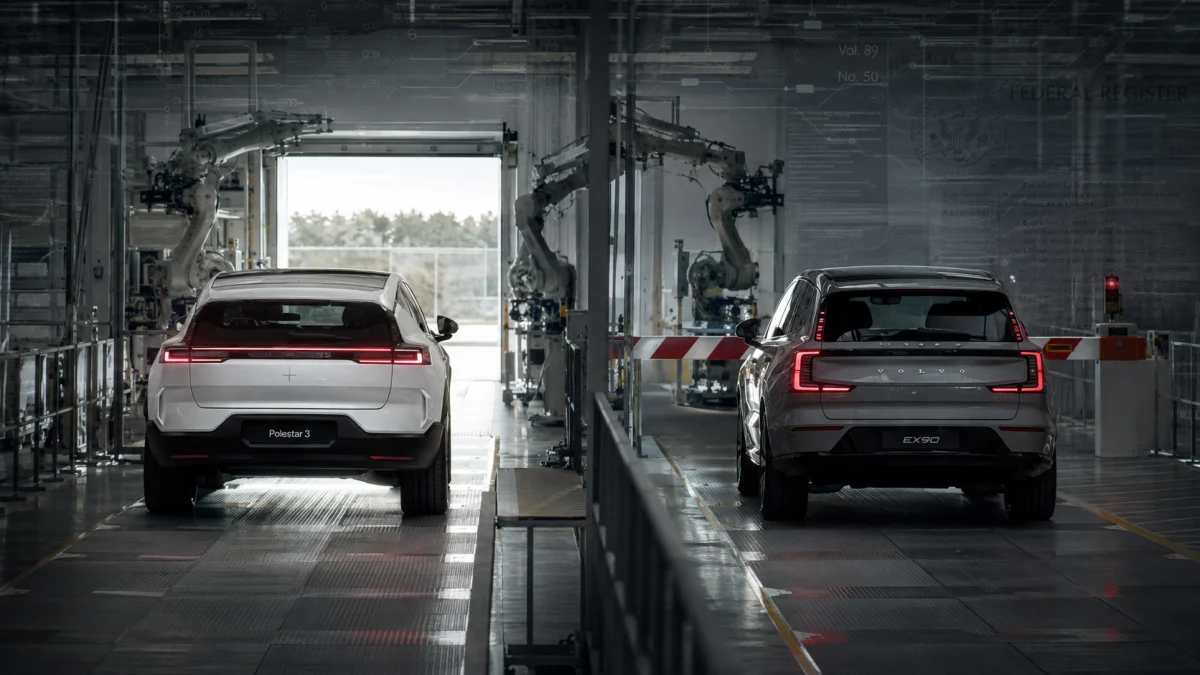
The comparison gets stranger. The Polestar 3 and Volvo EX90 share Volvo’s SPA2 architecture and related core-computing technology, and both are manufactured at Volvo’s plant in Ridgeville, South Carolina. In March—less than three months before Polestar was rejected—Volvo and Polestar were preparing to consolidate global Polestar 3 production at that same American factory.
Polestar now says federal officials had previously given it reason to expect approval if Volvo was approved.
But the most important piece of this story is also the least visible:
The Commerce Department does not publicly disclose the decisions or conditions behind these specific authorizations.
So we know how Volvo remained in the United States while Polestar was pushed out.
We still do not know exactly why Commerce decided one company’s risks could be mitigated and the other’s could not.
Was Polestar Actually “Banned” From the United States?
Not in the sense that existing Polestar cars suddenly became illegal.
Polestar can continue selling its existing U.S. inventory of Polestar 3 and Polestar 4 vehicles, and the company says it will continue supporting American owners through its service network.
The restriction instead becomes decisive with model year 2027. Polestar cannot sell those newer connected vehicles in the United States under its current regulatory status.
That distinction comes directly from the Commerce Department’s Connected Vehicles Rule.
For manufacturers controlled by China or Russia, vehicles manufactured before model year 2027 are exempt from the ownership-based sales prohibition. Beginning with model year 2027, a covered manufacturer needs an authorization before selling the affected connected vehicles in the United States.
So “Polestar banned in America” is useful shorthand.
More precisely:
Polestar was denied the authorization it needs to sell model-year 2027 and later connected vehicles in the United States.
The Rule Is Broader Than “No Chinese Software”
This is where much of the coverage becomes misleading.
The federal rule does restrict certain connected-vehicle software and hardware designed, developed, manufactured or supplied by people or companies linked to China or Russia.
But there is a separate provision aimed at the manufacturer itself.
Under 15 CFR § 791.304, a connected-vehicle manufacturer owned by, controlled by, or subject to the jurisdiction or direction of China or Russia is prohibited from selling covered connected vehicles in the United States regardless of whether the relevant hardware or software itself comes from China or Russia.
The final rule even gives a hypothetical example: if a Chinese-controlled manufacturer builds cars in the United States using connectivity hardware and software supplied entirely by non-Chinese companies, the manufacturer’s own foreign-adversary control can still make the sale prohibited.
That matters enormously here.
It means the answer cannot simply be:
Polestar had Chinese technology and Volvo didn’t.
Corporate control itself was enough to put both companies into the regulatory problem.
And Volvo has effectively acknowledged that. Its May announcement specifically said that, given its ownership, Volvo Car USA had to go through the Commerce Department’s specific-authorization process to continue importing and selling connected cars.
Volvo Is Swedish—but It Is Also Chinese-Controlled
Calling Volvo “Swedish” is geographically and culturally reasonable. Its headquarters and much of its engineering organization remain in Gothenburg.
It does not, however, answer the regulatory question.
Volvo Cars says Zhejiang Geely Holding ultimately controls it. Geely Sweden Holdings holds approximately 78.65% of Volvo Cars’ shares and votes, and Volvo describes itself in corporate filings as an indirect subsidiary of Zhejiang Geely.
Polestar’s structure is more complicated, but its ultimate control points in essentially the same direction.
Polestar’s 2025 financial statements state that, because of the company’s ownership structure, Li Shufu effectively controls the Polestar group. The company also says Geely is its ultimate controlling shareholder.
That gives us the first important conclusion:
Volvo did not avoid the Connected Vehicles Rule because the government considered it entirely separate from China. The government considered Volvo covered and then specifically authorized it anyway.
That makes Volvo’s authorization—not Polestar’s Chinese ownership—the proper starting point for understanding the difference.
The Polestar 3 Makes the Comparison Particularly Difficult
If Polestar and Volvo made completely unrelated vehicles through unrelated factories and software systems, the different decisions would be easier to understand.
They do not.
Polestar says the Polestar 3 is built on a Volvo Cars technology base shared with the Volvo EX90. The companies worked together on its central computing architecture, including technology involving NVIDIA’s DRIVE platform and Volvo-related advanced-driver-assistance systems.
Both vehicles also use Volvo’s SPA2 architecture.
And both come out of Volvo’s South Carolina manufacturing operation.
Polestar describes the Ridgeville plant as a Volvo-built facility adapted for Polestar production and says the relationship between the companies is evident throughout the Polestar 3 manufacturing process.
Volvo, meanwhile, announced on March 31 that the companies planned to consolidate global Polestar 3 production in South Carolina. Volvo said it had already invested roughly $1.3 billion in the facility, which has capacity for approximately 150,000 vehicles per year.
This does not prove that the Polestar 3 and EX90 are electronically identical.
They are not the same vehicle, and Polestar itself says they diverge in design, dynamics and performance.
Nor does sharing a platform tell us whether their cloud infrastructure, remote-access permissions, data-management systems, software-development controls, suppliers or corporate cybersecurity arrangements are identical.
But it does make a simple factory-origin explanation difficult to sustain.
An American-built Polestar was rejected while closely related American-built Volvo vehicles remained authorized.
The determining factor therefore appears to have been something deeper than the address of the assembly plant.
Volvo Didn’t Receive an “Exemption”—It Received a Specific Authorization
This distinction matters.
The regulation establishes a mechanism allowing BIS to approve transactions that would otherwise be prohibited.
It calls that permission a specific authorization.
BIS says applications are assessed individually. Its review can examine the risk of vehicle data being exfiltrated, the possibility of remote manipulation or operation of a vehicle, the nature and extent of foreign-adversary involvement, applicable cybersecurity standards and the applicant’s proposed safeguards.
BIS can also impose individualized conditions.
Those conditions can include controls designed to limit Chinese government access to or influence over the design, development, manufacture or supply of covered hardware and software. BIS can require audits, third-party assessments and other compliance or verification measures.
And for a Chinese-controlled manufacturer, the rule explicitly contemplates conditions as substantial as requiring relevant hardware and software to be assembled and integrated into the vehicle in the United States.
In other words, this was never supposed to be a simple ownership checklist:
Chinese-controlled = automatically gone.
The rule instead permits Commerce to say:
Chinese-controlled, but sufficiently mitigated = authorized.
Volvo apparently cleared that second test.
Polestar apparently did not.
The Most Important Document Is the One We Cannot See
Here is the central problem for anyone claiming to know precisely why.
BIS states plainly that applications are reviewed case by case and that decisions regarding specific authorizations will not be made publicly available.
Volvo has disclosed only the broadest description of what happened.
It says its authorization followed constructive discussions with Commerce and other U.S. officials about:
- governance;
- technology; and
- data security.
Volvo has not publicly disclosed the complete conditions attached to its authorization.
Likewise, Polestar’s rejection letter has not been made public.
That means anyone confidently claiming that Volvo passed because of one particular server, software supplier, board arrangement, factory or political consideration is going beyond the available evidence.
The decisive comparison is hidden inside two nonpublic federal regulatory files.
That is not speculation. Confidentiality is part of the regulatory structure itself.
There Are Real Operational Differences Between Polestar and Volvo
This does not mean Commerce lacked reasons to distinguish them.
One of the most important differences is visible in Polestar’s own SEC disclosures.
Polestar describes itself as an asset-light automaker. Rather than maintaining the independent manufacturing footprint of a traditional large automaker, it relies extensively on Volvo Cars and Geely.
Its filings say those relationships provide access to:
- technology;
- manufacturing facilities;
- logistical infrastructure;
- information-technology systems;
- product-development capabilities;
- supplier contracting; and
- research and development.
Polestar also says it has agreements with Volvo and Geely involving software licenses, intellectual property, product development and administrative and IT services.
Its manufacturing footprint illustrates the dependence.
According to Polestar’s 2025 annual filing:
- Polestar 2 is manufactured at a Volvo-owned plant in China.
- Polestar 3 is manufactured through Volvo facilities, including South Carolina.
- Polestar 4 is produced through Geely’s Hangzhou Bay plant and Renault Korea.
- Polestar 5 production involves Geely-operated facilities in China.
Volvo is certainly deeply integrated with Geely as well.
But Polestar’s own description of itself shows a company whose business model deliberately depends on technology, manufacturing and services supplied throughout the wider Volvo-Geely ecosystem.
That could matter under a regulation whose central question is not merely who owns the shares, but who can influence or access connected-vehicle technology.
What is verified
BIS evaluates foreign-adversary influence, data-exfiltration risk, remote-control risk, security standards and proposed mitigation.
Polestar depends extensively on Volvo and Geely for technology, manufacturing and other operational functions.
Volvo received authorization after discussions about governance, technology and data security.
What is reasonable inference
Commerce may have concluded that Volvo could create an acceptable security boundary around its U.S. connected-vehicle operations while Polestar’s broader dependencies created risks that were more difficult to isolate or mitigate.
That would fit the structure of the regulation.
What is not established
There is currently no public BIS document showing that this was actually the decisive reason.
That distinction matters.
A plausible explanation is not evidence that the government relied on it.
Polestar Says It Was Led to Expect Approval
The story became considerably more complicated in August.
According to an August 18 letter from Polestar to its American dealers obtained by The Wall Street Journal and reviewed by The Verge, Polestar says it began the authorization process on May 29, 2025 and spent approximately 13 months working through the Commerce Department’s review.
Polestar says BIS repeatedly requested additional information and extended the review.
According to the company’s account, by January 2026 officials had indicated that they had sufficient information and were preparing to recommend approval.
Then came an especially important April meeting.
Polestar says Commerce Under Secretary Jeffrey Kessler told its representatives that it would be reasonable for Polestar to expect approval if Volvo was approved under what Polestar characterized as effectively the same ownership structure and the same hardware and software circumstances involving the Polestar 3 and Volvo EX90.
That is a significant allegation.
But it remains Polestar’s account of a private meeting.
Commerce has not publicly released minutes, correspondence or another record confirming that Kessler made such a commitment.
The wording also matters. “Reasonable to expect approval” is not the same thing as a legally binding approval.
Still, the chronology is difficult to ignore:
May 29, 2025: Polestar says it submits its application.
2025: BIS requests additional information.
January 2026: Polestar says officials indicate an approval recommendation is being prepared.
April 2026: Polestar says Kessler indicates that Volvo approval would make Polestar approval reasonable to expect.
May 26: Volvo announces that it has received authorization.
June 24–25: Polestar learns its application has been denied and publicly announces the result.
If Polestar’s account is accurate, the remaining mystery becomes more specific:
What changed—or what did Commerce conclude about Polestar that it did not conclude about Volvo?
Polestar Says It Offered Security Safeguards Too
The dealer letter also undercuts one of the simplest accusations against Polestar: that it did nothing to attempt compliance.
Polestar says it offered to discuss mitigation measures including independent cybersecurity assessments, audits, geographic restrictions on data storage and management, and restrictions involving digital keys and remote access.
According to Polestar, BIS did not enter negotiations over those proposals and instead told the company it had enough information to make a decision.
Again, those claims come from Polestar.
Without the government’s side of the correspondence, we cannot determine whether BIS considered those proposed safeguards inadequate, unnecessary, incomplete or beside the point.
But they matter because BIS’s own regulation specifically identifies security standards, third-party validation and limitations on Chinese government access or influence as examples of the mitigation measures it can consider.
Polestar therefore appears to be describing exactly the kind of negotiation the rule contemplated.
It says that negotiation never really happened.
Then a Polestar Dealer Sued—and Offered a Very Different Explanation
While Polestar portrays itself as unexpectedly rejected, one of its dealers says the company was looking for a way out.
Prestige Imports, which operates Polestar locations in New Jersey, sued the automaker in Bergen County Superior Court in August seeking at least $25 million.
The lawsuit alleges that Polestar had been preparing to leave the United States for roughly two years and used the federal decision as cover for an exit it already wanted. The dealer contends that Polestar’s withdrawal effectively terminates its franchise without the protections required under New Jersey law.
Prestige’s lawyers characterize the federal restriction as part of a constructive termination dispute.
Polestar reportedly invoked force majeure after the Commerce decision, essentially arguing that an external government action prevented it from fulfilling certain obligations.
The dealer’s theory is the opposite:
The government action was not simply an unavoidable external event because Polestar’s own decisions contributed to the outcome.
That is an allegation.
It has not been established in court.
The Dealer’s Theory Has One Very Strong Question: Why Didn’t Polestar Appeal?
The regulation provides an explicit appeal process.
A company denied a specific authorization can appeal to the Commerce Department’s Under Secretary within 45 days of the adverse decision.
BIS also allows a rejected applicant to request reconsideration later if new material facts or changed circumstances arise. A denial of one transaction does not permanently prohibit an applicant from seeking authorization for a different transaction.
Polestar has nevertheless said it does not plan to appeal.
That deserves scrutiny.
If the company believes it was treated inconsistently with Volvo, why not challenge the decision?
Polestar’s own financial explanation provides at least part of the answer.
When it announced the U.S. decision, the company emphasized that Europe represented nearly 80% of its retail sales volume, while 94% of first-quarter 2026 retail sales came from outside the United States.
The American market had become relatively small.
A formal appeal, restructuring of supplier relationships, creation of new cybersecurity boundaries or redesign of connected systems could therefore cost substantial money to preserve a modest share of global sales.
That creates a perfectly rational middle possibility:
Polestar may genuinely have wanted authorization, genuinely have been surprised when it was denied, and then concluded that continuing the regulatory fight was no longer economically worthwhile.
That would not mean the dealer has no legitimate grievance.
But it would be very different from deliberately engineering a federal ban from the beginning.
Other Evidence Complicates the “Polestar Wanted Out All Along” Theory
The dealer’s allegations deserve investigation, but the public chronology does not neatly prove them.
In March 2026—while Polestar’s authorization application was still pending—Polestar and Volvo announced plans to move toward consolidating global Polestar 3 production in South Carolina.
That is a strange step for a company supposedly certain that it was about to abandon the United States.
The dealer lawsuit itself reportedly points in another direction as well.
Prestige alleges that as recently as February 2026 a Polestar executive supported a multi-year dealership expansion in New Jersey connected to an anticipated 2028 launch of the Polestar 7.
Ironically, that allegation can cut both ways.
If Polestar secretly intended to leave, encouraging dealers to keep investing could strengthen the dealer’s claims.
But if Polestar genuinely believed its authorization would be approved, those same expansion plans become evidence that the company was still preparing for a U.S. future.
That is why the internal correspondence will matter.
The public evidence currently supports skepticism toward both simplistic narratives:
“The government suddenly banned an innocent company for being Chinese.”
and
“Polestar deliberately got itself banned because it wanted to escape America.”
Neither has been established.
The Strongest Explanation Is Probably About Control, Not Assembly
What can we conclude from the evidence that is actually public?
First, the location of final assembly was not enough to save Polestar.
The Polestar 3 is built in South Carolina.
Second, Chinese control by itself did not automatically eliminate a manufacturer.
Volvo is overwhelmingly Geely-controlled and still received authorization.
Third, sharing substantial vehicle architecture with an approved manufacturer was not enough either.
The Polestar 3 and Volvo EX90 share a Volvo technology base and SPA2 architecture.
That leaves the issues BIS explicitly says it examines:
Who controls the company? Who can influence its connected systems? Who develops and supplies the technology? Where can data go? Who can access it? Can the company build an enforceable technical and corporate wall around those risks?
Polestar’s asset-light dependence on Volvo and Geely makes those questions more complicated, not less.
But without the actual authorization and denial documents, we cannot identify the exact answer Commerce reached.
There Is Another Possibility: Volvo Simply Offered a Better Deal
“Better” here does not mean money.
It means mitigation.
Specific authorizations can carry individualized conditions, reporting requirements, audits and technical restrictions. BIS says the conditions can differ from one application to another depending on the risk.
Volvo has acknowledged that its approval followed discussions over governance, technology and data security.
We do not know what Volvo agreed to.
If Volvo reorganized access controls, changed software-development responsibilities, restricted data transfers, created corporate firewalls, subjected systems to audits or accepted other controls that Polestar did not—or could not—the opposite outcomes could make perfect regulatory sense.
But until those conditions are disclosed, this remains a hypothesis.
It is equally possible that Commerce interpreted the two companies’ corporate structures differently for reasons not yet public.
And Polestar’s allegation that BIS declined to meaningfully negotiate its proposed mitigation raises another possibility: that the final decision involved a policy judgment that was broader than any one technical safeguard.
There is not enough public evidence to choose among those explanations confidently.
The Rule Itself Came From Two Administrations
The politics are also more complicated than “Trump banned Polestar.”
The national-security authority underlying the regulation traces to Executive Order 13873, issued by President Donald Trump in 2019.
The connected-vehicle rulemaking itself was developed during the Biden administration, beginning with a 2024 advance notice and culminating in the final rule published in January 2025.
The rule then remained in place under the second Trump administration, whose Commerce Department handled the 2026 Volvo and Polestar authorization decisions.
So the policy is better understood as part of a broader bipartisan hardening of U.S. policy toward Chinese involvement in connected vehicles, rather than as a rule invented specifically to target Polestar.
Why Connected Cars Are Treated as a National-Security Issue
Whether the government’s policy is proportionate is a separate question from what it legally does.
BIS’s stated concern is that modern vehicles are increasingly computers connected to external networks.
Vehicle connectivity systems can include cellular modems, telematics hardware, Wi-Fi, Bluetooth and other systems linked to sensors and internal vehicle networks.
The government argues that foreign access could potentially allow two particularly serious categories of harm:
- collection or exfiltration of sensitive data, including information associated with U.S. drivers and locations; and
- remote manipulation or operation of vehicle systems.
The rule is intentionally preventative.
BIS itself acknowledges that some of the risks it describes are forward-looking rather than evidence that Chinese manufacturers are currently remotely taking over American cars.
That distinction matters.
The rule is based on a judgment about potential access and coercive power, not a finding that Polestar has been caught spying on Americans.
There is no public evidence that the Polestar decision resulted from a discovered act of espionage.
Existing Polestar Owners Are Not Suddenly Stranded
For current owners, the practical picture is less dramatic than the word “ban” suggests.
Polestar says it will:
- continue selling remaining U.S. inventory;
- continue operating its service network; and
- continue supporting existing customers.
The federal rule also contains provisions designed not to interfere with repair and warranty obligations for older vehicles, including exemptions for certain replacement VCS hardware associated with pre-2030 model-year vehicles.
That does not eliminate longer-term questions about resale values, dealer availability or the size of Polestar’s future American service infrastructure.
But an existing Polestar does not become prohibited merely because the manufacturer cannot introduce its next model-year vehicles.
Could Polestar Eventually Return?
Potentially.
A denial is not necessarily permanent.
BIS says a rejected applicant may seek reconsideration based on new material facts or changed circumstances and can file another application involving a different transaction, different parties, or different hardware or software.
A meaningful restructuring of Polestar’s corporate control, technology chain or data architecture could therefore theoretically produce a different result.
The company could also revisit its decision not to prioritize the U.S. market if its economics change.
But under its current authorization status, model-year 2027 Polestars cannot be sold in the United States.
Volvo’s Victory May Not Be Permanent Either
There is an additional wrinkle.
Congress is considering legislation that could make the restrictions considerably tougher.
The bipartisan Connected Vehicle Security Act of 2026, S. 4429, would write broader restrictions into law. The Senate Commerce Committee advanced an amended version of the bill by voice vote in July. As of August 27, 2026, it has not become law.
The introduced legislation includes explicit ownership thresholds and would expand restrictions beyond the current regulatory framework.
If enacted in a sufficiently restrictive form, legislation could potentially change the position of companies that successfully obtained authorization under today’s BIS rule.
So Volvo’s current approval should not be confused with a permanent declaration that Chinese control of Volvo is irrelevant to U.S. policy.
It means Volvo cleared the regulatory regime that exists now.
So Why Was Polestar Banned While Volvo Wasn’t?
The most defensible answer is also the least satisfying:
Both companies’ Chinese control put them inside the federal Connected Vehicles Rule. Volvo persuaded—or agreed with—the Commerce Department that its specific transactions could proceed under an individualized authorization. Polestar did not.
The government has not publicly disclosed the decisive difference.
What we do know suggests that corporate and technical control probably mattered more than where the vehicles were assembled.
Volvo and Polestar share an owner, a factory and substantial vehicle technology. But they are not operationally identical companies. Polestar relies unusually heavily on Volvo and Geely for manufacturing, IT systems, product development, supplier contracting and technology.
That offers a credible explanation for why BIS might view the two differently.
It does not prove that BIS actually did.
Polestar’s August account complicates matters further. The company says it spent more than a year pursuing authorization, offered mitigation measures and was given reason to expect approval—only to be rejected shortly after Volvo received its authorization.
Then comes the dealer lawsuit, which asks the opposite question: if Polestar truly believes it was unfairly rejected, why did it walk away instead of appealing?
The answer may ultimately be less conspiratorial than either side suggests.
Commerce may have found a genuine security or corporate-control distinction between the companies. Polestar may have sincerely disagreed with that distinction. And once it lost, a company generating almost all of its sales outside America may have decided that spending more money to fight for the U.S. market simply was not worth it.
All three can be true simultaneously.
The missing evidence is sitting inside the government’s authorization files.
Until those records—or a meaningful explanation from Commerce—become public, anyone claiming to know exactly why Volvo passed and Polestar failed is filling in a gap that the federal government has deliberately left closed.
References and Further Reading
U.S. Government and Regulatory Documents
Federal Register — Securing the Information and Communications Technology and Services Supply Chain: Connected Vehicles, Final Rule The complete BIS final rule, including the ownership prohibition, specific-authorization process, mitigation criteria, confidentiality provisions and appeals procedure.
Bureau of Industry and Security — Connected Vehicles Specific Authorizations BIS guidance for companies seeking permission to conduct transactions that would otherwise be prohibited.
eCFR — 15 CFR § 791.304, Related Prohibited Transactions Current regulatory text governing sales by connected-vehicle manufacturers owned or controlled by China or Russia.
Volvo and Polestar Primary Sources
Volvo Cars — U.S. Specific Authorization Under the ICTS Connected Vehicles Rule Volvo’s May 26, 2026 announcement confirming its authorization and discussions with Commerce over governance, technology and data security.
Volvo Cars — Notice Describing Zhejiang Geely’s Controlling Ownership Volvo corporate disclosure identifying Zhejiang Geely’s approximately 78.65% ownership and voting control.
Polestar — June 25, 2026 U.S. Connected Vehicle Rule Announcement Polestar’s announcement that BIS had declined authorization for U.S. sales beginning with model year 2027.
SEC — Polestar 2025 Annual Report Primary disclosure covering Polestar’s ownership, related-party relationships, manufacturing footprint, technology agreements and dependence on Volvo and Geely.
Polestar — Polestar 3 Technical Relationship With Volvo EX90 Polestar’s own explanation of the shared Volvo technology base, computing collaboration and relationship between the Polestar 3 and EX90.
Volvo Cars — Plan to Consolidate Polestar 3 Production in South Carolina March 31, 2026 announcement detailing the shared South Carolina manufacturing footprint and SPA2 architecture.
Polestar’s Account and Dealer Litigation
The Verge — Polestar Says It Was Blindsided by the U.S. Sales Decision Reporting based on Polestar’s August 18 dealer letter describing its application timeline, alleged signals from Commerce and proposed mitigation measures.
The Wall Street Journal — Polestar Dealer Claims Automaker Orchestrated Its U.S. Ban Independent reporting on Prestige Imports’ lawsuit and its allegation that Polestar used the federal restriction as cover for an intended U.S. withdrawal.
ArentFox Schiff — Prestige Imports Lawsuit Against Polestar Summary from the dealer’s law firm describing the claims and requested relief. This is an interested-party source and should be read as the plaintiff’s account, not as a neutral finding.
Pending Legislation
GovInfo — S. 4429, Connected Vehicle Security Act of 2026 Official text and legislative information for the proposed statutory expansion of connected-vehicle restrictions.
Senate Commerce Committee — July 2026 Action on S. 4429 Official committee record showing the bill advanced in amended form.
Editorial currency note: The Polestar authorization dispute, dealer litigation and Connected Vehicle Security Act remain active matters as of August 27, 2026. The status of Polestar’s U.S. operations, pending legislation and any future BIS reconsideration or disclosure should be rechecked before substantive updates to this article.