Article type: analysis
Scope: Evidence-weighted analysis of Nigerian public opinion, religious and historical influences, bilateral relations, and official policy toward Israel and Palestine. It distinguishes public sentiment from government policy and does not treat polling as a causal decomposition.
Last updated: August 3, 2026
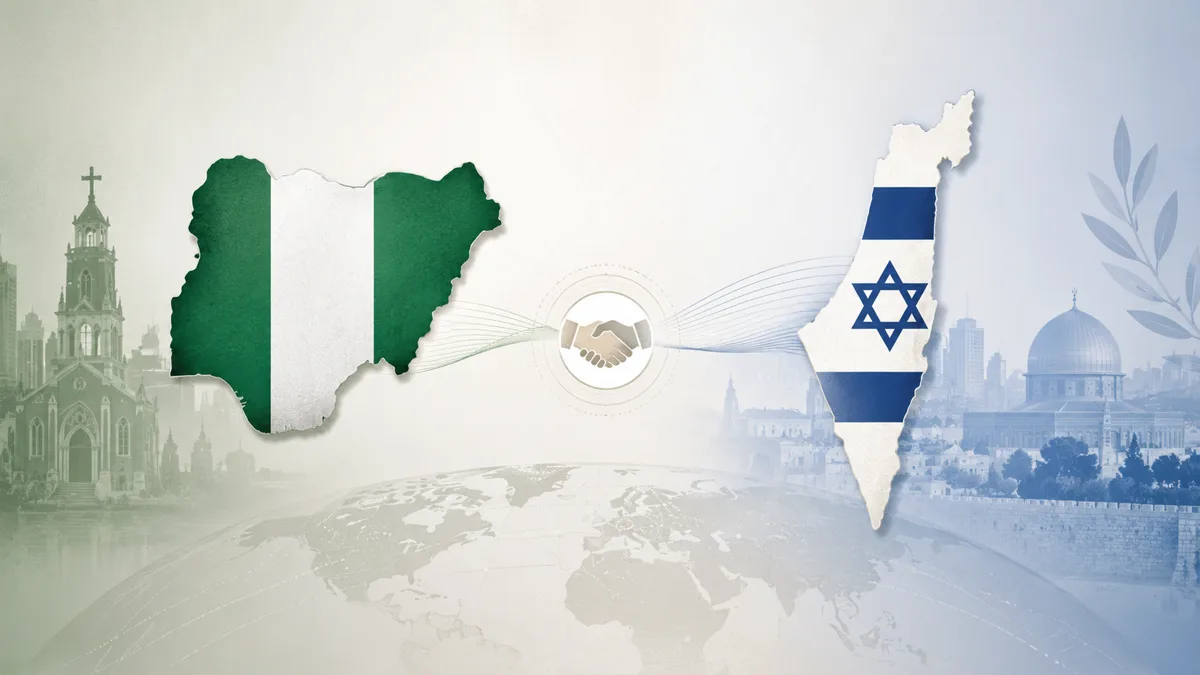
Nigeria’s unusually positive view of Israel is primarily a domestic religious phenomenon. A large and politically influential Christian population—especially within Pentecostal, evangelical and charismatic churches—often encounters modern Israel first as the Israel of the Bible and only second as a contemporary state whose policies can be judged like those of any other government.
Church teaching, prophecy, prayer campaigns and organized pilgrimages turn that theological identification into a living social relationship. Nigeria’s experience with jihadist violence, Israel’s reputation for military effectiveness and technological innovation, historic cooperation with southern Nigeria, and a narrower Igbo-Biafran identification with Jewish history all reinforce that foundation.
But the simplified claim that “Nigeria supports Israel” needs two major corrections.
First, Nigerian opinion has become substantially less favorable. Second, the Nigerian government does not support every Israeli policy. Abuja maintains diplomatic relations with Israel while officially supporting Palestinian independence, a permanent ceasefire, pre-1967 borders and Palestinian self-determination.
The honest conclusion is therefore not that Nigeria is uniformly or unconditionally pro-Israel. It is that Nigeria possesses one of the world’s strongest religiously rooted pro-Israel constituencies, but that constituency exists alongside a large and growing body of opposition.
How strongly does Nigeria actually support Israel?
The premise was substantially correct in 2025, but the latest polling shows that the gap has narrowed sharply.
| Survey year | Favorable view of Israel | Unfavorable view | Net favorability |
|---|---|---|---|
| 2025 | 59% | 32% | +27 |
| 2026 | 47% | 41% | +6 |
In Pew Research Center’s 2025 survey of 24 countries, Nigeria was one of only two surveyed countries—alongside Kenya—where around half or more of the public viewed Israel favorably. (Pew Research Center)
By 2026, Nigeria still ranked near the top internationally. Forty-seven percent of Nigerian adults viewed Israel favorably, compared with 41 percent who viewed it unfavorably. Only Kenya, at 50 percent, and Ghana, at 49 percent, recorded higher favorable shares among the 36 populations surveyed. The median favorable rating across all countries was only 25 percent. (Pew Research Center)
That makes Nigeria an international outlier, but no longer an overwhelmingly pro-Israel country. Favorability fell by 12 percentage points in a single year, while unfavorable opinion rose by nine points. Opposition remains comparatively low by global standards, but 41 percent is not socially or politically insignificant. (Pew Research Center)
Nor should a favorable opinion of “Israel” be mistaken for approval of every Israeli military operation, settlement policy or government. In the same 2026 survey, Nigerians were almost evenly divided over Benjamin Netanyahu: 43 percent expressed confidence in him, while 45 percent expressed little or no confidence. (Pew Research Center)
Pew measured the outcome but did not ask Nigerian respondents to rank the reasons behind it. The explanation that follows is therefore an evidence-based synthesis of Nigeria’s religious institutions, political history, diplomatic relationships and regional identities—not a claim that polling has mathematically assigned a percentage to each cause.
The main reason: Christian identification with biblical Israel
The most important explanation is Christian Zionism, although in Nigeria it does not always appear as a formally organized political movement.
Christian Zionism is the belief that the modern State of Israel retains special biblical or prophetic significance and should therefore receive Christian support. In its Nigerian form, it often appears through sermons, prayer language, pilgrimage, prophecy and teachings about God’s covenant with Abraham rather than through conventional lobbying organizations.
Many Nigerian Christians are taught that:
- the Jewish return to the land represents fulfilled biblical prophecy;
- modern Israel remains part of a continuing divine covenant;
- Christians and nations will be blessed for supporting Israel;
- Israel’s military survival demonstrates divine protection;
- and events in Jerusalem are connected to the eventual return of Jesus.
These beliefs are not exclusive to Nigeria. Scholarship on evangelical support for Israel has identified covenant theology, biblical prophecy, gratitude toward Judaism, fear of divine judgment and the perception of Israel as a defense against Islamist militancy as recurring motivations. (OUP Academic)
What makes the Nigerian case unusually powerful is scale.
Pew estimated that Nigeria had approximately 93 million Christians in 2020, making it home to the world’s sixth-largest Christian population. The same estimate placed Muslims at 56.1 percent of the total population and Christians at 43.4 percent. However, Pew also noted that surveys limited to Nigerian adults have sometimes found Christians outnumbering Muslims because the Muslim population is younger. Since political-opinion surveys question adults rather than children, the Christian share of the surveyed public may be larger than the total-population figure initially suggests. (Pew Research Center)
This helps resolve the apparent contradiction between Nigeria’s estimated Muslim majority and its comparatively favorable adult opinion of Israel.
Biblical Israel and modern Israel are not the same entity
The theological connection is real as a belief, but it must not be confused with a historical or political fact.
The Israel described in biblical texts was an ancient religious and political society. The modern State of Israel was established in 1948 and functions as a contemporary nation-state with elected governments, military institutions, territorial policies and political parties. Treating the two as interchangeable can make criticism of a modern government appear to be opposition to God or Christianity itself.
That conflation is one of the most important reasons pro-Israel sentiment can remain durable even when Israeli conduct is heavily criticized elsewhere. When Israel is understood principally as a sacred entity, evidence about civilian casualties, occupation, settlements or displacement must first break through a theological shield before it can influence political opinion.
This does not mean every pro-Israel Nigerian Christian endorses every Israeli action. It means Israel frequently begins with a degree of spiritual legitimacy that most other foreign governments do not receive.
Pilgrimage turns theology into a personal relationship
Nigeria does not merely contain churches that preach about Israel. It possesses a federal institution dedicated to organizing Christian pilgrimage.
The Nigerian Christian Pilgrim Commission coordinates journeys to Israel, Jordan and other biblical destinations. In one 2025 exercise, approximately 350 pilgrims from Imo and Abia states departed together following a ceremony attended by federal and state representatives. Nigerian leaders routinely describe these journeys as spiritually transformative visits to the “Holy Land.” (NCPC)
Pilgrimage matters because it converts a distant geopolitical subject into a personal religious experience.
A Nigerian visitor may pray at biblical sites, walk through Jerusalem, visit locations associated with Jesus and return home describing the journey from the pulpit or within a church community. Israel consequently becomes associated with faith, spiritual renewal, biblical authenticity and personal testimony.
The modern political geography of Israel and Palestine—including the separate legal and political circumstances of Jerusalem, the West Bank and Palestinian communities—can disappear inside the broader religious label of the “Holy Land.” The pilgrim may therefore experience a complex Israeli-Palestinian landscape primarily through an Israel-centered theological and tourism framework.
Repeated across churches, states and generations, this creates far more emotional influence than an ordinary diplomatic agreement ever could.
Nigeria’s security crisis makes Israel’s story resonate
A second major driver is Nigeria’s prolonged experience with terrorism, insurgency and religiously framed violence.
Boko Haram and the Islamic State West Africa Province have attacked, kidnapped and killed both Christians and Muslims. Churches and mosques have both been destroyed. Other conflicts in Nigeria’s Middle Belt combine competition over land, criminality, ethnicity, climate pressures and religious identity. (Pew Research Center)
Within some Nigerian Christian communities, these experiences create a powerful analogy:
Israel is seen as a small religious nation surrounded by hostile forces, while Nigerian Christians see themselves as communities threatened by jihadist violence.
The analogy is emotionally effective because it translates an unfamiliar Middle Eastern conflict into a Nigerian security experience people already understand. Hamas becomes mentally associated with Boko Haram, while Israel becomes the state that fights back successfully.
But the analogy is analytically incomplete.
The Israeli-Palestinian conflict is not simply a government fighting an organization comparable to Boko Haram. It also involves military occupation, territorial control, settlements, blockade, displacement, competing national movements and the unresolved right of Palestinians to self-determination. Nigeria itself recognizes those dimensions in its official foreign policy.
The security analogy therefore helps explain Nigerian support; it does not establish that the analogy is accurate in every respect.
Israel has cultivated an image of competence and development
Religion is the primary mass-public driver, but it is reinforced by Israel’s reputation in Nigeria as a technically capable and innovative state.
Nigeria and Israel established diplomatic relations in 1960. During the 1960s and early 1970s, Israeli specialists worked in Nigerian agriculture, education, medicine and technical training, while Nigerian professionals received training in Israel. Israel’s embassy currently says that more than 50 Israeli or Israeli-owned companies operate in Nigeria in sectors including construction, infrastructure, information technology, agriculture and water management. (Ministry of Foreign Affairs)
The relationship helps construct an appealing public image of Israel as a country associated with:
- irrigation and agricultural productivity;
- medicine and emergency response;
- intelligence and military capability;
- water management;
- entrepreneurship and technology;
- and the ability to build a powerful state despite limited territory and natural resources.
This image is especially attractive in a country confronting infrastructure deficits, agricultural insecurity, terrorism and inconsistent public administration.
Yet economic and technical cooperation should not be exaggerated as the main explanation for popular opinion. Most Nigerians do not form their view of Israel by studying memoranda of understanding or bilateral trade. These relationships strengthen Israel’s reputation among political, business and religious elites, but the emotional foundation of mass support remains largely theological.
The relationship has always reflected Nigeria’s internal divisions
Nigeria has never possessed a single, uninterrupted national attitude toward Israel.
Research on Nigeria’s early post-independence diplomacy shows that the Christian-majority southern regions actively developed relationships with Israel and welcomed Israeli technical assistance. Northern political leadership was generally more closely aligned with Arab states through religious, educational and geopolitical relationships, although individual leaders were often more pragmatic in private than their public rhetoric suggested. (Cambridge University Press)
Nigeria severed diplomatic relations with Israel in 1973 and did not restore them until 1992. Research based partly on Nigerian Foreign Ministry material concludes that religion influenced how successive governments managed the controversy, but religion was neither the formal reason for breaking relations nor the sole reason for restoring them. Pan-African politics, the Arab-Israeli wars, Israel’s relationship with apartheid South Africa and Nigeria’s broader national interests also mattered. (Ingenta Connect)
This history is important because contemporary Nigerian opinion did not emerge overnight. Israel has long functioned as a symbolic issue through which Nigeria’s regional, religious and political constituencies express different ideas about national identity.
The strongest pro-Israel attitudes have historically been associated with much of Christian southern Nigeria. Pro-Palestinian attitudes have generally found greater resonance in Muslim political and religious networks. Current national polling combines these constituencies into a single percentage, concealing the division underneath.
Igbo and Biafran identification is real—but it is not the national explanation
A smaller but highly visible factor exists among some Igbo and pro-Biafran communities in southeastern Nigeria.
Certain Igbo religious and nationalist movements claim that the Igbo are descended from one of the biblical Lost Tribes of Israel. Some Biafran activists compare the experience of Igbo persecution, the Nigerian Civil War and the unsuccessful struggle for Biafran independence with Jewish persecution and the eventual establishment of Israel.
The symbolic connection is visible at demonstrations where Israeli flags sometimes appear beside Biafran flags. Some separatist movements describe Israel as a model of a persecuted people securing independent statehood. (Cambridge University Press)
Academic research has found no archaeological or historical evidence establishing that the Igbo are literally a Lost Tribe of Israel. But a belief does not need to be genealogically true to exercise political power. The analogy provides some Igbo nationalists with a story of survival, return, sovereignty and redemption. (Cambridge University Press)
This is an important regional reinforcement of pro-Israel sentiment, especially in parts of southeastern Nigeria. It is not, however, a sufficient explanation for national opinion. Most Nigerians are not Igbo, and most Nigerian supporters of Israel do not base their position on Biafran nationalism.
Why religion alone is not a complete explanation
Religion is the strongest cause, but saying “Nigerians support Israel because they are Christian” is still too simplistic.
Many Christian societies have become deeply critical of Israel. Christian theology itself contains multiple interpretations of modern Israel, Zionism, Palestinian rights and biblical prophecy. Nigerian Christians are not politically uniform, and some churches and Christian intellectuals strongly oppose Christian Zionism.
What matters is not merely the number of Christians, but the particular form of Christianity that has become influential.
Nigeria has an enormous Pentecostal and charismatic ecosystem in which prophecy, spiritual warfare, biblical covenant, divine favor and national destiny are common themes. Within that worldview, Israel can function simultaneously as a sacred nation, a prophetic clock, a model of national resilience and an ally against perceived Islamist expansion.
The more relevant equation is therefore:
Large Christian population + Pentecostal theology + institutionalized pilgrimage + domestic insecurity + historic relationships = unusually favorable opinion of Israel.
No single element is sufficient by itself. Together, they produce the Nigerian outlier.
Nigerian support is falling
Any article claiming that Nigerians are simply and permanently pro-Israel would now be misleading.
Between the 2025 and 2026 Pew surveys, favorable opinion fell from 59 percent to 47 percent. The share with a very unfavorable view increased enough for Pew to identify Nigeria as one of the countries experiencing a double-digit increase in intense negative sentiment. (Pew Research Center)
Most of the 2026 interviews occurred after the United States and Israel began a military campaign in Iran on February 28, amid an already expanded regional conflict. The survey cannot determine whether Gaza, Iran, Netanyahu, civilian suffering, economic concerns or some combination caused Nigeria’s shift. It does establish that religious affinity has not made Nigerian opinion immovable. (Pew Research Center)
Images and reports of civilian deaths can compete with theological loyalty. Nigerians who may continue to feel cultural or spiritual sympathy toward Israel can simultaneously become hostile to a particular government, military campaign or political ideology.
That distinction is reflected in the nearly even Nigerian division over Netanyahu.
Nigeria’s government officially supports Palestinian statehood
The greatest error in discussions of this subject is the failure to distinguish Nigerian public opinion from Nigerian foreign policy.
Nigeria maintains normal diplomatic and economic relations with Israel. But its government also maintains a longstanding relationship with Palestine and repeatedly supports Palestinian national rights.
In April 2026, Nigeria’s minister of state for foreign affairs reaffirmed that Nigeria supports an independent Palestinian state and described Palestinian self-determination as “non-negotiable.” The ministry also highlighted the humanitarian effects of the conflict on women and children. (Foreign Affairs)
At the United Nations in July 2025, Nigeria:
- supported an immediate and permanent ceasefire;
- backed a Palestinian state based on the pre-1967 borders;
- called for Palestine’s admission as a full UN member;
- supported the work of UNRWA;
- and stated that Israel was obligated to end its presence in occupied Palestinian territory in accordance with the International Court of Justice’s advisory opinion. (UN eStatements)
Nigeria’s foreign minister again reaffirmed the country’s enduring support for the Palestinian people, international law and peaceful coexistence in February 2026. (Foreign Affairs)
This is not the policy of an unconditionally pro-Israel state.
Nigeria’s actual governmental position is closer to dual engagement: maintain relations and practical cooperation with Israel while supporting Palestinian statehood and criticizing occupation and humanitarian harm.
Ranking the real reasons Nigerians support Israel
The available evidence does not justify pretending that every explanation carries equal weight.
| Factor | Probable importance | What it explains |
|---|---|---|
| Christian identification with biblical Israel | Primary | Gives Israel sacred and prophetic significance |
| Pentecostal and evangelical church culture | Primary amplifier | Repeats and institutionalizes pro-Israel theology |
| Christian pilgrimage | Major amplifier | Converts religious teaching into personal experience |
| Security analogy with jihadist violence | Strong secondary factor | Frames Israel as a model of resistance and survival |
| Israel’s technology and development reputation | Secondary factor | Creates admiration for Israeli competence |
| Historic southern Nigerian ties | Background factor | Explains the regional roots of present attitudes |
| Igbo-Biafran identification with Jewish history | Regional factor | Strengthens support in parts of southeastern Nigeria |
| Government trade and diplomacy | Supporting factor | Sustains elite relationships but does not explain mass sentiment alone |
This ranking is not a numerical decomposition of the Pew poll. It is the most defensible interpretation of the combined historical, religious and institutional evidence.
What the evidence does not support
Several common claims go beyond what the facts establish.
“Nigeria unanimously supports Israel”
False. In 2026, 41 percent of Nigerians viewed Israel unfavorably, compared with 47 percent favorably.
“Nigeria supports Netanyahu and everything Israel does”
False. Nigerians were almost evenly divided over Netanyahu, and the favorability question did not ask respondents to endorse settlements, occupation, the Gaza campaign or any other specific policy.
“The Nigerian government has chosen Israel over Palestine”
False. Nigeria has relations with Israel but officially supports Palestinian independence, pre-1967 borders, full UN membership and an end to occupation.
“Nigeria’s position is entirely caused by business or Israeli influence”
Unsupported. Bilateral cooperation reinforces Israel’s favorable image, but there is no credible evidence that trade or diplomatic lobbying alone explains mass public sentiment. The cultural infrastructure of churches and pilgrimage is far more visible and socially pervasive.
“Igbo ancestry explains Nigerian support”
Overstated. Igbo-Jewish and Biafran-Israeli identification is genuine within particular communities, but it is a regional explanation rather than a national one.
The bottom line
Nigeria’s comparatively favorable opinion of Israel is not primarily the result of Nigerians studying Israeli borders, coalition politics or diplomatic treaties. It is largely the result of how Israel is understood inside Nigeria.
For millions of Nigerian Christians, Israel is not introduced as an ordinary foreign country. It enters consciousness through scripture, church, prophecy, prayer and pilgrimage. That gives it an initial presumption of spiritual legitimacy. Nigeria’s experience with jihadist violence makes Israel’s security narrative more compelling, while Israel’s reputation for technology and national resilience adds secular admiration. Historic southern ties and Igbo-Biafran symbolism deepen support within particular regions.
But none of this amounts to unanimous approval.
Nigeria’s public is now close to evenly divided. Favorability has fallen sharply. Opposition is substantial, Netanyahu is polarizing, and the Nigerian government continues to defend Palestinian independence and self-determination.
The most accurate conclusion is therefore this:
Nigeria remains one of the world’s most Israel-friendly societies because a powerful section of Nigerian Christianity treats Israel as a sacred and prophetic cause. Security fears, pilgrimage and historic cooperation strengthen that attachment. But Nigerian support is neither unconditional nor permanent—and the latest evidence shows that it is already weakening.
Frequently asked questions
Is Nigeria an ally of Israel?
Nigeria and Israel have diplomatic, commercial and technical relationships, but Nigeria is not an unconditional Israeli ally. It also maintains relations with Palestine and officially supports a Palestinian state based on the pre-1967 borders.
Why do many Nigerian Christians support Israel?
Many understand the modern state through biblical covenant and prophecy. Pentecostal preaching, religious pilgrimage and the belief that supporting Israel brings divine favor reinforce that identification.
Do most Nigerians still support Israel?
Not according to the latest available poll. In 2026, 47 percent had a favorable view and 41 percent had an unfavorable view. Nigeria remains comparatively pro-Israel internationally, but no side now commands a clear majority.
Does Nigeria support Palestine?
Yes. Nigeria officially supports Palestinian independence, self-determination, full UN membership, a permanent ceasefire and a two-state settlement based on the pre-1967 borders.
Is Nigerian support for Israel increasing?
No. Favorability fell from 59 percent in 2025 to 47 percent in 2026, while unfavorable opinion increased from 32 percent to 41 percent.
Is the Igbo-Jewish connection the main reason?
No. It is an important symbolic factor in some Igbo and Biafran communities, but Christian Zionist theology, pilgrimage and broader religious culture provide a much stronger national explanation.
—
References and Further Reading
Public-opinion and demographic research
- Pew Research Center. Most people across 36 countries have negative views of Israel and little confidence in Netanyahu. June 4, 2026.
- Pew Research Center. Most people across 24 surveyed countries have negative views of Israel and Netanyahu. June 3, 2025.
- Hackett, Conrad. Pew Research Center. Five facts about religion in Nigeria. November 11, 2025.
Nigerian foreign policy and bilateral relations
- Federal Ministry of Foreign Affairs of Nigeria. Nigeria reiterates support for an independent Palestinian state and a two-state solution. April 17, 2026.
- Permanent Mission of Nigeria to the United Nations. National Statement by Nigeria at the UN High-Level Conference on the Two-State Solution. July 2025.
- Federal Ministry of Foreign Affairs of Nigeria. Nigeria and Palestine strengthen bilateral relations and consular cooperation. February 4, 2026.
- Embassy of Israel in Nigeria. Israel–Nigeria bilateral relations.
- Nigerian Christian Pilgrim Commission. President Tinubu flags off the 2025 Christian pilgrimage exercise to Israel and Jordan.
Academic research
- Faseke, Babajide. Religion and Nigeria-Israeli diplomatic strains and rapprochement, 1973–1992. African Identities, 22(4), 911–925.
- Schler, Leena. The Sardauna’s Middle East: Regionalism and backstage politics in Nigeria’s postcolonial diplomacy. The Journal of African History, 63(2), 197–213.
- Ejiofor, Promise Frank. Jewishness without Jews? Ontological security, ethnonationalism, and the social power of analogical reasoning in postcolonial Nigeria. Nationalities Papers.
- Williams, Joseph. The Pentecostalization of Christian Zionism. Church History, 2015.
- Spector, Stephen. Evangelicals and Israel: The Story of American Christian Zionism. Oxford University Press, 2009.