Updated October 19, 2026. This article concerns the occupied West Bank. The most recent comprehensive UN harvest-attack tally cited below covers September 1 through October 12, while separately reported incidents extend through October 19.
Palestinian olive farmers are attacked because the harvest brings them onto land where some Israeli settlers seek to intimidate or exclude them, and where Israeli settlement expansion and military restrictions have made access increasingly contested. The documented methods include physical assaults, threats, theft of olives and equipment, destruction of trees, and interference with harvesting. Individual attackers’ precise motives are not always established, but the consequences are measurable: farmers lose crops and income, and some lose the practical ability to use land they still own.
This is not merely a dispute over a symbolic tree. Olive cultivation supports tens of thousands of Palestinian agricultural livelihoods and an entire chain of harvesters, mill operators and sellers. An attack can wipe out the current crop. Destroying a productive grove or blocking its upkeep can damage income for years.
The United Nations Office for the Coordination of Humanitarian Affairs (OCHA) documented 199 harvest-related settler attacks from September 1 to October 12, 2026, resulting in one Palestinian fatality, 124 injuries and damage to more than 2,500 trees and saplings. Those figures precede widely reported attacks on October 16 and 17 and should not be mistaken for a final seasonal total.
The broader question is how violence against farmers intersects with military access rules, expanding settlement outposts and the obligation of Israeli authorities to protect the people whose land is being attacked.
What happened to Palestinian olive farmers in 2026?
The official 2026 olive harvest was scheduled to begin on October 15. But attacks were already occurring across the West Bank before that date. OCHA counted 166 harvest-related settler attacks between September 29 and October 12 alone, within the longer September 1 to October 12 total of 199.
Of the 124 people injured in the September 1 to October 12 incidents, 92 were injured by settlers and 32 by Israeli forces in the context of settler attacks, according to the same UN report. These are specific incident-monitoring categories, not an assertion that each injury arose in the same circumstances.
| Measure | Recorded finding | Reporting period or scope |
|---|---|---|
| Harvest-related settler attacks | 199 | September 1 to October 12, 2026 |
| Palestinian fatalities in those attacks | 1 | September 1 to October 12, 2026 |
| Injuries during those attacks | 124 | 92 caused by settlers; 32 by Israeli forces in the context of settler attacks |
| Trees and saplings damaged during those attacks | More than 2,500 | September 1 to October 12, 2026 |
| All documented settler attacks causing casualties or property damage | More than 2,060 | West Bank, January 1 to October 12, 2026; not limited to olive harvests |
Source: UN OCHA, Humanitarian Situation Report, October 15, 2026, published October 19. The last row is a broader West Bank measure and must not be added to the harvest-specific count.
OCHA also described individual incidents that reveal what the statistics mean on the ground. On October 5 near Rammun, settlers attacked families picking olives and drove them from their land. Israeli forces subsequently arrested 15 Palestinians, while settlers reportedly took 17 bags of harvested olives. In Deir Abu Mash’al, OCHA reported that settlers harvested olives from Palestinian-owned land in Area B on multiple occasions while Israeli forces prevented the owners from approaching their groves. On October 7, a 44-year-old Palestinian was killed during an attack on olive harvesters near Burqa and Bizzariya, west of Nablus. OCHA reported that Israeli forces obstructed ambulances attempting to reach the wounded.
The man killed on October 7 was Ali Hassan Yasser al-Bazzari, 44, a Palestinian National Security Forces officer and father of four who had gone to Burqa after reports of an attack on harvesters. Associated Press reported that settlers fired on harvesters, citing Palestinian officials. His cousin, who was also injured, later described the attack to a reporter visiting the family’s olive grove. Available reporting does not conclusively identify the person who fired the fatal shot.
In Usarin, another Palestinian family described an assault on its olive grove to the same reporter. Warda Adeli, 63, was beaten and suffered facial injuries; one son had a broken shoulder, and another remained in intensive care with a severe brain injury when the report was published on October 14. These are not anonymous statistics. They are identifiable people describing the bodily and economic consequences of attacks on farming families.
These reported actions are not simply farmers and settlers encountering one another in a field. They include people being driven from their own harvest, produce being taken, civilians seriously injured, and state forces intervening against Palestinian landowners.
The October 16 and 17 attacks drew international attention
On October 16, Associated Press journalists documented settler attacks across at least eight Palestinian villages, including assaults, burned cars and damaged olive trees. In Abu Falah, masked settlers beat Washington Post photographer Heidi Levine, despite her clearly marked press vest. She was hospitalized with serious injuries.
The next day, AP reported another attack in Taybeh, where masked settlers armed with metal bars confronted and assaulted members of a visiting European delegation and other participants in an olive-harvest event. A French mayor described being struck and kicked.
On October 19, Israeli police announced the arrest of 10 suspects in an operation connected to the weekend violence. Police did not publicly identify the suspects or establish each person’s role. Arrests do not establish guilt or show how the investigations will ultimately end.
The attacks on a journalist and foreign visitors gained exceptional attention. Palestinian farmers, however, had already been experiencing similar attacks for weeks. The wider UN tally tells that story more clearly than the injuries of prominent foreign witnesses alone.
Are the attacks actually increasing?
Yes, the recorded long-term pattern has worsened, although different reporting windows must not be treated as directly comparable. OCHA recorded 33 harvest-related settler attacks in 2020 and 185 in the full 2025 season. Its preliminary 2026 total was already 199 by October 12, before the officially scheduled harvest opening.
The broader West Bank picture is also deteriorating: by October 12, OCHA had recorded more than 2,060 settler attacks involving casualties or property damage during 2026, an average of approximately seven per day, compared with about five per day in 2025. These are documented incidents meeting the UN’s monitoring criteria, not necessarily every threat or unreported assault.
Why do settlers attack olive farmers and destroy olive trees?
There is no single documented motive that can be assigned to every settler who attacks a farmer. But the evidence establishes several recurring mechanisms, and the distinction matters.
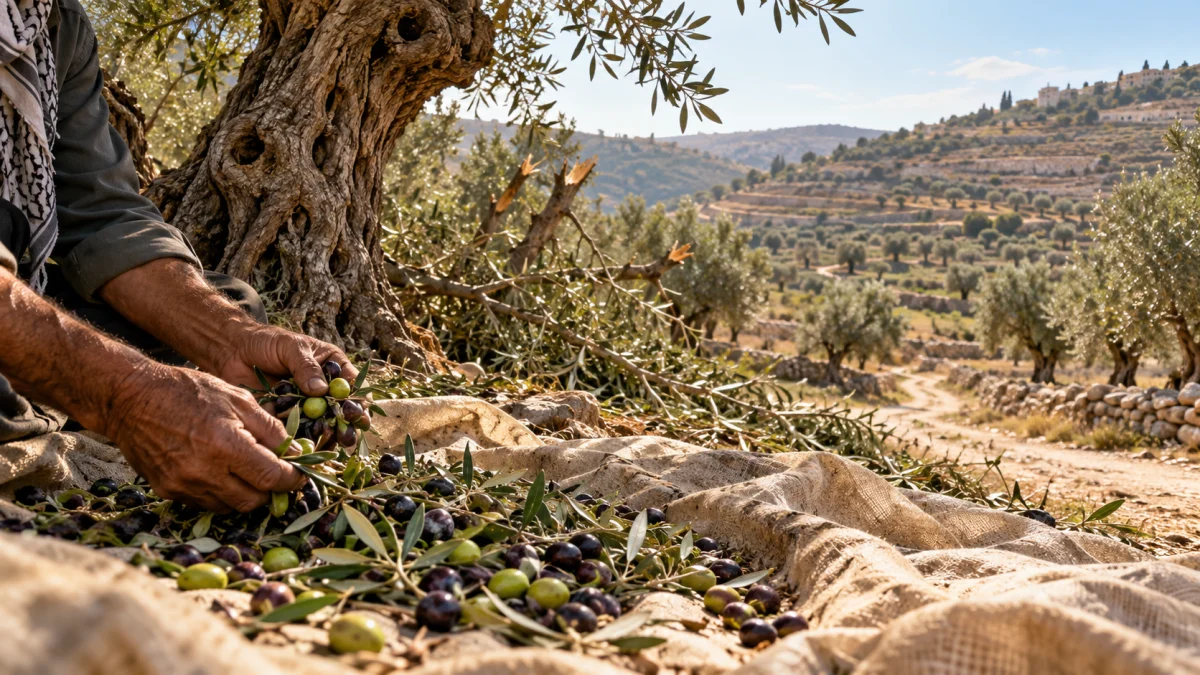
First, the harvest creates a predictable opportunity to confront Palestinians on agricultural land. Families return to their groves to pick olives, sometimes only during brief access windows. That makes them visible and vulnerable in places where armed settlers, nearby outposts or earlier threats have already made farming dangerous.
Second, stealing or ruining the crop imposes immediate economic damage. A family that is chased away may lose that day’s work and the olives already picked. A family that misses the permitted harvesting window may lose a much larger portion of the season’s output. Settlers do not have to cut down a tree to deprive its owner of income.
Third, attacks and intimidation can make continued cultivation impossible. Where repeated violence is followed by abandoned fields, blocked access or encroachment by a settlement outpost, the consequences extend beyond theft. Israeli human-rights groups have documented cases in which settler violence accompanied efforts to expand control over Palestinian land. The connection must be established in each case rather than presumed from every assault.
Fourth, attacks on mature trees can destroy a long-lived productive asset. Cutting, burning or uprooting trees may eliminate future harvests, not merely destroy fruit currently on the branches.
These explanations are supported by documented conduct and outcomes. They are stronger than speculating about the private thoughts of unidentified attackers. They also do not turn violent acts into understandable or acceptable methods of advancing territorial or political objectives.
Why is the Palestinian olive harvest so important economically?
According to UN OCHA’s 2026 harvest assessment, olive harvesting supports an estimated 80,000 to 100,000 Palestinian families. This does not mean olives are the primary income of every Palestinian household, or even of every family that participates in the harvest. For some, olive income is central; for others, it supplements wages, seasonal work or other crops.
The crop’s importance is acknowledged by institutions with very different perspectives. A September 2026 harvest guide issued by Israel’s Civil Administration describes the olive industry as a pillar of rural livelihoods and puts the number of supported families above 100,000. It estimates roughly 3.6 million workdays in a plentiful production year and 1.7 million in a low-production year. Those are the guide’s estimates for different crop conditions, not confirmed days worked in 2026.
An earlier FAO and European Bank for Reconstruction and Development examination of the olive-oil sector described a sector supporting at least 75,000 farmers and 100,000 seasonal jobs and contributing approximately 15% of agricultural GDP in 2020. Those are historical sector measures, not interchangeable with the UN’s 2026 family estimate.
The work does not stop when an olive is picked. Income and economic activity extend to:
- Preparing, pruning and maintaining olive groves throughout the year.
- Hiring relatives or seasonal workers for harvest labor.
- Transporting olives to pressing facilities.
- Operating mills, equipment, packaging and storage businesses.
- Selling olive oil, table olives and related products, while retaining some for household use.
The FAO’s December 2025 survey of West Bank agricultural households found that about 90% had recently experienced lost income and more than 72,000 farming and herding families required urgent assistance. The survey covers agriculture broadly, not only olives. Still, it shows why destroying a crop can be particularly damaging when alternative work is disappearing. Of respondents who had worked in Israel or Israeli settlements before October 2023, 91% reported losing those jobs.
Olive harvest income therefore matters both as a source of cash and as part of household food security. When one income stream disappears, the remaining farm income can become more important, not less.
How large is the 2026 crop supposed to be?
The Palestinian Ministry of Agriculture projected approximately 21,000 tonnes of olive oil in 2026, compared with 7,000 tonnes produced in 2025, according to the UN. The 2026 number is a forecast, conditional on farmers actually being able to reach and harvest their groves.
It would be misleading to attribute the entire difference between the two years to settler attacks or, conversely, to argue that a promising 2026 crop means the attacks are economically inconsequential. Olive yields naturally fluctuate between high- and low-production years, and weather, water, pests and access all affect output. University of California agricultural research documents this tendency toward alternate bearing. A larger potential crop may increase what farmers stand to lose when they are unable to harvest it.
What does destroying an olive tree actually cost a Palestinian family?
The financial harm depends on what happened. A stolen sack of olives, a missed harvest, a damaged mature tree and the uprooting of an entire orchard produce different losses. They should not be folded into one unsourced dollar figure.
| Type of harm | Immediate loss | Possible longer-term cost |
|---|---|---|
| Harvesters assaulted or forced to leave | Unpicked fruit, wasted labor, lost access time | Risk that the remaining harvest is missed or stolen |
| Olives or harvest equipment stolen | Crop or equipment value | Replacement tools and reduced ability to finish harvesting |
| Farm access blocked for weeks or months | Lost harvesting and maintenance opportunities | Lower future yields from neglected pruning, soil care and pest management |
| Mature productive trees cut, burned or uprooted | Current crop and property damage | Years of replacement growth, lower future output and rehabilitation expense |
| Water systems, fences or paths damaged | Repair costs and interruption of farm operations | Lower productivity and reduced viability of the land |
Olive trees are not a crop that can be replaced the following planting season and harvested at full capacity immediately. The University of California, Davis Fruit & Nut Research & Information Center notes that olives begin fruiting around their fourth year and can take approximately 15 years to reach maturity, though growth and productivity vary with climate, variety and cultivation. A mature tree may also recover from some damage; not every broken branch is a permanently lost tree.
The impact of inaccessibility, even without deliberate tree destruction, has been measured. In a 2016 OCHA assessment of northern West Bank groves, olive-tree yields in areas between the Separation Barrier and the Green Line were approximately 65% lower than yields from comparable trees with year-round access. That is a specific historical comparison, not a uniform estimate for all Palestinian farms in 2026.
The Palestinian Ministry of Agriculture’s July 4, 2026 damage assessment recorded 2,559 damaged olive trees during its late-June to early-July assessment period and assigned approximately $3.97 million in losses to those trees, within $11.78 million in recorded agricultural losses across several damage categories. The reported valuation is an administrative estimate, not independently audited compensation or an average market price per tree. Its large variation between districts makes a simple per-tree division especially unreliable.
The responsible calculation is not “one olive tree equals X dollars.” It requires the tree’s age and condition, expected yield over multiple seasons, oil recovery, likely selling price, replacement expenses, and the farmer’s ability to access the grove. The evidence is enough to establish serious multiyear economic harm without manufacturing one universal number.
Why can’t some Palestinians simply go to their own olive farms?
Because ownership of farmland does not always mean unrestricted access to it under Israeli military administration. Different areas are governed by different procedures, and combining them can obscure the problem.
Area C: Military coordination near settlements and outposts
Parts of the occupied West Bank are designated Area C, where Israel exercises extensive military and civil control under the Oslo interim framework. Ahead of the 2026 harvest, the military issued orders requiring Palestinians to obtain prior coordination before entering approximately 88,300 dunams of land, equivalent to roughly 21,800 acres.
According to Peace Now’s October 7 comparison of official military-order maps, this area increased from approximately 68,800 dunams in 2025, a rise of about 28%. Meanwhile, the area covered by military orders restricting Israeli entry to prevent settler disruption decreased from approximately 10,700 to 6,890 dunams.
| Military restriction category | 2025 | 2026 | Change |
|---|---|---|---|
| Land requiring prior military coordination for Palestinian entry | 68,800 dunams | 88,300 dunams | About 28% more |
| Land covered by orders restricting Israeli entry to prevent disruptions | 10,700 dunams | 6,890 dunams | About 36% less |
Source: Peace Now’s analysis of Israeli military orders and maps. These are two different categories of order, not equivalent blanket bans; the figures describe their geographic reach, not the precise number of trees or farmers affected.
The comparison raises a direct accountability question: Why has the area requiring Palestinians to coordinate access expanded while the area restricted to prevent Israeli settler disruption has decreased? The orders themselves establish the different treatment. Proving the motive for each boundary requires examining its geographic location and the military’s stated reasoning.
Peace Now identified newly restricted areas near recently established settlement outposts, including approximately 8,130 dunams of new restrictions in the Jenin district. The organization analyzes the orders as part of a wider process of territorial encroachment. That interpretation should be distinguished from the directly verifiable map boundaries, but it is a testable claim grounded in named places and orders.
Even permission granted on paper does not always result in a completed harvest. Yesh Din’s 2025 harvest documentation describes farmers receiving access for just one or two days late in the season and then being prevented by settlers from using even that short window.
The Seam Zone: Permits for land beyond the Separation Barrier
Another restriction operates in the Seam Zone, the area between the Separation Barrier and the Green Line. This is not the same as the Area C harvest-coordination system.
OCHA reported that most of roughly 20,000 Palestinian farming-permit holders had been unable to access their Seam Zone land since October 2023. Access depends on agricultural gates and permits, with many gates closed most of the year. During the 2025 harvest, 74% of the agricultural gates opened only for a limited number of days, according to the UN’s 2026 situation report.
The Israeli human-rights organization HaMoked documented a September 2025 change in access procedures. The rules placed greater emphasis on a military assessment of agricultural need rather than a landowner’s connection to the property. Because many olive growers were deemed to need only seasonal access, they faced restrictions during much of the year when pruning, land care and other work might be necessary.
On January 18, 2026, Israel’s High Court rejected HaMoked’s petition challenging the continuing Seam Zone restrictions, accepting the restrictions as proportionate to security and public-order duties. That is a distinct ruling concerning a different set of restrictions from the 2006 Supreme Court case discussed below.
A farmer who needs military approval to reach privately owned trees may be unable to harvest or maintain them, even without any change to the land’s legal ownership.
Does the Israeli military also damage olive trees or prevent harvesting?
Yes. It is important not to attribute every form of damage to the same actor.
OCHA’s October 2026 report separates two major categories of damage during the year:
- Settler attacks: More than 20,000 Palestinian-owned trees and saplings had been damaged in documented settler attacks since January 2026. This category includes agricultural trees other than olives and is broader than the September-to-October harvest total.
- Israeli military land-clearing operations: More than 10,000 trees and saplings, predominantly olive trees, had been uprooted or damaged by Israeli forces since January 2026, including roughly 4,600 in September. OCHA describes military orders citing security, road works or land near the Separation Barrier among the circumstances associated with these operations.
These are separate reported categories with different actors and contexts. They should not be casually combined into an exact number of olive trees destroyed or a sum of verified economic losses.
OCHA also documented incidents in which Israeli forces accompanied settlers, restricted farmers’ movement or intervened against Palestinian harvesters during settler attacks. In other incidents, Israeli forces have acted against settlers. Which soldiers acted, and what they did, must be established from specific records rather than assuming every incident follows an identical script.
The important distinction is between the state’s stated rationale for an order and what the order or the soldiers’ conduct actually does to civilian farming access. A security explanation does not establish that an attack on a farmer was justified or that taking the farmer’s crop was lawful.
Didn’t Israel’s Supreme Court already say farmers must be protected from violent settlers?
It did address precisely that problem two decades ago.
In Morar v. IDF Commander (June 26, 2006), Israel’s Supreme Court considered restrictions preventing Palestinian villagers from reaching their agricultural land, along with failures to stop settlers from attacking them. The published translation of the judgment explains that denying farmers access ostensibly for their own protection was disproportionate. The authorities should instead provide suitable security arrangements and restrict the people carrying out unlawful acts. The court also found law-enforcement efforts inadequate and ordered improvements.
The court did not rule that every security-related closure is unlawful under every circumstance. But it established an essential principle: a response to violence against farmers cannot simply presume that the people being attacked should be the ones excluded from their land.
That makes the contemporary system of limited coordination windows, expanded restricted areas and repeated reports of settler attacks a serious legal and administrative question. The separate January 2026 Seam Zone judgment does not erase the earlier court’s findings about protection against settler harassment; the cases concern different legal arrangements and should be evaluated on their own terms.
How can settler violence lead to loss of Palestinian land?
This is where precision is essential. Cutting down an olive tree does not automatically transfer ownership of the land to a settler. Formal title, military requisition, settlement planning, state-land declarations and physical occupation are different legal and factual events.
But a landowner can remain the legal owner while losing the ability to use the property. Attacks, threats and closed access routes may make a field inaccessible. A nearby outpost or other encroachment can then limit the owner’s ability to return, work or monitor the land. The result may be loss of effective control without a recorded transfer of title.
One documented case: Burqa and the former Homesh settlement
A 2017 UN OCHA investigation documented this distinction in Burqa, near Nablus. Land was requisitioned for the Homesh settlement in 1978. The settlement was evacuated in 2005. After a legal challenge, Israeli authorities revoked the old land-requisition order in May 2013 and later removed a related closed-military-zone designation.
Yet OCHA reported that Palestinian landowners continued facing settler harassment and barriers to returning. The report described settlers threatening farmers, blocking routes, and damaging plantings even after the formal obstacles to access had been removed.
One farmer, identified as Abu Kuteiba, described losing planted almond trees and later olive trees. In 2017, he estimated that access to his land could have generated approximately 8,000 shekels in profit from an olive harvest. That was his personal estimate at the time, not a representative income figure for Palestinian farmers in 2026.
The land-access record matters more than the exact amount: winning recognition of a property right did not automatically restore the ability to cultivate the property.
A more recent harvest case: Kisan in October 2025
Yesh Din recorded the experience of a family from Kisan whose land held about 50 olive trees aged 40 to 45 years. According to the farmer’s testimony, the family had already left its home on the plot after a new outpost was established and threats intensified. When family members returned to harvest on October 15, 2025, they found settlers picking their olives and damage to trees, fencing and water pipes.
The following day, Yesh Din reported, settlers again confronted the family. Soldiers pushed away individual settlers who were attempting to assault them, but a soldier also advised the Palestinian family to leave. More settlers arrived and the family fled. The farmer said the family remained afraid to return and declined to file a police complaint for fear of retaliation.
This account is documented testimony gathered by a human-rights organization, not a judicial finding about every alleged participant. It nevertheless illustrates the mechanism starkly: the family lost its home on the plot, found the harvest being taken, and was unable to safely resume farming despite seeking help.
These cases do not prove that every attack results in permanent land loss. They do show why focusing only on injured people or felled trees misses the cumulative loss of access and livelihood.
What happens to settlers who assault Palestinian farmers?
The available long-term enforcement record raises serious questions about accountability.
Israeli human-rights organization Yesh Din’s monitoring of police investigations from 2005 through 2025 found that 93.6% of the ideologically motivated offense investigation files it monitored ended without an indictment. Only 3% of monitored investigation files resulted in full or partial convictions, according to its published dataset. The organization further classified investigative failures in 82% of the examined cases under its methodology.
This is not an assertion that 93.6% of every settler attack anywhere in the West Bank was never prosecuted. The figures concern the cases and files monitored by Yesh Din, and not every incident generates a police complaint. Nor is a closed investigation proof that a named suspect committed an offense.
Still, the monitored outcomes show a persistent accountability problem for attacks on Palestinians and their property. The 2025 Kisan and a-Sawiya cases also illustrate why the absence of a complaint can be misleading: farmers told Yesh Din they feared retaliation if they went to Israeli police.
The October 19, 2026 arrests following the attacks on a journalist and foreign visitors are significant, but their ultimate value as evidence of enforcement will depend on what happens next: whether allegations are investigated adequately, whether charges are supported and filed, and whether trials result in findings of guilt or innocence.
What does international law say about attacks, land access and settlements?
Violence against civilians, intimidation and unlawful destruction or seizure of private property are not made acceptable merely because the victims live in occupied territory. The occupying power also has obligations regarding civilian protection and the administration of the territory.
In its July 19, 2024 advisory opinion, the International Court of Justice concluded that Israel’s settlements in the West Bank and East Jerusalem, and their associated regime, are established and maintained in violation of international law. The court also concluded that Israel’s systematic failure to prevent or punish attacks by settlers against Palestinians, together with excessive use of force against Palestinians, was inconsistent with its international obligations.
The opinion addressed the occupation and associated policies at a systemic level. It did not convict each participant in the 2026 attacks or rule on the facts of every incident. It is an advisory opinion, not a criminal judgment, but it is an authoritative legal analysis by the United Nations’ principal judicial organ.
Israel disputes core aspects of the international legal treatment of its settlement policies and says security restrictions can be necessary. Those arguments may be relevant to the legality of a particular military order; they do not, by themselves, rebut the documented assaults, thefts or the ICJ’s conclusions. The legal questions surrounding a military closure should not be used to blur responsibility for settler violence.
What happens to Palestinian families when the harvest ends?
The consequences do not end when the olive-picking season closes.
An inaccessible grove still needs care. A family that has lost its harvest may struggle to pay workers, repair damage or invest in the next growing season. A mill loses business when farmers cannot deliver olives. A landowner who repeatedly encounters threats may stop returning to a distant plot even if no formal document has changed hands.
OCHA reported that, since January 2023, 133 Palestinian communities had experienced displacement associated with settler attacks and related access restrictions by October 12, 2026, including 49 communities fully displaced. Those are figures for West Bank communities affected by a broader displacement process, not a count of villages emptied specifically because of olive-harvest attacks.
For the broader displacement pattern and its relationship to settlement expansion, see sherafy.com‘s source-led investigation into West Bank displacement and ethnic-cleansing claims.
Olive cultivation also carries a cultural significance that cannot be measured as crop revenue. The UNESCO World Heritage listing for Battir, Palestine: Land of Olives and Vines describes a landscape in which agricultural terraces, olive trees, irrigation systems and family land use are intertwined across generations. That heritage does not substitute for economic evidence; it helps explain why the destruction of old groves can represent the loss of more than a season’s earnings.
The central measurable issue remains access. A farmer may possess title to a grove, yet be unable to safely pick its fruit, maintain its trees, prevent theft or pass on a viable working farm. When that happens repeatedly, violence and restrictions can help transform who is able to use and control the land, regardless of what a property record says.
Frequently asked questions
How many Palestinian olive trees have Israeli settlers destroyed in 2026?
OCHA reported damage to more than 20,000 Palestinian-owned trees and saplings in settler attacks from January through October 12, 2026. That includes tree species other than olives and may include damage short of total destruction. Separately, more than 2,500 trees and saplings were damaged in the harvest-related settler attacks documented from September 1 to October 12. These figures are different scopes and should not be added together. The UN also documented more than 10,000 trees and saplings, predominantly olive trees, damaged or uprooted by Israeli forces during land-clearing operations, a separate category.
Why is the olive harvest a recurring target?
The harvest concentrates farmers, relatives, workers and their equipment in groves over a limited period. This creates opportunities for physical intimidation and crop theft. Where farmers also face military coordination requirements or nearby settlement outposts, a delayed or interrupted visit can mean losing much of the season’s production.
Is olive farming the main source of income for all Palestinians?
No. Olive cultivation provides primary or supplementary income for many rural families, but Palestinian livelihoods differ across households and regions. The UN estimates the harvest supports 80,000 to 100,000 families; this is not the share of all Palestinians whose principal income is olives.
Can Palestinian farmers legally own olive groves in the West Bank?
Yes. Many hold recognized ownership or other property rights. Ownership and physical access are separate issues, however. Israeli military orders, access gates and settler intimidation can prevent farming even without a legal change in title.
Do all settlers participate in these attacks?
No. The evidence concerns specific perpetrators, documented attacks, settlement outposts, military actions and institutional responsibilities. It does not establish that every Israeli settler committed or supported violence. Accountability belongs to the people and institutions responsible, not to an entire population by association.
Are the 2026 harvest totals final?
No. The comprehensive OCHA count of 199 harvest-related attacks covers September 1 through October 12, 2026. Subsequent incidents reported on October 16 and 17 demonstrate why that number must be labeled with its reporting cutoff. Later verified UN updates may change the totals.
What the evidence establishes
The evidence is clear that Israeli settlers have repeatedly attacked Palestinian olive farmers, damaged their trees, stolen crops and forced people away from land they rely on. UN monitoring identifies Israeli military conduct and access restrictions as additional sources of harm. Administrative maps document an expansion of areas requiring Palestinian military coordination in 2026. Long-term enforcement data show that accountability has been limited in cases monitored by an Israeli human-rights organization.
The evidence also establishes a crucial difference: destroying a tree does not automatically transfer legal land ownership, but repeated violence and exclusion can deprive an owner of the actual use of that land. Documented communities have experienced that loss even after legal proceedings recognized their rights.
The precise motive of every attacker and the complete financial cost of the 2026 harvest cannot yet be established. Those limits do not weaken what has already been documented. For the families affected, the immediate question is whether they can reach their own groves safely, harvest what they have grown, maintain their trees and obtain meaningful protection when they are attacked.
The answer is not settled by an ownership deed. It is determined by what happens when the farmer tries to enter the field.
References and Further Reading
United Nations and official agricultural records
- UN OCHA, Humanitarian Situation Report, October 15, 2026 (published October 19). Primary source for the September 1 to October 12 attack count, injuries, fatalities, broader settler violence, military tree-clearing, agricultural gates, access restrictions and displacement. Seasonal numbers are preliminary and have different reporting windows.
- FAO, West Bank: 72,000 Families Urgently Require Emergency Agricultural Assistance (December 24, 2025). Survey-based evidence of agricultural income losses, farm household vulnerability and disappearing off-farm employment. The surveyed population extends beyond olive growers.
- FAO and EBRD, Dialogue on the Olive Oil Sector in West Bank and Gaza Strip (May 16, 2022). Documents historical figures for farmers, seasonal jobs and the olive-oil value chain, along with production and marketing challenges.
- Israel Civil Administration, Preparations for the 2026 Olive Harvest (Hebrew; updated October 1, 2026). Official Israeli government acknowledgment of the sector’s livelihood importance and estimated workdays across high- and low-yield seasons.
- Palestinian Ministry of Agriculture, Agricultural Damage Assessment, June 23 to July 2, 2026 (published July 4). Itemized administrative records of damaged trees, agricultural infrastructure and claimed dollar losses. Its valuation methodology and regional differences warrant caution.
- UN OCHA, The 2016 Olive Harvest: Access Challenges Remain. Historical yield comparison documenting the agricultural consequences of restricted year-round access in northern West Bank groves. Not a universal 2026 loss estimate.
Military access, land rights and law enforcement
- Peace Now, Military Orders Restrict Access to 90,000 Dunams of West Bank Olive Groves (October 7, 2026). Comparison of 2025 and 2026 military access-order maps. The map areas are evidence; the organization’s conclusions about motives and territorial strategy are its analysis.
- HaMoked, From Emergency Measures to Permanent Policy: Seam Zone Farmers (January 6, 2026, updated after January 18 ruling). Documents the 2025 agricultural-permit procedures and the distinct January 2026 Israeli High Court ruling concerning the Seam Zone.
- Israeli Supreme Court, Morar v. IDF Commander, HCJ 9593/04 (June 26, 2006), English translation. Judicial decision addressing farmers denied access supposedly for their safety and the failure to protect them against settler harassment. The site identifies the Hebrew original as legally authoritative.
- Yesh Din, 2025 Olive Harvest Season: Violence, Denied Harvest and Olive Tree Destruction (December 22, 2025). Detailed testimonies involving Kisan, a-Sawiya and Burin; relevant for examining what happened when access was granted yet farmers still could not complete the harvest.
- Yesh Din, Law Enforcement on Israeli Civilians in the West Bank, 2005–2025 (January 1, 2026). Methodologically bounded monitoring of investigation closures, indictments and convictions, not an exhaustive census of all offenses.
- UN OCHA, Restricted Access to Farming Land Taken Over by Settlers Despite Legal Rulings (November 10, 2017). Primary humanitarian investigation documenting the difference between legal ownership and the ability to cultivate land, particularly around Burqa and Homesh.
- International Court of Justice, Summary of the Advisory Opinion of July 19, 2024. Explains the court’s findings on the settlement regime, state duties and the failure to prevent or punish settler attacks. This is an advisory opinion, not an individual criminal conviction.
Independent reporting, agronomy and cultural context
- Associated Press, Olive Harvesters Shot in the West Bank (October 7, 2026). AP’s contemporary report identifies Ali al-Bazzari as an officer who responded to the harvest-related attack and gives the initial accounts of the shooting. The linked page is an AP news roundup republished by The Washington Post.
- The National, West Bank Olive Farmers Set for Another Deadly Harvest (October 14, 2026). Original reporting and interviews with the al-Bazzari and Adeli families, documenting direct human consequences and injuries.
- Associated Press, Israeli Settlers Torch Cars and Trees in West Bank Villages (October 16, 2026). Independent field reporting on attacks against Palestinian harvesters, property destruction and the assault on a photojournalist.
- Associated Press, European Diplomats Attacked by Settlers in the West Bank (October 17, 2026). Accounts and video documentation concerning the Taybeh incident and the Israeli military’s response.
- Associated Press, Israeli Police Arrest 10 in Connection With Settler Attacks (October 19, 2026). Contemporary status of the arrests, with unidentified suspects and unresolved allegations.
- UC Davis, Olive in California and University of California Agriculture and Natural Resources, Olive Research. Horticultural context on time to maturity and alternate bearing. Their growing conditions should not be treated as direct Palestinian farm yield estimates.
- UNESCO, Palestine: Land of Olives and Vines, Cultural Landscape of Southern Jerusalem, Battir. Documentary context on olive cultivation as an enduring cultural landscape and agricultural inheritance.
Editorial currency note: The 2026 harvest remains in progress. OCHA harvest-attack totals end on October 12; some independent incident reporting and police developments extend to October 19. Forecast production is not final output, agricultural damage valuations are estimates, and arrest outcomes may change. Dates and populations must be retained whenever figures are updated.