
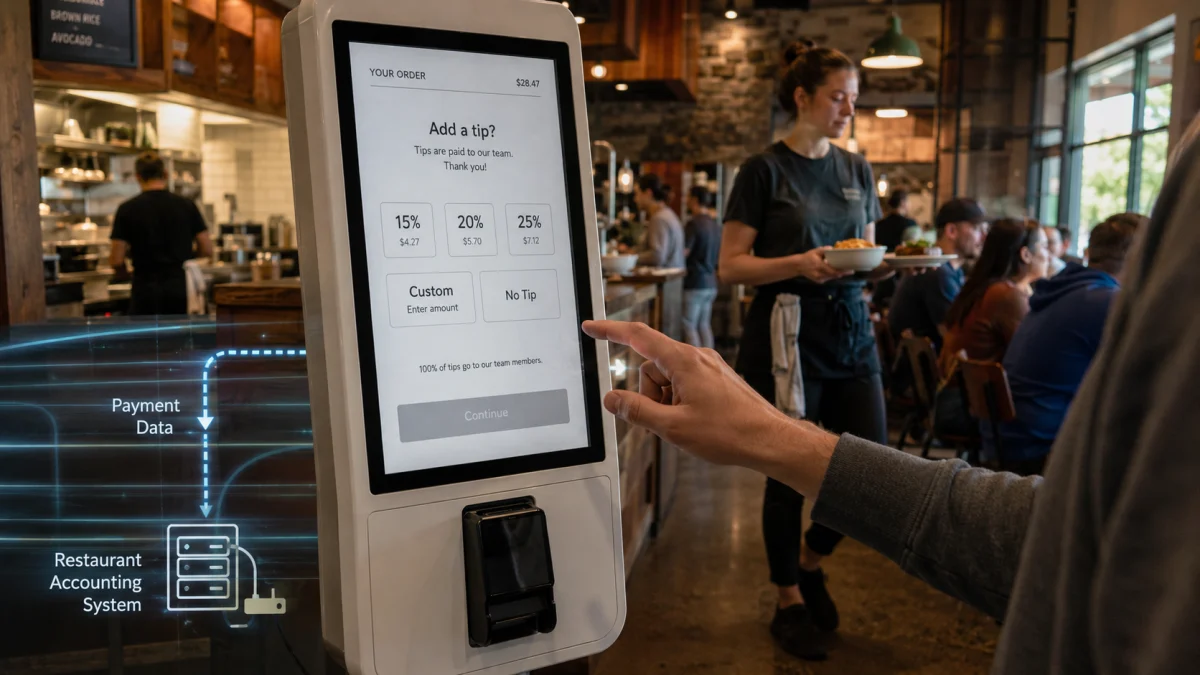
The short answer is uncomfortable: if the money is genuinely an employee tip, federal law generally does not allow the restaurant owner to keep it. But the tip screen itself gives you almost no assurance about which employee receives your money—or whether the restaurant is following the law.
That distinction matters.
Modern restaurant kiosks can ask you for 15%, 20% or 25% before anyone has provided table service. The restaurant can decide whether that screen appears, which percentages it displays and, depending on its point-of-sale configuration, how those tips are assigned, pooled and eventually distributed.
Federal enforcement records also show that restaurants really have been caught retaining credit-card tips, online-order tips and other gratuities that belonged to workers. This is not merely a hypothetical concern.
There is, however, no credible national statistic showing what percentage of kiosk tips specifically are improperly retained. Anyone claiming that most restaurants steal these tips would be going beyond the available evidence.
That does not mean customers should blindly trust the screen.
A better consumer rule is remarkably simple:
If a self-service kiosk asks you to tip before service but will not tell you who actually receives the money, 0% is a reasonable default.
You can still tip the person who serves you afterward. In fact, that may do a better job of accomplishing what you thought the kiosk tip was supposed to accomplish in the first place.
This is not an argument against tipping restaurant servers generally. Traditional table service is a separate question. The issue here is whether a customer should feel socially obligated to make an unverifiable transfer through a restaurant-controlled interface simply because the screen asks.
The Law Is Clearer Than the Kiosk Is
Federal law does not give restaurant owners a general right to pocket employees’ gratuities.
Under the Fair Labor Standards Act, an employer may not keep tips received by employees “for any purposes,” whether or not the employer takes a tip credit toward minimum wage. Managers and supervisors likewise generally cannot participate in employee tip pools. A manager or supervisor can retain a tip received directly from a customer only for service that person directly and solely provided.
States can impose even stronger protections.
California, for example, expressly provides that gratuities belong to the employees for whom they were left. Employers, owners, managers and supervisors cannot take a share of an employee tip merely because they operate the business. California also requires credit-card gratuities to be paid to employees by the next regular payday and prohibits employers from deducting the card-processing fee from those tips.
So if your waiter earns a legitimate tip and the owner simply pockets it, “that’s just how the machine works” is not a legal defense.
But that still leaves the question the customer actually cares about:
How do I know that the 20% I just added at the kiosk becomes an employee tip in practice?
That is where things become much less transparent.
A Tip Is Not the Same Thing as a Service Charge
There is an important distinction hiding underneath many restaurant bills.
A tip is voluntary. The customer controls whether to leave it and generally controls the amount.
A service charge is compulsory. The business imposes it.
The IRS specifically distinguishes mandatory service charges from tips. Under federal wage rules, a compulsory service charge is generally part of the employer’s gross receipts rather than a tip, although the employer can choose to distribute some or all of it to employees.
A screen offering:
15% — 20% — 25% — Custom — No Tip
is therefore very different from a bill announcing:
20% service charge added.
The first is ordinarily asking you to make a voluntary gratuity. The second is charging you another component of the price.
Customers should not assume the two payments follow the same rules or reach the same people.
The Kiosk Does Not Decide Where the Tip Goes. The Restaurant Does.
This is the piece missing from most tipping-etiquette discussions.
The touchscreen may look like an automated third party standing between you and the restaurant.
It is not.
The restaurant configures it.
Toast, one of the major restaurant point-of-sale providers, explicitly allows restaurants to decide whether a kiosk displays a tipping screen and to customize the suggested tip percentages shown to customers.
Toast’s documentation reveals another important detail: kiosk orders have to be assigned to a “server” account. That might be a particular employee, a manager or even a generic account created for kiosk transactions, such as a “Kiosk Server.”
From there, tip distribution depends on how the restaurant has configured its system.
Toast says tips are ordinarily associated with the employee managing an order, but restaurants can configure pooling and redistribution among eligible employees. In some tip-pooling configurations, Toast’s reporting tools merely calculate how tips should be divided; the software does not itself physically distribute that money to employees. Restaurant personnel must make the actual disbursement.
That does not mean Toast is doing anything improper. Tip pooling is perfectly legitimate when performed lawfully.
It demonstrates something more basic:
Pressing 20% establishes your intention to tip. It does not provide you with a chain-of-custody report showing where the money ultimately went.
Square similarly allows merchants to enable and customize tip settings, including the familiar percentage-based choices customers see at checkout.
The screen is therefore not some neutral national tipping convention.
It is a merchant-configured payment interface.
The business asking you for the money controls much of what happens behind it.
Restaurants Really Have Been Caught Keeping Electronic Tips
The concern would be much weaker if improper tip retention existed only in internet anecdotes.
It does not.
U.S. Department of Labor cases repeatedly document restaurants withholding tips collected electronically or improperly routing them through managers.
| Case | What investigators found | Result |
|---|---|---|
| Tommy’s Thai, Colorado — 2026 | Employer kept all employee tips | DOL recovered $61,568 for 11 workers |
| Chopstix Buffet, Tennessee — 2025 | Owners kept tips customers intended for workers when paying by credit card | DOL recovered $81,681 in tips for 12 workers |
| My Cielo Taqueria, New Hampshire — 2024 | Restaurant kept tips from online orders and improperly included managers in tip arrangements | DOL recovered $184,008 in back wages and liquidated damages for 56 workers |
| Pipe Dream Brewing, New Hampshire — 2024 | Employer illegally kept workers’ credit-card tips | Investigation resulted in more than $912,000 in back wages and liquidated damages for 44 workers |
| Subway, Tennessee — 2023 | Owner kept a portion of employees’ credit-card tips | DOL recovered $16,666 in back wages and liquidated damages for 24 workers |
These cases do not establish that self-service kiosk tips are normally stolen.
Most are not kiosk cases at all.
They establish the narrower—and much more defensible—point that digital collection does not guarantee lawful distribution.
A customer cannot reason that because the tip was entered electronically, software must automatically protect it from improper retention.
Sometimes employers do exactly what the customer expects.
Sometimes federal investigators later discover that they did not.
So How Common Is Tip Theft?
This is where an evidence-first answer has to resist an attractive exaggeration.
Nobody appears to have a reliable nationwide number for the percentage of restaurant kiosk tips that fail to reach eligible employees.
The Department of Labor has published broader restaurant enforcement figures. In fiscal year 2021, for example, its Wage and Hour Division found violations in nearly 85% of the restaurant investigations it conducted and recovered more than $34.7 million for more than 29,000 workers. But those violations included minimum-wage, overtime, child-labor, tip and other wage violations. More importantly, restaurants selected for investigation are not a random sample of American restaurants.
You cannot convert that 85% figure into “85% of restaurants break tip laws.”
You certainly cannot convert it into “85% of kiosk tips are stolen.”
What we can say is that improper handling of restaurant tips is recurrent enough that federal labor officials themselves have repeatedly described it as a persistent restaurant-industry problem. In a February 2026 case involving an employer keeping employee tips, a Department of Labor district director called violations like these “all too common.”
That is substantially different from claiming that every restaurant should be treated as dishonest.
The consumer problem is not that we know the majority are stealing.
The problem is that the customer generally has no way of knowing which one he or she is dealing with.
The Screen Creates Social Pressure Without Giving You Equivalent Information
The psychological part of kiosk tipping is worth examining because the uncomfortable feeling is not imaginary.
Pew Research Center found in 2023 that 72% of Americans believed tipping was expected in more places than it had been five years earlier. Forty percent opposed businesses suggesting specific tip amounts to customers, while only 24% favored the practice.
The same survey shows why treating every tip screen as equivalent to traditional restaurant tipping makes little sense.
About 92% of Americans said they always or often tip when eating at a restaurant where a server takes their order.
At fast-casual restaurants where there are no servers, only 12% said the same.
Americans have not adopted one universal rule saying that the presence of a touchscreen creates a 20% obligation.
Experimental evidence also indicates that the interface itself can influence what customers give.
A 2026 natural experiment involving 5,169 transactions found that displaying both a suggested percentage and its corresponding dollar amount increased average tips and the likelihood of tipping compared with percentage-only suggestions. Another field study found that simply displaying suggested amounts in descending order—25%, then 20%, then 15%—produced higher gratuity percentages than showing the same choices in ascending order.
Another 2026 study found that higher default suggestions can increase gratuities while simultaneously reducing customers’ sense of control and producing more negative reactions, particularly in unfamiliar tipping situations.
None of this makes a tip screen inherently deceptive.
It does mean that the screen is choice architecture.
Those large percentage buttons do not merely record a preexisting social norm. They can help create the pressure that makes customers wonder whether pressing “No Tip” makes them a bad person.
It doesn’t.
A Better Rule: No Transparency, No Automatic Kiosk Tip
This leads to a cleaner social norm.
When you receive normal table service and want to tip your waiter after the meal, nothing here argues against doing so.
When you voluntarily want to reward excellent service, nothing here argues against doing that either.
But a prepaid self-service kiosk presents a different transaction.
You may not know who will serve you.
You have not experienced the service yet.
You may not know whether tips are pooled.
You may not know which workers participate in that pool.
And the screen usually does not tell you whether 100% of the amount labeled “tip” will be distributed to eligible employees.
Under those circumstances, 0% should not carry a presumption of selfishness.
The burden is backwards.
The restaurant is asking for additional money on behalf of its workers. The restaurant therefore has better access than the customer to the information needed to explain where that money goes.
It should disclose it.
Until then, customers should not be expected to transfer money first and investigate its destination afterward.
“But Doesn’t Pressing Zero Hurt the Server?”
It can—if that particular restaurant properly distributes kiosk tips to employees and the worker would otherwise have received part of yours.
That is the strongest argument against an automatic zero-tip rule.
But there is a simple way to preserve the worker’s interests without giving the payment system blind trust:
tip after you know who provided the service and, when necessary, ask how that worker actually receives tips.
A question as simple as:
“Do you actually get the tips from that kiosk?”
can tell you more than the payment screen does.
If the employee says yes and explains that tips are pooled among the staff, you can decide accordingly.
If the employee says no, ask what method is permitted if you still want to tip.
Cash handed directly to the worker makes your intended recipient much clearer, although a lawful workplace tip-pooling policy may still require that employee to share it with other eligible workers.
Peer-to-peer payment services such as Venmo, PayPal or Zelle can sometimes provide another route, but customers should not assume employees are permitted to accept them privately. Restaurant policies, tip-pool obligations and tax-reporting requirements still apply. Ask the worker first.
The objective is not to help an employee circumvent a legitimate tip pool.
It is to make sure your voluntary gratuity actually enters the employee compensation system you intended to support.
Restaurants Could Solve This With One Sentence
There is no technical reason customers need to be kept guessing.
A restaurant asking for tips at a kiosk could display something like:
100% of optional tips are distributed to eligible hourly employees. Owners and managers receive none. Tips are pooled among front- and back-of-house employees according to our posted policy.
Or whatever accurately describes that restaurant’s system.
The disclosure could appear directly under the percentages.
It could be printed on the receipt.
The restaurant could link to the exact pooling policy.
The crucial word is accurately.
If businesses want customers to treat kiosk gratuities as an extension of traditional tipping, they should provide the piece of traditional tipping that the kiosk removed: a reasonably identifiable human recipient.
What If a Restaurant Owner Really Is Keeping the Tips?
If an employee believes an employer is retaining tips that legally belong to workers, that becomes a wage-law issue rather than a tipping-etiquette debate.
Workers can contact the U.S. Department of Labor’s Wage and Hour Division and, where applicable, their state labor agency. State protections may exceed the federal minimum.
Customers who hear such a claim should distinguish between something worth investigating and something already proven.
For example, an employee saying, “The owner gets all those kiosk tips,” is significant.
But several possibilities still have to be separated:
The electronic payment may initially settle into the restaurant’s merchant bank account before tips are later distributed through payroll.
The worker may be describing an illegal retention scheme.
The employee may be excluded from a lawful tip pool while other eligible workers receive the money.
Or the restaurant may be using terminology imprecisely.
That is why a specific restaurant should not be publicly accused of stealing tips based on one conversation alone.
Payroll records, tip reports, the restaurant’s written pooling policy, statements from additional employees and the owner’s explanation can turn a troubling claim into a verifiable finding.
Editor’s note: This article was prompted by a firsthand conversation in which a restaurant employee said that tips entered at the restaurant’s ordering kiosk went to the owner rather than to her. SHERAFY.com is not identifying the restaurant because we have not reviewed its payroll or tip-distribution records and have not established that the owner ultimately retains those gratuities. The employee’s statement is treated here as a reason to investigate the larger system, not as a proven accusation against a particular business.
The Screen Is Not Your Conscience
There are legitimate arguments about whether the United States should have a tipping economy at all.
That is not this argument.
Assume for the moment that you are perfectly comfortable tipping a waiter who provides normal table service.
The narrower question remains:
Should you feel obligated to tip an anonymous payment interface before service when the business asking for the money does not tell you which workers receive it?
No.
A tip is not a surcharge for being permitted to finish checkout.
It is a voluntary payment made because you want to compensate or reward service.
If the business wants to collect that payment on somebody else’s behalf, it should tell you who that somebody is.
Until kiosk systems provide that transparency, there is nothing unethical about selecting No Tip, receiving the service, and deciding afterward whether—and how—you want to tip the person who actually served you.
That isn’t refusing to care about restaurant workers.
It is refusing to confuse caring about the worker with trusting the interface.
References and Further Reading
-
U.S. Department of Labor — Fact Sheet #15: Tipped Employees Under the Fair Labor Standards Act — Federal guidance explaining employee ownership of tips, tip pools and restrictions on managers and supervisors retaining employees’ gratuities.
-
California Department of Industrial Relations — Tips and Gratuities — California’s rules governing ownership of gratuities, credit-card tips and employer participation in tips.
-
IRS — Tip Recordkeeping and Reporting — Explains the federal tax distinction between voluntary tips and compulsory service charges.
-
Toast — Set Up Your Kiosk — Primary vendor documentation showing that restaurants configure kiosk tipping options and assign kiosk orders to employee accounts.
-
Toast — How Toast Handles and Distributes Tips — Describes how tips can be attributed, pooled and redistributed under restaurant-configured settings.
-
Toast — Pool Tips and Tipping Out — Explains configurations in which the system calculates recommended tip distributions while the restaurant remains responsible for actual disbursement.
-
Square — Configure Tipping Options — Another major POS provider’s documentation showing merchant control over suggested tip settings.
-
U.S. Department of Labor — Tommy’s Thai Tip Investigation, February 2026 — DOL found an employer kept employee tips and recovered more than $61,000 for workers.
-
U.S. Department of Labor — Chopstix Buffet Credit-Card Tip Investigation, November 2025 — A particularly relevant example involving owners retaining tips customers paid electronically.
-
U.S. Department of Labor — My Cielo Taqueria Investigation, January 2024 — Documents improper handling of online-order tips and manager participation in tip arrangements.
-
U.S. Department of Labor — Restaurant Enforcement Initiative Results — Useful context on restaurant wage enforcement, with the important caveat that enforcement investigations are not a representative survey of all restaurants.
-
Pew Research Center — Tipping Culture in America — National survey documenting tipping fatigue, suggested-tip attitudes and the large behavioral difference between full-service and fast-casual restaurants.
-
International Journal of Hospitality Management — Natural Experiment on Digital Tip Suggestions — 2026 research showing that presentation of suggested gratuities can measurably affect tipping behavior.
Editorial currency note: Federal and state wage laws, restaurant POS features and tip-distribution systems can change. Legal and product documentation cited here was reviewed as of August 30, 2026. Workers facing a specific wage dispute should verify current federal and state requirements rather than relying on this article as individualized legal advice.