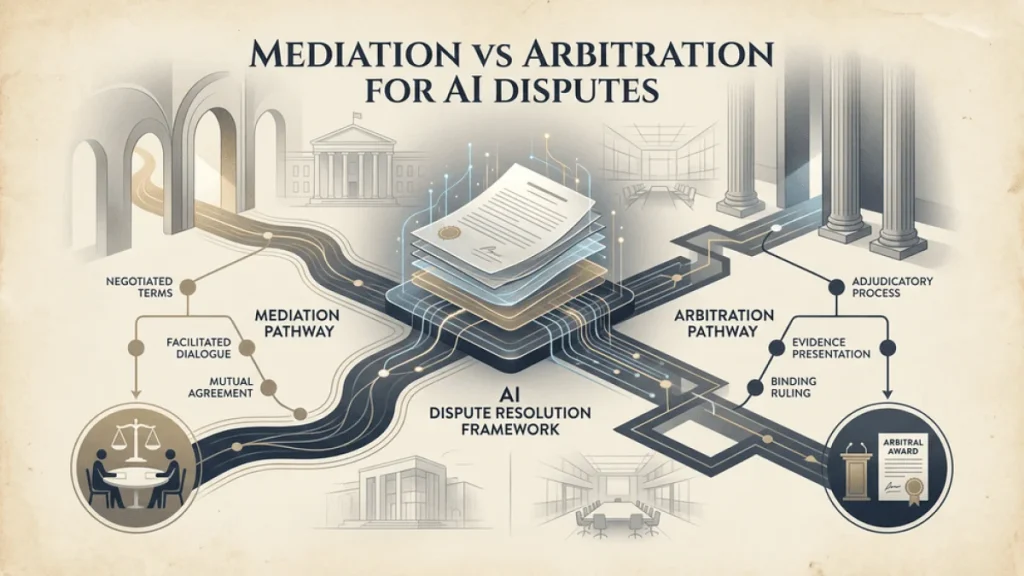

One of the easiest mistakes in AI contract drafting is to assume every serious disagreement belongs in full arbitration.
Sometimes that is right.
But some AI disputes are narrower than they first appear. They may turn on one technical question, one valuation issue, one benchmark, one audit finding, or one defined performance threshold. In those cases, full arbitration can be slower, heavier, and more expensive than the underlying issue requires.
That is where expert determination becomes useful.
What expert determination is
WIPO defines expert determination as a procedure in which a dispute or a difference between the parties is submitted, by agreement, to one or more experts who make a determination on the matter referred to them.
That definition matters because it highlights the real point: expert determination is not a mini-trial with a different label. It is a targeted mechanism for deciding a defined issue.
It is usually strongest when:
- the question is technical,
- the scope can be described precisely,
- the parties want subject-matter competence,
- and the dispute does not require a full adversarial process to be answered well.
Why AI disputes are a natural fit for expert determination
AI relationships often generate disagreements that are more technical than legal, at least at the start.
Examples include:
- whether a model met a defined benchmark,
- whether a milestone was achieved,
- whether a system complied with a technical specification,
- whether a dataset or provenance record meets the contract’s standard,
- whether an evaluation result supports acceptance or rejection,
- whether usage exceeded a contractual boundary,
- or what a model, feature, or license right is worth for payment purposes.
Those are not always good questions for a full arbitration record with broad submissions, witness disputes, and formal motion practice.
They are often better questions for an informed expert with a clear mandate.
The best use cases
1. Performance benchmark disputes
If the contract defines objective metrics, expert determination can be a strong fit.
Examples:
- accuracy thresholds,
- latency or uptime benchmarks,
- agreed evaluation scores,
- red-team or safety-test results,
- or whether a deliverable satisfied a documented technical acceptance standard.
The cleaner the benchmark, the stronger the fit.
2. Valuation and pricing disputes
WIPO expressly highlights valuation as a setting for expert determination, and that logic travels well to AI.
It can work when the dispute turns on:
- license value,
- pricing adjustment mechanisms,
- royalty calculations,
- earn-out triggers,
- or compensation tied to technical performance or deployment scope.
3. Compliance and audit questions
Some AI contracts require audit rights, data-use limits, or defined technical controls.
When the real question is whether the system complied with a specific requirement, expert determination can resolve the issue more efficiently than a full adjudicative process.
4. Scoped technical disagreements inside larger relationships
Sometimes the parties do not need a final answer on the whole contract. They need a reliable answer on one technical issue so the larger relationship can either continue or settle.
That is another strong use case.
When expert determination is the wrong tool
Expert determination is not a cure-all.
It is usually a weak fit when:
- the dispute turns on credibility,
- fraud or bad faith is central,
- the case needs broad third-party discovery,
- consumer or employment sensitivity changes the fairness stakes,
- the real conflict is legal interpretation rather than technical judgment,
- or the parties actually need a final adjudication of liability and remedies.
It is also a weak fit if the clause tries to send a sprawling, undefined conflict to an expert without clear boundaries.
A vague expert-determination clause often creates a new fight about what the expert is allowed to decide.
Why this matters especially in AI contracts
AI contracts often mix:
- technical performance,
- data rights,
- confidentiality,
- service commitments,
- valuation issues,
- and legal risk allocation.
Not all of those belong in the same process.
Expert determination is often best used as a precision tool inside a broader dispute-design structure, not as the only dispute mechanism in the contract.
That is why parties sometimes use a staged model:
- expert determination for defined technical questions,
- mediation for business repair,
- and arbitration for unresolved legal or damages disputes.
Used well, that structure can reduce noise instead of adding it.
The drafting questions that matter most
If a clause is going to use expert determination, it should answer at least these questions clearly.
What exact issues go to the expert?
This is the most important drafting question.
The clause should identify the category of issues narrowly enough that the expert’s role is obvious.
Bad version:
- “All disputes involving technical matters.”
Better version:
- disputes about whether defined performance benchmarks were met,
- whether a named evaluation protocol was satisfied,
- whether a valuation formula should be triggered,
- or whether a specified compliance test was passed.
Is the determination binding?
WIPO’s model materials allow the parties to make the determination binding or not binding.
That choice matters enormously.
A binding determination can create speed and finality.
A nonbinding determination can operate more like a high-value neutral evaluation.
The clause should not leave this ambiguous.
How is the expert selected?
The parties should decide:
- who chooses the expert,
- what qualifications are required,
- whether one expert or more than one is needed,
- what happens if the parties cannot agree,
- and whether the institution or appointing body can step in.
In AI disputes, “expertise” should usually be described more specifically than just “technology.”
What submissions and evidence are allowed?
The clause should set expectations for:
- documents,
- technical materials,
- demonstrations,
- source data,
- expert meetings,
- and timelines.
If the process is meant to stay narrow, the evidence channel should stay narrow too.
How is confidentiality handled?
WIPO’s rules and AI-use guidance both underscore confidentiality.
That matters especially in AI disputes because the record may include:
- prompts,
- model behavior data,
- benchmarks,
- security architecture,
- dataset descriptions,
- trade secrets,
- and other commercially sensitive information.
A clause that uses expert determination should think explicitly about confidentiality, secure data handling, and any limits on AI tool use within the process.
How does this interact with arbitration or litigation?
The clause should also answer:
- Does expert determination come first?
- Is arbitration paused while the expert works?
- Can the expert’s determination be used later in arbitration?
- Does the expert decide only one issue, with all others reserved?
That integration question is where many clauses fail.
A practical AI-specific checklist
An AI dispute clause may be a good candidate for expert determination if:
- the disagreement is technically defined,
- the contract contains measurable criteria,
- the parties want speed,
- the core question does not require broad witness credibility disputes,
- and confidentiality matters enough that a narrow targeted process is valuable.
It may be a poor candidate if:
- the issue is really about deception, inducement, or bad faith,
- the contract never defined meaningful technical criteria,
- the parties need a full liability ruling,
- or the dispute affects consumers, workers, or other high-sensitivity groups in ways that call for broader adjudication.
FAQ
Is expert determination the same as arbitration?
No. It is typically narrower, more technical, and less adjudicative. It is designed to resolve defined issues rather than an entire case.
Is the expert’s decision always binding?
No. The parties can make it binding or nonbinding, but the clause should say so clearly.
What kinds of AI questions fit best?
Performance benchmarks, technical acceptance questions, valuation issues, compliance findings, and other scoped technical disputes usually fit best.
Can expert determination be combined with arbitration?
Yes. In many AI contracts, that is the smartest design. The expert resolves the technical issue, and arbitration remains available for broader unresolved disputes.
What is the biggest drafting mistake?
Sending vague “technical disputes” to expert determination without clearly defining the scope, the standard, the expert’s role, or how the process interacts with arbitration.
Conclusion
Expert determination is useful in AI disputes because many AI disagreements are not yet full legal wars. They are defined technical conflicts that need a fast, informed answer.
The trick is not to use expert determination everywhere. It is to use it where it is structurally right: narrow issues, measurable criteria, informed expertise, and a clause that knows exactly what the expert is there to decide.
Further Reading
- WIPO What is Expert Determination?: https://www.wipo.int/en/web/amc/expert-determination/what-is-exp
- WIPO Expert Determination Rules, effective July 1, 2021: https://www.wipo.int/en/web/amc/expert-determination/rules/
- WIPO Expert Determination Clauses and Submission Agreements: https://www.wipo.int/en/web/amc/clauses/expert_determination/index
- WIPO Expert Determination Case Filing Guidelines, including note on AI in WIPO ADR proceedings: https://www.wipo.int/amc/en/expert-determination/filing/