
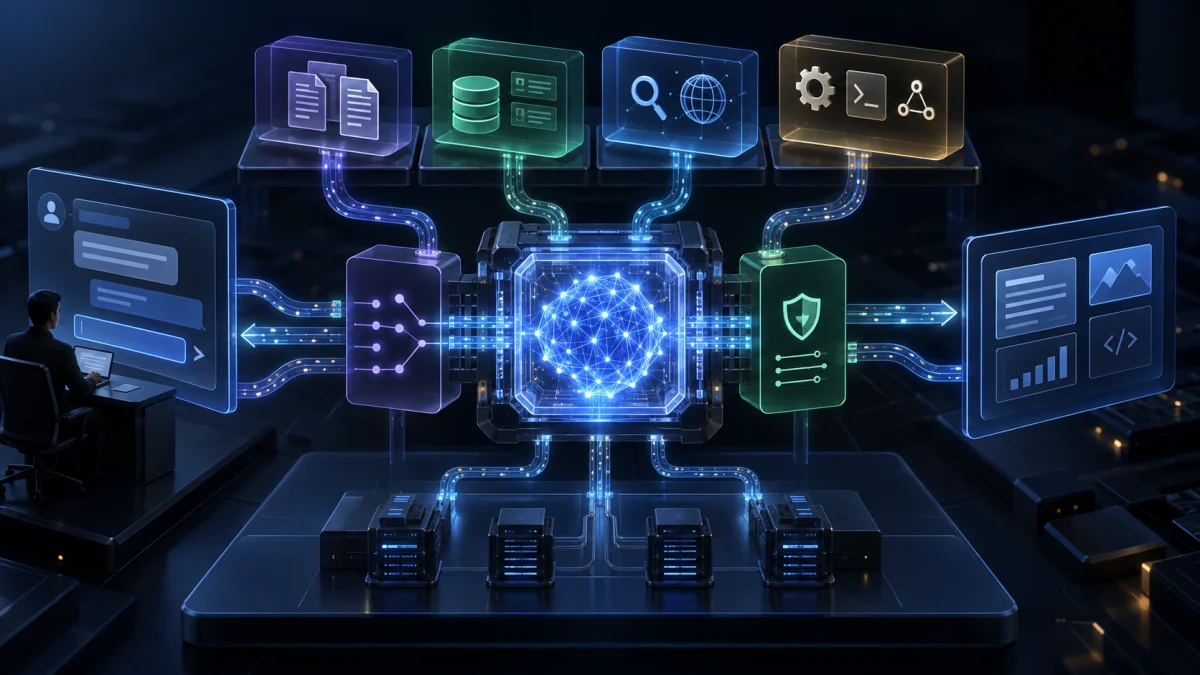
AI middleware is the software around an AI model that connects it to applications, data, tools and operational controls. Depending on the system, middleware can assemble context, retrieve documents, provide memory, route requests to different model endpoints, execute tools, enforce permissions, apply safety checks, log activity, cache responses and process outputs.
It is not another AI model.
But it can profoundly change what an AI product can do.
That distinction matters because when someone uses an AI application, they usually are not interacting with a raw model. They are interacting with an AI system in which the model may be only one component.
Two products can therefore use the same underlying model and still produce noticeably different results because the software surrounding that model gives it different instructions, information, tools, permissions and execution logic.
Gartner formalized this increasingly important category in May 2026, describing AI middleware as a broad architectural layer connecting applications, AI models or agents, and enterprise data while providing functions such as connectivity, orchestration, governance, security and operations. IBM describes AI gateways as a specialized form of middleware, while Microsoft’s AI-gateway architecture demonstrates how such a layer can sit in front of models, agents and tools and control routing, authentication, quotas, moderation and monitoring.
The important point is that "middleware" does not refer to one mandatory piece of software or one universally agreed architecture. It is a broad category.
The simplest way to understand AI middleware
Imagine a user asks an AI:
"What does my lease say about pets?"
A basic application could simply send those words to a language model.
The model has never seen the user’s lease, so it cannot reliably answer the question.
A more capable application could:
- identify the user’s lease;
- retrieve the relevant pages;
- extract the pet provisions;
- insert those passages into the model’s context;
- instruct the model to answer only from the document;
- ask the model to generate the explanation;
- attach citations to the relevant pages;
- check or format the result before displaying it.
The underlying model did the language interpretation and generation.
But much of what made the answer useful came from the system around it.
A simplified architecture might look like this:
User request ↓ Application ↓ Authentication / policy checks ↓ Context assembly Conversation history + instructions + memory + retrieved information ↓ Gateway / model router ↓ AI model ↕ Tools, search, databases, files, APIs or code execution ↓ Output checks / formatting / citations ↓ Answer shown to the user
Real AI systems can be much simpler or considerably more complicated than this, and not every component has to appear in this order. Agents in particular may cycle repeatedly between the model and external tools before producing a final answer.
That entire surrounding structure is why identifying the model alone does not necessarily tell you how an AI product will behave.
What comes from the model, and what comes from the software around it?
The boundary is easiest to understand by separating the model’s capabilities from the environment in which those capabilities are being used.
| Capability | What the model contributes | What the surrounding system contributes |
|---|---|---|
| Language generation | Learned patterns and capabilities from training | Prompt, context and output requirements |
| Reasoning and instruction following | Ability to interpret and respond to information | Which instructions and information the model receives |
| Knowledge from training | Information encoded during training | Nothing is required, although outside information can supplement it |
| Current information | Ability to interpret current information | Search, retrieval, databases or other sources supplying it |
| Private documents | Ability to analyze the documents | Access, retrieval and permission to provide them |
| Conversation history | Ability to interpret earlier messages placed in context | Storage and selection of which history is sent back to the model |
| Persistent user memory | Ability to use remembered information once supplied | Usually storage, retrieval and context injection outside the model |
| Tool selection | Model may decide which available tool to request | System defines which tools exist and whether they are permitted |
| Tool execution | Usually none—the model requests an action | External software actually runs the search, API, code or action |
| Model selection | None | Router or application can select a model/backend |
| Authentication and rate limits | None | Gateway or application |
| Safety controls | Model behavior can include trained safeguards | Additional filters, permissions and policy systems may also apply |
| Final presentation | Model may generate formatted output | Application may transform, filter, cite or render it |
This is why the question "Which model is this using?" is useful, but incomplete.
For many sophisticated AI products, the better question is:
What model is it using, and what system has been built around that model?
Why the same AI model can behave differently in different products
There are several major ways the surrounding system can change the result without changing the model’s trained weights.
1. The model can receive different instructions
Modern model APIs allow applications to supply higher-priority system or developer instructions in addition to the user’s message.
OpenAI’s API documentation, for example, explicitly describes its instructions field as inserting a system or developer message into the model’s context. Its agent guidance describes model, tools and instructions as three fundamental components of an agent.
One application might instruct a model:
Answer conversationally and make reasonable assumptions.
Another could tell the same model:
Use only the supplied documents. If the answer is not present, say that you cannot determine it.
Those applications can produce very different behavior even though the model weights are identical.
A system prompt itself is not middleware. It is information supplied to the model.
The software that creates, selects and inserts those instructions can be part of the surrounding application or middleware.
2. The model can receive different context
A model can only use outside information if that information somehow becomes available to it.
That may include:
- previous conversation messages;
- retrieved documents;
- user preferences;
- company records;
- database results;
- search results;
- tool outputs;
- summaries of earlier work;
- application state.
Anthropic calls the broader task of deciding what information should enter an agent’s limited context window context engineering. Its description explicitly includes system instructions, tools, MCP-connected information, external data and message history.
This creates an important distinction:
The model determines what it can do with context. The surrounding system can determine what context it gets.
3. Retrieval can give the model information it was never trained on
Retrieval-augmented generation, usually called RAG, is one common way to do this.
A RAG system searches an external information source and supplies relevant material to the language model when answering a question. AWS describes RAG as augmenting an LLM with external data, such as internal documents, so the model receives context relevant to the task.
That means RAG generally does not teach the underlying model new information by modifying its weights.
It retrieves information and gives it to the model at inference time.
This is why the same model can know nothing about a company’s private manuals in one application but answer detailed questions about them in another.
4. Tools can turn a chatbot into something that can act
A language model can produce text describing how to check a calendar.
Give an agent access to a calendar tool, however, and the model may be able to request that the surrounding system actually check it.
The same principle applies to:
- web search;
- databases;
- calculators;
- email;
- file systems;
- code execution;
- customer records;
- business software;
- computer control.
OpenAI’s agent guidance distinguishes the model from the tools it is allowed to use. Anthropic similarly describes an "augmented LLM" as a model enhanced with capabilities such as retrieval, tools and memory.
This distinction becomes especially important when tools can take real-world actions.
The model might generate a structured request meaning:
Send this email.
But external software still has to determine whether the tool exists, whether the model is authorized to call it, whether human approval is required, and how the email is actually sent.
5. Middleware can decide which model receives the request
Not every application is permanently wired to one model endpoint.
AI gateways can sit in front of multiple models or deployments and abstract those backends behind a common interface.
Microsoft’s Azure API Management, for example, can expose multiple LLM backends through one client-facing endpoint and supports multiple providers. It also supports load balancing across AI backends. IBM likewise identifies multi-model access and workload routing as AI-gateway capabilities.
That makes several architectures possible.
An application might:
- use one model for simple tasks and another for difficult ones;
- route traffic between deployments for capacity reasons;
- fail over to another endpoint during an outage;
- expose several providers through one interface;
- keep the client application largely unaware of backend differences.
None of those behaviors require modifying the models themselves.
The gateway decides where the request goes.
6. An agent harness can determine what happens between model calls
This is where the rapidly growing term agent harness becomes important.
A basic chatbot may call a model once and display the answer.
An agent may instead operate like this:
model → tool → result → model → tool → result → model → final answer
Something has to manage that loop.
OpenAI’s description of the Codex harness includes the core agent loop as well as conversation persistence, configuration, authentication, sandboxed tool execution, MCP integrations and other supporting functions. LangChain uses the term similarly for the scaffolding that connects a model to context, tools and its working environment.
This can materially affect what the same model accomplishes.
The harness might decide:
- what tool results are returned to the model;
- when old context is summarized;
- how failed actions are retried;
- when the model should continue working;
- how state persists between steps;
- what files the agent can access;
- when human approval is required;
- when the task should stop.
In other words, a capable agent is not simply a model that answers more slowly.
It is typically a system repeatedly placing the model inside an execution environment.
There is now evidence that changing the harness alone can change performance
This distinction is not merely theoretical.
An August 2026 preprint titled Same Model, Different Harness: Different Coding-Agent Results experimentally changed harness behavior while keeping the model and tasks fixed.
The experiment modified how older tool outputs were managed as context became constrained and how the system responded when work appeared stalled or repetitive. Across the tested coding benchmarks, changing that harness changed task performance.
In one 169-task, tight-context SWE-bench Verified comparison, the number of complete solutions increased from 43 to 72 under the modified harness.
That result deserves two qualifications.
First, the paper is currently a preprint, not a peer-reviewed demonstration of a universal rule.
Second, it studied coding agents under particular benchmark and context conditions. It does not show that the harness always matters more than the model.
What it does provide is unusually direct evidence for the narrower claim:
Holding model weights constant does not necessarily hold agent performance constant.
Anthropic’s own engineering work has independently reached a similar practical conclusion in long-running coding systems, reporting significant performance effects from changes to harness design and context management.
7. Safety rules can exist outside the model
Another source of confusion is AI safety behavior.
Some safeguards are associated with the trained model or the model provider’s inference service.
Others can operate elsewhere in the system.
Amazon Bedrock Guardrails, for example, can inspect both input prompts and model responses and filter content according to configured policies. Microsoft’s AI gateway similarly supports applying content-safety policies to LLM traffic.
So when an AI refuses, blocks or alters an interaction, it is not always possible for an outside observer to conclude that the model itself made the entire decision.
Depending on the architecture, a request could be stopped before reaching the model, the model could refuse it, or an output could be checked after generation.
Safety can exist at several layers simultaneously.
8. Sometimes middleware can avoid calling the model at all
One especially useful example of how much happens outside the model is semantic caching.
Microsoft documents an AI-gateway feature that can store previous LLM completions and reuse them when a later prompt is considered semantically similar. The purpose is to reduce model calls, latency and token usage.
In a system using such a feature, a user can receive an AI-generated answer even though that particular request did not necessarily cause a fresh generation from the backend model.
That does not mean all AI applications work this way.
It demonstrates why the visible interaction should not automatically be treated as a direct, one-to-one conversation with a model.
AI middleware vs. AI gateway
These terms overlap, but they should not be treated as synonyms.
An AI gateway is generally a narrower infrastructure component concerned with traffic between applications and AI services.
Typical gateway responsibilities include:
- authentication;
- routing;
- load balancing;
- rate limits;
- token quotas;
- logging;
- monitoring;
- caching;
- model-endpoint management;
- security policies.
IBM explicitly describes an AI gateway as a specialized middleware platform. Microsoft’s implementation shows the same narrower traffic-management role.
AI middleware is the broader category and can encompass gateways as well as orchestration, context management, integrations, governance and other services around AI applications.
A useful shorthand is:
AI gateway = one possible part of AI middleware.
AI middleware vs. an agent harness
This boundary is less settled.
There is not currently one formal industry specification defining exactly where "middleware" ends and an "agent harness" begins.
In current agent engineering usage, harness generally refers to the operational scaffolding that turns a model into a working agent: the execution loop, context handling, tools, state, permissions, environment and related logic.
LangChain’s 2026 documentation is particularly revealing because it describes prebuilt agent harnesses as containing an opinionated middleware stack for features such as memory, context management and sandboxing. In that terminology, middleware is something used inside or to customize the larger harness.
OpenAI uses "Codex harness" more broadly for the agent loop and supporting infrastructure around it.
So the safest interpretation is:
The concepts overlap, and the exact boundary depends on the architecture and the speaker.
Treating either term as having one rigid universal definition would imply a level of standardization that does not yet exist.
AI middleware vs. RAG
RAG is a technique. Middleware is a software layer or category.
RAG retrieves outside information and makes it available to a model.
A middleware system may implement or coordinate a RAG pipeline, but RAG itself does not encompass everything middleware can do.
RAG does not inherently mean:
- model routing;
- authentication;
- tool execution;
- rate limiting;
- logging;
- agent orchestration;
- output moderation.
It solves a narrower problem: getting relevant outside information into the AI interaction.
AI middleware vs. MCP
MCP is a protocol, not another name for middleware.
The Model Context Protocol defines a standardized way for AI applications to connect with external context and capabilities. Its specification defines concepts including hosts, clients, servers, resources, prompts and tools.
An AI application or middleware layer can use MCP to communicate with outside systems.
But MCP does not determine the entire agent architecture, choose every model, manage every memory system or replace the broader middleware layer.
One analogy is useful:
MCP helps define how components can communicate. Middleware is software that may use that communication method to make a larger system work.
AI middleware vs. a system prompt
A system or developer prompt is an instruction supplied to a model.
Middleware is software.
Middleware can create, retrieve, alter or insert instructions before calling the model, but the instruction itself is data in the model’s context rather than a middleware service.
This matters because people sometimes call everything outside the user’s visible prompt "middleware."
That is too broad to be technically useful.
What AI middleware cannot do
The importance of middleware can also be overstated.
A sophisticated harness cannot simply manufacture arbitrary intelligence out of an incapable underlying model.
Middleware can:
- provide better information;
- provide better instructions;
- give access to tools;
- maintain state;
- structure complicated work;
- let the model verify results;
- compensate for some predictable failure modes.
But it does not ordinarily rewrite the model’s trained weights during each request.
If the model fundamentally cannot understand a problem, middleware has limits.
Poor middleware can also make a strong model perform worse.
Bad retrieval can supply irrelevant information. Poor tool descriptions can cause incorrect tool use. Excessive instructions can introduce conflicts. Aggressive context compression can remove something important. An unnecessary multi-agent architecture can increase cost and introduce additional failure points.
Anthropic explicitly recommends starting with simple AI systems and adding agentic complexity only when it demonstrably improves results.
The strongest model and the strongest surrounding system are therefore not competing explanations.
Both matter.
Why this distinction matters when comparing AI products
Suppose two AI assistants both use the same model.
Product A gives it:
- the user’s current message;
- a basic system prompt.
Product B gives the same model:
- detailed instructions;
- relevant conversation history;
- persistent memory;
- retrieved documents;
- web search;
- a calculator;
- code execution;
- several external applications;
- an agent loop;
- a verification step.
Saying that both products "use the same model" is true.
Saying they should therefore perform the same is not.
This becomes particularly important with AI benchmarks.
A benchmark that sends standardized prompts directly to model APIs can be designed primarily to compare models.
A benchmark that lets coding agents browse repositories, execute commands, manage context, retry failures and use different tool environments may instead be comparing whole agent systems.
If the harness differs, the test no longer isolates model capability alone.
The distinction is not a reason to dismiss agent benchmarks. Quite the opposite: for many real-world tasks, the complete system is exactly what users care about.
It simply means the result should be described accurately.
The model is the engine, but the product is the system
The rise of AI middleware explains an apparent contradiction in modern AI.
People can use what appears to be the "same model" in several applications and come away convinced they used completely different AIs.
Sometimes they effectively did.
Not because the underlying trained model necessarily changed, but because everything around it did.
One system may give the model private data. Another gives it nothing.
One gives it search. Another does not.
One remembers prior interactions. Another starts fresh.
One lets it run code, inspect the result and try again. Another produces one response and stops.
One routes requests between several backends. Another always calls the same endpoint.
One places additional policy checks around the model. Another relies primarily on the model provider.
The useful mental model is therefore:
AI product ≠ AI model
The model supplies much of the underlying learned capability.
The surrounding system determines how that capability is supplied with information, constrained, connected to the outside world and turned into a usable product.
As AI moves from chatbots toward agents that can search, remember, execute software and take actions, understanding that distinction becomes increasingly important.
Frequently Asked Questions
Is AI middleware itself an AI model?
No. Middleware is software infrastructure around or between components of an AI system. It may call AI models, but it is not synonymous with the models themselves.
Can middleware change an AI’s answer without changing the model?
Yes. It can change the instructions, context, retrieved information, available tools and execution process supplied to an unchanged model. Output filters or post-processing systems can also affect what ultimately reaches the user.
Can middleware choose which AI model gets used?
Yes. AI gateways and orchestration systems can route requests among multiple model endpoints or providers. Whether a particular product does this depends on its architecture.
Is RAG a type of middleware?
RAG is better described as a retrieval technique or architecture that can be implemented as part of an AI system. Middleware may coordinate RAG, but the two terms are not interchangeable.
Is MCP AI middleware?
No. MCP is a protocol for connecting AI applications with external resources, prompts and tools. Middleware or an agent harness can use MCP as part of a larger architecture.
Is an agent harness the same as middleware?
Not exactly. The terms overlap and remain somewhat fluid. An agent harness generally refers to the broader execution environment around an agent, while middleware often refers to services or components within or between parts of that environment.
Does middleware make the underlying model smarter?
Not in the same sense as training a more capable model. Middleware can make the complete system more effective by giving the model better context, tools, memory and workflows. It cannot remove every limitation of the underlying model.
Does an AI model remember previous conversations by itself?
Persistent user memory is generally a property of the surrounding product or service rather than the model continually retraining itself on an individual user’s conversations. Stored information can later be selected and returned to the model as context. Exact implementations vary by provider.
Are safety restrictions always built into the model?
No. Safety can operate at several layers. Models can have trained safety behavior, while applications and infrastructure can separately inspect inputs, outputs, permissions and tool actions.
If two products use the same model, should they get the same benchmark score?
Not necessarily. If their prompts, context, tools, execution environments, inference settings or harnesses differ, the benchmark may be measuring the entire system rather than the model alone.
References and Further Reading
AI Middleware and Gateways
-
Gartner — Innovation Insight: AI Middleware — Gartner’s May 2026 research describing AI middleware as the architectural layer connecting applications, models or agents, and enterprise data.
-
Microsoft Learn — AI Gateway Capabilities in Azure API Management — Primary Microsoft documentation covering multi-provider model endpoints, routing, authentication, token limits, caching, safety policies, load balancing and observability.
-
IBM — What Is an AI Gateway? — Useful distinction between the broader middleware category and the narrower AI-gateway layer.
-
Red Hat — What Is Middleware? — Background on the established computing meaning of middleware before the term was adapted to modern AI architectures.
Models, Agents and Harnesses
-
OpenAI — A Practical Guide to Building AI Agents — Defines the model, tools and instructions as core components of an agent and explains orchestration and guardrails.
-
OpenAI — Unlocking the Codex Harness: How We Built the App Server — Detailed primary-source description of the agent loop, persistence, tool execution, configuration and other components surrounding Codex models.
-
Anthropic — Building Effective Agents — Describes augmented language models, retrieval, tools, memory, workflows and agents while emphasizing the tradeoffs created by additional system complexity.
-
Anthropic — Effective Context Engineering for AI Agents — Explains how system instructions, tools, external information and message history are selected and managed as model context.
-
LangChain — How to Build a Custom Agent Harness — Useful current example of industry usage of the term "agent harness" and its relationship to middleware.
Retrieval, Tools and Protocols
-
Model Context Protocol — Specification — Authoritative specification defining MCP hosts, clients, servers, resources, prompts and tools.
-
AWS — Understanding Retrieval-Augmented Generation — Clear technical description of using external information to augment an LLM at inference time.
-
AWS — Amazon Bedrock Guardrails — Primary documentation demonstrating that safeguards can inspect and filter both inputs and model outputs outside the underlying model.
Evidence on Harness Effects
- Lewis — Same Model, Different Harness: Different Coding-Agent Results — August 2026 preprint directly testing changes to a coding-agent harness while holding the model and task set fixed. Relevant evidence, but not yet peer-reviewed and not sufficient to generalize across all AI applications.
Editorial currency note: AI middleware, gateways, agent harnesses and related protocols are evolving rapidly. Terminology and vendor architectures were reviewed through September 6, 2026. The architectural distinctions in this article are intended to describe the concepts rather than imply that every vendor uses identical terminology.