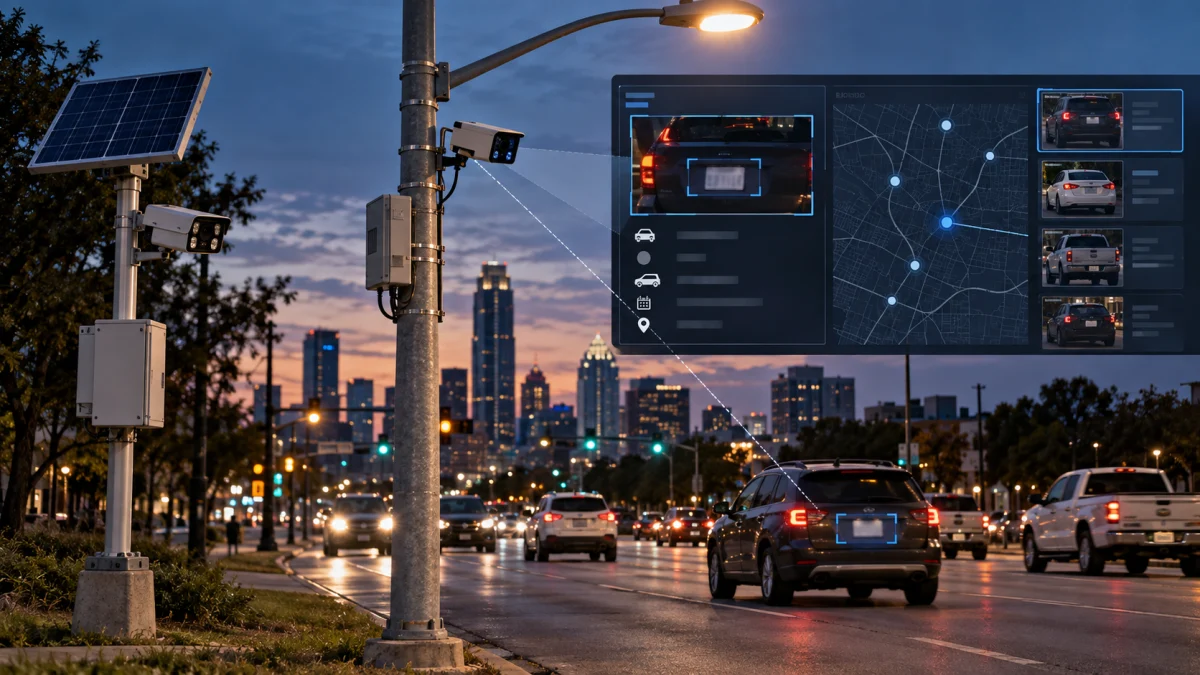
Axon Lightpost is a fixed automated license plate reader, or ALPR, designed to mount on existing streetlight infrastructure. It can continuously scan its field of view for license plates, analyze vehicle characteristics and provide authorized users with live video through Axon Fusus.
It is not a camera secretly hidden inside a traffic signal.
Axon’s own technical documentation describes a visible camera and supporting hardware attached to existing streetlights or similar outdoor infrastructure. The system uses a Ubicquia hub for power and connectivity and an Axis roadway camera for vehicle capture. Axon says it can be installed on an existing light pole in under an hour, without adding a new pole or trenching for a new installation. Axon Lightpost product documentation
That distinction matters because the real story is significant without exaggerating it.
A dedicated roadside ALPR usually announces itself as a new piece of infrastructure. Lightpost is designed to add the same basic surveillance function to infrastructure that is already standing along the road.
And it is arriving at an unusually important moment.
As public opposition to Flock Safety’s license-plate-reader network has intensified, several jurisdictions have moved toward competing Axon systems. But a city switching from Flock to Axon does not automatically mean it is installing Lightpost. Axon also sells Outpost and other ALPR products, and the specific camera model is not identified in every public procurement record.
That is the first rule for understanding this story:
Do not confuse “Axon ALPR” with “Axon Lightpost.”
Axon Lightpost at a Glance
| Feature | What Axon currently documents |
|---|---|
| Purpose | Fixed automated license plate recognition |
| Mounting | Existing streetlights and compatible outdoor infrastructure |
| Vehicle analysis | Plate recognition plus AI-detected vehicle attributes |
| Live video | On-demand livestreaming through Axon Fusus |
| Camera | Axis Q1800-series roadway camera |
| Connectivity | Cellular/LTE through the accompanying infrastructure |
| Power | Existing streetlight power through the Ubicquia UbiHub configuration |
| Installation | Axon says under one hour on suitable existing light poles |
| New pole required | No, where compatible existing infrastructure is available |
| Trenching required | Axon markets Lightpost specifically as avoiding new trenching |
Axon’s current product page describes Lightpost as combining ALPR, vehicle attribute recognition and livestreaming while using existing streetlight infrastructure. Axon Lightpost official product page
Those are manufacturer specifications. They establish what Axon says the product is designed to do. They are not an independent performance audit of every installation.
Is Axon Lightpost Hidden Inside a Traffic Light?
No.
This is probably the most important correction to the viral version of the story.
A streetlight illuminates a roadway or sidewalk.
A traffic signal controls traffic with red, yellow and green lights.
Axon Lightpost is built around streetlight infrastructure. Its camera remains physically mounted and visible.
Axon’s technical guide describes Lightpost as an “infrastructure-mounted” ALPR system installed on existing streetlights and other compatible outdoor infrastructure. The system combines a Ubicquia UbiHub with an Axis Q1800-series camera. Axon Lightpost hardware overview
Some configurations use the streetlight’s NEMA photocell connection for power.
So “Axon hides a license-plate reader inside the traffic light” is not an accurate description.
A more precise statement is:
Axon can attach a license-plate reader to streetlight infrastructure that was already there.
That can make the addition less visually distinctive than erecting a dedicated ALPR pole. But that is an inference from the physical design, not evidence that Axon created Lightpost for concealment.
Axon Lightpost Predates the 2026 Flock Backlash
Another tempting version of this story does not survive the chronology.
Axon publicly announced Lightpost and Outpost on April 22, 2025. Axon’s April 22, 2025 announcement of Lightpost and Outpost
The current wave of Flock cancellations and political backlash accelerated later.
So there is no factual basis for saying Axon invented Lightpost in response to the 2026 DeFlock movement.
What the evidence does support is different.
By August 2026, Axon CEO Rick Smith was telling investors that the company was seeing a “significant number” of agencies seeking to convert from existing license-plate-reader systems to Axon. NPR reported the statement while examining how competitors were benefiting from the backlash against Flock. NPR/OPB report on Axon and the Flock backlash
So:
Lightpost existed before the current backlash. The backlash is now creating opportunities for Axon products that were already on the market.
Those are two very different claims.
Our earlier sherafy.com investigation, Cities Are Dumping Flock Cameras. Are They Ending Surveillance—or Just Changing Vendors?, documents the broader Flock-to-Axon shift, including Axon’s earlier investment in and partnership with Flock. Read the sherafy.com Flock-to-Axon investigation
What Does Axon Lightpost Actually Record?
At its core, Lightpost performs automated license plate recognition.
But Axon’s current vehicle-intelligence system goes beyond a plate number.
Its Fusus search interface supports searches by:
| Searchable information | Current Axon documentation |
|---|---|
| Full or partial plate | Yes |
| Plate state/jurisdiction | Yes |
| Time range | Yes |
| Vehicle color | Yes |
| Vehicle make | Yes |
| Vehicle type/body style | Yes |
| Roof racks | Yes |
| Bumper or window stickers | Yes |
| Camera/device | Yes |
| Geographic area | Yes |
| Hotlist matches | Yes |
| Partner-agency data | Where an active sharing relationship permits it |
Axon identifies color, make, type and additional vehicle details as AI-detected attributes. Axon Fusus ALPR Search documentation
Search results can contain plate information, timestamp, detection location, vehicle attributes, camera information and one or more images depending on the source.
The system also exposes confidence scores for plate reads and AI-detected vehicle characteristics. Axon’s current interface allows investigators to lower or raise the confidence threshold used for vehicle-attribute searches and separately show lower-confidence partial plate matches. Axon ALPR Search fields and confidence controls
That qualification matters.
An ALPR detection is not infallible.
A plate can be misread. An AI-generated vehicle classification can be wrong. Axon’s own interface acknowledges this by attaching confidence values to plate OCR and vehicle attributes.
The sources reviewed for this article do not provide an independent, real-world accuracy rate that can responsibly be applied to every Lightpost deployment, so this article does not assign one.
Does Lightpost Identify the Driver?
Not from the plate read alone.
An ALPR record associates a detected vehicle or plate with a location and time. It may later be connected to registration information or other investigative evidence.
That does not establish who was driving.
This distinction is important whenever ALPR data is described as tracking a person. Repeated detections can help investigators reconstruct the apparent movement of a vehicle, but the camera does not prove that the registered owner was behind the wheel for each detection.
Likewise, the Lightpost documentation reviewed for this article describes plate recognition, vehicle attributes and video. It does not describe facial recognition as part of the Lightpost ALPR process itself. Axon Lightpost introduction and intended use
Axon sells and integrates other technologies across its broader platform. That does not mean every capability in the Axon ecosystem is automatically a capability of Lightpost.
Lightpost Also Provides Live Video
This is one of the more important differences between the common mental image of an ALPR and what Axon is selling.
Lightpost is not merely a device that takes a plate image and uploads a record.
Axon says the camera also supports on-demand livestreaming for authorized users through Fusus. Axon Lightpost product page
Its technical guide says the device continuously performs plate recognition while remaining available for real-time livestream sessions. Axon Lightpost technical introduction
There is an important limitation, however.
Axon describes the camera’s field of view as optimized for roadway and plate capture. It should not automatically be pictured as a panoramic CCTV camera watching an entire neighborhood in every direction.
The accurate description is:
Lightpost combines a fixed ALPR sensor with a live-video capability from the same installation.
Lightpost and Outpost Are Not the Same Camera
This distinction is already becoming muddled in public discussion.
Axon Lightpost is designed around existing streetlight infrastructure.
Axon Outpost is Axon’s more conventional fixed ALPR camera. Axon markets Outpost with multiple power configurations, including solar and line power, and the system also combines plate recognition, vehicle-attribute recognition and livestreaming. Axon Outpost official product page
That distinction matters because there is now direct evidence that the appearance of ALPR hardware itself has entered the post-Flock conversation.
On September 2, 2026, 404 Media reported that an apparent law-enforcement participant in a subsequently deleted Axon webinar asked whether Axon might redesign Outpost so it did not look so much like a Flock camera, explicitly referring to the optics surrounding the backlash. 404 Media’s report on the Axon webinar question
That is noteworthy.
It is also easy to overstate.
It does not show that Axon created Lightpost to disguise surveillance.
It does not establish a coordinated strategy by police departments to hide cameras.
It does establish that at least one apparent law-enforcement participant raised the visual recognizability of ALPR hardware as an issue during the backlash.
That is the evidence. Anything stronger would be speculation.
Why Existing Streetlights Matter
The most consequential feature of Lightpost may be logistical rather than futuristic.
Axon markets the system around eliminating several common deployment burdens:
a new dedicated pole, trenching for a new installation and a separate wired network connection.
Axon says Lightpost can be installed on a suitable existing light pole in under an hour. Axon Lightpost deployment specifications
From that, one reasonable inference follows:
Reducing the physical work required for each installation can reduce deployment friction and make network expansion easier.
That is not the same as proving that a city will install more cameras.
Budget, contracts, pole ownership, electrical compatibility, policy, public approval and local law still determine where and how broadly a system can be deployed.
The hardware creates the capability for easier installation.
Whether a government uses that capability aggressively is a separate factual question.
Are Cities Really Switching From Flock to Axon?
Yes, several documented jurisdictions are.
But the outcomes are not uniform, and not every Axon deployment is Lightpost.
| Jurisdiction | Flock outcome | What happened next |
|---|---|---|
| Denver, Colorado | City moved away from Flock | Denver formally approved a one-year, $150,000 Axon ALPR agreement covering 50 cameras. City officials said the agreement would include a 21-day retention limit and data-sharing restrictions. |
| Douglas County, Colorado | About 50 Flock cameras being replaced | County approved an Axon package that includes 100 Axon Outpost cameras and drones. This is a confirmed example of an Axon switch that is not Lightpost. |
| Longmont, Colorado | 15 fixed Flock cameras removed | City contracted for 15 Axon replacements but paused deployment while reviewing privacy, auditing, data-sharing and documentation rules. |
| Amherst, New York | Moving away from 17 Flock cameras | Town approved 24 Axon cameras for $300,000, according to public-record-based reporting by Investigative Post. |
| Town of Tonawanda, New York | Flock lease ending | Town approved replacing roughly a dozen Flock readers with Axon beginning in 2027. |
| Boston, Massachusetts | Earlier Flock pilot ended | Police later began a 30-camera Axon pilot and a separate 45-camera Motorola pilot. As of September 14, WBUR reported that it was unclear whether either pilot was still ongoing. |
| Richmond, California | Flock contract expires December 31 | Police proposed moving to Axon, but the City Council delayed the decision while seeking more evidence on privacy and effectiveness. |
| Kendall County, Texas | Commissioners voted 5-0 to shut down a 57-camera Flock network | No replacement ALPR system was announced as part of the decision; officials did not rule out different technology in the future. |
Denver’s final council record confirms the 50-camera, $150,000 Axon agreement, adopted March 31, 2026. Denver Resolution 26-0246 The 21-day retention and sharing safeguards were described by Denver officials during the transition. Denver Gazette report on Denver’s Axon safeguards
Douglas County’s official July 14 record identifies the purchase as involving Axon Outpost technology. Douglas County Axon purchase record Independent reporting describes 100 Outpost cameras replacing roughly 50 Flock readers. Denver Gazette report on Douglas County’s Axon system
Longmont’s own September 17 statement says it removed 15 fixed Flock cameras, entered an agreement for 15 Axon replacements and then delayed deployment while reviewing policy and legal questions. City of Longmont ALPR update
Investigative Post documented Amherst’s transition from 17 Flock readers to 24 Axon cameras. Investigative Post’s Western New York ALPR investigation
Buffalo Toronto Public Media reported that Tonawanda plans to replace about a dozen Flock cameras with Axon at the start of 2027. BTPM report on Tonawanda’s Axon switch
WBUR documented Boston’s separate Axon and Motorola pilots and explicitly noted uncertainty about whether those pilots remained ongoing. WBUR’s September 2026 Boston ALPR report
Richmondside documented Richmond’s delayed decision and the council’s request for more evidence before approving the proposed switch. Richmondside report on Richmond’s delayed Axon decision
And Kendall County provides an important counterexample: commissioners voted unanimously to terminate a 57-camera Flock network rather than simultaneously approving another vendor. KSAT report on Kendall County’s Flock shutdown
The conclusion should therefore be narrower than “cities are replacing Flock with Axon.”
Some are. Some are not. And among those buying Axon, the hardware and rules differ.
Longmont Shows Why Changing Vendors Is Not the End of the Question
Longmont is one of the strongest examples because the city’s own chronology is unusually clear.
The city said national and local concerns about Flock’s practices prompted officials to evaluate alternatives.
It removed 15 fixed Flock cameras and entered an agreement for 15 Axon replacements.
Then it paused the Axon deployment.
Longmont said it wanted additional review of policies, auditing, data sharing, documentation, transparency and privacy before moving forward. Longmont’s September 17 ALPR statement
That exposes the larger issue.
If the objection is:
“We do not trust Flock.”
Changing the vendor may answer it.
If the objection is:
“We want stronger rules around continuous vehicle surveillance.”
Then changing the logo on the camera does not answer the question.
The rules have to follow the technology.
How Does Axon’s Cross-Agency ALPR Sharing Work?
Axon’s current architecture should not be described as though it were simply Flock’s network under another name.
Axon introduced its current Fusus ALPR Sharing feature as generally available on July 30, 2026 and describes it as still rolling out across its US1 environment. The documentation also makes clear that the feature is not yet available in every Axon cloud region. Axon Fusus ALPR Sharing documentation
According to Axon’s current documentation:
Nothing is shared with another agency by default.
The agency holding the data initiates an invitation to a specific partner. The recipient must separately accept it. Either agency can revoke the relationship.
Axon says the underlying records remain in the originating agency’s tenant rather than being copied into a new centralized ALPR database. Axon ALPR Sharing architecture
But that does not mean partner agencies cannot search the data.
Once a sharing relationship is active, a recipient can include authorized partner data in an ALPR search.
The donor can limit sharing to plate reads matching the recipient’s hotlist, restrict sharing by Axon device type, or—if both restrictions are disabled—allow the partner to search the donor’s full ALPR dataset, subject to offense-category controls. Axon’s current ALPR sharing controls
Every cross-agency search must declare an offense category, and data from a donor that has not permitted that category is excluded. Axon offense-category controls for shared ALPR data
So both of these statements would be wrong:
“Axon automatically shares every plate read nationwide.”
and
“Axon data cannot be searched by outside agencies.”
The current documented system falls between those claims.
Axon’s Sharing Controls Also Have Current Limitations
The same product documentation identifies limitations that should not be omitted from a serious comparison.
Axon says its audit tools can show which partner searched shared data, the stated reason, case number where supplied, offense category and result count.
But Axon also documents a current flaw in one sharing audit report: its device-scope and data-condition columns can display “All Devices” and “Full Sharing” even when narrower restrictions were actually configured. Axon tells administrators to check the relationship-detail panel instead when confirming the active sharing conditions. Axon’s documented ALPR-sharing audit limitation
The same documentation says recipients currently cannot be required to supply a specific case number as a sharing condition, although searches themselves record required or configurable purpose fields.
Those are important caveats.
A vendor’s existence of audit controls should not be confused with proof that every control is complete, correctly configured or independently monitored.
What Does Axon Require When Someone Searches?
Axon’s current Fusus search interface documents:
- an offense category;
- a reason for the search; and
- an administrator-configurable case number field.
The case number can be hidden, optional or required depending on agency configuration. Axon ALPR Search requirements
That is more precise than saying every Axon search universally requires a case number.
It does not.
Whether a case number is mandatory is a configuration question.
That is exactly why evaluating an ALPR system requires looking at the local agency’s settings and policy, not just the vendor’s feature list.
Can Axon Fusus Search Flock Data?
Potentially, when the relevant integration and permissions exist.
Axon’s current ALPR search interface lists several possible data-source categories, including:
Fleet 3, Outpost, Works with Axon cameras, Jenoptik, Vigilant and Flock V3. Axon Fusus ALPR source list
That is a technically important detail.
It does not mean every Axon customer automatically has access to Flock records.
It does not mean Axon provides universal access to the Flock network.
It means Fusus is designed to search across multiple connected ALPR sources where the agency actually has that integration and the necessary access.
The broader lesson is that the camera beside the road is only one layer of the system.
The software platform behind it can matter just as much.
How Long Does Axon Keep Lightpost Data?
There is no single retention period that can responsibly be stated for every Axon Lightpost deployment from the current documentation reviewed for this article.
Axon’s Fusus administration guide allows agency administrators to configure:
read retention—how long ordinary plate reads remain; and
hit retention—how long hotlist matches remain.
Those periods can be configured separately. Axon Fusus ALPR retention settings
A separate Axon Fleet 3 FAQ identifies 30 days as the default retention period for Fleet 3 ALPR records.
That figure should not automatically be applied to Lightpost.
The correct question is:
What retention period has this particular agency configured or contractually adopted for this particular ALPR system?
Denver, for example, announced a 21-day limit except where records were needed for an active investigation. Denver’s Axon retention and sharing safeguards
Flock has also changed its own defaults during the current controversy. Its current Evidence Policy states that the standard Flock retention period is seven calendar days, unless a customer agreement or applicable legal requirement provides otherwise. Flock Evidence Policy
That makes older simplistic comparisons between a universal “Flock retention period” and a universal “Axon retention period” unreliable.
Is Axon More Private Than Flock?
There is no defensible universal yes-or-no answer.
There are material architectural differences.
Axon’s newly documented partner-sharing model is donor-initiated, configurable and not enabled by default.
Flock has its own current controls and has reduced its standard retention period to seven days.
But privacy in practice depends heavily on the actual deployment:
| Question | Why it matters |
|---|---|
| How long are ordinary reads retained? | Determines how far back routine vehicle history can be searched |
| Are hotlist hits retained longer? | Hit retention can differ from ordinary reads |
| Who has permission to search? | Determines internal access |
| Is a case number required? | Depends on agency configuration |
| What offense categories are permitted? | Limits stated authorized purposes |
| Which agencies receive shared access? | Determines network reach |
| Is federal access permitted? | Must be checked in local policy and contracts |
| Is live video enabled? | Adds a capability beyond stored plate reads |
| How are searches audited? | Determines whether misuse can later be detected |
| Who actually reviews the audits? | Logging misuse and detecting misuse are different things |
| What other cameras or databases feed the platform? | Determines the broader surveillance capability |
The contract, configuration and local policy may matter as much as the vendor name.
The Flock Backlash Is Expanding Into a Broader ALPR Debate
There is another reason this subject matters now.
On September 23, 2026, the Senate Judiciary Subcommittee on Crime and Counterterrorism held a hearing titled “Always Watching: Flock’s Nationwide AI Surveillance Network.” Official Senate Judiciary hearing record
Five days earlier, Subcommittee Chairman Josh Hawley had invited the CEOs of Flock Safety, Axon Enterprise, Motorola Solutions and Verkada to testify. Hawley’s September 18 invitations to surveillance-company CEOs
The official witness list for the hearing ultimately consisted of different witnesses.
That distinction matters: the CEOs were invited; the official hearing record does not show them as the witnesses who appeared.
But the invitations demonstrate something broader.
Even a hearing branded around Flock was already expanding scrutiny toward competing surveillance vendors.
At the municipal level, the same shift is visible in Longmont and Richmond.
Flock may have triggered the political debate.
The debate is increasingly becoming about ALPR surveillance itself.
Why Flock’s Physical Visibility Matters
Flock became unusually recognizable as a surveillance brand partly because people learned what its equipment looked like.
Matthew Guariglia of the Electronic Frontier Foundation told NPR that once people recognize the cameras, they become aware of how widespread they are. NPR/OPB reporting on the visibility of Flock cameras
Lightpost presents a different physical model.
It still has a visible camera.
But rather than necessarily requiring an obviously new standalone roadside installation, it is designed to attach to streetlight infrastructure already occupying the streetscape.
That supports a limited but important inference:
Integrated infrastructure can be less immediately recognizable to an ordinary passerby as a newly installed ALPR system.
It does not support saying the camera is invisible.
It does not support saying Axon intentionally designed it to evade public scrutiny.
And it does not support calling ordinary streetlights “secret surveillance devices” without identifying the actual hardware.
How Can You Tell Whether a Camera on a Streetlight Is Lightpost?
You often cannot establish that from appearance alone.
Roadways and intersections contain many different cameras and sensors:
| Equipment | Possible function |
|---|---|
| Axon Lightpost | ALPR, vehicle attributes and livestreaming |
| Axon Outpost | Fixed ALPR, vehicle attributes and livestreaming |
| Flock ALPR | Vehicle/plate detection and searchable vehicle characteristics |
| Traffic-detection camera | Signal timing and traffic-flow detection |
| Red-light enforcement camera | Traffic-law enforcement |
| General CCTV camera | Video monitoring |
| Transportation sensor | Roadway or infrastructure measurement |
A small camera near an intersection is not evidence by itself that it reads license plates.
The reliable way to identify a deployment is to check public records such as:
municipal procurement documents, contracts, city council agendas, police surveillance inventories, pole-attachment permits, vendor quotes and agency transparency portals.
That matters especially now that different surveillance products can occupy similar-looking roadside infrastructure.
What Should Residents Look for in an ALPR Contract?
The hardware is only the beginning.
Before anyone concludes that an Axon system is more restrictive, less restrictive or functionally equivalent to Flock, the public record should answer:
Which exact camera models are being purchased?
How many cameras?
Where will they be installed?
How long are ordinary reads retained?
How long are hits retained?
Who may conduct searches?
Are case numbers mandatory?
Which offense categories are authorized?
Which partner agencies can search the data?
Can federal agencies receive direct or indirect access?
Is live video enabled?
What other cameras or databases are integrated into Fusus?
Are searches routinely audited, and who reviews those audits?
Can the vendor add new analytics without another public approval?
Those questions reveal far more about a surveillance system than the logo printed on the invoice.
What the Evidence Supports—and What It Does Not
| Claim | Assessment |
|---|---|
| Axon Lightpost is an ALPR designed for existing streetlights. | Verified. |
| Lightpost can perform vehicle-attribute recognition and live video as well as plate recognition. | Verified in Axon’s current product documentation. |
| Lightpost is secretly hidden inside traffic signals. | False/misleading. It is a visible infrastructure-mounted camera system primarily designed around streetlights. |
| Axon created Lightpost because of the 2026 Flock backlash. | False chronology. Axon announced it in April 2025. |
| The Flock backlash is benefiting Axon’s ALPR business. | Supported. Axon’s CEO has publicly said agencies are converting to Axon amid the current environment. |
| Every city replacing Flock with Axon is installing Lightpost. | Unsupported. Some deployments use Outpost; others do not publicly identify the model. |
| Axon automatically shares all ALPR records nationwide. | Not supported by current Axon documentation. |
| Axon partner agencies can never search one another’s ALPR records. | False. The new Fusus sharing system allows configured partner searches. |
| Axon’s sharing feature is available identically everywhere. | False. Axon describes the feature as a new rollout with regional availability limitations. |
| All Axon ALPR records are retained for 30 days. | Unsupported. Retention is configurable; the 30-day default documented elsewhere is product-specific to Fleet 3. |
| A Lightpost detection proves who was driving. | False. It records a vehicle/plate detection, not driver identity. |
| Lower installation friction could make broader deployment easier. | Reasonable inference from the hardware design, not proof that a city will deploy more cameras. |
The Bottom Line
Axon Lightpost is a streetlight-mounted automated license plate reader that combines plate recognition, AI-assisted vehicle-attribute searching and on-demand live video.
It is not hidden inside a traffic signal.
It was not invented because of the 2026 Flock backlash.
But it is entering a market being reshaped by that backlash.
Some communities leaving Flock are buying Axon systems. Some are buying confirmed Outpost cameras. Some have not publicly identified which Axon hardware they will use. Some are pausing replacements to reconsider privacy rules. Others are shutting Flock down without immediately replacing it.
That makes “our city got rid of Flock” an incomplete answer.
The more useful questions are:
What replaced it? What does the new system record? How long does it retain the data? What other systems can search it? And who is allowed to look?
Lightpost matters because it demonstrates how the physical form of automated vehicle surveillance is evolving.
The familiar standalone ALPR is no longer the only model.
The next one may simply be mounted on the streetlight that was already there.
References and Further Reading
Primary Axon Documentation
Axon Lightpost — Official Product Page
Axon’s current overview of Lightpost, including ALPR, vehicle-attribute recognition, livestreaming, streetlight power and installation claims.
Axon Lightpost Product Guide — Introduction
Primary technical documentation describing continuous plate recognition, LTE connectivity, livestreaming and intended use.
Axon Lightpost Product Guide — Hardware Overview
Documents the Axis camera, Ubicquia infrastructure, power architecture and physical deployment model.
Axon Announces Lightpost and Outpost — April 22, 2025
Primary source establishing when Axon publicly introduced its fixed ALPR products.
Axon Fusus ALPR Search Guide
Documents search fields, vehicle attributes, connected data sources, exports and search requirements.
Axon Fusus ALPR Sharing Guide
Current vendor documentation covering partner sharing, offense-category restrictions, rollout status, auditing and known limitations.
Axon Fusus ALPR Administration Guide
Documents configurable read and hit retention periods and administrative permissions.
Axon Outpost — Official Product Page
Useful for distinguishing Axon’s standalone Outpost product from Lightpost.
Municipal Records and Local Reporting
City of Longmont — September 17, 2026 ALPR Update
Primary city statement confirming removal of 15 Flock cameras, the agreement for 15 Axon replacements and the decision to pause deployment.
Denver Resolution 26-0246
Primary municipal record approving Denver’s 50-camera, $150,000 Axon ALPR agreement.
Denver Gazette — Denver’s Axon Privacy and Retention Terms
Reports the city’s announced 21-day retention limit and restrictions on sharing and outside access.
Douglas County Axon Purchase Record
Primary county record identifying Axon Outpost technology in the county’s approved purchase.
Investigative Post — Western New York ALPR Investigation
Public-record-based reporting documenting Amherst’s move from 17 Flock cameras to 24 Axon cameras.
Buffalo Toronto Public Media — Tonawanda Switches From Flock to Axon
Documents Tonawanda’s decision to replace roughly a dozen Flock cameras with Axon beginning in 2027.
WBUR — Boston’s Flock, Motorola and Axon ALPR Pilots
Documents Boston’s 30-camera Axon pilot and notes that its ongoing status was unclear as of September 14.
Richmondside — Richmond Delays Proposed Axon ALPR Switch
Documents Richmond’s decision to postpone the proposed Flock-to-Axon transition pending further privacy and effectiveness review.
KSAT — Kendall County Votes to Shut Down Its Flock Network
Important counterexample showing a jurisdiction ending a Flock network without simultaneously approving another ALPR vendor.
Flock Policy and Broader Oversight
Flock Safety Evidence Policy
Flock’s current formal policy describing its standard seven-day retention period and exceptions.
404 Media — Axon Asked About Making Outpost Look Less Like Flock
Reports the September 2026 webinar question concerning camera appearance amid the Flock backlash.
NPR/OPB — Flock Competitors See an Opening Amid the Backlash
Documents Axon’s response to the DeFlock market opportunity and the role of camera visibility in the public backlash.
U.S. Senate Judiciary Committee — “Always Watching: Flock’s Nationwide AI Surveillance Network”
Official record of the September 23, 2026 subcommittee hearing.
Sen. Josh Hawley — Invitations to Flock, Axon, Motorola and Verkada CEOs
Documents the September 18 invitations that broadened the inquiry to several surveillance vendors.
Related sherafy.com Reporting
Cities Are Dumping Flock Cameras. Are They Ending Surveillance—or Just Changing Vendors?
Our earlier investigation into confirmed Flock-to-Axon transitions, Axon’s former investment and partnership with Flock, and the distinction between removing one vendor and eliminating ALPR surveillance.
Editorial currency note: ALPR software, retention defaults, sharing features, municipal contracts and deployment statuses are changing quickly. This article reflects documentation and records checked through September 28, 2026. Local contracts and agency configuration should be reviewed before assuming that a particular jurisdiction uses a vendor’s default settings.