
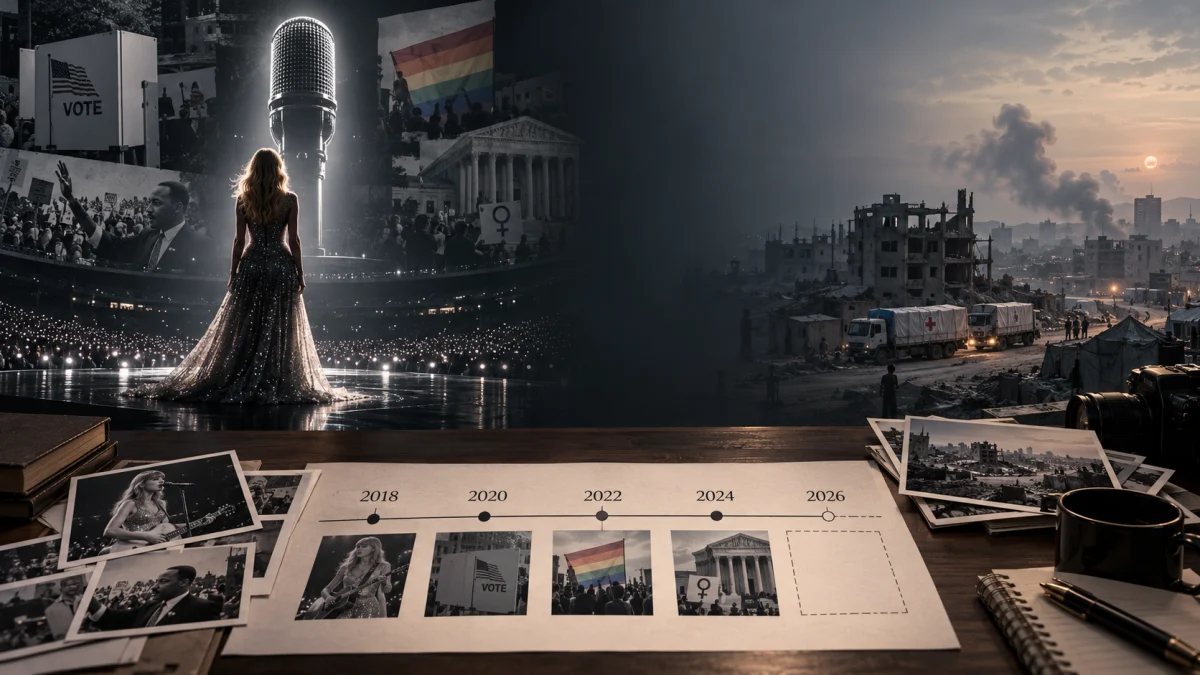
As of September 23, 2026, sherafy.com could not identify a public statement from Taylor Swift addressing Gaza, Palestine, Israel, a ceasefire, or the growing number of institutional findings that Israel committed genocide in Gaza.
There is one important qualification: Swift attended a December 8, 2023 performance by comedian Ramy Youssef in Brooklyn during a run of shows whose proceeds Youssef had pledged to humanitarian relief in Gaza through Anera. Anera itself documented the benefit performances, and contemporary reporting confirmed Swift’s attendance. Anera’s 2023 record of the Gaza benefit
That matters. It is an actual Gaza-related action associated with Swift and should not be erased simply because it complicates criticism of her.
It is also not the same thing as taking a public position.
Swift has not, on the public record we could substantiate, called for a ceasefire, condemned Hamas’s October 7 attack, defended Israel’s military campaign, condemned that campaign, endorsed Palestinian statehood, described the conduct in Gaza as genocide, rejected that description, or otherwise explained where she stands.
That absence has become notable because Taylor Swift is not simply a celebrity who has always insisted that politics are none of her business.
She made overcoming political silence part of her public story.
Why Taylor Swift’s silence is different from simply demanding that every celebrity comment on everything
There is a weak version of the argument against Swift:
She is famous, therefore she owes the public an opinion on Gaza.
That proposition is debatable. Celebrities are private citizens. Fame does not create expertise, and nobody benefits from performers manufacturing opinions about every war, election, disaster or social controversy because the internet demands immediate content.
The stronger criticism begins somewhere else.
Taylor Swift herself publicly rejected political silence when she believed fundamental rights were at stake.
Her transition is one of the central narratives of the 2020 documentary Miss Americana. In a filmed argument over whether she should oppose then-Tennessee Senate candidate Marsha Blackburn, Swift was warned that taking a political position could alienate a substantial part of her audience and create additional security concerns.
Her answer was not that celebrities should stay out of politics.
It was that the issue mattered enough to accept the consequences.
As documented in the Washington Post’s account of the scene, Swift said she regretted remaining silent previously and declared: “I need to be on the right side of history.”
In the documentary’s promotional material, she also described feeling relieved that she was no longer “muzzled,” while acknowledging that her earlier restraint had partly been her own choice.
That history changes the question.
The relevant issue is no longer whether musicians generally have a duty to become political commentators.
It is what happens when an artist who publicly established speaking despite commercial risk as part of her moral development later chooses not to speak about one of the defining human-rights controversies of her generation.
Taylor Swift has repeatedly used her platform on political and human-rights issues
Swift’s political involvement was not limited to one emotional scene in a documentary.
In October 2018, she publicly opposed Blackburn and endorsed Democratic candidates Phil Bredesen and Jim Cooper in Tennessee. In explaining her decision, Swift cited LGBTQ rights, racial discrimination, violence against women and what she described as basic human dignity. Her original Instagram statement was extensively reported at the time. Washington Post coverage of Swift’s 2018 political statement
In 2019, she directly lobbied Sen. Lamar Alexander to support the Equality Act and promoted a petition urging federal protections against discrimination based on sexual orientation and gender identity. The petition ultimately accumulated hundreds of thousands of signatures, and Swift used her MTV Video Music Awards acceptance speech to press the issue publicly. Los Angeles Times explanation of Swift’s Equality Act campaign
In May 2020, during the protests following George Floyd’s killing, Swift directly condemned President Donald Trump’s rhetoric and accused him of having “stoked the fires of white supremacy and racism,” ending her statement by saying voters would remove him in November.
Several months later, Swift explicitly endorsed Joe Biden and Kamala Harris. In an interview published by V Magazine, she tied that endorsement to racial equality, reproductive autonomy, LGBTQ rights and public health. Swift’s 2020 statement to V Magazine
When the Supreme Court overturned Roe v. Wade in June 2022, Swift again spoke immediately, saying she was “absolutely terrified” that decades of work protecting women’s control over their bodies had been reversed.
In September 2023, an Instagram message from Swift encouraging people to register to vote was followed by 35,252 new registrations through Vote.org on National Voter Registration Day. Vote.org reported a 1,226 percent increase in participation during the hour after her post. Vote.org’s registration data following Swift’s post
And most importantly for the Gaza timeline, Swift did not simply stop engaging politically after October 7, 2023.
In September 2024, almost a year into the Gaza war, she publicly endorsed Kamala Harris and Tim Walz, discussing reproductive rights, LGBTQ rights and political leadership while urging followers to research the candidates themselves.
So the record does not support the simple explanation that Swift returned to a universal policy of political silence.
Her public speech remained selective.
Gaza was one of the subjects she did not select.
What has Taylor Swift actually done regarding Gaza?
The December 2023 Ramy Youssef performance is the clearest documented connection.
Youssef had announced that proceeds from the remaining performances of his More Feelings tour would go to Anera, an established humanitarian organization working in Gaza and elsewhere in the region. Swift attended the December 8 show at the Brooklyn Academy of Music alongside Selena Gomez and other celebrities.
It would be unreasonable to pretend this meant nothing.
Buying a ticket to an event whose proceeds were designated for Gaza relief contributed, however indirectly, to an event raising humanitarian funds.
But it would be equally unreasonable to convert attendance into a political position Swift never stated.
There is no evidence that buying that ticket meant Swift endorsed Youssef’s broader political views, accepted the genocide characterization, supported a ceasefire, opposed Israeli policy or intended her attendance as a public act of Palestinian solidarity.
The evidence establishes the attendance.
It does not establish the motive.
That distinction is essential to evaluating almost everything else people have tried to infer about Swift and Israel.
Swift’s fans began asking the same question in 2024
The criticism did not begin with her 2026 wedding.
By May 2024, #SwiftiesForPalestine had become a major fan-organized campaign. TIME reported roughly 105,000 posts under the hashtag during one surge, with fans asking Swift to address Gaza and organizing signs, letters and other actions around the Eras Tour. TIME’s May 2024 coverage of Swifties for Palestine
The movement grew beyond simply demanding a celebrity statement.
A detailed Washington Post report on Swifties for Palestine documented fans raising money for Palestinian medical assistance, distributing Palestine-themed friendship bracelets and organizing independently of Swift. The newspaper reported at the time that Swift had made no statement on the war.
That article also identified the central contradiction years before the current debate resurfaced: fans remembered Swift arguing in Miss Americana that basic human rights could justify political risk, while Gaza appeared to remain outside the political issues she was willing to address.
Swift did not answer them publicly.
The evidence surrounding Gaza became significantly stronger after those early demands
There is another reason the question looks different in 2026 than it did in the first months after October 7.
The legal word genocide should not be thrown around casually. It has a specific definition under the Genocide Convention and requires, among other elements, prohibited acts committed with an intent to destroy a protected group in whole or in part.
But by 2026, the genocide characterization was no longer confined to activists or social-media rhetoric.
In December 2024, Amnesty International published a 296-page investigation concluding that Israel had committed genocide against Palestinians in Gaza. Amnesty said it based that conclusion on patterns of killing, destruction, displacement, deprivation of essential resources and statements by Israeli decision-makers.
In July 2025, two Israeli human-rights organizations reached similar conclusions.
B’Tselem concluded that Israel was taking coordinated action to destroy Palestinian society in Gaza, while Physicians for Human Rights Israel published a separate health-system analysis describing the destruction of conditions necessary for Palestinian life as genocide.
Then, in September 2025, the UN Independent International Commission of Inquiry issued its legal analysis. The independent commission concluded on reasonable grounds that Israeli authorities and security forces had committed four of the five genocidal acts defined by the convention and possessed the required specific intent.
The commission is a UN-mandated independent investigative body; its conclusions are not themselves a final judgment by the International Court of Justice and should not be described as though the UN as a whole judicially decided the question.
Israel has repeatedly rejected the genocide accusation and challenged the commission’s credibility and methodology.
The International Court of Justice, meanwhile, ordered Israel in 2024 to take measures under the Genocide Convention to protect Palestinians in Gaza and later issued additional provisional measures as conditions deteriorated. Those were provisional orders, not a final merits determination that genocide had occurred. International Court of Justice case record: South Africa v. Israel
As of 2026, the case remained unresolved on the ultimate merits.
That distinction matters.
So does the direction of the evidence.
A responsible article does not need to pretend either that the genocide conclusion is an uncontested judicial fact or that nothing significant has changed since early 2024. Multiple major human-rights organizations, including Israeli organizations, and an independent UN-mandated commission have now reached that conclusion after detailed investigations.
Swift has not publicly addressed those findings either.
Does Taylor Swift’s silence mean she supports Israel?
No.
Silence is evidence of silence.
It is not evidence of a hidden political position.
That sounds obvious, but much of the online argument has drifted away from it.
After Swift married Travis Kelce on July 3, 2026, renewed speculation about her position on Israel followed the revelation that Adam Sandler had officiated the wedding. Swift’s representative confirmed Sandler’s role.
Sandler has previously described himself as “very pro-Israel” and signed a 2023 entertainment-industry letter calling for the return of Israeli hostages. That history is relevant to Sandler’s political record.
It does not establish Swift’s.
The wedding discourse quickly produced claims that Swift’s relationships with Sandler, members of HAIM and other Jewish or pro-Israel people revealed what she secretly believes about Gaza.
That reasoning should be rejected.
People are not politically interchangeable with their friends, wedding guests, collaborators or relatives. Jewish identity is not evidence of Zionism. Israeli family connections are not evidence of support for a particular Israeli government or military campaign. Even an explicitly pro-Israel friend does not transfer that position to Swift by proximity.
One especially revealing rumor claimed Swift and Kelce had gone to Israel for their honeymoon. The story appears to have originated with a parody account and had no credible evidentiary basis.
This kind of speculation does something worse than merely produce bad celebrity gossip.
It allows a legitimate question about Swift’s own documented choices to get buried underneath guilt by association.
We do not need it.
The stronger criticism comes from Taylor Swift’s own record
The evidence supports a much narrower and much harder question.
Swift once argued that fear of commercial consequences was not sufficient reason to remain silent when she believed fundamental rights were at stake.
She then demonstrated that principle repeatedly.
She criticized political candidates.
She advocated legislation.
She condemned presidential rhetoric.
She addressed racial injustice.
She spoke about reproductive rights.
She endorsed presidential candidates.
She encouraged millions of people to participate in elections.
And after October 7, she continued making at least some political interventions.
Yet sherafy.com could find no comparable public statement from Swift about Gaza or Palestine.
That does not reveal why.
It does establish what she chose to do.
Could commercial or professional pressure explain the silence?
Possibly.
But there is no direct evidence that it does.
The entertainment business has now provided very public examples of the potential consequences surrounding Palestine-related speech.
In September 2026, Macklemore was removed from the remaining U.S. dates of Ed Sheeran’s tour after pro-Palestinian remarks at MetLife Stadium. The subsequent dispute established that multiple venues had objected to his participation and that Robert Kraft’s Gillette Stadium specifically refused to host him. Associated Press reporting examined how promoters, artists and venue owners exercised different forms of power throughout the controversy. Associated Press examination of the Sheeran-Macklemore venue dispute
sherafy.com has separately reconstructed the evidence in Why Was Macklemore Dropped From Ed Sheeran’s Tour?, including the difference between venue pressure, promoter authority and Sheeran’s own role. We also examined the underlying speech dispute in Why Are People Mad at Macklemore? Palestine Backlash Explained.
That episode demonstrates something real: artists who take highly visible positions on Palestine can encounter organized criticism and commercial consequences.
It does not prove that Swift is silent because she fears those consequences.
There is no public document, statement from Swift, leaked instruction, contract, adviser testimony or other evidence establishing her reasoning.
Fear of backlash is one possible explanation.
Personal political belief is another.
Strategic brand management is another.
Security concerns are another.
A judgment that foreign affairs fall outside the issues she wants to discuss is another.
We do not know.
Inventing a motive would undermine the case that can actually be made.
There is also one meaningful counterargument: Swift’s politics have mostly been domestic
The historical record shows that Swift’s public political interventions have overwhelmingly concerned the United States.
She has focused on American elections, American civil rights, American reproductive law and American politicians.
The Washington Post noted this limitation as early as 2024: speaking about Gaza would have represented a significant expansion into international affairs, an area in which Swift had generally remained quiet, including during Russia’s invasion of Ukraine.
That is relevant context.
It means the evidence does not show that Swift regularly comments on wars abroad but created a special exception for Israel.
But it does not entirely resolve the criticism either.
Swift’s own language did not describe her political awakening merely as an interest in domestic electoral policy. She framed it in terms of humanity, rights and being willing to accept consequences for saying what she believed was morally necessary.
Those are broader principles.
The tension is therefore real even if the comparison is imperfect.
Taylor Swift’s enormous platform is not hypothetical
There is sometimes a tendency to discuss celebrity influence as though it were mystical or impossible to measure.
With Swift, we have unusually concrete examples.
Vote.org reported more than 35,000 new registrations on the 2023 National Voter Registration Day after Swift urged followers to register, along with a dramatic immediate traffic spike.
Her September 2024 presidential endorsement generated millions of Instagram interactions almost immediately and became national political news.
That does not mean a Taylor Swift post could end a war.
It does mean statements from Taylor Swift predictably reach an audience that governments, campaigns, advocacy organizations and media companies spend enormous resources trying to reach.
When critics say her platform matters, that part of the argument is demonstrable.
What remains a moral judgment is what obligation, if any, should follow from possessing that platform.
What the evidence supports, and what it does not
| Claim | What the evidence supports |
|---|---|
| Taylor Swift has publicly supported Israel’s war in Gaza. | Not supported. We found no such public statement. |
| Taylor Swift has publicly supported Palestine or called for a ceasefire. | Not supported. We found no such public statement. |
| Swift attended an event benefiting humanitarian relief in Gaza. | Verified. She attended Ramy Youssef’s December 8, 2023 performance during a run whose proceeds were designated for Anera’s Gaza relief work. |
| Swift’s attendance proves she is privately pro-Palestinian. | Not supported. Attendance establishes attendance, not motive or political ideology. |
| Adam Sandler officiating her wedding proves Swift is pro-Israel or a Zionist. | Not supported. Sandler’s political views belong to Sandler. |
| Swift has historically avoided all political speech. | False. She has repeatedly spoken about elections, LGBTQ rights, racial injustice, abortion and other political issues since 2018. |
| Swift stopped speaking politically once the Gaza war began. | False. She endorsed Harris and Walz in September 2024, among other civic messaging. |
| Swift has publicly explained why she does not discuss Gaza. | We could not find such an explanation. |
| Major institutions have concluded that Israel committed genocide in Gaza. | Verified with qualification. Amnesty International, B’Tselem, Physicians for Human Rights Israel and the UN Independent International Commission of Inquiry reached genocide conclusions. Israel rejects them. The ICJ has not issued a final merits judgment establishing genocide. |
| Swift’s silence tells us what she privately believes. | No. It tells us that she has not publicly used her platform on this issue. |
Silence is not the same thing as endorsement
A recent argument circulating around Swift ends with a stark proposition: when genocide is at issue, someone is either against it or cheering it on.
That captures moral frustration.
It does not work as an evidentiary rule.
A silent person may be frightened, indifferent, conflicted, uninformed, calculating, privately opposed, privately supportive or simply unwilling to make a public statement.
We cannot select one of those possibilities without evidence.
Calling Swift’s silence proof that she is “cheering on” genocide would therefore go beyond what the public record establishes.
But rejecting that overstatement does not require pretending silence is meaningless.
Silence is still a decision about the use of a public platform.
And Taylor Swift is unusually vulnerable to criticism of that decision because she once made the rejection of silence central to her own political evolution.
The harder question is not “Is Taylor Swift a Zionist?”
There is no responsible evidence-based answer establishing that Taylor Swift is a Zionist.
Her Jewish friends do not establish it.
Adam Sandler does not establish it.
HAIM does not establish it.
Robert Kraft does not establish it.
A restaurant, wedding guest or basketball companion does not establish it.
Those theories substitute association for evidence.
The better question is simpler:
Why has a person who publicly decided that human-rights issues sometimes justified risking her commercial position declined to say anything publicly about Gaza?
We do not know the answer.
That uncertainty should remain uncertainty.
But nearly three years after October 7, it is also reasonable to recognize that this is no longer merely an opportunity Swift has not yet gotten around to taking.
It is an established pattern of public non-engagement with this particular issue.
“The right side of history” created a standard Swift now has to live beside
Taylor Swift did not promise the public that she would address every injustice.
She did something more specific.
She told the world that she had once allowed fear, expectations and career management to keep her politically silent, that she regretted doing so, and that when basic rights were implicated she wanted to stop behaving that way.
That standard came from Swift, not from her critics.
It is therefore fair to place two documented realities next to each other.
In 2018 and 2020, Swift argued that some moral questions were important enough to justify public political risk.
From October 2023 through September 2026, she has not publicly applied that principle to Gaza.
There is room to debate how much responsibility any entertainer has to comment on international affairs.
There is much less room to pretend there is no tension between those two parts of Swift’s public record.
And there is no need to speculate about her friends, her private ideology or what somebody at her wedding believes to see it.
Taylor Swift’s silence does not tell us whether she supports Israel.
It does not tell us whether she supports Palestinians.
It does not tell us whether she privately believes genocide is occurring.
It tells us something narrower and verifiable: on an issue that has produced enormous civilian suffering, sustained pressure from her own fans, formal genocide findings from major human-rights organizations and an independent UN-mandated inquiry, one of the world’s most powerful cultural figures has chosen not to tell the public what she thinks.
For an artist who once said she needed to be on the “right side of history,” that silence is itself part of her public record.
References and Further Reading
Taylor Swift’s Political Record
Taylor Swift’s Miss Americana political confrontation — The Washington Post Documents the filmed discussion in which Swift rejected warnings about audience loss and security risk and said she needed to be on the “right side of history.”
Taylor Swift’s 2018 Tennessee political statement — The Washington Post Reproduces and contextualizes Swift’s first major public political endorsement and her statements on LGBTQ rights, racism, violence against women and human dignity.
Taylor Swift’s Equality Act campaign — Los Angeles Times Explains Swift’s petition, her lobbying of Sen. Lamar Alexander and her use of the 2019 VMAs to advocate passage of the Equality Act.
Taylor Swift on Biden, Harris and political priorities — V Magazine Swift’s own 2020 comments connecting her presidential endorsement to racial equality, reproductive autonomy, LGBTQ inclusion and public health.
Taylor Swift’s 2024 Harris-Walz endorsement — The Washington Post Documents Swift’s continued willingness to make electoral endorsements after the Gaza war began.
Vote.org National Voter Registration Day data following Swift’s post Primary-source evidence of the immediate registration and traffic response following Swift’s September 2023 voter-registration message.
Taylor Swift and Gaza
Anera: celebrities attend comedy show raising money for Gaza Anera’s own record of Ramy Youssef’s December 2023 benefit performance, whose attendees included Swift and whose proceeds supported Gaza humanitarian relief.
Swifties Demand Taylor Swift “Speak Now” on Gaza — TIME Documents the May 2024 #SwiftiesForPalestine surge and fan pressure on Swift to address the war.
What Does It Mean to Be a “Swiftie for Palestine”? — The Washington Post A detailed examination of fan organizing, Swift’s political history, her Gaza silence and the distinction between celebrity pressure and independent fan activism.
Genocide Findings and Legal Status
Amnesty International: Israel’s Genocide Against Palestinians in Gaza Amnesty’s December 2024 investigation and legal analysis concluding that Israel committed genocide against Palestinians in Gaza.
B’Tselem: Our Genocide The Israeli human-rights organization’s July 2025 report concluding that Israel was deliberately acting to destroy Palestinian society in Gaza.
Physicians for Human Rights Israel: Genocide in Gaza An Israeli medical-human-rights organization’s analysis of the destruction of Gaza’s health system and conditions necessary for population survival.
UN Independent International Commission of Inquiry: Legal Analysis of Genocide in Gaza The September 2025 independent commission report concluding on reasonable grounds that Israeli authorities and security forces committed genocide.
International Court of Justice: South Africa v. Israel case record The primary judicial record. The ICJ ordered provisional measures under the Genocide Convention but had not issued a final merits determination on genocide as of this article’s publication.
2026 Context and Related sherafy.com Reporting
Taylor Swift and Travis Kelce’s wedding officiated by Adam Sandler — CBS News Confirms through Swift’s representative that Sandler officiated the July 2026 wedding. His participation subsequently prompted unsupported speculation about Swift’s Israel position.
Artists, promoters and venues have their own kind of power on troubled tours like Ed Sheeran’s — Associated Press Examines the institutional and commercial mechanics behind Macklemore’s removal from Sheeran’s tour following his pro-Palestinian remarks.
Why Was Macklemore Dropped From Ed Sheeran’s Tour? — sherafy.com Our evidence-based reconstruction of the venue objections, Robert Kraft’s Gillette Stadium decision, promoter authority, Sheeran’s involvement and the remaining disputed claims.
Why Are People Mad at Macklemore? Palestine Backlash Explained — sherafy.com Separates Macklemore’s actual Palestine-related statements from competing allegations of antisemitism and traces how advocacy pressure became a professional consequence.
Follow the Money, Not the Ethnicity — sherafy.com Explains why criticism of identifiable institutions, donors and political networks becomes less accurate when evidence is replaced by collective assumptions about Jewish identity.
Editorial currency note: This article reflects publicly available statements and reporting reviewed through September 23, 2026. Swift could clarify her position at any time. The South Africa v. Israel genocide case before the International Court of Justice also remains legally significant and should be updated in this article if a merits judgment or other material ruling is issued.