
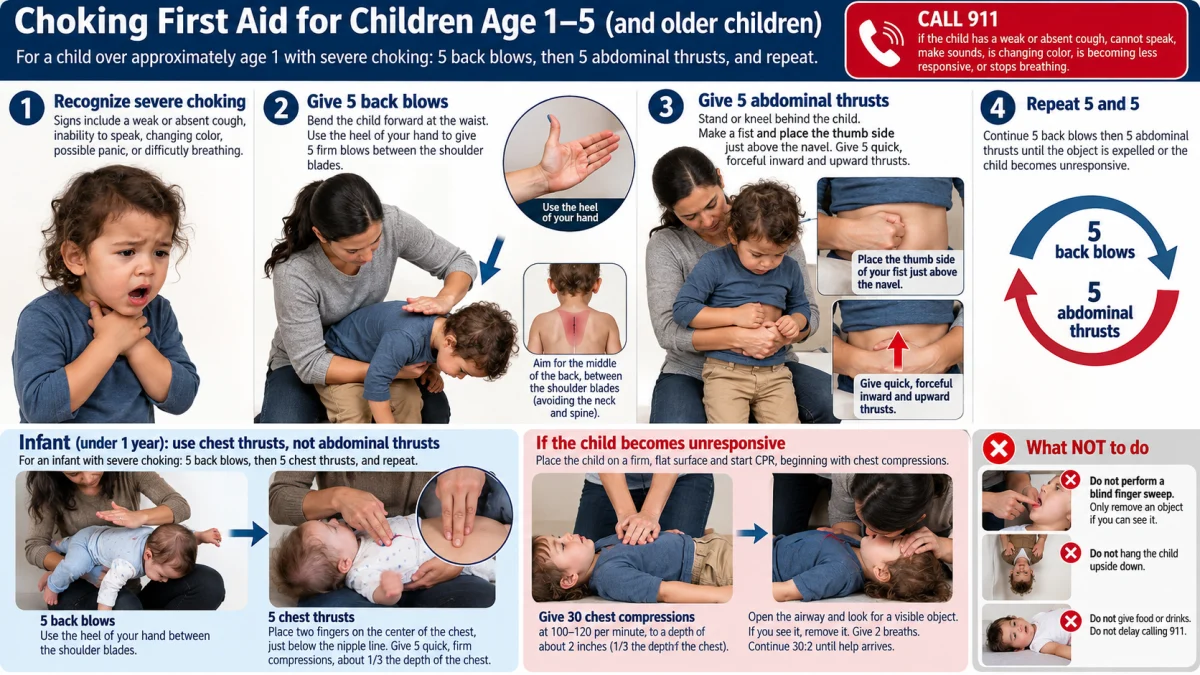
For a child approximately 1 year old or older who is severely choking, current American Heart Association and American Academy of Pediatrics guidance is: activate (call) 911 or the emergency response system, give 5 back blows, then give 5 abdominal thrusts. Keep alternating 5 back blows and 5 abdominal thrusts until the object comes out or the child becomes unresponsive.
If the child becomes unresponsive, start CPR beginning with chest compressions. Do not perform a blind finger sweep. When you open the airway to give breaths during CPR, remove an object only if you can actually see it.
Those instructions come directly from the 2025 American Heart Association and American Academy of Pediatrics Pediatric Basic Life Support guidelines and the official 2025 AHA/AAP Child Foreign-Body Airway Obstruction Algorithm.
A note for medical professionals: If you believe any part of this guide is incorrect, please first confirm that the guidance you are relying on is current. The 2025 AHA/AAP pediatric resuscitation guidelines changed the recommended response for severe choking in children over approximately age 1, including the sequence of 5 back blows followed by 5 abdominal thrusts. Some well-meaning challenges we receive are based on older training or prior guideline versions. We welcome corrections, but please compare this article against the current AHA/AAP guidance, not what was previously taught.
The age distinction matters.
For pediatric basic life support, the AHA/AAP defines:
- an infant as younger than approximately 1 year old;
- a child as approximately age 1 until puberty;
- someone showing signs of puberty is treated under adult basic-life-support guidance.
That means a typical 1-, 2-, 3- or 4-year-old toddler or preschooler follows the child choking protocol, not the infant protocol.
And yes: abdominal thrusts, commonly called the Heimlich maneuver, still apply after approximately age 1.
The important 2025 change is that abdominal thrusts are no longer the first maneuver used by themselves. For severe choking in a child, the current sequence begins with 5 back blows followed by 5 abdominal thrusts.
The Emergency Sequence for a Child Over 1
For a responsive child approximately age 1 or older with severe choking:
1. Activate 911 or the emergency response system.
2. Give 5 back blows.
3. Give 5 abdominal thrusts.
4. Continue alternating 5 back blows and 5 abdominal thrusts until the object is expelled or the child becomes unresponsive.
5. If the child becomes unresponsive, start CPR beginning with chest compressions.
The official AHA child choking algorithm lays out exactly this sequence.
First Determine Whether the Choking Is Mild or Severe
Not every coughing episode calls for back blows or abdominal thrusts.
The first question is whether the child still has enough airflow to cough effectively and make sounds.
Mild airway obstruction: let the child cough
According to the 2025 AHA/AAP Pediatric Basic Life Support guideline, a child with a mild foreign-body airway obstruction should be allowed to try to clear the obstruction by coughing while being watched closely for signs that the blockage is becoming severe.
In practical terms, if the child is coughing effectively and making sounds, encourage the child to keep coughing.
Stay with the child and watch closely.
Do not automatically begin back blows or abdominal thrusts on a child who is still coughing effectively.
Severe airway obstruction: act immediately
The official AHA/AAP algorithm identifies signs of severe foreign-body airway obstruction including:
- a weak or absent cough;
- inability to speak;
- a change in color, including cyanosis;
- altered mental status;
- apnea, meaning the child has stopped breathing.
The American Academy of Pediatrics’ current choking-prevention guidance for parents similarly warns about children who cannot breathe, cannot talk, cry or make noise, are gasping, become bluish, appear panicked or become limp or unconscious.
A toddler who is loudly coughing is therefore in a very different situation from a toddler who suddenly becomes nearly silent.
During an obvious choking episode, inability to cough effectively or make sounds is a medical emergency.
Step 1: Activate 911
If the child develops severe choking, activate emergency medical services promptly.
The AHA/AAP guideline specifically warns that infants and children with severe foreign-body airway obstruction can deteriorate rapidly into cardiac arrest.
If another adult is present, have that person call 911 while you begin treatment.
If you have a phone available, follow the emergency dispatcher’s instructions while beginning appropriate first aid.
Do not spend several minutes attempting improvised remedies before activating emergency help.
Step 2: Give 5 Back Blows
For a responsive child over approximately age 1 with severe choking, current guidelines begin with 5 back blows.
The American Red Cross child choking instructions provide practical positioning:
- Position yourself to the side and slightly behind the child.
- For a small child, kneeling may make positioning easier.
- Support the child’s upper body.
- Bend the child forward at the waist.
- Using the heel of your hand, give 5 firm, separate blows between the shoulder blades.
The Red Cross recommends bending the child far enough forward that the upper body is roughly parallel with the ground.
Each back blow should be a deliberate, separate attempt to dislodge the obstruction.
If the object comes out and the child begins breathing normally, stop the maneuvers.
If the obstruction remains severe, proceed immediately to abdominal thrusts.
Step 3: Give 5 Abdominal Thrusts
Stand or kneel behind the child.
Wrap your arms around the child’s waist.
According to the American Red Cross choking technique:
- Locate the child’s navel.
- Make a fist.
- Place the thumb side of your fist against the abdomen just above the navel.
- Grasp the fist with your other hand.
- Give 5 quick, forceful inward-and-upward thrusts.
These are the abdominal thrusts historically called the Heimlich maneuver.
For a small toddler, kneeling behind the child can make it easier to place your hands correctly.
Step 4: Repeat 5 Back Blows and 5 Abdominal Thrusts
If the obstruction remains:
5 back blows
→ 5 abdominal thrusts
→ 5 back blows
→ 5 abdominal thrusts
Continue until:
- the object is expelled; or
- the child becomes unresponsive.
This is the current sequence specified by both the AAP/AHA guideline and the official AHA choking algorithm.
Yes, the Advice Changed in 2025
Parents who learned choking first aid years ago may remember being taught to use abdominal thrusts alone for a conscious choking child.
They are not necessarily remembering incorrectly.
The American Academy of Pediatrics’ summary of the 2025 guideline changes explicitly states that earlier guidance for children called for abdominal thrusts only.
The current child protocol is:
5 back blows → 5 abdominal thrusts → repeat
Abdominal thrusts were not eliminated.
Instead, the new sequence begins with back blows.
Why Did the Recommendation Change?
There are no high-quality randomized trials establishing one perfect choking maneuver for children. For obvious ethical reasons, researchers cannot deliberately assign choking children to potentially inferior emergency treatments.
The guideline therefore relies heavily on observational evidence and accumulated resuscitation experience.
The 2025 AHA/AAP guideline specifically cites newer observational evidence suggesting improved foreign-body clearance with back blows compared with abdominal thrusts.
One important study was a 2024 population-based cohort study published in Resuscitation. Researchers examined 709 foreign-body airway obstructions requiring intervention and found that back blows were associated with greater odds of relieving the obstruction than abdominal thrusts or chest compressions.
The study can be reviewed through the PubMed record for Dunne and colleagues’ 2024 analysis.
That does not mean abdominal thrusts are ineffective or unnecessary.
The study was observational, involved both adult and pediatric cases and cannot establish the kind of causal certainty a randomized trial could provide.
The guideline committee’s practical conclusion was to begin severe child choking treatment with back blows and then proceed to abdominal thrusts:
5 back blows followed by 5 abdominal thrusts, repeated as necessary.
Never Perform a Blind Finger Sweep
This is one of the clearest recommendations in the entire guideline.
Do not put your finger into a child’s mouth and sweep around looking for the obstruction.
The 2025 AHA/AAP pediatric guideline classifies blind finger sweeps as Class 3: Harm.
In other words, the guideline does not merely say that finger sweeps are unnecessary. It specifically recommends against them.
A blind sweep can potentially move an object farther into the airway or injure the child’s mouth or throat.
The correct rule is:
If you cannot see the object, do not blindly sweep your fingers through the child’s mouth or throat.
During CPR there is an important distinction.
When you open the airway to provide breaths, look into the mouth.
If you can clearly see the foreign object, remove it.
If you cannot see an object:
Do not perform a blind finger sweep.
What If the Child Becomes Unresponsive?
If the child becomes unresponsive, stop performing the standing or kneeling choking maneuvers.
Lower the child onto a firm, flat surface and begin CPR.
The AHA/AAP choking recommendation specifically says rescuers should:
start CPR beginning with chest compressions and not delay CPR to perform a pulse check.
For a single rescuer performing CPR on a child:
- Give 30 chest compressions.
- Compress at a rate of 100 to 120 compressions per minute.
- Compress the chest at least approximately one-third of its front-to-back depth, about 2 inches or 5 centimeters in a child.
- Open the airway.
- Look for a visible foreign object.
- Remove the object if you can see it.
- Give 2 breaths if you are trained and able.
- Resume 30 compressions.
- Continue cycles of 30 compressions and 2 breaths.
These CPR specifications come from the 2025 AHA/AAP Pediatric Basic Life Support guidelines.
Because pediatric cardiac arrest is commonly caused by respiratory failure or asphyxia, the AHA/AAP encourages rescuers to provide breaths in addition to chest compressions when they are able and willing.
If the rescuer cannot provide breaths, performing chest compressions is still preferable to doing nothing.
Use an AED as Soon as One Is Available
If the child is unresponsive and requires CPR, use an automated external defibrillator as soon as one becomes available.
Current AHA/AAP guidance recommends a pediatric attenuator and pediatric pads for infants and children under age 8 when available.
Do not delay CPR while waiting for an AED.
Follow the device’s spoken instructions when it arrives.
Do Not Keep Sweeping the Mouth During CPR
The choking version of CPR includes one important additional step:
look in the mouth before attempting breaths.
If an object is clearly visible, remove it.
If nothing is visible, continue CPR.
Do not repeatedly put your fingers into the child’s mouth and sweep around looking for the obstruction.
The AHA/AAP guideline separately recommends removing a visible object and recommends against blind finger sweeps.
Those are not contradictory instructions.
They mean:
Visible object: remove it.
No visible object: do not go fishing for it.
Children Under 1 Follow a Different Choking Protocol
This is the age distinction that causes much of the confusion.
Under the current AHA/AAP pediatric basic-life-support definitions:
- Infant: younger than approximately 1 year
- Child: approximately age 1 until puberty
For an infant younger than approximately 1 year with severe choking:
5 back blows → 5 chest thrusts → repeat
Do not perform abdominal thrusts on an infant.
The 2025 AHA/AAP guideline specifically says abdominal thrusts are not recommended for infants because of the potential for injury to abdominal organs.
Once the child is approximately 1 year old, however, the child protocol uses abdominal thrusts.
| Situation | Current AHA/AAP response |
|---|---|
| Under ~1 year, mild obstruction | Allow coughing and observe closely |
| Under ~1 year, severe obstruction | 5 back blows + 5 chest thrusts |
| Age ~1 to puberty, mild obstruction | Allow coughing and observe closely |
| Age ~1 to puberty, severe obstruction | 5 back blows + 5 abdominal thrusts |
| Child becomes unresponsive | Start CPR beginning with compressions |
| Visible object during CPR | Remove it |
| Object cannot be seen | Do not perform a blind finger sweep |
What About Anti-Choking Suction Devices?
Commercial airway-clearance suction devices are increasingly marketed to parents as choking rescue devices.
The current AHA/AAP guideline does not establish them as a replacement for standard choking first aid.
The 2025 pediatric BLS guideline states that the effectiveness and safety of suction-based airway-clearance devices have not been established in infants and children and that there is insufficient evidence to make a recommendation for their use.
The guideline committee found that the available pediatric evidence included voluntary reports from an industry-sponsored registry, creating substantial potential for bias, incomplete reporting and confounding.
It also found no evidence establishing that these devices are superior to standard techniques such as back blows or abdominal thrusts.
The practical takeaway is important:
Do not allow an anti-choking device to delay 911, back blows, abdominal thrusts or CPR.
Do Not Hang a Choking Child Upside Down
Another improvised response occasionally circulated online is holding or hanging a choking child upside down.
Do not do this.
The American Red Cross choking guidance specifically warns against hanging a child upside down by the feet in an attempt to dislodge an object.
Use the established choking sequence instead.
What If the Object Comes Out?
If the child had a severe airway obstruction, emergency services should already have been activated.
If the object is expelled, the official AHA/AAP child choking algorithm says to continue monitoring the child until advanced care arrives.
That matters because apparent improvement does not always prove that every airway problem has resolved.
Continue watching the child’s:
- breathing;
- color;
- alertness;
- ability to speak or cry;
- coughing;
- wheezing or other abnormal breathing sounds.
Follow the instructions of the emergency dispatcher and responding medical professionals.
Choking Is Not the Same as Gagging
Young children can cough, gag or sputter while learning to eat.
Those events can look frightening, but they are not automatically the same as a severe airway obstruction.
The decisive issue is airflow.
A child who is coughing effectively and making sounds is moving air.
A child with severe choking may develop a weak or absent cough and become unable to speak, cry or make sounds.
That distinction is why the AHA/AAP guideline tells rescuers to allow a child with mild obstruction to continue coughing while closely observing for deterioration.
Why Toddlers Are at Particular Risk
Young children are especially susceptible to choking because of their small airways, immature chewing skills and tendency to put food and objects into their mouths.
The American Academy of Pediatrics notes in its current parent guidance on choking prevention that most children who die from choking are under age 5, with infants at particularly high risk.
Common hazards identified by the AAP include:
- hot dogs;
- whole grapes;
- nuts and seeds;
- hard, sticky or gummy candy;
- chewing gum;
- popcorn;
- chunks of raw fruit or vegetables;
- thick chunks of nut butter;
- marshmallows;
- meat sticks and sausages;
- chunks of meat or cheese;
- balloons;
- coins;
- marbles;
- small balls;
- small toy parts.
How to Reduce a Toddler’s Choking Risk
The CDC’s current choking-prevention guidance recommends preparing foods in a shape, size and texture appropriate to the child’s development.
It also recommends:
- having children sit upright while eating;
- not allowing them to eat while lying down, crawling or walking;
- avoiding eating in a moving car or stroller;
- keeping meals calm and unhurried;
- minimizing distractions;
- watching young children throughout meals and snacks.
Round, firm foods deserve particular attention.
Whole grapes, cherry tomatoes, hot dogs and similar foods can closely match the shape of a young child’s airway. They should be appropriately cut or modified before being served.
The CDC also identifies nuts, chunks of nut butter, popcorn, hard candy, gummy candy, chewing gum, marshmallows, raw hard fruit or vegetables and large chunks of meat or cheese as potential choking hazards for young children.
The Five Rules Worth Memorizing
If you remember nothing else from this guide, remember these:
1. If the child is coughing effectively and making sounds, encourage the child to cough and watch closely.
2. If the child has a weak or absent cough, cannot speak or make sounds, changes color, becomes less responsive or stops breathing, activate 911.
3. For a responsive child approximately age 1 or older with severe choking: give 5 back blows, then 5 abdominal thrusts, and repeat.
4. If the child becomes unresponsive: start CPR beginning with chest compressions. Look for a visible object before giving breaths.
5. Never perform a blind finger sweep.
The Bottom Line
The idea that the Heimlich maneuver somehow stops applying once a baby becomes a toddler has the age distinction backwards.
Abdominal thrusts are specifically part of the current choking protocol beginning at approximately age 1.
What changed in 2025 is the sequence.
For a severely choking child approximately age 1 until puberty:
5 back blows → 5 abdominal thrusts → repeat
For a severely choking infant under approximately age 1:
5 back blows → 5 chest thrusts → repeat
For either age group:
If the obstruction is mild and the child is coughing effectively, allow the child to cough while watching closely.
If the child becomes unresponsive, start CPR.
Remove a foreign object only when it is visible. Never perform a blind finger sweep.
These instructions reflect the current AHA/AAP pediatric resuscitation guidance, not an improvised choking technique or an outdated internet summary.
References and Further Reading
Primary AHA/AAP Guidelines
Part 6: Pediatric Basic Life Support — 2025 American Heart Association and American Academy of Pediatrics Guidelines
The primary joint AHA/AAP pediatric basic-life-support guideline. It establishes the current recommendations for mild and severe choking, back blows, abdominal and chest thrusts, CPR, blind finger sweeps and suction-based airway-clearance devices.
American Heart Association: Part 6, Pediatric Basic Life Support
The AHA’s official web version of the pediatric BLS guideline, including the supporting evidence and figures demonstrating infant and child choking techniques.
AHA/AAP Child Foreign-Body Airway Obstruction Algorithm
The official 2025 child choking flowchart. It shows the severe-obstruction warning signs, emergency activation, 5-back-blow/5-abdominal-thrust sequence and transition to CPR if the child becomes unresponsive.
American Heart Association: 2025 CPR and ECC Algorithm Library
Official AHA repository containing the current pediatric BLS, infant choking and child choking algorithms.
American Academy of Pediatrics Parent Guidance
Choking Prevention for Babies & Children: What Every Parent Needs to Know — HealthyChildren.org
Current AAP parent guidance, updated in February 2026, covering choking warning signs, common hazards, food preparation, supervision and prevention.
AHA, AAP Update CPR Guidelines to Help Save Young Lives — HealthyChildren.org
AAP’s explanation of the 2025 guideline changes, including the change from abdominal thrusts alone to alternating 5 back blows with 5 abdominal thrusts for children with severe choking.
Practical First-Aid Technique
Adult & Child Choking: Symptoms and First Aid — American Red Cross
Provides practical instructions for positioning a child, performing back blows and abdominal thrusts, recognizing severe choking and responding when the child becomes unresponsive.
Choking Prevention
Choking Hazards — Centers for Disease Control and Prevention
Current federal guidance on food preparation, supervision, eating position and common choking hazards for infants and young children.
Evidence Behind the Guideline
Evaluation of Basic Life Support Interventions for Foreign Body Airway Obstructions: A Population-Based Cohort Study — Resuscitation, 2024
Dunne and colleagues’ observational analysis of 709 foreign-body airway obstructions requiring intervention. This study contributed to the evidence considered in the updated recommendation to begin severe child choking treatment with back blows.
Removal of Foreign Body Airway Obstruction: A Systematic Review of Interventions — Resuscitation, 2020
Systematic review prepared with the International Liaison Committee on Resuscitation Basic and Paediatric Life Support Task Force. It summarizes the available evidence for back blows, abdominal thrusts, chest thrusts and related airway-clearance interventions.
Editorial currency note: This guide reflects the 2025 American Heart Association/American Academy of Pediatrics CPR and Emergency Cardiovascular Care guidelines and official sources reviewed through September 27, 2026. Resuscitation recommendations can change as new evidence is evaluated. Parents, grandparents, childcare providers and other regular caregivers should strongly consider hands-on pediatric CPR and first-aid training through the American Heart Association or American Red Cross. Written guidance is valuable for reference but cannot reproduce hands-on practice.