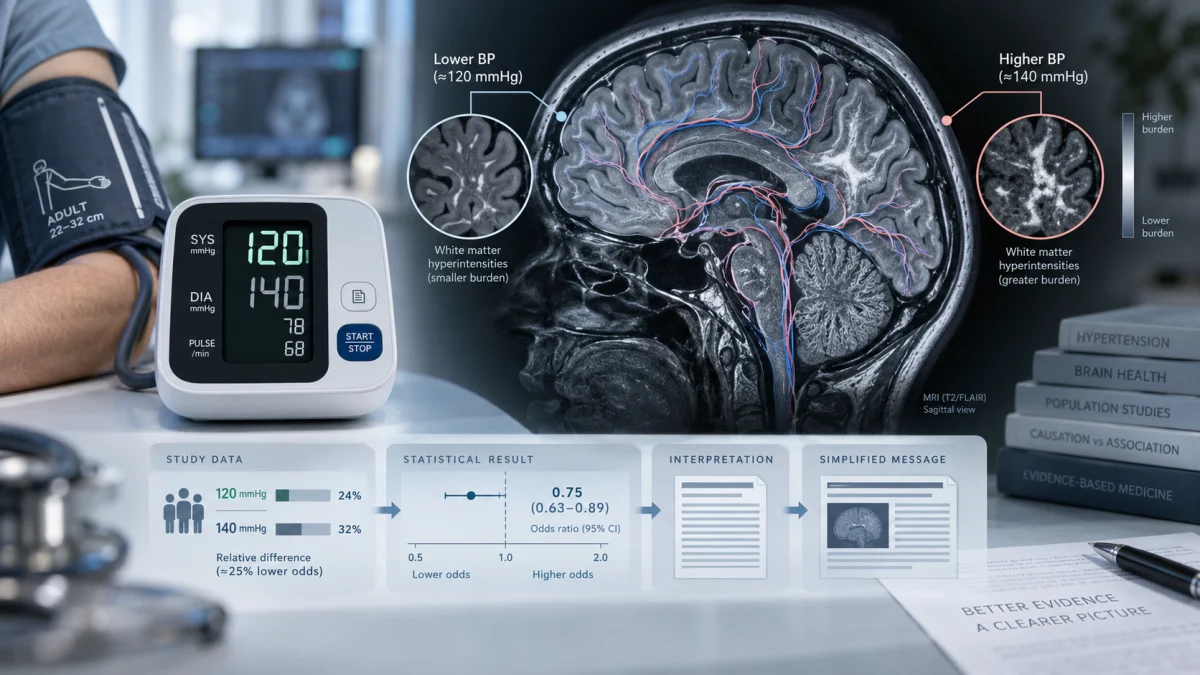
Lowering high blood pressure appears to protect the brain, but a new SPRINT analysis did not show that getting systolic blood pressure below 120 mmHg cuts “brain aging” by nearly 40%.
In the actual randomized comparison, participants assigned to an intensive systolic blood-pressure target below 120 had 16.9% less progression of a composite MRI measure of cerebral small-vessel disease than those assigned to a target below 140, expressed relative to the study’s mean baseline small-vessel-disease burden. The standardized effect size was Cohen’s d = −0.395, or about −0.40. A Cohen’s d of 0.40 is not the same thing as a 40% reduction.
The much larger 39.4% figure is also real, but it came from a different analysis. Researchers grouped participants according to how much their blood pressure actually changed after randomization. People whose systolic pressure fell by at least 20 mmHg had 39.4% less progression of the MRI composite than participants whose pressure increased. Because those groups were formed after randomization rather than randomly assigned, that particular comparison is observational, not a randomized estimate of what targeting below 120 causes.
And the study did not measure dementia incidence or a biological “brain age.” It measured changes in three MRI markers combined into an experimental measure of overall cerebral small-vessel-disease burden. The original 2026 eClinicalMedicine study on PubMed
That distinction matters. But it should not be twisted into the opposite claim that blood-pressure treatment has no effect on dementia. Other randomized evidence now supports blood-pressure control as a dementia-prevention strategy, and the current U.S. hypertension guideline recommends a systolic goal below 130 mmHg in adults with hypertension specifically to help prevent mild cognitive impairment and dementia.
The numbers that explain the entire story
| Number | What it actually represents | What it does not mean |
|---|---|---|
| 16.9% | Less progression of the composite MRI small-vessel-disease score in the randomized intensive-target group versus the standard-target group, relative to mean baseline SVD burden | 16.9% fewer dementia cases |
| Cohen’s d = −0.395 | Standardized effect size for the randomized treatment comparison | A 39.5% or 40% reduction |
| 39.4% | Less SVD progression among participants whose achieved SBP fell ≥20 mmHg compared with participants whose SBP increased | The randomized effect of targeting <120 rather than <140 |
| HR 0.86 | Extended SPRINT MIND estimate for probable dementia under intensive treatment; its confidence interval crossed 1 | Proof that SPRINT reduced dementia by 14% |
| RR 0.85 | Dementia result in a separate 2025 randomized hypertension trial targeting <130/80 | A result from this 2026 MRI study |
| <130 mmHg | Current U.S. SBP recommendation in adults with hypertension for prevention of MCI and dementia | Proof that 130 is a biological cliff edge |
The confusion becomes much easier to see once these statistics are kept separate.
Why is the study being described as a “nearly 40%” reduction?
The immediate source of the current media cycle is a September 16 UT San Antonio news release.
It says researchers found that managing systolic pressure at a 120 mmHg target rather than a 140 mmHg target “can reduce the progression of cerebral small vessel disease by nearly 40%.” Later in the same release, it lists a separate set of results:
- 0–10 mmHg SBP decrease: 21.2% less SVD progression
- 10–20 mmHg decrease: 26.3% less
- more than 20 mmHg decrease: 39.4% less
Read the UT San Antonio release
The problem is that the published paper does not calculate the randomized <120-vs-<140 comparison as a nearly 40% reduction.
For that comparison, the paper reports:
- β = −0.066
- 16.9% less progression relative to mean baseline SVD burden
- 95% CI: 6.9% to 26.9%
- Cohen’s d = −0.395
The university release does not explain why it describes the randomized target comparison as “nearly 40%.”
One possibility is that the wording drew from the 39.4% achieved-BP result. Another numerical coincidence is that the randomized standardized effect size was d ≈ −0.40. But there is no evidence establishing which, if either, produced the wording, so it would be speculation to claim an exact source for the discrepancy.
What can be established is simpler:
The “nearly 40%” characterization of the randomized 120-vs-140 target comparison does not match the percentage reported for that comparison in the paper. The paper reports 16.9%.
The simplified framing has already escaped the institutional press release. Current news coverage has repeated the idea that participants assigned to the lower target experienced roughly 40% slower progression.
What did the researchers actually study?
The new paper is a post-hoc analysis of the Systolic Blood Pressure Intervention Trial, or SPRINT, a major randomized trial comparing two strategies for treating hypertension.
SPRINT enrolled adults 50 and older with elevated cardiovascular risk. Participants were assigned to either:
- an intensive systolic BP target of <120 mmHg, or
- a standard target of <140 mmHg.
The parent trial included 9,361 people. It found that the intensive strategy reduced major cardiovascular events and all-cause mortality, although some adverse events were more frequent. Read the final SPRINT trial report in the New England Journal of Medicine
The new brain study analyzed the MRI substudy. Of 1,267 people screened for that substudy, 663 had qualifying baseline data for the new small-vessel-disease measure, and 442 had complete baseline and follow-up data after a median of 3.9 years. Participants had a mean baseline age of about 68.
That makes this more substantial than a small observational imaging study. But the outcome being analyzed in 2026 was created after the original trial was designed, which matters when judging the result.
What is cerebral small-vessel disease?
Cerebral small-vessel disease, or SVD, refers to injury involving the brain’s small arteries, arterioles, capillaries and related tissue.
It is strongly relevant to brain health because small-vessel disease contributes to stroke, cognitive impairment and dementia. It can accumulate without obvious symptoms and often appears on MRI before a patient has a major clinical event.
The new SPRINT analysis attempted to capture this process more broadly by combining three MRI markers instead of examining only one.
Periventricular white-matter hyperintensities
These are abnormal bright areas seen on certain MRI sequences near the brain’s ventricles.
They are common with aging but can also reflect accumulated small-vessel and white-matter injury.
White-matter free water
This MRI-derived measurement estimates the proportion of the diffusion signal associated with relatively unrestricted extracellular water.
Researchers use it as one indicator of changes in white-matter tissue and its microenvironment.
Basal-ganglia perivascular spaces
These are MRI-visible spaces surrounding small blood vessels in the brain.
Changes in their size or number can accompany cerebral small-vessel pathology, although they are not themselves a direct dementia measurement.
The researchers combined these three indicators into a latent global SVD factor, intended to capture the vascular injury they share.
That is scientifically interesting. But it also means there is no simple clinical translation such as “16.9% less SVD means 16.9% less dementia.”
What did the randomized comparison actually show?
Among the 442 participants with complete longitudinal data, the intensive group had a more favorable change in the global SVD measure than the standard group.
The treatment difference was β = −0.066, which the researchers translated into 16.9% less progression relative to the mean baseline SVD burden. The standardized difference was Cohen’s d = −0.395. Sensitivity analyses adjusting for age, sex, race and intracranial volume, as well as an analysis using all 663 participants with baseline data, produced similar findings.
This is the strongest causal evidence in the new paper because it retains SPRINT’s randomized treatment assignment.
The actual average systolic pressures also show why “getting below 120” is an oversimplification. In the longitudinal MRI sample, mean SBP went from 136.2 to 120.2 mmHg in the intensive group and from 138.8 to 135.6 mmHg in the standard group.
SPRINT therefore tested a treatment strategy targeting below 120, not a magic threshold where 119 is protective and 121 is harmful.
So what does the 39.4% result mean?
This was a second analysis.
Instead of comparing participants according to their randomized treatment assignment, researchers grouped them according to the blood-pressure change they actually achieved after randomization.
Compared with 118 participants whose systolic pressure increased, people whose pressure fell:
- 0–10 mmHg had 21.2% less progression relative to baseline SVD burden;
- 10–20 mmHg had 26.3% less;
- ≥20 mmHg had 39.4% less.
The trend was statistically significant.
This dose-response pattern is important. It supports the biological argument that greater reductions in elevated blood pressure may produce greater vascular-brain benefit.
But these achieved-pressure groups were not randomized groups.
Once participants are sorted according to what happened after randomization, characteristics associated with achieving a large pressure reduction can differ from characteristics associated with an increase or a smaller decrease. Randomization no longer guarantees that the comparison groups are otherwise equivalent.
That is why the precise 39.4% estimate should be treated as an association, not as proof that lowering an individual’s systolic pressure by 20 points will causally reduce SVD progression by 39.4%.
The paper’s mediation analysis provides additional evidence that changes in systolic pressure help explain the effect of intensive treatment on SVD. That strengthens the blood-pressure mechanism. It still does not turn the 39.4% post-randomization estimate into the randomized treatment effect.
A Cohen’s d of −0.40 does not mean “40% less disease”
This deserves emphasis because effect sizes are routinely mangled in health coverage.
Cohen’s d expresses the difference between groups in standard-deviation units. A d around 0.40 means the treatment groups differed by roughly four-tenths of a standard deviation on the modeled outcome.
It is not a percentage.
Fortunately, the researchers separately calculated a percentage-like interpretation for the randomized comparison: 16.9% less progression relative to mean baseline SVD burden.
That is the percentage that belongs with the randomized <120-vs-<140 comparison.
Did intensive blood-pressure treatment reverse the brain damage?
Not broadly. The study showed slower overall progression, not wholesale reversal.
Both treatment groups experienced increases in periventricular white-matter hyperintensity volume and white-matter free water over follow-up.
Basal-ganglia perivascular-space counts decreased significantly in the intensive group while showing no significant change in the standard group.
When the three markers were combined, overall SVD burden progressed more favorably in the intensive-treatment group.
So “slowed progression of cerebral small-vessel disease” is supported.
“Reversed brain aging” is not.
Did the study actually measure “brain aging”?
No, not in the literal sense suggested by that phrase.
Researchers did not calculate a biological brain-age score, estimate how many “years younger” participants’ brains became, or measure a global aging process.
They measured a composite of MRI abnormalities related to cerebral small-vessel disease.
Principal investigator Mohamad Habes used “brain aging” language when discussing the findings publicly, saying that prevention and slowing brain aging are important and that the study supports that goal.
That is a reasonable description of the broader research objective. It is not the study’s measured endpoint.
The distinction is important because small-vessel disease is one contributor to unhealthy brain aging, not a synonym for the entire aging process.
Did the study show a 40% reduction in dementia?
No. Dementia incidence was not an outcome in this 2026 analysis.
That does not mean blood-pressure treatment is irrelevant to dementia. The broader evidence is considerably more interesting.
What SPRINT MIND found
SPRINT’s dedicated cognition study compared the same intensive and standard treatment strategies.
In its original randomized analysis:
- probable dementia: HR 0.83, 95% CI 0.67–1.04;
- mild cognitive impairment: HR 0.81, 95% CI 0.69–0.95;
- MCI or probable dementia combined: HR 0.85, 95% CI 0.74–0.97.
The dementia result alone was not statistically significant because its confidence interval crossed 1. The MCI and combined endpoints were significant. Read the original SPRINT MIND randomized trial in JAMA
With extended follow-up, probable dementia still favored intensive treatment numerically but remained nonsignificant at HR 0.86, 95% CI 0.72–1.02. The combined MCI-or-dementia outcome remained significantly lower, HR 0.89. Read the extended SPRINT MIND follow-up in Neurology
The correct conclusion is therefore not that SPRINT “proved” a reduction in dementia itself. It did not. It found stronger randomized evidence for reducing mild cognitive impairment and the combined cognitive outcome.
But randomized evidence now does show that treating hypertension can reduce dementia
This is where a simple debunk would become misleading in the opposite direction.
In 2025, researchers published a much larger cluster-randomized trial involving 33,995 adults with uncontrolled hypertension in rural China.
The intervention used trained community health workers and physicians to intensify treatment toward <130/80 mmHg. After 48 months, the intervention group had a net 22.0-mmHg greater reduction in systolic pressure than usual care.
All-cause dementia was significantly lower:
RR 0.85, 95% CI 0.76–0.95.
That corresponds to roughly a 15% relative reduction in dementia risk. Serious adverse events were also slightly less frequent in the intervention group. Read the 2025 Nature Medicine randomized dementia trial
That trial was conducted in a different population under a different treatment program. Its 15% result cannot simply be substituted for SPRINT.
But it establishes an important point:
The fact that the new SPRINT MRI analysis did not measure dementia does not mean lowering blood pressure cannot prevent dementia. Randomized evidence now indicates that better hypertension control can reduce dementia risk.
What do current guidelines recommend for protecting the brain?
The 2025 ACC/AHA multisociety hypertension guideline makes the distinction clearer than the viral headline does.
For adults with hypertension, it gives a Class 1 recommendation for a systolic blood-pressure goal below 130 mmHg to prevent mild cognitive impairment and dementia. See the guideline recommendation on mild cognitive impairment and dementia
More broadly, for adults with confirmed hypertension who are at increased cardiovascular risk, the guideline recommends an SBP goal of at least <130 mmHg and encourages <120 mmHg when feasible. It also says treatment goals may need to be individualized when intensive treatment is difficult to tolerate or causes adverse effects. Read the full 2025 ACC/AHA blood-pressure guideline
The guideline also stresses that target achievement should be based on multiple readings, not one isolated blood-pressure measurement.
So the practical takeaway is not:
“Everyone needs a systolic pressure of 119 or lower.”
It is:
Hypertension should be controlled aggressively enough to reach evidence-based targets, with <130 supported broadly and <120 reasonable or encouraged for appropriate patients when it can be achieved safely.
Is 120 better than 140 for brain health?
For people resembling the SPRINT population, there is now substantial evidence favoring the more intensive strategy.
A previous 2019 SPRINT MRI study found that white-matter lesion volume increased by 0.92 cm³ in the intensive group versus 1.45 cm³ in the standard group over approximately four years. Read the 2019 SPRINT MRI study in JAMA
The 2026 study therefore did not discover from scratch that intensive BP treatment affects the brain.
Its main advance was to combine several manifestations of cerebral small-vessel injury into a single SVD construct and show that this broader measure also progressed more slowly under intensive treatment.
Add the SPRINT MIND cognitive results, SPRINT’s cardiovascular benefit, and the later dementia trial, and the overall evidence increasingly supports preventing prolonged exposure to uncontrolled hypertension.
What it does not establish is that 120 is a universal biological threshold.
Should everyone with hypertension try to get below 120?
Not as a blanket rule.
SPRINT enrolled a selected population: adults at elevated cardiovascular risk who were 50 or older.
It excluded people with diabetes, previous stroke and dementia, as well as nursing-home residents. Other protocol exclusions included severe kidney disease and certain forms of heart failure or orthostatic hypotension.
Those exclusions do not mean intensive BP treatment is inappropriate in every excluded group. They mean this particular SPRINT estimate cannot simply be transplanted into those populations.
Intensive treatment also involved tradeoffs. In the final SPRINT report, serious adverse events involving hypotension, electrolyte abnormalities, acute kidney injury or kidney failure, and syncope were more frequent in the intensive-treatment arm, even though major cardiovascular events and mortality were lower.
A target that works well in a clinical trial still has to be interpreted in the context of medication tolerance, kidney function, symptoms, other illnesses and the way blood pressure is measured.
People should not increase or reduce antihypertensive medication simply to chase a number from a news headline.
Is a systolic pressure of 110 too low?
The new study cannot establish a universal lower danger threshold.
SPRINT compared treatment strategies targeting <120 and <140. It did not randomize participants to 110 versus 120, nor did it test the theory that progressively lower pressure is always better.
The original trial also excluded people whose standing systolic pressure was below 110 mmHg during screening, which further limits what SPRINT can tell us about treating patients who already run that low.
Whether a particular pressure is too low depends partly on symptoms and clinical context, not merely on whether the number is below 120.
Does the result apply to people with diabetes?
Not directly. SPRINT excluded diabetes.
There is, however, separate evidence relevant to people with type 2 diabetes.
A secondary analysis of ACCORD MIND found less progression of white-matter hyperintensity volume among participants randomized to intensive rather than standard blood-pressure control: approximately 0.67 cm³ versus 1.16 cm³ over 40 months. Read the ACCORD MIND MRI analysis in Neurology
That supports the broader idea that blood-pressure control can influence vascular brain injury in diabetes.
It does not justify applying SPRINT’s 16.9% or 39.4% figures to people with diabetes.
What about people who have already had a stroke?
Again, SPRINT excluded people with a previous stroke.
That means the new MRI percentages should not be presented as estimates for stroke survivors.
The current hypertension guideline separately recommends BP management for people with previous stroke, but acute stroke is its own clinical situation and can involve very different blood-pressure decisions. For example, the same 2025 guideline specifically warns that aggressive lowering immediately after certain successfully reperfused ischemic strokes can worsen outcomes.
“Lower is better” is therefore not a rule that can be applied without context.
Which blood-pressure medication protects the brain best?
This study cannot answer that question.
SPRINT tested blood-pressure treatment targets, not one antihypertensive drug class against another for prevention of SVD.
Its treatment protocol allowed multiple major antihypertensive classes, with medication selection adjusted to clinical circumstances.
The 2026 analysis therefore supports the importance of controlling blood pressure, but it does not establish that an ACE inhibitor, ARB, calcium-channel blocker, diuretic or another class is uniquely responsible for the observed brain effect.
That would require a different randomized comparison.
How strong is the new study?
The result deserves to be taken seriously, but its strengths and limitations need to be kept in the same frame.
| Strengths | Limitations |
|---|---|
| Built on randomized SPRINT treatment assignment | The new global SVD outcome was post-hoc, not a prespecified SPRINT endpoint |
| Longitudinal brain MRI over a median 3.9 years | Only 442 participants had complete longitudinal data for all indicators |
| Combines three complementary MRI measures | MRI completion was lower than intended, partly because SPRINT ended early |
| Main randomized result remained similar in adjusted and missing-data sensitivity analyses | The composite is not a familiar clinical endpoint like stroke or dementia |
| Dose-response pattern is biologically coherent | Achieved-BP groups were formed after randomization and are observational |
| Mediation analysis supports BP change as a mechanism | No validated conversion tells us what a given change in the latent SVD score means for an individual patient’s cognition |
| Consistent with earlier SPRINT MRI evidence | Important groups such as people with diabetes or previous stroke were excluded |
| NIH-funded research built on a major randomized trial | The study cannot identify which antihypertensive medication is best |
The 2026 analysis was funded by several National Institutes of Health components, including the National Heart, Lung, and Blood Institute, National Institute on Aging, National Institute of Neurological Disorders and Stroke, and National Institute of Diabetes and Digestive and Kidney Diseases.
The key methodological distinction remains:
The randomized comparison provides evidence that the intensive treatment strategy reduced progression of the MRI SVD measure.
The precise 39.4% achieved-BP estimate is an observational association within the trial.
Those statements are compatible. Treating them as interchangeable is the problem.
The bottom line
The evidence does support a real brain-health benefit from controlling high blood pressure.
What it does not support is the simplified claim that:
“Getting systolic blood pressure below 120 cuts brain aging by almost 40%.”
The new SPRINT analysis found that assignment to the intensive <120 treatment strategy was associated with 16.9% less progression of a composite MRI measure of cerebral small-vessel disease than assignment to <140.
The 39.4% number came from a separate analysis of participants whose achieved systolic pressure fell by at least 20 mmHg compared with participants whose pressure increased. That comparison was based on what happened after randomization and should not be treated as the randomized effect of a <120 target.
And neither figure represents a measured 40% reduction in biological brain aging or dementia.
At the same time, the broader evidence should not be lost in correcting the headline. SPRINT found benefits for vascular brain injury and mild cognitive impairment, a separate large randomized trial found fewer dementia diagnoses with intensive hypertension treatment, and current U.S. guidelines explicitly recommend good blood-pressure control to help prevent cognitive impairment and dementia.
The useful conclusion is stronger, and less dramatic, than the viral version: chronic high blood pressure is bad for the brain, treating it matters, and the evidence favors intensive control in appropriate patients. But 120 is not a magic threshold, and “40% less brain aging” is not what this study proved.
References and Further Reading
Primary study and SPRINT evidence
Charisis et al., “Intensive versus standard blood pressure control and overall brain small vessel disease burden,” eClinicalMedicine (2026)
The primary study behind the current claim. Reports the randomized treatment effect, MRI composite, study population and achieved-BP dose-response analysis.
SPRINT Research Group, “Final Report of a Trial of Intensive versus Standard Blood-Pressure Control,” New England Journal of Medicine (2021)
Final report of the parent randomized trial, including cardiovascular benefits, achieved blood pressures, participant exclusions and adverse events.
SPRINT MIND Investigators, “Association of Intensive vs Standard Blood Pressure Control With Cerebral White Matter Lesions,” JAMA (2019)
Earlier randomized MRI evidence showing less progression of white-matter lesion volume under intensive BP treatment.
SPRINT MIND Investigators, “Effect of Intensive vs Standard Blood Pressure Control on Probable Dementia,” JAMA (2019)
Primary randomized cognitive analysis. Probable dementia alone was not significantly reduced, while MCI and the combined MCI/dementia outcome favored intensive treatment.
“Long-Term Effect of Intensive vs Standard Blood Pressure Control on Mild Cognitive Impairment and Probable Dementia in SPRINT,” Neurology
Extended cognitive follow-up showing a continued significant benefit for the combined MCI/dementia outcome but not a statistically significant dementia result alone.
Dementia prevention and current clinical guidance
He et al., “Blood pressure reduction and all-cause dementia in people with uncontrolled hypertension,” Nature Medicine (2025)
Large cluster-randomized trial of 33,995 adults showing significantly fewer all-cause dementia cases under an intensive hypertension-management program targeting <130/80.
2025 ACC/AHA Multisociety Guideline for High Blood Pressure in Adults
Current U.S. recommendations on treatment targets, including encouragement of SBP <120 where feasible for appropriate higher-risk patients.
2025 ACC/AHA recommendation for prevention of mild cognitive impairment and dementia
Specifically recommends an SBP goal below 130 mmHg in adults with hypertension to prevent MCI and dementia.
Relevant evidence in diabetes
de Havenon et al., “Blood pressure, glycemic control, and white matter hyperintensity progression in type 2 diabetics,” Neurology (2019)
ACCORD MIND analysis showing less white-matter hyperintensity progression with intensive BP treatment in participants with type 2 diabetes, a population excluded from SPRINT.
Current publicity and claim provenance
UT San Antonio, “Study finds lowering blood pressure benefits brain health,” September 16, 2026
The institutional release currently driving wider attention. It describes the 120-vs-140 target comparison as reducing SVD progression by nearly 40%, while separately listing the 39.4% result for participants whose achieved SBP fell more than 20 mmHg.
Editorial currency note: Blood-pressure treatment recommendations can change as new randomized evidence is incorporated into clinical guidelines. Guideline information in this article reflects the 2025 ACC/AHA multisociety hypertension guideline available as of September 2026.