You do not need to eliminate all sugar while taking antibiotics based on this study alone. The best-supported conclusion is narrower: sugar-rich intake may amplify the collateral disruption that some broad-spectrum antibiotics cause to the gut microbiome, but no randomized human trial has shown that cutting sugar improves infection cure rates, symptoms, microbiome recovery, C. difficile risk or survival.
The evidence is still unusually interesting.
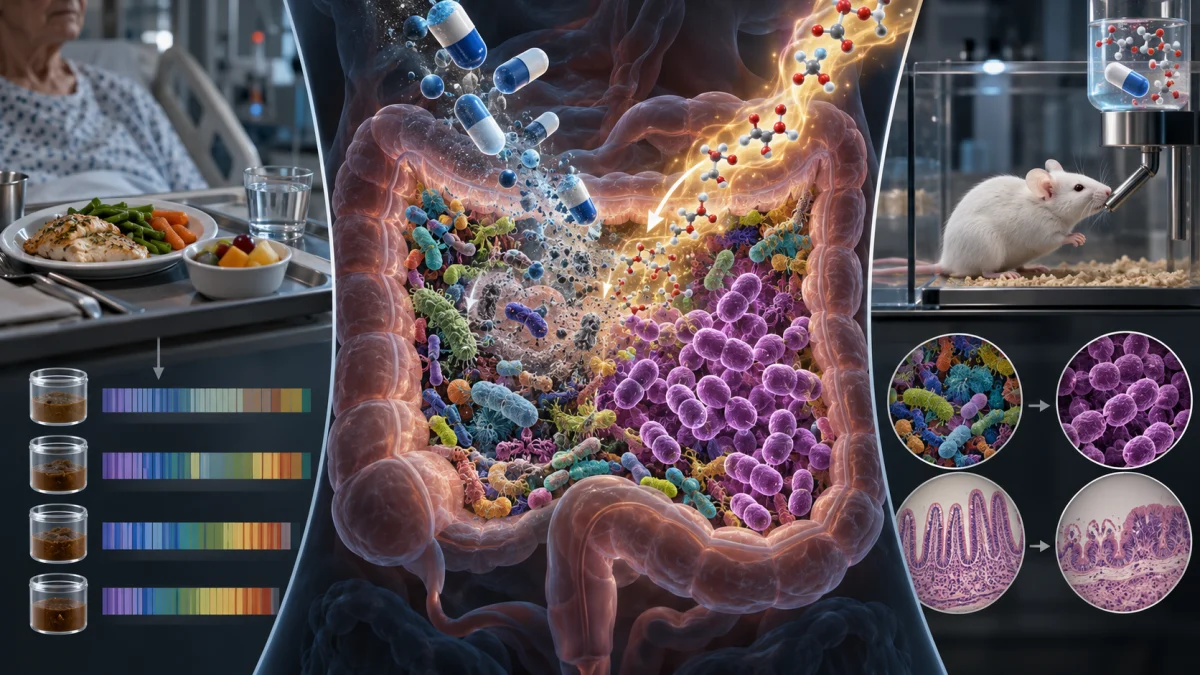
A peer-reviewed Nature study published September 30, 2026 tracked dietary intake from 9,419 meals in 173 adults hospitalized for allogeneic hematopoietic-cell transplantation. Researchers analyzed 1,009 stool samples from 158 of those patients. During exposure to broad-spectrum antibiotics, greater intake of foods classified as sugars, sweets and beverages was associated with lower microbial alpha-diversity and greater expansion of Enterococcus. The team then tested the hypothesis experimentally: sucrose made the antibiotic-triggered Enterococcus bloom substantially larger and longer-lasting in mice.
That combination makes the finding more persuasive than an ordinary nutrition correlation. The human cohort had repeated dietary, medication and microbiome measurements; the association survived several sensitivity analyses; and the mouse experiments showed that adding sugar can causally intensify antibiotic-induced microbiome disruption under the experimental conditions tested.
But several popular interpretations go beyond the evidence.
The study did not show that sugar makes an antibiotic stop treating the infection for which it was prescribed. It did not test whether otherwise healthy people recover faster from routine outpatient infections when they avoid sugar. It did not show that whole fruit is harmful during antibiotic treatment. And it did not prove that sugar caused deaths among transplant recipients.
Most importantly, the widely repeated claim that “100 grams of sugar caused a 24% additional loss of microbiome diversity” is not technically what the study’s primary food-group model measured.
What the study found — and what it did not
| Claim | Evidence verdict | What the evidence actually shows |
|---|---|---|
| Sugar can worsen antibiotic-related microbiome disruption | Supported under some conditions | Sugar-rich food intake predicted lower diversity during broad-spectrum antibiotic exposure in transplant patients, and sucrose worsened antibiotic-triggered Enterococcus expansion experimentally in mice. |
| 100 g of sugar caused a 24.1% diversity decrease | Misleading as stated | The 24.1% estimate was per 100 g of dehydrated food weight in the study’s “sugars, sweets and beverages” category. A separate nutrient model estimated a 20.6% additional mean diversity decrease per 100 g of dietary sugar. |
| Sugar makes antibiotics less effective at treating an infection | Not shown | The study measured gut microbial ecology, not antibiotic blood levels, infection cure rates or treatment failure. |
| Everyone taking antibiotics should stop eating sugar | Not established | The human participants were hospitalized stem-cell transplant recipients undergoing intensive cancer treatment. |
| Added sugar was more important than naturally occurring sugar | Suggested, not settled | Higher-resolution models pointed more toward added sugar, but added and total sugar intake were highly correlated, making clean separation difficult. |
| Fruit should be avoided during antibiotics | Not established | A commercial fruit smoothie augmented the effect in antibiotic-treated mice, but that does not demonstrate harm from whole fruit in humans. |
| High sugar plus antibiotics caused higher mortality | Not established | Longer broad-spectrum-antibiotic exposure was associated with mortality in a higher-sugar subgroup, but the analysis was observational and related dietary patterns also reflected much lower overall food intake. |
| Cutting sugar while taking antibiotics improves clinical outcomes | Unknown | No randomized human trial has yet tested that intervention. |
The study therefore identifies a real biological signal with a plausible practical implication, but not a universal clinical rule.
The human study was unusually detailed, but it was still observational
The researchers did not rely on a one-time food questionnaire.
According to the study methods, each hospital meal arrived with a printout asking patients to record whether they had consumed 0%, 25%, 50%, 75% or 100% of each ordered item. Those records were linked to recipes, item weights and nutrient data and were reviewed for quality control.
The cohort consisted of adults hospitalized at Memorial Sloan Kettering Cancer Center for allogeneic hematopoietic-cell transplantation between 2017 and 2022. The final matched analysis included 1,009 stool samples from 158 patients, with a median of five samples per patient and a range of one to 28.
The researchers modeled what patients had eaten during the two days preceding each stool sample alongside broad-spectrum-antibiotic exposure, transplant-conditioning intensity, tube or intravenous nutrition, differences between patients and where each patient was in the transplant timeline.
That is much stronger than comparing one recalled diet survey with one stool sample.
It is still not randomization.
These patients were undergoing chemotherapy and other intensive treatment. Many experienced mucositis, nausea, poor appetite, infection, nutritional support and changing illness severity. Broad-spectrum antibiotics were started because of clinical events such as fever or suspected infection rather than randomly assigned. The authors also note that records of food consumed from outside the hospital were incomplete and that short-term symptoms could alter food preferences.
The statistical adjustments and sensitivity analyses reduce several obvious alternative explanations. They cannot eliminate every time-varying confounder.
These were not typical people taking five days of a routine antibiotic
This qualification is central to interpreting the results.
All 173 participants received at least one antibiotic during dietary data collection. Patients were typically given prophylactic fluoroquinolones and intravenous vancomycin, and 138 of 173 patients, or 80%, were switched to broader-spectrum antibiotics after fever or other signs of possible infection.
The study’s broad-spectrum category included drugs such as piperacillin-tazobactam, cefepime, linezolid, carbapenems, metronidazole and oral vancomycin.
That means the key comparison was not simply “antibiotics versus no antibiotics.” It largely examined whether diet modified the microbiome effects associated with escalation to broad-spectrum therapy in a highly medically stressed population.
The study cannot tell us with confidence:
- whether dessert has the same effect during a short course of amoxicillin for strep throat;
- whether the effect is similar with doxycycline, azithromycin or nitrofurantoin;
- whether reducing sugar improves recovery in otherwise healthy outpatients; or
- what amount of sugar, if any, should be considered a clinically meaningful threshold.
Those are reasonable next questions. They were not answered here.
The “24% per 100 grams of sugar” statistic needs a correction
This is the clearest place where simplified coverage can mislead.
The primary food-group model found that, during broad-spectrum-antibiotic exposure, each additional 100 grams of intake from the “sugars, sweets and beverages” category was associated with an additional 24.1% predicted decrease in mean microbiome alpha-diversity, with a 95% credible interval corresponding to a 7.7% to 38.1% decrease.
A Memorial Sloan Kettering explainer summarized this as a 24% diversity drop for every 100-gram increase in sugar and compared the amount with roughly two cans of soda.
That is understandable shorthand, but it is not the unit used in the paper’s primary food-group model.
The researchers explicitly removed water from food weights before that analysis. In the Nature methods, they state that when they refer to a 100-gram increase in “sweets,” they mean 100 grams of dehydrated weight of foods within the sweets category.
So the technically accurate description of the 24.1% result is:
During broad-spectrum-antibiotic exposure, each 100-gram increase in dehydrated intake from the study’s sugars/sweets/beverages food category was associated with an additional 24.1% predicted decrease in mean microbial alpha-diversity.
That is not the same as consuming 100 grams of table sugar.
The paper separately analyzed actual dietary sugar
The researchers also re-encoded the meals by macronutrient composition instead of broad food groups.
In that model, sugar intake again interacted with broad-spectrum-antibiotic exposure. The estimated effect was an additional 20.6% decrease in mean microbial alpha-diversity per 100 grams of dietary sugar, with a 95% credible interval corresponding to a 2% to 35.6% decrease.
The 24.1% and 20.6% analyses therefore point in the same direction, but they measure different exposures.
They should not be merged into one statistic.
Why the sugar-antibiotic interaction is more convincing than “sugar is bad for the microbiome”
Another useful feature of the study is that the strongest signal was the interaction between sugar-rich intake and broad-spectrum antibiotics.
In the main model, intake from the sweets category by itself was not associated with lower microbial diversity. The additional decline appeared when sweets intake was combined with broad-spectrum-antibiotic exposure.
The unadjusted data showed the same basic pattern: sweets intake and alpha-diversity were inversely correlated in samples collected after broad-spectrum-antibiotic exposure, while the relationship was not apparent in samples without that broad-spectrum exposure.
That does not mean the second group was antibiotic-free. All patients received at least one antibiotic during dietary collection. It means they had not received one of the study-defined broad-spectrum antibiotics during the relevant two-day window.
The researchers also reran the analysis while accounting for cancer type, comorbidities and intensive analgesic use; excluding samples exposed to enteral or parenteral nutrition; excluding samples collected during treatment of documented bloodstream infection or C. difficile diarrhea; and restricting analysis to an earlier transplant period before severe mucositis usually develops. The interaction persisted.
The association also appeared when foods were classified using a different dietary nomenclature and in repeated subsampling analyses.
Those checks do not make the human analysis causal. They do make several simple confounding explanations less persuasive.
The added-sugar signal is interesting, but less definitive than it first appears
The authors report that higher-resolution models pointed particularly toward formulated nutritional beverages, including sports drinks and nutritional shakes, and toward added rather than other sugars.
That is worth following up.
It should not yet be translated into “added sugar is proven to be the problem while natural sugar is safe.”
The study’s Extended Data show that added-sugar intake and total-sugar intake were highly correlated (r = 0.88). When two exposures move together that strongly, separating their independent effects becomes difficult.
A more defensible conclusion is:
The human data suggest that added sugars and sugar-rich formulated beverages may be important contributors, but the study cannot cleanly establish that naturally occurring sugars are irrelevant.
Then the researchers tested the hypothesis in mice
The animal work is what moves this beyond an observational human association.
Researchers gave mice a single dose of the carbapenem antibiotic biapenem. That caused a temporary expansion of intestinal enterococci.
Adding sucrose made the bloom much larger.
Compared with antibiotic-treated mice that did not receive supplemental sucrose, enterococcal abundance was 16.3 times higher on day three and 33.4 times higher on day six in the main experiment. Sucrose by itself did not significantly increase enterococci in mice that had not received the antibiotic.
The researchers tested several alternative explanations. The sucrose effect persisted on a fiber-free diet, making reduced fiber intake an insufficient explanation. Short-term food consumption and body weight did not explain the result either.
Sucrose also failed to reproduce the same expansion when Enterococcus faecalis was placed alone in germ-free mice. That suggests sugar was not simply acting as direct fuel for Enterococcus in isolation; the effect appeared to depend on a more complex microbial ecosystem disturbed by antibiotics.
The precise mechanism remains unresolved. The authors propose several possibilities, including effects on opportunistic organisms, the competing microbes that normally provide colonization resistance or the intestinal host environment itself.
The mouse studies establish an important causal point:
Under the experimental conditions tested, supplemental sugar can intensify an antibiotic-induced disruption of the gut microbial community.
They do not establish the equivalent human dose, the effect of every antibiotic or the clinical benefit of sugar restriction in people.
What about fruit?
The animal experiments complicate any claim that only refined table sugar could matter biologically.
The researchers found that glucose and fructose could augment the antibiotic-associated enterococcal bloom in mice under some tested conditions. A commercial fruit smoothie also increased the bloom in antibiotic-treated mice in one experiment.
That is worth reporting.
It is not evidence that people taking antibiotics should avoid whole fruit.
A concentrated smoothie given under an experimental mouse protocol is not interchangeable with eating an apple, berries or another whole fruit. Whole fruits differ in food structure, fiber, dose, eating pattern and accompanying nutrients. No human arm of this study randomized people to whole fruit versus no fruit.
The evidence supports studying different sources of dietary sugar more carefully. It does not justify a blanket warning against fruit.
Why Enterococcus and microbial diversity matter here
The study was not simply counting how many bacterial species were present.
The organism that expanded most prominently as diversity deteriorated in the human cohort was Enterococcus faecium. In transplant medicine, Enterococcus is important because it can dominate a heavily disrupted intestinal ecosystem and is associated with difficult hospital-acquired infections and adverse transplant outcomes.
But “more microbiome diversity” should not be treated as a universal wellness score. Scientists still do not have one composition that defines a healthy microbiome for every person.
The transplant setting is different because there is substantial prior evidence linking severe microbiome disruption to prognosis. A 2020 multicenter study in the New England Journal of Medicine analyzed 8,767 stool samples from 1,362 allogeneic transplant recipients at four centers in the United States, Germany and Japan. Higher intestinal microbiota diversity around engraftment was associated with lower mortality in independent cohorts.
That older study was observational too. It does not prove that artificially raising diversity will save lives.
It explains why a dietary exposure that appears to push transplant patients toward a low-diversity, Enterococcus-dominated state deserves attention.
Does sugar make antibiotics stop working?
This study provides no evidence that dietary sugar makes the prescribed antibiotic ineffective against the infection being treated.
The researchers did not test whether sugar:
- lowers antibiotic concentrations in blood or tissues;
- prevents the drug from killing the target infection;
- increases routine treatment failure;
- forces the infection-causing organism to become resistant; or
- means a patient needs a larger antibiotic dose.
The paper is about collateral ecological effects on the gut microbiome, not the antibiotic’s therapeutic effectiveness against the target infection.
An antibiotic can successfully treat an infection while also disrupting non-target organisms in the intestine. This study asks whether diet can intensify that collateral disruption.
Patients should therefore not change the dose, timing or duration of a prescribed antibiotic because of this research. The CDC continues to advise taking antibiotics exactly as prescribed.
The mortality finding is real, but it is not proof that sugar caused deaths
The paper also reports a potentially alarming survival analysis.
Among patients with above-median calorie-adjusted sugar intake, each additional day of broad-spectrum-antibiotic exposure was associated with a mortality hazard ratio of 1.12 (95% confidence interval 1.01 to 1.23; P = 0.027) in a model adjusted for conditioning intensity, graft source and graft-versus-host-disease prophylaxis.
The equivalent association in the below-median sugar group was not statistically significant.
That should not be translated into “sugar plus antibiotics increased a patient’s chance of dying by 12% per day.”
A hazard ratio is not an absolute probability of death, and the modeled exposure was the duration of broad-spectrum-antibiotic use within dietary subgroups. Sugar was not randomly assigned.
The mortality analysis was also landmarked at transplant day 12, and the paper notes that the Figure 3 Wald tests were not adjusted for multiple comparisons.
A separate dietary-pattern analysis adds another major caution. The cluster characterized by relatively more sugar was also consuming 914 fewer calories per day overall and had a 10.5% greater proportion of calories from sugar than the comparison cluster.
Those are separate analyses, but they point to the same interpretive problem: in severely ill transplant recipients, a sugar-heavy dietary pattern can also be a low-total-intake pattern, and poor intake itself can reflect serious illness.
The authors explicitly acknowledge that the mortality association could partly stem from lower food intake.
The mortality result is therefore a signal worth investigating, not evidence that consuming sugar while taking antibiotics has been shown to cause death.
Could illness severity explain the human finding?
It remains one of the main competing explanations.
Doctors did not randomly decide which patients would receive broad-spectrum antibiotics. They escalated treatment when patients developed fever, suspected infection or other clinical concerns. Sicker patients can receive more antibiotics, eat differently and experience more severe microbiome disruption at the same time.
The study made a serious attempt to address this. The sugar-antibiotic interaction remained after several clinical adjustments and subset analyses, including analyses excluding samples collected while confirmed infections were being treated.
That makes a simple explanation such as “the sickest patients just happened to drink more sweet beverages” less satisfying.
But no statistical model can fully recreate randomization when important exposures and symptoms are changing together over time.
The strongest interpretation is therefore:
The human association is robust enough to take seriously, and the controlled mouse experiments give it causal plausibility. The magnitude and clinical importance of the effect in ordinary antibiotic users remain unknown.
So should you avoid sugar while taking antibiotics?
For most otherwise healthy people, this study does not establish a requirement to eliminate sugar.
It provides a reasonable biological argument for limiting heavily sugar-sweetened foods and drinks if doing so does not interfere with adequate nutrition. But that should be understood as a low-cost, plausible choice, not a clinically proven way to make antibiotics work better or to prevent complications.
The study gives no evidence-based sugar cutoff and no basis for eliminating all carbohydrates, fruit or other nutritionally useful foods.
The calculation changes for people undergoing cancer treatment, losing weight, experiencing severe nausea or mucositis, or relying on prescribed oral nutritional supplements. The population studied here illustrates the problem: these patients can have very high nutritional needs while struggling to consume enough calories.
For them, indiscriminately removing an accessible calorie source could create another risk. Dietary changes should be coordinated with the treating team.
What about probiotics?
This study did not test whether probiotics prevent the sugar-antibiotic interaction.
It also did not compare sugar restriction with probiotics, fermented foods, fiber supplementation or any other microbiome intervention.
A finding that one dietary exposure may aggravate microbiome disruption does not establish that a supplement or another food can reverse it.
The cleanest next experiment is simpler: randomly assign antibiotic-treated patients to nutritionally adequate diets that differ meaningfully in simple-sugar exposure while keeping other major nutritional variables as comparable as practical, then measure microbiome recovery and clinically meaningful outcomes.
Funding, conflicts and transparency
The Nature paper reports support from multiple National Institutes of Health institutes, cancer-center grants and philanthropic programs and foundations.
It also contains substantial competing-interest disclosures. Senior authors Jonathan Peled, Jonas Schluter and Marcel van den Brink report various microbiome-related intellectual-property interests, biotechnology-company relationships, consulting, equity, research support or advisory roles. Memorial Sloan Kettering reports financial interests involving Seres Therapeutics.
Those disclosures do not invalidate the results. They are relevant context in a field where microbiome findings may eventually support commercial diagnostics or therapies.
The study also has an unusually strong transparency advantage. The researchers released de-identified dietary, medication, microbiome and clinical data on Zenodo, while the analysis and figure-reproduction code is publicly available on GitHub.
That public material makes the paper more inspectable than research for which the underlying analytic inputs are unavailable. It also independently confirms the distinction between macronutrient sugar measured in grams and dehydrated food-group weights used in the separate sweets-category model.
What evidence would change the conclusion?
The missing evidence is a prospective human intervention trial.
The most informative design would randomize people receiving defined antibiotic regimens to nutritionally adequate diets that differ substantially in added simple sugars while keeping calories, protein, fiber and other major variables reasonably comparable.
Researchers could then measure:
- microbial alpha-diversity and community composition;
- Enterococcus and other opportunistic organisms;
- recovery after antibiotics stop;
- gastrointestinal symptoms;
- C. difficile infection;
- colonization with antibiotic-resistant organisms; and
- clinically meaningful outcomes where sample size and setting make those outcomes practical.
Replication outside allogeneic stem-cell transplantation is especially important.
If randomized trials in ordinary antibiotic users found that temporary reduction of added sugar preserved microbiome diversity, reduced pathobiont expansion or improved clinical outcomes, the evidence would move from biologically plausible to actionable clinical guidance.
If those trials failed to reproduce the effect, the current result would look more specific to the unusually disrupted transplant microbiome.
That is the evidentiary bridge still missing.
Bottom line
The new evidence supports a meaningful but limited conclusion:
Sugar-rich intake can amplify antibiotic-induced disruption of the gut microbiome under at least some conditions.
The human signal comes from an unusually detailed longitudinal dataset and survives several sensitivity analyses. The mouse experiments then show that sucrose can causally intensify antibiotic-triggered Enterococcus expansion in that experimental system.
But the evidence does not show that every person taking every antibiotic should eliminate sugar.
The human participants were hospitalized stem-cell transplant recipients undergoing intensive cancer treatment. Most were escalated to broad-spectrum antibiotics. The human diet analysis remained observational, and no randomized human trial has shown that reducing sugar during antibiotic treatment improves microbiome recovery or clinical outcomes.
And the most repeated number needs to be stated correctly: the study did not simply find a 24% diversity decline for every 100 grams of sugar. The 24.1% estimate came from a model using 100 grams of dehydrated food weight from the broader sugars/sweets/beverages category. A separate macronutrient model based specifically on dietary sugar estimated a 20.6% additional mean diversity decrease per 100 grams.
For now, reducing heavily sugar-sweetened foods and drinks while taking antibiotics is a biologically plausible choice for people who can do so without compromising nutrition.
Calling complete sugar avoidance a proven medical requirement would outrun the evidence.
References and Further Reading
Primary Research and Data
Dai et al. — “Sugar-rich foods exacerbate antibiotic-induced microbiome disruption,” Nature (2026). The peer-reviewed study underlying the findings. It contains the human diet-microbiome analysis, the 24.1% food-group estimate, the separate 20.6% macronutrient-sugar estimate, sensitivity analyses, mortality models, mouse experiments, methods, funding and competing-interest disclosures.
Supplementary Data for “Sugar-rich foods exacerbate antibiotic-induced microbiome disruption” — Zenodo. Public archive containing de-identified dietary, medication, microbiome and clinical-analysis data used by the researchers.
Nutrition_microbiome_reproducibility — Anqi Dai et al., GitHub. Public analysis repository with released data tables and scripts for reproducing the paper’s figures and models.
Independent Scientific Context
Du and Chan — “Sugar amplifies antibiotic disruption of gut microbes,” Nature News & Views (2026). Independent scholarly commentary on the significance of the diet-antibiotic interaction and the questions raised by the study.
Peled et al. — “Microbiota as Predictor of Mortality in Allogeneic Hematopoietic-Cell Transplantation,” New England Journal of Medicine (2020). Multicenter study of 1,362 transplant recipients showing that higher intestinal microbiota diversity around engraftment was associated with lower mortality.
Researcher Explanation and Patient Guidance
Memorial Sloan Kettering — “Study Suggests Sugar Can Worsen Common Intestinal Side Effect of Antibiotics”. Researcher-side explanation of the new paper, including senior author Jonathan Peled’s caution that the evidence is not yet sufficient to tell everyone taking antibiotics to avoid sugar.
CDC — “Healthy Habits: Antibiotic Do’s and Don’ts”. Current patient guidance emphasizing that prescribed antibiotics should be taken exactly as directed.
Editorial currency note: This article reflects the evidence available on October 1, 2026, one day after publication of the final peer-reviewed Nature paper. A preprint version of the research circulated earlier, but no randomized human trial identified in this audit has established that sugar restriction during antibiotic therapy improves microbiome recovery or clinical outcomes. This conclusion should be revisited if prospective intervention trials become available.