No, a new study does not show that TikTok makes teenagers eat more.
What it found is narrower—and still interesting.
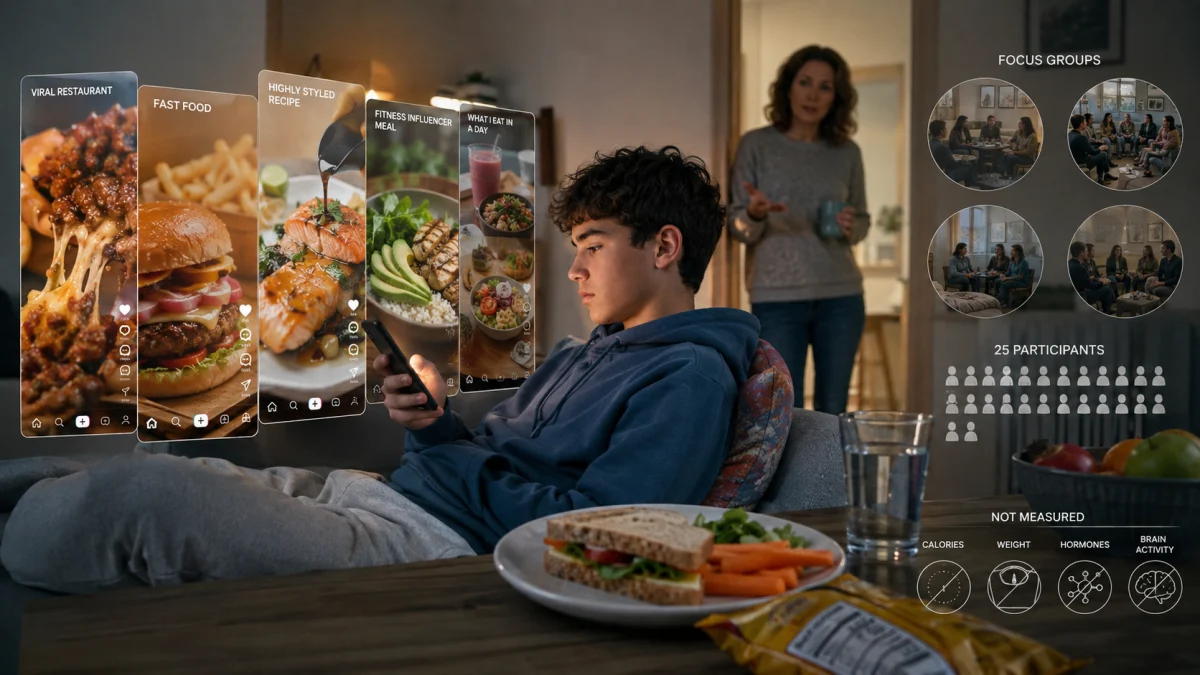
Researchers held four focus groups with 25 students ages 15 and 16 at one Midwestern high school. During those discussions, teenagers described TikTok recipes, restaurant videos, advertisements, viral foods, influencers and “what I eat in a day” content as things that could make them feel hungry, crave a food or want to try it.
But the researchers did not measure how much food any teenager actually ate. They did not track calories, meals, weight changes or food purchases. They did not randomly expose teenagers to TikTok videos. They did not compare heavy TikTok users with nonusers. They did not measure hormones or brain activity. And they did not experimentally test whether TikTok’s recommendation algorithm changed anyone’s diet.
The authors themselves conclude that future quantitative research is needed to determine how this exposure affects adolescents’ actual dietary intake.
That distinction matters as headlines based on the study begin spreading.
On August 21, HealthDay syndicated the story under the headline “TikTok Shaping Teens’ Appetites, Diet,” opening with the claim that TikTok is “shaping teenagers’ appetites.” The article does eventually explain that there were only 25 participants and acknowledges that more research is needed to connect TikTok exposure to actual dietary choices.
The headline is therefore not invented out of thin air. But it turns an exploratory finding about what a small group of teenagers said they experienced into language that sounds much closer to a measured biological or behavioral effect.
Those are not the same thing.
What Did the TikTok Teen Eating Study Actually Do?
The study, “‘I wanna try it so bad’: How TikTok Influences Adolescent Eating and the Role of Parents,” was electronically published July 3, 2026, in the Journal of Nutrition Education and Behavior and appears in its August 2026 issue.
This was a qualitative study, not a clinical trial or population survey.
Researchers conducted four semi-structured focus groups containing five, six, seven and seven participants respectively. Discussions lasted between 32 and 53 minutes.
The 25 participants had an average age of about 15.2. Most were girls, and the group was racially and ethnically diverse. Researchers then coded the discussion transcripts and used thematic analysis to identify recurring patterns in what the teenagers described.
Two broad themes emerged.
First, teenagers described food-related TikTok content as sometimes cueing appetite or a desire to try food.
Second, they generally described parents as having little involvement in their routine TikTok use, while also recalling situations where parents pulled them away from the platform or helped them critically evaluate diet, body and influencer claims.
The journal’s own conclusion is appropriately cautious: adolescents reported that TikTok food content may influence their eating, and researchers said quantitative studies are still needed to measure actual dietary effects.
The Number 25 Matters—But Not for the Reason You Might Think
A study involving 25 people sounds startlingly small if you assume researchers were trying to calculate how TikTok affects the average teenager.
They weren’t.
Qualitative research uses interviews and focus groups to discover experiences, perceptions, language and possible mechanisms. A relatively small sample is not automatically evidence of poor research when that is the goal.
The problem arises when a qualitative study is interpreted like a quantitative one.
These researchers can reasonably say:
Teenagers in these focus groups described TikTok food content as influencing their appetites and food interests.
They cannot use this design to tell us:
- what percentage of teenagers experience the effect;
- how large the effect is;
- whether teenagers consume more calories because of it;
- whether TikTok users eat differently from otherwise similar nonusers;
- whether TikTok is more influential than Instagram, YouTube, television or ordinary food advertising;
- whether the effects persist over weeks or years;
- or whether TikTok causes overeating or obesity.
There is another subtle point: this was not a poll in which 25 out of 25 teenagers answered “yes” when asked whether TikTok made them hungry.
Twenty-five teenagers participated in group discussions. Researchers identified themes recurring within those conversations.
Reducing the result to “25 teenagers said TikTok makes them hungry” actually overstates the study slightly too.
What the Teenagers Said TikTok Was Doing
The discussions themselves provide a useful picture of the modern online food environment.
Participants described seeing:
- viral recipes and food trends;
- restaurant reviews;
- fast food;
- advertisements;
- influencer promotions;
- fitness and diet content;
- visually elaborate food presentations;
- and “what I eat in a day” videos.
Presentation mattered. So did comments from other users and recommendations from creators the teenagers considered credible.
Some participants were skeptical of overt sponsorships, recognizing that creators could be financially motivated. But familiarity with an influencer could apparently make recommendations more persuasive.
One especially interesting theme involved influencers whose bodies teenagers admired.
Some participants described looking at what muscular or attractive creators ate and then attempting to imitate their diets. Others described repeated exposure to fast food content as potentially changing their perception of how normal or unhealthy those foods seemed.
These observations are valuable.
They identify several hypotheses worth testing: repeated exposure, social proof, visual presentation, parasocial trust, advertising and body aspiration could all influence food decisions.
But a hypothesis becoming plausible is not the same as an effect being measured.
What the Study Did Not Measure
| Claim | Did this study establish it? |
|---|---|
| TikTok food videos can make some teens say they want food | Yes |
| Some teens report changing food choices after TikTok content | Yes |
| TikTok increases teenagers’ calorie intake | No — not measured |
| TikTok causes overeating | No |
| TikTok causes weight gain | No — weight was not measured |
| TikTok changes hunger hormones | No — hormones were not measured |
| TikTok “rewires” teenagers’ reward systems | No — brain activity was not measured |
| TikTok’s algorithm causes unhealthy eating | No — no algorithmic experiment was conducted |
| Parents reduce TikTok’s effect on diet | Not established causally; teens reported potentially protective experiences |
| Food-related social media can influence eating behavior more generally | Yes, there is stronger evidence from other studies |
That final line is important.
Rejecting an exaggerated interpretation of this study does not require pretending food videos and digital advertising have no effect.
There is substantially stronger research suggesting that they sometimes do.
Does Watching Food Videos Actually Make You Hungry?
It can.
Humans respond to food cues. Seeing appetizing food can provoke attention, craving and physiological responses associated with eating.
A meta-analysis covering 45 published reports and 3,292 participants found that food-cue reactivity and craving predicted eating and weight-related outcomes, with visual cues such as food photographs and videos producing meaningful responses.
Brain-imaging research also shows that visual food cues activate networks associated with vision, reward and behavioral control. A 2025 systematic review and meta-analysis of 50 imaging studies found consistent activity in reward, frontal and visual brain regions during exposure to food images.
So the idea that watching a beautifully filmed cheeseburger can suddenly make someone want a cheeseburger is hardly revolutionary.
But that does not mean every food video causes extra eating—or that researchers can jump directly from “a teenager wanted the food” to “TikTok increased calorie consumption.”
Wanting, craving, choosing, purchasing and actually eating are separate outcomes.
Stronger Experiments Have Found Real Effects From Social-Media Food Marketing
The most useful context for the new TikTok study comes from experiments that actually measured behavior.
In a 2019 randomized trial, researchers assigned 176 children ages 9 to 11 to view mock social-media profiles featuring influencers with unhealthy snacks, healthy snacks or nonfood products.
Children exposed to influencers promoting unhealthy snacks subsequently consumed more calories overall than children shown nonfood posts—about 448 calories compared with 357 calories during the experimental eating period.
A separate randomized experiment involving 151 children found that influencer marketing increased immediate consumption of the promoted unhealthy snack.
And a 2022 systematic review and meta-analysis found that celebrity and influencer marketing of foods high in fat, sugar or salt increased consumption of the marketed products by an average of about 56 calories under experimental conditions, although the evidence base was relatively small.
That is much closer to evidence that social-media food content can actually change eating.
It is also different evidence from the new TikTok focus-group study.
A 2026 Experiment Found Social-Media Ads Can Strongly Affect Teen Purchase Intentions
There is also newer research involving teenagers specifically.
A 2026 randomized field experiment recruited 121 Australian adolescents ages 16 and 17. Researchers placed advertisements for a fictitious sugar-sweetened beverage into the real social-media feeds of the experimental group for two weeks.
At the end of the experiment, 71.6% of exposed adolescents said they intended to purchase the drink, compared with 26.2% of the control group.
The exposed teenagers were 2.73 times as likely to report purchase intention.
Even that study has an important limitation: researchers measured purchase intention, not whether participants actually bought and drank more sugary beverages.
But it provides considerably stronger causal evidence about digital food marketing than asking teens to remember how TikTok makes them feel.
So Is the Viral TikTok Study Wrong?
No.
Its results fit reasonably well with the broader literature.
A systematic review of 38 studies examining eating-related social media found links between some forms of content—including fast-food advertising, “clean eating” material and eating videos—and body-image concerns, disordered eating, consumption or willingness to consume foods shown online.
But the authors also emphasized the uneven quality of the evidence and the need for more experimental research.
The World Health Organization has separately concluded that food marketing affects children’s food choices, purchase requests and dietary intake, particularly when marketing promotes products high in sugar, salt or unhealthy fats. Its guidance specifically includes digital environments and influencer-style marketing.
So a reasonable evidence-based conclusion is:
TikTok almost certainly exists inside a larger digital food environment capable of influencing what young people want, buy and sometimes eat.
What remains unclear is how large TikTok’s independent effect is, which types of content matter most, which teenagers are most susceptible and how much actual dietary intake changes because of it.
The new 25-person study raises those questions. It does not answer them.
Are “What I Eat in a Day” TikToks Harmful?
This is a somewhat different concern.
“What I Eat in a Day,” or WIEIAD, videos do not merely advertise specific foods. They can implicitly tell viewers what an entire day’s eating is supposed to look like.
A 2023 analysis of 100 TikTok WIEIAD videos identified content involving “clean eating,” weight loss, thin-ideal imagery, highly palatable foods, excessive consumption and material related to disordered eating. The researchers warned that some of the content could potentially be harmful to vulnerable viewers, while emphasizing that content analysis alone cannot demonstrate that viewers are harmed.
Experiments have since started testing that question.
In a 2025 randomized experiment involving 481 college students, six minutes of different types of WIEIAD TikToks produced changes in weight-and-shape preoccupation and some urges associated with disordered eating compared with a non-food video condition.
Those participants were mostly young adults, however—not 15-year-old high-school students.
The broader adolescent literature similarly finds associations between social-media use, body dissatisfaction and disordered-eating symptoms, but researchers continue to call for better studies capable of determining causal pathways.
So concerns about WIEIAD content are evidence-based.
Claims that TikTok has been proven to cause eating disorders are not.
Does Mukbang Increase Appetite?
The evidence is surprisingly mixed.
Mukbang videos—videos centered on watching another person eat, often in very large quantities—would appear almost designed to trigger food-cue responses.
Observational studies have found associations between heavier mukbang viewing and measures such as food craving, hedonic hunger or disordered eating. But observational correlations cannot tell us whether the videos caused those outcomes or whether people already highly interested in food are more likely to watch them.
And experimental results are not uniformly harmful.
A 2026 pilot experiment involving 327 mostly young university students had participants watch a ten-minute mukbang. Researchers found no increase in body dissatisfaction, negative mood or anxiety, and some measured urges related to disordered eating actually decreased after exposure.
That is a useful warning against treating every category of food video as if it produces one predictable psychological response.
What About TikTok’s Algorithm?
This may ultimately be more important than any individual video.
Traditional food advertising exposes millions of people to essentially the same commercial.
TikTok can potentially do something different: learn what captures an individual user’s attention and continue supplying variations of it.
If someone consistently watches bodybuilding diets, extreme desserts, fast-food reviews, calorie-counting videos or weight-loss content, a recommendation system may repeatedly reinforce that interest.
Participants in the new study discussed their personalized feeds and repeated encounters with particular types of food content.
But researchers did not inspect participants’ recommendation histories, quantify their exposures or experimentally manipulate the algorithm.
Therefore the study cannot tell us whether TikTok’s personalization system itself altered their diets.
That remains an especially important subject for future research.
The Parent Finding Needs the Same Caution
Coverage of the study has also emphasized that parents can “protect” teenagers from TikTok’s food influence.
Again, the underlying finding is softer.
Teenagers described spending less time scrolling when parents initiated shared meals or other activities. Some also recalled parents challenging unrealistic diet advice, influencer body comparisons or questionable health information.
Those are plausible protective mechanisms.
But researchers did not randomly assign families to different parenting strategies and then measure their children’s diets.
So this study does not prove that family dinners or conversations neutralize TikTok’s effects.
What it does suggest is something much simpler: parents do not necessarily have to monitor every video to influence how teenagers interpret what they see.
Teaching a teenager to ask who created a claim, whether money is involved, whether an influencer’s appearance proves anything about the diet they recommend, and whether a viral anecdote is actually evidence may matter more than attempting to police an endless personalized feed.
Why the Headline Is So Easy to Overstate
There is an almost perfect headline-generation pipeline here.
The study says:
Teenagers participating in qualitative focus groups reported that food-related TikTok content could cue appetite and influence their desire to try foods.
That becomes:
TikTok shapes teens’ appetites.
A second retelling can become:
TikTok makes teenagers hungry.
Then:
TikTok makes teens overeat.
And eventually:
TikTok is rewiring children’s brains to crave junk food.
Only the first statement accurately describes what this particular study established.
Some later claims may eventually prove partly correct. Existing research on food cues and digital advertising makes certain mechanisms entirely plausible.
But scientific plausibility is not permission to pretend an experiment happened when it did not.
The Bottom Line
The new TikTok study is useful—but not because 25 teenagers proved that TikTok causes overeating.
They didn’t.
The study gives researchers a detailed look at how teenagers themselves describe the food environment inside TikTok: appealing food photography, viral trends, influencers, advertising, body ideals, recommendations from strangers, personalized feeds and the feeling that a food suddenly needs to be tried immediately.
Those experiences deserve further investigation.
And stronger evidence from other experiments already shows that visual food cues and social-media advertising can affect children’s eating and teenagers’ food-related intentions.
But the viral study making headlines in August 2026 did not measure any change in calories consumed.
That leaves the scientifically accurate answer in an uncomfortable but important middle ground:
There is good reason to believe food-related social media can influence young people’s appetite, preferences and eating behavior. The new 25-teen TikTok study adds useful first-person evidence about how that influence may operate. It does not prove that TikTok makes teenagers eat more.
References and Further Reading
Primary Study
- “I wanna try it so bad”: How TikTok Influences Adolescent Eating and the Role of Parents — Journal of Nutrition Education and Behavior — The original 2026 qualitative study. Researchers conducted four semi-structured focus groups with 25 adolescents ages 15–16. The paper is the key source for understanding what was actually measured—and what was not.
- Elsevier: Teens Say TikTok Food Content Shapes What They Want to Eat, but Parents Can Help Them Navigate Its Influence — Publisher summary of the study, including the authors’ conclusion that quantitative research is still needed to determine effects on actual dietary intake.
Stronger Evidence on Social-Media Food Influence
- Social Media Influencer Marketing and Children’s Food Intake: A Randomized Trial — Pediatrics — Randomized experiment involving 176 children. Exposure to influencers promoting unhealthy snacks increased subsequent calorie intake compared with exposure to nonfood content.
- The Effect of Social Media Influencer Marketing of Food on Children’s Eating Behaviour — Appetite — Experimental research showing that influencer promotion can increase immediate consumption of the advertised unhealthy snack.
- The Impact on Dietary Outcomes of Celebrities and Influencers in Marketing Unhealthy Foods to Children: A Systematic Review and Meta-Analysis — Synthesizes experimental evidence on influencer and celebrity food marketing and finds measurable effects on children’s consumption, while also highlighting limits in the size of the evidence base.
- Effect of Social Media Advertisements on Adolescents’ Sugar-Sweetened Beverage Choices: A Randomized Field Experiment — A 2026 experiment with 121 adolescents that found substantially higher stated purchase intentions after repeated exposure to beverage advertising in participants’ real social-media feeds. The study measured intention, not actual beverage consumption.
Food Cues, Appetite and Craving
- Food Cue Reactivity and Craving Predict Eating and Weight Gain: A Meta-Analytic Review — Meta-analysis of 45 reports examining how reactions to visual and other food cues relate to craving, eating and weight-related outcomes. Useful context for why seeing appealing food can plausibly trigger desire without proving that a particular platform causes overeating.
- Neural Responses to Visual Food Cues: A Systematic Review and Meta-Analysis — Reviews brain-imaging studies of responses to food imagery. Relevant to the biological plausibility of food-cue effects, but not evidence that TikTok “rewires” teenagers’ brains.
“What I Eat in a Day,” Body Image and Eating Behavior
- A Reflexive Thematic Analysis of #WhatIEatInADay on TikTok — Analysis of TikTok “What I Eat in a Day” videos identifying themes including dieting, thin-ideal imagery, highly palatable foods and disordered-eating content. It evaluates the content itself rather than proving harm to viewers.
- Experimental Effects of “What I Eat in a Day” TikTok Videos on Eating-Related Thoughts and Urges — Randomized experimental evidence that brief exposure to different forms of WIEIAD content can affect some eating- and body-related psychological outcomes in young adults.
- Associations Between Social Media, Adolescent Mental Health, and Diet: A Systematic Review — Reviews evidence connecting social-media use with body dissatisfaction, disordered-eating symptoms and dietary outcomes in adolescents, while emphasizing that many studies cannot establish causation.
- Digging Into Digital Buffets: A Systematic Review of Eating-Related Social Media Content and Its Relationship With Body Image and Eating Behaviours — Broad review of eating-related social-media research. Useful for separating consistent warning signals from claims that remain based primarily on observational evidence.
Public-Health Context
- World Health Organization: Policies to Protect Children From the Harmful Impact of Food Marketing — WHO guideline reviewing evidence that food marketing can affect children’s preferences, purchase requests and dietary intake, including marketing delivered through digital platforms and influencers.
How the New Study Was Reported
- HealthDay: TikTok Shaping Teens’ Appetites, Diet — Syndicated consumer-health coverage of the 2026 study. Useful primarily as an example of how an exploratory qualitative finding can acquire a stronger causal-sounding headline as it moves into mainstream coverage.
Editorial currency note: Research on TikTok, recommendation algorithms, influencer marketing and adolescent eating is developing rapidly. New randomized and longitudinal studies may substantially change estimates of how large these effects are and which types of content pose the greatest risk.