
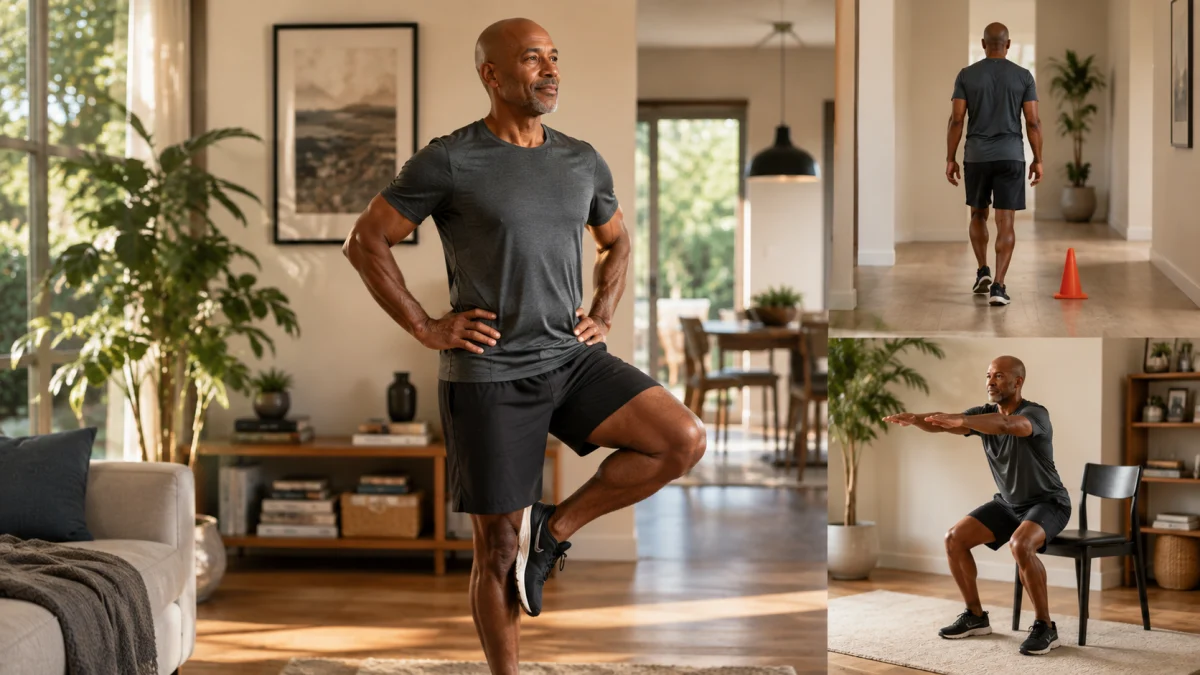
No, standing on one leg cannot tell you how long you will live. But the viral claim is based on a real and unusually large study.
A 2026 study published in JAMA Network Open followed 13,423 adults aged 65 and older in Taiwan and found that people who performed best on a one-leg balance test had about 50% lower adjusted mortality hazard than those who performed worst during a median seven years of follow-up.
That is a substantial association. It is not, however, the same as saying that standing on one leg for 30 seconds cuts your chance of dying in half—or that practicing until you can do so will add years to your life.
The study also tested strength, cardiovascular endurance, flexibility, and mobility. In fact, a short get-up-and-walk test was more strongly associated with mortality than standing on one leg, and a combined score incorporating all seven fitness tests performed better than any individual test.
Here is what the study actually found—and what the simplified social-media version leaves out.
What did the new JAMA study test?
Researchers used data from Taiwan’s National Physical Fitness Survey and linked participants to national health records and the death registry.
The 13,423 participants had an average age of 72.9. All were at least 65 when tested, and 1,631 participants—12.2%—died during the median seven-year follow-up.
Each participant completed a standardized battery measuring several different components of physical fitness:
| Fitness ability | Test used |
|---|---|
| Balance | One-leg stance with eyes open |
| Balance and agility | 8-foot up-and-go |
| Lower-body strength | 30-second chair stand |
| Upper-body strength | 30-second arm curl |
| Cardiorespiratory fitness | 2-minute step test |
| Lower-body flexibility | Chair sit-and-reach |
| Upper-body flexibility | Back scratch |
| Overall fitness | Composite score combining all seven tests |
Researchers then divided performance into sex-specific groups and compared subsequent mortality while adjusting for factors including age, sex, BMI, reported physical activity, socioeconomic and geographic variables, and multiple diagnosed health conditions.
So this was considerably more sophisticated than asking people whether they exercise and seeing who lived longer.
But it was still an observational cohort study, not an experiment.
How long did participants actually have to stand on one leg?
The maximum was 30 seconds.
Participants stood on their dominant leg with their eyes open and hands on their hips. The raised foot was positioned against the inside of the standing ankle. The test stopped if the raised foot touched the floor, the supporting foot moved, a hand left the hip, or the participant developed substantial body sway.
They received a demonstration and practice attempt, then completed two measured trials. Researchers used the longer result, with the test capped at 30 seconds.
That 30-second ceiling matters.
Among the entire study population, the lowest-performing balance group lasted approximately 0 to 4.1 seconds. The highest group consisted of people who reached the full 30-second maximum.
Because so many people reached the ceiling, the supposedly highest “quintile” actually contained about 27% of participants, rather than exactly 20%.
In other words, the study did not determine whether somebody capable of balancing for 45, 60, or 90 seconds had progressively better survival. Everyone who made it to 30 seconds effectively hit the top of the measuring instrument.
That makes “Can you stand on one leg for 30 seconds?” a reasonable shorthand for what was tested. It does not make 30 seconds a scientifically established longevity threshold.
What does “50% lower mortality” actually mean?
This is probably the most important distinction in the entire study.
For the one-leg stance, the highest-performing group had an adjusted hazard ratio of 0.50 compared with the lowest-performing group.
An adjusted hazard ratio of 0.50 means that, during the study’s follow-up period and after accounting for the variables included in the statistical model, the estimated rate at which deaths occurred in the best-performing group was about half that of the worst-performing group.
That is where the “50% lower mortality” headline comes from.
It does not mean:
that balancing for 30 seconds gives you a 50% lower absolute chance of dying;
that improving from four seconds to 30 seconds will cut your risk in half;
that balance training will extend your lifespan by a particular number of years;
or that the test can predict an individual’s age at death.
Those conclusions require evidence the study did not provide.
The raw numbers illustrate why the distinction matters. About 23.2% of people in the lowest balance group died during follow-up, compared with 5.8% in the highest group.
That difference looks even more dramatic than 50%.
But those are unadjusted proportions. People who can barely remain on one leg for several seconds at age 65 or 75 are likely to differ from people who easily reach 30 seconds in many other ways. Age, disease burden, strength, mobility, neurological function and overall physical reserve can all travel together.
The adjusted hazard ratio attempts to account for some of those differences. It does not magically eliminate all of them.
Which physical test was most strongly associated with mortality?
Interestingly, standing on one leg was not the strongest individual result.
The strongest individual association came from the 8-foot up-and-go test: stand up from a chair, walk eight feet around a marker, return and sit down.
The major results comparing the highest- and lowest-performing groups were:
| Test | Adjusted hazard ratio | Approximate lower hazard |
|---|---|---|
| Composite of all seven fitness tests | 0.39 | 61% |
| 8-foot up-and-go | 0.41 | 59% |
| One-leg stance | 0.50 | 50% |
| 30-second chair stand | 0.55 | 45% |
| 2-minute step test | 0.58 | 42% |
| 30-second arm curl | 0.63 | 37% |
| Chair sit-and-reach | 0.79 | 21% |
Flexibility generally showed weaker associations than balance/agility, lower-body strength and cardiovascular endurance.
There is an important statistical caveat here as well.
It is tempting to call the 8-foot up-and-go the study’s “best mortality predictor.” Technically, the researchers did not formally compare predictive accuracy using measures such as C-statistics or reclassification analyses. Each fitness test was entered into a separate survival model.
So the defensible conclusion is that the up-and-go test showed the strongest mortality association among the individual tests analyzed, not that it has been definitively proven to be the best clinical predictor. The researchers explicitly identified the lack of a formal prognostic-accuracy comparison as a limitation.
The more interesting finding may be that the combined fitness score beat every single test.
That makes biological sense: a person’s ability to balance, move quickly, rise from a chair, repeatedly step, and generate muscular force captures more information about overall functional health than any isolated trick.
Does the JAMA finding apply if you are under 65?
Not directly.
Everyone in the new JAMA study was at least 65 years old. People older than 90 and people with several conditions likely to substantially impair physical performance—including dementia, prior stroke, limb amputation and certain catastrophic illnesses—were also excluded.
You therefore cannot take the study’s “50% lower hazard” figure and apply it to a healthy 35-, 45-, or 55-year-old.
There is, however, separate evidence suggesting that one-leg balance contains useful health information before age 65.
A 2022 British Journal of Sports Medicine study examined 1,702 adults ages 51 to 75. Instead of the new study’s 30-second test, researchers simply asked whether participants could successfully balance on one leg for 10 seconds.
During a median seven years of follow-up, 17.5% of participants who could not complete the test died, compared with 4.6% of those who could. After adjustment for age, sex, BMI and comorbidities, inability to complete the test remained associated with substantially higher mortality.
So there is evidence extending into later middle age.
But it is a different population, a different test and a different statistical comparison. It does not validate the new JAMA effect size in people younger than 65.
And neither study tells us much about a 25-year-old wondering whether wobbling after six seconds is an omen. At younger ages, a one-leg test may simply have far less ability to distinguish meaningful differences in health because most healthy people can perform it easily.
Is good balance actually causing people to live longer?
The study cannot answer that question.
There are at least two explanations, and both could be partly true.
One possibility is that maintaining balance, strength and mobility helps preserve independence, reduces falls and injuries, keeps people active, and therefore contributes causally to better health.
The other is that balance is largely a visible output of health that already exists underneath.
Standing steadily on one leg requires multiple systems to cooperate. Muscular strength, coordination, sensory input, neurological control, reaction ability and overall mobility all contribute. An older adult who performs well may simply have greater physiological reserve across several systems.
That is essentially how the JAMA researchers interpret physical-performance testing: as a way of measuring what a person’s body can still functionally do, rather than only counting diagnosed diseases.
This also creates the possibility of reverse causation.
Early or undiagnosed disease can make someone weaker, slower or less stable years before it becomes severe enough to cause hospitalization or death. In that scenario, poor balance did not cause the disease. The disease helped cause both the poor balance and the higher mortality risk.
The researchers adjusted for substantial medical and demographic information, which strengthens the association. But adjustment cannot remove everything.
Smoking status, for example, was not available. Body composition was not directly measured. Fitness was measured only once. Cause-specific deaths were not examined. And because participants had to be healthy and mobile enough to complete the tests, the sample was biased toward relatively healthier ambulatory older adults. The authors explicitly state that residual confounding and reverse causation cannot be excluded.
The most defensible interpretation, therefore, is:
One-leg balance appears to be a useful marker of underlying functional health and physiological reserve. Whether balance itself independently causes longer life remains unproven.
Can improving your balance reduce the mortality risk?
This is where a legitimate scientific finding can very quickly become a “longevity hack” that the research never demonstrated.
There is good evidence that exercise can improve balance and reduce falls. There is not good evidence that increasing your one-leg stance time from, say, five seconds to 30 seconds will produce the 50% mortality difference observed in this study.
A 2024 JAMA systematic review conducted for the U.S. Preventive Services Task Force examined 37 randomized exercise trials involving more than 16,000 older adults. Exercise programs reduced the rate of falls by about 15%, reduced the proportion of people experiencing a fall, and reduced injurious falls. Most effective programs incorporated some combination of gait, balance, functional and resistance training rather than simply practicing a single balance test.
The USPSTF consequently recommends exercise interventions for community-dwelling adults 65 and older who are at increased risk of falling.
But reduced falls and improved balance are not the same thing as demonstrated longer survival.
A separate systematic review of long-term randomized exercise trials involving 11,441 participants in its primary mortality analysis found fewer falls and injurious falls among exercisers, but no statistically significant reduction in overall mortality.
That does not mean exercise has no longevity benefits. Mortality is influenced by many factors, and individual trials can be too small or too short to detect changes in death rates. Physical activity has extensive health benefits beyond balance.
It does mean we should resist turning an observational association into a treatment effect.
If two groups have an adjusted hazard ratio of 0.50, you cannot assume that training the lower-performing group until it resembles the higher-performing group will reproduce that 50% difference.
So should you practice standing on one leg?
Probably—but not because 30 seconds is a magic lifespan target.
Balance is trainable. Strength is trainable. Aerobic fitness is trainable. Mobility is trainable. And maintaining those abilities becomes increasingly important with age.
The new study actually argues against obsessing over a single test. The combined fitness score was more strongly associated with survival than one-leg balance, and lower-body strength, agility and cardiorespiratory performance all contained substantial information.
If the objective is healthier aging rather than winning a balance test, a broader program incorporating strength, cardiovascular exercise, balance and functional movement makes considerably more sense.
Think of the one-leg test less like a longevity treatment and more like a check-engine light.
Improving the light itself is not necessarily what fixes the engine.
Is 30 seconds a good score?
For the particular population in this study, reaching 30 seconds was the highest measurable result because researchers stopped the test there.
That should not be confused with a universal age-adjusted clinical standard.
Performance naturally changes with age, health status, test protocol and even seemingly minor details such as whether the eyes are open, where the free leg is positioned and whether arm movement is permitted.
The 2026 JAMA study therefore provides an especially useful comparison for adults 65 and older tested under the same protocol—but not a universal pass/fail rule.
There is another subtle finding worth noting: the study found several nonlinear relationships in the other tests. For some measures, mortality differences were largest among people at the lowest performance levels and then flattened as performance improved. Among men, for example, the association for chair stands began to plateau around 15 repetitions in 30 seconds. Among women, benefits associated with faster up-and-go performance flattened around seven to eight seconds.
That pattern argues against the simplistic idea that infinitely more performance must equal infinitely longer life.
Moving from very poor functional capacity toward normal capability may matter much more than turning an already good result into an elite one.
Should you use the one-leg test as a home longevity test?
It can be an interesting informal measure of balance, but it is not a diagnostic test and should not be treated as a personal death forecast.
The research protocol was conducted by trained examiners, included practice trials and safety screening, and used standardized positioning. Participants were not simply told to close their eyes in the middle of the kitchen and see what happened.
Anyone with significant balance problems, recent falls, dizziness, neurological impairment or mobility limitations should be particularly cautious about attempting unsupported balance tests.
More importantly, a poor result should be interpreted as a reason to look at why physical function may be impaired—not as evidence that a clock is suddenly counting down.
What the study actually proves—and what it does not
Verified: Among more than 13,000 Taiwanese adults 65 and older, stronger performance on several simple physical tests was associated with substantially lower all-cause mortality over approximately seven years. One-leg balance showed a particularly strong association, but the 8-foot up-and-go was stronger among individual tests and a multidomain fitness score was stronger still.
Not established: The study does not prove that balance causes longevity, that 30 seconds is a universal threshold, that people younger than 65 receive the same risk estimate, or that practicing until you can balance for 30 seconds reduces your mortality risk by 50%.
Reasonable inference: Balance appears valuable partly because it acts as a compact readout of several systems at once. When an older person’s strength, mobility, coordination and overall physiological reserve deteriorate, simple functional tasks begin revealing that decline—sometimes before a list of medical diagnoses fully captures it.
That may ultimately be more important than the viral one-leg challenge itself.
The bottom line
The influencer version—“standing on one leg can predict how long you’ll live”—contains a real scientific signal wrapped in an exaggerated interpretation.
The new JAMA study does show that one-leg balance is strongly associated with survival among adults 65 and older. Participants who reached the 30-second maximum had about half the adjusted mortality hazard of those in the poorest-performing balance group.
But the test does not calculate your lifespan.
Nor does the research show that learning to stand on one leg for 30 seconds will halve your risk of death.
Perhaps the most useful finding is broader: how well an older body can actually perform simple tasks appears to contain information about health that medical diagnoses and self-reported exercise alone do not fully capture.
And if you want one practical test from the paper to watch alongside balance, the data suggest paying attention to something even more ordinary:
How easily can you get out of a chair, walk across the room, turn around, come back and sit down?
That simple movement produced an even stronger mortality association than standing on one leg.
References and Further Reading
Original 2026 Research
Wu MC, Hsu CT, Hsu HT, et al. Physical Fitness and All-Cause Mortality in Older Adults. JAMA Network Open. 2026;9(8):e2628227. The primary study discussed in this article. The accompanying supplemental material contains the detailed testing protocols, performance distributions, sensitivity analyses and sex-stratified results.
PubMed: Physical Fitness and All-Cause Mortality in Older Adults. U.S. National Library of Medicine. Indexed abstract and bibliographic record for the JAMA study, including its DOI and principal results.
Earlier Research on One-Leg Balance and Mortality
Araujo CG, de Souza e Silva CG, Laukkanen JA, et al. Successful 10-Second One-Legged Stance Performance Predicts Survival in Middle-Aged and Older Individuals. British Journal of Sports Medicine. 2022;56:975–980. Earlier prospective cohort evidence involving adults ages 51–75. This study used a 10-second pass/fail test rather than the 30-second capped protocol used in the 2026 JAMA study.
Does Training Balance and Physical Function Improve Outcomes?
Guirguis-Blake JM, Perdue LA, Coppola EL, et al. Interventions to Prevent Falls in Older Adults: Updated Evidence Report and Systematic Review for the US Preventive Services Task Force. JAMA. 2024. Review of 83 randomized trials, including 37 exercise trials involving more than 16,000 participants. Exercise consistently reduced several fall-related outcomes, with gait, balance, functional and resistance training commonly included.
USPSTF Recommendation: Falls Prevention in Community-Dwelling Older Adults—Interventions. U.S. Preventive Services Task Force. Current U.S. preventive-care recommendation supporting exercise interventions for community-dwelling adults 65 and older who are at increased risk of falls.
de Souto Barreto P, Rolland Y, Vellas B, Maltais M. Association of Long-term Exercise Training With Risk of Falls, Fractures, Hospitalizations, and Mortality in Older Adults. JAMA Internal Medicine. 2019. Randomized-trial meta-analysis useful for separating established exercise benefits from the more speculative claim that specifically improving balance will lower mortality. Long-term exercise reduced falls and injurious falls but did not produce a statistically significant overall mortality reduction in its primary analysis.
Editorial currency note: The primary JAMA study was published August 10, 2026. This article reflects the available evidence and U.S. fall-prevention guidance reviewed through August 18, 2026. Future randomized trials may better establish whether changes in individual physical-performance measures independently translate into longer survival.